Washington Grown
Apples In Bloom
Season 10 Episode 1012 | 26m 46sVideo has Closed Captions
We visit the "mother tree" of the famous Cosmic Crisp apple, dine at 617 Nomad in Tieton
We visit the "mother tree" of the famous Cosmic Crisp apple, see helicopters used to pollinate orchards and dine on the freshest ingredients at 617 Nomad in Tieton, WA.
Problems playing video? | Closed Captioning Feedback
Problems playing video? | Closed Captioning Feedback
Washington Grown is a local public television program presented by KSPS PBS
Washington Grown
Apples In Bloom
Season 10 Episode 1012 | 26m 46sVideo has Closed Captions
We visit the "mother tree" of the famous Cosmic Crisp apple, see helicopters used to pollinate orchards and dine on the freshest ingredients at 617 Nomad in Tieton, WA.
Problems playing video? | Closed Captioning Feedback
How to Watch Washington Grown
Washington Grown is available to stream on pbs.org and the free PBS App, available on iPhone, Apple TV, Android TV, Android smartphones, Amazon Fire TV, Amazon Fire Tablet, Roku, Samsung Smart TV, and Vizio.
Providing Support for PBS.org
Learn Moreabout PBS online sponsorshipWashington Grown is made possible by funding from the Washington State Department of Agriculture and the USDA Specialty Crop Block Grant Program.
And by The Potato Farmers of Washington.
Learn why Washington is home to the world's most productive potato fields and farmers by visiting potatoes.com.
- What does it take to make the perfect apple?
Hi everyone, I'm Kristi Gorenson and welcome to "Washington Grown".
We are in apple heaven here in Eastern Washington.
And today we get to see how Cosmic Crisp apples have become a fast favorite and we'll learn what it takes to keep these orchards healthy year after year.
I'm learning how helicopters are helping pollinate orchards.
- Hovering around is blowing a lot of air.
- Mhhm.
- And so what we're doing is acting like a giant bumblebee.
- And I'm making apple quinoa salad at 617 Nomad in Tieton.
That is gorgeous.
It's not so gorgeous though that I don't wanna eat it.
[Craig laughing] - I really, really wanna eat it.
[Kristi laughing] - You will.
- Then we're checking out a Cosmic Crisp orchard in bloom.
- We've got what is the middle bloom, which we call the king bloom that opens first.
- Is there a queen bloom?
- There's a side bloom.
- Okay.
All this and more today on "Washington Grown".
[upbeat bright music] This is my favorite part of the day.
[chef laughing] You gave me this job just to keep me occupied, didn't you?
This is what fine dining is all about right here.
[dog barking] - I can eat these all day.
- You all make this look so simple and easy.
- Cheers to that.
[Tomás and woman laughing] - I only hang out in pretty potato fields.
[Kristi laughing] [plane revving] [upbeat bright music] In the small town of Tieton, outside of Yakima, on the corner of Wisconsin and Elm there's something a little surprising.
Here at 617 Nomad, you can find some absolutely beautiful dishes with flavor combinations so unique and vibrant that you're guaranteed to leave this little community a very happy customer.
- The flavors are just- It's just hard to describe.
- It always has something that is different and I would never try it otherwise if it wasn't here.
- Real welcoming place and good food.
And what else can you want?
- It's a small weekly changing menu featuring local produce that we grow here in the valley.
- Owner and Chef Craig Singer uses the amazing farms of the Yakima Valley to his advantage, changing his menu every week to reflect the freshest produce around.
- I don't live here, so I live a little bit lower in the valley where a lot of the farms are.
So basically when I start coming up on Mondays, I start hitting the farm stands, talking with the different farmers, finding out what's coming in this week, and that's what helps set up the menu for the week.
- Wow.
- The Yakima Valley has everything in terms of produce and they use every, every bit of it.
- Washington grown, it's all local stuff.
- We know where it's coming from and where it's going.
- It's great to see some of the people that come in week after week and you know, they love exploring the menu or going back to what they might feel comfortable with.
- Don't miss later in the show when Chef Craig and I make a special apple quinoa salad.
You gave me this job just to keep me occupied, didn't you?
Keep me away from hurting anybody.
- Not at all.
[Kristi laughing] Not at all.
[upbeat bright music] - In the Wenatchee Valley apple orchards paint the landscape with beautiful blossoms, and later in the season these flowers will become the amazing Washington apples we all enjoy.
But in order to produce the big and tasty fruit we know and love, something special has to happen first.
[helicopter whirring] - My name's Ryan McDonald and I'm the owner of North Wind Aviation.
Today we're gonna go out and apply pollen on some apple blossoms.
- Using a helicopter, Ryan and his team take bags of pollen from apple blossoms and spray it all over the orchard.
- Hovering around is blowing a lot of air and so what we're doing is acting like a giant bumblebee by carrying pollen to each one of the blossoms.
And the rotor wash is blowing so much air around and mixing it all around that we ensure that cross-pollinization happens throughout the orchard.
The timing on that's pretty critical.
- We get ahold of the grower if they think they need pollen and I just keep checking.
- Dan Winship is one of the fieldmen for North Wind Aviation.
His job is to decide when an orchard is ready for pollination.
As a former orchardist, he's seen firsthand the benefit of this operation.
- I was a pear grower and for me the biggest sell on it was it set all the seeds in the fruit.
The benefit was I brought a bigger pear to the warehouse.
- This is a good compliment to the bees and it also usually gets the bees pretty fired up after we've flown over the orchard.
They're out working and they can smell that new pollen too.
- Yeah.
- This is a Bell 206.
It's a common helicopter in our fleet.
We run six of them for agriculture.
So this tube, this very sophisticated, [Kristi laughing] very specialized tube is where the dispersal and see if I tap on here, you might be able to see some of the pollen coming out.
- You can, you can see some on the ground.
- Yeah so that's residual from our last application.
A co-pilot will sit in here with me and they will have metered bags of pollen.
And based on how big the orchard is we might have three or we might have 23 to make sure we get that metered out.
So we get the prescribed amount of pollen per acre in the orchard.
- Cool.
- Which isn't very much.
Maybe 30 to 40 grams per acre.
And if you can imagine- - So a little goes a long way.
- An acre is this big.
- Yeah.
- And just 40 grams is this big.
- Right.
- But pollen's really small.
- Yeah.
- And we're gonna blow all these particles all over the orchard.
- What does the work is the blades.
That 40 grams of pollen we're putting on per acre is everywhere, it's on every limb.
It's on every flower.
It's on every place that the bee might land and pick it up on their legs and then take it to the flower.
So this is what it looks like.
It's about like talcum powder.
- Yeah.
- That's what we use to test our pollinator, is talcum powder 'cause they're almost identical.
That's the refined stuff.
- As the bees are doing their job throughout the day, now all these parts are gonna be set out and spread in the orchard so they don't have to fly from here across the street to get the right flower.
Now everything they touch, they're also cross pollinating.
- Yeah.
- We're a super bee.
- Yeah.
- And complimenting the processes that nature does too.
- I think you need a new paint job though.
I think it needs to be- - Like orange and black.
- Yeah orange and black or yellow and black.
- Yellow and black.
[Kristi and Ryan laughing] - There is an incredible amount of work to put fruit in that store.
- I'm pretty blessed to live where we do and be able to work in a community, you know, in Central Washington where agriculture's so big.
- Yeah.
- And be a part of that whole process.
[helicopter whirring] [upbeat bright music] - Hey let's go.
When you've got an ice cold beer in your hand, there's nothing better than a great meal to go along with it.
Here at Single Hill Brewery and my hometown of Yakima, they're partnering with Tandem Unicycle pop-up company to bring you just that.
If you've got a hankering for locally sourced fresh food, Tandem's owner Jacob Garland and his team will fix you up with something delicious hot off the grill.
- Now we're kinda like sausages and sandwiches and whatever I wanna do, I get wild hairs and we kind of just roll with it.
- Today's special menu includes the Cajun sausage sandwich.
Made all the more perfect by using local Yakima grown apples.
Now being here in Yakima, how can you not use apples, right?
- Yeah, I mean they're kind of everywhere here.
- Look at this thing.
We got these little apples poking out here and some arugula and pickled onions and American cheese.
Woo it's hot.
Okay, here we go.
You know sometimes you come across a dish, it just makes you happy.
That slaw that you put on it with the arugula and the apples, the sweetness of the apples and that tartness of the vinegar.
Wow!
- That little bit of that undertone with like the horseradish in there.
- I'm gonna go see what the people around here think of these but I'm pretty sure they're gonna love them.
- I know, it's gonna be messy.
[upbeat bright music] - Delicious.
- It's an awesome sandwich.
- The sausage is really flavorful.
I love the greens and the pickled onions and the pickles add a little tang to it.
- The vinaigrette is perfect.
- The gooey cheese.
It was crunchy, I think that's- - Yeah.
- I think that's an apple.
- Yes it is.
- The apple's on there.
- The texture is what you need, that little bit of crunch.
A little bit of sweetness, little bit of acid.
- I would eat that just plain, just the greens.
It's like such a nice salad.
- You know, you brought the bitterness kind of from the arugula and I think it just like, and everything pairs really well.
- It's delicious, that's all that matters.
- I wouldn't wanna mess with that sandwich, it's perfect.
Yeah maybe lock this one in.
Rotation's good, but we'll keep this one the way it is.
[Tomás laughing] - Yeah I think so.
- Coming up, I'm making an apple quinoa salad at 617 Nomad.
You gave me this job just to keep me occupied, didn't you?
To keep me away from hurting anybody.
- Not at all.
[Kristi laughing] - Not at all.
[upbeat bright music] - We're back at 617 Nomad.
Huge flavors and incredible dishes are being produced right here and perhaps the last place you'd expect, the small community of Tieton.
- We live two miles down the road and nothing is close to us, but we have probably the best restaurant in the valley right here.
- Well people who didn't know where Tieton was have come out and come back.
- It's awesome to see people that come into this quiet little town.
They're like, "Why is this here?
This is amazing."
- Yes.
- Owner and Chef Craig Singer loves the Yakima Valley for the amazing produce grown right here.
For him Tieton is the perfect place to make incredible food and grow an incredible community.
- So it's always had a long history in agriculture.
About 15 years ago, there's been a little bit more of a transformation towards art.
Our plateware is made by a local artist here in town.
You know, a lot of the art that we have here in the restaurant is from local artists in town.
It's very inviting and very accommodating and very supportive.
- Yeah.
- It's so surprising to come to this funky little town where time forgot to come upon the finest dining that you're going to find anywhere.
It's really amazing.
- Yeah what are we gonna make today?
- Well today we're gonna be working with those Cosmic Crisp apples.
- Love it.
- We have some of those beautiful local carrots that we'll have in a quinoa salad, some roasted corn that we'll do an elote style relish with.
- Yeah, I'm hungry.
- All right, let's get to it.
[Kristi laughing] - Cooking with Craig and Kristi.
- That's right.
- Here we go.
- All right.
- Do you like to do stuff with Cosmic Crisps?
- I do, I love the flavor profile.
- I do too.
In my opinion it's just like perfect tart and sweet combination.
- Yeah, so we're gonna do a little charred corn so this is gonna be kind of more of a play of an elote or an esquite.
- Okay.
- So typically, you know that's the Mexican street corn that's charred and has a nice chili.
So we're actually gonna do a rose harissa.
So it's a mixture of dried rose petals.
- Yeah.
- Coriander, chilies.
- While the corn roasts I grind the ingredients together.
Meanwhile, chef starts on the quinoa.
- You gave me this job just to keep me occupied, didn't you?
To keep me away from hurting anybody.
- Not at all.
[Kristi laughing] - Not at all.
- I add some onions to the corn while chef adds some carrot, papitas, cherry vinegar and olive oil to the quinoa and mixes it up.
Why does the apple work well with this dish?
- Basically it brightens it up.
I mean the Cosmic Crisp has some nice sweetness, but also it's that beautiful acidity.
- Yeah.
- It's that really brightness.
And like for me with cooking that's what I want, is that balance.
So for this, this is kind of where it gets fun and we start pumping it up.
- Okay.
Now what is that?
- That's what you've been working on.
- Oh.
[Craig laughing] Seriously, I did all that work and you already had it pre- - Not at all.
[Kristi laughing] Not at all.
That's not how I operate.
- We start plating with some preserved lemon aioli, then add the quinoa.
We add some green onions, roasted peppers, and Cosmic Crisp slices to our corn, then add it onto the plate.
- And then with that we have some pickled red onion that mysteriously appeared.
- I did that when you weren't looking.
- That's true.
[Kristi laughing] - To finish it off, we add some chili thread, locally made rheba cheese and edible flowers.
That is gorgeous.
- Thank you.
- It's not so gorgeous though that I don't wanna eat it.
I really, really wanna eat it.
[Kristi laughing] - You will.
[upbeat guitar music] - I can't wait to try this.
- I'm gonna get a little bit of everything here for you.
- Yes, yum.
Thank you so much.
- You're welcome.
They're just showcasing the products.
- Yeah.
- I try not to do too much to manipulate it because you know, you have the nice earthiness with the quinoa.
- Yeah.
- And the robustness there like you were talking about the sweetness with the corn.
Beautiful, bright, fresh crisp notes from the Cosmic Crisp and then the beautiful rich texture from that cheese.
- Yeah, from the cheese.
- Kinda all like bundles it up and brings it home.
- It does.
- Yeah.
- It's exciting to eat.
The people of the Yakima Valley are very lucky to have you here.
- Oh.
- For more recipes, restaurants and more visit us on YouTube.
- Getting fruit to look and taste perfect takes a lot of time and energy by many skilled people.
That's why today I'm at the Tree Fruit Research and Extension Center for Washington State University in Wenatchee.
We're here to learn all about post harvest apple research.
- Post harvest is everything that has to do after fruit is taken out of the tree.
- Carolina Torres is the endowed chair of post harvest systems at WSU.
- In my science, we have to just make sure that apple looks great and tastes great after that period of time after harvest.
So if the consumers are actually saying, "You know, the fruit doesn't taste that well."
You know, "What's going on with this?"
That all gets back to us researchers to try to figure out what's wrong or what can be done better to prevent that not good quality.
- New varieties like the Cosmic Crisp are specifically bred to be amazing post-harvest.
This guy's only been out for three years, but it took a lot longer to develop this.
- Right.
- How long was this variety?
- I think more than 20 years.
- More than 20 years?
- Yeah.
- Does that mean that there's other apple varieties currently being developed?
- Absolutely.
- Okay, that we may not see for another two decades?
- Yes, absolutely.
It's always in the search and there's different generation of people, right?
It's much more valued today.
The taste of the apple, but before how red it was, right?
So that Red Delicious lasted for a long time because it was red.
It was a little long, typical from Washington state, but not great flavor.
But really today's more about sweet and a little tart and firm and no defect of course.
- One of the major concerns with apples post harvest is their shelf life.
- Most of the new varieties coming out, they produce very little ethylene.
Ethylene is a ripening hormone.
So post harvest, what happens is that all the maturity characteristics like increasing soluble solids or sugars goes on.
But it's post harvest.
It's not pre-harvest like other varieties that will last very little time like galas.
They produce a lot of ethylene and so their life post-harvest is much shorter.
- I see.
- When you're gonna store any apple long term, more than six months, you need to harvest the fruit in a more immature stage.
So that apple is not ready to eat at harvest.
You're not gonna think that it's a great piece of apple.
Because the changes will happen after the fruit has been stored.
So that's when the fruit has the best eating quality.
- Okay.
- And that's when you want the fruit to reach the consumer.
- I'm gonna have a bite of this.
- Do it, do it.
See how it's still crunchy?
- It's a year old apple.
- I know.
- It's delicious.
- Yes, yes.
- Coming up, we're visiting a Cosmic Crisp orchard in bloom.
- We've got what is the middle bloom, which we call the king bloom that opens first.
- Is there a queen bloom?
- There's a side bloom.
- Okay.
And we're in the kitchen at Second Harvest trying out some savory apple naan flatbread.
[upbeat bright music] - Apples, Washington is known for them and for a very good reason.
But we're not gonna talk about just any apple today.
We are talking about Cosmic Crisp and we're going to can it so we can have it on hand if you have family or friends come over and you wanna whip something up real quick.
What is better than an apple pie?
I'm gonna show you how to do that.
We're gonna do kind of a condensed version today 'cause there is quite a few steps.
But the recipe, the full thing is available on wagrown.com so go check that out.
But we're gonna hit the highlights here and give you some tips and tricks.
[peeler whirring] How cool is that?
Look at that, look at how cool that is.
And I'm just gonna take these, I'm just gonna cut them in half.
We are going to take the apples now and this is warm, the sauce and filling.
You have your basic sugar, nutmeg, apple juice, all the core ingredients to make the sauce that goes with your apples.
Now that this has steamed and everything's warm we're gonna go ahead and put it into the quart jar.
Clean all that off.
Again, check to make sure there's no cracks or anything on it.
Place your lid on, screw the top on and throw it in your water bath canner.
These have cooled on the counter for 12 hours.
Let's see if they've all sealed, these ones are great.
But... [jar lid plopping] this one has not sealed, which is totally fine.
Go ahead, put this in your fridge for up to a week and a half.
Use it in pies, apple crumble, apple strudel, whatever you want.
Use it within a week and a half.
Do not throw it away.
It is totally good and fine to eat.
I hope this has taken the fear out of canning for you and that you feel comfortable playing and experimenting in the kitchen and making some amazing apple pie filling with your Cosmic Crisp apples.
- Five years ago we visited a Wenatchee orchard that had just started growing some very special apple trees.
The famous Cosmic Crisp.
Today the orchard looks very different but the excitement hasn't changed.
I'm talking with Scott McDougall of Legacy Orchard to see what it's like being on the cutting edge of growing this special fruit.
- We're standing in a fifth leaf Cosmic Crisp block.
So that means this orchard was planted five years ago.
- We came out here five years ago and these Cosmic, they were like this big.
So from from this tall to these beautiful trees.
- These were actually the trees that we got in a lottery because there weren't that many trees available.
And we got selected, I believe for 17 acres worth.
And we're sitting in one of those blocks now.
We think Cosmic Crisp is a wonderful apple.
At this point in time there's probably 17 million Cosmic Crisp trees that have been planted in the last four years.
- Is it cool to be part of history and kind of being the first to grow these new apples?
- It's been fun.
There's been a lot of hype on cosmic.
We think it's gonna be an excellent apple.
It does store very well.
We're just hoping that once these trees are settled down the nitrogen's pulled off that some of the acids are going to convert to sugars and that the dessert quality is just gonna keep getting better and better.
- What are some of the things that you like about growing Cosmic Crisps?
- Well it's a very unusual apple.
It has very nice fruit size- - They can get pretty big, I've seen Cosmics that are like that big.
- It can, it's also a great coloring apple.
- Yeah.
- Color is very hard.
We're here today just getting past the pink stage.
We've got what is the middle bloom, which we call the king bloom that opens first.
- Is there a queen bloom?
[Scott chuckling] - There's a side bloom.
- Okay.
- These would be the queens.
- Okay.
- Yeah.
- When will these trees actually get apples on them?
- Around Red Delicious timing, which for us in this location will probably be somewhere around the 7th of October.
- So in about six months then we'll see some apples.
- Right.
We're challenged to do the best we can with the right type of pruning and try to achieve maximum bins per acre.
But of quality fruit for the consumer.
There isn't any one year that is the same.
Particularly with Mother Nature.
And we have to be able to adapt.
The thing that's exciting is that things are constantly changing.
It's incredible to look at a tree in the middle of winter that looks like it's dead.
- Yeah.
- And then in the spring to see these trees wake up.
The viability of a tree varietal can be 20 years plus.
- So these trees could be here for a long time.
- 20 years plus.
- Yeah.
- Hopefully.
- Yeah hopefully.
- Yeah.
[upbeat bright music] Welcome back.
We are in The Kitchen at Second Harvest Food Bank in Spokane.
This is a place where they have food to help the hungry, and also a teaching kitchen which is where we are at to teach the folks how to use the food that they receive from the food bank.
And we just appreciate Second Harvest for letting us be here to taste some wonderful food from allrecipes.com.
And I have chef and culinary arts instructor Laurent Zirotti joining me today.
- Good morning Kristi.
- Thanks for being here.
- Yes good morning Tomás.
- And we have Tomás as well.
- That's right, good morning and good to see all of you at home as well.
- I know, so this is the apple episode, and we talked a lot about Cosmic Crisp apples developed by WSU.
Super tasty, super crisp, a little bit tart.
Just great to do all sorts of things.
You can bake with it, eat it fresh.
- They're working on varieties right now that we're not even gonna get to taste for another 10 years.
You know, I mean that's how long in development the Cosmic Crisp was, which is a great apple, great shelf life.
I mean you could get one that's a year old and it tastes just like you just got it off the tree.
- Yeah.
- It's a fabulous product.
I really like that apple.
- Yeah.
- And then we have now over 30 varieties of apple.
And if you cannot find one in there, well you must not like apples.
[Kristi and Tomás laughing] - How do you like them apples?
- Yes that's right.
- So in French, apple is, - Is a pomme.
And the other gold medal we have here is potatoes.
And in French potatoes are pomme de terre, apple of the earth.
- I love that.
- Cool.
- I love that, isn't that cool?
So we are going to make a savory apple naan flatbread.
The creator of this recipe says, "When apples are abundant and inexpensive in the fall, jazz things up with a savory apple naan flatbread.
Perfect balance of sweet and savory."
- Nice.
- Yeah let's see how they make it.
- Yeah let's do it.
[upbeat bright music] - This is gorgeous.
- It's beautiful.
- And I love the idea of apples as like a savory dish.
- Yes, you can.
I think it's nice, it brings some acidity, some sweetness in some dishes.
- Yeah it's actually kind of rich.
- Yeah, yeah it's hearty, I wasn't expecting that.
- But I like the crispness of the apple.
- I do like that beautiful texture.
And I like the touch of the arugula on top that brings the nutty flavor to that dish.
- One of the comments is, "This is an easy go-to appetizer."
- Yeah.
- "It's a crowd pleaser when you're entertaining."
And then a Cole says, "I added a bit more bacon."
You can never have too much bacon.
Yep.
- Yep I could see that.
- It's delicious so give it a try.
And if you wanna recreate it tag us on social media, Facebook, Instagram and let us know how it goes.
To get the recipe for savory apple naan flatbread visit wagrown.com.
It definitely takes more than just sunshine and good soil to make the perfect apple possible.
It takes special care and new ideas.
And Washington apple farmers are truly the best at what they do.
That's it for this episode of "Washington Grown".
We'll see you next time.
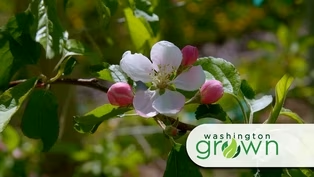
Preview: S10 Ep1012 | 30s | We visit the "mother tree" of the famous Cosmic Crisp apple, dine at 617 Nomad in Tieton (30s)
Providing Support for PBS.org
Learn Moreabout PBS online sponsorship

- Food
Christopher Kimball’s Milk Street Television
Transform home cooking with the editors of Christopher Kimball’s Milk Street Magazine.











Support for PBS provided by:
Washington Grown is a local public television program presented by KSPS PBS