Vermont This Week
April 10, 2026
4/10/2026 | 26m 46sVideo has Closed Captions
Gov, Legislature at odds over education reform | Unpaid property taxes strain local budgets
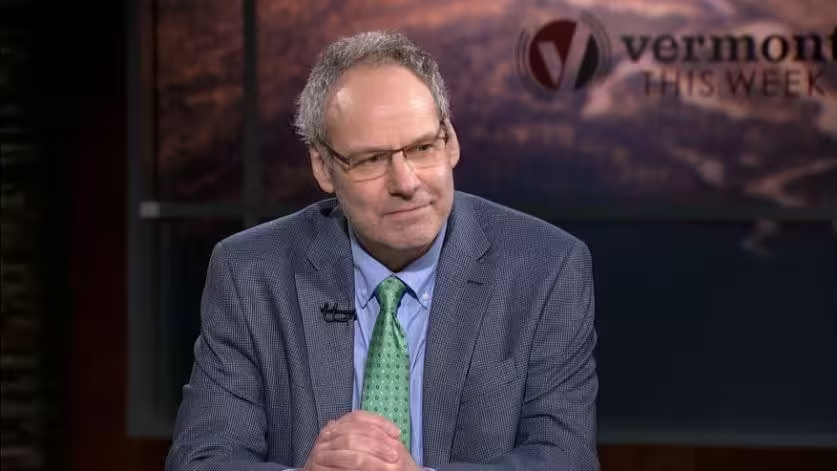
Gov, Legislature at odds over education reform | Unpaid property taxes strain local budgets | ‘Direct Primary Care’ in Vermont | Moderator - Mitch Wertlieb - Vermont Public; Alison Novak - Seven Days; Kevin McCallum - Seven Days; James Maloney - NBC5.
Problems playing video? | Closed Captioning Feedback
Problems playing video? | Closed Captioning Feedback
Vermont This Week is a local public television program presented by Vermont Public
Sponsored in part by Lintilhac Foundation and Milne Travel.
Support provided by:


Vermont This Week
April 10, 2026
4/10/2026 | 26m 46sVideo has Closed Captions
Gov, Legislature at odds over education reform | Unpaid property taxes strain local budgets | ‘Direct Primary Care’ in Vermont | Moderator - Mitch Wertlieb - Vermont Public; Alison Novak - Seven Days; Kevin McCallum - Seven Days; James Maloney - NBC5.
Problems playing video? | Closed Captioning Feedback
Where to Watch Vermont This Week
Vermont This Week is available to stream on pbs.org and the PBS app.
Support the crew
Help Mitch keep the conversations going as a member of Vermont Public. Join us today and support independent journalism.Providing Support for PBS.org
Learn Moreabout PBS online sponsorshipThe Scott administration presses lawmakers to act on education reform as we head into the final stretch of the legislative session.
The House Education Committee, the Senate Education Committee, Democrats, Republicans, the Redistricting Task Force, the Commission on the Future of Public Education all agree on the need for larger districts in order to deliver on the promise of act 73.
The only thing we disagree on is how hard we're willing to work to deliver on that promise, and how many difficult choices we will make as state leaders.
Plus, unpaid property taxes are putting a strain on local budgets and why some doctors in Vermont are cutting out insurance companies.
All that and more ahead on Vermont this week.
From the Vermont Public Studio in Winooski.
This is Vermont This Week, made possible in part by the Lintilhac Foundation and Milne Travel.
Here's moderator Mitch Wertlieb.
Thanks so much for joining us.
I'm Mitch Wertlieb.
It's Friday, April 10th, and with us on the panel today, we have Kevin McCallum from Seven Days, James Maloney from NBC5 and Alison Novak from Seven Days.
Thank you all so much for being here today.
And we're going to get right into it with the big story that continues to be the big story, education reform.
And what is Vermont going to do to bring down property taxes, all of that.
We've been talking about it for weeks now.
Alison Novak, we've got a little bit of an update today as we're going to tape here today.
This bill that the House has created has, has moved along a little bit.
It's moved out of the house ways and Means Committee.
Not any major big changes.
Catch us up to date, though, on where we stand with education reform.
At least the House bill.
Okay, so the House bill was passed out of House education last week.
And so, it's basically it's deviates a lot from what 73 called for, which was on mandatory mergers, to form bigger school districts.
And then the implementation of, a new funding formula called a foundation formula that would have a set amount per student that was given to each student regardless of where they lived.
Whereas now we have local, districts that are voting on their budgets.
And there's a lot of kind of inequity in terms of how much each student is getting on.
This would create, kind of an equity in terms of how much each student was getting across the state.
But what Zoe Saunders, the Secretary of Education, has said is we need bigger districts and we need to create scale before we implement a foundation formula.
The House Education Committee passed out a bill that calls for voluntary mergers.
So it would essentially form these seven CSAs, which are, We have to.
What those are, you know.
Course, of course.
So the seven, the seven CSAs, basically these are big regions throughout the state.
You know, we already know that Vermont has supervisory unions governing bodies, but these are a little different in the sense that they provide they help to help for resource sharing.
You know, among the examples that I've heard from, chair, chair of the House Education Committee, Peter Coleman, he says this can help for things such as special needs services and transportation.
That's been reflected by the, Woodstock Supervisory Union, who kind of, helped to create their own iteration of this.
And we actually heard from them, recently.
And they said that this has really helped to reduce costs for them.
I think that's why the committee wanted to put that within the bill.
The other element, of course, is the voluntary mergers.
Now, basically what they want to do with that is basically create study committees in order to help make that happen.
Of course, within the bill as well.
And the governor is happy about this, is that it pushes back that foundation formula by two years.
And of course, we don't really know what conclusions those study committees are going to create.
Exactly.
And the governor doesn't want voluntary mergers.
He wants mandatory ones.
Right.
And so within the sizes there would be study committees form that would be looking at, mergers and so under the education the House education bill, they have about 21 suggested groupings for new school districts, but they also kind of are allowing for local, you know, areas to decide how they might want to merge.
And so there's no guarantees that mergers would happen.
And because of that, if you what what, the governor and what Secretary Saunders has said is if you implement a foundation formula, but you haven't gone through with, the mergers to the scale that is needed, you'd have to either boost the amount of money in the foundation formula and then not achieve any cost savings, or you wouldn't be able to provide a high quality education to students if you're using the amount that's set in act 73.
So all of these pieces kind of interconnect and work together.
And because, the House plan doesn't call for, you know, mandated mergers, I think it's very uncertain as to, you know, what would the future state of governance be?
Well, very uncertain for sure.
And Kevin McCallum, we know that Governor Phil Scott has already said, I'm not going to sign the state budget until I'm going to veto it unless we get these, you know, mandatory mergers in the deal here.
I mean, is he willing to go all the way with this, do you think?
I think so, yeah, I think he doubled down on that threat just the other day.
So I mean, it's very clear that he thinks that if the legislature doesn't pass something that substantive substantively, consolidates districts in a major way that they're not following through on their promise that they made to the Vermonters with act 73 last year.
And so he's just trying to hold the line and say, guys, get back in there, figure this out and bring me something that I can sign, because otherwise you shouldn't be allowed to go home.
You shouldn't be allowed to claim victory.
And so the biggest challenge here, though, is that as Alison's great story in seven Days this week pointed out, was that the House and the Senate are just on different planes.
They're just on very different, you know, points where I don't know how they're going to consolidate those two.
I don't know how they're going to come to a meeting of the minds by.
Design, though, right?
I mean, it's true.
So, there is a lot of concern that the House is operating separately from the Senate.
And there's I loved Alison's story, but there was also a great graphic that illustrated it perfectly by Tim Newcomb at the top of her story.
And you've got these two classrooms where you've got the house over here looking at a blackboard and a map, and you've got the Senate over here and a completely different.
Right.
Classroom with a different board looking at and trying to figure out what's going on.
And that illustrates the fact that we have, you know, a bicameral legislature and they just work on things separately.
And then they try to come together at the end of the session and iron out differences between policies, between bills.
I just think this is too big of an issue.
And the differences between the two bills, which Alison Stewart laid out very well, are too great for them to actually make progress on this.
And so last year we did see this conference committee coming together at the end of the session.
The session went on way longer than it should have because of this, trying to hash out a plan between the House and the Senate.
And I think a lot of people think we're kind of in for a similar fate this year.
So the Senate's plan, you know, is very different.
They would preserve supervisory unions, which are essentially kind of structures that house school districts within them.
But within a supervisory union, you could have a couple of school districts.
Each of them still have their own school boards.
So what Zoe Saunders and what, Vermont Superintendents Association have said is they don't think supervisory unions are really the most kind of efficient.
Governance structure.
And they'd like to move just to school districts.
But in the Senate bill, they are is very set on preserving supervisory unions.
They would reduce the number of supervisory unions.
They also the bill aims to reduce the number of school districts from 119 to 58.
So kind of having it.
But 58 is still a lot more than what the governor and, you know, the Secretary of Education would like to see.
And if a foundation formula was implemented on top of 58 school districts, what Secretary Saunders, who I had a pretty long interview with last week, said is, you know, the money would not go far with 58 school districts.
It's not building the scale that's necessary to implement a foundation formula.
And what could happen if a foundation formula was put on top of 58 school districts?
It could lead to, you know, catastrophic cuts.
It could lead to kind of coerced mergers where districts are like finding themselves in a situation where, like they have to scramble to merge and they don't have time to think about it.
And so kind of decision making made on the fly, rather than kind of a system that kind of is more set up in order that school districts can kind of like wrap their head around before they have to do something.
I mean, this stuff is so complex.
Is it fair to say, Alison, that the, Senate plan is when you're talking about those, the school districts still maybe try and have a little bit more local control than perhaps the house version.
I think the reason for preserving supervisory unions and then allowing the school districts to be within the supervisory unions is so that those small school districts can continue to kind of have their own, like local control.
And, you know, the local control thing is so interesting.
I was thinking about it today and it's just, you know, I think there's there's good reasons for having local control.
But when it comes to kind of a school system, what 80,000 students do you want one high school doing one thing and another doing something completely different, like it seems that there would be a benefit to have a little more kind of coherence in our system, and local control really kind of works against that coherence.
This stuff is, as I said, so complex, but the reason that it's so important and the reason we keep talking about it week after week, is because of what could happen.
And to just lay out this example if nothing happens.
Here's what Vermont's tax commissioner has to say about that.
The reality of it is, if we do nothing this year, we're.
Looking at.
175 close to $200 million.
In increases in taxes.
At the property tax level next year, which is 7 to 10%.
So the problem's not going away.
Not dealing with it this year is not an option.
I mean, we keep hearing about this again, those kind of property tax rise.
That's the kind of thing that led, you know, to to the sweep of Republicans that we saw, you know, the Democrats no longer had their supermajority.
People are really, really worried about this.
So something has to give at some point.
James Maloney, I want to ask you about, one school district that seems to be trying to do something to get out ahead of all this.
And that's the Champlain Valley School District.
What have you found out about what?
Yeah.
So.
So, last May, the their school board basically charged a group of, including teachers, community members, some administrators to basically investigate one thing.
And that's the transfer of roughly 160, middle schoolers from the Waynesburg Community School to the, Charlotte Central School.
So basically, that's a study committee right there.
They've been working.
I talked to this, the district CFO who's basically been the head of that.
And basically they've been investigating this for the for the past eight months to see if it's possible.
And I think that this is very much a key example as to what we're looking at to bring this statewide is you know, if if individual, you know, districts, individual study committees are going to look into mergers, you know, how how long exactly is that going to take?
How long is it going to take to find how possible is it.
And and so that conversation is continuing.
And I actually didn't include this in my story, but I did speak to one parent, off camera who said, you know, I'm all I'm all for these, all for that change.
I just wish we could see a little more movement on it, because my children in that Heinz Burg school are just not getting as many opportunities as they would in the other school.
So that's interesting.
This is a school district is actually trying to take some action here and move the ball forward on, on this whole.
And that's the other thing they said, we really want to get ahead of this.
And it relates to what, Secretary Saunders had said in terms of, in terms of putting a lot of pressure on our school districts.
And while they're handling it, there is a lot of that pressure still there.
Two things.
One, that I think, you know, I think there is a difference between kind of school district, inner school district consolidation.
So kind of closure or consolidation of schools within school districts and then mergers of different school districts together.
So I think, you know, they are related.
But I think it's important to note that that would be more of like a within a school district closing or, you know, shifting things around.
Right.
Yeah.
And I also just think that, like you said, that Secretary Saunders said that like, this is something that, you know, people are already considering this, but I think what she's kind of said is that we need to kind of have a more clear cut plan, because what I think is happening is school districts are wanting to make some of these decisions, but they are also waiting for the legislature to see what the legislature does.
And so it's a little bit of a of a situation where I don't think school districts want to make big moves until they know what the kind of overarching, direction from the, from the state is going to be.
Right.
So to Kevin's point, though, again, with the House and the Senate kind of being siloed here and having their very different versions of things, that makes it tougher for the districts to figure out what's going on.
Right?
Yeah, right.
At this point, I don't think there's going to be any real clarity about which direction the legislature is going to go and whether they can get over the the bar that the governor has set for several weeks.
I mean, the session is, you know, supposed to wrap up in May, but what the governor's saying that they're not going home until they solve this.
I think it really makes it really unclear as to how long they're going to be able to slog away at this.
There's going to have to be some compromise right?
Someone's going to have to budge a little on their position.
And so I think right now it's very unclear as to who that will be.
And very quickly, Alison, now that this bill is moved out of House Ways and Means, where does it go next?
So it'll go to House appropriations.
So yeah, it passed House Ways and Means just about half an hour an hour ago.
And it passed on A65 vote.
So pretty close.
And I was listening to a little of the discussion before the vote.
And even the people who voted yes, I think they're pretty uncomfortable, unsure that this was going to be the path that is actually going to create the change that Vermont needs, with both relief for tax payers as well as higher quality education.
Relief for taxpayers.
This leads to our next story.
Kevin, you wrote this fascinating article that really shows what we're talking about here when we keep saying, why are people freaking out about property taxes?
Well, when the property taxes in many of these communities don't get paid, the community's hurt.
What did you find out in reporting that story?
That's right.
Well, first of all, this was a co reporting, story with my colleague Hannah Bassett.
So she did a lot of the heavy lifting of going out to, communities in the state and talking to the clerks and talking about what their, what their taxpayer delinquencies look like.
And so we had heard in the state House, people were starting to say, hey, look, there's there's some problems here, like, you've got a 40% increase in five years in property taxes.
That's not only stressing out families, which we obviously know.
It's also stressing out the towns that are trying to collect that tax revenue from people and then not being able to because people can't afford it.
And what we were, and I was very surprised to learn, was that, Vermont municipalities have to pay the education tax to the state, whether they're able to collect it from their tax payers or not.
So when tax delinquencies rise, towns are not able to get the money from their from their taxpayers.
The state is standing there with its hand out saying, I don't care like you got you got to pay us bills.
Do, bills.
Do.
And so it's putting, these municipalities in a triple bind.
They don't have the money from the taxpayer for their own services for the road department, for the wastewater treatment, for the library.
Then they're having to pay money they don't have to the state, which is another problem.
And then they have to, in many cases, borrow money to pay that bill to the state, and they have to pay back the bond or whatever they took out in order to pay the state.
So it's really putting, communities in a bind when their delinquencies go up.
Smaller communities more than large ones.
Because imagine if you only have a few hundred property taxpayers in your community paying all the bills and 3 or 4 of them, all of a sudden they're like, I just can't, I can't do this anymore.
That actually ends up having a disproportionate effect on small communities in the state.
So the Burlington's in the South, Burlington's are not really going to cry about this.
It's a problem, but it's nowhere near as big a problem as it is for a small community like Granville or whatever Roxbury that are like, you know, it got, you know, a quarter of their budget or something is outstanding because they can't they can't collect the money, and they don't want to collect the money from the property tax owner in a way that takes their property away from them.
No local municipality wants to be the bad guy here.
They want to find a way to figure out a payment plan and to figure something out that that works for everybody.
But at some point they have to get paid.
And so it's creating a lot of tension.
One of the amazing things I found in that story that you and Hannah Bassett reported, was the example of what you were just saying about how, you know, towns don't want to take, you know, put somebody under here.
But there were some folks who were actually paying property taxes in order to save their friends property.
And that that was one nice thing to see that it doesn't.
As you pointed out in the article, it can't happen across the board.
But there were some examples of that that you saw.
There were.
Yeah, yeah.
So it just shows that people are really willing to go out of their way to try to help their neighbors when they get in a jam, financial or otherwise.
And that's what's great about Vermont, right?
But at the same time, if you have so many people in such financial peril, in such dire straits, it's going to have an impact.
And the clerks and the other officials at towns that we spoke to said, this is really becoming a significant problem.
So when you hear, you know, the tax commissioner talk about a 7 to 10% possible tax increase, that's not just harming or potentially harming people's household budgets, right?
You know, that has the potential to actually impact the kinds of services that their towns offer them.
Such a domino.
Is so necessary.
It's a domino effect.
Exactly.
Oh, wow.
I really appreciate your reporting on that.
And, I want to now turn to Alison Novak, a story that absolutely fascinated me as well, that you wrote about, because we talk a lot about education reform, property taxes.
We're going to be talking a lot about health care.
We know that we are staring at a really difficult cliff when it comes to health care and paying for it, but you have found that some direct primary care services, IT services in Vermont now doctors are bypassing insurance and taking direct payments from people.
Do I have that right?
Exactly.
Yeah.
So this was something I really knew very little about before I started reporting this story.
I had met a doctor who ran, a company called Blue Spruce, that offers direct primary care.
So essentially what it is, it's it's for primary care.
So it's not for specialties.
But, basically people opt in by paying a monthly fee, kind of like a gym membership.
Usually it's no more than $200 a month.
And for that fee, they get unlimited primary care.
So sick of visits.
Well, visits.
Sometimes labs are included.
Sometimes, like, kind of common prescription medicines are included.
And they kind of tout themselves, as, you know, a lot more personalized than a typical doctor, where often I think we've all had the experience of kind of wanting to get in touch with your doctor and feeling like you have to go through many layers of, you know, calls to reach them.
In this case, you know, the patients who I talked to said they can just text their doctor.
They reach them directly.
They can, you know, when they're on vacation, they might need, you know, get sick and need a prescription.
It's very easy to get in touch with the doctor.
And so, you know, because these doctors bypass health insurance, they don't deal at all with health health insurance.
They are able to kind of offer this, the service at a lower cost because there's costs associated with working with health insurance.
Like, you have to have people who deal with the like the billing and, you know.
All the paperwork that's involved.
All that stuff.
Yeah.
So in a way, it's kind of like a back to basics approach, even though it's kind of a new approach.
When I went and visited one of these offices in Bristol, you know, like I walked in, it was like this old house.
This dog ran out to greet me, and it felt like very there's something very, like, nostalgic about hospitals almost.
Well, they do like several of the doctors, I talked to five different direct primary care doctors in Vermont all over the state, and some of them said they do make house calls.
I talked to a couple of 90 something year olds in Newport who see Doctor Malik, who's the the owner of Blue Spruce, and said, you know, he'll come and visit us when we're sick.
And so it's like a it's a very interesting kind of more, personalized type of care that, that the people I talked to said, you know, it really for them, makes them feel like they have a relationship with their doctor, like they're being heard.
And, you know, most of them have some type of insurance because, you know, you have to have insurance to cover.
You know, I think there's an insurance called catastrophic insurance that would cover, you know, emergency visits or, you know, if you got really sick and needed to be hospitalized or different things like that.
But often those are kind of lower monthly cost plans that have higher, deductibles.
But so so it's not that you could necessarily go without health insurance, although some of the doctors I talked to said, you know, they do have patients who don't have health insurance.
And this is kind of an option to kind of at least have them seeing a doctor and, you know, getting getting basic treatment and advice.
You know, it does sound promising.
Although I have to wonder, you know, we heard blue Cross and Blue Shield talking about really sounding the alarm, the big red flag saying they are losing money hand over fist.
What effect does this have on the insurance industry?
Do we know yet?
Yeah, I mean, I think that probably insurance companies don't really like this type of practice.
I think also, you know, these doctors might have a patient load of about 400 or 500 patients, whereas a typical primary care doctor might have up to 2000, which again, was news to me.
I didn't realize it was that high of a patient load.
So, you know, it's not like this could work for like as a system wide thing because, you know, each doctor is seeing less patients, but I just think it felt like a very solutions oriented story, about a topic that often feels like it doesn't have solutions.
And you know, I guess just talking all the patients who I talked to you, they all were really, really happy with the care and, you know, really felt like this was working for them.
After being in a system that was not working for them for a long time.
We could all use some kind of potential good news, at least on health care.
So I really appreciated reading about that.
I want to move to a story now that, feels like it's kind of niche, but in a way, it kind of affects a lot of people.
And that's do with wake boats.
Kevin McCallum.
Yeah.
And new rules regarding make boats.
First, what is a wake boat?
Why does some people like it and why is it caused controversy on some Vermont waters?
Sure.
So a wake boat.
And this was news to me.
I was kind of aware of water skiing behind a motor boat and like, oh, I kind of get what that is.
And I did it as a teenager.
And, I was like, okay, wake boats are that exactly, except they have more powerful motors and they have ballast tanks that suck in water and make the boat significantly heavier.
If you make a boat like that, significant, significantly heavier, the wake gets larger in some cases several feet.
And then you can do all kinds of fun tricks off the awake, right.
You can jump in the air.
You can even let go with a tow rope and just surf on the front of the wake.
It's actually pretty cool, right?
But it's a it's a headache for people who live on lakes in Vermont.
They don't like them.
If you're if you've lived on a lake in Vermont, you've got your your kayaks and your dock and your, you know, just want the nice, placid.
Quiet craft.
Yeah, exactly.
Then some guy comes by and this makes this huge wake, and he's yelling and having a good all time people are not down with that.
So two years ago, the state passed a bunch of rules and said, okay, guys, this is a problem.
We're going to have to ratchet down and tighten up the regulations on this.
And they, they, they tied themselves in knots trying to figure out how to do this because they do have a right, people.
Lake boaters have a right to use their boats.
Generally speaking, on the waterways of Vermont, but not everywhere.
And so they, they limited the number of places to 30.
And then it kind of went away as far as everybody knew.
And as far as I knew.
And lo and behold, there's been a behind the scenes push to clamp down even further on that number.
And the the people who are on those 30 lakes, as you can imagine, are not happy that they're the only lakes in the state where that is still allowed.
So they've got you got this push to further restrict lake boating in the state.
And finally, state environmental regulators said, last year, fine, fine.
We will come down with a new set of rules that are even stricter than the ones we passed already.
So they started that whole process, and it just reopened the wound.
And you got all these people who are mad about weak boats and now.
But they've got a plan to reduce the number of lakes where you can wake boat in the state to 18, 1830.
So it's a it's a sharp reduction in the number of lakes where you can do this in the state.
And they're racing furiously to try to get the rules in place and clarify, where you can do it and where you can't by the beginning of the boating season and in and Memorial Day officially.
So yeah, it's interesting.
I know Lake Iroquois is one of those places.
Now, you cannot use a wake boat anymore, right?
Is that right?
It's I think it's it's it's on the list now as a place where you can, but it's about to be off the list.
And so we interviewed an owner of a boat on the lake and he was not happy.
Yeah.
So, you know.
I'm sure that's true.
I did find also really interesting in your story that, Julie Moore, the, interim natural resources director, right, was saying if we had this much attention to other things going on, we could.
People really got into this.
This situation.
I think they had 1500 public comments that they had their.
Thoughts.
On, on this issue alone.
So, yes, you're right.
She was very frustrated.
Yeah.
That is quite amazing.
Yeah.
Yeah.
This has been a and it's really fascinating discussion.
Everybody.
Really appreciate your time.
We've run through everything.
Although we there is one more item we do need to get to before we say goodbye.
If you were looking for the New England Newspaper and Press Association's Reporter of the year, she is right here.
Alison Novak, congratulations on winning that award.
We are so, gratified to have you on this program for your excellent reporting for everything you delivered to us, and, of course, to all the readers of seven days.
So thank you.
And congratulations again on that award.
That does it for the Vermont this week.
I want to thank our panel, Kevin McCallum from Seven Days, James Maloney from NBC5 and Alison Novak from Seven Days.
Thank you so much for watching.
I'm Mitch Wertlieb.
I Appreciate your time.
And we'll see you next Friday on Vermont this week.
 New Episode
- News and Public Affairs

Top journalists deliver compelling original analysis of the hour's headlines.

- News and Public Affairs

FRONTLINE is investigative journalism that questions, explains and changes our world.




 New Episode
 New Episode



 New Episode
Support for PBS provided by:
Vermont This Week is a local public television program presented by Vermont Public
Sponsored in part by Lintilhac Foundation and Milne Travel.