Capitol Journal
April 10, 2026 - Week In Review
Season 21 Episode 66 | 56m 39sVideo has Closed Captions
Rep. Nathaniel Ledbetter; Sen. Bobby Singleton
We'll put a bow on the 2026 Regular Session and catch you up on this busy final week. Todd's guests: ▶️House Speaker Nathaniel Ledbetter ▶️Senate Minority Leader Bobby Singleton
Problems playing video? | Closed Captioning Feedback
Problems playing video? | Closed Captioning Feedback
Capitol Journal is a local public television program presented by APT
Capitol Journal
April 10, 2026 - Week In Review
Season 21 Episode 66 | 56m 39sVideo has Closed Captions
We'll put a bow on the 2026 Regular Session and catch you up on this busy final week. Todd's guests: ▶️House Speaker Nathaniel Ledbetter ▶️Senate Minority Leader Bobby Singleton
Problems playing video? | Closed Captioning Feedback
How to Watch Capitol Journal
Capitol Journal is available to stream on pbs.org and the free PBS App, available on iPhone, Apple TV, Android TV, Android smartphones, Amazon Fire TV, Amazon Fire Tablet, Roku, Samsung Smart TV, and Vizio.
Providing Support for PBS.org
Learn Moreabout PBS online sponsorshipThis week on Capitol Trump.
The 2026 legislative session is in the books.
We'll walk you through what passed and what didn't in the final days, and what legislative leaders had to say about it.
The end of the term means retirement for some lawmakers, including some key committee chairs.
We'll show those conversations.
House Speaker Nathaniel Ledbetter, jointly in studio, to offer his thoughts on the session, as does Senate Minority Leader Bobby Singleton and Ale Angle checks in from Washington with the latest on Iran and what Alabama's delegation is saying.
That's all next on Capitol Journal.
From our statehouse studio in Montgomery.
I'm Todd Stacy.
Welcome to Capitol Journal, the Alabama legislature's 2026 regular session is finished.
Lawmakers met for the 28th, 29th and 30th session days this week finishing up on legislative work and saying goodby to this building after 41 years of housing the legislature.
This current state house is coming down in a matter of months.
The soon to be finished new state House across the street will be the legislature's new home when they convene again in January.
This election year session has been a grin and at times has been dramatic.
One of the more controversial bills came down to the wire as time was running out.
It would require voters t register with a political party before voting in that party's primary.
Right now, Alabama's primar elections are open to any voter.
The only restrictio is crossing over in the runoff.
So if you vote in the Democratic primary, you can't turn around and vote in the Republican runoff.
But House Bill 541 from Stat Representative Ernie Yarbrough would require that voters register as a Republican or a Democrat to vote in that respective party's primary.
Supporters say it protect party integrity, while opponents argue it could shut ou thousands of independent voters.
As Capital Journal's Jeff Sanders reports, the debate was sharp, but the clock won in the end.
So we stand adjourned.
Sandy Dy as the 2026 legislative session came to a close so did hopes by many Republicans to close Alabama's primary system.
Senate President Pro Tem Garlin says when the House gaveled out Sunny Dye for the session before the Senate, everything stopped.
Our decision was real easy.
The House adjourned and we found out about it.
I was on a phone call in the back and somebod ran in there and told me, hey, they just adjourned and I'm inside out.
And so once that happens, we're finished too.
And so there's not a keeping the journal open or anything because it' the last moment of the last day.
So we had to sign it out.
The proposal would have required voters in Alabama to register with a political party to vote in primaries, although it would not hav impacted this year's elections.
The bill had already passed the House, but not without Republican pushback.
Earlier this week, it drew sharp debate during a Senate committe public hearing, with supporters arguing primary should b reserved for party members only.
Primary elections are not public free for alls.
They are the mechanism by which political party select its own nominees.
When the process is ope to those with no real commitment to the party, it ceases to be a reflection of shared tenant and becomes an open invitation to manipulation and possible intentional interference.
Opponents warn the change could shut out independent voters, especially in districts where primaries decide the election by excluding independent and unaffiliated voters from these elections.
HB 541 would effectively shut thousands of Alabamians out of the most consequentia part of the democratic process.
Bill sponsor.
Representative Ernie Yarborough argued voter are already making that choice.
They're already choosing already in the primary.
Right?
Like that's what that reality already exists in that their choice of a primary ballot is already public record, right?
It's with the Secretary of State.
We can all access that and see.
So the idea that you're you're being, you know, forced into some sort of public identification badge that you don't want as a misnomer because all that data is already public.
Democrats on the committee questioned the timing of the proposal.
So for me, I don't understand if you're winning, why do you change the process that you've been winning in?
Republicans control every branch of government in the state of Alabama.
The bill cleared committee along party lines and was on the calendar for the final day of the session.
But with protracted debate o the floor for a series of bills above it, the clock simply ran out.
Pro Tem Gardner says lawmakers were still working toward a path forward, even in the final hours.
Everybody was on board by the time we got there, except for just a few that would hurt them back home, they said.
And again, every senator has a vote in their own district, obviously, and he's going to take that vote for the people back home.
But the push for close primaries is probably not over.
Governor says he anticipates it will be back before lawmakers when they return to Montgomery next year.
Reporting from the AP Studios at the statehouse.
I'm Jeff Sanders for Capitol Journal.
Thank you Jeff.
Governor Kay Ivey has signed Senate Bill 99, better known as Bo's Law.
It makes keeping a dog outside without adequate food, water and shelter punishable by a class C misdemeanor.
Advocates for the law have filled the halls of the statehouse this week, urging lawmakers to act to protect dogs.
But the debate was sometimes chippy on the House floor.
This bill coming fro the Senate, from Senator Gauger, provides for reasonable, responsible and humane conditions for tethering a dog outside.
It simply requires access to adequate food, shelter and water.
This bill is about basic common human decency and compassion towards God's creatures.
This bill is very narrowly tailored to only apply to companion dogs.
So dogs that people have as a pet.
To be abundantly clear this bill has absolutely nothing to do with farm animals or working dogs.
They are explicitly exempt.
I think it is ridiculous that in this, with all the crime that we have on the human side here, we are talking about putting people in jail over them now.
If ludicrous to me, and the idea that they have to have a wooden floor or we're going to build condominiums for dogs now, it's this to me, is, not something that I can be in favor of.
When you come to rural Alabama.
They've got dogs on chains all the time.
Dogs and their natural are in the wild.
They don't have a roof over their head.
So why should these be require to have a roof over their head?
Most of them do, but most of them have a 55 gallon drum laying, which is better than an arm with a floor in it anyway.
Also passing this week was Senate Bill 342 from State Senato Clyde Chambliss of Prattville.
It would ensure that student who use choose Act tax credits to attend private school maintai their eligibility for athletics.
State Representative Danny Garret carried the bill in the House.
This is the bill that clarifies this.
Students who are utilizing Choose Act funds may not be disqualified from athletics solely for that reason.
The language adde in the Senate further clarifies this not does not supersede any other rules of any high school athletic association.
It just clarifies that solely because you're receiving shoes that funds you're not ineligible.
If some athletics over here in Alexander City and, we can move them ove to Clark County for next season.
So they they preparing to move now.
And so when football season start playing football, they're pretty strict about monitoring those moves.
So you have to have proof of residency and proof that you don't live in the other place.
And so we're going to move in.
Welcome.
Bo Bo and ami.
I don't think that's allowed.
I think I think there's I'm just asking I don't yeah I don't know all the rules, but that certainly this bill doesn't impact those rules.
I mean, those are the rules, but so what this bill does.
I can get that.
Choose the money and not b penalized and still be athlete.
You got made all the other rules.
You just can't be penalized because you're getting choose fines.
Lawmaker also passed a package of career and technical education bill on the last day of the session.
The Train act and the CTE Teacher Certification Act were championed by House Speaker Nathaniel Ledbetter, who said the measures are critical for modernizing Alabama's career tech offerings.
The career tech education is a great is a big piece of this, and we can't grow career tech without great instructors, and this legislation ensure that experienced professionals can get into the Alabama classrooms faster and easier to give the students the skills they need to be successful.
And what they're trying to accomplish is it creates a pathway or a certificate, rather, that these individuals that are in the career tech fields can now be teaching in the classroom.
So they're bringing their real world experience into the classroom, and then it allows their employers to get a tax credit for loaning that employee to the classroom.
You know, you got to have the instructors, you know, you can build the classrooms and you have the kids.
But if you don't hav the instructors in career tech, what good is it?
So all of this is working together to complete this missio of making sure that our children do have pathway to be successful in life and can have the opportunity to to earn a high wage, high demand jo and be successful in their life.
And so we started last year, and we put $100 million in expanding and building new career tech facilities.
We have 139 school systems with just about 80 career tech facilities.
Some of those are outdated and rundown.
And so, that's good.
Pro tem, good year to to join with me and in organizing some bills to put together not only to make sure tha we get the trades that we need for the different parts of the state, but also that we can move forward with schools that can accommodate the kids getting, traine that they can be successful in.
Let's take a look at other notable action here.
In the last week of the session.
The state's budgets are now law.
Governor Ka Ivey has signed the general fund and the Education Trust Fund budget, both of which passed unanimously in both chambers of the legislature.
A closely watched publi safety bill died on the last day of session.
Senate Bill 289 from State Senator Will Barfoot would have essentially forced the city of Montgomery to increase its police ranks or ris being taken over by the state, but the House adjourned before the bill was taken up, the speaker sai there was simply not enough time to consider it, given how lon the filibuster would have taken.
The legislature gave final passage to a bill to prohibit people from buying candy or soda when their Supplemental Nutrition Assistance Program benefits, better known as food stamps.
Senate Bill 57 from Senato Arthur, or requires the Alabama Department of Human Resources to request a federal waiver to exclude sugary product from those eligible purchases, and Alabama will now officially recognize the body of water to our south as the Gulf of America.
Lawmakers passed the bill last week, and Governor Ivey signed it into law this week.
We'll ask 50 lawmakers how the session went overall, and you might get 50 very different answers.
Capital journal's Randy Scott caught up with House members upon adjournment to get their perspectives.
In hindsight.
When everyone at the Alabama State House speaks Latin, in this case, signee die, what signal the end of the regular session?
House members had their hands full with thousands of bill filed for this regular session.
So how well do they think the handled the people's business?
Well, we asked them, I'm a tough grader, and I would give this session a D. We have had some good things but overall I'd characterize it by too little, too late.
We could have expanded Medicaid.
We could have the lottery.
We could do a lot more for voting rights.
Well, I think you have to give it a I mean, the thing about i is, and I look back on that by saying, you know what?
We passed, we passed a lot of good stuff but also the work of this body.
I mean, it' supposed to be a part time job.
They probably spend 60 hours a week doing it this year I'd give us a B, I'd give us a B. I'm pleased tha we did a pretty good job of of, of passing a good, education budget this year.
I think there was something i that budget for, for everyone.
Teachers got a 2% raise.
Retirees get a bonus.
I think, pre-K got a increase, K-12 got an increase.
Higher Ed got an increase.
And I'm going to give it a B plus y. I think we got some things done.
We hit some a few roadblocks we didn't get is as much done as I would like to have seen, but it was a very productive session, I think, especially in an election year, much more than some others.
But it's been a tough session.
That' why I'm staying with the B-plus.
Probably give it back.
And I would give it a C becaus we have passed some good bills and there's some good things that have gotten through.
But there are also som bad bills and things that that, you know, we some of us wouldn't like to not seen passed.
Well, I'm going to give them a say from literacy Numeracy Act.
Teams at the charter school are doing really well right now.
Rural hospital tax credit and f and I'm glad that you mentioned that.
Listen, we once again, we came here.
The hardest working people in the state of Alabama are educators.
We have over 50,000 educators here in the state of Alabama.
Many of them are now leaving this state to cross the state borders, to go to other, states, other cities that pay higher, rates of pay.
I graded as a strong A or or in that category.
I think we've had a good year.
There was a there's always when you have over a thousand bills passed, I mean, filed, there's always a lot of bills that are self driven, and don't need to pass.
I call this session a great c. And I paid attention a lot of local legislation that happened across the state.
I was very disappointed that we didn't get a Cola adjustment for our state employees.
And to our teachers, the Alabama House will have a year to get ready for a new session and a new state House to have it in as a current and soon to be retired state House Randy Scott, Capitol Journal thank you.
Randy.
In the Senate, most are characterizin the session as a productive one.
Senate President Pro Tem Garland governor pointed to the restructuring of the Public Service Commissio as the biggest accomplishment, calling it a major lift that he believes could impact the state for decades.
He also said the session ran smoothly, crediting strong communication among lawmakers for keeping debate on track and avoiding major conflicts.
Obviously, the most stressful and the biggest one that I feel like we had with the PSC bill, I do think it, will reduce electrical rates for people throughout the state, whether you're a single mom or elderly people or small businesses.
But I do think it was a huge lift restructuring the PSC, and that'll be something that will last, I believe, 75 to 100 years.
If you're talking about efficiency and moving through the operations of the Alabama State Senate for the last eight, that I can say compare it to, I truly feel like it was ran pretty smoothly, to the point where some people said, hey, y'all are starting to get boring up there.
You're not debating as much and having some fireworks, but I think it's because of communication.
Up and down the hallway before we came to the floor.
And a lot of times people said, hey, I feel like I'm not I'm not going to communicate anymore.
Our jo this session was to communicate, and I owe a lot of that t my chief of staff, just Skaggs, for allowing us to bring us into the room to be able to do that.
So I'm thankful for that.
I'm very thankful that I'm here.
I'm honored to be able to serve the people that, put me in this position, not only my people in the district back home and my constituents, but also the men and women of the Alabama State Senat that voted for me to be pro tem.
It is stressful.
It is tough.
It is like your hair turned gray.
But in the end, it's worth it if you put the time and effor into it to make Alabama better.
I'm so thankful that I'm here.
I can see myself being happy.
And one day down the road when I'm leaving this job.
But while I'm here if I'm not making an impact in that will probably be, the first key point that I se that I need to leave this job.
But right now, I feel like I'm making an impact with my staff and, the people for the state of Alabama.
And we're going to continue to do that for the Democratic side of the aisle.
This year's session ende with less drama than a year ago, when a filibuster derailed a slate of local bills, echoing the pro tem message message about improved communication behind the scenes, Democratic State Senator Roger Smitherman of Birmingham, spoke on the Senate floor, thanking colleagues for working with Democrats despite the Republica supermajority, especially during a rough stretch when Democrats felt they were being run over my lead over.
They asked me to speak on behalf of us.
I just want to tell you all thank you all very much.
Thank you for this session.
Thank you very much.
I mean that because you all, you know, the testimony to how you real hard are is the fact that the way that we got off track and and we came up stand the figures, we came up here and she spoke and I spoke behind her and we had other people to speak.
And.
And you want to know what the visuals, the fact that you came back with a second count and had our bills on it, that's what I meant when I say that.
Thank you very much.
Because you sat back an you thought and you reacted in a in a way that was very appropriate and was needed.
So I just want to tell yo and we want to we thank y'all.
Thank y'all.
more on the legislature in a second.
But let's turn to Washington for a moment.
As President Donald Trump this week veered from threats that he had made to devastate the Iranian civilization, there's now a tentative cease fire.
And all the while, Congress ha been out of session on recess.
Most Republicans have had little to say about the situation in Iran, and that includes Alabama's members.
But Democrats are demanding more congressional oversight of the war.
Alex Engle reports from Washington.
To break it all down.
Congress has remained in recess during the past two weeks as Trump ratcheted up his threats against Iran before announcing a cease fire on Tuesday night.
In a statement, House Armed Services Chairman Mike Rogers backed the White House's efforts on Iran.
He says, quote, thanks to President Trump' leadership, in the extraordinary courage and professionalism of our service members, Iran's military capabilities were decimated, demonstrating America' unmatched strength in creating the leverage neede to secure a diplomatic solution to put an end to the Iranian regime's nuclear program and campaign of terror, end quote, that came after Trump posted on social media Tuesday morning, threatening to destroy Iran's entire civilization.
Defense Secretary Pete Hegseth says that the U.S.
military had, quote, a target set before Iran agreed to that pause.
That type of threat i what brought them to the place where they effectively say okay, we want to cut this deal.
But Democrats quickly renounced the president's rhetoric.
Congresswoman Terri so called it, quote, reprehensible.
And Congressman Shamari figure said, quote, we are not dealin with a sane, competent person.
On Thursday, House Democrats tried to halt Trump's war with Iran via unanimous consent during a pro forma session.
But the Republican lawmaker presiding over that session rejected it.
Minority Leade Hakeem Jeffries says Democrats will try to pass another War powers resolution next week.
A two week ceasefire is not sufficient.
We need a permanent end to Donald Trump's costly and reckless war of choice.
Vice president J.D.
Vance will lead negotiations for the U.S.
in talks with Iran to find a long term agreement to end the war.
Lawmakers are set to return to Washington next week, where they will have to confront a range of issues, including the latest on the Iran war, homeland security funding and President Trump's budget request.
Reporting in Washington Alex Angle, Capital Journal.
Thank you Alex.
We'll take a quick break and catch our breath and be back with more Capitol Journal.
Stay with us.
You can watch past episodes of Capital Journal online any time at Alabama Public Television's website.
aptv.. org.
Click on the online video tab on the main page.
You can also connect with Capital Journal and link to past episodes o Capital Journal's Facebook page.
James Alexande Bryan, better known as Brother Bryan, was a well-loved pastor of Third Presbyterian Church in Birmingham.
He was an outspoken supporter of racial reconciliation.
He is best remembered for his tireless efforts to help the poor and homeless.
A 1934 statue of Brother Bryan kneeling in prayer is one of Birmingham's best known landmarks.
The city of Birmingham renamed Magnolia Park as Brother Bryan Park in his honor.
This final week of the legislative session also saw the retirement of several lawmakers who, for one reason or another aren't running for office again.
That includes some key committee chairs.
State Representative Terri Collins chairs the House Education Policy Committee and has overseen a significant period of education reform in the state.
I sat down with her this week to look back at her career and ask what motivated her to pursue education reform.
Running for office in 2009, and being elected in 2010.
I looked at different things and one of the things I learned was that Florida had move from the bottom 10% of schools, which is where Alabama was to the top ten in less than ten years.
And so I looked at some of the things they had done.
And one was a school grade, which I've worked on some this year.
And so I knew some issues that I wanted to work on, but I wasn't I was on education wise in Maine, which was really good.
And I'm thankfu that the speaker put me on that.
And in the last year of that first quadrennial, he actually moved me to education policy.
So I did serve that.
But I started going to, Sea bass, Southern Regional Educational Board.
The governor put me on that.
And excelling at some of the conferences where I was seeing successes from other states, and I wanted Alabama to have those successes.
So I just kind of learned how they worked.
And I worked with different groups, and have had a lot of success and a lot of the things tha even people fought back against.
Now they're all advocating for, you know that's been the funniest thing.
One of the first fields we passed was the rowing reserve, which was going to be you know, the death knell to education policy.
I mean, education budgets.
And now it's their first their favorite meal we've ever done because we've not had proration since then.
And so, so many things.
Literacy at every singl education group spoke against it the day it unanimously sailed out of my committee.
She'll be missed.
State Representative Jim Hill chairs the House Judiciary Committee, which is among the toughest challenges of any in the legislature.
Judge Hill has seen a lot through his career here in the legislature an before when he was on the bench.
With the benefit of hindsight I asked him how the legislature can avoid the political polarized nation that has taken over Congress.
The legislature is, by definition, a political body.
Sure, there you are, elected in a party.
You are elected by the people in your in your district.
So by by definition, it is it is a political animal.
How do you avoid that or how do you avoid that bleeding ove into what you're trying to do?
I think the first thing you do is you elect the very best speaker that you can.
And without question, we have elected the very best speaker, in my judgment, in the history of the state of Alabama, a notion of doing a little better.
Nathaniel treats people with a with an even hand.
Listen, I was up there yesterday on a bill, and Nathaniel was diametrically opposite to what I wanted.
That's okay.
He let me get up there He let me tell them.
Tell him?
He told me later.
He says you're wrong.
I said, no, Mr.
Speaker, I'm not.
You are, but that's okay.
We're still friends, and we are.
I think you've got to have.
If you want to avoid Partizanship leadership, people who are willing to, you know, the Republicans are super majority.
What could we pass?
Anything.
Everything.
Does that mean we should do it?
Or we can do it?
It means we can do it.
That does not necessarily mean you should do it.
And when you got people like, like speaker Ledbetter that are looking at that thing and making allowing people to have their say to come to the mike to, to vet their or whether it be their frustration or their feeling or their positions, that's fine.
He does a great job of that.
So if you want to avoid political saturation, then you've got to have people who are willing to to be that kind of leader.
I hope I was in the Judiciary Committee.
My intention was to let every day read every bill that came up and pick the best ones that I could.
We might have 100 file along reading.
Yes, and we'll do 10 or 12 a week.
Some of which need to go to subcommittees some of which need to be worked on, you know, for various things.
But it didn't matter to me if that bill was filed by a Democrat or a Republican or whatever the question was was the substance of the bill?
Good for what we were trying to do?
And that's that's what I tried to do.
And you know what?
But it's not just me.
Look at look, at Reynold and Garrett and and Joel Vaughn and these guys that had really important before the voting could keep every bill he wants to keep off of the House calendar if he wanted to.
But Joe didn't do that.
He puts them on there and there, and they're there.
And that he gives everybody an opportunity to be heard.
I am concerned about the political ization of America and of Alabama, because I don't see it as being a positive thing.
I think we ought to be able to work together.
You know, on nice thing about being a lawyer.
I have spent 50 years with people disagreeing with me, and it's okay.
It's okay.
We can disagree agreeably.
We can have different positions.
We we can go about what we're trying to do and the way we want to, but we should not be enemies.
And, and that's I don't want that to, to creep in to what we're doing in the Alabama legislature.
We need to disagree if we have to, we need to find a place that we can agree.
The legislation is by its definition, compromise.
You're supposed to give it.
You know, I just I just got through with one with, with the leader Lee.
You know.
I didn't lik the bill at all when we started.
I didn't like it much better when we got it amended, but I did like it a little better.
But you know what?
It's.
It was better when we got through with i than than when it started out.
So.
And I appreciate people like him.
You know, leaders that are willing to sit down and listen to you and talk and try to make that bill the very best it can so tha if you want to avoid political, I can't do it, do it to your leadership.
And that's what I think we've done in the House and I'm proud of.
And State Senator Tom Butler is chair of the Senate State Government Committee.
His colleagues honored hi on the floor on the final day, remarking on his caree and giving him one final honor.
And ladies and gentlemen, what is amazing is that this last good soul that's not going to be with us next time.
I don't know if you know it or not, but it's only fitting that I ask him to d our Sunday night announcement.
But before I do that I want to make sure everyone in this room knows it's also his birthday today.
So, Senator Tom Butler, would you do the Alabama State Senate?
One final announcement of Sonny Daza?
And I gratefully move right now that the Senate, the state of Alabama standing solid.
I did, All right.
Yeah.
All right.
You heard the motion.
And, for the last time, all those in favor say aye.
Any opposed?
We stand adjourned.
Sonny.
Die.
We'll be right back with House Speaker Nathaniel Ledbetter.
Stay with us.
Alabama Public Television is your place for quality educational services.
Free professional development for educators and childcare providers with access to free, curriculum aligned videos, lesson plans and instructional resources with PBS Learning Media and all the PBS kids programs, parents know and trust.
Learn something new every da with Alabama Public Television.
Visit us at AP tv.org/education to learn more.
You're watching Alabama Public Television.
And you.
Welcome back to Capitol Journal.
Joining me next is House Speaker Nathaniel Ledbetter.
Mr.
speaker, welcome to Capital Journal.
Good to be with you, Tom.
Absolutely.
Well, congratulate the end of another session.
This was a doozy.
It was glad to be done.
Yes, I am glad to be done.
And I'm satisfied what we've accomplished.
I think there's a lot of good things that come out and it's going to make Alabama a stronger state and help our people across the state.
So I'm excited that we're able to pass some bill that's going to be positive for for Alabamians.
Well, let's start there.
What would you put on the top of your list?
A couple of accomplishments this session before we get to the term, what sticks out in your mind is hey, I'm really proud of this.
I think it's really going to make a difference.
Well, you know, we've worked on career tech.
I think that's on that's going to be a positive.
I mean, if you look at th numbers that we've cut in taxes even this session, we have cut taxes in every session.
Those tax cuts, you know being on overtime and groceries this year.
I think that's positive.
You know, if you look, if you look through the whole session, I think there's a number of bills that we can kind of hang our hat on.
But, you know, the thing is, none of it gets done without staff and without all the members working together and and trying to move good legislation and then having a conversation where they are able to make good.
Last slide.
So it's a combination of everybody working together, you know.
And you know I always said that it really doesn't really matter who gets the credit.
What matters is what we do at the end of the day.
And I think we can be proud of the session.
Specifically on career tech.
I remember hearing you talk about it.
I guess it was on this program, maybe at the beginning of the session about how, all right, we've done the Literacy Act, we've done the numeracy that we've done things to really and you've seen it move the needle in terms of the ranking and really improve test scores.
And you kind of compared it to that.
Like we need to do the same kind of investmen and reform and policy programing for career tech, because, you know, there's there's a whole range of student that need those kind of programs because they might not be going to college.
Is that kind of how you see it?
Do you think that's going to be the next education success story with you?
I really do.
I mean, you know, if you look at what we've done in education with the nutrition, literacy, Alabama's moved up in reading and arithmetic more than any other state.
And, you know, we're not at the bottom anymore because of the work that we've done and the legislation has been passed.
I think we can take that same model of career tax and some of the legislation we passed just this morning and trying to d there is going to be positive, I think, and it's just a piece of the puzzle, and we have to continue to work to make sure that kids have an opportunity to be successful in the pathway that they choose.
And, you know we've talked about this before.
Certainly we want all our kid to go to college almost to go.
But statistically on about 34% of the kids in Alabama go to college.
So we just got to do a better job giving them more opportunities to see what they might like.
I mean, I think you mentioned it to m about kids working on a motor, I think in the county at Baldwin Tech and and seeing the interest that piqued them and something that they enjoyed doing.
You know, that same kid might not like math class, but he finds something he enjoys doing.
I mean, you might.
I've always heard you never work a day in your life if you found something you really enjoyed doing.
I think this is something that we can do to start that pathway forward, to give the kids opportunity to do so.
Switching gears, you'v had a dramatic session in your, your caucus, the House Republican Caucus.
We've talked about this before a few weeks ago because it's notable like through the year there's been very little drama.
And you know you have your elections, you move on.
And but this year it's been really interesting.
We talked about it before.
There was an audio recording that got leaked.
And then just this past couple of weeks, there was, you know, somebody got remove from the caucus for attempting, allegedly attempting to record a caucus meeting.
Where do you think all this stems from?
Is there is there continued, you know, grumbling in the caucus or have y'all mended fences?
No, I don't see that at all.
I mean, I think at the end of the day and the caucus understands what their job is and they try to work together to get it done.
It's unfortunate.
It really is.
I mean, you've you've bee betrayed by one of your friends.
And that's always unfortunate.
But at the end of the day, you know, as majority leader now, as speaker, we've never had this kin of problem in the caucus before.
So, yeah, I think they want to get to work.
I mean, they won't put that behind them and go forward, you know, and all those issues, it was talked about was one was private, too.
It was pretty much fals because all the story one told.
Right.
So, I mean, you know, you hate that.
I hate that happen.
But I will say that the men and women that serve in the Republican caucus and in the Alabama Statehouse is focused on doing the job that they were elected to do.
I guess at the end of the day, it's like, okay, you're supposed to meet in caucus, have that family discussion where you can be honest and be real.
And so that's the betrayal you're talking about.
But at the end of the day, it must be that some members of the caucus, I don't know how to put the number to put on it, are dissatisfied with the outcome and want to use outside forces to, I guess, move the needle or manipulate that somehow.
It's that, I mean, if you all kind of clamp down on that in terms of no, we got to stay internal.
You can't use outside forces to try to push the caucus one way or another.
Yeah, I think so.
I mean, we've talked about it before.
You know, a lot of them have Freedom Caucus, and you wonder if that's not what they're wanting.
And you and I both have looked at that.
And the thing about it is most time it makes legislation less conservative because have to work out deals with Democrats that are working out deals within their own party when they don't stay together.
That's what happened in Washington.
Yeah.
And so, you know, that's the thing tha we want to try to prevent and, you know, you gotta you got in our caucus, you got 76 different personalities.
So everybody's got different ideas.
But I will say this.
Everybody knows that we have open door policy and even Tyle won't talk to us about anything.
They go to the front line, and we've been that way since we've been speaker.
I think Leade Lee's going to do a great job.
He has really taken hold of the caucus and run it where the members have a chance to speak and have a chance to tell what their bills are and what they think.
And then the members are being ope with everyone else in the caucus and trying to decid which direction they want to go.
And so, yeah, I think, you know, it's like anything else, you have some issues like that and family sometimes my my wife and I don't always agree, but at the end of the day I love her.
And you know, we've been together 40 years.
So I think that's what you gotta look at.
What is the end result?
You know, you may go across a little bit of a, a rough bump in the road, but even Paul had a road to Damascus.
I mean, we got to continue to stay out strong of what we're doing.
And I have no question my mind that that's what the caucus will do.
The most recent dispute was over this PSC bill.
Public Service Commission, expanding it, reforming it.
Yo, pastor, it's now law.
Do you think that or are you satisfied with where that is?
Do you think you'll get to a good place in terms of, you know, a something that's going to be meaningful for electricity rates and the people can accept?
Yeah.
I think the one thing to we all understood rates have gotten higher and it gives us a chance to freezer for three years which should level it back off.
But also gave a voice to everybody in the state, which wasn't happening.
I mean, if you look at the Public Service Commission, all of them served in same congressional district and somewhat some of them was in North Alabama and TVA territory, they didn't regulate them.
You know, it's regulated by board, appointed by the president.
So, you know I think this certainly gives it a different perspective.
The two thing I think it's important to note, you know the way that our growth is being and we've talked about some of the legislation we've passed is reall is really growing our economy.
You know, Alabama ranks as I think eighth in the country as a place to do business.
And and because of that, we have got to be ready for the future.
And energy and electric City is going to be a priority.
I mean, we're already seein some deserts in the in the state where we don't have enough electricity either, even by either its transmission lines or either its distribution lines or something.
That's not where we need it, and we can't bring companies in if I don't have it.
So I think the importance of this is, i probably not being told fully.
So I think it was vastly important is something that, you know, the person next governor was warning and was very vocal about it, because if you look at our growth, it's been phenomenal.
But if we don't continue to look in the future and see what our needs are, we're going to stymie it or stop it ourself.
So I do think it was that important.
I think it's probably a bigger deal than anybody thought it would be.
Well we're almost out of time but I wanted to ask you about you know this is the last session in this building.
Y'all had some, a neat, meeting across the street, in the old Capitol, obviously in this building.
And so next year you'll be in the new state House.
Talk about what that's been like seeing the new state House come up, knowing that next time you gavel in, it'll this building will be gone, and it'll be, in that brand new.
Yeah.
It's kind of surreal.
I mean, you know, we looked at it.
I've been on the council House majority leader on the Legislative Council, and and, you know, we we did i through the Legislative Council.
So I knew going into it when I was majority leader, you know, the money that we had spent on existing building was over $200 million just to get it where the Hvac and the air conditioner works after it's half of the cos and the electrical could work.
So when you then you know, and spending instead of spending $200 million on just what would have been basically the utilities or the building and not doing anything cosmetically, you know, there was no use in trying to do that.
So that's when the conversation really started.
And, you know, it's kind of surreal.
And I'll be honest, I don't know if it's sunk in yet.
You know, we've had the opportunity maybe to serve in three different chambers.
And I think job most probably only the one that's ever done that.
So our members that had that opportunity, that will have that opportunity is historical.
I mean, this is something that this building will be there for generations to come and to be a small part of making it happen.
And everybody knows it's been here.
This building wasn't built to be a state house.
It's not adequate.
We don't have big enough meeting rooms.
We don't have the rooms where we can stream.
So I think it's vastly important that, we we I do believe we're in you, Alabama.
If you look at the job growth and what's going on, over 80,000 jobs with investment of over $60 billion in just the last few years, we got 223 companie looking at the state right now.
So for us to continue to do that, I think it helps us by having a facility where these companies can come and be caught in.
I do think Coach Stovall, if he's elected governor, that'd be his strength is recruiting.
So he's going to have the tools to do it.
Well, one thin I'm really looking forward to is you mentioned the bigger rooms, more access.
I hope the public will become more engaged.
I mean, it's so frustrating to watch committee rooms get full here.
People standing in the hallways, that's no way to interact with the government.
And so I really am excited abou that, including school groups.
Right.
I think you're going to see an uptick in school groups coming in and watching you all and participating, because it would just be more room to do it.
So next time in the new state House, Mr.
speaker, congratulations on, the session ending and the term ending at the end of the quadrennial.
So I know you want to get home but thanks again for your time.
Thank you Tom.
Appreciate it man.
So we'll be right back.
David Maniac was born near Pynchon Creek i present day Montgomery County.
He was of mixed Creek, Indian and white ancestry, and a grandnephew of Creek leader Alexander McGilvray.
He was one of the earliest ethnic minorities to graduate from the United States Military Academy at West Point, and the first cadet appointed from Alabama.
Maniac also had the distinction of being the only Native American commissioned as an office during the Second Seminole War.
Welcome back to Capitol Journal.
Joining me next is state Senator Bobby Singleton, minority leader of the Alabama Senate.
Mr.
leader thanks for coming on the show.
Well, thank you for having me.
Absolutely.
We haven't been able t catch up with you this session.
You've been pretty busy.
So busy session.
But here y'all are done signing, another session in the books.
Another quadrennial in the books?
Yes, I know you just walk out of the chamber, but take a moment to look back on this year.
This session.
What kind of grade would you get?
Would you call it a productive session?
Would you call it, significant, meaningful session?
Well, you know I thought the session has some some great point and it has some highs and lows.
I would give the session a be you know, I can't graded a because so many things that have came down.
I think it's going to hurt som people in the state of Alabama.
But our overall, you know, we work very wel together in a bipartisan manner to get things done for the state of Alabama.
Of course, there's always those there's red meat issues, right?
This that come to the floor.
And y'all use all of your procedural tools to try to block them.
And I guess it was really just that one day where it was cloture after cloture, after cloture to shut down debate and to t to kind of push those through.
Talk about what y'all, you know, how y'all game plan for that in terms of trying to use everything at your disposal to slow it down?
Well, you know, I mean, is it the the Republicans has gotten very, very clever at this because we are usually the party who cares to MC on on the debate side.
And on that particular day, they came in and took over and cloture their own bills and so but for us it's just time.
We just want time to be be wasted and and you have to speak on those bills just the same as we would have had to speak on those bills.
So if you hold the mic, meaning the the chair just recognizes the person, you know, the Republican, then you don't get tha 20 minutes or hour or whatever.
Exactly.
Okay.
Let's talk abou the energy affordability issue.
Okay.
This came out of nowhere, really, this session.
I mean, I guess the, the, the problem was out there, but you had some legislation addressing the public Service Commission.
It evolved quite, quite significantly.
Got to the place where it is now.
It's law, expanding the PSC, requiring hearings and things like that.
Are you comfortable with where it got?
Because, I mean, you were involved in this issue from the very beginning.
Do you think it's going to be a meaningful change for the state?
You know, I think what we have is something that, you know, people have not basically looked at the PSC, as a body in the past and most Alabamians don't really know what the PSC does and what they will regulate.
And when it comes up, the only think about Alabama power.
They don't think about the railways and the waterways and all the things that they regulate.
However, expanded from a three person body to a seven person body, give more representation across the state.
So we started doing it, in congressional districts.
So we feel very good about the fact that you have voices from all across the state, because right now, if you look at where those three members are from, and if you look at the congressional distric they all live in, they all live in Congressional District four, all three of them.
Correct.
And so really just got a voice from one side of the state of Alabama for this debate was give voice to all sides of the state of Alabama and they'll be elected by the people this in that district.
Because usually when you go and you vote, on a congressional committee or at large and just allow people to run, for most people like my vote as a Democrat, it has not been a Democra on the Public Service Commission in since the 80s.
So even the right to vote in a lot of people's crown.
But the right to vote, you get the right to vote.
But my right to vote has not resulted in anybody.
I felt like I could just pick up the phone call and talk about race studies now, just like we can call our congressman, Congresswoman Sewell and congressman, figures we can pick up and call our public service because we know we will have elected those people in that particular district.
We know the people who live in our community.
They may even live in our community.
So this gives us an opportunity to have someone we can pick up the phon and give an opportunity to call.
When Senator Chambliss was also saying just more people in general including this energy secretary, more eyes on it, more people asking questions, and that kind of transparency might lead to change down the road.
I guess that's part of it.
Let me ask you about the closed primaries issue.
That didn't happen past.
The House was on the calendar today in the Senate, but but, obviously y'all didn't get to it.
You had some interesting things to say on the floor about it, because it was almost like, obviously you're not for it.
Correct.
But you're almost daring Republicans to do it because you think it would benefit Democrats.
Talk about that.
Of course.
I think, you know, I think when anytime you right now, you have independence in this state that are voting, you know, largely Republican and those independent vote have shown Republicans have won all the constitutional offices across the state.
So everybody is voting Republican is not what we would call a registered Republican.
So this bill would allow them to have to register as a Republican to register as a Democrat.
And so if you have to do that, then you declare in a party.
And so what it was going to do is leave some people out.
And so Republicans are pushing it.
So what it say to a lot of, independents that I heard from across the stat that they was going to feel like they were being disenfranchized.
And so what I was saying is, hey, we'll welcome you with a big tent on the Democrats.
I will welcome you t the Democratic side of the House so you can start voting it, because we feel like we can give great candidates.
We feel like we hav a better platform in the state.
We feel that we we can move for the state to where it needs to go.
And so if that if that primary was closed and people had to register and those who didn't want to register, we felt that we could be able to have an opportunity to bring them back to the Democratic Party.
Well, you know, I, I was talking to this group the other day.
I was this week and about the legislative session issues, talked about a bunch of issues, but that's the one that they got the most animated about.
And I got the most question, not PSC, not power rates, but close primaries that were just really confused as to why this was happening.
So, you know, maybe it's for the best.
It's not, you know, going forward right away.
Yeah.
You know, the party was pushing for it, but you had a lot of members who was not for it.
And so I was hoping tha we get to a so I can see exactly how that vote was going to go down.
Well, it's like a it's like a vote.
Yes.
Hope.
No.
Yes.
Exactly.
Vote.
Yes.
Hope.
No.
Yes.
Well, I got you the one issu that did not come up this year by design, because Senator Gutter said we're not going to deal with this is gambling.
Yes.
Obviousl you've had packages in the past.
You've been involved in various, bill packages.
Do you see this coming up next session?
We're going to have a new governor, a bunch of new lawmakers.
You don't know what that makeup's going to look like, but do you think that will be a first year issue?
Next, when you come back, I think we'l I think it's always a good time to bring up those controversial issues like that.
In the first year of the first quadrennial, I think you will see a package, with tha package is going to look like.
I'm not sure.
And I guess it depends on the leadership of who's going to be sittin in the governor's chair.
Right.
In terms of what their leadership is.
And because the package will it's going to have to be a constitutional amendment for the people to go out and vote on, and hopefully that we will give the people an opportunity to vote on a lottery game in sports betting, whatever that may look like.
And so I think it will come.
I think you'll see some people pulling up some packages.
You may see or 3 different kinds of packages that will come up for gaming.
Interesting.
Well, whatever that happens we obviously like to report on, you know, the details so people really know what's going on.
I'm curious if part of it wil be regulating these prop bets.
You know, the this this, prop bet industry that's kind of taken over.
I think I've seen a lot of states kind of getting into that so we'll we'll see about that.
Well, I guess it's the good part of this building we will use this.
Is it a little bit bittersweet?
It's a little bit of bittersweet.
You know, this buildin I've been in this building now.
This is my 25th year, down here in, this building I'm going to miss have been some good times, and there have been some ups and downs in this bill, but for the most part, you know, 90% of the time have had some great times in this building.
I served in this buildin when it was majority Democrats, you know, actually had an opportunity to serve across the street for a couple of days.
And the great fluid that we had build.
So I took a vote over there, unlike what the House did was going to pass a resolution.
We took real votes from the Senate.
It was a crazy day.
Yeah, we took we took votes over there.
And so, but at the end of the day, this building, you know, is I'm going to miss this building in as much as it's cold.
Sometimes it's hot in this building can never get the temperature right.
You know sometimes there's a impossibly, you know, people talk about it best is or, you know, whatever may be here, it's all building.
It's time for us to move forward and move new, you know, because that building would be all in the next 100 years, you know.
So I look forward to moving into the new building in the next quadrennial, as we come back in February next year or March, February when we come back, and I look forward to serving with whoever this next administration is going to be.
Yeah, it's going to b interesting in the new building.
We're looking forward to our studio space.
It's going to be an upgrade, I promise you.
But look, look, thanks so much for your time.
Congratulations on the end of another session and the end of another term.
Thank you, I appreciate it.
Thank you.
We'll be right back.
Alabama Public Television is your place for quality educational services.
Free professional development for educators and childcare providers with access to free, curriculum aligned videos, lesson plans and instructional resources with PBS Learning Media and all the PBS kids programs, parents know and trust.
Learn something new every da with Alabama Public Television.
Visit us at AP tv.org/education to learn more.
You can watch past episodes of Capital Journal online any time at Alabama Public Television's website.
aptv.org.
Click on the online video tab on the main page.
You can also connect with Capital Journal and link to past episodes o Capital Journal's Facebook page.
Before we go there's a significant milestone we need to mark.
Today marks nine years since Governor Kay Ivey was sworn into office.
She was, of course, thrust into that role after the resignation of former Governor Robert Bentley.
There you see the moment in the old House, Senate, the old Senate chamber of the state Capitol.
That was April 10th, 2017.
And just think of all the history that has unfolded since then.
And this week the state is officially naming a Capitol complex building after Kay Ivey.
The building southwest of the Capitol, housing the Attorney General's office, is now named the Kay Ivey Office Building.
The naming was mad official Thursday by the Alabama Building Renovation Finance Authority after the legislature passed a joint resolution urging the renaming of their office.
Buildings in the complex hav been named for other governors.
The massive building.
Housing.
Housing the Department of Education is named for former Governor Gordon Persons.
The fulsome administration building behind the capitals, named for former Governor Big Jim Folsom.
And the building that houses the Medicaid Agency, is named for Alabama's first female governor, Lurleen Wallace.
And so that's our final sho of the 2026 legislative session.
But our coverage won't stop.
There's still plenty to review from session.
Plus, we'll get fully into campaign coverage over the coming weeks.
We try to have all the candidates from the major races on the show, so if you're one of them, come see us.
Plus, we'll have something interesting coming up later this summer.
So with that, thanks for watching.
We'll be back next week at the same time here on Alabama Public Television.
And for our Capital Journal team I'm Todd Stacey.
We'll see you next time.
 New
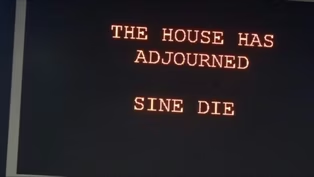
NewAlabama closed primary bill dies as session ends without final Senate vote
Clip: S21 Ep66 | 3m 15s | Alabama closed primary bill dies as session ends without final Senate vote (3m 15s)
Providing Support for PBS.org
Learn Moreabout PBS online sponsorship
- News and Public Affairs

Top journalists deliver compelling original analysis of the hour's headlines.

- News and Public Affairs

FRONTLINE is investigative journalism that questions, explains and changes our world.












Support for PBS provided by:
Capitol Journal is a local public television program presented by APT