
April 11, 2023
4/11/2023 | 55m 35sVideo has Closed Captions
Rep. Katie Porter; François Heisbourg; Philippe Étienne; Dr. Ricardo Nuila
Rep. Katie Porter discusses her new book "I Swear: Politics Is Messier Than My Minivan." French experts François Heisbourg and Philippe Étienne weigh in on President Macron's rapport with Chinese President Xi Jinping. Dr. Ricardo Nuila, author of "The People's Hospital," discusses the healthcare crisis in the United States.
Problems playing video? | Closed Captioning Feedback
Problems playing video? | Closed Captioning Feedback
April 11, 2023
4/11/2023 | 55m 35sVideo has Closed Captions
Rep. Katie Porter discusses her new book "I Swear: Politics Is Messier Than My Minivan." French experts François Heisbourg and Philippe Étienne weigh in on President Macron's rapport with Chinese President Xi Jinping. Dr. Ricardo Nuila, author of "The People's Hospital," discusses the healthcare crisis in the United States.
Problems playing video? | Closed Captioning Feedback
How to Watch Amanpour and Company
Amanpour and Company is available to stream on pbs.org and the free PBS App, available on iPhone, Apple TV, Android TV, Android smartphones, Amazon Fire TV, Amazon Fire Tablet, Roku, Samsung Smart TV, and Vizio.
Watch Amanpour and Company on PBS
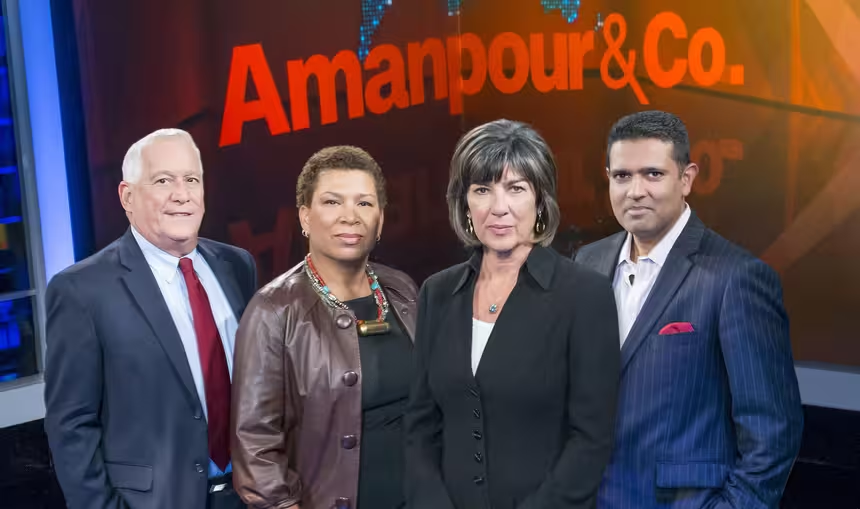
PBS and WNET, in collaboration with CNN, launched Amanpour and Company in September 2018. The series features wide-ranging, in-depth conversations with global thought leaders and cultural influencers on issues impacting the world each day, from politics, business, technology and arts, to science and sports.Providing Support for PBS.org
Learn Moreabout PBS online sponsorship>> What are we fighting for?
We are fighting for liberty, we are fighting for justice.
>> As President Biden visits Northern Ireland to celebrate the peace process, we dig into the existential challenges facing his party at home.
From guns to abortion rights to the judicial system.
I speak to Katie Porter about all of this and her run for Senate in 2024.
The United States and China conduct was very exercises in Asia.
We will have the latest.
Also ahead.
>> This health care crisis manifested in so many ways we did not think about.
>> What the American health care system could learn from one Texas hospital.
Amanpour and Company is made possible by the Anderson family fund.
We try to live in the moment and not miss what is right in front of us.
We believe taking care of tomorrow can help you make most of today.
Mutual of America financial group, retirement services and investments.
Additional support invited by these funders.
And by contributions to your PBS station from viewers like you.
Thank you.
>> Looking to the program.
President Joe Biden is in Ireland for a major celebration.
25 years since the historic and Friday peace accord and America possible viral in making that happen.
His four-day visit to the Ellen comes as he signals ever ladder is intentions deafly run again for president in 2020 four.
Just as hot but election issues around guns, rates and a woman's right to choose rose vital questions about the state of the democracy.
A Trump appointed judge in Texas once a nationwide ban on abortion built that has been approved for use by the FDA for more than 20 years now.
While in Tennessee, Republican state legislators expelled to black Democratic members who took part in an anti-gun protest.
One of them, Justin Jones has been reinstated.
Katie Porter has become a star in Washington by holding what she calls this abuse of power accountable.
She is known far and wide for her tough questions and trademark whiteboard.
She is running for Senate in California.
Politics is messier than my minivan.
I have been speaking to her about the challenges and about how to maintain America's role as a global beacon of democracy.
Katie Porter, welcome to the program.
>> Thank you for having me.
I want to start by asking an issue that has trans-Atlantic wings that has landed here as well.
Very important to American women.
That is this Texas judge who has decided this will not be allowed to anybody within the United States, the abortion pill.
The Justice Department is appealing that.
How does that happen, from this perspective, how does one judge in Texas, how was he able to make a ruling for the entire United States?
>> The judge ruled that the FDA acted unlawfully and because it is a federal case, it has federal authority, we do expect it is -- There will be an appeal of this decision.
I fully expect it to be reversed.
The basic argument is that the FDA did something wrong in its scientific work.
It is very unusual to have a judge put in the position of critiquing and criticizing the scientific and regulatory process.
>> You say it will be appealed as we have seen.
Before we get to the legalities, what about the impact on women?
What will this mean for the women who are already finding their access to surgical abortions restrictive, some great risk to their own lives?
What will it mean if even this pill is banned all over the U.S.?
>> We are hearing our state and local officials in locations like California where abortion remains safe and legal talk about that, making people aware there are still options, Governor Newsom in California recently announced we have about 2 million pills on hand and so the hope is this won't have any practical effects, that the decision will be reversed.
There is a lot of misinformation out there.
We saw the exact same set of facts after they decided the Dubs decision was limiting and taking away the constitutional right to an abortion, a lot of fear and misinformation.
That is part of the intentional political strategy of those trying to substitute their judgment for the judgment of doctors and patients at families about when and if to have a child.
>> Can I ask you this about a political and electoral issue, we saw women were motivated by this restriction of their rights, do you think this will re-motivate them, keep them motivated for this 124 election?
You're running for Senate but there is obviously a presidential election as well.
>> This is a huge issue for not just women but all Americans because fundamentally, the decision about having an abortion is a freedom issue.
It is about each person being able to make their own decision rather than the U.S. government and a few extremist politicians making it for them.
That is important to democracy.
What are we fighting for?
We are fighting for freedom and justice.
This is an issue that touches on that very value.
I think it will drive people to be politically active, to remain politically active.
And to come out to the polls.
I think the Democrats that have been taking a unified and strong stance and protecting the right for people to make your own decisions about abortion, they will come up for this issue as well as the issue of gun violence were Americans are pushing and pushing Congress to pass laws for government leaders to act in accordance with their wishes and that is what they understand democracy to be about.
>> Let me ask you for the threats to the gas to American democracy.
There is gun violence and the threat to women's rights.
These also form a threat to life, liberty and democracy.
Here are some headlines I want to throw you to see your reaction.
This week, the expulsion of the two epic American legislators are from the Tennessee house by the public and super majority.
One of them is being reinstated.
But that combined with reports that the supreme court judge Clarence Thomas has accepted undisposed -- undisclosed luxury trips over the years, we have Donald Trump's indictment, I know that is throwing a lot together.
Do you see any link?
>> We have seen consistent efforts to undermine the core institutions of American government.
I think these are all part of an overarching strategy by those who want to weaken government for their own benefit.
Those are largely corporate special interests, extremist politicians, billionaires who have too much influence in our politics so I think they're all connected and attacking people's fundamental confidence in government institutions.
We assume our court is free of corruption.
That is something we take a lot of pride in in the United States historically.
Something we compare ourselves favorably to with regard to other countries.
We assume that if your duly elected in the United States, you will be able to serve.
That is attack on the legislature.
Re-think they're all designed to weaken people's trust in government.
I think that has the effect of allowing those with power to exert more control over government, weakening the ability of people to have their voices heard.
>> You have become very well known since your election to the house.
It was your first run for politics as somebody holds the power for the accountable.
-- powerful accountable.
You were talking about the billionaires as we just wear.
Ides want to play a little clip from a while ago when you confronted or had an exchange with a former executive.
This is Robert Bright way of the engine Corporation.
He is the CEO.
>> Do you not know why you're not getting hundreds of tens of militant dollars a year?
What is the justification?
I would like to show the American people.
>> Our composition is consistent with competitive positions.
>> The other guy gets paid too much to?
That is not a justification.
>> I don't know how that all turned out but I'm sure the team must tremble when you throughout that whiteboard and hold them publicly accountable.
You're running for Senate and you have said in your book I don't do Congress the way others do.
So explain that and why you're running for this position that has been vacated by the long-standing Senator Democrat Dianne Feinstein.
>> In my time in Congress, what have shown is that the American people are interested in what their leaders are doing but they want those leaders to show them that.
Part of the reason he's the whiteboard is to make it easier for people to understand that I am in fact asking the questions on their mind.
Where CEOs being paid hundreds of militant dollars when they are failing to invest in the company and the workers and the small businesses and the supply chain?
I think what I showed a willingness to do was to stand up to power.
I think that is remarkably rare in Washington.
That is something a talk about in the book, the power of corporate donors and lobbyists and one of 11 members of the House of Representatives.
One of 11 who does not take out edition's from federal lobbyists.
I think it shows I'm willing to go toe to toe with powerful people and asked them the questions that while they may be unusual in Washington I think are the exact questions that are on the minds of most Americans most of the time.
Chris maybe has a way to get yourself wider -- I don't know if you can get wider attention but you have read this incredible -- written this incredible memoir.
You say politics is messier than my minivan.
Let's talk about that.
Funny title but how messy if our politics?
>> I would say politics is even worse than my minivan.
There is always a lot of beach sand in my minivan, discarded cups, paper work the kids, abandoned homework but I think politics is even messier.
I think some of that is inherent in our democracy and I think it is sort of baked into the very idea of representative government and having the legislature we have with house and the Senate and the checks and balances that we have.
I think the reason I wrote the book is to reveal to people some of that mess.
I think it's OK to show the American people what democracy is really like.
It is not that easy, it is hard.
There are corrupting influences.
What you hear from people in politics is this condescending attitude that you, the regular voter could not understand how Washington works.
That is nonsense.
The American people can and must understand how Washington works and why a lot of times it doesn't work and that is really it.
The book is to be honest about that and to show them why it is so hard to get anything done.
How Washington really works.
What is the role of special interests?
What can we do about it?
To that point, you're famously a single mom, you have had young children when you decided to young -- when you decided to run for Congress.
Still young.
They call you Congress mom.
You write very frankly in your book about being a single mother, about experiencing sort of a threatening environment when you wanted to get out of the marriage.
That is very similar to what so many women experience in the United States.
Working Sam others.
Do you find that really cements you as an elected representative?
What did your kids think about what you wrote about their father?
>> The kids definitely were tough critics of the book.
Part of them just must amount to be a mom, they don't want their moms also be a Congress person but a lot of kids feel that way.
The competition between taking care of your family and your job.
I think most of us feel that.
I really focused on that struggle, that difficulty does not go away.
As a job, it is not a 30 minute commute, it is a 3000 mile commute.
My colors are challenging to put generously in -- colleagues are challenging to put in generously.
Like all kids, sometimes Mike is just wish they could have their mom be there mom.
At some point, I think there also proud of what I have been able to compass.
I also look at my children and I see what they have learned.
They're going to be terrific voters when the time comes.
There is sacrifice for them but I also see the strength they have gotten out of having their mom involved in politics.
>> Let me ask you about the next presidential election.
President Biden is all but saying he pre-much confirmed to Al Rocher, NBC that he would be running but has not made the announcement yet.
You see the hullabaloo around Donald Trump with the indictment and divisions when the -- divisions within the amp up -- divisions within the Republican Party about what to do with this character.
How do you foresee this next year of campaign turning out?
What you think will be the challenges for Biden and Trump if he is the nominee?
>> President Biden has been on a strong footing innocent of election because he is still there for the American people.
He will be able to talk about the infrastructure bill and point to in all most every county that the bipartisan for structure project has funded.
People talk about investing in American jobs and bring back manufacturing the chips asked.
He will build to talk about the climate crisis, bringing down home energy cost for people.
He is someone who is accomplished -- has a compass a tremendous amount.
He will be able to run a very strong campaign because he has delivered things and improved Americans lives.
President Trump on the other hand I think it's a plea going to cast accusations.
He will continue to incite a certain brand of very damaging and extremist politicians.
I represent Warren County.
It is a split area.
That even numbers of Democrats and Republicans.
There will never happen without him as the nominee and not as the president.
>> I see that you interned for public and Senator, Charles Grassley.
You know what it is like to work across the line and across the eye when it is possible but what I want to ask you is about your competition during your Senate campaign now.
Their other high-profile Democratic Congressman who would like to have this.
What you think set you apart to win the seat of Dianne Feinstein?
What I have shown is a willingness to rethink how we do politics.
I have been willing to hold people to account.
I have some congressional hearings are not just opportunities for politicians to give speeches but they are moments in which we can push for and get real answers and meaningful solutions in people's lives.
During Covid in the early days, I questioned the CDC director and got them to commit to making testing free for every American.
There was a tremendous victory for commerce mints in government.
My goal would be to continue to show people that elected officials can and should work for us and that they are willing to stand up to the CEOs, the special interest to have too much power in Washington to put our interest first.
>> Next to this, this does seem to unionize -- Tensions just keep matter between the United States and Beijing.
The U.S. started joint military exercise with the Philippines today.
Just as China wraps up there three days of drills around Taiwan.
But Washington is deeply concerned about the mango Macron's recent rapport with President Xi Jinping and his declaration to the palooka Lucite that Europe needs strategical autonomy.
The worst thing would be to think that we Europeans must become followers on this topic and take our cue from the U.S. agenda and Chinese overreaction.
Joining me on this is the echoing French ambassador to the United States and the senior advisor for Europe at the International Institute for strategic studies.
Gentlemen, welcome back to our program.
Is this a NATO is brain-dead moment?
Is this something that people just can't get their heads around?
As a member of the president's government, a former member, what do you make of what he said about strategic autonomy and particularly on the issue of Taiwan?
>> I don't think the statement by our present about strategic autonomy is very new.
It doesn't mean we are equidistant between China and the United States.
I would say on the contrary that it means that the is a confirmation by our present that we want our sovereignty to be more efficient and to bring about defense, to build up our energy independence after the Russian invasion of Ukraine hen finally think it is in the best interest of such an alliance to have a European side that is stronger.
They had their own in the Pacific strategy.
We are very much interested in the into Pacific and where there is a respect for international law.
>> L come back with a specific question around Taiwan.
First onto ask you if you believe it is more of the same and definitely the president of France doubling down on more strategic autonomy for Europe?
>> If that is the case and I don't think it is, nobody has actually realized the political and media brouhaha in Germany and other European countries -- they have the distinct impression that this is actually very new language.
Clearly, Macron has hit some very raw notes and not only in the states but in a more vivid way, among some of our European partners.
They see strip in China as being an extension of his attempts to get through to put in except that this time around, he was trying to get through to him via -- This is perceived as something that perceptions are also part of the reality.
>> You mentioned the criticism and as we now, he was very critical.
He says Macron has managed to turn his China trick into a PR Q and a foreign policy disaster for Europe.
Former ambassador, can you see why they would say that?
None of them were particularly impressed by President Macron's outreach to President Putin at the beginning of the war.
They heard what he said, that I am going to try and go there and stop this he is had absolutely zero success.
What do you think you can do so special and different with President Xi?
Whether it is on Taiwan or whatever?
>> I think that the people who heard what President Macron said would be advised to read the interview he gave there would not be satisfied with some excerpts but I think that we should also take into account their France has led the battle to elevate the capacity of the European Union -- the Europeans which after all, how democracy is normal, it is what we call sovereignty.
Just one example, when they were bullied by China because they had taken -- We have just adopted a coalition in Russell's.
France has talked about 22 implement a lot of new tools.
It is absolutely not true that we are in a sort of appeasement and say we do not want to be strong.
We are building up our strength.
Even militarily, look at the budgets.
The different budgets we are doubling down on.
>> Can I ask you both?
The Taiwan issue has struck the biggest nerve in the United States.
One of your former colleagues has said and this is -- they have said that Macron has started an important debate at a time when the temptation exists to consolidate us into a Western block under American direction sure to be on the side of the good.
It would be a mistake to give into this.
When it comes to Taiwan, the West, American things Taiwan is on the side of the good and there -- they're not so strategic ambiguity is about defending Taiwan.
If some kind of trouble breaks out around Taiwan initiated by China, do you think France would support the U.S.?
>> I don't know what the U.S. would do, there is this ambiguity and I will not answer this question because we will see what happens but we must prevent something like that happening.
This is the point and for this to be avoided, we must prevent this to be a sort of issue like blocks and we must engage including on the war in Ukraine.
Obvious they, China has a role to play.
We are really supporting the quitting resistance.
Of course, we have to talk with China about this.
And to avoid this, it does not mean we are contrary to our alliances.
I was with the ambassador during the last state visit to the U.S. and I read about the extruded relations between the U.S. and France.
Something ask you.
Particularly on the issue of Ukraine as well and then I want to get a response from the United States.
Resident Macron said to President Xi and Beijing that I know I can count on you to bring Russia to his senses but we also understand that he did getting answer from President Xi.
What do you think the response to it and bested her at Seann has said?
?
In which President Macron spoke about the Chinese and American role in the press conferences -- It was read by most serious people in Europe.
It is not good enough to say that people who are currently a bit unhappy heavily read excerpts.
President Macron spent rather more time splitting the Americans have been revving of tension that doing so vis-à-vis China.
I don't approve of everything the U.S. does in regards to Talon policy.
They would be ready to use force as China does.
The effect of Macron's words have not very greatly appreciated.
I am sorry but your question actually slipped my mind.
>> That's OK. That was actually the question.
Now I will play a response from those in the U.S. Congress.
We know that some have said President Macron has played directly into the Chinese Cummings party's agenda.
Senator Marco Rubio you know as quiet powerful in the Senate, he has Casper President Macron has said and done around China in terms of what it might mean for your support of Ukraine here.
Listen to what he said.
I want to hear you both react.
We're pretty heavily involved in Ukraine right now.
We're spending a lot of our taxpayer money on the European war.
Supported that.
I think it is in the interest of the night stays to be allies to our allies.
If Macron speaks for all of Europe and the position is they will not take sides between the U.S. and China over Taiwan, maybe we should basically say we are going to focus on Taiwan and the threats that China poses and you guys handle Ukraine and Europe.
>> Yikes.
If that is the result, they could be pretty dicey.
What do you make of Marco Rubio's Association?
>> At a this debate in the U.S. has done anything.
I would question the qualifications made by Senator Rubio about the war in Ukraine as a European war, it is a global war.
It is a war against democracy.
It is of basic interest for the biggest democracy in the world.
This is the reason why since the very beginning of the invasion in Europe and U.S., they have been working so hard together to give them the possibility to win.
It is absolutely crucial.
It affects our whole world.
It is not the violation of all basic principles of the U.N. charter.
There are enormous consequences.
There are consequent is on food, energy.
It is a global war.
>> On the other issue -- Court is not leaving for the chairperson of the European Commissioner Co. visiting clientele away from Macron.
They do not get too much of the stage.
He actually does have a rather tough China policy, he was talking about the risking between China and the European Union.
Europe as an institution tends to be on China currently as somewhat less and beloved president then is that Macron.
You asked me a question about what Macron is expecting from Xi Jinping.
If you want Xi Jinping to lean on Putin, try to put together a mediation.
The problem here is Macron spent the years prior to the war hoping to pull the Russians from the Chinese embrace.
Now he has been trying to pull China from Russia's embrace which proves spokesperson Emelia says this was not the time for negotiation.
Indeed, present Macron -- President Macron said there is no way for that.
>> This is a really interesting moment.
We are very pleased to have both sides of the story.
We have run out of time but we will continue to follow it.
Thank you very much indeed for joining us.
There are numerous challenges facing the health care system in the United States with millions of Americans uninsured and unable to pay for a doctor's visit, for the health care is hard to come by.
Dr. Ricardo will works at a hospital where cost is second to care.
In his new book he chronicles the lives of five patients who turned to his help after facing financial barriers and he joins us to discuss what America needs to do to fix its health care crisis.
>> Thank you so much for joining us.
To give our audience a bit of background, you are writing this story about the safety net hospital in Houston.
What is the safety net hospital?
>> It is a hospital that provides health care even if people don't have health insurance.
The safety net hospital I am running about his part of the system, this health care system in Houston Texas that provides health care for people who can't access health care or can't afford health care.
Which is becoming more and more in our society.
The safety net hospital is a public health care system in Houston.
This is generated by property taxes to help assure that everybody has health coverage.
Chris Houston the highest uninsured rates in the country.
More than one million people are uninsured in Houston, Texas.
That is more than 5 billion people.
In the United States, that is 40 million people.
We had health insurance to employment.
As employment changes, people get laid off and we see more people at the safety net hospital.
>> What is the kind of experience that a young doctor can get at a safety net hospital that they might not be able to at a fancier one?
>> Etiquette is that contact with people.
I think it is the ability to feel the responsibility.
That is what kept me in the safety net hospital.
A feeling of responsibility.
We are in a crisis of burnout for our profession.
A lot of that has to do with the bureaucracy of our health care system but when that is spread away and you can just deal with what you are trained to do which is sit and think through problems with people, I think -- one of the reasons why people come to the safety net of a hospital, they come to see the different illnesses that manifest in patients.
That is why a lot of students really want to come to safety net hospitals to learn how to train.
It makes them better doctors.
>> Less talk about some of the things that you're more likely to see than in other places.
One of the patients you described is a woman named Ebony.
To put this in the context of maternal health challenges in the United States, the Orient specifically to black women and what they face.
>> She had a problem, she was bleeding during her pregnancy and that put her at high risk.
She moved from estate in California where she had Medicaid or health insurance provided by the state but she moved to Texas where she was uninsured.
When the bleeding started, she was shuttled between emergency rooms until she found safety net hospital.
The placenta was blocking the birth canal.
That meant it cannot be borne without causing a catastrophic leak.
Doctors at that moment offered her medical abortion.
There would be the best way to ensure that Ebony's life was saved.
>> If she came to you with the same symptoms today in Texas, what would she be facing given how the political landscape has changed?
>> She would be phasing risking her own life for that birth.
Not even the choice.
That is the thing.
Ebony selected to proceed with the pregnancy but this happens and many women don't want to risk their lives.
In my mind, that is their liberty.
In Texas, it is very confusing for doctors on what advice to give patients.
>> Is it harder in Texas for Dr. at a hospital or doctor anywhere to have an honest conversation with a woman about her health care?
For fear of being sued by a third party if the word abortion enters the conversation?
>> Undoubtedly.
My dad is enough to attrition.
My colleagues are obstetricians.
I have spoken to some of them about this but one of the things that sets safety net hospitals apart is then transparency and conversation and knowledge that we will be trying to help the person make the best decision for their own lives.
That has changed because of the abortion laws in Texas.
>> We talk about one of the patients called Geronimo and he had needs for a liver transplant.
Tell us a little bit about him.
>> He was a gas station attendant.
He had liver disease that had gone to the point where he was very ill and he made too much, he qualified for Medicaid but when he started to get his disability payments, it -- he was not poor enough for Medicaid.
It was taken away from him right at the moment when he needed a liver transplant to survive.
The safety net system does not have transplant capabilities.
The infrastructure needed to build transplant centers and to have the personnel, so much high investment that a safety has system has to be utilitarian with these funds and transplant are just not something it can afford.
One of our goals is to see if they can follow up with this.
>> There is an entire demographic you have seen more at this hospital -- a document to people.
You wrote about Roxanne.
An undocumented woman from El Salvador that had competitions from a cancer related illness and she needed a few patients.
It is just startling that something like that could slip through the existing tracks and get to you.
>> It is an example of how broken our system is.
We don't have the standards or they may be for patients.
Roxana came to the safety net hospital because she suffered a great cap legation during a life-saving surgery.
The life-saving surgery she had was an incredible manifestation of the American health care system.
It showed we have surgeons capable of doing amazing things.
We just can't complete the job and give people chronic care.
When she changed from an emergency patient to a chronic care patient, she was discharged out into her apartment with gangrenous arms and legs and there was no plan for how to deal with her.
Thankfully she lived in the city where she could go to the public health care system funded by property taxes, members of the community where she can get those applications and the care she needed.
Quickly or in a state with conservative values and you have a legal climate that create other challenges for you.
You are also saying this hospital could be a model for the rest of the country to still have these conservative values and show compassion.
Chrysler has played this in America is trying to bring these two concepts together.
They are represented by political sides.
They want to provide health care for everyone in this country.
But because it is so Spencer -- expensive, it is difficult to provide for everybody.
These conservative values of cost-cutting come together with the more liberal values of providing to everyone regardless of citizenship or insurance status.
I think one of the reasons that has happened is because there has been conversations in order to make the system work.
Seven out of 10 Texans believe the federal government has oval in providing basic insurance to everybody in the country.
Think about that.
Across the political spectrum, there is agreement.
We just have to focus on that agreement and I am proud that I worked in a system where we found ways through those clinical ideologies.
>> One of the interesting things in the book is how the hospital is able to cost about half the national average per patient but at the same time, you are the fastest in the country for figuring out whether somebody is having a heart attack or not.
How can you keep the costs where they are and still have the level of expertise that the rest of the country hasn't got yet?
>> This is the philosophy of quality improvement.
Making sure that the health care goes to what is needed.
They just isn't waste in the system like there's waste in the private health care system.
Since we are not performing more health care than is necessary, we can focus on emergencies like heart attacks, strokes, trauma and building protocols to identify those and take care of those in offender manner.
If you think on the other side, the resources are used for other things that are not as essential and vital for those things.
That is one of the reasons why we can demonstrate quality while demonstrate and cost.
>> What is the cost of what you're spending per patient?
How do you quantify the level of efficiency this safety net hospital has?
>> Great question.
There are ways to look at how much Medicare is paying for.
Private insurance pays less but only because Medicare is for patients 65 and older who usually utilize health care services.
If you take apples to apples, -- our health care system can look and see and what the overall budget is and how many people are in the system and -- or it is 30% of the total cost.
One of the things I do in my book is follow a patient and the medical bill he incurs in our public health care system where it is that profit motive.
One of the patients had treatment for cancer that involved x-ray therapy, surgeries, admissions, his total bill was less than a pickup truck according to him.
People in health care system know how little that is according to the equivalent in the private system where there is a private loan.
>> I wonder if there is a hesitation on the parts of doctors.
Especially in a state like Texas to come out and speak like you are, we are talking about the difficult climate, having reproductive health care conversations with women and we're talking about compassion and were talking about compassionate care for undocumented, we are talking about universalized health care.
And I wonder if there is a concern that even having these conversations, being out front, I wonder if it was a bull's-eye on your back.
>> I feel hopeful in my system because for instance, I feel the local government is supportive of this safety net.
Because it is a public health care system, it is subject to the politics of what is going on locally.
I think we are also arriving at a >> Rate here.
Physician burnout is occurring and it is a big problem for the United States.
You think about how much society pours into doctors studying and performing all the acts they do, my colleagues, many of them are leaving the profession early.
It just means we will have less doctors with more health care that is needed for this country.
We have hit a point where we need to think about -- we are spending so much money on health care.
It is a problem -- we just kick the can down the road.
What has happened is the profession itself is people are leaving it and not wanting to go into it.
That is one of the reasons why people like me are speaking up about it.
We are genuinely concerned about that experience patients have with the health care system.
And also that collies are leaving the profession already.
>> You are from El Salvador.
You also read about your grandmother who came to you for advice.
I just went through the algorithm it was a normal test.
I dissent I don't know what your sentiments is due to.
Later that she got another test and she went back to El Salvador and she found out she had a solvable cancer.
The overreliance on algorithms, I stopped thinking about the person of my grandmother the moment that test came out and what I wished I had done was follow that symptom.
Say this is negative.
If it was an unnecessary surgery in El Salvador after she suffered greatly from that.
She could have been diagnosed in a more precise manner.
It still weighs on me today.
>> We can come together to solve this health care prices.
This health care crisis manifests in 70 ways that we do not think about.
It affects real people's lives.
We can solve this problem if we just think about will be in for.
We need to decrease costs and we need to give health care access to everybody.
There is strength in numbers.
If we can think about building a health care system rather than just passing one up since the early 1900s, I think we can solve this problem.
>> The book is called the People's hospital.
Thank you so much for joining us.
>> Finally tonight, a Lego masterpiece from an iconic artist and prominent Chinese activist.
The first design exhibition is making sense -- A re-imagination of the iconic water lilies.
There is a hole in this piece and he revealed why when we visited the exhibition.
>> It is a real hole.
>> It stayed there for five years inside this home.
For me -- these are the worse and my the most among the impressionists.
That is it for us tonight.
If you want to find out what is coming up on the show every night, sign up for our newsletter at PBS.org.
Thank you for watching.
Join us again tomorrow night.
"The People's Hospital:" Can Healthcare For All Work?
Video has Closed Captions
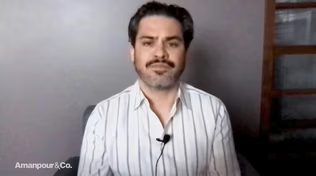
Dr. Ricardo Nuila discusses his book "The People's Hospital." (17m 56s)
Providing Support for PBS.org
Learn Moreabout PBS online sponsorship
- News and Public Affairs

Top journalists deliver compelling original analysis of the hour's headlines.

- News and Public Affairs

FRONTLINE is investigative journalism that questions, explains and changes our world.












Support for PBS provided by: