
April 12, 2023
4/12/2023 | 55m 38sVideo has Closed Captions
Nic Robertson; Leon Panetta; Lt. Gen. Dan Leaf (Ret.); David Axelrod
Biden visits Northern Ireland on the 25th anniversary of the Good Friday Agreement. Former CIA director Leon Panetta discusses the Pentagon intelligence leak. Dan Leaf, former deputy commander of American military forces in the Pacific, believes it’s time to try again to make peace with North Korea. David Axelrod discusses Brandon Johnson’s victory in the Chicago mayoral election.
Problems playing video? | Closed Captioning Feedback
Problems playing video? | Closed Captioning Feedback
April 12, 2023
4/12/2023 | 55m 38sVideo has Closed Captions
Biden visits Northern Ireland on the 25th anniversary of the Good Friday Agreement. Former CIA director Leon Panetta discusses the Pentagon intelligence leak. Dan Leaf, former deputy commander of American military forces in the Pacific, believes it’s time to try again to make peace with North Korea. David Axelrod discusses Brandon Johnson’s victory in the Chicago mayoral election.
Problems playing video? | Closed Captioning Feedback
How to Watch Amanpour and Company
Amanpour and Company is available to stream on pbs.org and the free PBS App, available on iPhone, Apple TV, Android TV, Android smartphones, Amazon Fire TV, Amazon Fire Tablet, Roku, Samsung Smart TV, LG TV, and Vizio.
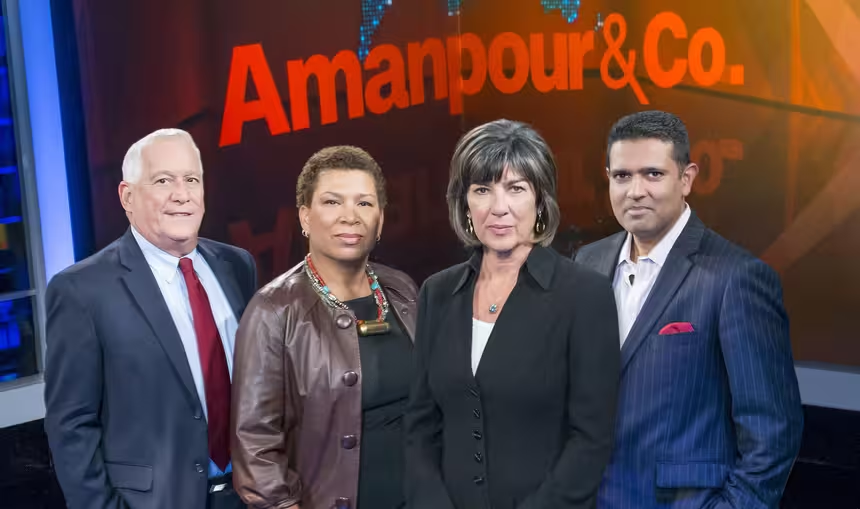
Watch Amanpour and Company on PBS
PBS and WNET, in collaboration with CNN, launched Amanpour and Company in September 2018. The series features wide-ranging, in-depth conversations with global thought leaders and cultural influencers on issues impacting the world each day, from politics, business, technology and arts, to science and sports.Providing Support for PBS.org
Learn Moreabout PBS online sponsorship♪ >> Hello, everyone and welcome to "Amanpour and Company ."
Pres.
Biden: the United States of America will continue to be your partner building the future of young people whom our world deserves.
Christiane: President Biden comes to northern island to celebrate the anniversary of the peace agreement at having to reassure allies about embarrassing Pentagon leak that threatens to overshadow his foreign policy.
I speak to the former CIA director Leon Panetta.
70 years after the end of the Korean War, is it time for the U.S. to make peace with Pyongyang?
Retired Air Force general joins us.
>> I think if he succeeds, he will be an emblem for Democrats.
If he does not, it will be exploited by Republicans.
Christiane: Much at stake for Chicago office because it knew Democratic mayor Brenda Johnson.
Michel Martin speaks to David Axelrod about how he plans to bring down poverty and crime.
♪ >> "Amanpour and Company" is made possible by the Anderson family fund.
Sue and Edgar Wachenheim III.
Candace King Weir.
Jim Attwood and Leslie Williams.
The family foundation of Leila and Mickey Straus.
Mark J. Blechner.
Seton J. Melvin.
Bernard and Denise Schwartz.
Koo and Patricia Yuen, committed to bridging cultural differences in our communities.
Barbara Hope Zuckerberg.
We try to live in the moment, to not miss what is right in front of us.
At mutual of America, we believe taking care of tomorrow and help you make the most of today.
Mutual of America financial group, retirement services and investments.
Additional support provided by these funders.
And by contributions to your PBS station from viewers like you.
Thank you.
Christiane: Welcome to the program, everyone.
I am Christiane Amanpour.
In Northern Ireland President Biden hails the powers and possibilities of peace and 25 years after the Good Friday agreement ended the troubles.
That was three decades of sectarian violence between Protestants and Roman Catholic nationalists.
When 3005 hundred people were killed, mostly civilians.
And when a province was ruled unhappily from London.
At the president's speech marked the real successes since and the power of smartly deployed diplomacy.
Pres.
Biden: let's celebrate 25 years by recommitting to renewal , repair, by making this exceptional piece the birthright of all of the children in Northern Ireland.
Christiane: Swiftly traveling south of the border to the Republic, Biden was eager to reconnect with his Irish roots.
Our correspondent is in Belfast joining me live.
Let's talk about the rather short Eliphaz to visit.
He did to meet with the two main leaders and the others.
Did he make any inroads in getting the devolved government there to actually rule and get back to work?
>> On the surface you would have to stay no -- say no.
He certainly had a warm reception from the party.
The leader said it was a very special moment President Biden coming up.
The leader of the union party, his party is holding out and will not go into the power-sharing government that President Biden says is an important institution that grew out of the peace agreement, and President Biden said he did not want to be presumptuous, that he thought the parties should go back into it.
Donaldson said he did not think President Biden's speech had moved the dynamic at all, the political dynamic, although he did agree with President Biden that business is the way forward.
His emphasis was on having better trade between Northern Ireland and the mainland U.K.
The smart money at the moment leaves after the local elections, Jeffrey Donaldson might try to swift -- so party to accepting this compromise over Brexit.
It will be destructive for his own party willing to show his real political hand right now.
We know that when he was at the White House during St. Patrick's Day celebrations a few weeks ago, he did speak with President Biden perhaps at more length.
Christiane: It would not be a functioning democracy if they cannot actually rule themselves and are continuing to be ruled from London, but let me ask you about Biden's fairly short trip.
What is he doing in the South or the Republic?
That is where he is putting most of his attention?
>> It is, it County and another area, both areas that his family hails from.
The Finnigan side of the family, a great great grandfather of President Biden.
Tomorrow he will spend the day in Dublin, meet the president, the Prime Minister and then he will address a joint assembly of the parliament there, both houses with the speech.
Again more relatives and giving a big speech outside of a Cathedral Friday evening.
A cathedral where one of his relatives actually sold the Brexit that were used in that cathedral.
It allowed him to pay for that strand of the family to emigrate to the United States, so a lot of history.
A lot of that is family time for the president.
Christiane: There is always an anecdote, thank you so much continuing a long tradition of American presidents visiting both Northern Ireland and the Republic.
If the administration is in major damage control mode trying to reassure allies about a highly embarrassing leak of Pentagon and intelligence documents that the CIA director Yum!
Brands calls an urgent problem to investigate.
Here he is speaking at a university in Texas.
>> The issue that you mentioned, the deeply unfortunate leak of classified documents is as intense as anything.
It is something the U.S. government takes extremely seriously.
At the Pentagon, the Department of Justice have now launched an investigation to get to the bottom of this.
Christiane: CNN as not seen all of the documents and therefore cannot confirm their authenticity, but there are concerns about how the league might impact a range of issues including the Ukraine war.
A source close to President Zelenskyy tells CNN some of their military plans have been altered as a result.
The former CIA director and Defense Secretary Leon Panetta gives us his take on the worldwide ripple effect.
Welcome back to the program, Secretary.
>> Good to be back with you.
Christiane: We still do not know.
You heard your successor your burns.
We have heard from the national security spokesperson John Kirby that they do not know where this happened, how it happened, how much of it is gotten out there.
It is been out for a while, it is not like it popped up yesterday.
What is your assessment of the damage that has been caused?
>> It is hard to fully assess the damage when we do not have the additional information we need on the how and the why and the who that were behind this leak, but I think it is fair to say that any leak of highly classified information is going to damage our national security, particularly impacting all the sources of that intelligence.
These are sources that put their lives on the line in order to gather intelligence, and they are now vulnerable.
Secondly, this is also timely intelligence.
It deals with information over the last two months on the strengths and weaknesses of both Russia and Ukraine, so there is no question that it is going to impact on the military decisions that will be made in these next few weeks.
Christiane: Does it strike you as odd even though as you correctly say do not know the who and the how, etc., but that itself is pretty strange, is it not?
You knew almost immediately when wiki happened, and that was the last big dumb.
You knew almost immediately after snowden, but it was different with those leaks as well.
Are you surprised that they are surprised and caught unaware?
>> This is information that appeared on a social media app, I think discord is the name of it.
You would think that we would be able to have the forensics to determine exactly how this leak occurred.
I am sure that the Pentagon, the Justice Department, and the FBI are applying as many resources as possible, because frankly, we do not know whether or not there is additional information out there, and if there is more to come, this could be particularly damaging not only with regard to what happens in Ukraine and the decisions that are made there, but also the impact that it has on our allies.
We have already had to explain this intelligence to South Korea, Israel, the UAE, and others that are involved.
There could be even more damage to come if we do not plug this leak as soon as possible.
Christiane: Before I get into the substance of what it might do in real time to a current war , what does it mean?
What could happen to those allies?
What could their reaction be?
What would they do?
They are obviously angry, but what would they do?
>> Well, we went through this with Snowden.
When there was a tremendous release of classified material at that time, some of which impacted on our allies, and it takes a lot of repair work to basically restore confidence.
It is going to take a while.
After all, we are dealing with classified information.
This is very sensitive information.
All countries obviously spy on one another, but the fact that it is made public impacts on credibility, so to restore that credibility is going to take time.
And ultimately, the only thing that can ultimately deal with this is that you have two be able to show how this happened, that you were not at fault, that somebody deliberately did this, and that ultimately will be able to restore the confidence in our classified information again.
Christiane: Just quickly, the government, and I think you were probably in government when the Snowden leaks happened, and there was a promise to make sure that there was never any kind of leak like this again.
What went wrong?
>> Well, you know, there are a lot of concerns about classified information.
How presidents handle classified information.
We are dealing with classified documents that President Trump, President Biden, Vice President Pence had.
We are dealing with this leak of information that obviously had a sensitive information.
It raises serious questions about whether or not we are in fact providing real security here in order to protect the most important and sensitive information we can gather.
If we do not, then it is going to create additional problems in terms of our relationship with the world that is facing a lot of danger points.
Christiane: In the meantime, as you correctly point out, there are very real considerations about the war in Ukraine that have been revealed in this dump, and that is not least that the U.S. is at least according to the statements which we have not authenticated concerned that there is no winning this war by the Ukraine site anytime soon, that Ukraine's air defense network would collapse by the end of this month, giving Russia an opportunity to strike with impunity, and Ukraine is changing battle plans against Russia.
With U.S. Secretary of Defense hat on, what is the most appropriate next step given the fact that the U.S. and its allies have put so much on the table to actually back Ukraine victory?
>> Well, you have got to keep your eye on the target with regard to what is happening and Ukraine.
I think it is very important that Ukraine be able to put into effect and offensive against the Russians, to be successful at pushing the Russians back in the Dundas -- donbas if not premier, because that is the only way we will bring this war to an end, to get putin to withdraw or negotiate.
At the only way that happens is if Ukraine conducts a serious and effective offensive.
Now, this information, it has been speculated it could have been released by the Russians, because it makes it the opinions look bad.
On the other hand, the Ukrainians could have released it in order to basically mislead the Russians.
We just do not know, but the fact that that information is out there and raises the prospect that we could have a long-term stalemate in Ukraine I think it can impact on the support element that is so important to making sure that Ukraine continues this war and ultimately is successful at it.
That is the concern.
Christiane: That is a huge concern, and to that end, the Ukrainian Prime Minister has been in Washington alongside the U.S. defense secretary at Lloyd Austin, and this is what the Ukrainian Prime Minister ask for again, more weapons, please, help us.
>> We will win this war, but to achieve faster and with fewer casualties, Ukraine needs intensive military support, defense systems that impact -- minimize the impact of Russian attacks.
We also ask you for the possibility of providing to Ukraine long-range missiles.
Christiane: These are very important things you know very well how important they are and how they have been asking for a while and why they still need them.
Evelyn, who was at the Pentagon under the Obama administration, and she says there is no way that Russia is going to get Ukraine back, but it may be this leak will give NATO and the U.S. a kick in the pants to get Ukraine precisely these kind of weapons that the Prime Minister is asking for.
What do you think?
>> Well, I do not know what else needs to happen here to make sure that there is kick in the pants with regards to providing the weapons necessary.
We have been through this.
We know that these weapons have to be provided.
We know the United States and our allies are critical to providing these weapon systems, whether it is air defense, missiles, fighter planes.
Those weapons have to be provided in a timely fashion, because of we are going to see an offense conducted in the spring, and we are now in the spring, it is a few weeks off.
Ukrainians cannot be successful unless they have the full range of weapons that they need in order to sustain and offensive -- an offensive.
That is the absolute bottom line that will determine what happens in the Ukraine.
Christiane: We have been asking this question, I am sure you have been asking and talking about it months.
Everybody knows this is what has to happen.
Why is it not happening?
Is it really a question of ability, or is there some other political reason why they do not want to give Ukraine what it takes to do the necessary?
>> You know, there is -- what happens here is there is a sense that Ukraine has indeed been successful with what they have received it they stopped a Russian invasion.
They have been able to regain territory that the Russians achieved.
At the Ukrainians and fighters have done a great job in this war, and they are winning this war.
So there may be a kind of what else do we have to do here?
The Ukrainians are doing fine.
I think in this kind of situation, you have got to always operate on the basis that tomorrow you could suffer a serious defeat, and therefore you have got to do everything necessary to not only bolster this offensive that needs to take place, but to give Ukrainians all of the weapons that they need in order to succeed.
This is a critical and pivotal war that will determine not just the future of democracy in Ukraine.
It will determine the future of democracies in the 21st century.
Christiane: Finally therefore given this is about relative strength, what does this leak do for Russia?
Of the many successes U.S. and NATO have shown over the last year is the absolute knowledge, minute by minute, of what is going on around the Russian space, intelligence, defense, all of the rest of it.
What does this now say to the Russians and due to that kind of window?
>> Obviously, it gives the Russians probably what they already know, which is that we do a pretty good job at being able together sensitive intelligence on exactly what is happening with the Russia's.
They are a depleted force having problems with command and control, logistics.
They are essentially losing this war.
But the fact that we have this information and that they might not know -- they might know now what the sources of those information may be could very well give them the ability to stop some of the sources that provide this critical information.
That is the danger right now is that the Russians will be better informed about the sources of information to be used in order to gather this intelligence, and that could be dangerous.
Christiane: Can I ask you one final question, because we are turning next to the crisis on the Korean peninsula.
You are Secretary of Defense and CIA director under the president.
He regarded North Korea as the top security priority for the incoming Trump Administration in 2016.
Should the Biden administration be more focused out on how to believe at least one major tension in the world and particularly that part of the world?
>> We are living in a dangerous world where there are a lot of flashpoints, with Russia and Ukraine, China, North Korea, Iran, and terrorism.
There are a number of flashpoints is that we have got to confront.
The only way we will be able to do that quite frankly is to rebuild alliances.
That is what we did with NATO.
I think it has been successful in supporting Ukraine.
We need to build a similar kind of alliance in the Pacific not just with China but also with North Korea.
If we can sustain a strong alliance with South Korea, Japan, Australia, India, and others in the Pacific, I think that is the best way to make clear to North Korea that any step they take that is aggressive toward South Korea spells the end of their regime.
We need to make clear that we have the deterrence capability to be able to go after them, and I do not know whether we will be able to bring them to the negotiating table.
I doubt it, but we certainly have to make clear that we have a strong deterrence in place that can defend not only South Korea but the Pacific as well from North Korea.
Christiane: Thank you very much, and we are going to turn next to the possibility of negotiation, which you do not think holds much hope.
It has been decades since the end of the Korean War.
The United States is technically still at war with the North, and there are fears growing Pyongyang might conduct a nuclear test.
Initially force the can that is its military flu nuclear capable bombers to the Peninsula sending a clear message.
With the worst risks still on the table, and how can the temperature be lowered there?
It has been tried numerous times most notably under the Bush administration.
CNN got access to a nuclear plant and I watched Pyongyang demolish the cooling tower.
This is a top-secret plan where North Korea used to make energy and has made plutonium for nuclear weapons.
This is the last place we thought the North Koreans would ever let us film, but they went to make a point to CNN and the world.
It is scary as hell.
In February 2007, North Korea agreed to disable the plant in exchange for fuel oil, trade, and being removed from the U.S. list of state sponsors of terrorism.
Christiane: That was back then.
Later President Trump tried in two meetings with Kim Jong-un, but nothing seemed to change the status quo.
The former Debbie commander of American military forces in Pacific Dan leaf joins me now.
He was trained as a nuclear warrior, and he believes it is time to try to make peace, try out that negotiating tactic again.
Lieutenant General, welcome to the program.
Just tell me what you think -- why you think this is the right thing to do?
You heard what the former secretary of defense saying he thought that it would be very -- probably very low chances of getting your vision achieved.
>> Well, I think there are two primary reasons to try something else.
The first is kind of obvious.
Everything else has failed.
We are approaching the 70th anniversary of the signing of the armistice that simply stop the fighting of the Korean War.
It was intended to hold us out of conflict until a formal peace agreement was solved, so that is part one.
We are still there.
In July it will be 70 years.
We are in a different place with regard to the Korean threat, and while I respect the former secretary's emphasis on alliances and deterrence, they are both important, we are one bad decision away from nuclear war with North Korea.
They have the capability in terms of weapons.
They have the capability in terms of delivery systems, and they have the authority.
Even in a dictatorship you have to have some guidelines.
They passed a law that allows first right.
When I lived in seoul, our home was 57 seconds away from the nearest North Korean rocket launcher.
Those now can carry nuclear weapons.
Christiane: OK, so let's just -- you have written personally and strongly about this in a recent column for the New York Times.
You describe yourself as a nuclear worrier.
Christiane: Much of my career was spent as a nuclear worrier.
You are in Strategic Command.
How were you trained?
Walk us through what that meant at that time?
>> Well, the bottom line is I had to think about things we do not want to think about.
As a young lieutenant, I trained and certified to attack a Warsaw Pact target with my F4.
Later as a Wing Commander overseas, I was responsible for the storage, security, and maintenance of actual nuclear weapons held in a war reserve.
As the vice commander, we oversaw all of the ICBMs in the U.S. arsenal, and as Pacific Command, we had unique national decision-making responsibilities, so I thought about nuclear war more than most.
Christiane: What would it look like, and I ask you that because I know it has been written in history and people see what happened, our generation sees what happened in Nagasaki and Hiroshima, but right now you just mentioned correctly Pyongyang has issued a new law enabling a first strike.
We see in Russia the president hinting at the possibility of a tactical nuclear strike.
We understand it Russia, the state media is almost preparing people for that possibility.
What would it look like?
>> It would look like nothing we can imagine.
I mentioned living in seoul close to North Korean rocket launchers in terms of time and distance, but the metropolitan area has roughly 14 million people.
Imagine nuclear weapons in that environment?
I have been to Hiroshima.
I would like to emphasize that I am not dismissing the dangers of nuclear Russia or conflict from China, Taiwan, and the U.S. is spreading 28 nuclear outkiln.
They are just not as urgent.
One bad decision from North Korea, and we are in nuclear war , and they could reach the United States.
Christiane: Sorry, yes, you said they could reach the United States, but the question now is as we laid out, several U.S. presidents have tried.
There is peace on the Korean peninsula acting Congress that has not moved since 2021.
What has to happen?
And is it really in Kim Jong-un's interest to remove himself from this hermit-like kingdom?
>> That is a really complicated ball of yarn you just laid out.
Let me see if I can pull the right threads.
What it has to happen first of all is we have to narrow our focus to something that is achievable.
We kind of have treated North Korea -- and it is a difficult problem, so I am not being dismissive -- like a cat chasing a laser dot.
We are looking at provocations, opportunities, will the sister or the daughter be the next leader?
We should focus on the fact that we are one bad decision away, and as a very first step, not a panacea or solution, pursue a peace agreement.
A way to do that since presidents have found it difficult, and the politics of the executive branch make it difficult to sustain the interest and commitment, and we saw that with the Trump Administration, is to have a congressional mandate to pursue peace.
The piece on the Korean Peninsula act is imperfect, it needs work as I said in my article.
It needs more structure, and it should clearly mandate the pursuit of peace within limitations, because right now if we say it North Korea, we would like to negotiate a peace treaty.
They would be asking for this, asking for that.
A congressional mandate should define the limits of the negotiation to simply establishing a peace treaty, and by the way, not a unilateral declaration of peace.
That is not enough.
Christiane: To sort of un-complicate my own ball of yarn, I went to take this next thing.
This is the counter argument that you yourself wrote in 2017 at the Oslo peace for them.
You wrote that the domestic Kim family survives because of the notion that the Democratic People's Republic of North Korea stands alone.
The rationale that guides all of the actions of the leaders of the government of North Korea and ensures the servitude of its citizens is that the whole world is out to get them, partly out of jealousy and partly from flawed ideology.
Why would they want to enter any kind of peace agreement that makes them part of the world and just another country?
>> Well, there is no guarantee, but we do not know until we try in a serious way to achieve a peace treaty.
And I think there are incentives embedded within the pursuit of peace, like the chance for economic progress for North Korea.
I cannot speak for Kim Jong-un, but we have to try, and we can provide incentives that do not require negotiation.
The maritime boundaries on the West Coast of North Korea are an aberration.
They are left over from the pharmacist and years afterwards.
They are not fair to North Korea.
I am not endorsing the Kim family dynasty.
I am just saying they are not right, and a pursuit as part of this pursuit of a treaty of normalized boundaries would be a good starting point.
We cannot get into chasing sanctions or the other things, but establishing a peace treaty will allow us to pursue the process of reconciliation, which we have never tried, to address the court belief for the North Korean regime and then to get down to the real balls of yarn denuclearization and improving the human condition.
If we talk mostly about the nuclear threat.
Christiane: Obviously for their own people it is dire, but for Kim Jong-un and his regime, for 70 years they have conducted the most appalling human rights abuses that I think turn off a lot of Western interlocutors.
That is another side of this.
What I do want to ask you is, given your former status in the Pacific Command, are you concerned not by the de-escalation there but by the escalation and the possible axis between Russia, China, North Korea?
>> Yes, I am concerned about that escalation and the evolving relationships between Russia, China, and North Korea.
I am most concerned about the immediacy of the North Korean threat, without dismissing the role an axis could play, but I am equally concerned about the human condition in North Korea.
While it is not our fault, the U.N., U.S. or South Korea's fault, if we do not aggressively pursue a solution, we are at least complicit.
I feel that in my heart.
It is going to sound funny coming from a grizzled old fighter pilot, but the human condition is appalling, and we cannot use the reason that it is too hard to make peace to not make peace.
End the reasons why we should make peace are far more compelling than the reasons why not.
Christiane: We do not have much time, but I want to play this one soundbite from Kim Jong-un saying that they have fundamentally changed their doctrine a nuclear war.
Let's play this.
>> The fundamental mission of our nuclear forces is to deter a war, but our nukes can never be confined to the single nation of war deterrent even as a time a situation is created on this land.
Christiane: Literally we have 30 seconds.
Do you think they have the capability and that he would do that?
>> Yes, and that is my concern, and we have to go after a solution.
A solution starts with a peace treaty.
Christiane: General, thank you so much for joining us.
And now a noteworthy week for the Windy City.
President Biden and his party have picked Chicago to host the 2024 Democratic national convention, and the city also has elected a new mayor, Brendan Johnson, a progressive former teacher who campaigned against racial and economic disparities, and he won by a margin of less than 20,000 votes.
He inherits a city struggling with soaring primates -- crime rates.
Table exit around -- David Axelrod is host of a podcast on CNN.
He spoke to Michel Martin about what this victory it means amid the many challenges ahead.
Michel: Thank you so much for talking with us.
>> Happy to be with you.
Christiane: We have just learned that Chicago will host the 2024 Democratic convention.
>> I think it is exciting news for the city.
I remember the 1996 convention that made a huge impact on our city and some lasting improvements, so it is a great opportunity to showcase the city.
Michel: I was going to ask, is a congratulations or condolences?
For those of us to get to visit, it is awesome.
I am wondering if it is awesome for the people who live there.
>> My experience in 1996 was people were pleased to showcase the city.
We had the 1968 convention in Chicago, which lives in infamy in American history for the disorder and chaos that erupted there, so it was a chance to exorcise that and I think people appreciate it.
But it is a challenge for the city as well and the new mayor, who will preside over this.
Michel: Should we read anything into it?
What does the choice of Chicago State -- say about what the Democrats think their messages going into the 2024 election year?
Obviously a lot goes into these decisions.
What does the choice of Chicago State?
>> It says that the Midwest is an important battleground.
Illinois, Wisconsin, which is perhaps to the swingiest of all swing states in some ways, and Michigan is nearby.
And these are two states that a Democrat must have, so I think it speaks to the political importance of the region.
I also think being in the middle of the country is a statement rather than on the coasts.
I think Democrats have had a challenge winning over voters in what has become known as flyover country.
This is a way of saying we are in touch with the entire country.
Michel: Let's talk about the mayor.
The new mayor will be presiding over this monumental event next year.
As we are speaking, it has only been about a week.
Progressive candidate Brendan Johnson, a former social studies teacher and who became an organizer for the Chicago teachers Union.
Besting Paul Vallas, who is a former CEO.
Mr. Vallas had momentum, and Brendan Johnson pulled it out.
>> Polls can be misleading, and these were pretty close even though they gave Vallas an edge.
It was always going to be a close race because of the way the city is divided.
The question for Brendan Johnson was could he consolidate the African-American vote in the city, and could he continue to inspire to build on the support that he got in the general election, because these were the two finalists in the general election among young, white progressives, and he was able to do both things.
He got 80% of the African-American vote, as opposed to 20% in the first round when there were seven African-American candidates, and he inspired greater turnout among white progressives to go early in the north side lakefront wards of the city.
He did better than people thought he would among Hispanic voters, breaking almost even with Vallas, and those three elements gave him a winning multiracial coalition.
Michel: Black voters are not enough to win in Chicago.
It is not a majority black city.
>> In terms of population the city is a 1/3, 1/3, 1/3.
In terms of voting population, the dominant vote is the white vote.
What happened here is Brendan Johnson inspired young voters, young, white progressive voters who did not embrace Vallas.
Vallas ran almost entirely on the issue of increasing policing in the city.
He wanted 1800 more police in Chicago, and that got him far in the race in a city that is deeply concerned about crime, but Johnson had a more nuanced position, which was that the city needed more than policing, that they needed to relieve police of the kinds of social work type of interactions that the police are often asked to engage in and sometimes lead to unwanted confrontations and that the city needed to focus more on the economic status of communities that were forgotten on the south and west sides of Chicago.
A lot of younger voters who deeply believe that.
Beyond that, one thing you learn in politics in the modern age is that videotape is often not your friend.
Paul Vallas did an interview 14 years earlier or 13 years in which he was thinking about running for office as a Republican in Chicago against a democratic officeholder, and she said if I run again I will run as a Republican.
He said he was personally opposed to abortion.
Those things were very incendiary to these young progressive voters, and you put that together with his closeness to the police union, he became persona non grata mobilized by this young, progressive candidate.
Michel: Do you think there are national applications for this?
It is not a secret that Republicans have been hoping to hammer Democrats on the issue of crime.
Shootings and homicides are down from one year ago.
Chicago's homicide rate remains a five times higher than New York City's, 2.5 times higher than Los Angeles is -- Los Angeles's.
Chicago is not alone in this.
>> That was a piece I wrote the day of the election in the Atlantic.
Crime and public safety is issues number 1, 2, 3 in Chicago.
Brendan Johnson had to make some amends to this as well, because in the wake of George Floyd, as a member of the county board he was very outspoken and said at one point defunding police is a political goal.
What he was referring to was shifting resources to other elements of public safety and community health.
Michel: How come his previous statements around defunding the police did not drag him down?
>> His past statements on defunding police did not sink him, because in part he walked them back and made very clear in debate after debate he was not going to defund the police.
In his last debate I think he said he was not going to take a dollar away from the police.
He had to make some accommodations to the public mood on this and make clear not just of the public but to the police themselves that defunding the police was not his program, but I do think another lesson of this is that policing is complicated, and it is not just a matter of the number of police you have, because after all Chicago has more police per capita than any of the other major cities.
Our more than Los Angeles, New York, and yet it has a deeper problem with violence.
More police is not the only answer.
A smart policing, and how you deploy the police and other things come into play.
That was Johnson's message.
A winning coalition of voters accepted that message and felt comfortable with what he was saying about public safety.
Now the question is how does he perform?
He has to appoint a new police chief within a short period of time.
He will have to and over -- win over the police.
The head of the police chief union said 1000 police will resign.
You need the police to be fully engaged and willing to work with you to solve the public safety problem.
They did not feel that way about her.
She lost in the first round.
Brendan Johnson has absorbed those lessons, and now the question is how deceiver or, and how does Chicago perform in terms of public safety moving forward.
If Chicago fails, undoubtedly Republicans will hold him up and his past statements as emblematic of the Democratic Party.
I think he knows this is one of the challenges, perhaps the major challenge he faces in the short run.
Michel: Talk a little more if you would about Lori Lightfoot, the outgoing mayor.
She was elected with such promise, and there was so much excitement around her.
An African-American woman that was openly queer.
It just seems like a big moment.
What happened there?
>> Lori Lightfoot was elected in a landslide back in 2019, and there was a great deal of hope for her.
First of all, I think she has a strong and interesting personality.
The first openly gay mayor of Chicago, but she also was elected kind of as a loner.
She was a former prosecutor.
Her message in that campaign but she was going to clean up corruption, but she came to office with no political relationships, and she had a hard edge to her.
She was more apt to extend a clenched fist rather than the open hand, and she ended up alienating a lot of political partners that she needed in order to move the city forward.
And all of that in addition to rising crime rates in Chicago, which were related to the pandemic, but nonetheless on her account, they conspired against her.
She had a high disapproval rating by the time of the election rolled around, but I will say this.
Nobody can plan on a pandemic greeting them when they take office.
She led the city through a very difficult time.
I think she did an excellent job on the pandemic, but the public safety issue overwhelmed her, and at the end of the date she paid a price for it.
Michel: I went to go back to the piece you wrote prior to the election.
You wrote Chicago needs a healthy dose of what each men office -- man offers by choosing one.
So tell me what is missing with Brandon Johnson's victory?
>> What is missing is experience.
Paul Vallas has 40 years of experience in government.
He had run major government agencies in Chicago and elsewhere over those years, and he brought that knowledge and experience to the job.
That also was a comfort to the business community, and one of the other challenges Johnson will have is that he does not have a relationship with the business community in the city at a time when some major companies have moved their headquarters out of the city.
People want to reverse that.
In addition to building relationships of trust with the police, he also has to build relationships of trust with the business community without compromising his progressive approach.
Michel: You have experience with young, progressive person with not as much experience as other people think that person should have for the job.
Talking Barack Obama, of course.
I am wondering if there are lessons that you would impart from your experience with this monumental and transformational political figure that you think Brandon Johnson could learn from.
>> First of all, Obama had some natural executive instincts even though he did not have a great deal of executive experience, and one hopes that Johnson will as well, but part of that was the ability to get good people around him.
To get a variety of opinions and call -- cull through those and take the right steps.
On your point, Obama's view was always that if you can move the ball forward, if you can get things done that are going to help people, you probably need to be willing to compromise, because 100% of nothing is not as good as 60% or 70% or 80% of something.
Brandon Johnson comes from a labor background, so he understands negotiations.
You do have to compromise when you are in office, and the trick is to not compromise those principles that are fundamental to who you are.
Some may argue that Obama did.
I strongly disagree with that, but certainly Johnson has to keep that in mind.
Be willing to compromise and listen and understand what other people's concerns are, try to act on those and do it within the framework of who you are and what you believe.
Michel: Just looping back, progressives want to see something different.
It will say, look, what has been tried as not worked.
The same things have been tried over and over again.
More policing, harsher policing has not worked, so try something else.
Other people say we cannot afford that.
It is too scary out there.
People feel their quality of life is being seriously compromised.
>> The reality is though things are true.
You need effective policing.
There is a need for police and communities.
There also is a need to evaluate what we are asking of police, and are there better ways to handle some of the things we are asking them to handle that often can escalate it ways that are not necessary.
And finally are there root causes that you can attack.
In Chicago, we have a big problem with street gangs, and a lot of those gains are young men in their late teens and early 20's who have nothing else to do but hang out with gangs, and they make a little money whether it is through the drug trade or otherwise, and they have a sense of community there.
The question is how do you get those young men out of that life and give them a sense of hope, opportunity that they do not have today?
Violence prevention is a big part of the prescription here, and now you have a mayor who seems deeply committed to exploring all of those avenues.
And, I think if he succeeds, he will be an emblem for Democrats.
If he does not, it will be exploited by Republicans.
You are right, we tend to weaponize problems too often it rather than coming together around solutions.
Michel: David Axelrod thank you so much for talking with us today.
>> Good to be with you.
Christiane: Finally tonight a visit to commemorate an enduring alliance and honor his ancestral roots.
President Biden walks up after Ireland well trodden, but perhaps none better known than President John F. Kennedy.
Just five months before his assassination back in June, 1963, Kennedy captured Iris hearts with his vintage warmth and humor as he sealed the deal between two nations, one people.
>> If the day was clear enough, and if you went down to the bay and you looked west, and your sight was good enough, you would see Boston, Massachusetts.
[APPLAUSE] Christiane: That is it for a program tonight.
If you want to find out what is coming up on the show every night, sign up for our newsletter at PBS.org.
Thank you for watching, and join us again tomorrow night.
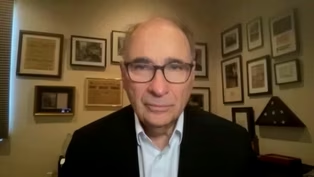
David Axelrod on Chicago’s Progressive Mayor Victory
Video has Closed Captions
David Axelrod joins the show. (18m 15s)
Providing Support for PBS.org
Learn Moreabout PBS online sponsorship
- News and Public Affairs

Top journalists deliver compelling original analysis of the hour's headlines.

- News and Public Affairs

Today's top journalists discuss Washington's current political events and public affairs.












Support for PBS provided by: