
April 14, 2023 - PBS NewsHour full episode
4/14/2023 | 56m 44sVideo has Closed Captions
April 14, 2023 - PBS NewsHour full episode
Friday on the NewsHour, the Supreme Court steps into the battle over the abortion pill. The man suspected of leaking highly-classified government documents appears in court to face criminal charges. Pressure mounts on Sen. Dianne Feinstein to resign over her prolonged absence from Capitol Hill. Plus, David Brooks and Jonathan Capehart offer their takes on the week's political news.
Problems playing video? | Closed Captioning Feedback
Problems playing video? | Closed Captioning Feedback
Major corporate funding for the PBS News Hour is provided by BDO, BNSF, Consumer Cellular, American Cruise Lines, and Raymond James. Funding for the PBS NewsHour Weekend is provided by...
April 14, 2023 - PBS NewsHour full episode
4/14/2023 | 56m 44sVideo has Closed Captions
Friday on the NewsHour, the Supreme Court steps into the battle over the abortion pill. The man suspected of leaking highly-classified government documents appears in court to face criminal charges. Pressure mounts on Sen. Dianne Feinstein to resign over her prolonged absence from Capitol Hill. Plus, David Brooks and Jonathan Capehart offer their takes on the week's political news.
Problems playing video? | Closed Captioning Feedback
How to Watch PBS News Hour
PBS News Hour is available to stream on pbs.org and the free PBS App, available on iPhone, Apple TV, Android TV, Android smartphones, Amazon Fire TV, Amazon Fire Tablet, Roku, Samsung Smart TV, and Vizio.
Providing Support for PBS.org
Learn Moreabout PBS online sponsorshipGEOFF BENNETT: Good evening.
I'm Geoff Bennett.
Amna Nawaz is on assignment.
On the "NewsHour" tonight: The Supreme Court steps into the battle over the abortion pill.
The 21-year-old suspected of leaking highly classified government documents appears in court to face criminal charges.
Pressure mounts on Democratic Senator Dianne Feinstein to resign over her prolonged absence from Capitol Hill.
And David Brooks and Jonathan Capehart offer their takes on the week's political news.
(BREAK) GEOFF BENNETT: Good evening, and welcome to the "NewsHour."
The U.S. Supreme Court has blocked any restrictions on the abortion pill mifepristone at least for a few days.
Late today, Justice Samuel Alito stayed a lower court's restrictions that would have taken effect tomorrow.
That followed emergency requests by the Biden administration and drugmaker Danco Laboratories.
The matter is now on hold through Wednesday, giving the full court time to act.
Our other top story tonight, the U.S. government charged the Air National Guardsman accused of leaking classified information with two charges under the Espionage Act.
Airman Jack Teixeira made his first appearance in a Boston court today, as President Biden directed the military and intelligence community to limit the distribution of sensitive information.
Nick Schifrin starts our coverage.
NICK SCHIFRIN: He appeared in front of a federal judge, the 21-year-old who followed his family into the military now accused of exposing the military's secrets.
Jack Teixeira joined the Air National Guard in September 2019 and was assigned to Otis Air National Guard Base in Massachusetts and the 102nd Intelligence Wing, which consolidates and analyzes intelligence for senior military commanders and receives near-real-time imagery collected by drones and spy planes from around the world.
MAN: As a cyber transport system specialist in the Air National Guard, your job is to make sure everybody else has the opportunity to finish their mission and save lives.
NICK SCHIFRIN: That's the job that Teixeira had, not an intelligence analyst, but a cyber transport systems journeyman, an I.T.
specialist.
To maintain the network, court documents today confirmed he had a top secret clearance and sensitive compartmented access, or SCI, to other highly classified programs since 2021, when he was called to active duty.
The documents detail how, in December, Teixeira began posting the text of classified documents.
But he was concerned he would be discovered, so, in February, he accessed this particularly sensitive document mentioned in court filings, and one day later allegedly posted a photograph of it.
Today, President Biden said the military and intelligence community would limit the distribution of sensitive information, and defense officials told "PBS NewsHour" the Joint Staff was already reviewing its distribution lists.
Teixeira could face decades in prison.
U.S. law says the unauthorized disclosure of top secret information reasonably could be expected to cause exceptionally grave damage to national security.
Attorney General Merrick Garland: MERRICK GARLAND, U.S. Attorney General: People who sign agreements to be able to receive classified documents acknowledge the importance to the national security of not disclosing those documents, and we intend to send that message, how important it is to our national security.
NICK SCHIFRIN: Teixeira posted on Discord, a social media site popular among gamers.
Today, court documents revealed Discord provided the FBI with details of Teixeira's account and the private group he administered, where he originally posted the documents.
It's a fall from grace for a proud military family.
His mother posted these photos online.
And that's his stepfather, retiring in 2019 from the same Massachusetts Air National Guard unit after a 34-year career.
QUESTION: What do you think he was trying to accomplish?
NICK SCHIFRIN: But, today, outside the courthouse, his father faced a media gauntlet, his son accused of exposing the very information he was assigned to maintain.
For the "PBS NewsHour," I'm Nick Schifrin.
GEOFF BENNETT: So, how does the U.S. government determine who should have access to secure computer networks and the information on those networks?
For that, we turn to retired Special Agent Frank Montoya, who served 26 years in the FBI, and Heidi Beirich, co-founder of the Global Project Against Hate and Extremism.
With a welcome to you both, Frank, Jack Teixeira was a cyber transport systems journeyman, what we civilians would call an I.T.
specialist.
Help us understand how he would have had access to such sensitive top secret material.
FRANK MONTOYA JR., Former FBI Official: Well, just like the promo said, the young man who was presenting that information said they're the backbone.
They're the guys that manage the communications networks on which all of this information is stored, is transmitted, is collected.
And so, in that regard, he has access to that kind of information, kind of like a systems administrator, with not as many privileges perhaps, but still very much involved in the actual management and storage and transmission of that data.
GEOFF BENNETT: And, Heidi, Teixeira was granted a top secret security clearance in 2021.
And according to the federal complaint, that means he would have signed a lifetime binding nondisclosure agreement acknowledging that leaking protected information could result in criminal charges.
Should he have had a security clearance, based on the current standard and what we now know about his background?
HEIDI BEIRICH, Global Project Against Hate and Extremism: Well, it really depends on whether or not the kinds of things he was posting online were inaccessible to the Pentagon to find.
But, if they weren't, then he should not have had a clearance.
You cannot trade in racism and antisemitism, as he did, and have clearances.
And, in fact, the clearance system was tightened up in the summer of 2021 to provide continuous monitoring of social media.
So how he slipped through that net, I think, is unclear, but he really shouldn't have.
GEOFF BENNETT: Frank, is it possible for the government to continuously monitor all of the people who have security clearances to make sure that they're living up to the standard that people with security clearances are supposed to live up to?
FRANK MONTOYA JR.: Yes, it's a terrifically challenging task, especially when you look at the kinds of information that people have access to on a daily basis off duty, as well as on duty.
I mean, one of the challenges that we faced after the Snowden disclosures when we were trying to get a handle on who has information and how they handle it and how we can protect it from being illegally disclosed was trying to -- especially in the age of the Internet and social media, was trying to develop guidelines so that we can look at, continuously evaluate their accesses, not only on their government systems, but also when they're working -- when they're at home, when they're surfing the Internet.
And that's a bigger challenge for a lot of reasons, one, because there's so many people with clearances, but also because of First Amendment concerns.
We -- it's important that, even when you join the community, and you do surrender a lot of your personal freedom or personal rights, as far access to information is concerned, you still have First Amendment rights as an American off duty, or when you're not at work.
And there's not a lot of management or control over what you might see or not see on the Internet.
And this is a classic example of that.
GEOFF BENNETT: Heidi, I know you say that this Jack Teixeira case serves as an example of the ways in which young people are radicalized online, and that he is in many ways typical of the people that you track.
In what ways?
HEIDI BEIRICH: Yes, I mean, a young mail involved in gaming culture.
He was posting this on a private server on the Discord system, which is used by gamers.
He apparently was using this classified material to show off to his friends there, who were very young, some of them teenagers, and that's where they were trading and racist memes and posting all kinds of things about guns and so on.
And this, unfortunately, is very typical.
We have a lot of young people getting radicalized in this way.
GEOFF BENNETT: Frank, this trove of leaked Pentagon documents, they were circulating apparently online for months, without it being discovered by the U.S. government.
Why didn't the federal government notice the leaked documents until it was apparent in the news media?
FRANK MONTOYA JR.: Yes, I mean, this is just kind of an old school espionage kind of thing.
I'm not saying that he committed espionage.
It was -- the charges are about unlawful retention and removal of classified information.
But he was looking at it at the work site.
And then he was taking notes and then writing stuff down.
And then, later, he was taking out specific documents out of the workspace and taking them home or photographing them, and I would imagine returning them back to the workspace, so that it was harder to track how that kind of stuff is monitored.
Or it's always harder to monitor things that way, because the emphasis is on looking on the computer networks, what -- the digital trails, that -- what you're looking at, downloading, maybe printing out on your printer or on a copy machine.
And this was stuff that he had access to, that he could look at in hardcopy, and then was, again, smuggling out of -- smuggling it out of the workspace, taking photos at home, and then bringing it back, and so much more like an old school in the way that he was doing it, and harder to monitor, because was the workspace doing bag checks at the end of the day?
Probably not because of concerns about First Amendment rights again and personal freedoms.
And so, yes, very difficult to monitor this kind of activity.
And then he's posting it on these close-hold Internet social media networks, platforms, where only a small group of people know about it.
And, in fact, if that one individual hadn't posted it on other sites, we still probably wouldn't know about it.
GEOFF BENNETT: Heidi, all of this speaks to the question of, how can the U.S. better defend against the insider threat?
HEIDI BEIRICH: Well, that's exactly right.
The insider threat is the issue here.
And I think, if we don't get a hold better on what's happening on social media, and enforce the new rules that were actually put in place on this front a couple of summers ago, we may find this again.
And I would just like to add that extremist people with racist and antisemitic beliefs and so on, they are a particular threat when it comes to insider threats.
And that's what we have seen in this case, and it's what we have to be worried about in terms of domestic extremists being in the military.
GEOFF BENNETT: Heidi Beirich is co-founder of the Global Project Against Hate and Extremism, and Frank Montoya is a retired FBI special agent.
My thanks to you both.
FRANK MONTOYA JR.: Thank you.
HEIDI BEIRICH: Thank you.
GEOFF BENNETT: In the day's other headlines: The U.S. Justice Department charged 28 members of Mexico's Sinaloa drug cartel in a sweeping investigation of fentanyl trafficking.
The drug has fueled a surge of overdose deaths.
Today's indictments name several sons of convicted drug lord Joaquin "El Chapo" Guzman, the so-called Chapitos known for their brutality.
ANNE MILGRAM, Administrator, Drug Enforcement Administration: To dominate the fentanyl supply chain, the Chapitos kill, kidnap, and torture anyone who gets in the way.
In Mexico, they fed their enemies alive to tigers, electrocuted them, water-boarded them, and shot them at close range with a .50-caliber machine gun.
GEOFF BENNETT: Most of those charged to remain at large.
The probe also targeted a complex supply network, including Chinese chemical and pharmaceutical companies.
Montana is poised to impose the nation's first total ban on TikTok.
State lawmakers headed toward final approval of the measure this evening.
It would bar the popular video-sharing app in the state and impose hefty fines on app stores or the company itself.
The federal government and nearly half of the states already ban TikTok from government devices over concerns about its ties to China.
The Constitutional Council of France gave it's approval today to a government plan raising the retirement age to 64.
The decision means the bill can now become law, after months of public outcry.
In Paris, protesters gathered outside city hall to condemn the decision, and some people set fires.
Riot police charged at one point, trying to disperse the crowd.
In Yemen, the Saudi-backed government and rebels linked to Iran have started a three-day exchange of nearly 900 prisoners.
Some were greeted by loved ones today in the capital, Sanaa, held by the Houthi rebels.
The International Red Cross hailed it as a breakthrough toward ending the long-running civil war.
RALPH WEHBE, International Committee of the Red Cross: The look of despair changed now to the look of happiness is exactly what it's all about.
We thank the parties of the conflict who reached this conclusion, and we are sure that this is a good boost for better days for Yemen.
GEOFF BENNETT: Other flights carried prisoners to cities held by the internationally recognized government.
South Korea and the U.S. conducted a new round of military exercises today, this time involving two B-52 bombers.
The nuclear-capable planes were joined by South Korean fighter jets.
That followed North Korea's latest missile launch.
The North's state TV said it was a new solid-fueled, long-range weapon.
President Biden has wrapped up three days in Ireland.
He visited a Roman Catholic pilgrimage shrine today in County Mayo.
His great-great-grandfather had lived there before coming to America.
At the shrine, the president also met a priest who had performed last rites on his son Beau Biden in 2015.
Here at home, Minneapolis will become the first major U.S. city to allow broadcasts of Muslim calls to prayer day and night.
The city council has voted to amend a noise ordinance, so the calls will now be heard on loud speakers five times a day.
Minneapolis has had a growing number of East African immigrants for decades, and mosques are now common.
On Wall Street, stocks fell after a Federal Reserve Board member said inflation is still much too high.
The Dow Jones industrial average gave up 143 points to close at 33886.
The Nasdaq fell 42 points.
The S&P 500 was down eight.
And a Spanish mountain climber emerged today from a cave where she spent 500 days in a social isolation experiment.
Beatriz Flamini greeted family and friends after living more than 200 feet underground since late 2021.
Cameras recorded her daily life, and she says she lost track of the outside world.
BEATRIZ FLAMINI, Mountain Climber (through translator): I'm still anchored in November 2021.
I don't know what has happened in the world.
I don't know.
I have come out of the cave.
For me, it is still November 21, 2021, and seeing you all in masks, for me, it's still the height of the COVID pandemic.
GEOFF BENNETT: Flamini says she spent her time exercising painting and reading, and teammates left food and necessities where she could find them.
But water was limited.
So, today, she had her first shower in 16 months.
Still to come on the "PBS NewsHour": the White House warns of a new drug threat, fentanyl mixed with a sedative; journalist Mary Louise Kelly's new memoir discusses the difficult task of balancing her career and her family; and we catch up with the man walking around the world.
The Senate returns to Washington next week without its oldest member, California Senator Dianne Feinstein.
And calls are growing louder for her to step down for good.
Earlier this week, the 89-year-old announced she would temporarily forfeit her position the Senate Judiciary Committee while she recovers from an infection, a move intended to allow committee business to resume.
But that did not satisfy critics, who say she's no longer fit to serve.
Congressional correspondent Lisa Desjardins has been following all of this and joins us now.
So, Lisa, catch us up on why Senator Feinstein has been out since February and why it matters now.
LISA DESJARDINS: She has been recovering from a shingles infection.
That is something that normally isn't a problem, but it has taken longer for her to recover than usual.
That happens with older Americans more frequently than others.
And it's not unprecedented for a senator to be out for two months.
But what is unprecedented now is the math of this situation.
Let's look at what it is for Senate Democrats right now.
They hold the Senate chamber with a 51-seat majority.
They hold the Judiciary Committee with 11 Democrats to 10 Republicans.
That is critical, because, without Feinstein, that committee is at a tie.
If it's a tie, Geoff, the Judiciary Committee can not pass on any judicial nominations.
And I don't know if anyone's noticed, but the Senate hasn't been doing anything else except for nominations.
Democrats wanted to get judge after judge after judge on the federal bench.
Without Feinstein, that entire thing is frozen.
She has requested to be replaced on that committee.
But that can't happen unless Republicans agree.
And my reporting is, it's not clear that they will do that next week.
So, Feinstein's absence really has major consequences for the Democratic agenda in the Senate.
GEOFF BENNETT: Well, a number of Democrats have said, the longer this persists, the greater the problem becomes, but there are some Democrats who are saying, look, she has to resign right now.
What's your reporting on that?
LISA DESJARDINS: Right.
So we have got her health condition now, but also questions that have been hovering about her abilities in general.
This week, two House Democrats say she should resign, one of them a California Democrat, Ro Khanna.
He said it is now clear that she no longer can fulfill her duties.
More notable, I think, today was this from a person closer to Dianne Feinstein.
Senator Amy Klobuchar raised concerns.
SEN. AMY KLOBUCHAR (D-MN): I want to see what happens in the next month or so.
We -- you give her that time to be able to come back.
But if she can't come back month after month after month, with this close Senate, that's not just going to hurt California.
It's going to be an issue for the country.
LISA DESJARDINS: There are a lot of unspoken layers here.
The charge here is that Senator Feinstein is mentally unfit.
I spoke to her the last week that she was here in February.
It was a normal conversation.
It was short, but normal.
Other reporters have had different experiences.
Notably, she did not seem to know when her retirement was announced.
But her office tells me that she is in charge.
She is daily speaking with them.
And my understanding is that, unless something changes, she does not plan to retire.
GEOFF BENNETT: Well, how does that compare with other senators you cover?
LISA DESJARDINS: Notable difference.
I can count on both hands -- I need both hands to say how many older male senators I have spoken to who have been confused, who haven't understood me, including one who called me, had a rambling conversation that was very confusing, that person no longer in the Senate.
But there is a question here about a double standard.
And House Speaker, former Speaker Nancy Pelosi raised this herself.
REP. NANCY PELOSI (D-CA): It's interesting to me.
I don't know what political agendas are at work that are going after Senator Feinstein in that way.
I have never seen them go after a man who was sick in the Senate in that way.
LISA DESJARDINS: Another layer here, of course, is the age of the Senate itself.
GEOFF BENNETT: Yes.
LISA DESJARDINS: Let's look at where things stand.
Right now, the current 118th Congress, the average age of U.S. senators is 64 years old.
I looked at the Department of Labor.
The average age in the U.S. work force, 42, much younger.
Another way of looking at this, a third of the current U.S. Senate is 70 years of age or older.
There is obviously number of senators that have been there a very long time.
It's a gerontocracy.
And there's a question of when things need to change hands.
Also, another senator over 80 years old, Mitch McConnell, he is recovering as well from a concussion he suffered.
He has been out for several weeks.
He is to return Monday.
GEOFF BENNETT: So what are the other -- the - - really the larger politics happening here around whether Senator Feinstein stays or goes?
LISA DESJARDINS: There's so much around this race for her seat.
Let's look at who's running, just the Democrats alone in California, a Democratic state, Adam Schiff, Katie Porter, Barbara Lee, three of the Democrats, most well-known House members, two of them the biggest fund-raisers.
That is a battle royal for House Democrats to try and get Feinstein's seat.
So there are political reasons that some Democrats would like her to retire, not just necessarily the good of the country, though that is what other Democrats say as well.
GEOFF BENNETT: Lisa Desjardins, thanks for sharing that reporting with us.
Have a great weekend.
LISA DESJARDINS: You too.
GEOFF BENNETT: Now the latest in our continuing coverage of how opioid addiction and overdose deaths have devastated the U.S.
Concerns are growing about overdoses that are linked with an animal tranquilizer mixed with opioids, and it's a problem increasing across the country.
Ali Rogin has more.
ALI ROGIN: Geoff, this week, the Biden administration declared the combination of that sedative, xylazine, and the opioid fentanyl a -- quote - - "emerging threat."
It's the first time any drug has been given that designation.
Veterinarians have been legally using xylazine, often referred to as tranq, for 50 years, but it made its way into U.S. street drugs sometime in the early 2000s.
And in the past two years, its use has spiked nationwide.
Joining me now is Dr. Raagini Jawa.
She's an assistant professor and clinician investigator at the University of Pittsburgh.
Dr. Jawa, thank you so much for joining us.
You regularly treat people who have been using xylazine.
What are some of the symptoms that you commonly see?
DR. RAAGINI JAWA, University of Pittsburgh: So I'm an infectious disease and addiction medicine provider, and I take care of patients in the Pittsburgh area, not only at our local needle exchange or syringe service program, but also in our addiction treatment clinic and in the hospital.
And a lot of my patients coming in for the last year have been exhibiting increasing symptoms of wounds and more complicated overdoses.
And they have just been telling me: "You know, Doc, something doesn't feel right.
And I'm having new symptoms that I haven't had when I was just using fentanyl or heroin alone."
ALI ROGIN: And how does xylazine differ from fentanyl?
And what's happening a lot now is the two are being combined.
So what happens when that takes place?
DR. RAAGINI JAWA: Yes, so there's -- we're learning a lot right now from our patients, because what we know from the original studies on xylazine that were done only on animals is, it has a myriad of effects.
And the most important effect is that it is a -- not an opioid, and it is a sedative.
What that means is, it can -- it's used in procedures for veterinarians.
But when it's mixed in with fentanyl, patients, human patients are exhibiting many symptoms.
One thing that they're saying is, this prolonged periods of sedation, that if they are using the drug, they're just out for several hours and they don't even realize it.
The second thing they're realizing is, they have chronic exposure to xylazine mixed in with whatever substance they're using are wounds.
And these wounds tend to happen all over their extremities, so on their arms or their legs.
And they can be quite painful.
And so those are some of the few symptoms that my patients are experiencing.
ALI ROGIN: So, these are two different drugs, but Narcan, naloxone, can still help, right?
DR. RAAGINI JAWA: Absolutely.
And it's really important, when we're thinking about public health messaging around xylazine, that the first step, if you're worried about someone who's overdosing, even if it's associated with xylazine, is to administer naloxone first, call for help, and then monitor patients.
Usually, we say wait two to three minutes before administering the second dose, and then watch for breathing, oxygen level, and provide supportive care.
ALI ROGIN: What do you think of the Biden administration's announcement this week that xylazine and fentanyl together are going to be treated as an emerging threat?
DR. RAAGINI JAWA: So, I'm really glad that the ONDCP released this statement.
And as an addiction medicine physician and someone who works with harm reduction organizations, we have been doing a lot of this work on the side for a while now.
And communities of researchers and harm reduction organizations have been banding together to meet our patients' needs.
And so hopefully we can leverage some of the federal attention and funding and bring all of these people in the community who've been doing some good work together.
And I think, hopefully, we can use this attention to bring them to the table as we're thinking about national strategies on how to deal with this problem.
The second thing I hope is that I hope the funding helps with research, and some of the funding goes to harm reduction organizations, like syringe service programs, so that we can have access to low-barrier drug checking, because, when you have a toxic, unregulated drug supply, my patients don't know what they're using.
They think they're buying heroin or fentanyl, but it might be something totally different.
And they're having these really devastating harms of being exposed to adulterants like xylazine.
ALI ROGIN: Right.
There's really a lot to do about this very yet unknown substance.
Dr. Raagini Jawa, thank you so much for your time.
DR. RAAGINI JAWA: Thank you.
GEOFF BENNETT: As the 2024 presidential race heats up, several Republican hopefuls are headed to Indianapolis and Nashville for the NRA's annual convention and the Republican National Committee donor retreat this weekend.
We turn now to the analysis of Brooks and Capehart.
That's New York Times columnist David Brooks and Jonathan Capehart, associate editor for The Washington Post.
It's great to see you both.
JONATHAN CAPEHART: Hey, Geoff.
DAVID BROOKS: Good to be with you.
GEOFF BENNETT: And let's start by talking about guns and abortion, two issues that dominated the headlines this week, two issues on which Republicans have achieved their political and policy goals, but that are potentially threatening the party's long-term political viability.
David, Governor Ron DeSantis last night quietly signed a six-week abortion ban into law.
The only evidence we have of it is that photo that he tweeted out.
Very different than when he made a big event of signing a 15-year ban into law last year.
DAVID BROOKS: Fifteen-week ban, yes.
GEOFF BENNETT: Or 15-week ban into law.
DAVID BROOKS: Yes.
GEOFF BENNETT: So, what might that suggest about the politics of the moment?
DAVID BROOKS: Apparently, only women live in Florida, because they're all women.
And he wanted to make a point.
The -- abortion was obviously a big issue for the Democrats in the midterms, and a lot of Democrats think abortion will be a big issue for them in 2024, and it could be.
But let me make the case for against that.
First, if you ask people what issue -- first of all, only 68 -- 68 percent of Americans basically agree with 10 Democrats on these issues.
So it is a minority position the Republicans have embraced.
But if you ask people, what do you really care about, abortion is way down there.
It's about 5 percent of people care.
But if you look at what people really care about, it's obviously the economy, protecting democracy is really big, and so it just may not be a salient issue, as it has not been in most presidential races.
Second, Brian Kemp, governor of Georgia, also signed in a very aggressive anti-abortion measure, did not seem to hurt him at all in his race against Stacey Abrams this time.
And then, finally, I now think it's likely that Donald Trump will be on the ballot in 2024.
And so Donald Trump will be the only issue in 2024.
And so that would be my case for why it may not be as powerful as it was last time.
GEOFF BENNETT: And, Jonathan, a six-week ban could spell trouble for DeSantis, one, if he runs, but, two, if he makes it into the general election trying to get independents and suburban voters on his side.
JONATHAN CAPEHART: Absolutely.
And I'm going to take issue.
I'm going to answer your question and take issue with what David said.
I disagree that abortion is an issue that isn't top of mind.
Maybe, if you ask specifically about abortion, but when you wrap it into the overall threats to liberty, attack on liberty, voting rights, abortion rights, and other things that are happening in school libraries, that people look at that, look at what's happening in Florida, looking at what happened with the Texas decision, and see, whoa, whoa, whoa, whoa, this is not what we want.
And so, yes, this is a great issue for Democrats.
But what we saw in Kansas over the summer, what we saw in Wisconsin just a couple of weeks ago, is that this is quickly not becoming a nonpartisan issue.
This is becoming an issue where women who are Democrats, independents and Republicans, and particularly the Republicans might not say a whole lot, but they make their voices heard at the ballot box.
And we have seen it in two places, and I think we will continue to see that, which is why Governor DeSantis, hiding under the cover of darkness, signing in a six-week abortion ban, might play well in the only place where the red wave hit last November, but it's not going to play well if he is the candidate - - if he is a candidate for president or any Republican running for president in 2024.
GEOFF BENNETT: On Jonathan's point about this playing well in places where the red wave hit, there were Republicans, base Republicans, who sort of derisively referred to Florida as a sanctuary state of the South, because it had less restrictive abortion policies up until now.
And there are people who say that DeSantis took this step of signing the six-week ban to make the point that he is a reliable -- he's a reliable anti-abortion voice.
DAVID BROOKS: Yes, you have got to be there in the Republican Party.
You have to be at six weeks now.
I thought they would have been saner to settle at 15 to 20, but six weeks is where you got to be.
And I think there's going to be complete unanimity.
To preserve what's the wreckage of my case for why it won't matter... (LAUGHTER) DAVID BROOKS: ...
I would say a couple of things.
First, it wasn't only DeSantis -- or it wasn't only Brian Kemp who did fine.
DeSantis, he was pretty clear where he was going on abortion.
He did fine.
Greg Abbott in Texas, he did fine.
And then I just think, presidential races is -- when voters can say, I want my voice heard on abortion, like in Kansas or in Wisconsin, then they're going to make their voices heard.
But a presidential race is the sum total of where this country is going, and they tend to be highly polarized.
And so will independent voters be moved on this issue?
Maybe.
I -- maybe Jonathan will be right.
It's the future.
We could either be right.
(LAUGHTER) DAVID BROOKS: But I will wait to be heard.
GEOFF BENNETT: Well, let's shift our focus to the debate around gun safety, because some of the current and potential Republican presidential candidates, they're addressing the NRA's convention in Indianapolis.
We have a picture of the folks who are planning to address that convention.
I think you might see Mike Pompeo there.
He apparently told FOX News tonight that he's actually not going to seek the presidency.
So you can mark an X by his name.
DAVID BROOKS: I will never smile again.
(LAUGHTER) GEOFF BENNETT: But, David, even as the NRA - - I mean, it's a shell of its former self, in terms of its influence, in terms of its campaign spending, but you still see Republican after Republican flocking to that convention, even as Nashville and Louisville are mourning the massacres in their cities.
DAVID BROOKS: Yes, I think what's happened with the gun issue is, there's been an evolution in Republican world about it.
It was, why do we want to have guns?
We feel unsafe.
We want to be able to protect ourselves.
And that's a position you can argue with, but it's a position.
And then it became a cultural issue, a cultural sign.
You support guns because you don't like those Northeastern elitists telling us what to do.
But, over the last couple, three or four, it's migrated into a form of idolatry where, if you're a Republican congressman, you're sending out a Christmas card, what are you going to do?
Of course, you're going to gather a family around the tree with your assault rifles.
Like, that's just what you do.
And that's the MAGA-ization of the Republican Party, where it's become aggressive, cultural, own the libs.
And so, in a weird way, the gun issue is always going to be salient in the Republican Party, but it's morphed into an unreasonable version of what was already, in my view, pretty unreasonable.
GEOFF BENNETT: Yes.
Well, Jonathan, I mean, on the left, gun safety has not been as potent an issue as abortion access or public perceptions of Donald Trump and his influence.
Might that change?
JONATHAN CAPEHART: Oh, I mean, I would take issue with that.
I think gun safety has been a big issue.
It's just that now we are living through a time where we have children who are living through their second mass shooting event at school.
GEOFF BENNETT: Well, in a sense that voters don't always cite gun safety as their top issue.
JONATHAN CAPEHART: Oh, sure.
That may be, but let's see what people say come 2024 as we get into the presidential elect and as we go through yet another period of mass shootings.
I mean, we're talking about -- the donor conferences is in Nashville, where six people were killed.
Three of them were children.
And the Republican legislature, what did they do?
They kicked out two Democrats who were advocating on behalf of people who were mowed down in a mass shooting.
I think this aspect of owning the libs is, they don't realize that their own constituents are dying.
Their own constituents want something done about this.
And the fact that they don't feel any compunction to do anything about it, because of the NRA, even though it's a shell of its former -- of its former self, says a lot about the NRA, but says a whole lot more about the Republican Party.
GEOFF BENNETT: How do you see it?
DAVID BROOKS: Yes, again, playing -- I could play the moralist and what I think about guns, but we probably don't disagree too much about that.
Just as the cold-hearted political pundit, again, A, it's low down when you ask people, what are you going to vote on?
Two, it used to be a very powerful issue for Democrats when they were running at Republicans who are in affluent suburbs, Northern Virginia, Delaware County, Pennsylvania, Winnetka, Illinois.
Those places have already all turned Democrats.
So there's not a lot of pickup to be picked up anymore, because those former Republican places have shifted.
And then the final thing I will say is, where's this presidential election probably going to be fought out?
Well, the Democrats put their convention in Chicago for a reason.
It's the Upper Midwest.
And so will the gun issue be an issue that will help you win rural voters in Michigan, in Wisconsin, in Illinois?
Well, not Illinois.
But those Upper Midwest states?
Maybe.
But I'm not saying whether it's right or wrong.
I'm just trying to access whether I think it will be a powerful issue.
GEOFF BENNETT: Well, as we wrap up our conversation, let's talk about Democratic Dianne Feinstein.
She says she plans on serving out her term, despite growing calls for her to resign.
She's 89 years old.
She hasn't cast a vote in the U.S. Senate since February 16.
She's missed nearly 60 of the Senate's 82 votes so far this session.
Jonathan, what do you make of the Democratic pressure on her, to include a tweet from Congressman Ro Khanna, who said, "We need to put the country ahead of personal loyalty" and calling for her to step down?
JONATHAN CAPEHART: It was a very aggressive move by the California Congressman, but he got an assist from Senator Amy Klobuchar of Minnesota, who said, let's give her some time.
But there's an issue there on the Senate Judiciary Committee, which I think Lisa Desjardins pointed out very well, that the whole goal of the Senate majority is to, let's get some judges through.
Let's get the presidential nominations through.
And you can't do that if you don't have a functioning Democratic majority on the Judiciary Committee.
And so I think what we're going to see over the coming weeks, especially with the Senate coming back into session, may be a growing call.
Something needs to be done.
If there were a 60-seat Democratic majority, no one would care about this.
The Senate would function.
But it can't function when it doesn't have a key vote on a key committee.
GEOFF BENNETT: What's your take on this perceived pressure campaign?
DAVID BROOKS: I... GEOFF BENNETT: It's not happening in a vacuum.
I mean, there's an active campaign to replace her in California.
DAVID BROOKS: Yes.
No, one might have ulterior motives.
(LAUGHTER) DAVID BROOKS: I don't think Ro Khanna does.
He may want to run for senator maybe someday.
JONATHAN CAPEHART: He's not.
He said he's not running.
DAVID BROOKS: He's not.
He's not.
But I have extremely high regard for Ro Khanna.
And so when he said that, I thought, ooh.
And so this is a question that we can solve.
If she has a press conference and she can volley answers, questions and answers, issue over.
And so have I been -- seen senators who were not capable of that and were still serving?
Yes.
I was around Strom Thurmond at the end.
GEOFF BENNETT: Is there a double standard, do you think?
I mean, far be it for three men to sit here and talk about whether there's a double standard.
(CROSSTALK) DAVID BROOKS: Yes.
GEOFF BENNETT: But what do you think?
DAVID BROOKS: Yes, I -- well, I will -- well, she sits on this unique committee that's important.
But I certainly have been around members of the Senate who were not up to their job.
Let's put it that way.
GEOFF BENNETT: Yes.
Jonathan?
JONATHAN CAPEHART: Yes, it's a double standard generally.
But I do think, because of the issue with the Judiciary Committee -- and, also, let's also keep in mind that it's not so much the age that's the issue, because folks keep talking about Bernie Sanders running for president.
He's, if not in his 80s, almost.
But it's about her health, and her health as she's recovering from shingles now.
But before then, there were questions about her mental -- her mental acuity, her mental fitness.
And I think that's what's also feeding this.
This isn't coming from out of nowhere.
GEOFF BENNETT: Jonathan Capehart and David Brooks, my thanks to you both.
Have a good weekend.
JONATHAN CAPEHART: Thanks, Geoff.
DAVID BROOKS: Thank you.
JONATHAN CAPEHART: You too.
GEOFF BENNETT: Many parents wrestle with balancing the competing demands of their personal and professional lives.
It's a struggle that NPR co-host Mary Louise Kelly recently discussed with Amna Nawaz.
And it's also the focus of Mary Louise's deeply personal new memoir, "It.
Goes.
So.
Fast.
: The Year of No Do-Overs."
AMNA NAWAZ: Mary Louise Kelly, welcome to the "NewsHour."
Thanks for being here.
MARY LOUISE KELLY, Author, "It.
Goes.
So.
Fast.
: The Year of No Do-Overs": Thank you, Amna.
It's a pleasure.
AMNA NAWAZ: So this is a book about you, your family, your boys.
But you put it very succinctly in the book early on.
You say: "This is a book about what happens when the things we love, the things that define and sustain us come into conflict."
MARY LOUISE KELLY: Yes.
AMNA NAWAZ: What did you mean by that?
MARY LOUISE KELLY: I meant I have wrestled for years, like I think many parents do, with trying to balance a family I love and a job I love.
And, to my great surprise, I found it was getting harder.
Like, the deals I was cutting with myself were getting harder as my kids got older, which was not what I was expecting.
And I decided to write what was the last year that I knew my family would all be intact and under one roof, because my oldest son was about to be a senior in high school.
And we were all under one roof.
And I thought about all the choices I have made over the years.
And I thought I want to wrestle with this year in real time.
So I wrote the book in real time to kind of see what stuck, whether I was getting it right or wrong.
AMNA NAWAZ: Tell me about your kids.
MARY LOUISE KELLY: I have two boys.
They're two years apart, both teenagers.
My oldest, as I say, was heading into his senior year of high school last year.
And the thing that I kept circling back on, because it just brought everything to such a sharp point, was that child loves soccer.
That's his thing.
His games are weekdays at 4:00.
I have a conflict at 4:00.
It's when my show goes on the air.
I can't be there.
And, for years, I said, well, I will figure this out next year.
But then ninth grade slid into 10th, slid into 11.
And, suddenly, he's a senior, and I have no more chances.
Like, there's no more do-overs.
There's no more rethinking this.
And it really brought home to me all of the choices that I have made and thinking not so much what would I do differently, because you can't turn back that clock... AMNA NAWAZ: Yes.
MARY LOUISE KELLY: .. but thinking, how have these choices impacted my family?
How have they impacted me?
What would I learn if I just sat and kind of reckoned with this for a year?
AMNA NAWAZ: There's one particularly difficult decision you write about after a particularly poignant moment when you're in Baghdad, and you decide these two things have come into conflict at a point that's no longer sustainable.
Tell me about that moment.
MARY LOUISE KELLY: That moment, I was in Baghdad.
I was covering a visit by the defense secretary.
What threw the day out of whack was an incoming call from the school nurse back in Washington, who wanted to tell me that my youngest son was sick, and when could I get there?
And I kind of thought, if you could see where I am, it's not happening today or tomorrow or anytime soon.
And before I could say any of that, she starts speaking more loudly and saying: "I don't mean to bring him home.
I mean, he's really sick.
He's struggling to breathe.
We need to get him to a doctor or the hospital.
We're already" -- and I started running through the time zone calculations on where's my husband and where's the babysitter and what can I do, and I lost the cell phone line.
The signal died.
And I had to get into a helicopter.
And I do remember just being in the air looking down over the traffic and thinking, what am I doing with my life?
My son needs me, and I'm halfway around the world.
And I love my job.
And I'm good at it.
And I worked hard to get here.
But this is not working for my family.
And I hit a wall.
AMNA NAWAZ: You decide to leave.
Eventually, you do come back to this work that you love.
And, as you well know, this job is one that requires you to just get up and go sometimes, right?
So that guilt can really weigh heavy on you.
You write about, later in life, though, you cornered one of your sons.
And you asked him about it.
And you said, has there ever been a time when you really needed me and I wasn't there because of my work?
MARY LOUISE KELLY: I was so curious what the answer would be.
I asked him that question, Amna.
He looked at his shoes for so long.
I could feel my heart thumping, thinking he's about to really let -- like, the litany of things I have done to damage this child must be very long.
And he eventually looked up and said: "I'm sure there must have been times, mom, but I can't remember.
And could I have 15 bucks for Chipotle?"
(LAUGHTER) MARY LOUISE KELLY: OK.
I must have done something halfway right, if that's the biggest grievance you can come up with.
AMNA NAWAZ: There's going to be a lot of working parents who read this.
And we have to remind everyone we live in a country where the childcare crisis is real, right?
MARY LOUISE KELLY: Yes.
AMNA NAWAZ: We don't have paid family leave for most people.
Families with two working parents are still struggling to make ends meet.
MARY LOUISE KELLY: Yes.
AMNA NAWAZ: What is it that you hope they take away from your story?
MARY LOUISE KELLY: I hope that, whether you look like you're at the top of your game or not, not a single one of us has figured this out.
I had so many conversations as I was writing this with girlfriends, with work colleagues.
And we all -- I will speak for myself.
I have spent a lot of time beating myself up over the years for my inability to do what is, in fact, impossible, to be in two places at once, to be at the White House doing that - - the interview that you have spent months trying to get, or be in the Black Hawk in Iraq, and be home when your kids need you.
And the graciousness that I have tried to extend to myself, which I'm so good at extending to other people, but have not extended to myself in these years, and realizing, I'm fortunate.
My kids are fine.
They're healthy.
I can't be in two places at once.
And I have done, as I explain in the book, a lot of on-ramping and off-ramping and leaning in and leaning out over the years.
But I think that's the takeaway.
We're probably all do a little bit better than we think.
AMNA NAWAZ: You also write very honestly about aging... MARY LOUISE KELLY: Yes.
AMNA NAWAZ: ... and how you think about it at this stage of life.
You talk about women who've allowed their hair to go gray and how men are granted sort of the assumption of credibility and gravitas when they get older.
That's something women do not have.
Do you feel like it's getting better, though, that double standard going away?
MARY LOUISE KELLY: No, to be completely honest.
I just turned 52.
I write in the book about wrestling with feeling invisible in a way that I didn't imagine.
At 52, people stop driving past and giving you a wolf whistle.
And I can't believe I'm admitting this out loud, because it drove me crazy in my 20s and 30s.
But now I kind of miss it.
AMNA NAWAZ: You miss the wolf whistle.
MARY LOUISE KELLY: I admit that I miss the wolf whistle.
(LAUGHTER) MARY LOUISE KELLY: And, again, my 20--or-30-something self would come slap me hard for saying that and saying, what are you talking about?
(LAUGHTER) MARY LOUISE KELLY: And I was I'm not claiming I ever was Cindy Crawford or something or that I am condoning men behaving or anyone behaving in offensive ways.
It's not that.
It's the -- how we move through the world and how the world perceives us changes.
AMNA NAWAZ: Have your boys read the book?
MARY LOUISE KELLY: They have read parts of it.
They were required to read chapters in which they each feature prominently... (LAUGHTER) MARY LOUISE KELLY: ... because, partly, I needed them to help me fact-check.
And they did.
And they had some good suggestions.
They had veto power over it, because this is my memoir.
It was my book about my struggles.
But they're right in there.
And I didn't want to put anything into the world that they didn't feel comfortable with.
So they had veto power over it.
But I hope that has been -- it's been fun to watch their reaction and laughing over the chapters that they remember differently from me.
AMNA NAWAZ: The book is "It.
Goes.
So.
Fast."
The author is Mary Louise Kelly.
Thank you for being here.
MARY LOUISE KELLY: It was my pleasure.
Thanks, Amna.
GEOFF BENNETT: Lots of people track how many steps they take every day, but it's a safe bet they're not close about to Paul Salopek, who's walking across the world.
He's halfway through his years-long journey and is now trekking across China on his way to his eventual endpoint, at the very southern tip of South America.
Stephanie Sy recently spoke with him about his progress.
STEPHANIE SY: National Geographic explorer Paul Salopek is trekking the globe on foot for a project dubbed the Out of Eden Walk.
We have checked in with Paul along the way, from Georgia, Kazakstan, Kyrgyzstan, and Pakistan.
But it's been some time since we caught up with him.
And Paul joins us now from Shaanxi province in China.
My first question to you, Paul, is what it was like doing this journey in the midst of the pandemic and the lockdowns.
I know it wasn't the peak at that point.
But I'm curious how that affected your plans.
PAUL SALOPEK, Fellow, National Geographic: I had to adapt my route to move around parts of mostly rural China, because I'm walking through the countryside for the most part, that were locked down.
And so my walking route through Western China looks a little bit erratic.
There are no maybe mountains in the way, but there are these invisible boundaries of hot COVID zones that I had to skirt around.
STEPHANIE SY: I read one of your dispatches that you spent some time with a poet that believes he's an incarnation or reincarnation of an ancient Chinese poet.
That was really interesting.
What other stories and anecdotes and people have really stood out for you while you have been in China?
PAUL SALOPEK: This is my first time in China.
And so I had to some degree in my mind built up this stereotype, this kind of cartoon image of China, that we get in international media of the factory of the world, a country of mega-cities, of tens of thousands of people, of robotic ports, of massive traffic, and highways and bullet trains.
All of that exists.
But what startled me a bit about coming from Southwestern China is that I'm coming through a frontier province of Yunnan that's one of these last enclaves of rural, pastoral economies in China.
So it was very much an amazement to me to walk over mountain ranges and into valleys where people were still doing tinker, tailor, candlestick maker kind of economies, people doing things with their hands, meeting people like horse traders who are still moving cargo by horseback over mountains through Yunnan Province, people doing subsistence farming, people who were doing artisanal crafts, working very much by muscle power and not robotics.
STEPHANIE SY: It's so interesting, because, speaking about that narrative, so much of what we hear in the U.S. media these days is about U.S. competition with China.
What should viewers understand about the China that you have encountered?
PAUL SALOPEK: It sort of comes with the territory of crossing the world on foot, is that you can't really skim over a country or culture or society.
It really forces me to slow down my observations and to absorb the China that I'm seeing at a very slow, immersive, nuanced level.
At the very beginning of my walk through the province of Yunnan, I was walking through more than 25 different minority communities that each had their own language.
They had sometimes their own cosmologies.
I was walking through landscapes that varied from tropical rain forests, to the Eastern Himalayas, snowfields up around 14,000 plus feet, walking through Taoist communities, through Buddhist communities.
This project is about the micro level stories of the world.
Yes, we're extraordinarily, kaleidoscopically different.
But, at the same time, when you have conversations with people, if you just spend enough time, you will also find points of connection, where the things that we talk about are like 90 percent the same.
STEPHANIE SY: Have you become a weary traveler, or do you still have a lot of gas in the tank?
PAUL SALOPEK: Stephanie, I'm talking to you from 10 years in, 12,000 miles in.
All along the way, people are helping me, strangers, strangers.
They have no reason to, but they reach out their hand and say, hey, do you need anything from directions to the next village or across this river valley to, do you need a glass of water?
That is affirming.
Every single time I am privileged to hear somebody's story that they're, that they're willing to share it with me, gives me positive energy to take the next steps to keep going.
STEPHANIE SY: Well, of course, it is also a privilege to be able to choose to live this sort of nomadic lifestyle.
And I know you have also written about the tens of millions of people around the world that do not have a choice, they feel, but to leave their homeland.
You have written about that and had some profound insight.
PAUL SALOPEK: We live in an age of migration.
It could be mass violence, like war.
It could be economic hardships.
And, increasingly, climate change, climate crises are pushing a whole new wave of people out of their homes.
I have no illusions about romanticizing the difficulties of migration.
But, at the same time, Homo sapiens have been rambling around this Earth for about 300,000 years.
And until only about 10,000 or 12000 years ago, we were doing it constantly, moving the way true nomads do, from encampment to encampment, from landscape to landscape, following wild animals, following resources.
Human movement is the oldest tool of coping and survival that we have in our toolkit.
And I don't see it as a problem, per se, at kind of a big level.
It's a solution.
And, boy, we had better start getting used to it, because I'm not sure of any society or any polity in the world through time that has ever succeeded building walls.
Just ask the Chinese.
STEPHANIE SY: What a unique and profound view you have gained of the world in the last 10 years.
National Geographic explorer Paul Salopek, thank you so much for joining us, and good luck on the rest of your journey.
PAUL SALOPEK: Thank you very much.
It's pleasure to join you today.
GEOFF BENNETT: Remember, there is much more online, including a look into maternal health disparities and why Black women face a greater risk of death and trauma from childbirth.
You can find that on our Web site, PBS.org/NewsHour.
And be sure to tune into "Washington Week."
Our own Amna Nawaz will speak with a journalist roundtable about the abortion pill battle and the fallout from the classified Ukraine documents leak.
That's later tonight here on PBS.
And watch "PBS News Weekend" tomorrow for a story on a Native American tribe in Louisiana forced to move because of climate change.
And that is the "NewsHour" for tonight.
I'm Geoff Bennett.
Thanks for joining us, and have a great weekend.

Explorer halfway through journey to walk around the world
Video has Closed Captions
Explorer halfway through journey to walk around the world (5m 51s)

Guardsman accused of leaking classified information charged
Video has Closed Captions
Guardsman accused of leaking classified information charged under Espionage Act (10m 2s)
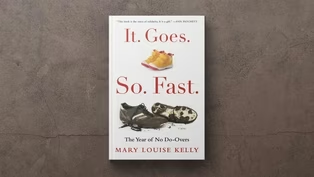
NPR host describes balancing career and family in new book
Video has Closed Captions
NPR's Mary Louise Kelly describes how she balances her career and family in new book (8m 16s)

Sen. Feinstein faces more calls to resign over absence
Video has Closed Captions
Sen. Feinstein faces more calls to resign over absence from Capitol Hill (4m 54s)

U.S. designates tranquilizer xylazine as 'emerging threat'
Video has Closed Captions
Why the U.S. designated the animal tranquilizer xylazine an 'emerging threat' (4m 54s)
Providing Support for PBS.org
Learn Moreabout PBS online sponsorship
- News and Public Affairs

FRONTLINE is investigative journalism that questions, explains and changes our world.

- News and Public Affairs

Today's top journalists discuss Washington's current political events and public affairs.












Support for PBS provided by:
Major corporate funding for the PBS News Hour is provided by BDO, BNSF, Consumer Cellular, American Cruise Lines, and Raymond James. Funding for the PBS NewsHour Weekend is provided by...