
April 18, 2024 - PBS NewsHour full episode
4/18/2024 | 57m 46sVideo has Closed Captions
April 18, 2024 - PBS NewsHour full episode
Thursday on the NewsHour, after some setbacks, the jury in the Donald Trump hush money trial is filled. The U.S. and Britain target Iran with new sanctions as the world waits for Israel's response to the weekend drone attack. Plus, scientists sound the alarm as warming waters trigger massive bleaching of the world's coral reefs.
Problems playing video? | Closed Captioning Feedback
Problems playing video? | Closed Captioning Feedback
Major corporate funding for the PBS News Hour is provided by BDO, BNSF, Consumer Cellular, American Cruise Lines, and Raymond James. Funding for the PBS NewsHour Weekend is provided by...
April 18, 2024 - PBS NewsHour full episode
4/18/2024 | 57m 46sVideo has Closed Captions
Thursday on the NewsHour, after some setbacks, the jury in the Donald Trump hush money trial is filled. The U.S. and Britain target Iran with new sanctions as the world waits for Israel's response to the weekend drone attack. Plus, scientists sound the alarm as warming waters trigger massive bleaching of the world's coral reefs.
Problems playing video? | Closed Captioning Feedback
How to Watch PBS News Hour
PBS News Hour is available to stream on pbs.org and the free PBS App, available on iPhone, Apple TV, Android TV, Android smartphones, Amazon Fire TV, Amazon Fire Tablet, Roku, Samsung Smart TV, and Vizio.
Providing Support for PBS.org
Learn Moreabout PBS online sponsorshipWILLIAM BRANGHAM: Good evening.
I'm William# Brangham.
Geoff Bennett and Amna Nawaz are away.
On the "NewsHour" tonight: After some setbacks,# the jury in the Trump hush money trial is filled.
The U.S. and Britain target# Iran with new sanctions,## as the world waits for Israel's# response to Iran's weekend attack.
And scientists sound the alarm# as warming ocean waters trigger## massive bleaching of the world's coral reefs.
(BREAK) WILLIAM BRANGHAM:#Welcome to the "NewsHour."
A full jury has been seated in former President# Trump's criminal trial.
.. had a rocky start, as two previously selected# jurors were dismissed.
And prosecutors again## accused the former president of violating a gag# order and asked the judge to hold him in contempt.
I'm joined now by former# federal prosecutor Jessica Roth.
Jessica, great to have you back on the# program.
A bit of a whiplash with this## jury.
It was up and then it was down# and now there was a full jury seated.
Two issues came up with regards to these jurors# being dismissed.
One, a juror was worried that## her identity was being revealed in the process.
A# second was concern over whether another juror was## somehow hiding his or her true intentions# about why they wanted to sit on the jury.
Are those just normal concerns,# especially in a case like this?
JESSICA ROTH, Former Federal Prosecutor:## Well, they raised two distinct# concerns, these two jurors.
The first juror who said that she was# concerned essentially about her privacy## and I think implicitly her safety because# she thought that her identity essentially## was being found out, that's particular# to this case.
You usually don't see## those kinds of juror concerns about# their safety and privacy in a case,## for example, involving falsification of business# records, which is, of course, the charge here.
You might see that in an organized# crime case or a terrorism case.
But,## of course, this is an unusual case that's,## at its heart, a white-collar case involving# the former president of the United States,## but who is -- has engaged in a pattern of conduct# and speech online, in particular, that really has## caused threats to people who are involved in# legal proceedings that are associated with him.
And so it's highly unusual that you would# have a juror in a case like this expressing## those kinds of concerns.
And it's unique to# the circumstances presented by Donald Trump## and his followers.
So that particular instance# with the juror was of grave concern to me,## because I'm concerned not only about that juror,# but about other jurors who similarly may develop## concerns about their safety and privacy and those# of their families as this case goes forward.
The second juror presented a different# kind of issue.
And that was somebody who## appeared possibly to be trying to get# onto the jury potentially because of## some bias that this person harbored,# so a sort of motivated, biased juror## who would have been potentially lying about# their own past, failing to disclose something## that might have caused the lawyers to strike that# juror for cause or using a peremptory challenge.
And the worry with somebody like# that is less about whatever it is## they're concealing and more the# fact that they're concealing it,## because that suggests they might# not be a fair and impartial juror.
WILLIAM BRANGHAM: I see.
Prosecutors, as I mentioned, have also asked# Justice Merc.. court, arguing that he has repeatedly violated# the gag order that the judge placed on him,## which bars him from attacking witnesses,# jurors, the judge, other members of his family.
Merchan said he's going to have a hearing# about this next week.
Do you think that## this has gotten to the point, with# the former president's behavior,## that the judge does need to issue# some kind of censure or worse?
JESSICA ROTH: I think the judge absolutely has to## take some firm action here# that involves a sanction.
The question is, what will the sanction be?
As of# the last time the district attorney's office had## filed a motion in this regard and briefed it,# they were asking for monetary sanctions and a## reprimand and a stern warning that future# conduct would lead to even more severe## sanctions.
They had asked for $1,000 fine per# instance in which Mr. Trump violated the order.
But that was when I think there were only# three instances that they were pointing to,## and those involved witnesses in the case.# Now what we have are instances of Mr. Trump## allegedly violating the gag order, and I think# that the record's pretty clear that he did,## with respect to jurors, who# also were listed on that order,## prohibiting from making comments outside# of the courtroom about those people.
And so I think a lot is going to turn on how# the judge handles this next week, not only## for these particular instances of misconduct# and violations of the order, but it's going to## set the tone for the rest of the case, in terms# of how strict he's going to run this courtroom.
WILLIAM BRANGHAM: Jessica Roth, always# good to hear from you.
Thank you so much.
JESSICA ROTH: My pleasure.
WILLIAM BRANGHAM: In the day's other headlines:# Police in New York City have arrested several## pro-Palestinian protesters who had set# up an encampment at Columbia University.
This comes a day after the school's president# addressed a congressional hearing on antisemitism.## Minouche Shafik said students participating# in the protest would be suspended.
That## included the daughter of U.S. Congresswoman# Ilhan Omar.
Police made several arrests and## removed the tents put up by protesters.
They did# not say what charges the protesters would face.
President Biden picked up endorsements from# members of the famed Kennedy family today.## It was a rebuke against Robert F. Kennedy Jr.,# who is running as an independent.
Members of the## prominent Democratic family appeared with the# president at a campaign event in Philadelphia.
Kerry Kennedy, who is the# daughter of the late RFK,## said President Biden shares many# of the same values as her father.
KERRY KENNEDY, Daughter of Robert F.# Kennedy: Daddy stood for equal justice,## for human rights, and freedom from want and# fear, just as President Biden does today.
(CHEERING AND APPLAUSE) KERRY KENNEDY: Donald Trump mocks these# values, just as he mocks our system of laws.
WILLIAM BRANGHAM: Kennedy did# not mention her brother, RFK Jr.,## by name, but she did allude to# him, saying -- quote -- "There## are only two candidates with any# chance of winning the presidency."
There were dramatic scenes on Capitol Hill today,## as House Speaker Mike Johnson scrambles to# get the votes for his proposed foreign aid## bills.
Johnson has doubled down on separate# funding measures for Israel, Ukraine, and the## Indo-Pacific.
Hard-liners within his own party# are angry over further aid to Ukraine, and there## have been growing calls for Johnson's removal.# Votes on the bills are expected this Saturday.
In Germany, authorities have arrested two# German-Russian nationals for allegedly spying## on behalf of Russia.
One allegedly agreed to# carry out attacks on U.S. military facilities## in a bid to undermine support for Ukraine.# A court ordered they remain in custody while## prosecutors seek indictments.
Germany's# top official vowed to stand with Ukraine.
NANCY FAESER, German Interior# Minister (through translator):## Since Russia's murderous war of aggression# against Ukraine, our security authorities## have ramped up all protective measures against# this threat from the Russian regime.
We will## continue to provide Ukraine with massive# support and will not be intimidated.
WILLIAM BRANGHAM: Germany is# one of the biggest suppliers## of weapons to Ukraine, second only to the U.S. Back in this country, Maine's state# legislature has approved sweeping new## gun reforms.
They come nearly six months# after the state's deadliest mass shooting,## where 18 people were murdered in Lewiston.# The legislation mandates background checks## for private gun sales, requires# waiting periods for gun purchases.## It also criminalizes the sale of guns to# people who are barred from having them.
The mass outage of 911 emergency# services across several states## last night has been blamed on a# light pole being installed.
The## company that provides the service# said a fiber line had been cut.
Emergency lines were down in South# Dakota, Nebraska, Nevada, and Texas,## though the outage in Texas was# unrelated to the cut fiber line.## All call entries -- all call centers were# up and running again within a few hours.
On Wall Street, a lackluster day of# trading with markets ending mixed.## The Dow Jones industrial average# gained 22 points to close at 37775.## The Nasdaq fell 81 points.
The S&P 500# closed lower for a fifth straight day.
Reuters photographer Mohammed Salem has# won the World Press Photo of the year.
His## image shows Gaza resident Inas Abu Maamar# cradling the body of her 5-year-old niece,## Saly.
The young girl was killed alongside# her mother and sister when an Israeli missile## struck their home last October.
Salem won# the same award more than a decade ago.
And legendary guitarist and singer Dickey Betts# has died.
Betts, there on the left, was a founding## member of the Allman Brothers band.
He wrote# some of their biggest hits and helped pioneer## the Southern rock sound.
Here he is in 1981# performing his best-known song, "Ramblin' Man."
(MUSIC) WILLIAM BRANGHAM: Betts died# at his home in Florida after## battling cancer.
He was 80 years old.
Still to come on the "NewsHour": a new# report looks at the high turnover of## election officials; philanthropist Melinda# French Gates discusses increasing economic## empowerment for women across the globe; after# the end of Ethiopia's brutal civil war, famine,## starvation and an uneasy peace; and why more# employers are exploring a four-day workweek.
Today, the U.S. imposed new sanctions on# Iran in response to Tehran's unprecedented## attack last weekend on Israel.
The# U.S. is also vetoing an attempt in## the U.N. Security Council to create# an independent Palestinian state,## all this as Israel continues to debate# how and when to respond to Iran's attack.
Nick Schifrin looks at the U.S.' attempt# to prevent even more regional escalation.
NICK SCHIFRIN: William, this afternoon, President# Biden and Prime Minister Benjamin Netanyahu's top## national security aides talked about Israel's# potential response to the Iranian attack.
U.S. officials have made it clear they think# Israel should not respond militarily and are## trying to increase economic and diplomatic# pressure on Iran to help make their case.
For the lay of the land in the U.S.# and the region, we get two views.
Ambassador Dennis Ross played leading# roles in the Middle East peace process## for more than 12 years.
He is now the# counselor and a distinguished fellow at## the Washington Institute for Near East Policy,# a Washington think tank.
And Khaled Elgindy has## participated in past Israeli-Palestinian# negotiations and is now the director of## the Middle East Institute's Program on# Palestine and Israeli-Palestinian Affairs.
Thanks very much.
Welcome,# both of you, to the "NewsHour."
Ambassador Ross, let me start with# you, and let's start in New York.
The U.S. is vetoing a resolution that would# have allowed the state of Palestine to join## the U.N. as a full member.
U.S. allies# and fellow permanent member the United## Kingdom is abstaining and France is voting in# favor.
What's your response to those votes?
DENNIS ROSS, Former U.S.
Envoy to Middle# East: Well, I'm not surprised that## the Biden administration is going to veto it.
I think they look at this# as not just a symbolic move,## but at this point the Palestinians don't look# like a state.
And so I don't think they're## prepared to recognize it as such in a U.N.# context.
I also think they see this as not## necessarily connected to the diplomacy that# they're engaged in right now with the Saudis.
They clearly still have an interest in trying to# reach a Saudi-Israeli normalization deal.
I think## they're negotiating exactly what that might mean,# not only in terms of bilateral U.S.-Saudi issues,## in terms of defense treaty, the Saudi# development of a nuclear industry.
But I## think they're also talking about what would the# Palestinian component of this understanding be?
What would the Israelis have to do in# terms of recognizing some kind of move or## commitment towards Palestinian statehood?# I think, while they're negotiating that,## they're not interested in having a# symbolic move at the Security Council.
NICK SCHIFRIN: Khaled Elgindy, what's your# response to the U.S. vote in New York?
KHALED ELGINDY, Middle East Institute: The# U.S. vote is not at all unexpected.
I mean,## we expected that the United States would# veto this resolution.
They have said it.## They have said all along that the# only possible way for a Palestinian## state to emerge is through direct# bilateral negotiations, which means## essentially that Israel has a permanent# veto over Palestinian self-determination.
And so this is an attempt by Palestinians# maybe to do an end run around that principle.## But I think even they understood that this# was not going to pass.
I think President## Abbas has pursued this for his own reasons.# I think he's looking more and more obsolete,## given the destruction in Gaza.# He's unable to influence either the## military or the diplomatic equation and# is looking for some way to be relevant.
NICK SCHIFRIN: Dennis Ross,# as I mentioned, some of this## effort by the U.S. to try and tamp down# escalation in the region is economic.
New sanctions announced on Iran# today, on Iran's drone program,## Iran's defense industrial base, including steel# production, the first time that those sanctions## have been imposed in about three years.# Do those kinds of actions help convince## the Israeli government not to respond to# Iran's attack with another military attack?
DENNIS ROSS: Look, I think it probably helps.
But I'm not sure it's enough.
I think the# Israelis would probably be more impresse.. we were closing some of the loopholes on sanctions# as it relates to Iran being able to sell its oil;## 91 percent of their oil sales are going# to the Chinese.
If we were doing more## to basically prevent those sales, convincing the# Chinese either not to go ahead or being prepared## to sanction Chinese companies, that would# probably be more impressive to the Israelis.
NICK SCHIFRIN: Khaled Elgindy, do# you believe that President Biden is## doing enough to try and influence Israeli# behavior, whether toward Iran or in Gaza?
KHALED ELGINDY: Well, I agree with Ambassador# Ross that it's probably not enough to convince## the Israelis not to go off on their# own or to pursue a military response.
And I think they're going to leverage# that.
I think they're going to try and## extract more from the United States,# quite possibly up to and including## the oil sanctions that Ambassador# Ross mentioned.
I mean, that would## be definitely a game changer as far as Israel's# decision-making.
But we're not quite there yet.
NICK SCHIFRIN: Ambassador Ross, there are# some Democrats who are wanting President## Biden to use more leverage on Bibi Netanyahu# when it comes to Gaza especially and condition## military aid until Israel takes certain# steps when it comes to the war on Gaza.
Do you believe the U.S.# should condition military aid?
DENNIS ROSS: No, I have not been in# favor of conditioning military aid,## especially right after Israel has just been# targeted with more than 350 cruise missiles,## drones, and ballistic missiles.
I think that# would be the wrong signal to send right now,## especially vis-a-vis the Iranians and many# of their proxies, including Hezbollah.
NICK SCHIFRIN: Khaled Elgindy, do you believe that# the U.S. can exert pressure on Israel, especially## when it comes to Gaza and how Israel wages that# war, separate from how Israel responds to Iran?
KHALED ELGINDY: Yes, absolutely.# There's no question that the lack## of consequences is precisely why we have this# humanitarian catastrophe unfolding in Gaza,## where we're now at the fastest any population has# reached the stage of famine in recorded history.
So there's a lot that the United States could# do.
It should.
It can and should condition## military assistance.
At a very minimum,# it could hold up the offensive weapons,## the massive 2,000-pound bombs that do# what President Biden called indiscriminate## damage in Gaza and that have caused# so much civilian death and suffering.
So, I think there are ways to condition# aid that don't necessarily affect Israel's## ability to mount a defense against# an Iranian threat, but that would## inhibit its ability to continue to cause# this mass death and destruction in Gaza.
NICK SCHIFRIN: Khaled Elgindy, Dennis# Ross, thanks very much to you both.
DENNIS ROSS: Sure.
Good to be with you.
KHALED ELGINDY: Thank you.
WILLIAM BRANGHAM:## The temperatures of the world's oceans are quite# literally off the charts.
That orange line,## that is last year's reading.
The red line at the# very top, that's this year's temperature readings.
One of the most severe consequences of these# warming falls on the world's coral reefs,## which nearly a quarter of all ocean# species rely on.
According to NOAA,## the National Oceanic and Atmospheric# Administration, scientists issued a## warning due to record-breaking temperatures# in 2023 which accelerated the speed of the## second largest mass bleaching event across# the Atlantic, Pacific and Indian Oceans.
For more on the global situation and what's# at stake, we are joined by Julia Baum.
She's a## marine ecologist and coral reefs researcher and a# professor at the University of Victoria in Canada.
Julia Baum, thank you so much for being here.
So NOAA just issued this report# showing this widespread bleaching,## which is a sign of distress in corals.
We have# seen reports over the years of declining health## in corals.
So how do you put what's happening# now in the context of what we have seen before?
JULIA BAUM, Marine Ecologist, University of# Victoria: What we're seeing now is the fourth## global coral bleaching event, as you said,# and it's alarming and likely catast.. And what's particularly alarming about it is that,# in the past, these bleaching events occurred a## sufficient amount of time apart that coral reefs# had a sufficient time to recover in between## them.
But now we're seeing these global coral# bleaching events occur two within the past decade.
So there was a mega event during the 2015-2016 El# Nino that devastated coral reefs right around the## world, including mass bleaching and mortality# on the Great Barrier Reef and in many, many## other locations.
And coral reefs take many years# to recover, so 10, 20, 30, 40 years to recover.
So now to see another bleaching# event that is very, very intense## and widespread happening just eight# years later is extremely worrying.
WILLIAM BRANGHAM: So I mentioned briefly corals# importance in the ocean ecosystem.
I mean,## we love them because they're not just# what we see in Jacques Cousteau and## David Attenborough documentaries.
They are# that, but they are also many other things.
Can you sort of explain,# remind us of their importance?
JULIA BAUM: Absolutely.
So I'm a marine ecologist, so, of course, I think# about all of.. reefs.
And you already mentioned that a quarter# of the world's diversity, different species of## animals in the ocean live on coral reefs, which# is completely astounding when you think about## the fact that coral reefs cover less than 0.1# percent of the surface area of the world's oceans.
But coral reefs are also extraordinarily# important to people, so they are worth## hundreds of billions of dollars every year.
And# that's through things like tourism, recreation,## all of the coastal protection that they provide.# So when we risk losing a huge proportion of the## world's coral reefs, we're actually at risk# of losing all sorts of other things that are## vitally important to many, many people around# the planet, especially those who live really## close to coral reefs and rely upon them for# either their sustenance or their livelihoods.
WILLIAM BRANGHAM: When you look at# the drivers of this warming ocean,## climate change, El Nino,# perhaps some other factors,## what does your research indicate# is most complicit in this problem?
JULIA BAUM: Right.
Well, it's climate change.
So this is# without a doubt driven by human-caused## climate change.
And so I want to link El Nino# to that.
Under climate change, El Ninos are## now supercharged.
And that means that they# are occurring more frequently.
They are at## a greater intensity.
So the magnitude of the# heat stress that they unleash is a lot bigger,## and they also can last for a much longer period.
So, in the past, for example, you might have# had some heat stress on an individual coral## reef lasting for a couple of weeks.
Now we# see that type of heat stress lasting for many,## many months, and that causes the corals# to bleach and then eventually die.
So## they're becoming much more serious, and# that's a direct result of climate change.
WILLIAM BRANGHAM: We have seen over the# past year all of these efforts to try to## preserve the corals, pull them out of warmer# oceans and store them in cooler tanks on land,## sometimes cryopreserve these corals.
What do you make of those efforts?
And do you## think overall they are going to# be enough to save this ecosystem?
JULIA BAUM: I think it's a tragedy# that we are pushing to -- coral reefs## and coral reef researchers to that# absolute extreme.
That's a triage## type of response.
And it's a last-ditch response.
Maybe it will make a little bit of a difference# in some areas where it's being implemented,## but it's not a solution that is going to# save the world's coral reefs.
And it's## undoubtedly the only thing that is going to# save the world's coral reefs at this point## is a rapid reduction in greenhouse gas# emissions.
That is absolutely certain.
Anything else that we do might help# a few areas here and there.
And,## of course, that will be important in those# areas where it helps.
But if we are going## to ensure that the world's coral reefs are# still in existence in the coming decades,## we have to rapidly mitigate climate# change.
There's no other way forward here.
WILLIAM BRANGHAM: All right, Julia Baum# of the University of Victoria in Canada,## thank you so much for talking with us.
JULIA BAUM: Thank you.
WILLIAM BRANGHAM:## A new report reveals a historic amount of# turnover within local elections offices,## but also the resiliency of that work force.
Stephanie Sy takes a closer look.
STEPHANIE SY: The new report from the Bipartisan# Policy Center, in collaboration with researchers## at UCLA, acknowledges what we have been hearing# from election workers since 2020, when Trump## supporters were accused of intimidating# and threatening these civil servants.
But while many election# workers have left the field,## the report finds that there are glimmers of hope.
Miles Parks covers voting and election# security for NPR and joins us now to help## us unpack what this new data may teach us# about what's to come in this election year.
So Miles Parks, the report states that# turnover is not new and that, for decades,## local election offices have dealt with# this.
Why is that context so important?
MILES PARKS, NPR: Well, it kind of gives a good# news and a bad news, I feel like, Stephanie.
I feel like, on the good news, it -- there's# been all of this hyperbole over the last## couple of years as this started to come out# that election officials were leaving their job,## kind of people freaking out about the state# of the 2024 election.
The fact that this## isn't as new indicates to some experts that# maybe the election administration profession## is a little bit more prepared than --# for 2024 than maybe previously thought.
The bad news is that the fact that# turnover has been ticking up over## the last 20 years indicates that# there are some chronic issues with## the profession outside of the threats and# harassment we have heard so much about,## things like election officials saying that# they are not getting enough resources.
And the other thing I hear a lot from election# officials is that their jobs have just gotten## a lot harder over the last decade.
We know# that laws are changing rapidly.
That can have## an impact on how hard an election official's# job is.
And then election officials have to do## things like become cybersecurity experts, become# physical security experts now, in addition to## just making sure people can get their ballots and# making sure those ballots are counted correctly.
STEPHANIE SY: And some of those# election workers would say that,## after the 2020 election in particular,# things got even harder for them.
You have been covering the election landscape,# Miles, since 2016, including threats to election## workers.
I just want to remind viewers of# what some of them have been going through.## We spoke to election officials from both sides# of the aisle in North Carolina and Pennsylvania.
AL SCHMIDT, Pennsylvania Secretary of the# Commonwealth: In the past, candidates ran## against other candidates and campaigns ran against# other campaigns.
And in the .. the people responsible for running elections# have been targeted as enemies, when, in reality,## they are simply trying to make sure# that their voters' votes get counted.
KAREN BRINSON BELL, Executive Director, North# Carolina State Board of Directors: These are not## high-paying jobs for a lot of folk.. for serving the public, for carrying out our# elections process.
They do so with integrity.
And yet we're at a time when their# integrity is being questioned,## both personally and professionally, quite often.
STEPHANIE SY: And we have heard# of similar frustrations, Miles,## among election workers here in Maricopa# County, Arizona, where I'm based.
Did this report show turnover has# been worse in battleground states?
MILES PARKS: It did.
And this was one o.. researchers looked at, turnover kind of impacted# jurisdictions, no matter their political leaning,## no matter their geography.
And then, in 2020,# what they found specifically, that turnover jumped## the most in states that were competitive in the# presidential election, which aligns with what we## have heard from law enforcement about where there# has been an uptick in threats and harassment.
And I will also note, even when I talked# to election administrators who are in these## battleground states, even if they personally have# not received the threats, they talk about how## much more pressure is on them to do their jobs# completely perfectly every single day because## there's just this general sense, this cloud# that they could be next in terms of targeting.
STEPHANIE SY: You know, one# of the positives, however,## that came out of this report is that# the data suggests, even though there's## been more turnover, more experienced# election workers are filling the jobs.
Is that across the board, or do you# see more of a struggle to retain those## experienced election officials# in hotly contested districts?
MILES PARKS: So, what we're actually seeing is# kind of the inverse,is that, across the board,## on average, the people replacing the who are# -- who have left, according to this new report,## on average have about eight years of# experience in the administration field.
But when you look at these larger jurisdictions,## which generally since 2020 have been the# places, the Detroits, the Philadelphias,## the Maricopa counties, highly populated# areas, on average the election officials who## are replacing the people who've left there have# 11 years of election administration experience,## which is really surprising, I think,# to the researchers I talked to.
They found it oddly comforting, that maybe# it's not all doom and gloom ahead of 2024.
STEPHANIE SY: So maybe things aren't as bad# as post-2020 election headlines suggest.
Miles, I want to ask you about something# else.
You also recently have reported that,## despite concerns about voting access that# came after the 2020 election, that new data## shows it has actually gotten easier to vote since# 2000.
Tell me a little bit about that reporting.
MILES PARKS: Yes, this was a really# interesting report that came out## recently from the Center for Election# Innovation and Research that basically## looked at, do people have more than just# Election Day to be able to cast a vote?
And what they found is that in 46 states and D.C.,# voters have the -- have some sort of option to## vote early, which is a really big sea change# when you think about two decades ago.
In 2000,## 86 percent of voters cast a ballot# on Election Day, whereas, in 2024,## 97 percent of voters live in a place that# they have the opportunity to vote early.
And so when you just think about the most basic# aspect of voting, filling it out, turning it in,## that -- voters have more options to# do that now than almost ever before.
STEPHANIE SY: As you said,# it's not all doom and gloom.
Miles Parks with NPR.
Thanks so much, Miles.
MILES PARKS: Thanks, Stephanie.
WILLIAM BRANGHAM:#Consider this.
In at least 93 countries,## it's legally acceptable to pay women less# for doing the exact same job as a man.
That's just one of a litany of# examples where women's economic## equality is denied.
And these inequities# impact not just women, but their children,## their families and their broader communities.# The U.N. estimates that closing the gender gap,## not just in pay, but in other ways, such as# giving them more access to loans and capital,## could give the global economy# a $7 trillion jump-start.
These issues are atop of mind for many this# week as world leaders gather in Washington,## D.C., for meetings hosted by the World# Bank and the International Monetary Fund.
One person advocating for a more just economy# is Melinda French Gates.
She's the co-chair of## the Bill and Melinda Gates Foundation,# which is a funder of the "NewsHour."
Melinda Gates, welcome back to the# "NewsHour."
So nice to have you here.
MELINDA FRENCH GATES, Co-Founder, Bill and Melinda# Gates Foundation: Thanks for having me, William.
WILLIAM BRANGHAM: So I mentioned this# one fact about the -.. to pay women less than men, but, again,# that's just one example of so many.
When you are here trying to convince people## about this inequity existing and# causing harms, what do you argue?
MELINDA FRENCH GATES: I'm arguing for, let's fix# the system.
And to be honest, it's not that hard.
If you look at high-income countries,## we don't have it all right yet, but women are# doing better in our country than in many others.
WILLIAM BRANGHAM: Right.
We're not immune to this.
MELINDA FRENCH GATES: We're not immu.. it was 19 -- early 1970s that a woman finally## didn't need her husband to sign on# her bank account in our country.
So if we get the regulations right in# other countries and we move capital,## this large-scale capital that goes from# the World Bank or the IMF, but we really## hook it up to the women entrepreneurs,# there are literally millions of female## entrepreneurs across the continent of Africa,# and we make sure the loans are right-sized,## the interest rate is paid monthly, not# weekly, it isn't at an exorbitant fee,## these women will actually grow not just# their business, but their entire economy.
WILLIAM BRANGHAM: And those disparities that# you're describing, those are what exist today?
MELINDA FRENCH GATES: Yes, they still exist# in many countries.
A woman can't get a loan## without her husband signing off on it.
So we need# to fix those laws, but we also need to fix credit.
Right now, a woman often doesn't have a credit# score in Africa.
She doesn't have the collateral## to prove she's creditworthy.
And yet, if# we can get her on a mobile bank account,## which many women are getting on to, we can# start to see that she's paying bills.
She's## actually financially very literate and that she# can build credit and we can help her then get a## small loan to not only educate her kids,# but advance the business she cares about.
WILLIAM BRANGHAM: So you're here talking# to the World Bank and the IMF and the## heads of these very large# international banking structures.
When you make this argument to them,# are they nodding along with you?
Are## they looking skeptical at you?
Do they# appreciate what you're talking about?
MELINDA FRENCH GATES: I would say it's only# been in about the last eight years that the## world and these large financial institutions have# woken up to the opportunity that women present.
If I look back 15 years, when I used to# come to these institutions or to the U.N.,## we didn't really talk about women.# But now people realize -- like,## take the United States.
Women have the most# purchasing power of anybody in our own country.
WILLIAM BRANGHAM: Right.
MELINDA FRENCH GATES: And .. their whole organization moving in that direction.
WILLIAM BRANGHAM: How do you explain that chasm,# the disparity that exists?
Again, we understand## some of the societal forces that work here that# we have been fighting against for generations.
How do you explain that around the world?
MELINDA FRENCH GATES: Well, it's# much the same.
It's the social norms.
For better or for worse, we set the world up for# males.
And what's happening now is that females,## when you send them out into the work force# or to capitalize their small business,## they run up against these systemic barriers.# So, a man doesn't understand their business## if he's the one that's going to extend the# credit or he's going to give the loan, right?
They don't see the business.
They don't# understand it.
They often have bias,## thinking, oh, a woman can't run a business.# So we have to break down those barriers so## that we show and we demonstrate that women can# create society the way we want it and that we## can as investors get a good return.
And then I# think you will see vast amounts of money flow.
WILLIAM BRANGHAM: It's a good investment,## a good return on investment that always see.. MELINDA FRENCH GATES: That's# right.
And it should be,## right?
We expect in our investments to have a# return, but sometimes also in.. For instance, these large global# institutions we're talking about,## you have to both do some grant funding and# the loan piece, because we know -- India is## a perfect example.
They put their women -- many# women in these self-help groups, and now they are## lending to 42 million women-led businesses because# they're seeing it's advancing the Indian economy.
But there had to be grant-making at the# beginning to get women organized and have## the mentorship and the sponsorship to then# be able to know how to start their business.
WILLIAM BRANGHAM: I imagine there's also this# suite of other complicating factors too, war,## conflict, political unrest,# climate change, that, again,## we know disproportionately falls hardest on# women and that you also have to be trying to## ameliorate those things to create the# conditions by which women can thrive.
MELINDA FRENCH GATES: Absolutely.
And it's particularly difficult at the meetings#.. climate change.
Conflict is rife.
But what# we're trying to get the high-income countries## to understand is, you have to also continue these# investments in Africa and across the continent## of Africa and Southeast Asia, because countries# want to move from low to middle to high income.
And we know it's possible.
Peru has done# it.
India has done it.
South Korea used## to be a recipient of aid.
Now they give aid.# And so, if we keep making these investments,## you will see peace and prosperity in# those places, as opposed to more conflict.
WILLIAM BRANGHAM: You touched on this before,## but I know you're here trying to cajole bankers# and the World Bank and the I..
Some of this, as you mentioned,# is also pushing back on societal,## cultural, oftentimes religious beliefs about# the role that women should and ought to play## in societies.
That seems like that's# a much tougher stream to swim against.
MELINDA FRENCH GATES: Those issues are tough to# swim against, even in our own country, right?
We're seeing the rollback of women's rights and# health.
And so, when I look at those issues,## I say we need to get more women,# for instance, in our country,## in the 7,000 seats in the statehouses# and in Congress and in the Senate,## because women have a different lens on# society and they will make different policy.
In countries around the world, much is# the same thing.
Some -- they're trying## to get more women into their parliaments# because they create different policies.## They see what is often unseen.
They see# the unpaid work women do.
They see the## caregiving burden of they need to care# for the children and run the business.
And so I think getting women into all those# seats of power really will change society.
WILLIAM BRANGHAM: Are there examples that you# point to, if someone expresses skepticism about## moving this rock up this huge hill, that# you say, look at X, this proof of concept?
MELINDA FRENCH GATES: Well, at large scale,# I say, look at India.
India really has gotten## their mobile phone penetration out there.# They have gotten people I.D.ed on their## phone.
People have bank accounts.
It's# not just men, but they have looked at## the gender gap and they're trying to get# more women with their own bank account.
They're now scaling and getting resources out## to women.
And they're starting to see# they're on the economic rise in a huge## way.
So I point to them as a large-scale# example of how and where this can work.
WILLIAM BRANGHAM: Melinda French Gates, thank# you so much for being here.
Great to see you.
MELINDA FRENCH GATES: Thanks for having me.
WILLIAM BRANGHAM: Ethiopia continues to face#one of the worst droughts in recent history, and millions of its people are# suffering from acute hunger.
Back in December, the United States resumed# aid shipments after previously suspending## them due to concerns about theft,# but starvation is still prevalent.
Special correspondent Jack Hewson reports# from the Tigray region in Northern Ethiopia.
JACK HEWSON: These might be the last days of# Gebremichael life.
After months of little or## no food, he's starving, his stomach swollen# from water retention that results from protein## deficiency, skin stretched taught across# his upper body, his heartbeat visible.
GEBREMICHAEL TESFEY, Farmer (through# translator): I have a hard time## breathing.
It gets worse each day.# I'm al..
I can't go to the toilet because# everything I eat, I vomit out.
JACK HEWSON: Gebremichael# is so acutely malnourished## that his body is rejecting food.
His wife, Gember,## grinds a few grains outside their home in the# Yechila district of Northern Tigray province.
This is all they have.
After the rains failed to# fall in August, the crops failed too.
As climate## change bites, Ethiopia's drought is the worst many# here have ever experienced.
People here are just## trying to forage the last grains and berries# that they can get from this arid landscape.
Food aid is beginning to arrive, but,# for some, it may be too late.
Millions## face acute food insecurity in the region.# Approximately 400 have reportedly died of## starvation in Tigray and Amhara.
Gebremichael is# dangerously close to becoming the next fatality.
GEBREMICHAEL TESFEY (through# translator): There's nothing## we can do about the .. JACK HEWSON: The legacy of conflict,# visible across the region, is also## making the situation worse.
The civil war# that ended in November 2022 displaced 2.5## million.
These people here in Yechila have fled# ethnic persecution in contested Western Tigray.
Among them was Dessalegn# Abadi Tafere and his family.
DESSALEGN ABADI TAFERE, Ethiopia (through# translator): I have so many problems.
I## lost my house,.
I lost everything.
I have# to beg.
I ask people to help me for the## sake of my babies.
I ask people to support# me until we get through this hard time.
I used to go to local people before.# But now I can't even go to them,## because they are also suffering themselves.
JACK HEWSON: Despite this widespread# suffering, in January, Ethiopian Prime## Minister Abiy Ahmed was awarded the U.N.# Food and Agriculture Organization's highest## award for his contribution to rural and economic# development, this for a leader accused of using## starvation as a weapon of war as government# forces laid siege to Tigray two years prior.
ABIY AHMED, Ethiopian Prime Minister (through# translator): I am deeply honored and grateful## for the U.N. Food and Agriculture# Organization for recognizing Ethiopia's## diligent efforts over the past five years# in addressing food and nutrition security.
I would like to emphasize my government's# commitment to meeting zero hunger goals.
JACK HEWSON: Zero hunger?
That's the rhetoric.# But, in Tigray, the reality looks very different.## Baby Leul was brought to Ayder Hospital in# Mekelle by his mother, Alem Degefu Birhan, after## she was unable to produce breast milk# and he became dangerously underweight.
ALEM DEGEFU BIRHAN, Mother (through# translator): When I was pregnant,## there were food shortages.
When# I got cl..
I had so many problems.
My breasts# ran out of milk because I had no food.
JACK HEWSON: Further down the ward are other# children that have developed hydrocephalus,## the swelling of the brain with spinal fluid,## a condition that can be caused by# malnutrition in pregnant mothers.
If nothing is done, Tigray could slide into# famine.
But using what's termed the F-word is## sensitive for the government and aid agencies# alike.
The memory of 1984 haunts Ethiopia,## when pictures of the devastating famine shocked# the world.
Forty years later, the death rates and## numbers suffering severe acute malnutrition do not# now meet the U.N.'s technical famine definition.
But for Reda Getachew, interim Tigrayan# president, he's not interested in semantics.
GETACHEW REDA, Interim President, Tigray Region:# I see people dying because there is no food on## their plate.
No amount of technical obfuscation# is going to convince me that this is not hunger.
Whether the F-word should be avoided at this# point is overly academic, as far as I'm concerned.
JACK HEWSON: Tigray's hunger was exacerbated# by the World Food Program and USAID suspending## food deliveries last March.
The grain# was being systematically stolen and## sold on the black market, reportedly by# both the federal and Tigrayan military.
After changes to prevent theft,# WFP resumed shipments in August,## and USAID in December, but, according# to Mr. Getachew, it's not enough.
GETACHEW REDA: The response is not adequate# at all.
The resumption of food aid only covers## 20 percent of what used to be the humanitarian# need in Tigray.
I know the federal government## for quite some time has been dragging its feet# to come to terms with the reality on the ground.
JACK HEWSON: And the reality remains bleak.
Responding to "PBS NewsHour" in a written# statement, the Ethiopian government said## it was distributing $250 million in food# aid, and claimed that national wheat yields## had increased dramatically since 2021.
But# there's little sign of this supposedly bumper## crop in rural Tigray.
For millions facing# acute hunger, the words will ring hollow.
For the "PBS NewsHour," I'm Jack# Hewson in Northern Ethiopia.
WILLIAM BRANGHAM: Nearly one-third of large U.S.## firms are exploring new work# schedules for their employees.
Economics correspondent Paul Solman takes a look## at some companies that are trying out a# four-day, 32-hour week with the same pay.
PAUL SOLMAN: At Metro Caring in Denver,# the food pantry is crazy busy.
There## were 45,000 visits last year, not far off# the 47,000 at the start of the pandemic.
TEVA SIENICKI, CEO-Visionary, Metro Caring: I# came out of the pandemic just exhausted, frankly.
PAUL SOLMAN: CEO Teva Sienicki# felt overworked and overwhelmed.
TEVA SIENICKI: I worked far too many hours.# Hunger has been steadily growing.
I was really## feeling discouraged.
I just don't see us making# progress.
And so that landed really heavily on me.
PAUL SOLMAN: And on many of her co-workers.
TEVA SIENICKI: We were experiencing a# lot of burnout on staff, and feeling## like we were treading water around our mission.
PAUL SOLMAN: Cory Scrivner oversees# food procurement and distribution.
CORY SCRIVNER, Food Access Manager, Metro# Caring: We have had four different food## access managers in the last four# years.
It has 1000 percent been## a burnout factor with every single# one of the last three previous ones.
PAUL SOLMAN: In fact, Sienicki almost quit.
TEVA SIENICKI: Burnout among nonprofit# CEOs and nonprofit employees was higher## than any other industry.
Probably like four# out of 10 left the field.
I was nearly there.
PAUL SOLMAN: Instead, though,## she took a sabbatical .. TEVA SIENICKI: If you can have a more# balanced life and work fewer hours,## you actually bring more creativity to your job and## you bring more efficiency.
And those# hours that you do work mean more.
PAUL SOLMAN: Alex Pang has# written about working less,## runs research and innovation at# nonprofit four day week global.
ALEX SOOJUNG-KIM PANG, 4 Day Week Global:# If you're in an industry in which there## are serious challenges with recruitment# and retention, with work-life balance,## or if you have concerns about the# sustainability of your organization,## a four-day week is a great way to address# all of those challenges simultaneously.
PAUL SOLMAN: Hey, Bernie Sanders# thinks so.
He recently introduced## a Senate bill to reduce the# standard workweek to 32 hours.
SEN. BERNIE SANDERS (I-VT): The sad# reality is Americans now work more## hours than the people of any other wealthy nation.
PAUL SOLMAN: Now, look, a shorter# workweek is hardly a new idea.
In## 1930, given ever-increasing output per# person, increasing productivity that is,## economist John Maynard Keynes foresaw# a 15-hour workweek in 100 years.
In 1956, vice President Richard# Nixon predicted a four-day workweek## in the -- quote -- "not-too-distant# future."
That future is yet to arrive,## but thanks perhaps to COVID,# companies have begun to shift.
ALEX SOOJUNG-KIM PANG: The pandemic had forced a# lot of companies to change how they had worked,## and so they were more open to the# idea of playing around with work time.
PAUL SOLMAN: As were workers.
NICHOLAS BLOOM, Stanford University:# We all realize our own.. PAUL SOLMAN: Stanford's Nicholas Bloom.
NICHOLAS BLOOM: More than a million Americans# have died.
You should enjo.. here.
Work from home has been such a# bonanza.
So, I have taught hundreds,## thousands of managers, employees.
And they're# kind of like, why didn't we do this earlier?
And so as soon as you start thinking like# that, you think, well, what else is there?## And other things like the four-day week,# the whole bunch of changes come into play.
PAUL SOLMAN: Metro Caring's pilot began# in late summer.
The staff worked Monday## through Thursday, took Fridays# off, 32 hours of work, same pay.
TEVA SIENICKI: There's definitely# a learning curve, right?
Like,## it doesn't just like happen, like you're# just like, oh, I'm going to be efficient.
PAUL SOLMAN: To get their work# done in eight fewer hours,## employees turned off computer# alerts, reorganized their time.
TEVA SIENICKI: A lot of those have# been around meetings and e-mails,## not responding right away, but like# setting aside concentrated blocks,## and how to make meetings that are# normally an hour into 15 minutes.
PAUL SOLMAN: A shortened week# increases focus, says Graye Miller.
GRAYE MILLER (Food Access Assistant, Metro# Caring): If I have to be here Monday through## Friday, I am much more likely to# take that half-an-hour sitting and## drinking coffee or that 15 minutes# stepping outside for a cigarette.
PAUL SOLMAN: Integrity Pro Roofing# also tried a four-day week.
RAE BOYCE, CEO, Integrity Pro# Roofing: There are so many tangible,## tactical ways that you can give your team# back that additional eight hours of time.
PAUL SOLMAN: CEO Rae Boyce says her staff# focused on tasks and projects in the morning,## when they were more energized,# pushing meetings to the afternoon.
ALEX SOOJUNG-KIM PANG: The average knowledge# worker loses about two hours of productive time## per day to overly long meetings, to poorly# used technology or outmoded processes.
So,## in a sense, for a lot of us,# the four-day week is already## here.
We're just spending a full day in the# office sitting around in meetings wondering## who's going to change the toner cartridge# or talking about whatever football game.
PAUL SOLMAN: In surveys completed in# February at the end of Metro Caring's trial,## employees reported well-being had improved.# Pretrial, just 8 percent were highly or very## highly satisfied with their work-life balance.# At the end, that figure rose to 46 percent.
At the start of the pilot, 50 percent felt# burned out, by the end, half that number.
GRAYE MILLER: Having four days# and then a three-day weekend,## oh, my lord.
It is rejuvenating on all levels.
The results didn't surprise Pang.
His firm# helped run a 2022 trial of 61 British firms## that showed benefits to workers' health and# productivity when their hours were reduced.
ALEX SOOJUNG-KIM PANG: Mangers and companies also# reported that people were collaborating better,## that they were happier in the office.
All of the# important metrics trended in positive directions.
PAUL SOLMAN: Bloom has his doubts, though.
NICHOLAS BLOOM: Very productive,# well-managed American companies## that are already pretty kick ass in terms# of how well-managed they are, these places## are very efficient.
It's not that easy to# take a day out and produce the same amount.
PAUL SOLMAN: At Integrity Pro Roofing, a strictly# four-day workweek did not work year-round.
RAE BOYCE: Roofing and construction# tends to be very seasonal.
PAUL SOLMAN: So employees now work# fewer hours during the off-season, but: RAE BOYCE: The summer and the fall is# our busiest season.
And so we have found## that there are times where we do need to# ask our team to be flexible and to come## back to a five-day workweek when we're# experiencing that type of a high volume.
PAUL SOLMAN: Still, Boyce remains# committed to a shorter week for## her employees the rest of the year.
RAE BOYCE: Time is our most precious resource.# We have a really short life.
So if there's any## ways that we could give them some additional# time, that's really what we wanted to focus on.
PAUL SOLMAN: At Metro Caring, the four-day# workweek created some problems of its own.
CORY SCRIVNER: We rely on donations# and foundations and grant funding to## be able to exist in the way that we do.# And they don't have a four-day workweek.## They don't have a three-day weekend.# There are deadlines that are due on## Friday.
I often miss e-mails that# are important that come on Fridays.
We really do need to be available# for some of these bigger deadlines.
PAUL SOLMAN: As a result, CEO Sienicki# still has to put in hours on Fridays.
TEVA SIENICKI: I don't know that all of us# are two 32 hours yet.
I think some of us,## at least on some weeks, are at 35 hours.
But,## frankly, 35 hours is way better than the# 50 hours I was working prior to this trial.
PAUL SOLMAN: Metro Caring plans to# make the shorter workweek permanent,## even as they work out the details.
TEVA SIENICKI: It may not be exactly like# we have done the trial, right?
Maybe we## go to a 35-hour workweek, or maybe we# look at a little bit more flexibility.
PAUL SOLMAN: Different schedules, perhaps.
CORY SCRIVNER: Maybe it looks like one team# works a different set of days than another team.
PAUL SOLMAN: And that flexibility# may help with retention.
Cory Scrivner thinks she will last# longer than her three predecessors.
CORY SCRIVNER: I'm feeling# really good.
I'm not leaving.
(LAUGHTER) CORY SCRIVNER: I broke the curse.
PAUL SOLMAN: Scrivner bucked the burnout trend,# she says, thanks in part to the four-day workweek.
For the "PBS NewsHour," Paul Solman.
WILLIAM BRANGHAM: And that is the "NewsHour"# for tonight.
I'm William Brangham.
On behalf of the entire "NewsHour"# team, thank you so much for joining us.

Ethiopia conflict eases, but starvation risk remains
Video has Closed Captions
Conflict in Ethiopia eases, but millions there still face risk of starvation (6m 25s)
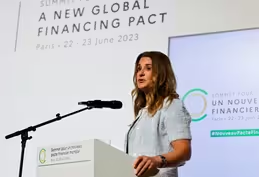
Melinda French Gates on economic empowerment for women
Video has Closed Captions
Melinda French Gates discusses increasing economic empowerment for women (8m 15s)

More companies explore 4-day workweek for employees
Video has Closed Captions
The benefits companies are seeing after embracing 4-day workweek (7m 59s)

Record ocean heat triggers massive coral reef bleaching
Video has Closed Captions
Record-breaking ocean heat triggers massive coral reef bleaching (6m)
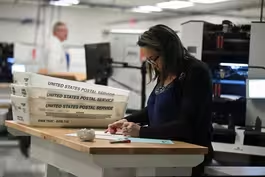
Report reveals high turnover within local election offices
Video has Closed Captions
New report reveals high turnover within local election offices (6m 30s)
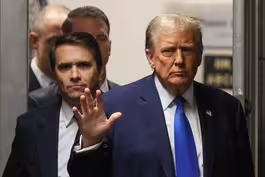
Trump trial closer to opening after 12 jurors selected
Video has Closed Captions
Trump hush money trial closer to opening statements after 12 jurors selected (4m 38s)

U.S. hits Iran with sanctions, urges Israel against attack
Video has Closed Captions
U.S. hits Iran with new sanctions while urging Israel against military response (7m 6s)
Providing Support for PBS.org
Learn Moreabout PBS online sponsorship
- News and Public Affairs

FRONTLINE is investigative journalism that questions, explains and changes our world.

- News and Public Affairs

Today's top journalists discuss Washington's current political events and public affairs.












Support for PBS provided by:
Major corporate funding for the PBS News Hour is provided by BDO, BNSF, Consumer Cellular, American Cruise Lines, and Raymond James. Funding for the PBS NewsHour Weekend is provided by...