Compass
April 2021 Edition
Season 5 Episode 7 | 26m 48sVideo has Closed Captions
Grief recovery, Riverview Estates in Dawson and Undowanpi.
The April edition of Pioneer PBS’s reformatted public affairs program Compass features stories about recovery and growth after grief, the Riverview Estates living development project in Dawson and an episode of Undowanpi (We Sing).
Problems playing video? | Closed Captioning Feedback
Problems playing video? | Closed Captioning Feedback
Compass is a local public television program presented by Pioneer PBS
Compass
April 2021 Edition
Season 5 Episode 7 | 26m 48sVideo has Closed Captions
The April edition of Pioneer PBS’s reformatted public affairs program Compass features stories about recovery and growth after grief, the Riverview Estates living development project in Dawson and an episode of Undowanpi (We Sing).
Problems playing video? | Closed Captioning Feedback
How to Watch Compass
Compass is available to stream on pbs.org and the free PBS App, available on iPhone, Apple TV, Android TV, Android smartphones, Amazon Fire TV, Amazon Fire Tablet, Roku, Samsung Smart TV, and Vizio.
Minnesota’s Alt-Meat Revolution
“Minnesota’s Alt-Meat Revolution" is a year-long video and print journalism collaboration project, looking into the roots and impact of the plant-protein phenomenon that’s exploding across the globe.Providing Support for PBS.org
Learn Moreabout PBS online sponsorship(soft music) - Funding for Compass is provided in part by, the Otto Bremer Trust, the McKnight Foundation and members of Pioneer PBS, thank you.
Hi, I'm Amanda Anderson.
Welcome to the April edition of Compass, the regional public affairs show on Pioneer PBS.
A quick refresher on our new look, we've been creating monthly broadcast episodes because the new Compass format is digital first.
All of these stories that you're about to watch have already been posted on Compass' website and social pages.
We encourage audience interaction and feedback on our social media.
So have your devices at the ready so you can comment and tell us what you think of each story as you watch.
First, Dr. Kandy Noles Stevens talks about how grieving led her to be a more empathetic educator.
She advocates that, especially now with distance learning, students are not alone when they need help.
- My name is Dr. Kandy Noles Stevens.
We started our family here in Marshall.
So we have four children and our four children and I attended school.
I was a teacher at Lakeview School.
Every morning, I would drive my children to school.
And then in the afternoon they would ride the school bus and I would pick them up at Green Valley.
One day, so this would have been February 19th, 2008, the bus didn't come.
And while we were sitting there, there were, you know, fire trucks and ambulances and Sheriff's, deputies and police cars that just were speeding by, lights, sirens, blaring.
We figured something happened that held up the bus.
I thought to call a friend of mine who was a bus driver at the time.
And her words were the first moment that we realized that it was our children's school bus and that our kids were involved.
At some point in the evening, one of the EMTs that was on scene came in and let me know that my son Sawyer had been taken to the Granite Falls Hospital because he had a broken leg.
And at the time I didn't really think, I mean, broken legs are bad and I wanted to be with my son but I still didn't know where my son Reed was.
My pastor and my best friend's husband started making phone calls.
They had been given some numbers by school officials.
And eventually my pastor had to tell me that it was my son who had been flown out and he didn't make it.
I have learned that just about everything in life is a lesson to be learnt and that was similar to grieving.
So the reason behind writing books for me has somewhat been transformative.
In the case of my first book, "The Redbird Sings the Song of Hope."
That book was sort of a process for me to be able to speak out loud my grief and to write it in a way that made sense to me, it's somewhat akin to acknowledging the elephant in the room, that I was carrying this heavy load of grief but yet there were still bright things in that.
- So, in the process of, you know, learning how to navigate through grief but also translating that into becoming a better educator, there has been an offshoot that I never expected or would have planned to happen.
And that really wonderful gift that I have been given is that, in the building of relationships with students, that in some cases they've somewhat adopted me as a second mom.
And in many ways I lost one son but I gained about nine more.
- Josh Brusven, I graduated from SMSU in 2010.
I met Kandy back in seventh or eighth grade.
She came in as the new science teacher at Lakeview and immediately struck up a, you know, conversion was very easy.
I had her all the way through high school.
She taught me chemistry all the way through high school.
Then I started at SMSU and she helped me a little bit through chemistry and would just, you know, basically do a little study session with her.
After that, we are basically an adopted family.
My six year old and four year old boy call her Granny.
We aren't related by blood, but we have that relationship there.
- Doctor Kandy Stevens.
She was my professor for my first semester at college.
She was really the only professor that I felt very, very comfortable with.
She was very relatable and she talked to us like we were her own children.
And I really liked that about her, 'cause she made me feel very welcoming to her class.
And I feel like every freshman, especially during this time during the pandemics really need something like that.
- (indistinct) she was my home for four years of my life.
You know, there were some good times, you know, there was some tough times.
- There are like counseling services here for people who are going through stuff and need someone to, but I didn't know of it until a friend told me.
So I feel like it needs to be talked about more.
Other students are struggling with distant learning.
I feel like they should know that they're not alone, 'cause I am one of them.
There are people like, you know, Mrs. Kandy out there that do want to help those who need it.
- This is kind of a crossover between my role as a professor and my education in grief that I wasn't expecting to get, but I've learned something from my students.
And this was probably one of the most powerful things that I have learned during this pandemic, when students are in high school, they're often told, and as a former high school teacher, I am guilty of this as well.
That we tell students that, "You need to," you know, "You need to start," you know, "Working on your work" or "You need to start caring about your work, because when you get to college, you're on your own."
And while that is true to some degree, what students hear is that you are completely isolated and you can't do this with help.
And nothing could be farther from the truth.
We have support services to help students through but we also have academic services, we have health services, we have all kinds of things.
So the message in life and for education is that, we aren't doing this independently.
We are doing this interdependently.
And that it is okay to allow someone else to help you.
- This story was produced by Isatu Shirek.
A student from SMSU in Marshall.
To learn more about contributing to Compass, contact yourtv@pioneer.org.
Next, I recently visited the City of Dawson to learn about how a number of private investors are addressing the City's housing shortage.
- One of the aspects of the mission statement was to provide quality, affordable housing for the City of Dawson.
And secondly, to try to facilitate with local vendors and suppliers, whenever it was financially feasible.
- An interesting phenomenon is occurring in rural spaces, even though the population has been steadily declining for the past 50 years, there has been an increase in the number of households.
Kelly Asche, research associate for the Center for Rural Policy and Development wrote in an April, 2018 report, that population and housing are not as clearly linked as one might think.
- So I'm gonna use actually the economic development region 6W which is where you're located.
So kind of, West Central Minnesota.
That region has experienced the most significant population decline since 1970.
I wanna say it's lost 20 to 30% of its population since that time till today.
What's interesting though, if you look at the number of households, it's actually increased by 4% or 9%.
It's just this idea that a household sizes are smaller.
- And there are jobs in rural areas, but in order to hire people for those jobs, there has to be somewhere for them to live.
- So you would think a simple solution to that then is, "Why don't we just build more housing?
If there's demand for it, developers should come in."
Well, there's a couple problems.
One, building house today is very expensive.
So you talked to a lot of experts and they're gonna say minimum, the cheapest house you can build is probably $200,000.
- [Amanda] Also, developers who build that $200,000 house can probably sell it for that much in rural areas.
But if they build their $200,000 living space in a metropolitan area, they're probably gonna turn a much larger profit or as Asche puts it.
- More money, more profit.
- More money, more profit.
Asche also said that Great Recession wiped out many small contractors who would be more likely to build housing infrastructure in rural spaces.
- And so this whole mixture of stuff, along with just not having a lot of housing stock because we haven't built a lot of housing in rural areas for the past 30 years.
There's no housing available.
- [Amanda] So what can be done about all of this?
Asche introduced this idea of housing churn and explains why it's not enough to just build more houses.
There needs to be diversity in housing availability - In a really healthy kind of housing market, you'll see people move at all these different points in time, right?
So their kids might graduate from high school.
And the parent in that household may be like, "We need to get a smaller house."
You retire, you may move and get a smaller house.
You've kind of reached that age where you want single floor living, but you don't want senior living.
So you're living in a different house.
And during that time you're constantly going to a new place, but then opening up the housing that they left, right?
And they call that churn - (indistinct) the Riverview estates living development project in Dawson.
Recently, a group of people who invested in the project, Peggy Crosby and her husband, David Peterson, Charlie Prestholdt and Ken Club gathered in the Dawson city hall.
But their work manifests itself less than a mile away.
From city hall, take a walk down Chestnut Street, go over the railroad tracks and take your first right to go over the (indistinct) River.
You can't miss it.
The idea for Riverview Estates started in late 2016, after three world real estate visionaries, Ken Club, Charlie Prestholdt and Lee Gunderson saw a need for more affordable housing in Dawson.
Their idea was pretty straightforward.
And it sounds a lot like this idea of housing churn, purchase eight lots from the city that could be resold to people who could build their dream home, which in turn would free up their previous homes in town for new occupants.
With lots ranging from 11,000 to almost 31,000 square feet.
They estimated that the project would cost between 350 to $600,000.
They fanned out and approached 10 to 15 people to invest in their project.
- We had property to sell and they came to us, they get lined up in investment group.
And then we developed a water and sewer in there and then we sold them the land but they only had to pay for it after they sold the lots.
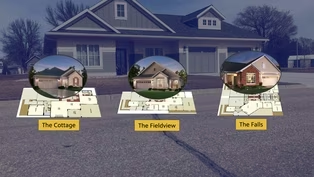
- The investor group came up with three floor plans for potential buyers.
All of the plans have flex building options which give the purchasers the freedom to come in at any point of development to modify the plan.
The cottage home option is about 1300 square feet.
The field view plan about 1500 square feet.
And the falls option comes in at around 1800 square feet.
The investor's original intent wasn't to have Riverview Estates turned into a retirement community of sorts, but with their one floor patio slab homes, that's what's starting to happen.
The residents of the first five houses in Riverview Estates come from other houses in Dawson.
Those houses are now available for new families.
The first churn cycle is starting to happen.
Doc and Sharon Skordahl, both retired.
Were one of the first to purchase a lot.
They decided to move from their home of over 60 years in Dawson to Riverview Estates, because they liked the idea of having everything on one floor, no steps.
That was key.
- We sold our house, it's about four blocks from here.
I had lot of steps to go up and down all the time.
And so when we decided to make a change, why we thought about going to an apartment and then our son thought we should be in a house.
So here we are.
- Doc Skordahl really liked many of the features of his new abode.
- And what I really like about it is-- - [Amanda] But the top two were that the houses could be modified, so they're all different.
There's no cookie cutter situation going on in Riverview Estates.
- That's what I really like-- - [Amanda] And there's plenty of yard space without the yard responsibilities.
- So I don't wanna own a lawnmower or a shovel.
And I like it.
- [Amanda] Oh yeah, and the walking path.
- And then right across the road, we got a walk (indistinct) walking trail.
So it's used a lot.
And we like that also.
- [Amanda] Talking with Doc and Sharon, even after a year and a half of living in their new home, they seem just as excited as the day they moved in.
- I'll show you this closet.
This is simple, one of the best things, 'cause I was very sure (indistinct) in here.
Look at my closet.
- And they always say, if your wife is happy, everybody's happy.
So that's where I am.
- That's our stove over there.
It's one of those stoves, you know, put your hand down when you're boiling water, yeah.
Or when you're cooking on the stove, it boils right away.
But you don't feel anything, but I don't put my hand there just because I'm not gonna show off about it.
- Even though Sharon isn't the type to show off, the Riverview Estates project is a beautiful example of the potential for housing churn in rural communities.
Next, Pioneer PBS's Tanner Peterson worked on a video project highlighting what traditional song and drum means to four different native artists.
We've been airing one video from his series for the past three months.
If you've missed any, head over to our website to watch.
The next and final installment features Gabriel Desrosiers, lead singer of Northern Wind.
Gabriel is from Northwest Angle 33 First Nation, but currently lives in Brown's Valley.
- We're seeking life.
There's a word for that.
(speaking in foreign language) Which means you are seeking life.
And that's what powwow's about.
(traditional drums music) (speaking in foreign language) My name is Red Eagle and I'm from the Bear clan.
My title here at the University of Minnesota Morris is language and cultural lecture.
Jeez, I started singing probably when I was about five or six.
I remember my attending my first powwow.
It was in a wooded area, in a bush area.
I remember walking through the bush in the forest with my parents.
And they said, obviously, in their language, they said, we're going to a powwow.
And there was this circle, this altar type of thing, where people were there sitting around.
And I remember drums there.
I remember distinctively when we got home that time, I could sing the songs that were sung during that day.
I remembered them.
So I learned early that I had the gift of song with me.
(singing in foreign language) As a young child, I listened to my grandfather who is also a singer, a drum keeper, a medicine man, a grass dancer.
I remember him singing and dancing.
And so I kinda like followed his ways as an individual.
My first experiences as being in an organized drum group was when I was about nine years old.
And I sang with a group called Whitefish Bay Singers, is how I kinda like got involved in powwow and traveling.
(singing in foreign language continues) Back in the day, song kept me alive.
Song has been instilled in me.
Without song I think, I would have been gone long ago, you know?
Because it was all, everything was sorta like dysfunctional, you know?
(indistinct) a lot of alcoholism, (indistinct) a lot of obese, so my outlet was singing.
And so I think kinda like, through that setting kinda like gave me more of the inspiration to continue on to sing and become a singer and later on become a dancer.
I formed my own group in 1990, we're called Northern Wind Singers.
And so I'm the lead singer and I compose the music.
Without song, you know, we can't be identified.
Song is a part of our life language, dancing, you know, ceremonies.
They're all equally important.
I think the music has influenced many.
And so I try to be grounded in everything that I do.
It's about a gift and you have to give thanks for it.
And my whole philosophy, ever since the way I was taught by my parents and my grandfathers and all my relatives is that, always have that humility, when you're singing, when you're dancing.
Because the basic reasons why you do these things is because we seek life when we do those things.
Those are the main reasons why we sing and dance, is to ask for that life and having that understanding, always being grounded.
You know, that's the most important thing.
(singing in foreign language) - Finally, Nathalie Nkashama, started Worthington's World Mart in 2018 after realizing the community needed an African grocery store.
By opening World Mart, Nkashama is bridging a gap and bringing different types of African foods to Worthington but COVID-19 brought some unforeseen challenges.
- I came here because of the job.
I am a child protection social worker for Nobles County.
When I moved here, I just saw a different place.
Like there's different cultures, different races, different communities here.
It's like a small village.
I never had this experience in the cities.
World Mart, it started out of a need that was inspired by my children, my son, particularly (indistinct).
And we talked about it and it was over.
So here I am busy with whatever I do, came one day to hand me out a book, "How to Turn a $100 into $1 million."
He said, "Mom, see, look, I told you, you can sell toys, you can sell at school."
That's where in the book it's mentioned.
So he said, "I was going gonna do it, but you say you were gonna help me to start a business and you haven't even done it.
I knew you were not gonna do it."
Ah, this is my personality, when somebody tells me I cannot do it, it's like the put wings for me to fly and go do it.
Like you put fire on me, like, "Hey, get it done."
So I started figuring out, I said, "I better show my son that I can do this."
You know, I can do this.
I can do a business.
I can start a business.
And then I started looking around and finding different resources, interviewing small businesses.
Then I asked my kids like, "Okay, tell me what type of business do you want?"
They said, "Well, we want something like," you know, they told me the bigger store, like big stores.
I looked at them, I'm like, "I thought this kid wanted to sell like just toys."
But first of all, let's sit and see what are the needs in our community.
And I realized that there was no African store here, African food store, grocery store, none.
There's Hispanic, Asian, all that.
So I told him, "Well right now, this isn't the need, this is what we have to get started."
So my diamond team, Worthington Regional Economic Development Center.
And then I have Southwest Initiative Foundation, Southwest Regional Development Commission.
And I also have the Small Business Development Center.
Those are my team and my family and the community.
Those are my diamond team.
I also had to learn to meet and, you know, like Ethiopians.
So now I had to get to know new culture, but now, it wasn't that hard, because already am a people person, you know?
And when I see a black person or people, I just say, "Hi, how are you?"
You know?
'Cause I always wanna make sure the model that I have is bridging the gap.
So there was a big gap that needed to be bridged, which is African food.
People travel like three hours, 45 minutes away to get their food.
And I said, "No, this cannot happen, I couldn't find what I needed to eat."
So I said, "Well, we have to start now East African groceries and West African."
That's how we started.
Now, I had to be accepted by the community because I'm selling something that is not really like, you know, from my country.
When COVID started there was a big challenge.
Already with the business, I was thinking to do different things with the business.
A lot of people now accepted me, but now there was a need for food.
There's COVID, there's South Dakota, you know, we heard there was so much things going on there.
In the cities, they limited the supply.
So people relied on me and I couldn't have a staff member to run the businesses, I have a full-time.
I was going back and forth, back and forth, serving customers, you know, from home, I would drive.
It was just a lot.
Then came the idea of this, out of, you know, that dark cloud, here came the silver lining.
Oh my goodness.
I was so scared to take this path.
'Cause I didn't know how it's gonna look like, I was so scared.
I didn't know, how am I gonna be driving a trailer?
I have never driven a trailer, like, you know?
This way, for full time, customers could (indistinct), some customers could not come to us, now we had to go to them.
And some people had COVID but I did like drive way drop-off, pre-order, that's where the idea of pre-order started.
Now people are pre-ordering.
I wasn't making as much as I'm making now with this trailer.
I didn't have more customers like I have now, because whenever I go to drop off they're so excited, the neighbor sees and then they're like, "Hey, I want this, I want that."
And now I have more customers than I had when I had a storefront.
I'm like, what was I missing a trouble in different countries?
You know, I was always like an outsider but I always want to be part of the community.
Be involved, learn something new, yeah.
So with World Mart, we are one stop to knowledge culture.
It's not just food.
We don't just sell food.
We sell more than food.
It's leading people to resources in the community, whatever they need, it's more than just that.
It just not receiving money.
It's about serving the community.
That's the model.
I don't know if it's unique, but I believe it's unique.
You know, they say also that you don't have to brag about what you do, because that means it's not really good, but I have confidence in what I do.
- Thank you for watching this April edition of Compass.
Remember, we encourage audience interaction and feedback and we want to hear from you, head over to our social pages and website and let us know what you think we should be covering.
And a heads up, the May edition of Compass will air on May 13th.
Thank you for watching Compass on Pioneer and see you then.
Funding for Compass is provided in part by, the Otto Bremer Trust, the McKnight Foundation and members of Pioneer PBS, thank you.
(soft music)
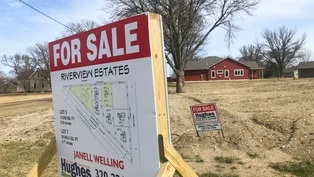
Preview: S5 Ep7 | 30s | Tune in for the April broadcast compilation of Compass Thursday, April 8 at 9 p.m. (30s)
Dawson addresses housing shortage by creating its own churn
Clip: S5 Ep7 | 7m 3s | Addressing Dawson's housing shortage by creating the Riverview Estates living development. (7m 3s)
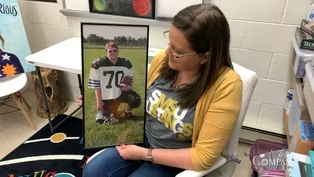
I lost one son, but, in a way, I gained nine others
Clip: S5 Ep7 | 6m 47s | Grieving her son's death, Dr. Kandy Noles Stevens learned how be a more empathetic teacher (6m 47s)
Providing Support for PBS.org
Learn Moreabout PBS online sponsorship
- News and Public Affairs

Top journalists deliver compelling original analysis of the hour's headlines.

- News and Public Affairs

FRONTLINE is investigative journalism that questions, explains and changes our world.












Support for PBS provided by:
Compass is a local public television program presented by Pioneer PBS