
April 2021: Into The Storm
Season 2021 Episode 4 | 26m 47sVideo has Closed Captions
Go behind the scenes of a student documentary examining Sarasota desegregation.
Go behind the scenes of a student documentary that delves into the rich history of Sarasota and Booker High School, in a tale about basketball, desegregation, and the love of a school that brought a community together. In this episode of Up Close, we sit down with a producer, subject, and the students of Into the Storm.
Problems playing video? | Closed Captioning Feedback
Problems playing video? | Closed Captioning Feedback
Up Close With Cathy Unruh is a local public television program presented by WEDU
April 2021: Into The Storm
Season 2021 Episode 4 | 26m 47sVideo has Closed Captions
Go behind the scenes of a student documentary that delves into the rich history of Sarasota and Booker High School, in a tale about basketball, desegregation, and the love of a school that brought a community together. In this episode of Up Close, we sit down with a producer, subject, and the students of Into the Storm.
Problems playing video? | Closed Captioning Feedback
How to Watch Up Close With Cathy Unruh
Up Close With Cathy Unruh is available to stream on pbs.org and the free PBS App, available on iPhone, Apple TV, Android TV, Android smartphones, Amazon Fire TV, Amazon Fire Tablet, Roku, Samsung Smart TV, and Vizio.
Providing Support for PBS.org
Learn Moreabout PBS online sponsorship(upbeat music) - [Narrator] This is a production of WEDU PBS, Tampa, St. Petersburg, Sarasota.
- Talent, adversity, courage.
A student documentary discovers a hidden story behind the championship basketball team at Booker High School in the late sixties.
What the students recount is a tale of desegregation and determination to protect the communities beloved institution.
Go behind the scenes with a subject, a producer, and the students of "Into the Storm."
Coming up next.
(upbeat music) In 2018, two seniors at Sarasota's Booker High School set out to make a film about the championship basketball team from their schools past.
During five months of research these digital film and motion design students realize that the story behind this all-star Tornadoes team was much more.
It was a tale of desegregation in the late 1960s, a traumatizing school closure, and a protest that would ultimately save the Booker schools in Sarasota.
The resulting hour long documentary is called "Into the Storm."
It has premiered at the Sarasota Film Festival and the Prague Youth Film Festival in the Czech Republic.
WEDU will feature the documentary immediately following this program, during which we dive behind the scenes to learn more about the making of the film and the history chronicle in the student production.
Welcome to "Up Close."
I'm Cathy Unruh.
Today we are joined by John Timpe.
He is the film and screenwriting teacher at Booker High School's VPA Film and Animation program.
He's also one of the producers of "Into the Storm."
Lindsey Jennings is one of the student filmmakers and a graduate of Booker High School.
Fred Atkins is one of the interview subjects of the documentary.
He's the Booker High School alum and also played for the Tornadoes.
Thank you all for joining us today.
We appreciate it.
So, John, let's start with you.
Tell us a little bit about the VPA program at Booker.
- Sure, it's an arts magnet program, and a number of schools around the country and in Florida have this.
And basically what it means is in addition at our school to having the students who are zoned for this high school as a comprehensive high school.
There's also an arts magnet program where students throughout the county and neighboring counties can audition and be accepted into the program.
And for three periods a day, these students get to study and practice the art that they choose for all four years that they're here and then use that for college and career possibilities in the arts.
- And there are some impressive college and career outcomes from this school.
- Oh goodness, yes.
A number of our students in our film and animation track specifically in addition to going to neighboring Ringling College go to all the other fantastic film and animation programs in the country, including Savannah College of Art and Design and Florida State University.
Our UCF has an excellent film and documentary program.
- And Lindsey, the making of the documentary is this sort of a capstone project for a senior.
- Yeah, all the seniors do kind of a major project, the end of their year.
And this was ours to do a documentary.
You can choose to do a short film or a documentary.
And we started kind of early too.
We started our junior year.
We got the idea and started working on it.
So we we're excited.
- And when you say we, it was two of you and then it grew, correct?
- Yes.
So me and Carol were the main team.
And then as we needed, we would pull a couple of team members from our classes.
- Because as you went along you discovered there was a lot more to that story.
And that's what the documentary is gonna tell us about.
- Yes, of course.
It's a lot of work doing a whole documentary and filming everything, editing everything.
All the little bits that go along.
- And Fred, you were a student at Booker back in the sixties.
- Yes.
- And you've remained in Sarasota.
Tell us about your career.
- Well, I'm born and raised here in Sarasota.
I was a student and a fan of the team.
I was on the junior high school basketball team that was county champions but the varsity team was a foster period.
That's why we knew who we were gonna be great continually in Sarasota County.
But I'm a former mayor of the city of Sarasota.
Worked in the community, worked in social works, graduated from University of South Florida in Manatee Junior College.
- And during this year of the tremendous championship you were watching, you were not on the court.
Tell us though about that year, what was so amazing?
- You have to understand that I being an athlete and an ultra fan in the most amazing way this was what you dream of having a super team at your school, with a super player and a company cast of characters that would enlighten the whole community and the county and the state of Florida with how dazzling they played the game.
- And the dazzling was an average of 102 points per game, finished the season 32 and zip and outscored their playoff opponents by 49 points.
It was really a wow, sir.
- Oh yeah.
It really wasn't fair because you know, everybody had good teams, but this team was just so far superior that I have never seen a high school team put together like this one yet still.
- In the documentary we're gonna learn a little bit about why it was so fantastic, but Lindsey whose idea was it to make a documentary about the team?
And this was a long time ago.
- When we kind of got this idea, I believe Mr. Timpe lightly said something about this story.
And none of us knew anything about it.
All being Booker students.
And I'm like a bit of a history nerd.
I know a lot about Sarasota's history.
I've never heard anything about it before this.
And when we kind of realized that this is so untold we had to, you know, it felt like we truly needed to help these community members tell their story and get this in the history books.
It was such a big thing and get it told around.
- And you had some challenges from the production standpoint, which those of us who do production can really relate to.
It was hard to find interview subjects from the time.
And it was hard to find visuals.
Yes?
- Yes, of course.
We spent so many afternoons just in the historical resource centers in Jetson Historical Resource Center.
We went on the Newtown tour and everything.
And just asking members if they had photos from the time.
Like running into their houses with scanners just trying to be as cautious as possible but trying to get all of this media and show it, you know.
- So that was a huge project for you and something you'd never delved into to quite this extent before.
- Yeah.
I don't think me and Carol knew exactly what we were signing on to when we did it.
'Cause it turned into such a big thing.
But like I know we are both so grateful to be a part of this project.
- And when we mentioned Carol, she's another student, Carol Fauls who worked with, was the one who started it with you.
John, tell us about the funding for the project.
- So our program receives funding from the school district, of course.
And then because of the specialization in the arts that our students participate in, we seek supplemental funding.
Our director Rebecca Abrahamson organizes an annual fundraiser.
And we go out and meet with members of the community who are interested in seeing the growth of student film, and they also provide funds.
Organizations such as Tervis Tumbler make donations.
And that allows us to buy additional cameras and things like that.
Or in the case of this film as a result of their hard work the students earn some scholarships from that.
But basically the equipment we have is what high school film programs typically have as far as like DSLR cameras and light tripods and that kind of thing.
So they spun a feature length film out of something that's typically used for 10, 15 minutes student films.
And it was pretty audacious.
In the film festivals we entered it into were really surprised at the length and the breadth, and the complicated work that they did with the resources that they had.
- And again, it was a Sarasota Film Festival and the Youth film festival in Prague.
And you were invited to enter it in that festival, correct?
- That's right.
And they loved the film so much that they used it to kick off the festival.
They screened it at the American embassy there in Prague.
And of course we were very proud of that.
- And on the funding side, we just wanna mention that the school board contributes and the Gulf Coast Community Foundation did as well.
So we had a lot of community support.
Fred, what was it like for you to see this documentary?
- I really was flabbergasted.
I thought those young women did a fantastic job of putting this project together because when they first approached me about it, you know they come to you as an individual, you say, "Okay I'll help these little kids do this."
And when we looked up, we had a major production when the debut came that I said, "Wow, they really did an outstanding job."
And they pulled together nearly all the live participants from that era into the documentary and add some old photos that I hadn't seen in decades.
And so I was rather pleased with the process.
- Did you learn anything new because it was about more than the basketball team.
Did you learn anything from the documentary?
- Yes, I did.
I learned a lot of things from the documentary.
You know, you think you know your community.
You think, you know the events as they come together.
But from the Plymouth Volare opening up the film to seeing some of the stories that was told by individuals and how things came together on that team in practice and around the practice, I always remember then, you know one of my favorite teachers during that time was Rubin Maze.
And he worked with that basketball team as an assistant coach.
And I missed him in this process, but he's still alive.
And he's seen the documentary 'cause I made sure I sent him what I had.
- And I just wanna point out for everyone that this was a time during segregation.
And so black teams played black teams, white teams played white teams.
Sometimes if the principals agreed they could play each other.
As I watched the documentary, it was stunning to me to learn what life was like for black folks in Sarasota at that time.
And that's enough said about that but it's really an eye opener in the documentary.
Lindsey were you kind of blown away by that when you started doing the research.
- It was something that I knew wasn't documented as well but deep diving into it.
Yes.
You know, I'm a Sarasota native.
I'm a history nerd.
And that I thought I kind of understood everything, not everything, but the general story of Sarasota and the fact that these stories need to be worked in and they need to be told as well.
And we need to lift this up until this as much as any other historical event.
So yes, I was shocked.
I was like let's tell everyone, you know.
- You did an outstanding job.
- Thank you.
- It's amazing to think of people like Fred, who have lived since that time as children into what life is like today.
It's been quite a journey Fred.
- Yes.
- Yes.
Oh, I've been a willing participant.
You know, I could have gone a lot other places but I found no place better than Sarasota in the Booker community and the Newtown neighborhood to basically plant my roots and grow.
And this community has loved me all the way into being the mayor of the city of Sarasota.
And work with the students here in the Booker schools.
And just to preserve our institutions have been most gratifying for me - Lindsey quickly, the four people who worked on the documentary, tell us what each of their roles was.
- So Carol was main filmmaker and editor.
I was more kind of production, getting everything in line, helping the storyline through, getting all the people, all the places.
And then towards the end, Kiara and Sydney came in.
Kiara helped write some of the storyline, the voiceovers, what we were gonna place in all of these little holes for all the media to show.
And Sydney helped as well with, you know placing these things, doing voiceovers and just the organization at the end.
'Cause we were seniors, you know, we were trying to graduate from high school.
So towards the end, we were just like overwhelmed a bit.
We had to bring in more people and we had to just.
Balancing school and this whole documentary was a challenge for sure, and I'm so grateful we had all these people, all these wonderful people within the Digital Film and Motion Design program help us out - And we did speak to the other students who were involved in the making of the documentary.
(upbeat music) - Anytime that I think about "Into the storm," I think about the days that we spent in this room with this white board filled with, "Okay how do we connect this to this?"
And it was filled with ink that half the time I couldn't even read.
- At first I probably wouldn't have taken this topic on just because I didn't understand anything about it.
I didn't know what had happened in the past.
I didn't know my school had all this controversy with other schools and it was incredible to learn the story and to understand where people are coming from.
Because I think that's maybe something I didn't do as much beforehand.
- "Into the storm" was kind of last minute for me, Carol and Lindsey were working on it to begin with as their kind of their thesis project.
I love storytelling.
And the fact that they wanted to reach out specifically for me to write this screenplay was really great.
My writing teacher, Mr.Timpe said, "Well, hey, I know you can write.
Do you wanna help us figure out the narrative for this story?"
And I hopped on it and it's helped me in college a lot.
I'm taking a lot of storytelling related classes that help with structure and everything.
So yeah, it's been really good.
There is a sort of independence in the whole project.
You're not being guided to information.
A lot of the information that we found you really had to dig for it.
So there's something to be said about finding truth and information that's given to you and then finding truth and information that isn't necessarily like handed to you on a silver platter.
- At that time, some of the players on the team had passed away sadly, but the people we did find, we loved everyone we interviewed who were so nice and we all had this amazing story to tell.
- My role was to have someone be like the voiceover.
So I known someone from here from the college room, Mr. Andrews.
I thought he was the perfect fit for the voice.
So we set up like an audition for him.
He didn't want.
So I'm like, "Yes, we need him."
He got it.
He got the role.
- Seeing the reactions of people in the community.
I remember seeing people in the front rows just laughing at old photos and crying with each other about what they were reliving, what they went through.
And I'm glad that I got to experience that.
And I got to help in giving that to them.
- I'm very grateful to be part of the story.
I'm a Sarasota native myself.
So to tell this story is very impacting, inspiring for others to learn about the history of Booker High School.
- I kind of learned a lot of things that I would have learned in college at Booker High School in that film program.
I think it really prepared me in a way that I didn't realize it would because coming to SCAD, Savannah College of Art and Design, I just realized it made the transition so easy into college.
- Lindsey, it's interesting that it's an all female production.
- Yeah.
I didn't think of it much, you know when we were making it but looking back, it's definitely empowering I guess to do a full documentary with just a female team.
- You mentioned how time consuming it was, trying to do everything and get this done.
Do you have any idea of how many hours went into the creation of this?
- No idea, no idea at all.
We would would spend, you know all day, three periods during school, the lunch, you know after school, stay.
There were times when me and Carol would stay at Booker way past, you know.
But we were allowed, obviously we got approval, but we'd be in the digital media labs.
Like it, sun would set, you know, we'd be in high school still and just leaving school so late.
And I would have no idea how much time and driving to these places, meeting these wonderful people, talking to them hours on hours of researching.
(Lindsey laughs) truly no idea.
- And Fred, I wanna talk briefly without giving away the whole documentary about two of the big subjects that turned up as these ladies were looking at the basketball team.
And one of course was desegregation, which we tend to think of, "Oh that's a great thing, you know, desegregating, integrating.
That's a good thing.
That's number one."
And then number two is how that impacted Booker and led to students protesting.
Can you just touch upon those - Desegregation in Sarasota County came as late as it could.
The Sarasota County School Board resisted it to nth degree until the federal government said they had 12 months to make a decision.
So there we were in that process.
And when they finally made a decision, it was like cut and dry we're gonna do it our way as the majority of community demanded.
And they drew a line down 27th street and said, "Hey everybody on the North side going to Riverview and everybody on the South side going to Sarasota High.
And it didn't fit well in this community at all.
And so after awhile, we just refused to let them take our elementary school and just close it too.
They closed the high school for several years, but one of our goals in our protesting was to also get our high school back open and continue to maintain our institutions in our neighborhood.
And we are proud to say in the African-American community in Sarasota County, we have all three of our institutions, our middle school, our high school and our elementary school, right within a mile radius of the present Booker High School.
And so we work hard to do that.
Throughout the country there are people that looks at us and say "How did y'all manage to do that?"
And it was hard work.
It was commitment.
It was love of our people in our community - John here in the 2020s.
How important is it, how significant to have the larger community learn this story?
- I think it's so vital because it's easy as you alluded to earlier with the passage of time to either not remember, lose some of the details or to kind of consign this to the distant past.
But if you look closely in our community you can still see some elements of some of these concerns, some of these feelings, some of these limitations.
And so, you know, allowing everyone in the community just to have access to this film helps increase the awareness.
Including of the idea that everyone needs to have a voice because if you don't hear all of the voices you won't necessarily really understand.
And one of the things that really brought that home for me was after the premiere, some folks who saw the film who were not disposed to being mindful of diversity and multiculturalism said, "I could understand why they felt the way that they did, why the community of Newtown was so concerned.
Because if I had been in their shoes I would have felt the same way."
And that was one of the best outcomes from this film is realizing that this art has the power to open eyes and to help different people understand things that they wouldn't otherwise.
- And you'll learn about Newtown everyone as you watch the documentary but that was the town where black people lived in, basically were confined to.
John, are you from Sarasota?
Or how did you come there?
- Oh, I'm from all over.
As a longtime member of the media and filmmaking community, I've moved for a lot of jobs but I've lived in Florida mostly since 1992.
And Sarasota has always held a special place in my heart because of its commitment to the arts, because of its natural beauty.
So when my family had a chance to move over here we took it.
But again, as Lindsey and Fred said, completely unaware of what incredible stories were here and what amazing things happened here that didn't happen anywhere else in the country.
And so this discovery of the things that are around here has been been a pleasure.
- Lindsey, did you grow up in Sarasota?
- Yeah.
Born and raised right by Booker, right by the museum.
- So from your perspective, what is there in the community to do to further progress on this front?
- I think just getting the recognition of the historical societies and just really making sure that we get this in the books, you know.
Any of the books I've read on Sarasota, any of the media that I've consumed about Sarasota, you know obviously it's not telling the whole story.
It barely mentions the protests that we had on Lido beach.
So just really making sure that the community kind of comes together and acknowledges like, "Hey, we didn't document this."
You know, it was purposely suppressed for a while.
And we need to give them the voices now.
We need to have Fred on and speaking his story and everyone speaking their stories and sharing and getting it on film.
And making sure that we have it to share for future generations to Booker High School students.
So they know why they're here.
And like what, you know, great lengths people like Fred had to go to get this school back so our community could be a community.
- And this not knowing about or thinking about or being aware of the full history of a community, of course, is not singular to Sarasota.
Sarasota is just lucky to have you do this project but many of us live in communities where we have no idea of the full history.
Fred, how valuable do you think it is to have this be told?
- Well, to have the VPA program at Booker High School.
You know, across the street from where I live now and to have those young women raise this project to the height that it has been risen is an amazing process for me.
And I'm just honored to have been able to contribute to it.
I didn't relish the idea of living it, but I understand that the story of this episode need to be told.
But there are so many stories in Sarasota, in Newtown and African-American communities all over the country that need to be told that have been left out of the history - Correct.
That's so correct.
Lindsey what's reaction critically been to the film?
- To the film overall, we've had a lot of very good, very positive talks with people after, you know, showings and everything.
But while we were filming it and we present this idea just when Fred was talking, I remember this people would think that their stories were insignificant.
You know, some of the biggest protestors just saw it as, you know, their hardship.
They didn't think of this as this big thing that everyone's working towards that actually made a difference.
So kind of convincing our interviewees that they took this important role, you know and making them really realize it was a pleasure and just overall complete community awareness and excitement, you know.
- And John, what are future plans for the documentary beyond coming up right now?
- Yes.
And that's part of the next phase which is the availability of this documentary on WEDU for the next couple of years, which is wonderful.
We're gonna reach a regional audience now.
And we talked with a distributor about getting out on maybe another platform later on.
And our principal, Dr. Shelley has been wonderful about making sure this gets shared with our school district for students to use in the classroom and for our community members to be able to view it at any time they want to.
And see the part that they or their family members played in this story.
So we're very excited.
- It's definitely well worth the one hour investment of time.
Thank you very much, John and Lindsey, and Fred, all of you for being with us today.
For more information about Booker High Schools Film and Animation Program, you can visit bookervpa.com Stay tuned right now for the premier of "Into the Storm."
And you can find additional program schedules at wedu.org.
This episode of "Up Close" may also be viewed in its entirety at wedu.org.
And thanks for watching.
I'm Cathy Unruh and I'll see you next time on "Up Close."
(upbeat music)
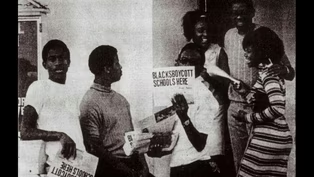
Preview: S2021 Ep4 | 29s | Go behind the scenes of a student documentary examining Sarasota desegregation. (29s)
Providing Support for PBS.org
Learn Moreabout PBS online sponsorship












Support for PBS provided by:
Up Close With Cathy Unruh is a local public television program presented by WEDU