
April 2021: The Holocaust and Today
Season 6 Episode 3 | 26m 40sVideo has Closed Captions
Remembering the Holocaust and its lasting impacts in today's world.
The Holocaust occurred between 1941 and 1945. It may seem like ages ago, but its impacts are still felt today. As modern white nationalism appears in the United States, what lessons can we learn from the tragedies of the past and how can we unite a fractious nation?
Problems playing video? | Closed Captioning Feedback
Problems playing video? | Closed Captioning Feedback
That's All I'm Saying is a local public television program presented by WEDU
April 2021: The Holocaust and Today
Season 6 Episode 3 | 26m 40sVideo has Closed Captions
The Holocaust occurred between 1941 and 1945. It may seem like ages ago, but its impacts are still felt today. As modern white nationalism appears in the United States, what lessons can we learn from the tragedies of the past and how can we unite a fractious nation?
Problems playing video? | Closed Captioning Feedback
How to Watch That's All I'm Saying
That's All I'm Saying is available to stream on pbs.org and the free PBS App, available on iPhone, Apple TV, Android TV, Android smartphones, Amazon Fire TV, Amazon Fire Tablet, Roku, Samsung Smart TV, and Vizio.
Providing Support for PBS.org
Learn Moreabout PBS online sponsorship(peaceful music) - [Narrator] This is a production of WEDU PBS, Tampa, St. Petersburg, Sarasota.
(gentle music) Premier Eye Care is a leader in national managed eye care, with 4 million insured members nationwide through its network of optometrists, ophthalmologists, and specialists, recognized for best practices and delivery of care, associate engagement, and commitment to the community.
Premier Eye Care is proud to support "That's All I'm Saying" with Ernest Hooper.
For more information, go to PremierEyeCare.net.
(peaceful music) (upbeat music) - Every April, the world pauses to recall one of the most horrible acts of genocide in global history.
In Hebrew, it's called Yom HaShoah, a day to remember the victims, honor the survivors, and celebrate the liberators of the Holocaust, the Nazi-led mass murder of European Jews during World War II.
It's undoubtedly a day of sadness, a day to reflect on the estimated 6 million Jews who lost their lives, and all the murders of others caught up in the ethnic cleansing, but surprisingly for leaders at the Florida Holocaust Museum and for others who ensure we never forget, commemorating this tragedy fuels an uplifting hope and contagious empathy.
On this episode of, "That's All I'm Saying," we'll explore the importance of educating a new generation about this tragedy, and we'll take a deeper look at how present day acts of antisemitism echo back to the Holocaust, but first, we're joined by Jacqueline Albin.
She's a Holocaust survivor originally from France, who often speaks to students and museum visitors about her experience.
Jacquelyn, welcome to the show.
- Thank you so much.
I appreciate your having me today.
- So, Jacqueline, I know you were rather young going through this experience in a small town in France near the Swiss border, but you still have a lot of memories of that experience.
Tell us a little bit about what you recall from those early days.
- Well, the little village in Switzerland, or near Switzerland, was in the occupied part of France, and I remember, between the ages of two and five, looking out the window of our apartment and watching the German soldiers.
Apparently, their headquarters was right across the street and I do remember them walking back and forth, and my grandparents and my mother, of course, had to wear the yellow star.
I didn't because I was under six years old.
This is a picture of me taken in 1942.
That was after we rejoined my father, who had been in the French army, and he mobilized in the so-called unoccupied zone.
This is my father.
He was in the French resistance, and this is a picture of him in the French resistance.
And anyways, we later rejoined my father with much...
Okay, and you're coming up with these pictures.
This is a picture of my mother, from the left.
My mother, my father holding me, and my paternal grandparents, who were murdered in Auschwitz in 1944.
Unfortunately, they, unlike us, because we had left and gone to rejoin my father, they were not protected by their neighbors.
They were arrested by the French police in February of 1944, and they stayed in a transit camp for three weeks and then were taken to Auschwitz.
They were in one of those railroad cars for three days, and then, I'm sorry.
And then, they were immediately murdered on March 10th, 1944, and I do know this, because the Nazis, the Germans, kept very, very good records, and I found out about it.
- And Jacqueline, you have said in your story that you were able and your mother were able to survive because people helped you, good people helped you.
- Absolutely.
- How important is that in your story?
- That's very important.
This is what I based my entire story on.
When I first started talking, I didn't quite know how to do it except in chronological order, and then I realized that, really, my story revolves around these, what we call up-standers.
You know, in the museum, when I was a docent, we used to tell the children, mostly children, that there were several types of people in the Holocaust.
There were the victims, the perpetrators, the up-standers, and the bystanders, and so I tell my story around these up-standers who helped us very much, one of whom took my mother through the mountains.
This was, I understand, a very mountainous country.
Took her for a very long walk from 6:00 a.m. to 7:00 p.m., took her to a place where she could take off her star and get on a train and rejoin my father.
Two weeks later, two or three weeks later, he pretended I was his daughter.
- [Ernest] And helped you.
- And helped me.
He took me on the train to rejoin my parents.
So, and we also had many friends, at some point later, the Nazis who were not headquartered where we lived, but were headquartered in a big town, big city nearby, who knew where we were, and we always found out when they were coming to get us, because my father - So, in the last few seconds we have, Jacquelyn, just tell us, why is it so important for you to share your story of being a Holocaust survivor?
- Well, I'm hoping that people begin to learn to judge each other not on the basis of their external characteristics, not on the basis of their religion, their race, but as individuals who are worthy of respect, and, you know...
I often try not to be pessimistic when I see that there are still genocides happening, like in Rwanda, or...
I can't think right now, but there are others.
Uyghurs, for example, in China.
I hope I pronounced that correctly, and I see that all this is still happening and that people, what we saw on January 6th, and I sometimes almost lose hope, but I hope that, in some small way, when I speak to mostly children, that they can learn to do better, so that we can have a better world for everybody.
- All right.
Well, Jacqueline, thank you so much for being with us and sharing your story.
I really appreciate it.
Up next.
I'll look at how the Florida Holocaust Museum is educating the next generation.
(somber music) Last year, the first-ever nation-wide survey of Millennial and Gen Z generations found 63% of respondents did not know that six million Jews were killed in the Holocaust, and perhaps more disturbing, 11% believe Jews caused the Holocaust.
The study reinforces the need for education.
Joining us now is Elizabeth Gelman, executive director of the Florida Holocaust Museum, and Howard Tevlowitz, CEO of the Jewish Federation of Sarasota-Manatee.
Thanks to both of you for being with us today.
Elizabeth, I wanted to start with you.
How concerned are you about those polling numbers?
- Well, I believe you are referring to the Claims Conference survey that came out, and it is important to recognize.
I mean, I think that surveys like that are a wake-up call to all of us, especially those of us who are in the business of educating about the Holocaust.
It's a great reminder that there's so much more work to be done.
The most important part of that survey, I think, is looking at the age group of who took that.
Those are not the students that are currently in school right now.
Those are, however, the generations of many of the teachers who are teaching about the Holocaust, and they have the very heavy responsibility of teaching about a subject that they themselves were not taught while they were in school, and so a great deal of our resources does go into teaching teachers, not only in the Tampa Bay, Sarasota, the five county area, but all throughout the state of Florida.
- So, Howard, you've seen those numbers.
What are your thoughts?
And to follow up on Elizabeth, I know you have some efforts that focus on teaching teachers.
- Yeah, I agree with Elizabeth.
The whole purpose of teaching teachers is to be able to impart what happened through more of an integrated approach to education.
So it's not just about Holocaust education.
It can be done through history.
It can be done through science.
It can be done through English.
It can be done through the arts, and it's really teaching both the teachers and then giving the teachers the opportunity to teach to students.
- So, Elizabeth, I know that Holocaust education is weaved into the state curriculum.
How do you think that process is coming along, and what role does the museum play in that?
- We are very fortunate to have a robust partnership with the Florida Department of Education.
The current commissioner, Commissioner Corcoran, is a proponent of Holocaust education, believes in it strongly, and so our programs, especially our statewide programs, are really getting the airplay that they need so that teachers are finding out about the educational opportunities, and we're able to work with teachers and students in a variety of ways.
- So, Howard, tell me a little bit more about the program you have that's sending teachers to Poland to learn about the Holocaust.
- Correct.
We're part of a program called Classrooms Without Borders.
It is for teachers in Eastern Ohio, the Pittsburgh area, West Virginia, and Sarasota, and every year, except for this past year, obviously, we send between 10 and 15 teachers to Poland, where they learn together.
They learn to...
They learn from experiences.
They learn from survivors, but they learn from each other and they learn how to teach with each other.
So, a couple of years ago, a teacher from our Jewish day school and from one of the Catholic schools has been working on programs together.
So it's a different way of dealing with education.
- Great.
Elizabeth, I wanted to ask you about what we call Holocaust distortion.
Tell us a little bit about what that is, and your concerns regarding that particular issue.
- It's a fascinating subject.
Thank you.
There are enough learned people in the world to recognize that the Holocaust was an actual factual event, and so Holocaust denial, while unfortunately rising, is still at a low level.
What we're finding now is something called Holocaust distortion, where people question various parts of the Holocaust.
They might say, "Well, yes, there were Jews that died in the war, but it was only 600, not 6 million."
And by chipping away at some of the facts as we know it, they're able to push their own agendas and ideology.
It's very dangerous, because now, in our world that's so full of, we communicate so much through social media and we listen to our friends more often than we listen to educational resources, that these lies, these distortions are passed on in a quickly rolling rate, and they, you know, the old saying, if you say something enough times, it becomes the truth, and it's very dangerous, what's happening.
- Right, right.
All right, well, Elizabeth, Howard, thank you so much for your time and your insight.
- Thank you.
- [Elizabeth] Thank you.
- Extremism seems to be on the rise in the US.
Still ahead on the show, is there a link between antisemitism and nationalism that we've seen in the news, and what role does the media play?
How do we heal a nation divided?
(somber music) The attack on the nation's capitol on January 6th put white nationalism on display like never before as America watched the violence and horror.
Joining me now to continue the discussion are Michael Igel, chairman of the Florida Holocaust Museum, Eric Deggans, NPR TV critic, and author of the book, "Race-Baiter: How the Media Wields Dangerous Words to Divide a Nation," and Frank Orlando, a political science professor and director of the St. Leo University Polling Institute.
Thank you all for joining us.
Michael, I wanted to start with you.
We know that at least two of the people involved in the attack on the nation's capitol have ties to Neo-Nazism.
Given that and the broader uptake in antisemitism in the nation, how concerned are you about what's happening right now?
- Thanks for having me.
In a word, deeply.
It's very difficult to describe what it's like to see swastikas and Camp Auschwitz sweatshirts inside the nation's capitol.
I am the grandson of Holocaust survivors, so I've grown up with sort of an intricate understanding, at a human level, what my grandparents and what millions of other people went through.
Millions were killed, and so to see that these images and this behavior brought to America is deeply, deeply concerning.
- So do you think a greater awareness of the Holocaust, emphasis or re-emphasis on the Holocaust, can help with this issue, Michael?
- I think there's absolutely no doubt.
I mean, you know, the three words would be education, education, education.
I mean, that's how you solve these issues.
You know, we speak of fringe people.
You know, members of the fringe of society, and hopefully civil society sort of recoils when it sees that and leaves them out on the fringe, but there's also fear for a normalization of antisemitism, and we see a lot of that.
Now, when somebody, you know, disagrees with a politician, all of a sudden, they get compared to Adolf Hitler.
When somebody has a situation in their country that they don't like, you hear about how it's compared to Auschwitz.
People are comparing mask wearing to having to wear the yellow Jewish star that Jews had to wear, and that normalization that seeps into discourse in many ways is even more concerning, because, again, of its apparent normalcy.
So, education is the way to address that.
- Sure, sure.
So, we talk about education, but you know, Eric, I know that you have written about the misinformation that is coming from certain segments of the media.
How can we take on that challenge when we have really a very lucrative side of the media that is just appealing, in some cases, to the far right?
- Yeah, that's the unfortunate truth of it.
We talk about people being on the fringe, but what we learned, particularly during the Trump administration, is that this fringe can be 30 to 40% of the population, and the way to address that, I think, is two-fold.
First, mainstream media outlets have to be very focused on battling back misinformation and not giving safe harbor to people who traffic in it.
So if you have legislators, if you have media figures who insist on saying things that aren't true, you cannot allow them to have oxygen space on your media outlets, because all they're going to do, even if they air misinformation and it's debunked in the next breath, there's always a possibility that a viewer or an audience member may hear the misinformation and miss the debunking.
Secondly, I think we have to find ways to remove the profit motive for these platforms that traffic in misinformation, targeting advertisers to let major advertisers know, look, you know, you may be spending money to run ads on Tucker Carlson Show or on a show on Newsmax, but did you know that those shows are spreading misinformation about how the November election went or who was responsible for the attack on the capitol on January 6th, or what the Black Lives Matter protests actually were about, and whether or not they were violent over the last summer.
Once you call prominent advertisers' attention to the fact that they are subsidizing this information, hopefully they will stop, and then the second thing to do, of course, is to try to get cable systems to stop carrying channels that traffic in misinformation and require them to be more stringent about the material that they're airing on their channels, and if you can sort of capture it in a pincer move and attack the two different ways that they make money, with any luck, you'll discourage these platforms from trafficking in misinformation, and push them more towards more factual reporting.
- All very interesting.
Both of you have spoken about how the nation is divided, and we have Frank Orlando from St. Leo.
Frank, you recently did some polling that indicated that 83.8% of the people surveyed believe the nation is divided.
83.8%, but 67.3% said they'd be willing to join others in building bridges.
Where does that polling indicate where we are as a nation?
- Well, we've been asking this question for several years now, and we found that the most recent iteration of the poll, this February poll, found more people responding that they think the nation is more divided than ever before than we've ever seen.
So, clearly, people are seeing this division, but despite that, about two thirds of the people, and it really isn't just Republicans or just Democrats, it's across the board, are willing to do something to combat that.
Like everyone has said, education is an important thing.
Obviously, the media environment is an important thing, and even beyond things like cable news, the internet can be a great place where misinformation spreads and radicalization can happen.
People want to help, but they realize we're kind of in dire straits.
I think that might start from people even looking at their circle of friends, their circle of family, staying connected with people.
Instead of trying to find people online or fight people on Facebook, try to use relationships to discourage disinformation, discourage violence, discourage this sort of rhetoric as a way to build a platform for a more constructive way to build bridges and get back together.
- All right.
Well, Frank, Eric, Michael, thank you all so much for joining me.
I really appreciate it.
- Thanks for having me.
- Thank you.
- All right.
I'll be right back with my closing thoughts.
(somber music) Whenever you revisit some of the darkest vestiges of history, detractors undoubtedly argue that the journey back in time only serves to divide.
Whether you're talking about the Holocaust, the civil rights movement, or some other chapter that reflects man's inhumanity, some will insist it's only an attempt to imbue guilt.
They couldn't be more wrong.
We need to revisit our history, the good and the bad, to frame how we can move forward.
It's not about guilt trips.
It's about acknowledging the lessons that need to be divined from those moments when our society failed itself.
The forays into the grim realities of our past may create discomfort, but what matters most is how you choose to respond to that discomfort.
The Florida Holocaust Museum depicts the horrors of Nazi Germany's genocidal rampage, but also explores other historic hate-filled chapters.
It does so not to vilify the perpetrators, but to show what can happen when good people allow the evil in their hearts to go unchecked.
The unvarnished truths in our history represent one of the best ways to keep that evil in check, to avoid making the same mistakes.
Historian Tariq Ali said, "History never repeats itself, but its echoes never go away."
If we turn a deaf ear to those echoes, we put our way of life, our morals, our very existence at risk.
Now is the time to listen, to learn, and to remember.
I'm Ernest Hooper, and that's all I'm saying.
(bright music) (gentle music) - [Narrator] Premier Eye Care is a leader in national managed eye care, with 4 million insured members nation-wide through its network of optometrists, ophthalmologists, and specialists recognized for best practices in delivery of care, associate engagement, and commitment to the community.
Premier Eye Care is proud to support "That's All I'm Saying" with Ernest Hooper.
For more information, go to PremierEyeCare.net.
(gentle music)
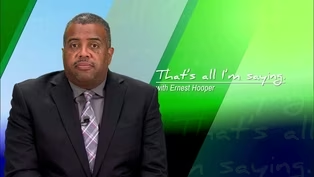
Preview: S6 Ep3 | 31s | The Holocaust may seem like ages ago, but its impacts are still felt today. (31s)
Providing Support for PBS.org
Learn Moreabout PBS online sponsorship
- News and Public Affairs

Top journalists deliver compelling original analysis of the hour's headlines.

- News and Public Affairs

FRONTLINE is investigative journalism that questions, explains and changes our world.












Support for PBS provided by:
That's All I'm Saying is a local public television program presented by WEDU