
April 2022: Patrick Manteiga (La Gaceta Newspaper)
Season 2022 Episode 4 | 26m 40sVideo has Closed Captions
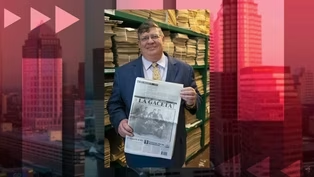
Patrick Manteiga carries on the 100 year tradition of publishing La Gaceta newspaper.
It's getting harder and harder as newspapers go online and compete with everything else on social media, but in Tampa's Ybor City, there's one newspaper publisher who's defying the trend. It's La Gaceta, a 100 year old weekly newspaper founded by Ybor City cigar worker, Victoriano Manteiga. Now, his grandson, Patrick, carries on the newspaper's independent tradition.
Problems playing video? | Closed Captioning Feedback
Problems playing video? | Closed Captioning Feedback
Suncoast Business Forum is a local public television program presented by WEDU
This program sponsored by Raymond James Financial
April 2022: Patrick Manteiga (La Gaceta Newspaper)
Season 2022 Episode 4 | 26m 40sVideo has Closed Captions
It's getting harder and harder as newspapers go online and compete with everything else on social media, but in Tampa's Ybor City, there's one newspaper publisher who's defying the trend. It's La Gaceta, a 100 year old weekly newspaper founded by Ybor City cigar worker, Victoriano Manteiga. Now, his grandson, Patrick, carries on the newspaper's independent tradition.
Problems playing video? | Closed Captioning Feedback
How to Watch Suncoast Business Forum
Suncoast Business Forum is available to stream on pbs.org and the free PBS App, available on iPhone, Apple TV, Android TV, Android smartphones, Amazon Fire TV, Amazon Fire Tablet, Roku, Samsung Smart TV, and Vizio.
Providing Support for PBS.org
Learn Moreabout PBS online sponsorship(upbeat music) - [Man] This is a production of WEDU PBS.
Tampa, St. Petersburg, Sarasota.
- Where would we be without a free press?
It's so important that Thomas Jefferson, one of America's Founding Fathers said, if he had to choose between a government without newspapers or newspapers without a government, he would choose newspapers.
Here we are 250 years later in a high-tech world the Founding Fathers never dreamed of.
We have an overabundance of free speech while at the same time newspapers and traditional journalism face existential challenges.
You're about to meet the publisher of an iconic 100-year-old Tampa Bay newspaper who is meeting these challenges head-on and keeps the presses rolling.
- [Man] Suncoast Business Forum brought to you by the financial services firm of Raymond James, offering personalized wealth management advice and banking and capital markets expertise.
All with the commitment to putting clients' financial wellbeing first.
More information is available at raymondjames.com.
(upbeat music) - Tampa's historic Ybor City has a rich heritage of political and social involvement.
During the first half of the 20th century, its thriving community was a big part of Tampa's economic and cultural growth.
In the early 1920s, cigar worker, Victoriano Manteiga, launched a Spanish language newspaper, La Gaceta, in Ybor City.
There were dozens of local newspapers at the time.
100 years later, La Gaceta is still going strong.
It's a unique blend of local news, politics and commentary, and it's the nation's only trilingual newspaper printed in Spanish, English and Italian.
Victoriano Manteiga's grandson, Patrick, carries on the legacy and independence of La Gaceta.
Patrick, welcome to the Suncoast Business Forum.
- Thank you for inviting me.
It's very nice for you to invite me into your studio here.
- It's great to have you.
Now La Gaceta is really an enigma because first of all, businesses in America, family businesses typically don't make it pass the third generation as you have.
And on top of that, newspapers all across America, printed newspapers have been been in decline for some time.
- Mm-hmm.
- Nonetheless, here you are at 100 years, you're still printing.
- Yes.
- So what's the secret sauce?
- Well, I mean, I guess it's how you measure success, it's how you measure what you're doing, and I enjoy the newspaper business, my father did, my grandfather did.
And they didn't treat it as a business, they treated it as something that needed to be nurtured, something that needed to be taken care of.
And so you didn't take from the paper, you only gave to it.
And so I learned this from my father over the years, and so during hard times, you don't close up shop, you give, you work harder, you make it happen.
During good times, you don't take all the money out, you leave some there for the rough times.
And so, it's really having, I guess, a different perspective.
I really don't look at it as a business, I look at it as a voice, it's part of, the word "La Gaceta" is synonymous with Manteiga, it's my family name, my family reputation.
- And you're carrying on the legacy of your father and your grandfather, both of whom were very prominent, very active and involved in the life, the culture and the history of Tampa Bay- - Yeah.
- And Ybor City.
Let's talk about those two- - Okay.
- Charismatic individuals, starting with your grandfather.
- Well, my grandfather was born in Cuba, and he came here in 1913 after a couple of trips between Key West and Tampa.
And he got a job here working at the Morgan Cigar Factory as a lector.
The workers at that time would had the right to hire somebody to read to them, the lector, the reader.
And so the people at Morgan got a committee together, they interviewed my grandfather, and they felt he was gonna be the right man for the job.
And so they hired him, and every week they would program what would be read to them, whether it was news or a novel.
And then at the end of the week, they would gather up all the money from all the workers and pay them.
So my grandfather did this for awhile, and being a lector here was a very prominent thing.
These were intellectuals in a day when intellectuals were appreciated.
And four or five lectors gathered at a table, and drinking coffee people would sit around them and listen to their banter, go back and forth.
So he did that for awhile- - Mm-hmm.
- And then he made a natural progression to start a Spanish daily called La Gaceta.
Six days a week with wire service from Cuba and Spain.
- [Geoffrey] Mm-hmm.
And he was followed by your father.
- Yes, and Roland was a little bit different than Victoriano.
Most people when my father came around didn't think that he would fill Victoriano's shoes.
I know how that feels because nobody thought I could fill my father's shoes either, but Roland took the paper in a different direction.
My grandfather is very international focused with local.
My father realized that the paper had to develop, so we added English and Italian because our population was getting more English-dependent.
And he also got involved a lot more into local, local politics, and developed the paper to get a reputation of being the place to read for the inside scoop on what was going on.
And so, I took over from him upon his death in 1998, but I started working at the paper in 1984, so I had a pretty long apprenticeship.
- Mm-hmm.
La Gaceta has a very strong, independent voice.
In a recent column, you wrote, "The theater at last Thursday's city council meeting was disgusting."
- [Patrick] Mm-hmm.
- And that wasn't the only shot that you took at local- - Oh no.
- City government people.
Now are you fearless about taking on the establishment?
- No, no, no, no, no, fearless, no, no.
People talk about free speech or free press, you really only have the kind of press you can afford.
If you say something, you've gotta be able to withstand whatever negatives are gonna come of it.
And my father also taught me that you can really only make 50% of the people mad at one time, that way you still have some friends.
(Geoffrey laughs) And so I've been very consistent with this administration, I don't like how it's being run, I don't like the way they do certain things.
And we're gonna continue to take a side on this issue until we find it happening better.
Like it says, it's a little different than most newspapers.
We kind of do crusades.
It's just not reporting, we want to change the world.
- Let's talk about that further.
Are La Gaceta's insights and opinion a vital part of what attracts readers?
- I would say absolutely.
I think we come at things very differently.
I like to say that we use hispanic-colored glasses instead of rose-colored glasses.
Sometimes a story we treat from a Latin point of view, and then other times we just try to give a voice to those who we feel might be on the losing side of an issue.
Try to give a voice to the voiceless.
And so we've always tried to be a very pro-union, pro-democratic newspaper.
We're very transparent with this, people don't... We're not hiding what we are.
My father was a Yellow Dog Democrat.
That's somebody who read the vote for Yellow Dog than a Republican.
(Geoffrey laughs) My grandfather was a Roosevelt Democrat, and I am too, and so when we write, we have a lot of Republicans that read us because we'll talk honestly about their party and ours.
There maybe issues, you find partisanship, but the going on behind politics is really not an issue issue, it's more like personalities, and who's behaving and who's not behaving.
- There are less than half of the printed newspapers in existence.
You've seen local newspapers close, you've seen local newspapers merge, yet here is La Gaceta still printing a printed newspaper.
Why is it that you've chose, one, to stay printed?
Two, not to necessarily migrate online as so many others have?
- Well, I remember in the early 80s, I talked to my father, actually late 80s, and we were talking about the internet and what we were gonna do, and we decided that we were going to wait and watch other newspapers and see who did it right.
So after about 20, 30 years, I was still watching because there just wasn't a whole lot of papers that went from print to online successfully.
They went there, but most of the time they lost revenues.
Most of the time they lost writers, they lost prestige, they lost a lot.
And so our industry made some really bad choices in trying to give away its product for free on the internet, and we've never made that choice.
Also we're happy with what we have, I'm okay being a niche, I don't need to serve everybody, I don't have to be the biggest.
If you discover us and you like us, that's great; if you don't, it's your loss.
- Hmm.
How do you view your audience?
- Hmm.
We believe we have an audience that is very politically interested, astute.
We also get to a group of people, since we have trilingual newspaper, we get to people who wanna stay in touch with their Spanish language, people who need help with figuring out how to operate in this country, and need to learn that through Spanish language.
And our Italian, we really talk about cultural things, so that's mostly about people keeping in touch with their Italian roots.
So we're a little bit different to everybody.
It's an odd readership, we don't repeat any articles in the other language.
So if we write in English, it's only in English, whatever we write in Spanish is only in Spanish.
- When your grandfather started La Gaceta, it was an immigrant community.
And it was then second generation as your father came along.
- Mm-hmm.
- How has you seen it evolve from that point to this point?
Is it a different international community, Hispanic community?
- Absolutely.
In my father's day, it was all Cuban or Spaniards, today it's Puerto Ricans, Mexicans, Cubans, but the Cubans are a different kind, they're Cuban exiles.
A lot of them who came over to their 60s, came over and have a deep hatred towards Castro, and what happened there.
And then you have newer Cubans who come in, who really are not involved at all in politics.
So yeah, we have to be a little bit, we have to write a little bit more about Puerto Rico and its issues, and we would have.
So yeah, the community constantly changes, and it constantly learns.
A lot of people think that Hispanic communities like ours, that people just come here and only speak and read Spanish to the rest of their lives.
It's not really true.
- Okay.
- They learn English, they move to the suburbs, and then they're replaced in West Tampa by new immigrants who feel comfortable in a place that has Latin signs, Spanish language is heard on the street.
And so, that's the process that kind of happens, and I don't think a lot of people understand.
I think they'd be a lot more embracing of immigration, if they understood that.
- Let's talk about your formative years, where you grew up and about your family.
- Okay.
Born in West Tampa, St. Joseph's Hospital.
My mother came to Tampa from Atlanta, she'd had a couple of husbands before, my father had been married a couple of times before, they found each other, and I came along couple of years later.
They got divorced early on, so I lived mostly with my stepfather, and so I went to private school here.
And then my stepfather did a pretty big change for us and decided to buy a chicken farm in Antioch, and so- - Where is Antioch?
- Between Thonotosassa and Plant City, and so we went from having a pool in West Tampa, and I didn't even have to take out the garbage.
All of a sudden now my daily job was to feed 26,000 chickens in the morning, 26,000 in the evening, and every weekend I had to work and pick up eggs.
Every day we would produce about 45,000 eggs, and all of them had to be picked it by hand.
And so it was really a great, great experience for a kid.
I really learned that my efforts kept the family fed.
I was a necessary person in the family to help keep things going.
And so, I would raise hogs to make some extra money, and cows, and we had hayfield, and a bunch of stuff.
And so, my early entrepreneurship was 60 head of hogs, I was able to trade hogs for a '65 Mustang.
I still have the Mustang, the guy still doesn't have the hogs.
(Geoffrey laughs) I bought a canoe motorcycle, I was rolling in the dough selling hogs.
(laughs) So I went to Plant City High School, and while I was in Plant City, I got involved with a friend that I think we both had, Bud Lee, who was an artist in residence.
And Budd gave me and some other kids a camera and a video camera and sent us on our way to learn about photography and videography and the arts.
And I got hooked up with a gentleman named Johnny Barthwell who was a videographer and a photographer who did (mumbles) worked in the mobile home industry taking photographs.
And I worked for John for a period of time, I really fell in love with photography, but eventually he couldn't pay me enough, and when I went to go look for another job, my father said, "Why don't you come work for me?"
And so, I worked for my father, and I started it as sales, and haven't left ever since.
- So you joined your dad at La Gaceta.
- Mm-hmm.
- He had taken over from his father.
- Right.
- What was the environment like?
This is the 1980s, right?
- It was heady times for us, we were actually doing very well.
Hispanic advertising had become in fashion by that time, during the 60s it wasn't in fashion.
Places like Tico and others would not advertise with us because we were in Spanish language or partially in Spanish language.
And so in the 80s was a discovery that the Hispanic community was a community that had money, and so advertisers started to turn to it.
We probably had our most employees in the 80s that we ever had.
So it was very good, everything was well, but as we started to get into the 90s and stuff, things started getting a little tougher.
And then, of course, in 2000 things got really tough.
- And 2000 was really the advent of the internet when things started to migrate from print to (mumbles) - And then we had the recession in that area, and that really killed newspapers, the banks left you, everybody left you.
We were lucky though, when all those newspapers went down, we went up, we had a client that we'd had from the 60s, they were a little law firm that did foreclosures.
And so we used to get seven or eight ads a week from them for foreclosures, every foreclosure requires a legal notice.
Well, in the height of the recession, we're doing a hundred pages of foreclosure ads.
We are making money, and off of people's misery we are prospering.
And so the legal ads gave us this chance to make more money when things got rough.
So when you lose your retail advertising, you would gain in legal advertising, divorces would go up, foreclosures would go up, adoptions would go up, all kinds of things would go up, and a lot of them require legal ads.
- Your grandfather and your father had loud voices, loud independent voices.
- Mm-hmm.
- They also ran a business, and it was run successfully.
- Mm-hmm.
- What were the primary lessons you think?
The takeaways you took from your grandfather and your father?
- That if you're gonna do it, do it with some gusto.
My grandfather got involved in Cuba politics to the point where at one point a Cuban gunship came here to kidnap him because of what he was writing about a Cuban President.
He got involved in the Spanish Civil War, giving local support here to the point where J. Edgar Hoover said he was a communist for supporting the Republic as opposed to the Nazis.
My father used to do the same thing and used to crusade for everything, for women's rights, to children, to not have them in our justice system treated the way they are.
And so we tried to do the same thing.
One of our crusades for the last 20 years has been trying to end the trade and travel embargo on Cuba.
And that's certainly something you don't get a lot of friends trying to do.
- [Geoffrey] And you recently visited Cuba, what was your impression?
- Things are so tough there, it's so disappointing.
No gas, very few cars on the road, supply chain issues.
And my understanding and my study of Cubans let me know that America plays a large role in their struggle, it plays a large role in the failure of their economy.
And so it's very sad to see these people who really like us are so much like us suffer because, and us aid their suffering.
I mean, it just is, it's disappointing.
I live in a great country, I love America, but I don't love what we do there.
- La Gaceta started as a Spanish language newspaper, and for a long time that's all it was, but then you added English and then you added Italian.
So this is the only trilingual newspaper in the United States.
Tell us about the evolution, and why it's trilingual.
- Okay.
Well, we were Spanish language forever, but when the troops came back from World War II, many of the Tampa Latin boys had learned English.
They were getting readied in to move out to the suburbs, they were no longer gonna live in a house with three generations in it.
And so there was this huge switch, and also we were starting to run into issues with urban renewal, the Interstate came through throughout Ybor City.
And so, La Gaceta had to change, we were losing our readership because while we could appeal to new immigrants coming in, we really couldn't hang on to our second generation of readers.
And that second generation was becoming doctors and lawyers.
It was the immigrant dream, you move here, you raise your family right, and they go on to be successful.
And so my father added English in the early 50s, a couple of months later the Italian community came to them and asked if we could add Italian to help them keep their language alive, which was suffering because in the cigar factories you had to learn Spanish, and the schools you had to learn English, and there was no real room for Italian in those Sicilian homes.
And then also there was certain laws that prevented us from doing advertising.
You could not do legal advertising in the state of Florida if you were in the Spanish language.
And so we got it to change in 1955, and the law was changed, and it was the La Gaceta Bill, it was written just for us, and it said that 25% of your newspaper had to be in English in order to run legals.
And so that's how we got into the legal ad business, and so it's turned out to be a real blessing because most Spanish language newspapers as their people become more influent, they lose them, they lose their reader.
And whereas we can keep with that reader, no matter what their position is in the immigration process.
If you hear the... From day one, we offer you something.
If you've been here for four generations and now become English-dependent, we offer you something.
And so it's great to be able to service people in that way, and we wish more Spanish language newspaper also offered English, I think it would be a great way of helping our community better.
- Patrick, what are your thoughts about the steady shifts we're seeing from print journalism to online journalism, and where that's headed?
- I'm very saddened by what's going on with Americans, and their ability to learn enough about their democracy to operate it.
Because of the internet and because of the way the internet operates, people are only seeing articles that they've shown some interest in.
And so it starts to narrow our focus more and more and more.
Also a lot of large newspapers and TV stations are looking at the clicks on these articles, and they're deciding that if you're getting a lot of action on a article about adoption of puppies, and you're getting very little action on the story about rising property taxes in the city of Tampa, then we should do more articles on puppies.
And so we are finding less and less hard news as more and more people click soft news stories.
And in my day, the Tampa (mumbles) well, still at La Gaceta, I decide what news is, that goes in my newspaper.
In the old days, The Tribune editorial staff and management staff decided what news is.
We didn't look on the internet to see what was getting clicks to make that decision.
And then newspapers fed TV stations, they would read the newspaper every morning, and they would see what they were doing that day.
And so this has all gone afoul, and therefore we find ourselves with just the same old story being repeated over and over again.
And we find that on news stations and news channels that we really aren't finding a lot of news, finding a lot of opinion, finding a lot of special interest stories.
I mean, when I watch my morning news, it's traffic, it's a visit to somebody who opened up a new coffee shop, it's sports, but there is just...
If there is two minutes of hard news, I'm amazed.
- Ybor City is going through a transformation.
Downtown Tampa is going through, all the downtown areas here are going through some major transformation.
What are your thoughts about the development of these communities?
- Well, it's fascinating to see my town change.
It's changing so fast now, it's hard for me to keep in touch with, I mean, there's places I go where I'm just amazed at the difference.
I've always loved Tampa, I've been here all my life, Tampa gave you the feel of a small city, it gave you the charm of a Southern town, it gave you some international feel with our population here.
And I think all those things were great.
I hope the new Tampa offers the same friendliness, I hope it offers the same international feel, I hope it offers places where the poor can live and the rich can live alike, but it looks, it's certainly changing completely.
And a lot of poor people are having to move outta our area to go to the unincorporated counties or other counties because they just can't afford this area anymore.
And I think to some degree that's a little bit sad, but all you can do is embrace future.
And if you're in the newspaper business, all you can try and do is change the direction of the ship, if you don't like where it's going.
So we continue to watch and we continue to report, and sometimes we sign-off that it's a great development, sometimes we write that it's a bad development.
We'll continue to do that.
- As an entrepreneur, as a journalist- - Mm-hmm.
- And as a publisher- - Mm-hmm.
- How do you measure success?
- Well, knowing that the ghost of my father and grandfather are looking over my shoulder, getting to 100 years and keeping the paper is certainly a huge success.
I also have a... My free job is trying to restore The Cuban Club in Ybor City, a beautiful four storey building.
And my father was involved with the building, and my grandfather was involved with the building, and neither one of them could really get it restored, and so I've decided to make this a goal.
And in the last five years, we've had about $4.5 million of investment into the building and paid off $1 million mortgage.
And so, you're starting to see new windows and new doors, and that feels like success.
I got married to my prom date, we're still married.
When your wife loves you and your grandkids hug you, neck, that's really what success is.
And so, I really have a charm life, and I do what I want, I enjoy what I do.
My family loves me, and their community occasionally calls me and tells me, I'm doing a good job, and pat me on the back.
And so it's all good.
- Well, Patrick, I wanna thank you so much for being our guest today, it's been great having you here.
- Thank you very much, I really appreciate you.
- It's been fun.
(Patrick laughs) If you'd like to see this program again or any of the CEO profiles in our Suncoast Business Forum archive, you can find them on the web at wedu.org/spf.
Thanks for joining us for the Suncoast Business Forum.
(upbeat music) (upbeat music)
Video has Closed Captions
Preview: S2022 Ep4 | 30s | Meet Patrick Manteiga, the editor and publisher of La Gaceta Newspaper. (30s)
Providing Support for PBS.org
Learn Moreabout PBS online sponsorship
- News and Public Affairs

Top journalists deliver compelling original analysis of the hour's headlines.

- News and Public Affairs

FRONTLINE is investigative journalism that questions, explains and changes our world.












Support for PBS provided by:
Suncoast Business Forum is a local public television program presented by WEDU
This program sponsored by Raymond James Financial