
April 2023
Season 7 Episode 7 | 26m 51sVideo has Closed Captions
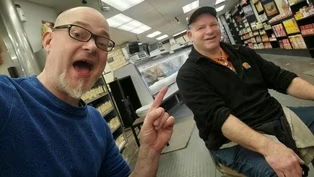
Local businesses featured include Chin’s Place, The Cigar Lodge and DiFeo’s Poultry.
Host Blue Green visits with Jakard the Artist, a former podiatrist who changed careers. Then it’s off to Chin’s Place, offering traditional Cantonese Chinese food, to visit with owner Elaine Chin. The Cigar Lodge is an upscale cigar lounge featuring a movie theatre indoor golf simulator and more. Finally, DiFeo’s Poultry owner Ed DiFeo talks about the products and history of his establishment.
Problems playing video? | Closed Captioning Feedback
Problems playing video? | Closed Captioning Feedback
Around Akron with Blue Green is a local public television program presented by WNEO
April 2023
Season 7 Episode 7 | 26m 51sVideo has Closed Captions
Host Blue Green visits with Jakard the Artist, a former podiatrist who changed careers. Then it’s off to Chin’s Place, offering traditional Cantonese Chinese food, to visit with owner Elaine Chin. The Cigar Lodge is an upscale cigar lounge featuring a movie theatre indoor golf simulator and more. Finally, DiFeo’s Poultry owner Ed DiFeo talks about the products and history of his establishment.
Problems playing video? | Closed Captioning Feedback
How to Watch Around Akron with Blue Green
Around Akron with Blue Green is available to stream on pbs.org and the free PBS App, available on iPhone, Apple TV, Android TV, Android smartphones, Amazon Fire TV, Amazon Fire Tablet, Roku, Samsung Smart TV, and Vizio.
Providing Support for PBS.org
Learn Moreabout PBS online sponsorship(upbeat music) - Hey, out there, Akronites, welcome once again to "Around Akron with Blue Green".
And wow, do we have an amazing show ahead of us today!
I'm gonna head over to Grant Street and learn all about the chicken industry with DiFeo's Chicken.
I'm gonna head over to West Market and learn about Chinese food with Chin's Place.
Then it's off to South Main Street in Portage Lakes to learn all about cigars and bourbon at The Cigar Lodge.
Now, to kick this show off today, I'm gonna meet up with a guy who was a foot doctor for many years, and then after COVID he decided he didn't wanna be a doctor anymore, and he pursued his love of artistry.
Let's go see what Jakard, the artist, is all about.
(mellow acoustic guitar music) - Growing up, I used to always watch artists like John Nagy, and I used to paint and follow their painting on Saturday, and I'd participate.
And then when I got to high school, I went in, I took Art, and I found my passion there.
I even had a couple art shows at high school.
I also, when I got to college, I was a Arts major.
And I had a very, very strict grandmother who told me that I could not feed kids as a starving artist.
And I switched later to Science, Pre-Medical Sciences, and I pretty much left art alone, because she told me I could always paint and hang it on the wall if I want to, and sell it if I want to later on.
(mellow acoustic guitar music continuing) My oldest son was a pilot in the Air Force, called me one day and asked me to come down and watch his dog.
He had just moved into a house, and he had a dog, and he didn't want to put him in a kennel, 'cause he was gonna be deployed for seven, eight months.
So, Papa to the rescue.
I came down and spent that time watching him.
And in the meantime, because I got bored, I went and bought some art supplies, and I started painting.
And I painted the whole time that he was being deployed.
And when he got back, I was gonna throw all the paintings away.
And he told me, "Don't do that.
Never throw anything away."
So everything that I wanted to throw away, he kept, and he went and put it all in frames.
To my surprise, they looked so good, I almost wanted them back, (chuckling) but I let him keep 'em.
And he has those original paintings that I've started, and that's what kinda got me started back painting again.
Since then, I've been painting ever since.
(mellow acoustic guitar music continuing) When I went to college, and decided to change from Art to Pre-Med, I went into the Ohio College of Podiatric Medicine and Surgery.
I graduated.
I later went and did a surgical residency in Kansas, in Leavenworth, Kansas, where I did orthopedics lower extremity surgery.
I then later went into practice.
I had three offices.
And I got married and had a couple of kids.
And recently, because of COVID, I decided that I didn't want to be involved in medicine anymore.
I wanted to do something else.
I wanted to follow my passion.
And that's when I decided, "Oh, it's time for me to pull up my art, start again."
(mellow music) Scientific brain's on one sided, artistic brain's on the other side.
It was a- I guess, when I was in medical school, I used to, even in college, I would draw tests out.
You know, like in embryology, I used my art skills.
So I drew the test out of what the different stages, the embryonic stages that they developed.
So I always used my art skills in medicine, kind of.
That's why I kinda went into surgery, because I could see it.
I can understand it, I can see it in my mind even before I do it.
And that's where the two came.
I saw where the two merged, and now it is time go on.
When I put medicine down, this pops out.
So now I'm gonna be using this a hundred percent.
(mellow music continuing) Everything happens for a reason, and I think that one helps the other to move me forward.
Maybe my studying of anatomy really helps me with people.
I think I'm where I'm supposed to be as a result of combining...
It's like in the Bible, Luke was a physician.
That Book of Luke?
He was a physician.
So he writes from a physician's perspective.
I think God uses those things, uses you and your talent that he's given you for His purposes.
And maybe this was give me...
It was me that thought I could not do caricatures or people.
I shied away from it.
But when I did, all of a sudden, this is what I get.
And I'm looking at it, "Wow, why was I holding back so long?
Why did I think," 'cause in my mind, I thought that I couldn't.
But yet I had developed all of this understanding that gave me this, that people look like they do.
And this is my first effort, and I'm shocked.
I'll just paint.
And my grandmother say, "If you don't sell it, put it on your wall."
(mellow music continuing) - Next up, it's Chin's place over at West Market in Highland Square.
We're gonna learn all about their story, and Chinese cuisine.
Let's go see what Chin's Place is all about.
(mellow keyboard music) - Well, we're immigrants from... My great-great-grandfather came to the United States for the gold mines.
My family came to the United States as chefs from this history.
They came in the 1800s for the gold mine.
Back then, it was my grandfather's father and his grandfather, 1850s, and they worked there till they were senior.
Back then, they couldn't bring their wives and children, so they sent money home.
But the thing is, you really couldn't stay, because you weren't accepted.
It was the Anti-Chinese Exclusion Act that prevented that.
So when they retired and went back home while there was another opportunity to come to the United States.
And so my great-grandfather sent his grandkids, and his siblings sent their kids to culinary school.
And they went to a culinary school in Hong Kong.
And when the call says, "We're looking for chefs," my grandfather ended in Akron, his cousins ended up in Chicago with their licenses.
And so it was like a work passport.
But you couldn't bring your wives, you couldn't bring your children.
So same thing happened from the 1800s to the fifties.
You could come work, but you couldn't stay.
In 1800s, you couldn't even own land or marry in the United States.
So the monies get sent back abroad to take care of your children.
But then, 30 years later, my dad, my mom were married, and they had kids.
My dad was nine when his father came to work in the United States as a chef.
But when we got our papers to come, immigrants, through the natural process, it was 30 years.
I was six-and-a-half when we got the paperwork.
My mom and dad just built their home two years prior, but here was our opportunity to come to the United States, see snowflakes, participate in the modern world, because we came from a tiny little village on the base of a mountain in Taishan, China, which is in Canton, China.
It's about an hour away from the South China Sea.
(mellow keyboard music) A lot of restaurants around here are from Shifu Shan, Taiwan, and it's a different taste.
You can't say, "Chinese food is Chinese food."
Everybody has that misconception.
They're like, "Well, I went to this place.
It tastes different from this place."
I'm like, "Well, it's a big country.
You have influence in inner Mongolia.
We're in the Southeast Asia part, so Buddhism, and spicy, sweet, salty, savory is in the Cantonese cuisine.
So when we introduce our food, we don't talk about, "We're just Chinese food," we're Cantonese food.
So we're from the province of Canton, which is a tropical area.
So our spices, like curry, chilies, ginger, black beans and garlic, and the types of vegetables and seasonings, basically come from our region, and the flavors of sweet and salty, that's the tropics, and we had sugar cane where we come from.
So it's our identity.
You can't say, "Well, Inner Mongolian food or a Taiwan food is similar to Cantonese."
A lot of people think Chinese food's all the same, it's cookie cutter.
No, it's not.
I would ask them the question, well, okay, we could talk about Thanksgiving, the American identity of food.
Okay, if you go to Cape Cod area, their stuffing has oysters in it.
In Ohio, we're looking about traditional stuffing, the celery, the onions, and the plain stuffing.
Then you go down south, you got cornbread stuffing, or even down to the ribs.
So can American food be cookie cutter?
No.
Down to ribs, you got gooey, saucy ribs, you got dry rub, you got vinegary ribs.
I mean, it's different.
And that's why I try to explain to people that Chinese food is not exactly cookie cutter.
(mellow music) So my parents had no credit, so we were intimidated by banks and credit cards.
And then finally, I'm like, to do business, we had to do credit cards.
Everybody's like, "Hey, it's credit cards."
I'm like, "Okay."
So we signed up for credit cards.
And you know, like, wow, here it is.
You're losing two, $3,000 a month of hard-earned money to the credit card company.
Okay, in old days, we had the swipe, and it was dial up.
Sometimes dial up would lock things up, and you'd get busy, you can't ring out.
Okay, so you had to modernize to the internet.
So you buy the little machine that has internet in it, and then you buy internet.
And so it's another cost.
Then I think about all these young people that come in here and wanna ring up a dollar.
In the old days, okay, every swipe, it was a quarter, then it's a percentage.
Then at night you send the money to the bank to deposit in your business account, it's a deposit fee.
Then you got your monthly statement fee.
So all these things, with inflation, kinda hurts a small business.
And, especially with inflation, the cost of doing business, and higher wages, then taxes goin' up, insurance goin' up, it kind of really hurts the little guy.
And in the past, I noticed some neighbors, I was like, "You know, we have small business day.
Pay cash."
It really does help.
I mean, leave it to the big corporations using your credit cards, but the small guy can't absorb it.
That's why there's a minimum fees.
And don't feel like, you know, a little animosity, think of the small business, because it hurts them, and a lotta people don't realize.
You know, you get the statement and you're like, "Oh, they just took $3,000.
There were $4,000."
I'm like, "I could have done this with it."
I could have painted this, or I could have fixed a broken piece of equipment, or I could have paid two dollars more to hire somebody to defray some of the hard work we're doing.
(mellow music continuing) - Next up, it's down to South Main Street to learn all about bourbon and cigar culture at The Cigar Lodge.
Let's go see what they're all about.
(smooth jazz music) - First and foremost, this area is very prominent in the community of Summit and Stark County, because of some things that are really near this location.
The building originally was a car dealership, and I bought it about 20 years ago from a paint store.
And back then, Verizon Wireless was in here.
And when they moved, the building became vacant.
And as an owner of the building, I wanted to put a new business in here.
Often, you contemplate on what that business may be and what that business may not be.
And I knew that something special was in the bourbon and the cigar world, the clientele, the people.
It's a very not high-paced, high fast type of an industry, but it's something that is very dignified, classy, and something that I'd wanna do on an ongoing basis.
So when I was in Las Vegas, at Caesars Palace, I went in and I saw a cigar bar, and it was very classy and fun, and it was something that I could see doing all the way through retirement.
And so when we came back to Akron, just like anything else, people always have their nay sands.
"You can't do something like that in Akron.
That's for Chicago, New York, Las Vegas."
Well, when I thought about where we were located here, right behind us, literally an eighth of a mile, is Firestone Country Club, one of America's top 10 golf courses.
Down the street is Portage Lakes, one of the area's wonderful waterways that people use.
So we're in such a great location between Canton, Ohio, and Akron, Ohio.
We're right in the middle, easy access.
We decided to go ahead and start down the road of a cigar lodge, as we call it.
Now, in the beginning, we weren't sure if we were just gonna do retail, or if we were gonna go into a private.
And so what we've done is we've kind of quasi'd it.
We've painted it mauve.
So we have a private membership program, with 350 private members, and then we are open to the general public.
Again, people from Firestone, people from all over the country coming to Firestone, they need cigars.
This is kinda like the extension of the cigar shop for Firestone.
(upbeat jazz music) When you're a member, the nice thing is is that there's so many more perks that go with it.
It's not a tremendous amount of money to become a member.
What it does is it offers and allows for a revenue stream for those areas of the place that want higher luxury items.
Just like first class on an airplane, or just like the upper rooms in a hotel, they're kind of the suites.
So in our membership program, they give us $50 at the beginning of the month.
Our job's to kinda try to give 'em the money back, 'cause I have learned a long time ago, the closer I get my members to free, the longer they stay.
How do I do that?
I let 'em buy my cigars at wholesale.
They get 20% off, kinda helping them get a refund, giving them a dividend back on their investment of the $50 a month.
And they get a locker.
The locker's humidified.
Just like anything else, you can't buy bulk in the form of a cow if you don't have a freezer to put it in.
So you can't buy bulk in the cigar world unless you have a humidor to put it in.
So the gentlemen have the opportunity to do that.
It's nice, 'cause some people use it for morning time, when they come and get a cup of coffee, do their paperwork for office work.
They might have a cigar.
Some people do, some people don't.
We've morphed into so much more than just a cigar shop.
Some people use us as a $50-a-month for an office.
Some guys don't smoke cigars, they use it as, "For $50, I get a locker that I can put my stuff in, and I can get in here and I can do internet and stuff like that."
As one guy said, it's way cheaper than going to Starbucks.
But, as you'll see around the facility, it makes you feel like you're in a high-end, resort-type of a feeling, and it's your office for the day.
Our members, a lot of the cigar world, likes golf.
Well, boy, what can you do in the wintertime?
Instead of going and paying $50 an hour at these golf simulator places, you become a member.
And you come in, and you can use my golf simulator unlimitedly.
And it's a place for you to bring your guests, 'cause that's what makes us successful, not the 350 members.
They get their money back through the discounts.
What makes us successful is that those 350 members are out in the marketplace, and they're bringing their guests to be entertained.
So when they bring their guests here, and the quality and the high luxury that we offer them, they feel good that they're bringing their guests to a great place, and their guests are gonna feel wonderful, and then they're gonna buy product from us.
And so I kinda like to think of my members as a business partner.
(upbeat jazz music continuing) We are humbled by our members.
I mean, we really do feel that we have 350 business partners.
We feel that those people are the lifeline of what keeps us successful.
We don't have the unbelievable amount of traffic, where it's in, out, in out.
We're not that kind of a cigar store.
We're a luxurious cigar store.
We're above and beyond your typical cigar shop.
And when that comes into effect, what we like to do is make sure that we are able to maintain that quality and that kinda stuff.
And, just like anything else, the cigar lockers, sometimes people move away, sometimes people quit smoking, so we always have a little bit of room.
Right now, out of 350 lockers, I believe we have nine available.
And so we're always looking for new members.
And you know, we never thought we'd be honored enough to have that many.
But if you're looking for somewhere to be part of, you wanna be somewhere where you can come have a cigar in the middle of a snowstorm, hit 20 golf balls, shoot a round of pool, and pretty much be a free system, because you'll get your $50 back through discounts, come on down.
We'd love to have you be part of this team.
That's exactly what we are.
It's 350 of the greatest people, and it's just people that wanna be around you and you be around them.
(upbeat jazz music continuing) - Now, to wrap this show up today, we're gonna go down to Grant Street to DiFeo's Chicken.
They've been serving chicken to Akron for well over a hundred years.
Let's go see what DiFeo's is all about.
(mellow electric guitar music) - Back in the early twenties, there were chicken, people did that as a common practice.
So it wasn't hard to believe that there'd be five, six, seven chicken places on the same street.
So everybody produced chickens and sold them.
So my grandfather was no different.
They sold chickens.
They had a farm, not a farm, but a backyard, where they probably raised some so they could sell 'em.
And they sold them on the street.
We had a picture of all the different signs , and they had, you know, 15 cents a pound, or they sold 'em by the pound.
Some people would just buy the chicken, take it home, and do it themselves.
(mellow electric guitar music continuing) My dad actually grew up in the house that was in the parking lot.
So he was born there, and he spent his whole life in this 50-foot area.
They built this building in the fifties.
Up until then, it was run out of the house.
They lived upstairs, and they had a small storefront, and they sold the chickens onto the street to the people that'd come by.
And there were other chicken places around, but somehow we were able to survive.
(mellow electric guitar music continuing) Well, you know, my dad's intention back in the seventies, it was a little slow back and forth, and he was just a little nervous about if you live in Fairlawn or Copley, or wherever, Cuyahoga Falls, Kent, why are they gonna come here, you know what I mean?
Why are they gonna drive all the way across town?
Well, so then when the fish market and the meat market were here, they had a reason, 'cause they could get their poultry, they could get their meat, and they could get their fish right here in this central location.
So that was his plan: Give 'em a another reason to come, instead of just chicken.
A lot of people were coming for chicken, but maybe they weren't coming back enough.
So my dad built some of these buildings around here, and bought some properties to make parking lots, 'cause he had that vision, that it needed to be that way.
(mellow electric guitar music continuing) It's mostly family.
We do have a couple other workers, but me, my wife, and a lot of our kids.
Some of our kids have other jobs.
They come when they're not working at their other job, but it's mostly family.
And my brother, John, helps us.
He's still here as a worker also.
(mellow electric guitar music continuing) I don't consider myself old, but I've been here 50 years, you know, and it seems like I've been working here for 50 years.
And my son, people remember him when he was four or five years old.
He was carrying boxes, and they always say, you know, "How's...," they can't believe he's 22, (chuckling) 'cause, you know, it was just a few years ago he was carrying their bags to their car.
(mellow electric guitar music continuing) We're just trying to recover from COVID.
And the one thing about our store is, you know, we're DiFeo's, but we're not the store, it's the people's store.
My dad, he wanted it that way.
The people felt like this was their store.
So the neighborhood people and the people come across town, and so we're just trying to, after COVID, everybody's so tired of all the rules and the regulations.
They want to just come in and get their stuff, and enjoy themselves.
So that's what we're trying to produce.
And it's been a lot of fun.
(mellow electric guitar music continuing) Well, the future is a good question.
I want it to stay the same.
I wanna expand a little bit on what we're doing, but to always give the service and the quality, you know?
And I think if you do that, people will give you a break on some of the other stuff that, maybe you can't keep up with the Joneses, but, you know, they wanna come here, and they want it to be the same, you know?
And remember when they took away the windows downtown at the holidays, how many kids said, "Can we go see the windows?"
And they said, "Well, they're not there anymore."
You know, it just, it's a part of you that's taken away.
And I don't want that to happen, because it's definitely like a reunion, for some people to see their friends, family members in the store at the same time they're doing their shopping.
So that's the future, is keeping true to the past.
(mellow electric guitar music trailing off) (rave music) - Thank you once again for watching this episode of "Around Akron with Blue Green".
Now, if you have any questions or any comments, you can reach out to me on social media.
Thank you.
And have an amazing day.
♪ La, la, la, la, la, la, laa ♪ Aa, aa, aah, aa, aa, aa Not that I know how to sing or anything.
(laughing) (clapping) All right.
Serious poker face.
(rave music continuing)
Preview: S7 Ep7 | 30s | Local businesses featured include Chin’s Place, The Cigar Lodge and DiFeo’s Poultry. (30s)
Providing Support for PBS.org
Learn Moreabout PBS online sponsorship













Support for PBS provided by:
Around Akron with Blue Green is a local public television program presented by WNEO