
April 2024
Season 8 Episode 6 | 26m 35sVideo has Closed Captions
Meet civil servants from two government organizations and visit a cancer wellness center.
Learn about Summit County Board of Elections’ commitment to election security and bipartisanship before visiting Stewart’s Caring Place in Fairlawn, a cancer wellness center devoted to cancer patients, survivors and their families. Finally, explore the work of the Ohio Department of Natural Resources in an interview with Jamey Emmert, the avian education coordinator at the Division of Wildlife.
Problems playing video? | Closed Captioning Feedback
Problems playing video? | Closed Captioning Feedback
Around Akron with Blue Green is a local public television program presented by WNEO
April 2024
Season 8 Episode 6 | 26m 35sVideo has Closed Captions
Learn about Summit County Board of Elections’ commitment to election security and bipartisanship before visiting Stewart’s Caring Place in Fairlawn, a cancer wellness center devoted to cancer patients, survivors and their families. Finally, explore the work of the Ohio Department of Natural Resources in an interview with Jamey Emmert, the avian education coordinator at the Division of Wildlife.
Problems playing video? | Closed Captioning Feedback
How to Watch Around Akron with Blue Green
Around Akron with Blue Green is available to stream on pbs.org and the free PBS App, available on iPhone, Apple TV, Android TV, Android smartphones, Amazon Fire TV, Amazon Fire Tablet, Roku, Samsung Smart TV, and Vizio.
Providing Support for PBS.org
Learn Moreabout PBS online sponsorship(upbeat music) - Hey, out there, Akronites.
Welcome once again to "Around Akron with Blue Green."
And, yes, we have an amazing show ahead of us today.
We're gonna meet up with the ODNR.
That's the Ohio Department of Natural Resources.
We're also gonna head over to Stewart's Caring Place.
Now, to kick this show off today, it's off the downtown Akron to the Summit County Board of Elections.
I know a lot of people have opinions about elections, but trust me, the elections are more safe than your banking system.
Let's go see what the Summit County Board of Elections are all about.
(upbeat music) - [Pete] We have a variety of folks who work here and from a variety of backgrounds.
I mean, the board, which is a four-person board, makes all hiring decisions.
And it's a bipartisan board, and our staff is bipartisan.
For pretty much every task here, we have a Democrat and a Republican, and the board will hire those folks.
And a lot of our folks we hire from our seasonal ranks, folks who who come in for an election season.
And when an opening happens, that's usually the first place that we'll look to find people.
So it's very much people that start out because they care about the system.
You have committed people on both sides of the aisle.
They're committed to the ideals of their party, but they're also committed to the system.
It leads to a very productive dynamic because you've got both sides who care about the outside stuff, but really care about making sure that the elections are run well and runs securely.
(upbeat music) Their votes are always safe with us.
And anytime any ballot is handled, you must have members of both parties involved in it.
I, the deputy director, the director, we can't individually handle a ballot.
We need someone from the other party to be with us to do it.
Our voting equipment, that is also only handled in a bipartisan manner, and it's never connected to the internet.
You can't hack it if it's not on the internet.
Our voting equipment never connects to the internet, and we only use paper ballots here in Summit County.
Voters don't have to worry about any of the myths that are out there about those kind of voting machines.
There's a verifiable trail because the ballots are there, and we have an audit after every election to verify that the results are what the machines say they are.
(upbeat music) In Ohio, we have early voting that's both by mail, what would colloquially be called, absentee voting, and then we've got in person early voting.
At Summit County, we have an early vote center right next door to the board offices that's set up just for handling our early voting.
And then, of course, election day at your local precinct, you'll have the opportunity to vote as well.
Those are the primary options in Ohio.
There are certain exceptions for like nursing homes.
We will go out and vote certain nursing homes.
Folks who are in the military or overseas, there are certain options to help them vote.
But for the average voter, you've got early voting by mail, early voting in person, and voting on election day.
(upbeat music) Once you vote, depends on the way you vote, if you vote at the polls or you vote at the early vote center, you feed your ballot directly into a tabulator.
And then those ballots, after they're tabulated, they make their way to our vault.
An election that has federal races on it, we have to keep those ballots for 22 months, and we keep them usually a little longer than that.
The count you'll see is essentially the tabulator count.
But after the election, we do post-election audits.
In particularly close races, we're mandated to do recounts as well.
And both of those processes involve manual hand counting.
What we have found is our results and audits have matched that up with what we're getting in the machines.
And we test the machines before every election.
We have public testing available before every election so that everyone can come in and see us test the machines and confirm that they are matching the results that the voters say.
(upbeat music) To a certain extent, there's only so much you can say to anyone, but our response here as the board is to go about doing our job the right way in a transparent way.
And we'll rest on our results and the way we do things.
And if someone really wants to look at how we do things, they'll see we do things the right way.
And we run fair elections here in Summit County and all throughout Ohio.
And if you don't like the way elections went, work harder on your campaigns because we work very hard to make sure that the results we put out reflect the votes that were cast in that election.
I understand the frustration of losing an election.
It can be frustrating.
But you didn't lose an election because we said you lost an election.
You lost an election because the voters voted for your opponent.
- Next up, it's over to Stewart's Caring Place.
We're gonna learn all about their Cancer Wellness Center.
Let's go see what Stewart's Caring Place is all about.
(upbeat music) - Stewart's Caring Place was founded by Mimi Surloff.
Mimi's husband, Stewart, was a podiatrist here in the area and was diagnosed with cancer.
At the time of his diagnosis, they had two young daughters at home, and Stewart and Mimi saw that the cancer diagnosis was impacting the daughters, Mimi as the spouse, almost as much as it was Stewart himself.
They were having a mental and emotional reaction to watching their father and loved one go through this journey.
So Stewart, unfortunately, passed away, but in 2003, Mimi sought to keep his legacy alive.
They often talked about they wished that there was a place that they could come receive services as a family.
They often wondered what others who were on this journey did who didn't have as tight of a network of friends and family surrounding them.
So Mimi in early 2003 put together a community forum and asked the community if a place like Stewart's Caring Place would be needed and welcomed in the community.
And, of course, she was met with a resounding yes.
So we opened our doors in 2003.
At the time, just offering a few support groups, a few small programs, a wig room, eventually rented some space off of market for quite some time.
And then as the needs of the community continued to grow, she and our executive director at the time, Jeannine Marks, decided to launch a capital campaign to try to find a space where we could have a standalone building where people could find us.
Our doors were open in September of 2020 thanks to the generosity of the community.
(gentle music) We offer supportive services and programs at no cost to anyone impacted by a cancer diagnosis.
This goes back to Stewart and Mimi's experience with how a cancer diagnosis not only affects the patient or the diagnosee, but it affects their caregivers, their spouses, their children, their siblings, whoever it may be.
All of our programs and services here are offered at no cost to anyone impacted by a cancer diagnosis.
And it is not just at the time of diagnosis, we serve anyone regardless of age, the stage of the diagnosis, or the phase of the diagnosis.
We know that oftentimes people put their head down.
They get through the treatment or get through the treatment with a loved one.
And it may be a year or two years later that they really start to understand the emotional and mental impact that cancer diagnosis had on them.
We are a wraparound organization.
What that means is we are an additional resource to the medical treatments that come along with a cancer diagnosis.
We are non-medical, but we offer things like support groups, counseling.
We know that oftentimes hair loss is the first visible sign of disease for some.
And so we have a beautiful wig room where people can come and find a wig in a salon setting to feel more confident about themselves as they're going through this journey.
We offer things like teaching kitchen where we can talk about different ways of eating, healthy lifestyles.
We have physical fitness classes, a food pantry, and so much more.
(gentle music) So at Stewart's Caring Place, we thrive on time, talent, and treasure by those in our community.
We have volunteer opportunities, especially around some of our bigger events.
We always need some people to help with our family programming.
We have a beautiful food pantry that, unfortunately, we just cannot keep up with the the need.
So we ask corporations, organizations to do canned food drives for us to keep our shelves as stocked as possible.
We are fully funded by the generosity of local foundations, grants, and then individual and corporate giving.
(serene music) As a breast cancer survivor myself, I can understand that sometimes there's a hesitancy to admit that you want or need help.
Some people are, myself included, too stubborn to admit that.
But I think just knowing that Stewart's Caring Place is a place full of people who understand what someone on the cancer journey is going through.
Our staff has all been impacted by cancer in one way or another.
So everyone here understands what someone who's been diagnosed or has a loved one who's been diagnosed is going through.
We are welcoming, we are always smiling.
We approach each person who walks through our doors with care and love and respect.
We will laugh with you, we will cry with you.
We will scream and get the emotions out if needed.
So I would say if you're hesitant to come to Stewart's Caring Place, I understand, but just give us a chance.
We have so many people that have experienced Stewart's Caring Place, who they themselves were also hesitant and keep coming back and now have turned into volunteers or friends of Stewart's.
So it's okay.
There's nothing to be ashamed or afraid of.
We are here to walk beside you.
(upbeat music) - Next up, it's over to Portage Lake to learn all about the ODNR, the Ohio Department of Natural Resources.
Let's go see what the ODNR is all about.
(upbeat music) - The ODNR stands for Ohio Department of Natural Resources.
So we're a great big statewide government agency, and our main responsibility is to protect our natural resources.
And there's many different ways to look at that depending on the division within ODNR.
There's many different divisions.
We all have different responsibilities.
I represent the Division of Wildlife.
So as you might surmise, my responsibility and those of my colleagues around me, we are responsible for protecting wildlife resources in Ohio.
We believe strongly in conservation.
And what conservation means to us is to use wisely.
So we want people to enjoy wildlife through hunting, fishing, wildlife, watching, but do so in a respectful manner that protects the populations overall so that we can all enjoy wildlife however we see fit.
So I am an educator.
I bring awareness and education to wildlife species here in Ohio and connecting people with those wildlife species.
But I also work with biologists to conduct research and enter in data to learn more about the populations we have here in Ohio.
And I also work with wildlife officers who enforce regulations and laws that protect wildlife.
And then there's so many other people behind the scenes that make us more productive and efficient as an agency.
So there's about 400 employees in Division of Wildlife alone, but there's thousands of employees across the state who represent ODNR.
So a lot of Ohioans are familiar with the Division of Parks and Watercraft, for instance, if they go camping or hiking, This division encourages people to get outside and just be outside in nature, where Division of Wildlife is little bit more specific to getting outside and pursuing wildlife, whether it's through binoculars or hunting or fishing.
(upbeat music) ODNR is a statewide agencies.
We have field offices and administrative offices throughout the Buckeye State.
We call Akron home for our Northeast Ohio headquarters of Division of Wildlife.
So we're in the heart of Portage Lakes, and that's where our staff reports.
But we have staff speckled throughout northeast Ohio as well as the rest of the state too.
Our Northeast Ohio district office based in Portage Lakes is responsible for 19 northeast Ohio counties.
Our most western county is Lorain County.
And then if you drop south to Millersburg, Holmes County, Amish country, and then east to the Pennsylvania border.
(upbeat music) We are on an island in North Reservoir.
It used to be an old state fish hatchery many decades ago, and it's been converted to our Wildlife District Three office.
It's a beautiful facility.
We have a trail that goes around the perimeter of the island.
It's open to the public Monday through Friday 8-5.
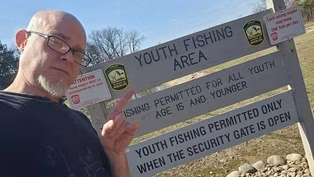
And what we're really known for is our youth fishing area.
So the old hatchery ponds were converted to fishing access for youths 15 and under.
And we had appointments through the week.
We have birthday parties that are celebrated here for little ones.
And so this youth fishing area is open on the weekends, typically Memorial Day through Labor Day, and we provide the bait and tackle, a staff member to help take fish off hooks.
There's restroom facilities and picnic tables, and it's a really fun time.
We are experiencing a renovation right now, which is just getting underway and the ponds are really old.
The infrastructure is very old and needs some serious TLC.
So for the next two summers through 2025, the youth fishing area will not be open because it's undergoing this massive construction project.
But we have partnered with a very important agency also here in Summit County, the Summit Metro Parks.
And so we're encouraging young anglers to head over just a few miles away to Little Turtle Pond where they can pursue all sorts of species of fish and have a similar experience until we open those ponds back up again in 2026.
(upbeat music) This is a public facility.
We want people to come visit with us and spend time on the island, come see our office, walk around, see all the cute and cool wild critters we have in the form of taxidermy wildlife, talk to some staff.
There's so much here to experience.
Myers Island, which is the name of the island on which our district office sits, has been here for many, many decades since the canal system came into existence as far as I know.
And so we've been able to build on this island and have all of our staff report here.
So it's very special in that way, but we're connected to the mainland, so to speak, with just a small driveway.
So it's kind of confusing to people when they pull into the Portage Lakes State Park parking lot right off of Portage Lakes Drive.
If you continue through the gate, you'll see our aquatic education center straight ahead.
It sits amongst the youth fishing ponds, but then you can head on up the hill.
It winds around past a pretty meadow and then another pretty meadow.
And then lo and behold, is our district office straight ahead.
So it's a one-way driveway that takes you up and then another driveway that takes you back down.
(upbeat music) We have a small but very mighty education section consisting of two people for northeast Ohio.
We do programs, we attend events, we conduct public outreach related to wildlife and connecting Ohioans with the outdoors, no matter the age.
So we work with kiddos, we work with adults, so we do as much as we can, and we have colleagues who pitch in.
Even our biologists and our wildlife officers make time for education because we all value it.
So please consider visiting our facility or setting up a time where we can do a program.
You can call 1-800-WILDLIFE or visit wildohio.gov to learn more about the programs that we offer and to connect with someone local to you here in northeast Ohio.
- Now, to wrap this show up today, we're gonna go back to the ODNR and learn all about why it's so important to preserve nature and see what you can do to preserve nature.
Let's go see what preserving of nature and the ODNR is all about.
(gentle music) - [Jamey] Conservation is important to me personally because I care so much about nature.
I want to enjoy nature, I want to experience nature, but I want it to be here for future generations.
I don't even have children of my own, but I care about it so much that I want to make sure that experience isn't stolen from future generations.
It just brings me so much happiness, so much joy to be outside in nature, and especially with other people who appreciate it and respect it the way I do.
And fundamentally, nature is important to our wellbeing as humans.
Without it, we will suffer and there's no argument there.
If we protect the ecosystem and the nature within that ecosystem, we protect ourselves.
(soft music) By the next several decades, within the next several decades, there will be the biggest disconnect ever between humans and nature because so many people are living in cities and concrete jungles.
And that's something that scares the daylights out of me.
That's not good for us, that's not good for nature and wildlife and the priorities surrounding those subjects.
So we need to try to get outside as much as possible.
And it's hard to find the time, but we have to learn to prioritize, even if it's only 15 minutes.
Research has proven that exposure to the outdoors in just 15 minutes time helps reduce our blood pressure, just makes us feel better, puts us in a better mood.
So nature is such a great antidote for a life that's full of stress otherwise.
So we need to try to support those experiences and support endeavors to create those experiences as much as we possibly can.
So getting outside is so important, and it was discovered in the last few years, there was a little bit of an upheaval in our lives.
I don't have to tell anyone that.
And since there were very few options to do what we considered to be our normal lives, a lot of people headed outdoors.
We saw an uptick in hunting license sales, we saw a huge uptick in fishing license sales, people using public areas that are dedicated to nature experiences.
And then it has since calmed down a little bit, but it's still up for some people.
But because we've gone back to what we consider our more normal lives, it's tough to find the time to do those things that we sometimes feel guilty of in taking pleasure because there's so many things that are bothering us and we feel like we are obligated to get done, and that's important too.
But we have to make time for ourselves.
We have to make time for the outdoors because it just makes us better people in the long run.
(upbeat music) There are many ways that Ohioans can help connect with wildlife on whatever level you see fit.
So call 1-800-WILDLIFE, ask some questions, get some guidance if you have no idea where to start.
But what I highly recommend is planting native, even if you have just what you consider a postage stamp lot, you don't have a lot of property, maybe consider putting some native wildflowers in flower pots.
They're not gonna thrive as well as putting the plants in soil in the ground, but it still gives you an opportunity to connect with native wildlife.
If you plant some milkweed or other pretty colorful flowers that are important to insects, you may attract moths, you may attract butterflies, bees, hummingbirds, and then the list goes on and on.
But if you don't or you're not interested in attracting those species, there's many other ways you can help wildlife too.
Planting habitat in the form of vegetation is really important.
Flowers, grasses, trees, shrubs, anything that you can fit into your yard and what you can afford to do.
But there's other steps too, like minimizing window collisions for birds.
That's one of the major elements that influence bird populations negatively is they see a window, they can't differentiate that reflection with what real sky is and real trees are.
So when they see that reflection, they fly into that window thinking they're passing through, when in fact then they come in contact, and it's often fatal.
And this really harms bird populations as a whole.
So minimizing that reflection, there's many different ways to do that.
But basically you need to break up that reflection, put a pretty window cling representing your favorite holiday up on your window or put up curtains, or there's chalk and paint that you can buy specifically designed to minimize window collisions for birds.
So that's a really, really big one.
Keeping cats inside.
It's not only fair to the cats, but it's fair to wildlife too.
One of the biggest factors affecting wildlife populations and specifically wild bird populations is encounters with predators, non-natural predators like cats.
So please consider keeping your cats indoors and minimizing the use of pesticides and other chemicals that harm wildlife.
When you're killing insects, which sometimes is necessary, but please consider minimizing that approach.
When you're killing insects, you're killing a lot of species that depend on insects.
So, for instance, it's hard not to love a chickadee.
Chickadees are beloved by anyone who has ever paid attention to birds because they're so common around us.
They're always calling.
They're so often present.
When they are raising their young, they depend solely on insects.
They eat thousands and thousands of insects within a relatively small space near their nest.
So if you grow wildlife, you grow insects, you're growing chickadee.
So like I said, it's all connected.
So if you need a place to start, you're overwhelmed with the idea, please reach out to us, and we will help guide you in the right direction.
(soft music) - Thank you once again for watching this episode of "Around Akron with Blue Green."
If you have any questions or comment, you can catch me online.
Thank you and have an amazing day.
You are on with Blue Green.
♪ A-B-C, 1-2-3 ♪ A-B-C, 1-2-3 ♪ You're on with Blue Green Now, to kick this show off today, it's down to down.
Now, to kick this show off today, it's over to.
Next up, it's over to Portage Lakes, and we're gonna learn all about.
(gibberish) Tongue tied.
(energetic music)
Preview: S8 Ep6 | 30s | Meet civil servants from two government organizations and visit a cancer wellness center. (30s)
Providing Support for PBS.org
Learn Moreabout PBS online sponsorship













Support for PBS provided by:
Around Akron with Blue Green is a local public television program presented by WNEO