April 21, 2026 | Carolina Impact
Season 13 Episode 1323 | 26m 46sVideo has Closed Captions
CMPD Chief Patterson Speaks; Can Fighters Be Friends? Theatre 50th; AR Workshop Inspires Creativity.
CMPD Chief Estella Patterson on staffing, visibility, crime drops, trust and leading CMPD ahead today; Air Force Veteran David Vipperman reconciles with the Vietnamese he once fought against; The Old Courthouse Theatre in concord has been entertaining audiences for 50 years; & Two local moms took their love for DIY projects and flipped it into a nationwide empire.
Problems playing video? | Closed Captioning Feedback
Problems playing video? | Closed Captioning Feedback
Carolina Impact is a local public television program presented by PBS Charlotte
April 21, 2026 | Carolina Impact
Season 13 Episode 1323 | 26m 46sVideo has Closed Captions
CMPD Chief Estella Patterson on staffing, visibility, crime drops, trust and leading CMPD ahead today; Air Force Veteran David Vipperman reconciles with the Vietnamese he once fought against; The Old Courthouse Theatre in concord has been entertaining audiences for 50 years; & Two local moms took their love for DIY projects and flipped it into a nationwide empire.
Problems playing video? | Closed Captioning Feedback
Where to Watch Carolina Impact
Carolina Impact is available to stream on pbs.org and the PBS app.

Introducing PBS Charlotte Passport
Now you can stream more of your favorite PBS shows including Masterpiece, NOVA, Nature, Great British Baking Show and many more — online and in the PBS Video app.Providing Support for PBS.org
Learn Moreabout PBS online sponsorship(bright music) - [Announcer] This is a production of PBS Charlotte.
- Just ahead on" Carolina Impact."
In an exclusive one-on-one interview, we sit down with CMPD Chief Estella Patterson to talk about her first 100 days in office, where her passion for law enforcement first began, and more.
Plus, how a Vietnam War veteran built unlikely friendships with those he once fought against.
And see how two local moms took their love for DIYing and transformed it into a nationwide empire.
"Carolina Impact" starts right now.
(exciting music) Good evening, thanks so much for joining us.
I'm Amy Burkett.
Charlotte-Mecklenburg Police Chief Estella Patterson's journey has come full circle.
She began her law enforcement career in Charlotte back in 1996, rose through the ranks, went on to lead the Raleigh Police Department, and is now back home leading CMPD.
In this conversation, she opens up with "Carolina Impact's" Chris Clark about what first drew her into the field, what the job has taught her, and the priorities she's worked to put in place during her first 100 days.
- You spent 25 years with senior PD rising up through the ranks.
How is it going to Raleigh and then coming back here, how has that changed how you lead and bringing this to like a full circle moment?
- It felt just natural to come back here to Charlotte.
I know this community, I know this police department.
It's just really a memorable feeling for me to be back.
- What's the thing that you would say coming back here that immediately when you showed up, looked around, that you kind of thought, "You know what?
CMPD needs this."
Fill in that blank for me if you would.
- Hmm, well, I'm gonna say first for Charlotte coming back like, what is the city?
Like, it has just exploded.
There's so many things going on, but looking at the department, the first thing that I noticed was our staffing levels.
I said, "This city is growing tremendously but our police department's not growing commensurate with it."
So I said, "We've got to really start figuring out how do we get the staffing numbers up?"
And we've been doing that and working through it as a department.
- Now that you've been here 100 days, just over 100 days, roughly-ish, we'll say, thereabouts.
What do you feel like you've accomplished that Charlotte can actually see and feel and touch that you could point to that's tangible for people?
- Yeah, I think the biggest thing is just the crime reductions that we're starting to see, right?
So Charlotte has seen reductions in violent crime as well as property crime.
Of course, we're like any big city, you're gonna have those trends, it's gonna ebb and flow, you're gonna have those upticks and that kind of thing.
But I think that we're starting to see that we're getting a handle on our crime, which is good.
And our community is engaged as well.
So this is not just a CMPD initiative or work that we're doing.
Our community members have really come out in force, our community leaders, particularly here in our uptown, and I think you can see it tangibly the difference that it's making.
- You talk about reducing violent crime.
What can you do about that?
I mean, usually, you're all the ones that are called after it happens.
But what can you do to prevent things along those lines and where are you kind of feeling like, you know what, we can do better in that area to help?
- Sure, I think there's a lot of proactive things we can do, from a police department to a community, and let me start with community.
So we always tell our community members, "If you see something, please say something."
No, about amount of information is too little for us.
You know, for instance, we have a camera system in our real-time crime center where residents can be a part of that.
So you can register your camera with us so that if a crime is committed, we can get some leads from it.
But more so for our businesses.
Also too, one of the things I've been impressing upon our officers is that we need to be more visible in our communities.
When I came on the police department 30 years ago, old school policing, you knew your community, you were out in it, you were riding around, you were stopping in, checking in on your businesses.
But if we can just kind of get back to that old school kind of policing, I think it pays dividends.
- And numbers may say this, but the feelings, you know, have people not wanting to go downtown, not wanting to get on, you know, the CATS train.
I mean, how do you kind of bridge the gap and make the perception the reality if you would?
- I believe that for members of our community, they need to see it, they need to feel it, right?
What's the tangible things that is out there?
Because, yes, I can talk about numbers all day long, they're favorable to us, but if you go out there and you don't feel safe that's problematic.
So what we are doing is, really, telling community members to go out, to come to the light rail because we're there.
We're highly visible on the platforms, we're on the train.
We're working very closely with the transportation system and units here in Charlotte to say, "We want this environment to be safe for you.
Trust us, come out, see for yourself" kind of thing.
And I know that trust is earned, we just can't say it.
We have to prove it, and that's what we're about.
- How much pressure do you feel to be a positive example for all the young little girls out there that are coming through to finally see somebody that you know looks like them too in the position you're in?
Because that, I'm not saying it was unthinkable, it wasn't impossible, it was just improbable when things first started with you here.
- Yeah, yeah, yeah, for sure.
Lots of pressure, extreme pressure, because I know there are eyes on me.
Anytime you're a first, everybody's expecting so many things, right?
And if you can't deliver, then you feel like a failure.
But in my eyes, for me, it's about being that positive example.
Showing young women and showing young boys too, anybody.
If you choose a certain profession, you can succeed in that profession.
You can rise to the top because they're looking, and I don't want to be a discouragement to them.
I want them to know that the job is attainable.
But there's a lot that comes with it.
- A lot of pressure in this job.
Where can we find you just kind of getting away from the pressure?
What is it that you do that takes your mind off of things for a little bit that lets you reset?
- Ah, yes.
I'm a big sports person.
And incidentally so is my husband.
We love, not necessarily to play sports, but to watch sports.
And so we're both real big football people, and so we enjoy going to football games.
- I'm assuming your team is, what, practices a couple of blocks from here.
Who is your team?
- Uh, yeah, I don't know I can- - We found the question that stumped her.
Yes.
(Estella laughs) - So my default team is the Panthers.
I'm a Carolina Panthers fan.
- Okay, go ahead and check that box, all right.
- Yes, I support the Panthers, but I'm from California originally, so I really root for the San Francisco 49ers.
- Wow.
- Because of my background.
But I love the Panthers, I love the Panthers.
We don't wanna make any mistakes about that.
- Thank you, Chris.
Chief Patterson says the first 100 days were about setting the tone.
Now she says it's about delivering results, supporting officers, and building safer neighborhoods.
From the front lines of law enforcement, to the front lines of war, it's incredibly rare for people who fought against each other to become friends, but that's exactly the story "Carolina Impact's" Jason Terzis brings us now.
- All right, so picture this.
You are an Air Force fighter pilot serving the United States of America in the Vietnam War.
Some 40, 50 years later or so, you get a phone call with the person on the other end asking if you'd be interested in meeting some of the very same people you once fought against all those years ago.
Would you do it?
David Vipperman of Rock Hill did.
And this is his story.
(music) It's been a long time since David Vipperman stepped into a cockpit.
You're 85?
- 85.
- [Jason] 85.
- We're gonna have some fun.
- [Jason] But it's a place he's very familiar with.
- That's where I went to work.
When I woke up in in the day, that was my office.
- [Copilot] And then you have your seatbelt on?
- I do.
Do I want to accomplish the mission?
Yes.
- [Jason] Today's mission is simple: to enjoy that flying feeling one more time.
- [Copilot] Master on, rotating beacon on, fuel pump on.
- I know there were missions that I flew that a lot of people surely were hurt.
None of us took joy in the destruction we brought to each other.
- [Jason] In many ways, David Vipperman has lived a charmed life.
The Rock Hill native, graduating from The Citadel, marrying the love of his life, Kloo.
- There we are at the ring dance.
- Right, that's our youth.
- [Jason] A family man with two sons, a successful career in education, real estate and banking, and recognized with South Carolina's highest civilian honor: the Order of Palmetto, honoring a lifetime of outstanding service, dedication, and contributions to the state and its people.
- Well, I served in the Air Force about nine years.
(psychedelic rock music) - [Jason] His service to his country, putting David right in the middle of the Vietnam War.
- Our son was six weeks old when he left.
- Most of the missions that I flew were at night over North Vietnam.
- [Jason] David flying the biggest, fastest plane of the time, the F-4 Phantom, - Just advance the throttles and wait a few moments, and you would be passing Mach one and then Mach two, which is twice the speed of sound, about 1400 miles an hour.
- [Jason] A fighter jet so advanced for its time, David felt nearly invincible.
- I felt very confident.
I loved the airplane.
I felt very much at home in it.
It was like putting on a sweater almost.
You just felt like you were one with the airplane.
And at that age you feel a little bulletproof anyway.
- [Jason] David even making headlines in the Rock Hill newspaper after one of his airstrikes.
- I was over there for about nine months.
- [Jason] The Vietnam War ended in 1975.
43 years later, in 2018, David got a call that would change his life - From a former Air Force pilot whom I knew, and he informed me that there was a group putting together a trip to North Vietnam.
It's all Vietnam now.
He wanted to know if I were interested in going.
And I said, "Absolutely."
- [Jason] The proposal: have retired American pilots go to Vietnam at their own expense to meet with the very same people they once fought against.
David recently shared his experience with a group at Lifelong Learning in Rock Hill.
- So the government is not involved, the Air Force is not involved, it's a personal thing.
We're just gonna get together in this room, have a meal together and see what unfolds.
- [Jason] Of course not all veterans were on board with the idea, but definite intrigue for those who agreed to go.
- And the agenda simply says, "And see what happens."
That was all it was.
Are we going to fight?
Are we gonna have outing?
Are we going to get mad at each other?
Are we going to want to punch each other out because we bombed their country, and they shot down some of our friends?
There were 15 of us former pilots that made this trip together.
We met 23 of their pilots.
- Well, I was very happy for him because he wanted to go back to Vietnam, and we just never made those arrangements.
- One of their pilots sitting across the table from me, I could tell that he was giving me the eye.
He said to me, "Did you bomb my country?"
And I said, "Yes, I bombed your country."
He said, "Did you bomb my hometown?"
I said, "What's your hometown?"
He said, "Hanoi."
And I said, "Yes I did."
And he named some other targets that we had attacked, and he asked me was I a part of that.
And I said, "Yes I was."
He said, "You just look like a kind old man to me."
(audience laughs) Those were exactly his words.
And I said, "I'll accept that as a title."
See what happens?
He had decided to be friends in the awfulness of war.
His name is Quy, Nguyen Quy.
He was a great pilot, got shot down by us.
- [Jason] To this day, David and Quy still keep in touch, mainly through email.
- We ask about each other's family.
We pray together at times.
And I thought this is something that's marvelous.
Once an enemy, now a friend.
There is another pilot that I met that has made a difference in my life and his name was Van Bay.
- [Jason] During the war, Nguyen Van Bay is credited with shooting down seven American planes.
But through an interpreter, he made a connection with David.
- There was an acceptance that it just felt right, and that all happened on this same night.
- [Jason] This national hero who had been Vietnam's top pilot during the war, invited David to his family farm some 800 miles away.
They even went to an opera together.
- And as he said to me, he and Quy said, you know, "We didn't know you.
You didn't know us.
We were both doing what our country asked us to do, and we did it and it's over.
Now we can put that aside and have a relationship that amounts to a good friendship."
- [Jason] The reconciliation between American and Vietnamese pilots was a success, but it's impact felt even more one year later.
- 1:30 in the morning, our phone rang and it was Van Bay's son, and he told me that his father had a stroke.
Van Bay had a stroke in his garden and he was dying.
He asked me to call you.
- [Speaker] Wow.
- To have that to happen, it just makes this happen.
(reporter speaking in Vietnamese) - [Jason] Nguyen Van Bay passed away following his stroke, his death making national news across Vietnam and making the impact of his reconciliation with the United States and with David that much more meaningful.
- If it weren't for reconciliation, we as a nation, we as a Christian country, people, would be in deep trouble.
But God has reconciled us.
We can reconcile other people and restore relationships, fix things and go forward.
And that's the hope that I have for our country and for the world.
- [Jason] In David's words, a closing reflection: "The bravest mission I ever flew did not involve weapons."
- Oh, I love that story so much, Jason, because I admit I am friends with the Vippermans.
Kloo and David are some dear, dear friends of ours.
And his commitment to service certainly runs deep in his DNA, doesn't it?
- It does.
And that's the interesting thing about this is that, you know, we talked about David, and obviously everything he's done and having gone to The Citadel and serving the US Air Force, but we didn't really talk too much about the family and both of David's sons and Kloo's sons, ended up following in his footsteps going to The Citadel.
And one, actually, I believe, flies commercial, I think he's with one of the major airlines.
I think it's Delta.
- Absolutely.
- But, you know, so it's a family of aviators is really what it's turned into between the Air Force and The Citadel and now flying commercially - And, again, you won't meet better human beings in the world than the Vippermans.
And so thank you so much for sharing that story with us.
- Yeah, a sweet, sweet couple.
- We've got more living history for you now.
Celebrating its golden anniversary, the Old Courthouse Theatre in Concord has been entertaining audiences for 50 years.
Local artist Mary Snead Boger created it in 1976.
The name came from its original performance location inside the historic Cabarrus County Courthouse.
Now, today its home is inside the old First Baptist Church on Spring Street Northwest.
As producer Russ Hunsinger shows us, the mission remains the same.
(upbeat music) - [Director] So let's go to the top.
♪ I'm gonna get up, get up and do it ♪ - We call the theater the Seven Lively Arts because every art form that you can think of: painting, sculpture, lighting, photography, almost all of them are involved in some fashion in putting on plays these days.
- The mission here is to provide high-quality entertainment for the community of Cabarrus County.
We offer five main stage shows from August through May, three plays and two musicals.
And we are now offering a black box series next door in our Wilson Family Black Box theater.
We offer summer camps for youth, and we are looking at offering workshops as well.
(intriguing music) - You could come to it with any number of skills, and you could come to it completely having never done it before in your life because that's part of the mission of almost every community theater I've ever worked with is to give people an opportunity who've never had one before.
- They're open call auditions for people to come in and audition and get cast in onstage roles, but also technical backstage and have the opportunity to act, work lighting, work sounds, work backstage, work all the technical attributes to go into making a production happen.
- There's a girl in the lake down there.
- There's always a new group that comes in for a show.
You always end up meeting new people, and by the end of the process they're family.
There's that sense of connectedness that happens by the time you've gotten through the other side and when you get to strike and it's that bittersweet moment when the show's over.
But you've made these fabulous new friends that hopefully you will work with again and some you will and some you won't.
♪ Let your freak flag fly ♪ - The show I'm in is "Shrek: The Musical Jr."
and I am Pig Two.
The first line that I have is, "Hello, we can hear you."
I just like being on stage and performing for other people.
Sometimes I feel nervous, but then once the show actually starts, I kind of get more relaxed.
(exciting music) - For me, it's a hobby at the moment.
I like doing it because I love portraying a character on stage and just being someone else.
Ooh.
- That's sharp.
There's a childlike quality to it.
Pretending, stepping in another person's shoes, playing dress up out of the treasure chest.
I do think that there is an element of play in it.
- And it's not just for the people who are on stage.
It reaches out and brings the community, the greater community together because whether you want to be on stage and performing or you just like to come to shows, you get a huge group of people together that share a moment.
And that's important.
- And we have a very, very strong volunteer base.
Some volunteers that actually have been involved since day one for 50 years.
- All right, go.
There are 18 actors in the show, and then there's going to be about 10 people behind the scenes making sure the scenery gets where it belongs, the lights are where they are, the costumes and the makeup and the wigs, and all the other aspects of the show.
And then you've got what we call the front of house people, which are the ushers who help the patrons get into their seats.
You've got the box office people selling the tickets, and then you've got the people in the concession stand, all necessary to make the play happen and all volunteers.
- I think what's really special about this place is we've been going 50 years strong in the community, providing high-quality entertainment on a volunteer basis.
Everyone here is a volunteer that does it for the love of the arts.
It gives you space to be yourself, to be creative, and I think it's important to provide a safe space for the community to be able to do that.
- Thank you, Russ.
The Old Courthouse Theatre's next show is "Sweet Charity," which runs from April 30th to May 10th.
Wrapping up tonight from fine art to art everyone can create.
What started as two local moms sharing their passion for DIYing Online has now turned into a brick and mortar empire with approximately 80 franchises across the country.
"Carolina Impact's" Dara Khaalid and videographer John Branscum show us how it happened.
(light pop music) - [Dara] We all know that feeling of trying something new.
- It's not going great, but that's okay.
- [Dara] The frustration of wrapping your head around, or in this case, your fingers around a concept you've never encountered before.
- [Alicia] I think I messed up in the beginning.
- [Dara] For many taking the chunky knit blanket workshop at AR Workshop in Pineville, making mistakes is just part of the process.
- You'll learn more from your failures than your successes.
So I'm learning a lot.
- Those failures are okay because instructor Laurie Radke is there to help undo them and get attendees back on track.
- Sometimes people, when they start making it, they're questioning why they did that, but they get the hang of it.
- [Dara] This three-hour class doesn't require any knitting needles, just their hands and a special method.
- [Laurie] You're taking your working yarn, wrapping it around your hand, crossing over, and then you're gonna slide your hand out to create a slip knot.
- [Dara] This creates a braid-like pattern, and as they repeat this process over and over with their fuzzy, colorful yarn, the ladies' blankets come together beautifully.
- I get to meet new people, hang out with old friends, and walk away with something, yeah, that I can use.
- [Dara] Which makes all those initial frustrations worth it In the end.
- They're surprised that they finish it in the amount of time and then they get to take it home, and it's a really comfy, cozy blanket.
It holds you in and makes you not wanna get off of the sofa.
- [Dara] That feeling of accomplishing a DIY project is something AR Workshop founders Adria Ruff and Maureen Pike know all about.
- I've always designed interiors in my own home and lots of DIY, I love DIY.
I love to look at something that you can purchase and think, oh, how can I make this better?
Or how can I make it on my own for less money.
- I would take paint chips and create collages and turn it into artwork, which was really cool.
That was one of my favorites.
- [Director] In 2016 when the two friends opened the doors to their flagship boutique DIY studio in Pineville, they wanted people in the community to feel that same sense of pride, completing projects they made with their own hands too.
- We're happy that they come here for almost like a sanctuary.
We know that we're empowering lots of women to be able to use power tools or to be able to create artwork that they may not be able to do on their own.
- [Dara] Aside from the hands-on classes that the company hosts, there are several other ways for people to explore their creativity at AR Workshop, like the craft bar where they can make jewelry, the hat bar where they can customize trucker hats so they actually look cute, and then there's the newest edition, the pouch bar.
- They pick their favorite color pouch, their favorite size they like, and then we have a whole selection of very quality patches that are actually permanent adhesive.
So, you know, you can pick any color of different icons or your letters.
- [Dara] This fun isn't just happening in Pineville.
There are nearly 80 franchises across the country.
- It was all just through word of mouth, people seeing it in social media, and women and men wanting to feel empowered to open their own business.
I didn't wanna keep it just in Pineville.
It's too great to not share with everybody.
- [Director] Maureen and Adria's business journey together didn't begin in 2016 with a brick and mortar store.
Six years before, they started a design company called Anders Ruff where they specialized in party styling, graphic design, and ran a blog and online shop.
- We just kept getting busier and selling more and doing more with our graphic design, and we got to the point where it was going really well.
We were working with magazines and movie industry, and they were hiring us to do graphic designs for printables.
- [Dara] Everything was going well until a pretty big competitor changed the game.
- Then Pinterest happened.
Once Pinterest happened, people were starting to put graphic design printables on there for free that you could download for free.
And so it started to compete with what we could do.
- [Dara] Which meant the duo had to figure something out.
But instead of giving up, they decided to pivot.
And that pivot led to where they are today.
- We thought let's bring the experience to a brick and mortar and really kind of offer a variety of projects and mediums and everything from your walls, art for your walls to your couch with pillows, and we've evolved over the years to different experiences.
- [Dara] When you see Adria and Maureen laughing together and reminiscing on memories they've made, it's easy to think they've known each other all their lives so no wonder they went into business together.
But the reality tells a very different story.
- And when we first launched our original business, we had known each other for a couple weeks.
I'm not kidding.
- [Director] Yes, you heard that right.
They were complete strangers.
But wait, the story gets even better.
- When Maureen and I met at our preschool open house, she originally thought I was the teacher because I was dressed up and it was kind of comical because I'm so not a teacher.
- If we wouldn't have gone to that preschool open house back in 2010, we would've never met.
- [Dara] And their businesses would've never launched, which means opportunities for these ladies to connect and challenge themselves in this chunky knit blanket workshop would've also never happened.
It just goes to show that being ready to seize any opportunity can truly pay off, not just in business, but in friendships too.
For "Carolina Impact," I'm Dara Khaalid.
- Thanks, Dara.
AR Workshop has lots of spring-related programs.
You can find details on our website at pbscharlotte.org.
Before we leave tonight, I'd like to thank the homeschoolers from Statesville who joined us in the audience.
They were fantastic.
I loved getting to know them and learning about all the things they love and all the great things that they will do with their lives in the future.
It's going to be very exciting to see what these young people do.
Well, thanks so much for joining us.
We always appreciate your time, and I look forward to seeing you back here again next time on "Carolina Impact."
Good night, my friends.
(upbeat music) (upbeat music continues) (bright music) - [Announcer] A production of PBS Charlotte.
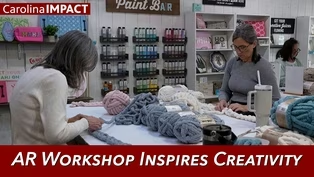
AR Workshop Inspires Creativity | Carolina Impact
Video has Closed Captions
Clip: S13 Ep1323 | 5m 55s | Two local moms took their love for DIY projects and flipped it into a nationwide empire. (5m 55s)
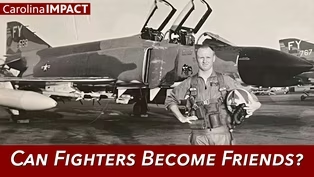
Can Fighters Become Friends? | Carolina Impact
Video has Closed Captions
Clip: S13 Ep1323 | 8m 21s | Air Force Veteran David Vipperman reconciles with the Vietnamese he once fought against. (8m 21s)
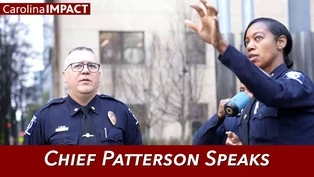
CMPD Chief Patterson Speaks | Carolina Impact
Video has Closed Captions
Clip: S13 Ep1323 | 5m 52s | Estella Patterson on staffing, visibility, crime drops, trust and leading CMPD ahead today (5m 52s)
Old Courthouse Theatre 50th | Carolina Impact
Video has Closed Captions
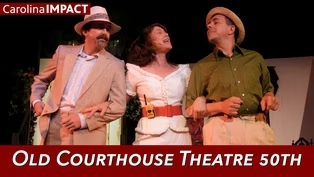
Clip: S13 Ep1323 | 4m 25s | The Old Courthouse Theatre in concord has been entertaining audiences for 50 years. (4m 25s)

April 21, 2026 Preview | Carolina Impact
Preview: S13 Ep1323 | 30s | CMPD Chief Patterson Speaks; Can Fighters Be Friends? Theatre 50th; AR Workshop Inspires Creativity. (30s)
Providing Support for PBS.org
Learn Moreabout PBS online sponsorship New Episode
- News and Public Affairs

Top journalists deliver compelling original analysis of the hour's headlines.

- News and Public Affairs

FRONTLINE is investigative journalism that questions, explains and changes our world.
 New Episode
 New Episode
 New Episode
 New Episode
 New Episode
 New Episode
 New Episode
 New Episode

 New Episode
 New Episode
Support for PBS provided by:
Carolina Impact is a local public television program presented by PBS Charlotte