
April 23, 2023 - PBS News Weekend full episode
4/23/2023 | 26m 44sVideo has Closed Captions
April 23, 2023 - PBS News Weekend full episode
April 23, 2023 - PBS News Weekend full episode
Problems playing video? | Closed Captioning Feedback
Problems playing video? | Closed Captioning Feedback
Major corporate funding for the PBS News Hour is provided by BDO, BNSF, Consumer Cellular, American Cruise Lines, and Raymond James. Funding for the PBS NewsHour Weekend is provided by...
April 23, 2023 - PBS News Weekend full episode
4/23/2023 | 26m 44sVideo has Closed Captions
April 23, 2023 - PBS News Weekend full episode
Problems playing video? | Closed Captioning Feedback
How to Watch PBS News Hour
PBS News Hour is available to stream on pbs.org and the free PBS App, available on iPhone, Apple TV, Android TV, Android smartphones, Amazon Fire TV, Amazon Fire Tablet, Roku, Samsung Smart TV, LG TV, and Vizio.
Providing Support for PBS.org
Learn Moreabout PBS online sponsorshipJOHN YANG: Tonight on "PBS News Weekend," recent high-profile shootings reignite the debate over so called Stand Your Ground laws.
Then I'll look at how artificial intelligence is being used to create hoax images and sounds known as deep fakes.
JACK STUBBS, Vice President Of Intelligence, Graphika: It's almost impossible to ascertain what is true and what is false.
And the scary thing is we don't actually know how that is going to play out yet what impact that will have on us.
JOHN YANG: And how climate change is raising tensions over control of the Arctic resources and shipping routes.
(BREAK) JOHN YANG: Good evening.
I'm John Yang.
The United States has joined the exodus of foreign diplomats out of Sudan as fighting sends the North African nation deeper into chaos.
U.S. special forces airlifted nearly 100 Americans, most of them U.S. Embassy staffers out of the country by helicopter, taking them to Ethiopia.
But U.S. officials say it's still too dangerous to stage an evacuation of the estimated 16,000 private American citizens trapped in Sudan.
Republican Senator Lindsey Graham was asked about that today on CNN State of the Union.
SEN. LINDSEY GRAHAM (R) South Carolina: Should, yes, I'm worried.
You got thousands of people in the middle of a civil war.
And right now if I were an American in Sudan, I would shelter in place and hopefully we can find a way to end the fighting, get humanitarian aid and get our people out.
JOHN YANG: UN agencies report tens of thousands of Sudanese have already fled the country.
Millions more are left sheltering in their homes as food and water grows increasingly hard to get.
Former Vice President Mike Pence has drawn another direct contrast with his former boss Donald Trump, this time on abortion.
At a gathering of Evangelicals last night in Iowa, Pence said Trump's position that post Roe abortion laws should be left to the states to decide isn't good enough.
Pence said a nationwide ban on abortion after 15 weeks of pregnancy should be considered though he stopped short of endorsing the idea.
MIKE PENCE, Former U.S. Vice President: But I don't agree with the former president who says this is a state's only issue.
We've been given a new beginning for life in this country.
I think we have an opportunity to advance the sanctity of life, move it ever closer to the center of American law.
JOHN YANG: Pence said he hasn't decided yet whether to run for president.
On the Democratic side, President Biden is expected to announce his reelection campaign later this week.
And the once ubiquitous retailer Bed Bath and Beyond filed for bankruptcy today, and said that later this week, it will begin the process of closing its 360 outlets around the country.
The 52-year-old home goods chain has been losing money for years, and a series of recent turnaround efforts have failed.
The company said its 120 Buybuy Baby locations will also begin store closing sales on Wednesday.
Still to come on "PBS News Weekend," how artificial intelligence is being used to create hoax images online.
And the race for valuable resources and shipping routes in the Arctic as melting ice opens up new possibilities.
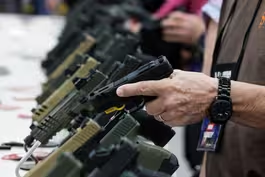
(BREAK) JOHN YANG: This month in the space of a single week four young unarmed Americans were shot one of them fatally over simple everyday mistakes, pulling into the wrong driveway, ringing the wrong doorbell, getting into the wrong car in a parking lot.
These high profile cases have reignited the debate over self-defense and what justifies the use of deadly force.
According to the National Conference of State Legislatures, about 30 states have some form of so called Stand Your Ground laws.
They expand on a person's right to use force if they feel threatened.
Robert Spitzer is a Professor Emeritus of Political Science at the State University of New York at Cortland.
His latest book on U.S. gun policy is "The Gun Dilemma: How History is Against Expanded Gun Rights."
Mr. Spitzer, there are differences from jurisdiction to jurisdiction in these laws.
But what's the general principle?
What's the general idea of Stand Your Ground laws?
ROBERT SPITZER, State University of New York, Cortland: Well, there are two parts to the Stand Your Ground laws that are relevant.
The first is the general idea that if you're in a public place, and you are attacked, or somebody is about to do you grievous bodily harm, or even to kill you, instead of leaving this public place, if you could do so safely, which is a standard, some states have, Stand Your Ground laws so you can stay where you are, and resist force with force even to the extent of killing the other person.
So that's the Stand Your Ground idea, which itself I think, is somewhat controversial in legal circles, but there's an added dimension to this, which began when the state of Florida enacted a heightened Stand Your Ground law in 2005, that not only adopted the standard ground standard, but made it as they said in the law and absolute and irrevocable presumption that an individual who kills or harms another has acted in self-defense and cannot be prosecuted.
This began the spread of a heightened Stand Your Ground law in many states that change the legal presumption.
So, if you make a stand your ground claim, all you need to do is say I felt that I my life was in danger, or that I was going to be grievously harmed.
And that standard then places the burden on investigators, police prosecutors to try and make the case that No, you really didn't face the threat to claim.
And this shift in the legal standard has really opened the door wide for people to make Stand Your Ground type claims.
And in many instances, not all, obviously, to avoid any kind of prosecution.
And that widening of Stand Your Ground stand your ground on steroids, or some even call it a license to kill or shoot first laws.
That is what has really come to the country's attention in recent years.
JOHN YANG: Where does this idea come from?
Is it rooted anywhere in the sort of the history of gun laws in America?
ROBERT SPITZER: Well, Stand Your Ground laws take an older idea, something called the castle doctrine, an old principle that people may have heard of the castle doctrine goes back to the Middle Ages, a person's home is one's castle, that is to say you have a right to retreat into your home and feel safe there.
And if somebody intrudes within your home, you're entitled to defend yourself and not leave your home.
That idea goes back to the Middle Ages in Britain, it came to the United States.
But in the 19th century, another idea evolved.
And that was the standard ground idea.
That is to say, if you're in a public place, the principles of the castle doctrine in your home could apply to you in the public realm.
That is to say, instead of safe retreat, which is the legal standard, even today, in many states, you could meet force with force.
JOHN YANG: The idea behind these the sponsors of these bills and backers said it was intended to curb crime.
Is there any way of telling the result of these laws?
ROBERT SPITZER: There is zero evidence that Stand Your Ground laws of recent years have deterred crime, or improved public safety.
And a host of studies.
Numerous studies have demonstrated that what we see when these Stand Your Ground laws are enacted, is an increase in homicide and gun homicide.
For several studies have found an increase between eight and 11 percent in homicides in states after they adopt these laws, the state of Missouri which has come under focus, just in recent days, and not adopted to Stand Your Ground law in 2016, and also eliminated pistol permitting for pistol carrying, and indeed, Missouri witnessed an even larger increase in its homicide rate thereafter.
In addition, there's a race problem, which is that these laws tend to be administered in an inappropriate way between the races.
So if a white person kills another kills a black person, let's say it makes us stand your ground claim, that claim is much more likely to be accepted than the reverse.
Then there are studies that support that conclusion.
So it is deeply problematic at UK and indeed law enforcement and prosecutors have generally opposed the enactment of these laws.
JOHN YANG: You mentioned permitless concealed carry.
These two sort of trends.
We've now had the 26 state of Florida have a law that you don't need a permit for concealed carry, combined with the Stand Your Ground laws, what is the effect?
Or what do you think could be the effect?
ROBERT SPITZER: Well, it means more civilians owning guns and more civilians carrying guns with them around in society in now 26 states, and civilians lack the training, skill, judgment and the likelihood of mistakes or the likelihood of road rage or the likelihood of spontaneous anger resulting in the deployment and firing of a gun by a person carrying it are much greater and the murder statistics bear that out.
JOHN YANG: Robert Spitzer, thank you very much.
ROBERT SPITZER: You're most welcome.
JOHN YANG: As technology grows most sophisticated sodas the potential for deception.
Last month, images went viral purporting to show police arresting Donald Trump and the former president in an orange prisoner's jumpsuit, but they were fakes.
Trump hadn't even been indicted yet.
There have also been lots of other so called Deep Fakes on social media, including an image supposedly showing Pope Francis wearing a stylish, puffy jacket.
William Brangham spoke with Jack Stubbs, the Vice President of intelligence at Graphika, a research firm that studies online disinformation, WILLIAM BRANGHAM: Jack Stubbs, thank you so much for being here.
Before we get into the weeds of this, can you just start with a clear definition of what a deep fake actually is?
JACK STUBBS: It's a good question.
And it's one probably a lot more people are asking themselves and they were a few months ago.
Deep fake is often the word used to describe a piece of media content that has been created by artificial intelligence.
And typically, you would use the fake to refer to an AI generated media content that is also misleading.
So portraying something that hasn't happened.
WILLIAM BRANGHAM: So I showed some of those examples of deep fakes that we've seen circulating recently.
How else are deep fakes being used today?
JACK STUBBS: I mean, we see this type of technology being used across the board.
And a lot of it has a very legitimate use case, you know, some fantastic piece of art, for example, have been created using this technology.
But unfortunately, you know, as with anything, people will use it for good things, but there will be people out there that use it for less good things, and some that are outright bad.
At Graphika, we study and kind of analyze a whole host of different harmful online pages from politically motivated influence operations by foreign nation state actors to coordinated harassment campaigns.
And what we're seeing is that this technology is kind of having an impact across all those different arenas.
WILLIAM BRANGHAM: And how easy is this technology to use?
I mean, I think people are familiar with old school, sort of Photoshop, and how to creating those images requires a certain level of technical knowhow.
Is this technology similarly difficult to master?
JACK STUBBS: Well, that's one of the things that's really interesting.
And that's probably how much stuff has changed over the last six months.
So, this type of technology using, you know, computers to create images, or video has been around for a long time, right?
I mean, special effects have existed in the in the movies for decades, and they've got increasingly good.
But what we're seeing now is that the sophistication of the technology is increasing, but at the same time is becoming more accessible.
So the majority of these tools are now available for anyone to use on the Internet for just a handful of dollars and a subscription fee.
And that means more people can do it.
And the stuff that able to do with it.
There's a wide variety of outputs.
WILLIAM BRANGHAM: I mean, some of these examples are pretty harmless.
I mean, I thought the pope looked pretty swanky in that puffy coat.
But it's not too hard to imagine the darker side of all of this.
Can you sketch out some of the scarier possibilities for this?
JACK STUBBS: Yes, possibilities and also things we've seen, you know.
So for example, we very closely track, state aligned influence operations from a host of different countries that are targeting political conversations United States and other Western countries.
We recently saw a Chinese state aligned influence operation, using AI generated fictitious avatars in their videos to create content about domestic political issues like gun violence, and then try and distribute them online to influence the conversation so authentic online people are engaged.
WILLIAM BRANGHAM: I mean, do we have any way I know this is a tricky thing to try to measure.
But is there any way to know whether or not people are actually being fooled by these things?
JACK STUBBS: It's very tricky to measure and it probably comes down to a case by case basis but I mean, the that image of the pope in a very swanky puffer jacket is a good example.
A lot of people including myself, I mean saw that and thought notes it's probably true and it's quite funny.
Most of these outputs whether it's AI generated video or images, I mean, they don't stand up to kind of deeper inspection and scrutiny.
You'll see that maybe the hand is actually quite blurred or they're often quite bad at that showing text.
But what they're good enough to basically kind of pass it a cursory glance.
And that's the nature of the internet, right?
I mean, it's an attention deficit environment.
And people don't often look at things for more than a few seconds before making a reaction or feeling a certain way.
WILLIAM BRANGHAM: When we saw recently, with regards to artificial intelligence that Elon Musk and another of other prominent tech people called for a moratorium sort of pause on the development of those technologies.
Has anyone called for a moratorium on the use of deep fakes?
JACK STUBBS: Not that I'm aware of, and I'm not sure that would be practical or possible to enforce, honestly.
WILLIAM BRANGHAM: Because the cat out of the bag, so to speak.
JACK STUBBS: Yes, the cats out of the bag, the technology is available, and folks are going to express themselves in good and bad ways.
You know, regardless of what we try to do about it, and just emphasizes a lot of really positive and legitimate use cases for this technology.
Not just in terms of deep fake images.
But you think about the technology we now see with language models and things like ChatGPT, this is an amazing tool.
I mean, it can organize holidays for you.
And write emails and be a basically a personal assistant.
But as with any technology, as well as least legitimate kind of good faith use cases, you'll see that bad actors also use it for bad use cases, whether that is conducting an authentic influence operation or coordinating an online harassment campaign.
WILLIAM BRANGHAM: So you're part of an organization that studies disinformation, how do we go about helping people combat this?
JACK STUBBS: I think we need to talk about it.
And that not particularly original book kind of tried and tested answers, a lot of it comes down to education and media literacy, as we were discussing earlier.
You know, many people don't interrogate the sources of media that they see online for more than a couple of seconds.
But we need to ingrain a reaction at the people of this is a really interesting and funny picture of the Pope and a puffer jacket isn't actually true.
And how do I know that?
And how is it making me feel?
And what is going to be my reaction?
After I've kind of made that more informed and thoughtful assessment.
WILLIAM BRANGHAM: You mentioned how if you really scrutinize these images currently, you can usually find flaws in the in the visual detail that are a tip off.
But we know that technology is getting better every day and will continue to get better.
Do you think in this ongoing war between fact and fiction, which side is going to win out?
JACK STUBBS: I can't say which side is going to win out and I want to be optimistic.
You know, humans have existed for a long time and technologies, you know, had multiple leaps forward that has brought these really profound impacts to the way we live.
And, you know, for the most part, we're actually still in a fairly good place.
But we're accelerating in terms of the speed at which we're heading towards this situation that some people refer to as zero trust, you know, this, this environment, particularly online, where it's almost impossible to ascertain what is true or what is false.
It's not just being presented with, you know, something that never happened to be convinced it's real.
But also on the flip side, where there can be perfectly real world legitimate, authentic events, but it's impossible to verify that's the case.
For example, the Access Hollywood tape from a few years ago, if that was released a day, it'd be very easy to argue that that wasn't real, and we're very hard to prove otherwise.
WILLIAM BRANGHAM: All right, that is Jack Stubbs, the research organization Graphika, thank you so much for being here.
JACK STUBBS: Thanks for having me.
JOHN YANG: No research shows that climate change is causing the Earth's ice sheets to shrink even faster than previously thought.
The annual rate of sea ice loss has more than tripled since the 1990s.
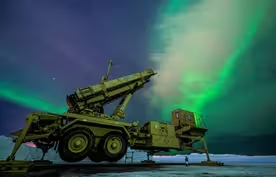
In the Arctic, melting ice is raising geopolitical tensions, kickstarting a race for potentially priceless minerals, oil deposits and shipping routes.
Lisa Desjardins takes us into the global contest at the top of the world.
LISA DESJARDINS: Ice in the Arctic is getting thinner by the day.
The endless thick ridges of ice and landscapes of snow are on the way to being things of the past.
That thinning is transforming, making the Arctic easier to navigate drill, and mine bringing new possibilities.
JOE BIDEN, U.S. President: The energy that's going to be produced there estimated would count to 1 percent, 1 percent of the total production of oil in the world.
LISA DESJARDINS: But also bringing new problems.
EDWARD STRUZIK, Queen's Institute for Energy and Environmental Policy: It's warming up four times faster than any other part of the world.
LISA DESJARDINS: Edward Struzik is with the Institute for Energy and Environmental Policy at Queen's University in Canada.
He's journeyed to the Arctic almost every year for the last last four decades EDWARD STRUZIK: I was in the Arctic last summer and what struck me was the number of exploration sites rare earth mining exploration sites that dotted the landscape.
LISA DESJARDINS: And more are coming.
SEN. LISA MURKOWSKI (R) Alaska: This is an extraordinarily significant project for the state of Alaska.
SEN. DAN SULLIVAN (R) Alaska: This is a really important question not just for Alaska, for America.
LISA DESJARDINS: Last month, the Biden administration gave final approval for the Willow Drilling Project long sought by one of the country's biggest oil companies, ConocoPhillips.
On the one hand, it could be an economic boon, including an estimated eight to $17 billion for state and federal governments.
But environmental and indigenous groups estimate the oil produced will add emissions.
Emissions equal to an extra 1.7 million cars on the road for 30 years.
KAREN PLETNIKOFF, Aleutian Pribilof Island Association: Definition has a great opportunity to invest in the things that could build a stronger economy that could help us be more prepared for the impacts of climate change that can demonstrate our moral authority and leadership in the world.
LISA DESJARDINS: Alaskan Karen Pletnikoff runs the environment and safety program at the Aleutian Pribilof Islands Association, an area directly affected by projects like Willow, Pletnikoff worries how opening up this region could impact indigenous communities there.
KAREN PLETNIKOFF: Yununga (ph) people have been on our islands and waters for 10,000 years, we want to see another 10,000 years.
LISA DESJARDINS: But now some world powers increasingly are eyeing the Arctic and glaring at one another.
Look at the map.
On one side of the Arctic states, Greenland, Canada and the U.S. add up their northern most coastlines, and they still fall short of Russia's Arctic border of a 15,000 Miles, 53 percent of the Arctic frontier.
And with Moscow's invasion of Ukraine, Russia is moving away from collaboration.
EDWARD STRUZIK: The Russians have been a signatory to many international agreements on monitoring climate, weather, pollution, search and rescue, polar bear research, whale research, peatland ecology, and I find it really kind of tragic, you know, that the geography of hope is now turning into the geography of despair.
LISA DESJARDINS: As Russia slips away from diplomatic ties, its military forces are expanding.
In February, Russian bombers flew over the Bering Sea close to Alaska and Canada's borders.
U.S. and NATO Allies responded last month with a joint military exercise in Norway.
It is a climate driven military posture.
MICHAEL KLARE, Author, "All Hell Breaking Loose": The Arctic is becoming very important as a future battlefield.
LISA DESJARDINS: Michael Klare is the author of "All Hell Breaking Loose" about the military and climate change.
MICHEAL KLARE: The more we look into the future, climate change is going to have an increasingly severe impact on U.S. national security.
And of course, the Arctic is one area where that's especially the case.
LISA DESJARDINS: That thought is echoing in the halls of Congress, Alaska Senator Lisa Murkowski recently warned.
LISA MURKOWSKI: The reality is that the threats that we're watching very carefully, where are they?
It's Russia.
It's China.
We are the eyes and the ears.
We are protecting that front line.
MICHAEL KLARE: Remember the balloon that came over the United States, went across Alaska on its way to the U.S. because that's the way planes or missiles or balloons will travel from China to the United States or from Russia to the United States.
The Arctic is the shortest route.
LISA DESJARDINS: Arctic water routes appearing for the first time in recorded history could cut global shipping distances by over 4,000 miles.
That's about two weeks of precious travel time.
Claims of ownership and sovereignty are already being tested in these new open waters.
For example, Canada claims jurisdiction over the Northwest Passage, but that ownership is challenged by the U.S. and others.
EDWARD STRUZIK: What of China decides at some point that they're just going to test those waters and pass through what is Canada going to do.
MICHAEL KLARE: For China, the Arctic is important because it's the leading shipper of goods, imports and exports in the world.
And a passage through the Arctic from the Pacific Ocean to the Atlantic Ocean would be extremely useful to them if that were to open up.
LISA DESJARDINS: Is the whole map going to go into change?
Our maps in the future going to look significantly different?
MICHAEL FLARE: I think we are going to be looking at the map differently.
There'll be more traffic.
There'll be cruise ships going into the Arctic, more of fishing will be there and of course you have this military competition occurring in a place where that never occurred before.
LISA DESJARDINS: The old Arctic ice pack stood and was relatively isolated for thousands upon thousands of years, but now a new Arctic is a modern flashpoint for the world's biggest struggles over resources, and the future of the Earth itself.
For "PBS News Weekend," I'm Lisa Desjardins.
JOHN YANG: And that is "PBS News Weekend" for this Sunday.
I'm John Yang.
For all of my colleagues, Thanks for joining us.
Have a good week.

How AI is being used to create ‘deepfakes’ online
Video has Closed Captions
How artificial intelligence is being used to create ‘deepfakes’ online (7m 44s)
‘Stand your ground’ laws scrutinized after recent shootings
Video has Closed Captions
‘Stand your ground’ laws under scrutiny again after recent spate of shootings (6m 6s)
Tensions rise as nations race for resources in the Arctic
Video has Closed Captions
Tensions rise as nations race for valuable resources in the Arctic (6m 45s)
Providing Support for PBS.org
Learn Moreabout PBS online sponsorship
- News and Public Affairs

FRONTLINE is investigative journalism that questions, explains and changes our world.

- News and Public Affairs

Each week, explore science, health, and technology headlines with leading experts.












Support for PBS provided by:
Major corporate funding for the PBS News Hour is provided by BDO, BNSF, Consumer Cellular, American Cruise Lines, and Raymond James. Funding for the PBS NewsHour Weekend is provided by...