Vermont This Week
April 26, 2024
4/26/2024 | 26m 46sVideo has Closed Captions
Vt. House Approves Property Tax Bill, Concerns Over Increases Remain
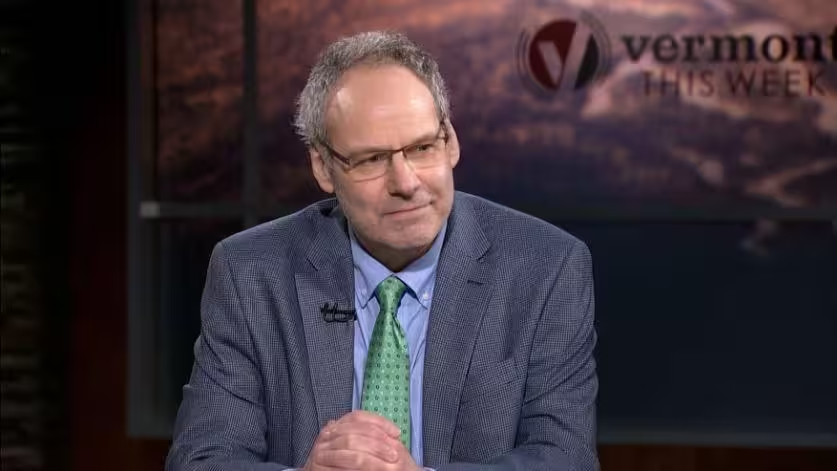
Vt. House Approves Property Tax Bill, Concerns Over Increases Remain | Divided Senate Committee Votes to Recommend Saunders as Ed Secretary | Gov Signs Bill Prohibiting Negligence Claim Relating to Sexual Conduct | Panel: Cat Viglienzoni - Moderator, WCAX; Lola Duffort - Vermont Public; Stephen Biddix - NBC5; Sarah Mearhoff - VTDigger.
Problems playing video? | Closed Captioning Feedback
Problems playing video? | Closed Captioning Feedback
Vermont This Week is a local public television program presented by Vermont Public
Sponsored in part by Lintilhac Foundation and Milne Travel.
Support provided by:


Vermont This Week
April 26, 2024
4/26/2024 | 26m 46sVideo has Closed Captions
Vt. House Approves Property Tax Bill, Concerns Over Increases Remain | Divided Senate Committee Votes to Recommend Saunders as Ed Secretary | Gov Signs Bill Prohibiting Negligence Claim Relating to Sexual Conduct | Panel: Cat Viglienzoni - Moderator, WCAX; Lola Duffort - Vermont Public; Stephen Biddix - NBC5; Sarah Mearhoff - VTDigger.
Problems playing video? | Closed Captioning Feedback
How to Watch Vermont This Week
Vermont This Week is available to stream on pbs.org and the free PBS App, available on iPhone, Apple TV, Android TV, Android smartphones, Amazon Fire TV, Amazon Fire Tablet, Roku, Samsung Smart TV, and Vizio.
Support the crew
Help Mitch keep the conversations going as a member of Vermont Public. Join us today and support independent journalism.Providing Support for PBS.org
Learn Moreabout PBS online sponsorshipComing up on Vermont this week, double digit property tax increases and a little relief move forward in Montpelier.
I worry that if this year doesn't spark real change, I'm not sure what will.
And a controversial pick for education secretary gets approval from a key committee.
Plus, protections to keep sexual assault victims from being blamed for their assaults.
From the Vermont Public Studio in Winooski, this is Vermont this week made possible in part by the Lintilhac Foundation and Milne Travel.
And thanks for joining us for Vermont this week.
I'm Cat Viglienzoni.
And joining us this week are Vermont Publics Lola Duffort.
NBC5s Stephen Biddix and Vermont Digger's Sarah Mearhoff.
Thank you all for being here.
At the risk of some déja vu, for those of you who have been following us this session, we are talking about property taxes again today.
That conversation has dominated the statehouse.
Move forward a bit.
This past week, though, the House approving a property tax bill with a 15% statewide increase for homeowners and an 18% increase for commercial property.
Stephen, we'll start with you.
What happens now to this bill?
Yeah.
So now that this bill was given final approval in the House on Wednesday, 1 to 1 239 roll call vote.
So we'll head to the Senate to see what ideas they have.
But the passing on Wednesday really caught the eye of Governor Scott.
This bill in general and some of the policies or lack thereof, has caught the eye of Scott for quite a few months now.
And if really go back to December 1st, when this letter originally began, someone thought we may have some more progress that we have now, but we haven't really quite gotten there yet.
House Democrats say, well, we have done some whether it's the short term rental tax and some other taxes that have worked it down from that, give or take 20% number down to 15.
But it's still not a massive amount of immediate relief that the administration Republicans want to see.
Scott has thrown out multiple times now this payment deferment plan that the Treasurer's not necessarily been on board with.
But his argument is, hey, it's the only plan that's out there really that would have drastic impacts right now, but now it's really just going to be up to the Senate to see if they have any new ideas.
Yeah, I would just quick counterpoint.
I, I think lawmakers have been trying to manage expectations as all session.
Really.
They've been saying property taxes are going to be really high.
We're going to try and do something to help.
But at the end of the day, we have to fully fund budgets as they are approved.
So I don't I don't think this is particularly surprising.
I'm very curious to see what the Senate does with this.
I think they're also trying to manage expectations.
They've suggested that they will make some changes, but they're also not trying to signal we're going to come up with a grand fix that's going to provide property tax relief, because at the end of the day, the way that we pay for school budgets is through is primarily through property taxes.
So I think, you know, we'll have to see what happens.
I'll be very I'll be very curious to see if they pick up Scott's proposal any more.
I'd be a little surprised, too, given how diplomatic but emphatic the Treasurer was that this would be a terrible idea and that that state might be risking tanking its credit rating.
Yeah, to that point there, you know, despite the moving on the bill, the governor did pitch his own plan.
He still has stood by that kind of loan money to towns to pay down the property taxes this year.
Lawmakers, of course, maintaining that it's too risky.
They say they need more information.
Rating agencies have warned us about this for a long time.
The affordability of the state of Vermont is always a question that they have and they bring it to our attention.
This is going to exacerbate the situation.
So doing nothing might produce are on grading as well.
Before we make any decisions.
More time is needed to look at the system as a whole and ensure that our kids are getting the best education possible.
So Sarah, obviously it's a little early because the Senate hasn't had a chance to take a crack at this bill yet.
But have you gotten a sense on how the governor would act on it if he were given that yield bill today until, you know, sign it or not?
We asked him that at his press conference on Wednesday and he immediately punted and said it's too early for him to say whether he will sign or veto.
But back on the point of this being such a huge problem to solve within one year, I think that's even more emphatically emphasized by the fact that the yield bill that the House did pass includes, I think it's an 18 month long study on the issue.
And so you just saw Speaker Kaczynski pointing to that and saying, you know, we need more time to look at this.
This problem has been a long time in the making.
It's going to take a long time to solve.
Let's pose a hypothetical here.
If the governor were to veto the yield bill, if it passed the House, passed the Senate and went to him, what would happen then to property taxes potentially if the governor said no to this meal bill, I think they would override.
Don't you guys think that they would have the votes to override?
I think they'd have to.
I mean, right now they have the votes to override.
It passed with a hundred votes in the House.
So I think.
But they'd have to keep voting to come up with something, right?
Because you can't not fund school budgets.
Right.
You can have a government shutdown.
I mean, I guess, yes, you could have a government shutdown of schools come July 1st.
But I would imagine that there'd be quite a bit of scrambling to try and avoid that kind of another hypothetical.
You know, the bill bill passes, let's say we do the 18 month study.
Does that mean that potentially next session the same exact conversation is happening because the study isn't over yet and we haven't done anything about it yet?
I think that is kind of the thing is that we are going to have not a complete Groundhog Day of this year because I think things really hit the fan this year.
And I think we're going to know going into this next coming legislative session that this is going to be a problem.
But yeah, it is an 18 month long study and it will be continuing throughout the duration of next legislative session, to which we should note that there is some moderate cost containment.
That's included in the yield bill.
You know, I don't think we should be like, don't worry, taxes aren't going to go up a lot the following year.
But there is an attempt to kind of before this the conclusions of this study are submitted to lawmakers there being like some attempt to kind of rein in spending so that we don't have a giant spike.
And actually, you know, Republicans in the House who object to this yield bill haven't said what you really should be doing is the governor's plan.
What they've mostly actually targeted their critiques at are how aggressive that cost containment is.
Right.
They wanted more aggressive kind of interim cost containment as we transition to something else.
And the high cost of education and thus the high cost of property taxes was one topic that a group of Vermonters took aim at under the Golden Dome on Thursday.
I'm not anti-education education.
I'm just anti going broke, paying for it.
More and more, we're losing dignified, skilled and land based work.
Now we build second homes, wait tables and run ski lifts.
The legislature has decided that it's okay to discriminate against the culture of the people whose families built their state.
So, Stephen, clearly this goes beyond just property taxes, though.
What else sparked this kind of movement in Montpelier?
Well, I would say one of the main reasons that this big coalition is up yesterday is there's a bill.
It's already passed the Senate.
It's in the House.
It would have to change the way people can coyote hunt with dogs and baits and things like that, but also change the way the Vermont Fish and Wildlife Board, who's appointed and how it's regulated, putting some more power in the legislature compared to right now, which is Governor Scott.
So I think that was just another thing for this group.
And they feel it's just been been in nickel and dime year after year after year and they've kind of been thrown by the wayside as how they feel and similar things they said was if you look at House and Senate leadership, they're both based out of Burlington originally and a lot of the state is obviously not like Burlington.
I know when I moved here I heard the joke, Oh, you live in Burlington, it's so close to you are so nice.
You live that close to Vermont.
Because people argue that a lot of Vermont's not like Burlington.
And a lot of the people at this press conference, they're just fed up, they're frustrated.
They feel like they're getting left behind.
And in the Cedar Creek room, where, as you guys know, these press conferences typically happen at the state house, it was the most packed.
I've seen it I mean, it was shoulder to shoulder and there was real frustrations that were there.
So is this hunting bill in a way, kind of a one issue that is indicative of maybe a larger, you know, Vermont identity crisis?
Well, that was one thing they wanted lawmakers of, is we are losing the core values of Vermonters, whether that's hunting, fishing, trapping or being outdoors.
They also some of them advocating for actual stronger Act 250 regulations because they don't like seeing Williston for, say, built up to what it is now with all the corporate companies.
One speaker actually compared it to Charlotte, North Carolina and Atlanta, Georgia, with the amount of corporations that are there now.
And they just feel Vermont's starting to lose its identity a little bit with what's coming out of Montpelier, the Vermont Senate advancing an $8.61 billion state budget.
Sara, what are some of the key points in that budget that people should kind of take away?
I would say that the major things going into this budget season were the fact that lawmakers had a pretty tight box to work within.
From the start of the legislative session, we knew going into this year that there was not going to be the same level of wiggle room in the past couple of years due to all the federal pandemic money that came into the state and so a lot of when you're comparing the governor's budget to the Senate, to the Houses, you see a lot of in the columns that say the difference between the three bodies see a lot of zeros because there were a lot of points that they happen to agree upon.
Now, one thing that definitely was not agreed upon were the question of taxes.
As always, Governor Scott has always had this line in the sand that he doesn't want to raise any more taxes for the past couple of years.
Now, in the House version of the budget, they've factored into a number of proposed tax increases, namely targeting corporations and the wealthy.
And then in the Senate version, they instituted or factored in a streaming tax on things like Netflix, Hulu, stuff like that, and then increased fees.
But the Sky administration has already come out and said that they're really concerned about there's a $61 million difference between the Senate budget and his budget.
Now it's going to go into a conference committee now for the next couple of the last weeks in the legislative session.
So the House and the Senate are going to compare, contrast and come to an agreement probably.
And so as the governor basically saying, you know, if this thing reaches my desk as it is right now, you know, because of the new taxes, I'm going to get out the red pen or it has he has not been that strong in his language.
I would say he hasn't been that strong.
And I would also point to he did sign begrudgingly, but he signed the Budget Adjustment Act earlier this legislative session and he did it with a quite a finger wag and a furrowed brow.
Sure, but he still did it, saying that the time was nigh and, you know, bills needed to be paid and he needed to sign this puppy into law.
And so that could happen again this year.
But also he vetoed the budget last year.
So I think it's a little early to speculate and it will be easier once the bill is out of conference committee, I would say.
And you have a better picture of the final.
Exactly.
Yeah.
And going off of that to I think just the way we've been at these press conferences, Governor Scott, his whole motto is we're not going to raise taxes and fees on Vermonters.
And then if all of a sudden he signs a budget, that would kind of do just that, it would somewhat go against kind of what his main message has been the last few months, which would be interesting to see.
Mm hmm.
The other big story at the statehouse, the governor's pick for education secretary Zoe Sanders narrowly gets support from a key Senate committee lower.
You've been following this one.
Were you surprised at the decision from the Education Committee?
Not entirely.
No.
So we saw a32 vote with the chairman, Brian Campion, who's a Democrat from Bennington, siding with the two Republicans to endorse Zoe Sanders, who has been a really polarizing pick.
She comes from Florida, where she worked for about three months at Broward County Public Schools, and before that was working for the city of Fort Lauderdale and before that was working for a for profit charter school management company.
And that part of her resume, right, which is the job she's had, she had the longest, has really animated people in Montpelier and kind of brought to the fore this kind of long simmering tension between kind of the public and private school sector.
Right.
We have this kind of parallel system in Vermont where we use public dollars in certain towns to pay for private schools.
And that system has long created friction and never more so than this year.
And I think tensions are also really heightened because of the property tax thing.
And everyone is saying this is an inflection point.
Everyone is saying, you know, these the next couple of years is when we're going to decide what the next 30 years will look like in education.
And so everyone feels like this moment is existential, right?
And here comes this pick who has kind of like very carefully tried to dodge the question of like where she kind of stands on this public versus private debate.
But people are reading something into her resume.
And so that's created kind of tr when it comes to the public school community and whether or not her the full Senate is going to vote on her confirmation next week.
And I think, you know, whether or not she is appointed and I think people generally predict that it'll be close.
No one no one that I've talked to knows which way it's going to go.
So what's the hypothetical if she so she doesn't get, you know, approved, do they have to go back to the drawing board, find another candidate?
Yes.
Yeah.
Yeah.
I mean, what people have also been saying is there's a possibility that he waits until the legislature is no longer in session and that he just re appoints her, in which case she would serve until I mean, she could serve in perpetuity because the legislature could come back and be like, fine, we'll accept it.
Or they could confirm her, right?
So she could be like, you know, taken out of office, put back in office, removed again or kept.
And so, yes, he could technically not be the final word on this.
I think the only thing that we know for sure is that this kind of illustrates that in this moment of in this existential crisis that Vermont is having about its schools, there is like no unifying vision.
And people are kind of at each other's throats, which is pretty unfortunate and kind of in relation to that.
I think the Community of Roxbury is a pretty good example of some of this kind of big, big ideas sort of debate.
Judge this past week dismissed the town of Roxbury as attempt to undo the results of its town meeting day vote, where the school budget failed.
So the district then what's what's next for them?
They have a vote coming up this Tuesday, correct?
Yes, that's right.
So, you know, Montpelier, Roxbury Public Schools, their budget went down on town meeting day.
In response to that, the school board and, you know, mostly the people on the Montpelier side said, well, we're going to just have to close Roxbury Elementary, which has about 40 kids in it.
The town of Roxbury, you know, as expected, has been livid about this, sued that lawsuit has been dismissed.
And so now there is a budget vote, a budget revolt scheduled for this Tuesday that, if approved, would probably seal Roxbury Village schools fate.
I think it's really an outstanding question whether or not Montpelier can get approval of this budget.
Right.
We have seen multiple budgets fail in a row in towns this year.
So just that inertia alone could kill the budget.
And also it's possible that Roxbury will band together and help vote it down.
But, you know, we'll see.
I think it's going to be next step in an ongoing story.
Yeah, a bill that makes sure that sex assault victims aren't punished for the attacks against them was signed into law by the governor this week.
Sara, you've been following this bill.
Describe what prompted it.
Yeah.
And so this is basically a piece of Vermont civil law that applies to any sort of different civil claim in court.
And it's called comparative negligence.
And so the kind of like best illustrative example is the hypothetical situation.
Say a tenant is walking into her apartment building during an ice storm and her landlord did not assault the sidewalk going in.
She slips and falls, hurts herself, sues her landlord says you were negligent, didn't salt the sidewalk.
Maybe in this case, it comes up in discovery that the tenant when she was walking in was wearing stiletto heels.
Then the landlord can say, well, what about you?
You were wearing stilettos in an ice storm.
That feels a little silly.
You contributed to your own fall.
And then in court, they can duke it out.
And if the plaintiff is found to be less than 50% at fault, they can still get a judgment of, you know, fault from the defendant.
But whatever proportion of fault they are calculated to have and it's completely arbitrary, that gets that proportion, that percentage gets taken out of their settlement.
And so think about that situation and apply it to a sexual assault.
And the argument that advocates for sexual assault survivors have said is that it's never the fault of somebody when they're sexually assaulted, not in part not in fault that this is a glaring hole and a victim blaming what they would say.
And Vermont civil statute.
And so there is kind of a case example that was brought to lawmakers this year to show them, you know, how this can actually affect a survivor in real life.
I won't describe the intimate details here, but the case was a man named Jack London.
He was sexually assaulted as a student in high school.
And when he sued his school, him and his parents sued his school.
The school responded and said that he was partially responsible for his own sexual assault.
And this went all the way actually up to the Vermont Supreme Court.
And so he came in and testified to lawmakers and said, like, I'm the case study, look at me when you are looking at this bill, picture my face.
And the legislature ended up agreeing and saying that this is a problem and we need to address this.
And the governor agreed to and signed it into law this week.
Have you heard at all from the sex assault survivor about how he feels now that this bill is actually a law?
Yeah, he actually texted me and he said, I can't believe I did it, which was a very surreal text to get.
Honestly, I spent a lot of time with him when I kind of profiled him and put a face to the bill.
It's a really emotional story.
Yeah, definitely.
Also this week, we're talking turnover in Montpelier as longtime state Senator Dick Massa steps down due to health issues.
Caledonia County Senator Jane Kittrell is elected to a powerful committee panel.
Stephen, this panel, though, isn't one that I think most people think of when they think of, you know, powerful committees in Montpelier.
But it really does have some important influences under the Golden Dome.
How so?
So it plays a major impact in the state house.
You know, the average person outside might not understand, but you have a four as Senator Amasa Vance, a Senate president, and Senator Phil Bruce, and then also Lieutenant Governor David Zuckerman.
But what this committee does is, one, it helps assign chairs of different committees.
So say Senator Campion with the crucial Senate education vote.
That's where he was appointed from.
But they also appoint people for conference of committees, such as what the budget's going to be now.
And so what they really do is they just kind of identify and put together the key players in these committees, in these key conferences.
So while it may not look massive from the outside, a lot of these bills that are very controversial that come to these conference committees, this committee on committee plays a major role in kind of divvying out who's going to be in those.
And Sarah, Senator Bobby Starr announced he's also not seeking reelection after more than four decades.
Does this open up some opportunities for other lawmakers?
Oh, yeah.
State Representative Katherine Simms, a Democrat, has already said that she's going to jump into that race.
I would say that this is kind of a continuation of a bit of a trend that we've been seeing in the past couple of years where there is an older kind of sector of the Senate, especially.
I think I referred to them in a story this week as the old guard.
And as they're retiring, we're seeing these kind of fresh folks coming in and it's really shaping the way of the current Senate makeup.
Mm hmm.
Yeah, it's a changing of the guard.
Yeah, it's fascinating to watch.
And is there a concern, though, that any of you think of about, like a loss of institutional knowledge, you know, as some of these longtime players under the statehouse, you know, stepped down?
I think so.
I think that that is partially a concern.
But there's also this other kind of conflicting concern.
Right, of who is really controlling the the laws being made and drafted in Montpelier and are they really representative of folks on the ground, quote unquote, real people kind of like that protest that Stephen was just talking about.
I think that there are not a ton of people in the state legislature who say, I don't know, work several jobs and need to worry about paying for daycare and that it's it's really difficult to serve in this body if you have a normal working class life.
I mean, there is a reason why a lot of the folks that we see serving are retired or have some kind of cushion right to fall back on whether that be a spouse or whatever.
So I think that, yeah, institutional knowledge is something that's important and is, you know, valued in the halls of government.
But there's also the question of is the government truly representative of the population?
And also I think that also what a lot of people are wondering and I know Bobby Starr, when he gave my colleague an interview about the departure of Dick Maza, you know, he said you alluded to the fact he might be retiring and kind of bemoaned the fact that the Senate this last decade or these last couple of decades has been much more moderate than the House.
Right.
And we're increasingly things divide between the House and the Senate in terms of like what they are willing to, you know, how progressive and how ambitious they want to be with what government does.
And I think there is this this expectation.
I would love to see if it actually comes to bear that the newer people that are going to come in may be of that more progressive persuasion, right?
Mm hmm.
And that was exactly where I was going to go with that.
If Governor Scott decides to run again, the administration has kind of always relied recently in times at least, that the Senate will kind of sober up proposals that come from the House and make things a little bit more neutral, whether it's the budget and some of these other bills and senators that are kind of the old style of Democrats compared to what we're seeing now, they wouldn't necessarily always vote on party lines.
We saw 18, for example, the flavor tobacco bill.
We saw people on both sides jumping over on that vote.
But yeah, I think the administration definitely the key because they've just kind of always relied on the Senate to kind of try to push things back a little bit more moderate from where the house has been.
Mm hmm.
Speaking of longtime politicians, a new poll from the University of New Hampshire shows a majority of Vermonters want Governor Phil Scott.
Senator Bernie Sanders and Representative Beck about to run for reelection in this year.
58% of people said they want to see the governor run again.
46% say they think he deserves to be reelected.
62% said they approve of his handling as the job of governor.
Sara, briefly here, the governor has not actually announced that he's running again.
We know he has his critics, too.
Recently, the ACLU gave him a failing grade on several issues.
What do you make of that?
You know that he's got a large support from the polls, but also some pretty staunch critics who are, you know, wield some power in Vermont.
I think that the governor has this session especially really kind of postured himself as the check on the Democratic supermajority and that there are some interest groups that are not thrilled about that because they want to see the policies of the Democratic supermajority going through.
And he's kind of this firewall to some of them.
But that's his shtick, right?
And that is the selling point that he gives to Vermonters, why he should be reelected.
And if he does want to announce his reelection, Governor, call me.
Thanks.
And I think we're you know, we'll probably hear a little bit more about that as the session comes more to a close.
That's usually when he decides to make those meetings normally.
Yeah.
Yeah.
Well, we do want to close with an important announcement about Vermont this week.
This week, Vermont Public announced that longtime Morning Edition host and current host of the Frequency podcast, Mitch Wertlieb, will be the new host of Vermont this week.
You've also seen him along in the rotation of guest moderators over the past year or so.
His first show is coming up on May 10th.
So very exciting for Vermont this week to finally have the the face that you will see every week.
Although all of us, I think, who have filled in as hosts have quite enjoyed our time as well doing that.
So we look forward to seeing him on May 10th.
And that does it for us on Vermont this week.
This week.
Thank you to our panel of journalists.
We have Vermont public slow to do for NBC five's Stephen biddick and Vermont Digger's Sarah Meyerhoff.
And thank you all for watching from home.
Take care.
Make it a great week

- News and Public Affairs

Top journalists deliver compelling original analysis of the hour's headlines.

- News and Public Affairs

FRONTLINE is investigative journalism that questions, explains and changes our world.












Support for PBS provided by:
Vermont This Week is a local public television program presented by Vermont Public
Sponsored in part by Lintilhac Foundation and Milne Travel.