Vermont This Week
April 19, 2024
4/19/2024 | 26m 45sVideo has Closed Captions
Lawmakers Advance Property Tax Bill, With Little Relief for This Year
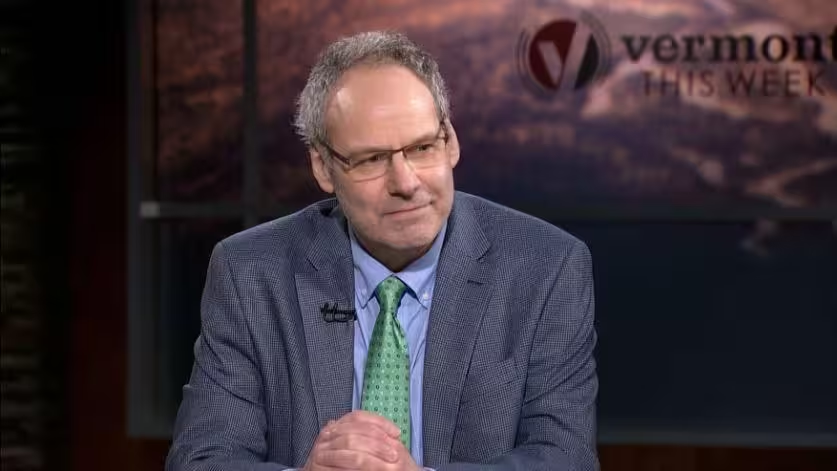
Lawmakers Advance Property Tax Bill, With Little Relief for This Year | Contention Over School Budgets Continues | Site in Vergennes Eyed for New Secure Juvenile Treatment Facility | Panel: Cat Viglienzoni - Moderator, WCAX; Audi Guha - VTDigger; Kevin McCallum - Seven Days; Calvin Cutler - WCAX.
Problems playing video? | Closed Captioning Feedback
Problems playing video? | Closed Captioning Feedback
Vermont This Week is a local public television program presented by Vermont Public
Sponsored in part by Lintilhac Foundation and Milne Travel.
Support provided by:


Vermont This Week
April 19, 2024
4/19/2024 | 26m 45sVideo has Closed Captions
Lawmakers Advance Property Tax Bill, With Little Relief for This Year | Contention Over School Budgets Continues | Site in Vergennes Eyed for New Secure Juvenile Treatment Facility | Panel: Cat Viglienzoni - Moderator, WCAX; Audi Guha - VTDigger; Kevin McCallum - Seven Days; Calvin Cutler - WCAX.
Problems playing video? | Closed Captioning Feedback
How to Watch Vermont This Week
Vermont This Week is available to stream on pbs.org and the free PBS App, available on iPhone, Apple TV, Android TV, Android smartphones, Amazon Fire TV, Amazon Fire Tablet, Roku, Samsung Smart TV, and Vizio.
Support the crew
Help Mitch keep the conversations going as a member of Vermont Public. Join us today and support independent journalism.Providing Support for PBS.org
Learn Moreabout PBS online sponsorshipToday on Vermont this week, property tax pushback, the tit for tat between lawmakers and the governor ramps up in Montpelier.
I don't know what the plan B would be if they're not willing to do anything right now.
Then they're part of the problem.
They're accepting this 20% increase, which I'm not accepting.
The fight over school budgets comes to a head and what to do with Vermont's most troubled youth.
Why state officials are eying Addison County as the site of a new treatment facility.
From the Vermont Public Studio in Winooski.
This is Vermont this week, made possible in part by the Lintilhac Foundation and Milne travel.
And thanks for joining us on Vermont this week.
I'm Cat Viglienzini.
Joining us on our panel today.
WCAX political reporter Calvin Cutler, northwest and equity reporter for Vermont Digger Audi Guha and a political reporter Kevin McCallum from Seven Days.
Thank you all for being here.
No major property tax relief coming out of Montpelier this session.
It looks like it appears the issue, which was the main focus of this session, is not getting significant resolution leaving Vermont property owners facing double digit tax increases.
Calvin It feels like property tax relief is kind of the only thing we've been talking about this session.
So why do you think lawmakers were not able to do more about this?
I think, number one, just because how complex property taxes are, how many people it affects, you know, their schools, kids jobs, you know, there's so many different angles of affordability to this as well.
And in lawmakers really this week, you know, advanced a plan saying that we need more time to study this issue and to take a look at it.
The yield bill, which sets the statewide property tax rate every year.
This year, you know, state lawmakers are advancing it.
You know, we're looking at about a 15% increase in homestead property taxes, 18% in non homestead property taxes, where they were able to raise some taxes on cloud software and on short term rentals to to buy that down a bit.
But in terms of like widespread systemic education, finance reform and moving the ball forward, you know, lawmakers really said that they wanted to avoid unintended consequences or doing something that, you know, could have have unintended consequences in five or ten years.
So they're going to take you know, they're advancing a bill which essentially would would create a blue ribbon task force, a commission to to study this.
So, yeah, I think there's a lot of frustration right now, though, at the state House over this.
Mm hmm.
We did hear from the governor at the start of the broadcast kind of blasting lawmakers under the golden dome who he says aren't doing enough and calling for them to be part of the solution and not part of the problem for not acting.
But those lawmakers came out swinging themselves to kind of push back on that characterization.
The issue is very complicated.
That's just not a tried thing to say.
It really is.
You are seeing the culmination of some really tough decisions coming here today to make sure that we get it right and we don't have any unintended consequences for what we want to do.
Now, Kevin, Republican is also under the golden dome.
You know, were they supporting the governor's kind of plan here to potentially try to, you know, buy down our property taxes or were they saying that's not really going to work either?
Well, I think what you're seeing is Republicans were initially okay with the idea of buying down some of the property tax increases if there were structural changes in place that were going to restrict and limit the spending in the school districts and what happened was the bill, as it was moving forward, apparently had some of those guardrails, some of those structural changes in there.
And then, according to Scott Beck, who's an influential member of the Ways and Means Committee, a Republican, he he said that last week some of the teachers unions and superintendent organizations came in and said that's not going to work.
The spending restrictions that you're calling for would be would be extremely detrimental to us in the short term.
We can't go there.
We'd have to take the more thoughtful, long term approach that Calvin explained.
And so the Republicans were just dead set against the yield bill as it stands, because they just called it more of the same.
I will say, too, I think one of the big challenges or one of the big goals that they're looking to accomplish and both Democrats and Republicans have have said this is a top priority, is to better connect people with their votes.
And when you vote on your local school budget, understanding, you know, the first off transparently saying how much is the per pupil cost increase, what are the trends in education spending?
But also making sure that, you know, when you vote on your local school budget, that's how it's going to affect your local property taxes, because as of right now, we have a system, you know, which is we're 25, 30 years into it now where it there is not necessarily a connection between between that.
So that's what another thing they're hoping to bring out of out of this study.
But I think, you know, to Kevin's point, Republicans wanted to see that change start this year, but it appears that's that's not going to happen.
We'll see what the Senate does.
But again, at this point, there's only, I think, two weeks left in the legislative session.
So it's a challenge.
Mm hmm.
Now, I imagine if you're a property taxpayer, a homeowner, for instance, you know, waiting for a study to be done is not necessarily tenable for some folks.
Yeah.
And I think that's another really big concern of the governor.
And we heard that from Republicans as well.
I mean, you know, from the governor's perspective, this property tax increase is coming at a really tough time.
There's a new payroll tax going into effect.
There are still questions about the clean heat standard, what that will do for fuel prices.
There's, you know, a number of taxes that the House of Representatives is looking at to fund expansion of the judiciary and housing initiatives.
So from Republicans perspective, you know, this is all really coming to a head.
And the question is from really from everybody's perspective, from the homeowners and renters to is can we enact long term systemic change in a way to make this financially sustainable before people are priced out?
Because, you know, property taxes is just one piece of it.
Health care costs are continuing to rise.
You know, a lot of not just in Vermont, but nationally, we're seeing big affordability challenges.
People don't have pandemic savings.
Interest rates are still high.
Inflation is still really stubborn.
So I think there's a lot of national trends that are kind of hitting here in Vermont.
But there's also things that, you know, state lawmakers are concerned about as well, makes it difficult to budget now, given that this is an issue that affects pretty much everyone in Vermont directly or indirectly.
If you're a homeowner, it affects you when you pay your property taxes.
That's a renter.
It's a trickle down situation where your landlord is probably going to pass that cost on to you.
Do you think then that this will be a kind of a focal point on the campaign trail this year?
You know, that's a really good question, and I think that remains to be seen.
Right.
I mean, I think there is an opportunity, certainly for folks like Governor Phil Scott.
And we've heard him this session using his bully pulpit, you know, really harping on on that affordability question and criticizing Democrats for it.
But with the property tax question, as I mentioned, off the top, because of how complex this is.
And, you know, somebody at the statehouse told me once it's everybody's problem.
And because of that, it's nobody's problem at the same time that we're all part of of this this challenge that we find ourselves in.
So I think, you know, pointing fingers or specific blame politically or electorally might be a challenge.
But I think certainly we will hear this on the campaign trail.
Mm hmm.
Voters in many communities still pushing back on their school budgets to send a message to Montpelier about education spending.
More voted this week, and only one of them, the state's largest school district of Champlain Valley school district, passed their budget on the second try.
The rest continue to say no, including Springfield right now is going to be impacting students in the programs that they have.
And we have to look at what will not detrimentally do that and still fulfill the education quality standards to make sure our students are getting the best education that they possibly can.
So, Calvin, what happens next for these districts if voters continue to say no for a budget?
Yeah.
So as we've talked about, state lawmakers are advancing the yield bill doesn't really provide a lot of immediate relief from the state this year.
And so the question is, is can districts, you know, cut their budgets and to to a place where that's palpable and acceptable for for town meeting day voters to pass, but also balancing the really strong need that's still in schools for mental health, for academics, nutrition, you know, staffing costs, that that type of thing.
So I think a lot of districts are really looking at this balance.
When you look at what positions are being cut in some you know, in some districts, we're already seeing that, you know, mental health counselors, academic counselors, a lot of these COVID cash positions which were intended to be one time positions, those are now people are, you know, receiving notices that there could be layoffs coming.
And also we're seeing cuts to programs as well.
Language, arts, music, I think those will be some of the first ones to go.
But again, those are important programs.
You know, for for kids and for families, too.
So it's a real struggle that we find ourselves.
And I think lawmakers got that message loud and clear from the teachers union and from the superintendent and principals associations last week.
And so they were loath to find other mechanisms that would have that would have put the pressure on those districts even more.
And so that's why you saw the the bill that they came out with doing modest reductions to the property test, tax increases like bringing it down from the governor said it was going to be 20.
They brought it down to 15.
They're very proud of that.
I mean, the work they did to get it down to 15, they're very proud of it.
And yet they also knew that going deeper was just not something that they felt they could stomach this year because of all that they were hearing about the pain at the district level and.
Oh, sorry.
Go ahead.
I was going to say I will say to a, you know, this the yield bill with everything that's in it is just one piece of the puzzle, too.
You know, there's also a number of bills that the House Education Committee has advanced dealing with education policy.
They're advancing that school construction aid program.
They're going to be restarting that.
There's, you know, a bill that lets school districts enter into contracts for like mental health and transportation together.
So outside of the yield bill, there are other ways to contain costs that are rolling along.
Certainly, this is is getting all of the spotlight.
But I mean, it just really goes to show how many how many challenges or how many like pieces of the puzzle there are that are leading to this school property tax crisis because it's so complex and it touches so many different policy areas.
We saw it this week.
Roxbury now suing its school district to try to keep their small school open.
The plan is to right now at least, is to bus those students to Montpelier.
However, Roxbury says voters weren't given a fair say in that.
And in more, you know, kind of seems like a long shot attempt.
But do you think it has legs?
It could.
I mean, I think, you know, the the the contention here is that voters weren't properly warned in that people really didn't understand the full impact of this vote.
You know, but I think this this lawsuit is really it's it's the tip of the iceberg in just really the strong feelings that many people have in terms of closing their schools.
One of the big questions that we've heard all along is, you know, can we rightsize our education system by closing schools, by consolidation?
And, you know, when you look at the Roxbury school, it's in a rural community in it, you know, it costs money to keep it open.
And this is one of those schools that if you want to save money, it might make sense to to close it.
But it plays a huge role in the community, not just for education, but there's community events that are held there and other things.
And so I think, you know, this is this lawsuit is really a flashpoint of how strongly people feel about that that consolidation conversation.
And I think, you know, going forward, you know, what role the state in the state legislature will play in that is going to be key because those decisions right now are made on the local level.
It is and certainly an issue we will continue to follow.
Another big headline this week, the state is reportedly eyeing Virgin's as the site of a new juvenile secure treatment facility.
This follows the closure of Woodside and Essex and a failed attempt to build a new facility in Newbury.
And the reporting out first from seven days court residents by surprise.
We were as taken back on Monday from that article as everybody else and we were trying to find answers to want the people here to know what's going on and to be happier about it.
So whatever that entails, Kevin, you broke the news that the state is choosing virgins over the other site that they had considered South Burlington.
That's something officials would not confirmed when asked by the media.
So why did why virgins?
Well, I think the state chose Addison County and virgins in particular, because there's a strong contingent of lawmakers for one in in Virginia that is very supportive of the idea of locating there.
Diane Lamphere said to me in the story that she thinks that actually the rural character of Virginia is a perfect place for an institution like this.
For a facility like this, kids who are in trouble, kids who are stressed, kids who need treatment, like there's just this gorgeous area.
And being out in nature and in the fresh air and in the countryside is is a benefit.
The other side, by contrast, was possibly going to be South Burlington.
It's a long highway in 89.
There's a lot of benefits to that site as well, according to the people who were behind that plan.
But ultimately, the Virgin site has been has been chosen.
They are not willing to confirm that yet, but we have it from multiple people that that is where where the facility is headed.
It's a 14 bed facility to treat children who are in trouble.
It's a locked facility.
And so you would imagine that there may very well be some people in the town that once this is official and once the the public information campaign goes forward, that there's some trepidation about that.
But this area is north of Virginia in a very rural area.
And I there's not many immediate neighbors.
There's a dog kennel across the street.
There's a dairy farm up the road.
So I don't imagine that there's going to be significant pushback against this because we did see Newbury residents successfully rebuff the state's attempt to put a facility in their town.
Does Virgin's have a chance?
You think it may be doing the same or.
No, I don't know.
I mean, I've spoken to several lawmakers who seem supportive of it.
I know them.
I know the mayor there was on tape there, didn't realize that this was coming.
And so there is a bit of a disconnect here between the state making decisions and the local municipality being involved in those decisions.
And the key here is that the property in Virginia is state land.
The state owns some 100 acres near a former a former school, the week school.
And I think at the end of the day, when you look at why Virginia was chosen, it was, well, it's free land.
This is land the state owns.
We can move quickly, kind of like we saw in the in the in the homeless the homeless issue, right where they were like, where can we open up a bunch of emergency shelters quickly?
And the first thing they do is look at land that they already own to try to bypass perhaps some of the regulatory hurdles or local hurdles that might be in their way if they weren't going.
And the cost factor and the cost factor, it's going to be millions of dollars to buy out.
I mean, I don't know the exact site of the property in Virginia, but the one in in South Burlington was 20 acres.
So 20 acres of land is, you know, that's millions of dollars.
And so I definitely think that that played a role.
More help to make it easier for Vermonters of color to become homeowners.
Audie, tell us about this program and how it works, because you've been looking into this.
Yes, it's really quite unique.
It was first launched by Champlain Housing Trust in northwest Vermont.
And what it essentially does, it gives you a loan that could be up to $25,000 for first time bipoc.
That's black indigenous people of color to buy their first home and not and be funded with this fund that they've created to pay for things like down payments and closing costs.
So that program was very successful.
I was told that there were 23 homebuyers that have successfully used it, and we know how that is given the housing crunch we are in.
And it's impossible to find rentals or places to buy.
But this program has made it accessible for people to buy it in a very short time.
And the loan is forgivable if you live there and on it for three years.
And when you talk to homeowners, do they think this is enough to help them clear some of those hurdles into homeownership?
It more than does that.
I spoke to a young Cuban couple who came two years ago to study at Vermont Law School, and they said that homeownership wasn't even a dream they were considering.
Without this program and without the 25,000, they would not have been able to buy a home at any cost.
And not only were they able to buy a home or a two bedroom unit in South Burlington, they did it in very few months.
I think they applied in June or July and they were shown the place in December and they moved in in February.
That's a pretty quick timeframe given the housing market, especially in Chittenden County as you brought up.
It's kind of interesting.
You said this program helps because housing is available through it as opposed to having to go on the open market and just try to bid against everybody.
Talk a little bit about that.
Yeah.
So I saw the program through Champlain Housing Trust is they own these homes that they offer at a significant discount through the equity program.
And this loan is in additional loan.
In addition to that, that helps people keep the costs low, but also access housing that in the open market would really be impossible.
So the expansion that's going on, who then does that cover?
So it actually covers all of Vermont, not several, I think nine partner housing associations have teamed up to offer this fund to equity homebuyer first time homebuyers across the state.
So they're just in the process of launching that.
So we should be able to see more happy homeowners in the near future.
It's nice to see happy homeowners in Vermont.
We're now about nine months out from the devastating flooding last summer that hit many homeowners and businesses.
How to recover so that future floods don't hit harder is still a large conversation among many towns.
And Kevin, you're looking into this.
Talk a little bit about this conversation that's still ongoing and where we're at now, now that we've had several months post flooding.
Sure.
So it's obviously a very complicated process of figuring out how to recover from a flood of this magnitude.
And it's and one of the angles that I thought was very interesting was the fact that there are now some government agencies that are essentially saying we probably ought to make smarter decisions about where we invest in our buildings and not continue to invest in buildings in these floodplains.
And so that's something they've been sort of encouraging homeowners to think about harder, like when they make decisions about whether to to help people rebuild their homes in these flood prone areas, they've kind of encouraging them to not write because they don't want to sort of be on the hook for, you know, another set of thousands of dollars of payments down the road.
But in in this case, what they're doing is they're kind of, you know, showing people that it can be done.
And so what I had was two examples in the story a couple of weeks ago about how the Agency of Transportation has decided to move a large central garage in Berlin, which is right on the Stephen's branch out of that area and up the hill about a mile up out of harm's way, because they just realized that they couldn't in good conscience rebuild that facility in the exact location, knowing what the flood hazards of that property are, because it flooded multiple times over the years.
And I think this was just the straw that broke the camel's back.
And they just they just couldn't justify it anymore.
And I don't think FEMA was willing to say, oh, sure, here's several million dollars to help you rebuild.
And then so when when I saw that going through the legislature, I started to look around.
And there are other examples of that same thing.
Feast Farm is a farm in Montpelier.
It's got a historic property on it and it's beloved by many people in Montpelier and it's the same situation.
It's right on the Winooski River.
It flooded horribly.
And so the city has said, look, we just can't we just can't keep running a little farm there.
We can't fix up this old farmhouse, which is historic and it's a shame.
But like that said to me that there's a there's a pattern here that's starting to develop of the state, essentially saying we need to back away from our rivers.
We can't keep putting ourselves in harm's way.
So and order you've been talking with some bipoc owned businesses in the Montpelier Barre area.
Are they able to recover from the flooding or are they facing some issues that maybe other businesses are not at this point?
It's definitely been an uphill struggle.
I was in Montpelier and Barre yesterday walking around and several of the Bipoc businesses I spoke to said that business is not up to the standards they were pre-pandemic and they did not get a lot of the rescue and FEMA aid that other organizations and businesses have qualified for.
A lot of immigrant owners do not qualify for federal aid, so that has left them behind and they are still struggling and they don't know.
And they are also not connected to the community in ways American businessmen are.
So they feel very much left out of the lurch and wondering what's going to happen in the future.
Is there any help for them?
There have been some local grants by community organizations for just a few thousands, not not even comparable to the tens of thousands of dollars in losses that they have faced.
For example, the one business that I have written about Sherpa dinner house, a beloved Indian Himalayan chain.
They've been struggling their house and their restaurant, the house in Barre and their restaurant in Montpelier flooded twice.
They estimated their damages were worth more than 40,000.
They've gotten maybe 20 to 30000 in small grant funding and have further damages over the over the months because their business is not up to what it was.
So they cannot recoup the money that they have lost.
Mm hmm.
I wanted to get to a headline that we weren't able to get to last week from Vermont's Goddard College closing after 86 years.
Kevin can't really call this a surprise given that they only had a handful of students on campus anymore.
But still, it was, you know, sort of like, oh, when you saw that happen.
Right.
Right.
It's a it's a it's a campus that's been there at 117 acre gorgeous campus in Plainfield, been in there since the 1930s.
And you're right, the writing has been on the wall for several years now.
There were even some people quoted in my colleagues story about this saying that they were they were surprised it took this long.
But when in Rome, there were two significant signs that this was pretty much over, and that was when they went virtual earlier at the beginning of the term, they're like, we're just going to have online classes.
And that was like, Well, okay, that's not a good sign at all.
And then apparently the enrollment numbers had dropped from in the three hundreds to now just to 20.
So that's just not sustainable for a, you know, Institute of Higher Education.
And it's unfortunate.
There's a lot of people mourning the loss of that, but there's also some community groups that are stepping forward and saying, look, this is a gorgeous property in a great location.
There's lots of opportunities for this campus and we don't know what's going to become of it.
I imagine there's going to be some people that push for housing on the property down the road, and I wouldn't be surprised to see some of that.
Mm hmm.
And another headline we wanted to get to, Kelvin.
The impeachment process ended against the Franklin County sheriff.
You know, very quickly, what impact does this have on attempts in Montpelier to increase accountability among sheriffs and states attorneys?
Because I know those are still in the works, right.
Well, that was one of the big priorities among lawmakers that did not get across the finish line this year in the Senate was a constitutional amendment to set requirements and qualifications for, you know, county officials, state attorneys and and sheriffs.
And, you know, they that didn't get across the finish line because of pushback.
State lawmakers hanging up the impeachment process and not recommending articles of impeachment to the full House of Representatives is significant because Sheriff John Grizz Moore committed these these acts.
He kicked the the handcuffed detainee.
And there were also financial improprieties.
Lawmakers say it all happened before he was elected.
And, you know, in theory, voters knew this heading into the ballot box.
So I think it's significant there.
I think in terms of the bigger picture, though, about accountability and transparency of of county officials, I don't know if that that's going to be moving forward this year.
I think certainly lawmakers will try again next session because this is still a very active topic.
There's been many county officials that have been in the headlines recently from from Addison County to Orange County to Franklin, you name it.
Very quickly, do we have a number on the cost of that impeachment process?
Not yet.
But we were told that between the downs, Roland Martin, attorneys, legislative council, overtime pay for lawmakers, it was tens of thousands of dollars and people can make of that what they will.
Calvin, thank you.
And that does it for us on Vermont this week.
Thanks to our panel, Calvin Cutler from WCAX, Audi Guha from Vermont Digger and Kevin McCallum from Seven Days.
And thank you all for watching at home.
Take care.

- News and Public Affairs

Top journalists deliver compelling original analysis of the hour's headlines.

- News and Public Affairs

FRONTLINE is investigative journalism that questions, explains and changes our world.












Support for PBS provided by:
Vermont This Week is a local public television program presented by Vermont Public
Sponsored in part by Lintilhac Foundation and Milne Travel.