
April 3, 2023
4/3/2023 | 55m 27sVideo has Closed Captions
Alexandra Pelosi; Brian Greene; Elizabeth Williamson
“Pelosi in the House” shows Nancy Pelosi’s fight to preserve democracy in the face of danger. The woman behind the camera is Pelosi’s own daughter Alexandra. Brian Greene on this week’s scientific breakthrough on nuclear fusion. Ten years after the Sandy Hook shooting, Elizabeth Williamson discusses the disinformation campaign and the question of whether the families will ever receive justice.
Problems playing video? | Closed Captioning Feedback
Problems playing video? | Closed Captioning Feedback
April 3, 2023
4/3/2023 | 55m 27sVideo has Closed Captions
“Pelosi in the House” shows Nancy Pelosi’s fight to preserve democracy in the face of danger. The woman behind the camera is Pelosi’s own daughter Alexandra. Brian Greene on this week’s scientific breakthrough on nuclear fusion. Ten years after the Sandy Hook shooting, Elizabeth Williamson discusses the disinformation campaign and the question of whether the families will ever receive justice.
Problems playing video? | Closed Captioning Feedback
How to Watch Amanpour and Company
Amanpour and Company is available to stream on pbs.org and the free PBS App, available on iPhone, Apple TV, Android TV, Android smartphones, Amazon Fire TV, Amazon Fire Tablet, Roku, Samsung Smart TV, LG TV, and Vizio.
Watch Amanpour and Company on PBS
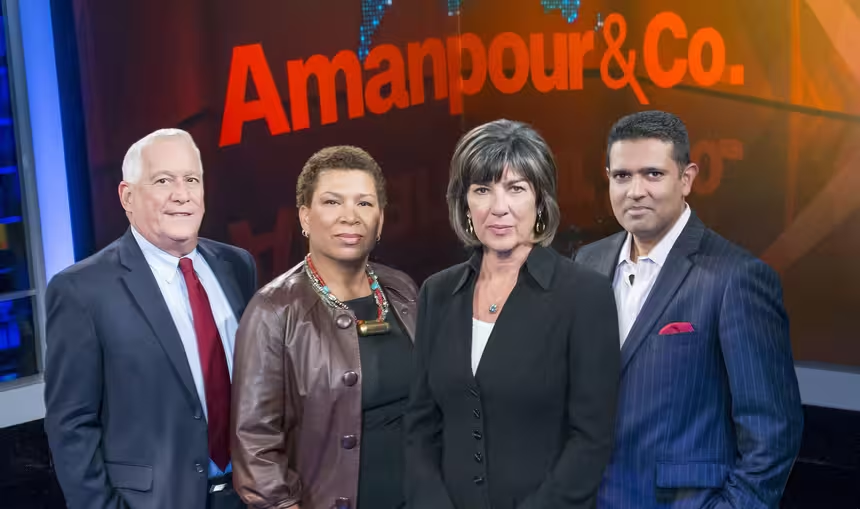
PBS and WNET, in collaboration with CNN, launched Amanpour and Company in September 2018. The series features wide-ranging, in-depth conversations with global thought leaders and cultural influencers on issues impacting the world each day, from politics, business, technology and arts, to science and sports.Providing Support for PBS.org
Learn Moreabout PBS online sponsorship- Hello everyone and welcome to "Amanpour & Company".
Here's what's coming up.
- Are they calling the National Guard?
- Yes.
Yes ma'am.
- If they stop the proceedings, we will have totally failed.
- [Christiane] As the January 6th committee finalizes its long awaited report, a new documentary offers a behind the scenes look at one of the rioters' main targets, Speaker Nancy Pelosi.
Her filmmaker daughter Alexandra tells me about capturing her mother's story, and the brutal attack on her father, Paul.
Then.
- This is one of the most impressive scientific feats of the 21st century.
- [Christiane] But what exactly is nuclear fusion and how soon could it unlock new hope for our planet and clean energy?
Columbia Math and Physics Professor Brian Greene breaks it all down for us.
And.
- To have part of your community and your own nation calling you a liar and a fraud and saying that this horrific loss didn't happen to you was just devastating to them.
- [Christiane] The Sandy Hook Massacre 10 years later.
Journalist Elizabeth Williamson tells Hari Sreenivasan how that schoolhouse tragedy became a watershed moment in the spread of disinformation.
[dramatic music] - [Announcer] "Amanpour & Company" is made possible by the Anderson Family Fund, Sue and Edgar Wachenheim III, Candace King Weir, Jim Atwood, and Leslie Williams, Mark J Blechner, Seton J Melvin, Bernard and Denise Schwartz, Koo and Patricia Yuen, committed to bridging cultural differences in our communities.
Barbara Hope Zuckerberg, the Family Foundation of Leila and Mickey Straus.
We try to live in the moment, to not miss what's right in front of us.
At Mutual of America, we believe taking care of tomorrow can help you make the most of today.
Mutual of America Financial Group, retirement services and investments.
Additional support provided by these funders, and by contributions to your PBS station from viewers like you.
Thank you.
- Welcome to the program everyone.
I'm Christiane Amanpour in London.
After more than a year of investigating, the January 6th committee is near the finishing line.
Next week, it'll release its final report about the attack on the Capitol.
And at its last public hearing, it'll make criminal referrals to the Justice Department.
House Speaker Nancy Pelosi was a prime target that dark day.
Her office was ransacked and some rioters hunted around the Capitol looking for her, and then Vice President Mike Pence, they were all there in Congress to certify Joe Biden's election.
A new documentary called "Pelosi in the House" features this phone call between the Speaker and the Vice President as the insurrection unfolded.
- Give me the phone.
Hi, Mr. Vice President?
Hi.
Yeah, we're okay.
We're here with Mr. Schumer, Mr. McConnell, the Leadership House and Senate, and how are you?
Oh my goodness, where are you?
God bless you.
But are you in a very safe?
We are still not safe enough for us to go back.
We're being told it could take days to clear the Capitol and that we should be moving everyone here to get the job done.
We're at Fort McNair, which has facilities for the House and the Senate to meet.
We'd rather go to the Capitol and do it there, but it doesn't seem to be safe.
We've gotten a very bad report about the conditions of the House floor with defecation and all that kind of thing.
I worry about you being in that Capitol room.
Don't let anybody know where you are.
- [Christiane] The woman behind the camera is Pelosi's own daughter, Alexandra, an Emmy nominated filmmaker.
Her father Paul survived a vicious assault in October at the hands of a man asking "where is Nancy?"
The very same question that Insurrectionists were yelling that day inside the Capitol.
The documentary shows her mother's fight to preserve democracy in the face of danger.
It also tracks her stunning rise from homemaker to House speaker, the first and only female to hold that office.
And Alexandra Pelosi joins me now from New York.
Welcome to the program.
I just wanna ask you first, as a daughter for how is your father?
We saw him make his first appearance in public at the Kennedy Center, but how is he?
- Well physically, he's getting better every day.
But traumatic brain injury is not something that goes away.
There's a lot of PTSD.
This is still very raw for our family.
And I think our whole family's very traumatized because we've been so numb to these threats that have been coming, I mean, literally since she first became Speaker 20 years ago.
We've been getting these threats for decades now.
My own children have had death threats in FBI affidavits.
There are crazy people that just really have put a big, huge target on my family and the fact that they actually succeeded with my father, it's really a lot to process.
And so I think he's still very traumatized.
And I think the road is a very, very long road to recovery.
It's not something where he is gonna just wake up one day and say, "oh, I feel better now".
It's a lot.
Plus, today is the first court, you know, it's all in court now about what happened that night.
So we're gonna have to relive it when we have to listen to the 911 call and the body cam.
All that stuff is gonna happen in court and the family's gonna hear all of that stuff.
So this is all very raw for us still.
- And clearly, as you say, the family's been traumatized.
You yourself got up and went immediately accompanying your mother from Washington to San Francisco as soon as you heard the news.
Tell me about... Nope?
- That was something that we didn't know if he was gonna have brain damage.
We didn't know if he was gonna live.
That was probably the most terrifying day.
You can imagine.
He really was lucky.
The doctor said centimeters from death.
It really was, it was a hammer attacked to the head.
An 82 year old man alone in his own home, attacked in the middle of the night with a hammer.
I mean, there's not, and more than once, there are lots of blows, it's a lot to sort of process.
So it was a very, I mean, it ended well.
He got his head fixed and now he looks like Frankenstein.
But it's still a lot to sort of, going through that whole process, I think is something that we, I haven't slept through the night since it happened.
I mean, it's still a lot.
- I can only imagine.
I mean, it's just so awful.
And all of us who've covered your mother's career and watched from afar know the relentless attacks on her character that finally led to this point.
And it is chilling to hear that they were shouting in your home "Where is Nancy?"
when we heard them in your documentary that day when all the footage came out, "Where is Nancy?"
They were hunting her down.
So you've said and others have said and she's said that this is really the final blow for her political office holding going forward.
- Well you have to remember that if I take you back to the beginning of January, the first week of January, someone put a bloody pig's head on my parents' doorstep on my childhood at home.
there's a big.
bloody, this was over the holidays.
And spray painted the garage and all that.
So that was the week leading into January 6th.
So we go to Washington for when she was being sworn in as Speaker.
And this is a ceremonial event that the family always goes to, the whole family goes, all families go to these things.
So I was with her for the day that they were gonna certify the election results.
And when the Capitol police took her out of the, you know, she was at the rostrum, just going through the script of how we certify the election results, the security came in and they removed her from the podium.
She didn't even have her cell phone with her.
She was just taken out of the building.
She didn't even wanna be removed from the building because she's like a captain.
She wanted to stay with, you know, the ship.
She was not happy.
There's footage of her.
She wasn't very happy about the fact they were taking her to an army base to get out.
But I started filming because you didn't have the clerk of the House there to record this.
I'm a documentary filmmaker.
That's what we do.
You know, it's like a soccer player.
You put a soccer ball down, what does a soccer player do, they kick the ball.
Of course I filmed everything because that was my human nature.
It was all with an iPhone.
People think conspiracy theories say like, oh, Nancy Pelosi brought a documentary crew to the Capitol.
No, I had an iPhone and I filmed what was happening.
But she started to make calls to the Vice President, as you just saw, and to all the people, Secretary of Defense, the Attorney General.
What they were trying to do was they were trying to take 435 members of the House and 100 senators and get them from the Congress to the army base to certify the election results.
So they were gonna do this, they were going to complete what it says in the constitutions, this is how it goes.
They were going to complete that task that night no matter what.
And so that's what I was filming was how they got, you heard in that call, what she's trying to do, saying, should we bring everybody here to the Army base or should we go back to the Capitol?
And as you know, they got to go back to the Capitol.
So that's the whole... - Yeah, no, no, exactly.
I mean just the fierce fight to defend democracy at its most endangered moment in memory was captured incredibly, incredibly poignantly by what you did.
And of course by so much of the other footage we've seen.
But some of it obviously we haven't seen because you had the iPhone and you were with her the whole time.
I was struck, I have to say by the fact that she was so solicitous of Vice President Pence and maybe he was solicitous back, I don't know, but he clearly asked how she was, I was struck by how she was talking to him.
She pulled down her mask.
She pulled out something to eat.
I mean all these normal natural reactions, but solicitous of essentially a political opponent who, along with the President he served, had demonized her.
How does it work in Washington?
- Does it work in Washington?
I mean, there is definitely a disconnect.
And this has been sort of my whole life's work.
I've made 14 HBO films, they're all sort of around the same topic, which is how people behave in private compared to how they behave at the podium.
And there's definitely a disconnect.
Last week I went to Washington to see my old friend, George W. Bush because he and I, I made a film about him in 2000.
That was my first documentary, it was called "Journeys with George".
And I went to go see him because I consider him an old friend despite all of the, I wouldn't agree with him about anything politically, but I've always considered him a decent human being, despite the Iraq War.
And I brought my mother along and you would've thought it was a buddy film.
The two of them were getting along so well.
They had bitter fights.
She voted against the war.
There were people protesting living outside of our house for the entire Iraq war because they were angry that even though she voted against the war, there were people living outside, the protestors.
This whole idea of protestors living outside of our house, we've just been living with that for forever it seems.
So they still got along as human beings because even though they didn't agree, they still had respect for the institutions.
He's the President, she's the Speaker, and they come from political families and they understand that there has to be some respect.
That's what we lost with the last President.
There was zero respect for the office of the Presidency, zero respect for anything in the Congress.
And so the reason why January 6th was such a tough day for Nancy Pelosi, I think is because her father was in Congress and she thinks of the Capitol as the sacred temple of democracy.
This is like the most sacred place on earth to her, right?
She's been in Congress for 35 years.
She thinks public service is a noble calling.
And so for people to break the windows and break in and literally poop all over the place is really what I think offended her her soul.
- Yeah, I mean, absolutely.
And you talk about George Bush and again, in the film it's very interestingly portrayed because of course he was the President when she became House Speaker, the first female.
And he paid that tribute to her saying, "for the first time, I have the honor to say Madam Speaker".
And there really did seem to be a reflection.
And in the film she says to you, or I think she says to you that many sons have followed their fathers into Congress or into wherever.
But I am the first daughter to follow my father into this position.
And that was of course when she was first elected to the House, I believe it was 1987.
Being a woman has also been fundamental to what she has...
I guess I'm asking you, to what she has lobbied for, things like the Affordable Care Act.
She has been incredibly vociferous and passionate about doing that kind of legislation that benefits families and children as well as everybody else.
- And that's the hardest part for our family to deal with now because my children, I have teenagers, right?
My 16 year old was with me in the Capitol on January 6th.
And he kept saying, "why do all these people wanna kill Mimi?"
He's trying to understand what has she done that has led to this actually leaving us in the ICU with my father.
I mean, what is it that you can point to?
I understand if you don't agree with her politics and half the country doesn't, and that's fine.
And I understand that if you watch Fox News, you hate Nancy Pelosi.
Because if I watch Fox News, I would hate Nancy Pelosi too.
I don't don't know how it goes from hating her and hating her politics to I'm gonna go break into her home and attack her husband or break into the Capitol and literally poop all over the place.
And that to me is the effect of social media.
How social media has destroyed the fabric of our society.
And how I feel we have to ask.
She loves to talk about defending democracy, but I have to ask, I mean, is it even a democracy if such insane conspiracy theories can be spread and the kind of misinformation?
There's no civility left.
I really worry about the future of our democracy.
See, when she went to Congress the first time, there was no social media.
We didn't have these misinformation machines spreading all this toxic misinformation.
So it's really a scary time.
And I guess you're asking about what did she do in her career?
When I was sitting in the ICU with her the first day, I said to her, "if I had known that this is where it was gonna end, I never would've let you go to Congress in the first place".
Because this has really had damaging long-term effects on my family that I don't know if it was worth it.
- That's interesting because I think your father chimed in at that point as well and sort of, I mean, maybe not in the ICU, but since about why-- - Since then.
- About why she's done it.
- And my father defends her decision and her career and says, well I understand, my whole family would say if she came to us today, if we could roll back the clock, if she came to us and say, "in this social media environment, I would not ever recommend this life", which is not for the faint of heart.
- Which is a really sad thing to do because actually, as you say, like her politics or not like her politics, the legislating has been very, very effective.
And perhaps more effective than perhaps any man, I don't know, since Lyndon Johnson, I'm not sure, but anyway, she's clearly very, very effective.
And we see in one of the clips her whipping the votes for the Affordable Care Act.
And she said famously that "some people count sheep when they sleep, I count votes".
She was taught by her father and her brother, both elected officials to always do the math.
And here's a little clip.
- I don't know why he thinks that this is okay to vote no on this.
He said to somebody that he expects to get a pass from the speaker, but he's thinking of a different speaker.
I don't give out passes.
- The Speaker was very masterful about rounding up members who had difficulties with the Affordable Care Act for whatever reason, she had to persuade those members kind of one by one that they had to go onto the bill.
You do not take it to the floor for debate until you have the votes locked up.
- I had a little disturbing report and he said you expect to get a pass on this.
There are no passes, especially on something as special to who we are as Democrats.
No, but I mean this is, this is the defining moment for the Democrats.
This is why do we elect Democrats.
This is why we are here.
And it can't just be on the taking end of it, but it's just the definition of saying, and not on this team, has to be some of a giving, especially on a vote like this.
I'm gonna take a break, okay?
Thank you.
Bye-bye.
But I hope you don't think I'm just a taker.
You know and then you expect to get something?
I was really clear with, you know, I start in bed nights and nights, and that sledgehammer comes out, I can't even talk to them anymore again because I'm trying to pass a bill here.
- I also find your filmmaking quite interesting because you often take her from behind, you film her from the back, you often pan across to see the children because your children are often there and other children are often there.
And she managed to to mix being a mother and a wife and a grandmother with being the most powerful elected woman in American history.
How did that change her to you as a mom maybe?
- Well, you know, that's the Ginger Rogers part of her life is that she had to do it backwards and in heels.
She has five children, nine grandchildren, and she still has to be a grandmother and a mother.
We don't just give her a past just because she has a day job.
But the thing about filming from behind her back, this film was not authorized.
Nancy Pelosi never signed a release.
It's a miracle that HBO even aired it because she never gave me permission to make the film.
And she saw the film for the first time at the National Archives on Monday night.
And so-- - [Christiane] Okay, what did she say?
- And this is decades, decades of filming.
- What was her review?
Because look, I mean, I was stunned that she let you take pictures of her in her pajamas, no makeup, lying back on her pillows or whatever, talking to leaders, counting the votes, getting things done.
But in situations that we've never seen her in public like that before.
- I don't think she ever gave me permission.
I was always filming, I do everything myself, either with an iPhone or a handheld camera.
So it's not as if I had film crews and lights and camera.
I think she just got used to me.
I've been doing this for so many years, and you showed the footage from the Affordable Care Act, none of that ever ended up in public.
I'm not on social media, so it never ended up out there.
So I was filming for so long, that was 2009, 2010.
And no one ever saw it until Monday night.
So I think no one ever was afraid of me or threatened or scared of me because they were used to me there.
And they just figured that's what she does because she's always here and she's just bored and she's just filming.
The biggest task of all this was editing into a story that you could watch from beginning to end because I had hundreds of thousands of hours of footage over decades.
- Alexandra, I was gonna ask you, look, you are a daughter, you are not a warts and all critical analyst of your own mother.
You are a daughter and you love your mother.
What would you say to people who say, oh my gosh, this is really, you know, it's a family movie, but it's also her view, the Nancy Pelosi family view of her politics.
- You nailed it.
That's it.
I'm not pretending to be objective.
I'm her daughter.
I got to be in the room when it happened and I filmed everything and I thought it was a public service.
It's like a civics lesson.
You heard in that clip.
You do not take a vote to the floor if you don't have the votes.
I've seen Mitch McConnell take a lot of bills to the floor that he does not have the votes for.
I think a lot of people, especially the next generation that are coming in, they should all watch this film so that they can learn how a bill becomes a law.
This is like "Schoolhouse Rock" for the next generation.
But I'm not pretending that this is some sort of objective journalist presentation.
I am her daughter, but I don't know anyone that looks at their mother with the kind of...
I mean, she is in her pajamas and she is lounging around like a regular mother would.
I don't think it's that flattering.
I think that people don't-- - That's why I wanted to know what she thought.
Last question.
What was her review when she finally saw the film?
- I think she was just very nervous.
She was at the edge of her seat the whole night.
And so I don't think she even knew what to make of it.
It's very hard to look in the mirror.
It's like how your daughter sees you, I don't know, I think she's pretty uncomfortable with it, but she hasn't said anything.
She's smart enough not to say because she knows I'm the off message daughter.
She knows I'll go and tell everybody what she said.
So she's just keeping her view to herself so that...
Families are complicated ecosystems, you know?
And so not everybody in the family, we don't all agree.
We don't all drink the Kool-Aid.
It's not as if we're all in some cult where we all have the same opinions.
We all have our own worldview.
And this is just my take.
I'm the youngest of five.
And this is the way I see my mother.
I'm sure if you asked my sister, she would've made a completely different movie.
- And I thought it was very funny because you kept saying, "I want to crack you, I can't crack you, you're a tough nut to crack".
So it was fascinating.
Thank you so much, Alexandra Pelosi.
"Pelosi in the House", it is now on HBO and HBO Max.
Of course, that's part of Warner Brothers Discovery, which also owns CNN.
In her more than three decades in politics, Nancy Pelosi has made protecting the planet as well one of her key issues.
And a new report out today underscores the urgency of the matter.
The International Rescue Committee says that climate change will accelerate humanitarian crises around the world next year.
So this week's scientific breakthrough on nuclear fusion has been hailed as a clean energy game changer.
But my next guest says it's not all that clear.
It's not a silver bullet.
Brian Greene is a professor of mathematics and physics at Columbia University, and he's joining us now from New York.
Welcome to the program.
Brian Greene, you are known for making very difficult subjects accessible.
So everybody got extremely excited.
You saw the Secretary of Energy in our clip earlier talking about how this is gonna change the way this whole notion is looked at.
What is fusion?
What is nuclear fusion first and foremost?
- So nuclear fusion is a way of extracting energy that's locked up in matter.
We've done this in the past with nuclear efficient, which is taking large atoms and breaking them apart.
And when they break apart, sort of like rubber bands snapping, energy is released.
But we all know the problems with fission, right?
There's nuclear waste, there's meltdowns and so forth.
Nuclear fusion is a cleaner form of nuclear energy where you take light atoms like hydrogen, plentiful atoms and you meld them together.
This is exactly what powers a star like the sun.
And when these atoms meld together, some of their mass is converted into energy.
Einstein's famous e=mc2 comes into the story here.
When that mass is converted into energy, we can then harness that energy in principle like the sun does to create the energy that we need here on planet Earth.
That's the basic idea of the science.
- So I feel like a but is there.
So if people say or ask you, I mean, where does it stack up?
Penicillin, electricity, the combustion engine, how big of a breakthrough is this?
- Well, nuclear fusion, if we could truly harness it and have fusion power plants around the world, if it could have the kind of fusion power plant that you saw perhaps at the end of the film "Back to the Future", Mr. Fusion sitting on top of this futuristic vehicle, if it could harness that energy, then this would be a huge, huge breakthrough.
And what's happened now is for the very first time, and this is a big scientific breakthrough, the scientists at Livermore Laboratory have been able to get more energy out from a fusion reaction than they directly put in.
And this has been kind of the gold standard, when you can reach more energy out than you put in, now you're on the road to being able to harness this.
So it sounds great and it is great.
This is a big breakthrough, but the leap from what they've done to having power plants that use nuclear fusion is a huge leap.
And I guess I somewhat worry when I hear about thinking that this is the panacea for climate change.
This is the panacea for our energy needs maybe 30 years, 50 years from now, I don't know.
Nobody can predict the rate of technological progress, but you don't want this to somehow mitigate in the minds of people and leaders the crisis that we face right here, right now, which requires direct attention.
This is not the answer to our problems right now.
- Yeah.
I mean, and that's always the thing, right?
Every time we think we're on the verge of something, there's always a whole nother group of people who say, well we have to wait and it's a process and this and that.
To that end, professor Katharine Hayhoe, she has said, and we've had her on this program often, getting a lot of questions about what today's nuclear fusion breakthrough means for climate.
My answer is not much.
We already have the technologies we need to decarbonize 80% of the electricity sector by 2030, even as demand soars due to electrification.
So you've explained that this is not a short term solution.
So okay, we have the technology as she says, but obviously not the will, right?
Then otherwise we'd be well on the way to meeting the 2030 goals.
- Yeah, I mean that's absolutely the case, and my fear, and perhaps it's not a completely well founded fear, but I just think that we scientists need to be really clear that this breakthrough is scientifically essential and vital and the scientists need to be lauded for the decades of research that has finally allowed us to cross this threshold of getting more out than we put in.
But we need to focus on cleaning up our act today, not looking 50 years down the road to what may well be the answer at that time.
And I sort of also can't help but underscore one point, which is this.
So the scientists for the first time have found that they're putting in less direct energy through powerful lasers that cause the fusion process to happen compared to the energy that comes out.
But if you also include the energy that is required to power up the lasers themselves, if you look at sort of the whole shebang from beginning to end, they put in a heck of a lot more energy if you include that than what they're able to extract.
So this is an important step, a vital moment that perhaps will be remembered, December 5th, 2022 as the moment when we finally crossed this barrier between getting more energy out than we put in for the first time.
But this is the first step of many steps to get to a place where we can actually turn this into a technology.
I mean right now we're able to create this experiment, a couple times a week they're able to fire the lasers into this little tiny gold capsule that fuses the ingredients together to yield a net excess of energy.
But the energy that's produced can boil a pot of water.
It can keep a couple light bulbs on for a couple of hours.
That's the amount of energy we're talking about right now.
To turn this into a power plant, you're gonna have to do this thousands of times a second, which is orders of magnitude beyond anything that anybody can really do today.
So scientifically huge, technologically, big leaps yet to come.
- So managing expectations, I guess is vital, but we don't have a long time to just manage.
We have to actually deliver.
So where do you think we, and I say was the world, are post COP27, which didn't really, I mean people are very disappointed by what it didn't do and didn't pledge and didn't achieve.
- Yeah, I mean it's absolutely the case, right?
I mean we need a focus that will view this crisis as a crisis and we need to be in crisis mode.
And it's very hard to get the world to that place.
And the problem with these kinds of issues is when you finally see the terror that the situation is going to yield, it's too late.
And so this is a part of human nature.
You need to fire people up now about a problem that's gonna hit us very hard very soon.
And that's an issue.
I don't know how to resolve that.
- Yeah, I mean the truth is people are fired up.
It's governments and special interests who are not fired up.
I mean, even business, quite a lot of it is fired up, obviously not the fossil fuel business because they feel that they have a bit to lose.
I wanna ask you to weigh in on big oil companies and greenwashing, that's the word that the Democratic led House Oversight Committee used today, published findings of a year long investigation into big oil companies saying that they've engaged in long-running greenwashing campaigns while raking in record profits at the expense of American consumers and no doubt consumers over the world, finding that the fossil fuel industry is "posturing on climate issues while avoiding real commitments to reducing greenhouse emissions".
BP has said stated it strives to be a net zero company by 2050 or sooner.
Committee finds that internal BP documents show the company's recent plans don't align with the company's public comments.
I interviewed BP's Bernard Looney about this just after COP26.
I'm just gonna play what he said to me on this issue.
And then I would like to get your take on all of this.
- This is not a light switch.
We don't turn a 112 year old company on its head overnight.
But we've carried out the biggest restructuring in our history.
We've entered offshore wind and the largest and fastest growing markets in the world in the US and the UK.
We're involved in hydrogen, we're doubling down in electrification.
We're doing all of the things that a company of ours needs to do to be part of the solution.
- Part of the solution?
- I mean, you know, it sounds good.
I haven't read the report, I haven't studied BP's particular business plans, but yeah, I'm highly skeptical that the approach that they're taking is going to be enough to save the world.
I mean, look, even look at the US government, the amount of money that we spend on subsidies for fossil fuels dwarfs the amount of money that we say put in to fusion research.
So right there you see the disparity between the kinds of things that we as a people, at least as a government of the people, for the people, is actually supporting.
So it's not enough.
- So you are obviously very good at explaining particularly these difficult things, and you do it in your day job, but also sometimes in cameos on various films and all the rest of it, and series.
You were in "The Big Bang Theory" and I just wanna play a clip where you are playing yourself and you are being mocked by other scientists, let's just play this.
- Dr. Greene, question?
- Yes?
- You've dedicated your life's work to educating the general populace about complex scientific ideas.
- Yes, in part.
- Have you ever considered trying to do something useful?
Perhaps reading to the elderly?
- Excuse me?
- But not your books.
Something they might enjoy.
I kid of course, big fan.
- I get to see you and you're smiling.
First of all, do you like doing those things?
And what is your view about trying to teach this stuff and trying to make it accessible to people who probably don't have a background in it or the like?
- Yeah, I think part of the big problem with science education is we view it as this siloed undertaking.
You take your math, you take your physics, you take your biology, you take the test, and then the student leaves the classroom and they forget all about it.
And so I've dedicated part of what I do to try to move science to the center of popular culture, and being on a show like "The Big Bang Theory", sure, we weren't covering deep scientific ideas in that little humorous exchange.
But to see a real scientist talking about ideas that are relevant to the universe, it helps to move science where it belongs, which is in the center of public discourse.
- Absolutely.
Professor Brian Greene, thank you so much indeed for joining us.
- My pleasure.
- Now President Obama called it the single darkest day of his presidency, exactly 10 years ago when 20 children and six teachers walked into Sandy Hook Elementary School and never walked out.
President Biden paid tribute to the victims today and he said "our nation is missing a piece of its soul".
But the heartache didn't end there.
Conspiracy theories cast illegitimate doubt on the shooting and caused inordinate pain to the parents.
Elizabeth Williamson, author of the book, "Sandy Hook: An American Tragedy" joins Hari Sreenivasan now to explore the disinformation campaign and whether families will ever receive justice and compensation for their suffering.
- Christiane, thanks.
Elizabeth Williamson, thanks for joining us.
- It's my pleasure, Hari.
Good to see you.
- In the beginning of your book, you take great pains to point out the amount of research, the amount of interviews, the number of interviews that you did.
I think it'll become apparent in this conversation why, but why did you do that at the outset?
- Thanks Hari.
I did that because I wanted to do two things.
One, establish the baseline truth of an event that unfortunately has become a foundational story in how disinformation spreads in our society.
And so it's been questioned and denied by so many people.
And then I also wanted to point out how many records there are out there that tell the truth of what happened on December 14th, 2012.
And the record is voluminous and the investigations have been replete.
So I wanted to show readers of the book that there is plenty out there telling you exactly what happened that day.
- When you talked to the survivors of this tragedy in all the different ways that they've been affected beyond the immediate grief of losing their child, what does the disinformation, what do the sort of campaigns of lies do to them?
- Hari, it's a significant secondary trauma that is inflicted on these individuals.
I mean, when they went through the tragedy, one thing that they did receive from the great majority of Americans was an outpouring of heartbreak and support and positive messages to them, people telling them that they kept their loss in mind, that they grieved with them.
And then when you have a growing swath of Americans, of their own fellow citizens saying that this loss didn't occur and that not only that, but this was some sort of government gun control plot and they were accomplices in this plot.
So sort of villainizing them and demonizing them.
That was just really difficult for them to take because if there's one thing that people look for when they're grieving this way, it's the community of others.
So to have part of your community and your own nation calling you a liar and a fraud and saying that this horrific loss didn't happen to you was just devastating to them.
- You're right that it's happened many times since, but Sandy Hook was the first mass tragedy to spawn an online circle of people impermeable and hostile to reality and its messengers.
You basically wrote these conspiracies, that this actually didn't happen, started so fast after that tragedy.
How did it happen?
- Yeah, within hours these theories began, and I would have to place at the center of this Alex Jones of Infowars, who has an audience of tens of millions of people.
And so he gave voice to these suspicions among misguided Americans that this was a so-called false flag operation, a government plot to institute draconian gun control measures.
And Jones on his show, within hours of the shooting, put that forward.
I think both sides knew of the gun debate, rather knew that this was going to be a watershed moment.
But what people didn't understand was that this was a watershed in the spread of these false narratives in our society.
And this is something that we've seen happen repeatedly over the next 10 years since Sandy Hook.
There was one father, Lenny Pozner, whose son, Noah Pozner was the youngest Sandy Hook victim who has a technology background.
And he did understand that these falsehoods spreading on social media were the beginning of a trend.
And we have seen that since.
So we've gone from these false theories attaching themselves to Sandy Hook, then to most mass shootings, then Pizzagate, then the great replacement theory that led to the violence in Charlottesville, Coronavirus myths, the 2020 election conspiracy that brought the rioters to the capitol on in January of 2021.
So it really was kind of the beginning of a terrible trend in our society.
- What's interesting is we all know someone who is kind of just suspicious, might be drawn to conspiracies.
And what you lay out is also the role of the algorithms behind social media here.
These people who might have been by themselves found friends, what did that do to them?
- Absolutely.
So it's really important to remember, and in a strange way, comforting to know that most of the people who attach themselves to this particular body of falsehoods don't necessarily believe it, but they're getting something out of being part of a group of Sandy Hook deniers or a group of conspiracy theorists around any major event.
And that's that they get a chance to form a new identity for themselves.
They become citizen journalists or investigators.
They find other friends.
A lot of conspiracy theorists, as you point out, were very isolated before the internet and before social media.
Here they find this group of people, they become a kind of army of misguided people, a closed circle.
They sort of praise each other, they embroider these theories.
They create a growing body of falsehoods and they defend them and sometimes with confrontation, and as we've seen, with violence.
- So tell us a little bit about Alex Jones here.
What did Sandy Hook do for him and what is his role in the spread of how these conspiracy theories make it into the mainstream?
- Alex Jones, for Alex Jones, Sandy Hook was first of all, a driver of sales on his Infowars website.
His business model is that he sells products in advertising adjacent to these theories on his Infowars online and radio show.
So when people listen to his show, he pitches them products like dried food and doomsday prepper gear for your shelter when you're preparing for the end of times, diet supplements and quack cures for people who distrust traditional medicine and established science.
So he uses these kind of viral theories to move merchandise, and he makes up to $70 million a year in revenues doing that.
So for him, this was definitely a profit making event.
And this theory was something that, as we've seen in court, he was tracking how successful the sales were and the viewership was as he spoke about this theory.
- There was an instance right after Newtown where one of the parents reluctantly sort of steps up to oppress lectern, to address this tragedy.
What is important about, I guess that speech and more specifically, a few seconds right before that happens?
- So yes, you're speaking about Robbie Parker, Hari, whose daughter Emily Parker died at Sandy Hook.
He was the first relative of a victim to speak publicly.
So he was hearing from friends that media were trying to piece together the lives of all of the victims and say a little bit about them.
And he wanted that information to come from him.
So he agreed to meet at his church in Newtown out in the parking lot at just the lectern, what he thought would be a single journalist, but really it was a sea of cameras and reporters and microphones.
And so when he steps to the lectern, he gave a kind of shocked gasping half laugh.
And Alex Jones seized upon that, that split second, beginning what was otherwise a wrenching and heartbreaking recollection of Emily's life.
And he used that half laugh to say Robbie Parker is an actor and he's a fraud and he's making this up and he's getting into character.
And he played that video snippet over and over again for years.
And in so doing, he turned Robbie Parker into kind of the face of this false idea that these parents and relatives of the victims were participants in a government plot.
- Well, where did that idea of crisis actor come from?
- That's really an interesting thought because the person who really coined that in this context was a man named James Tracy, who at the time, unbelievably, was a journalism professor at Florida Atlantic University.
And he had found a website in which people were offering to help first responders rehearse for the response to a mass tragic event, mass casualty event.
And so they were offering people who they called crisis actors to pose as victims so that firefighters and EMTs could practice triage and first aid and evacuation.
And he applied that term to the Sandy Hook families, and it stuck and it sticks to this day to a variety of people who are falsely accused of participating in government plots, including most recently, it was used by the Russians to describe the women who were evacuated from the maternity hospital that the Russians found in Mariupol, they were calling them crisis actors.
So that just gives you an idea of the virality of these terms and how they have come to pervade our culture.
- So what is the cost of being called a crisis actor or being kind of at the center of one of these conspiracies?
What is the cost to the parents of these children who were murdered in their daily lives?
Do they have to deal with this?
- Yes.
So the abuse for them began online.
People started going on to their personal social media pages and leaving violent comments, calling them actors and liars, frauds, and worse.
They went on to social media pages that were created by their friends and family, both to memorialize the victims and also to raise money for things like funeral expenses.
Then they started to confront them on the street.
They showed up at their homes, they dug through their trash, they looked in their windows, they harassed family and friends, they disrupted memorial events that they were holding to commemorate the lives of their loved ones they lost that day, and then they began to threaten their lives.
And some individuals have actually been arrested and jailed for doing this over the years.
- There have been a series of lawsuits against Alex Jones.
What is the state of that now?
- So in, as you say, in mid 2018, the families in total of 10 Sandy Hook victims sued Alex Jones for defamation in a series of four separate lawsuits filed in Texas and Connecticut, later combined into three.
At the end of last year, after nearly four years of stonewalling, refusing to submit business records, and testimony ordered by the courts, the courts in both those states found him liable by default, which meant that he lost those cases.
He lost his ability to defend himself in court because he wasn't complying with what the judicial system requires.
So that set the stage for a series of three trials for damages, one that was in Austin this summer in which a jury awarded Neil Heslin and Scarlett Lewis, the parents of Jesse Lewis who died Sandy Hook, a total of nearly $50 million in compensatory and punitive damages.
And then a very big case brought by the families of eight victims in Waterbury, Connecticut that netted a verdict of $1.4 billion for those plaintiffs, those family members.
And then there is one more damages trial brought by Lenny Pozner and Veronique De La Rosa, whose son is Noah Pozner, and that is scheduled for March 27th.
Alex Jones is trying to evade these verdicts that he's already received.
And so he has declared bankruptcy and so that is moving through the courts.
- So how do we deal with that?
It seems that we are in an era where disinformation and misinformation spreads a lot farther and faster than the truth.
- Yeah, unfortunately, we have a lot to lay on the doorstep of the big social media platforms for that.
They can spread this material with impunity.
Something needs to be done to reign in that ability to spread disinformation and not be held liable or even responsible for the consequences when vulnerable people are harassed or when our democracy is eroded by these lies as we saw on January 6th, 2021, and in election questioning since.
So there is some work being done to try and adjust the policies governing social media platforms so that there's a disincentive for spreading this disinformation.
And then on the personal front, there is some work being done developing some ways to teach people how to recognize these manipulative viral conspiracy theories when they encounter them in the wild, when they see them online.
Because once someone embraces them, for all those social reasons, it's really hard to get them to relinquish their grip on these theories.
But you can teach people to be a little more savvy and aware when they encounter them online and to be more likely to report them and less likely to spread them.
- And do you think that there is any step that we can take?
Is there a legislative solution?
Is there something about holding social media companies responsible that doesn't trample free speech?
- If you look at the social media platforms, first of all, there's a wide misconception that this is a freedom of speech issue when a lot of what happens here is happening on private platforms that are businesses.
This is not the government stifling one's freedom of speech.
This is companies saying "by spreading falsehoods, or inciting violence through these falsehoods, you are violating our terms of service".
That is not a violation of free speech principles.
And companies have to be incentivized either through penalty or through some kind of positive measure to tighten the cranks on this kind of disinformation that's spreading and causing these problems, downstream problems both in our democracy and the violence that we're seeing and the domestic terror plots that are based on these misconceptions.
So if a company is using disinformation or viral conspiracy names to draw attention, and they're pushing it out through their algorithms to people in order to keep them online, one of the models says that that should be held as a violation of section 230 or an outright violation that if you are actively as a company, as a very profitable, successful business using this information to draw in and reel in and keep people online, then you should be held liable for that content.
- So what are these families looking for now 10 years afterward?
I know some of them were party to the lawsuits against Alex Jones, but every parent will tell you that I don't really care how much money, you're never gonna give me back my kids.
So what is it that they're looking for?
- They really are looking to alert Americans to the fact that this is not something that just impacted them, that it wasn't the specifically horrible nature of this crime that ignited these conspiracy theories, that this phenomenon is pervasive.
That there is a growing number of Americans who are willing to embrace these delusions and act on them.
And that's eroding the way our politics operates, the way we conduct ourselves online, and really how our society functions.
So that is their message, and you're absolutely right, Hari.
The money doesn't matter to them, but they want people who engage in this to be held to account.
- The book is called "Sandy Hook: An American Tragedy and The Battle for Truth".
Author and journalist of the New York Times, Elizabeth Williamson, thanks so much for joining us.
- It's my pleasure, Hari.
Thank you.
- And finally, this toxic distortion of information comes at a particularly frustrating time as science driven by verifiable facts is actually notching some wins.
From nuclear fusion as we discussed earlier, to news of another promising advance, an experimental cancer vaccine powered by the same mRNA technology used in COVID 19 shots was effective against melanoma, skin cancer, in a critical early trial.
The messenger RNA treatment cut the risk of recurrence or death by 44% according to a preliminary report.
The vaccine helps direct a patient's own immune system to hunt down and destroy cancerous cells.
And even more good news, unlike with nuclear fusion, mRNA based cancer vaccines are well on their way to broader approval.
Multiple versions could be widely available within the next five years.
And just a note, tomorrow we'll devote the whole program to the war in Ukraine.
And I'll speak live to the country's foreign minister Dmytro Kuleba, and I'll review all that's happened in the 10 months since the invasion, with Ukrainian and Russian authors Andrey Kurkov and Nina Khrushcheva.
And we'll also look back at some of our reporting from there.
So do tune in.
And that's it for our program tonight.
If you want to find out what's coming up on the show, sign up for our newsletter at pbs.org/amanpour.
Thanks for watching "Amanpour & Company" on PBS and join us again tomorrow night.
[bright music]

- News and Public Affairs

Top journalists deliver compelling original analysis of the hour's headlines.

- News and Public Affairs

Today's top journalists discuss Washington's current political events and public affairs.












Support for PBS provided by: