Vermont This Week
April 3, 2026
4/3/2026 | 26m 46sVideo has Closed Captions
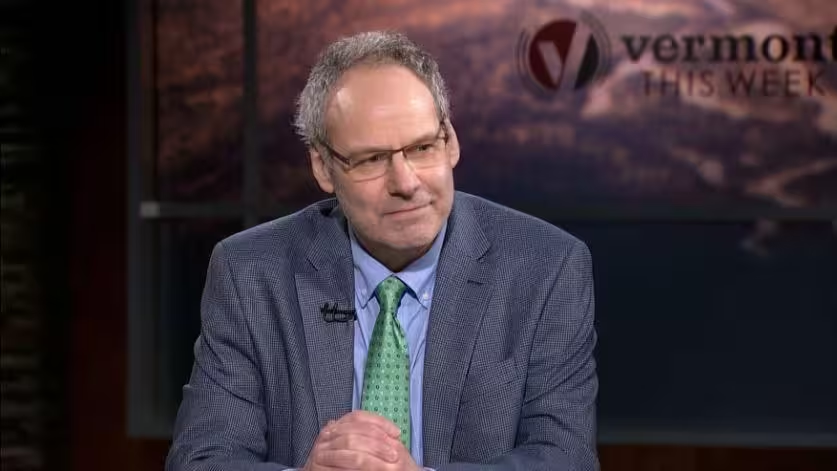
House education committee advances reform bill
House education committee advances reform bill | Vt. labor board overturns Gov's return-to-office mandate | Lawmakers hold public hearing on ICE raid | Moderator - Mitch Wertlieb - Vermont Public; Peter Hirschfeld - Vermont Public; Calvin Cutler - WCAX; Lucy Tompkins - Seven Days.
Problems playing video? | Closed Captioning Feedback
Problems playing video? | Closed Captioning Feedback
Vermont This Week is a local public television program presented by Vermont Public
Sponsored in part by Lintilhac Foundation and Milne Travel.
Support provided by:


Vermont This Week
April 3, 2026
4/3/2026 | 26m 46sVideo has Closed Captions
House education committee advances reform bill | Vt. labor board overturns Gov's return-to-office mandate | Lawmakers hold public hearing on ICE raid | Moderator - Mitch Wertlieb - Vermont Public; Peter Hirschfeld - Vermont Public; Calvin Cutler - WCAX; Lucy Tompkins - Seven Days.
Problems playing video? | Closed Captioning Feedback
How to Watch Vermont This Week
Vermont This Week is available to stream on pbs.org and the free PBS App, available on iPhone, Apple TV, Android TV, Android smartphones, Amazon Fire TV, Amazon Fire Tablet, Roku, Samsung Smart TV, and Vizio.
Support the crew
Help Mitch keep the conversations going as a member of Vermont Public. Join us today and support independent journalism.Providing Support for PBS.org
Learn Moreabout PBS online sponsorshipThe House Education Committee advanced reform plans this week, but the path to head for education transformation remains unclear.
I think we all have to work together, which we've been doing, and I think that they have to get more realistic about the needs.
And lots.
Of their.
Constituency.
Plus, the Vermont Labor Board overturned Governor Scott's return to office mandate for state employees.
And activists come together at the state House to recount their experiences during the South Burlington ice raid.
All that and more head on.
Vermont This Week.
From the Vermont public studio in Winooski.
This is Vermont this week, made possible in part by the Lintilhac Foundation and Milne Travel.
Here's moderator Mitch Wertlieb.
Thanks so much for joining us.
I'm Mitch Wertlieb.
It's Friday, April 3rd, and with us on the panel today, we have Calvin Cutler from WCAX.
Lucy Tompkins from Seven Days.
And joining us remotely today, Peter Hirschfeld from Vermont Public.
Thank you all so much for being here.
Really appreciate it.
The big news we're going to start with Peter Hirschfeld.
Let me talk to you about House Education Committee advancing a reform bill.
We've been hearing so much about revamping Vermont's education, the way it's paid for, etc.. What can you tell us about the latest here?
There is one glaring omission, in this movement of the bill.
But tell us what you know so far.
Yeah, just to back up a little bit, Mitch, what what the legislature is attempting to do right now is take next steps on act 73, which was this historic education reform bill they passed just last year.
The critical first phase of that, of that new law is for the legislature to approve new school district maps that would effectively force Vermont, 119 school districts and 52 supervisory unions to merge into a much larger governance units.
Statehouse reporters like me and Calvin have been waiting to see if the House was going to be able to pull that off.
There was a lot of opposition within their own caucus, and among Republicans to this concept of mandatory consolidation.
And what we saw happen this week, the big news is that the House has abandoned that forced merger construct.
Leaders said, look, it became clear we didn't have the votes to move this forward.
And they also say that in these months since the legislature has begun talking about this again in Montpelier, it's become clear to them that Vermonters don't want it either.
So Governor Phil Scott wanted some consolidation maps.
What's it going to look like when we consolidate districts?
This is not included in the plan.
Calvin Cutler So what's the governor's reaction so far?
Well, the governor earlier this week, you know, he expressed appreciation I think is to put it diplomatically, is how he described it, that they are moving something.
This is a vehicle.
This is a bill that is moving forward in terms of the actual policy, like Pete said, about, you know, non voluntary mergers, not moving forward.
And also the CSAs, which are cooperative service education agreements, trying to bring down the cost of doing services.
Those both are probably nonstarters for Governor Phil Scott.
And we can expect him to say, go back to the drawing board, give me maps.
But to Pete's point, though, you know, the House Education Committee has really been struggling over this.
You know, lawmakers have been hearing from their constituents in a big way.
And this isn't just a party line Democrat Republican thing.
I mean, this is, it's a real big challenge they've had to overcome.
And, you know, this is also in line with sort of the findings of the redistricting task force, who had looked at the data and looked at the configurations of the maps and said, adhering to the vision as outlined in act 73, they said was was, near impossible.
And so where do we go from here?
This bill is now moving forward.
It's going to at some point maybe get on the House floor, then the Senate's going to take a whack at it.
But this the last point is the governor has threatened to continue to veto the state budget, which is a must pass bill.
Lawmakers cannot adjourn.
And the governor is basically holding the budget, back unless they advance maps, in line with act 73.
And right now it is unclear whether that kind of proposal or that idea can even get a majority can get 76 votes in the House.
This sounds like loggerheads to me.
Pete Herzfeld, is there a path forward here?
There are two key pieces to act 7273.
One is this forced merger construct the other is what's known as the foundation formula.
And this is the mechanism that is going to effectively wrest control over the school budgeting process from local boards and give it to the state.
It's it is in a lot of elected officials views, the surest cost containment method in this education reform law.
House and Senate leaders say, look, we're ready to move forward toward this foundation formula and enjoy all the cost savings that that guarantees without mandatory mergers.
Phil Scott says we can't do it without mandatory consolidation.
You need to have those economies of scale before you foist this new funding construct on schools.
And so I think that is going to become one of the bones of contention as this plays out, is can lawmakers convince Phil Scott that we can get to the cost containment part and skip this really politically untenable thing, that that comes up when you when you touch force consolidation?
Yeah.
The governor has the power of the veto pen here.
But, you know, I've been talking with some folks at the legislature saying, okay, the governor was the one that originally put forward this idea of, I think, five district maps and, you know, the whole idea of act 73, maybe the governor has to give a little bit here, too.
I mean, you know, like, yes, you know, there is 180 lawmakers that he has to win over, to move forward with this construct.
But is the governor and the administration going to have to give a little bit as well?
In the spirit of negotiation, to try to get something across the finish line?
And to Pete's point, to get to the foundation formula.
There certainly are concerns from some with the foundation formula about you know, a lack of local control and sort of what does that mean for spending decisions and the tax rate in some communities.
But to Pete's point, you know, legislative leadership is, by and large, on the same page with the foundation formula.
So will we see the governor also give a little bit to it's going to be a very, very chaotic last few weeks of the session.
And I can just close my eyes and imagine, like with the yield bill a couple of years ago, that lawmakers are going to be there really late in the night, burning the midnight oil, trying to work out a deal behind the scenes.
It's going to get very, very, very chaotic.
I imagine so.
But before we move on from this, though, Calvin, and I'll ask you this question too.
Because I am curious, though, to your point, Calvin, you know, lawmakers want to see something move forward with this.
Everybody wants to see something break through it.
Are there enough Republican lawmakers potentially, potentially to split with Scott on this issue and not back a veto that he that he puts out?
Yeah.
Mikayla LeFrak asked this question a few weeks ago when you guys had Scott back on.
And it was a very good question, because once we start getting into this stage of education policy, as I mentioned, it's not a Democrat Republican issue.
You know, you talk about issues of school choice and, you know, the size of your school in your town and your tax rate.
These it really does not fall on party on along party lines.
And to the question of if the governor does veto the budget, or if lawmakers pass the budget, he vetoes it.
Will we see Republicans also back the governor up in that veto override to potentially pass a framework in an election year, which could lead to the to a consolidation of school districts and further down the line, maybe the closure of some schools?
We don't know.
We'll have to see.
But it's going to be a really fascinating dynamic to watch in the weeks ahead.
I do think there's going to be a lot of late hours put in.
You're right.
Go ahead.
Pete, you were to say something else about this issue.
I was just going to say the longer this drags on, the more political it's going to get and the more political it gets, the more likely Phil Scott is going to be able to maintain, Republican support among those GOP caucuses in both chambers.
And it's a very real scenario that we see this stalemate.
Extend to the end of the legislative session.
And we asked Phil Scott, you know, what are you going to do if you just can't get what you want?
And he said, well, then it's going to be up to the voters.
And it's very clear that he is ready to take his case to the campaign trail, try to convince Vermonters once again that Democrats are the ones holding up true progress on education reform.
And at that point, the play will be to try to get a majority of Republicans and at least one chamber of the legislature so that when they come back in 2027, perhaps there will be, an environment that is more conducive to the brand of education reform that Phil Scott says Vermont needs to see.
It's going to be so interesting moving forward with this.
The political angle.
This is really fascinating.
Thank you both for the update on that.
Calvin Cutler, I want to stick with you for a moment because another bone of contention with Governor Phil Scott is, you know, he had this return to office mandate for workers, state employees to get back physically to to their offices.
The Vermont Labor Board overturned the governor's return to office mandate on this.
Governor.
Not too happy about that, I imagine.
No, certainly.
I mean, this decision has been a long time coming since Covid.
A lot of state employees, those that can work remotely, some have had some kind of remote work setup.
And, you know, the governor had called, employees back into the office, three days a week, basically saying that this was better for, you know, synergy in the workplace, if I can use that word.
And also for, you can.
You're allowed.
Yeah.
Thanks for our for for customer service for Vermonters and showing up and and all of that.
But, you know, the state of this VCA, the State Employees Association, fought this and the Labor Relations Board ruled against the governor in this case, Governor Phil Scott.
Number one called the you know, he said that this decision was disappointing but not, unexpected.
You know, he talked about the labor relations Board and its members.
He called them biased, and sort of already baked into the side of coming from a pro union, pro-labor background.
So that was the governor's reaction.
He says that they're going to now take their case to the Vermont Supreme Court, which I believe is the next step for this.
They've already filed an appeal.
They're asking for a stay right now.
But there's still a lot of questions in the meantime that that need to be worked out.
Number one, what happens to to the space that they've leased out in Waterbury at Pilgrim Park?
And number two, this order also says that Vermont taxpayers may be on the hook to reimburse some of the state employees for travel time, for childcare, for other expenses that have.
They've occurred during the last five months or so since December 1st.
I think it was when they were called back to the office.
So we'll have to see.
But I mean, for a lot of state employees, I spoke with one who lives out of state, very far out of state.
And, you know, for her, this was a huge relief because a lot of state employees also were hired, with, you know, with the expectation of you are going to be working remote.
This is my job.
And so a lot of them don't have connections to Vermont.
So it's, it's interesting.
We'll see where we go from here.
Yeah.
For sure.
Pete Herzfeld, you're in Montpelier a lot.
You know what things are like on the ground there.
And a lot of this has to do with, the capital city.
I have to wonder a couple of things.
One, why is Phil Scott digging his heels in so hard on this issue of bringing remote workers back to the physical office?
And also, you know, he was very critical of the board that overturned his decision, but he appointed that board at least four out of the five people.
Right.
So so what's going on here?
Phil Scott has, frequently over the years, voiced real concern with any effort being in the legislature or otherwise to, usurp control of the executive branch.
He says, look, there are things that we get to make decisions about as leaders of this branch, and we can't have outside parties undermining our ability to run state government the way we think it ought to be run.
He issued a scathing written statement after this ruling from the Labor Relations Board came out.
That really challenged the legitimacy of the board itself.
Steve Howard, the executive director of the Vermont State Employees Association, said Scott's statement was almost Trumpian in its, the way in which it, indicted, this, you know, government institution that is charged with making these sorts of decisions.
But Phil Scott feels like this board is structurally flawed, that it gives too much weight to the perspective of labor.
He suggested that perhaps the legislature in the future ought to consider legislation that would reconfigure who is on that board and who they represent.
But yeah, for Phil Scott, it's an extraordinarily frustrating moment at a time when he is trying to move past Covid and realign the operations of government in ways that, you know, we've been more accustomed to seeing in, in, in the past.
Yeah, we'll we'll wait and see what happens.
As it looks, it's like it's heading to the state's highest court to ultimately resolve this.
Thank you both for that update.
Lucy Tompkins, I want to ask you about a story you've been following very closely.
In fact, you were on the ground when this, happened originally the ice raid in South Burlington.
That so many people have been talking about.
Frightening moment, certainly for the state.
There was a public hearing on this ice raid.
What's the latest that came from that as lawmakers held this hearing?
Yeah.
So a few weeks ago, the, the House and Senate Judiciary Committee heard from the leaders of Vermont law enforcement who were on the scene.
And they largely sort of defended their role at the raid, explained their position.
Sort of blamed agitators for for why things got.
Protesters and your folks who were right there.
Yeah.
Well, they.
Yeah, they they, called them agitators or some of them agitators.
But this was an opportunity this week, for the public to sort of respond and share their testimony of what happened.
So there was, a hearing on Tuesday evening.
We went for 2.5 hours.
Dozens of people who were there, talked about what happened from their perspective and gave, sort of opposite view of, how they, felt police handled themselves and, and why things kind of turned violent.
And so, yeah, we heard from a lot of people who wanted accountability, wanted investigations, felt like the police had violated the state's fair and impartial policing policy, which, prohibits local police from assisting in and federal immigration enforcement, which they felt happened in this case.
But yeah, it was just an open hearing.
So there wasn't, you know, back and forth engagement with the lawmakers.
And at this point, it's sort of unclear whether any reforms will come from this, whether there's any changes kind of underway.
Well, we do have, some testimony from that public hearing.
Let's hear what some folks had to say.
The community members who came out in support of our neighbors, and I imagine the residents who are being besieged did not feel the least bit protected.
We felt threatened.
We felt confronted.
I demand a thorough and transparent formal investigation and prosecution of those involved.
Accountability from police and elected leaders, and an enforceable plan.
Yeah, accountability.
Calvin Cutler seems to be the watchword here.
But can we expect anything to come from this?
I have not heard rumblings as of yet of anything substantive coming out of this from the legislature.
And maybe Pete can back me up or prove me wrong if he has heard something.
But you know, the idea here being lawmakers are still in the fact finding stage.
They're trying to take in testimony to potentially what changes can they make, right?
You know, can they, compel pass a bill to compel the Criminal Justice Council to to clarify or make changes to the, the fair, impartial policing policy or the state's use of force laws?
That's one thing they could do.
I am not hearing anything of that nature as of yet.
Senator Tanya Wachowski had called for sort of a blue ribbon independent sort of investigatory panel.
We have not heard that either state police is still working on their own internal investigation that has not yet been released.
As of right now, it doesn't seem like there are a few bills independent of of the South Burlington situation that are moving forward about Ice and law enforcement and masking and sort of where they can conduct, you know, warrants and inspections.
But in terms of, you know, what do we what is the state legislature going to do about a situation where immigration officials come in and detain three people who are not named on the warrant at all?
We haven't heard that from the legislature yet.
That's something I want to ask you about, Lucy Tompkins.
Because to Calvin's point, there were three people who were.
I believe they were detained.
I mean, they were they were not the people that the federal point was seeking, right, that we know.
Yeah.
You interviewed one of these people right inside the house.
I did, I so there were four people inside the house all day.
And, three of them were ultimately detained.
One of them was not.
And he was an 18 year old U.S.
citizen.
So, for that reason, they didn't take him.
And I spoke to him about sort of what happened throughout the day and what happened when agents, came into the house.
He said he and his uncle were were sitting on the floor with their hands up and said that agents grabbed them and slammed them on the ground and handcuffed them.
And then there were two women also in the house.
Two sisters who were detained.
None of those people were on the warrant.
I, I believe this week finally kind of officially admitted that all of this started because of, misidentification of the person.
They were looking at that information.
Yeah.
So, that, yeah, that clears that up.
Did you get the sense talking to these folks, though, that they were really scared at the moment?
I just have to imagine it was an emotional time.
Yeah.
I think it was really scary.
And actually, one of the men who was detained, also testified at this hearing and this week and spoke a bit about that.
Yeah.
He said they were scared, didn't really know who to call for help.
And, but, at this point, all of them have been released.
A judge, in two cases, it was a federal judge who ruled that their detentions had been unlawful.
And then, the man who was detained was released by an immigration judge.
So, Yeah.
Okay.
Everyone's been been released.
Well, I appreciate your reporting in the update on that.
And, you know, when we talk about these issues of immigration, there is, of course, the political component, what's happening nationally.
There's also the economic impact here in Vermont.
And you did a story recently, about a group of people in Vermont during sugaring season.
And this we're just getting, I guess, out of the sugaring season now, or maybe into the throes of it, folks called the Ackerman's, and they depend on temporary, workers who get visas to come and do their work.
Folks from Mexico.
Jamaica.
What can you tell us about what you found out when you talk to these folks?
Yeah.
The Ackerman's, they have, maple operation up in Cabot.
And this is their first year, using a worker from the H-2a visa program, which is, seasonal visa that workers from other countries can get to come and fill roles that, American, companies or.
Yeah.
That work is still on a. Local labor for sure.
Yeah.
So, they I went up there for their first boil of the season.
They were just starting to, take all the sap that they'd collected and start boiling it into sirup and they had a worker from Jamaica joining them for the season.
And this is seems like it's becoming a bit more common as, maple production is really booming in Vermont.
The, the production has doubled in the last decade, and there's just not enough local labor to help fill these positions that are pretty intensive, but also very seasonal and brief.
So it's hard to find people who want to work for four months or something.
And Lucy briefly, you know, the workers themselves that you spoke with, are they you know, because this all sounds above the board.
It's legal, these visas, they work.
But are they concerned, given the general tenor of what's happening in the country, are they concerned at all about getting caught up in some of these immigration crackdowns.
That didn't really come up in my conversations?
H-2a is very, common and legal.
But, yeah, I think for, for other industries like dairy, that's definitely a concern because there aren't visas for those workers that are year round.
So and we've seen that effect here for sure.
All right.
Thank you for that reporting as well.
Pete, Hirschfield, I want to talk to you about, you know, the we're looking at the potential, governor's race.
Next year, what do we know about some candidates who have thrown their hat into the ring so far?
Or those who maybe potentially will?
Yeah.
So, Amanda, Janu, this is, Burlington resident, former, formerly worked at the United Nations doing economic development in countries around the world.
Announced her candidacy on for the in the Democratic primary last month.
There is now, a public record, on the Secretary of state's website where we see that Ali Richards, the former CEO of Let's Grow Kids, has filed paperwork, at least to run for governor.
All indications are that she will likely be announcing her candidacy formally next week.
And, it's stirring some real excitement in Democratic circles.
You're talking about two millennial generation women with deep roots in rural Vermont vying for the chance to challenge, Republican Governor Phil Scott, who's 67.
He's been in office for five terms.
Democrats think, voters are ready for a change at the top of the ticket.
Phil Scott, of course, still very popular with Vermonters.
If you if you believe the polls.
He beat his last three general election opponents by at least 39 points.
So, I think Calvin and I and other people that cover politics, are starting to get excited about a Democratic race that we think might be more exciting than than we previously thought it would be.
And Calvin, you had a chance to sit down with him, as you know, recently, right?
Yeah.
I mean, it was a really fascinating conversation.
I mean, covering everything from health care to town meeting to just the challenges facing the state.
It should be a really fascinating Democratic primary.
And, you know, to for the Phil Scott perspective, too, he, of course, has announced that he is running for reelection, hasn't made that decision yet.
But we did confirm this week that, his campaign is circulating petitions to get him on the Republican primary ballot so we can assume he'll probably.
Run where we're assuming that's going to happen.
But it does sound like there there could be some excitement generated this year total.
And I imagine fundraising and the like to especially in the Democratic side, to Pete's point, to be pretty exciting.
The motel program that, the winter rules for motel voucher programs.
That's ending.
Right?
Yeah.
This is, somewhat of a perennial issue.
Now, these are the, 80 day limits.
Well, people have 80 days, but also during cold weather, up until April 1st, they greatly expand the use of hotel rooms as a shelter to keep people alive.
And to keep people housed.
Advocates, once again, are really deeply concerned about the sunsetting of this funding.
And people, especially with complex medical needs, having to find other options.
The Scott administration and the legislature is moving forward with, you know, reforms to our, homelessness sort of continuum, also leaning more on shelters as well.
You know, again, advocates with the ACLU and others are saying that there's Medicaid funds that we could have drawn down, a waiver that we received a couple of years ago.
But we learned earlier this week that, the administer the has not yet set up that program because there's been a lot of stumbling blocks and there's, it's it's been a very complex to get off the ground.
So, it's it's kind of a story we've heard time and time again.
I want to briefly mention, of interest to all of us here that Representative Beck about has introduced a bill to strengthen protections for journalists.
And before we go, we also want to say congratulations to, the Middlebury campus, which was named the 2025 New England College Newspaper of the Year in March, according to its editors, a first for the 121 year old publication.
So congratulations to them.
That's going to do it for Vermont this week.
I want to thank, say thanks to our panel.
So much Calvin Cutler from WCAX, Lucy Tompkins from Seven Days.
And joining us remotely today, Peter Hirschfeld from Vermont Public.
Thank you for all your reporting and your updates.
Thanks so much for watching as well.
I'm Mitch Wertlieb.
We'll see you next Friday for Vermont This Week.

- News and Public Affairs

Top journalists deliver compelling original analysis of the hour's headlines.

- News and Public Affairs

FRONTLINE is investigative journalism that questions, explains and changes our world.












Support for PBS provided by:
Vermont This Week is a local public television program presented by Vermont Public
Sponsored in part by Lintilhac Foundation and Milne Travel.