Vermont This Week
April 5, 2024
4/5/2024 | 26m 45sVideo has Closed Captions
Vermont Prepares for Monday’s Total Eclipse
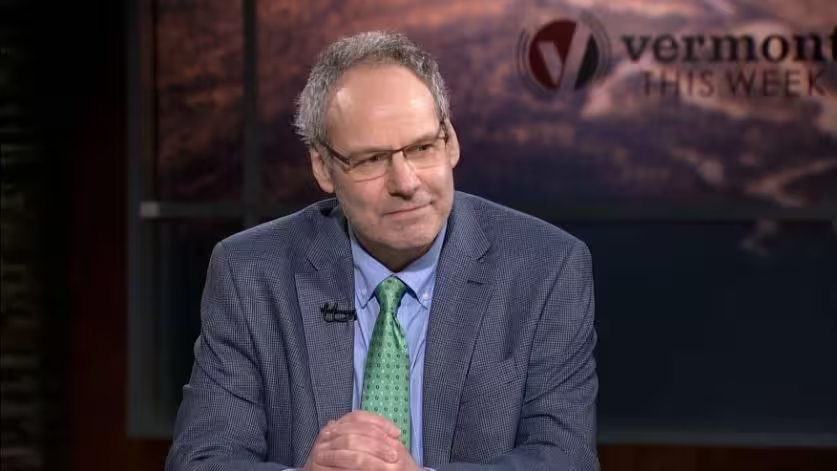
Vermont Prepares for Monday’s Total Eclipse | Gov Vetoes Bill Banning Sale of Flavored Tobacco Products | Vt. Senate Passes Bill to Establish 'Climate Superfund' |Panel: Colin Flanders - Moderator, Seven Days; Mikaela Lefrak - Vermont Public; Calvin Cutler - WCAX; Anne Wallace Allen - Seven Days.
Problems playing video? | Closed Captioning Feedback
Problems playing video? | Closed Captioning Feedback
Vermont This Week is a local public television program presented by Vermont Public
Sponsored in part by Lintilhac Foundation and Milne Travel.
Support provided by:


Vermont This Week
April 5, 2024
4/5/2024 | 26m 45sVideo has Closed Captions
Vermont Prepares for Monday’s Total Eclipse | Gov Vetoes Bill Banning Sale of Flavored Tobacco Products | Vt. Senate Passes Bill to Establish 'Climate Superfund' |Panel: Colin Flanders - Moderator, Seven Days; Mikaela Lefrak - Vermont Public; Calvin Cutler - WCAX; Anne Wallace Allen - Seven Days.
Problems playing video? | Closed Captioning Feedback
How to Watch Vermont This Week
Vermont This Week is available to stream on pbs.org and the free PBS App, available on iPhone, Apple TV, Android TV, Android smartphones, Amazon Fire TV, Amazon Fire Tablet, Roku, Samsung Smart TV, and Vizio.
Support the crew
Help Mitch keep the conversations going as a member of Vermont Public. Join us today and support independent journalism.Providing Support for PBS.org
Learn Moreabout PBS online sponsorshipAs Vermont gears up for its first total eclipse since 1932, state leaders encourage residents to be prepared.
Vermonters should expect a lot of traffic this weekend through Monday and possibly Tuesday.
So please plan accordingly and use common sense.
Think of this as peak foliage weekend on steroids.
Plus, Governor Scott vetoes a bill banning the sale of flavored tobacco products.
And the Senate passes legislation to establish a climate super fund.
All that and more ahead on Vermont this week.
From the Vermont Public Studio in Winooski, this is Vermont this week, made possible in part by the Lintilhac Foundation and Milne Travel.
Thank you for joining us.
I'm Colin Flanders.
It's Friday, April 5th.
Joining us on our panel today, we have Mikaela Lefrak from Vermont Public.
Calvin Cutler from WCAX.
My colleague Anne Wallace Allan, from Seven Days.
Thank you all for being with us.
So I'm going to be honest, I don't know about you all, but I have to admit, I was a bit wary when I first heard about this eclipse.
I think part of me was kind of fed up with these once in a lifetime events after 2020 and the pandemic I came around to it gradually is the people who pay attention to this kind of stuff assured me this would last only about 3 minutes, not three years.
But that's not to say that there hasn't been a lot of planning going into this.
Michael, I want to start with you.
I think in the months leading up to this event, there's been a lot of uncertainty about how many people might be coming here and part of that is because we didn't really know what the weather was going to look like.
Surprisingly, Vermont's fickle weather seems to be cooperating with us here.
What do we know so far?
Can you believe that, Colin?
So from what I hear, it sounds like we're going to have better weather than Texas, which I just feel very proud of for some reason.
So along that path of totality, the National Weather Service has been issuing forecasts for the last week as people try to figure out where they're going to go.
A lot of people are making last minute plans, it seems like.
And, you know, while we usually have very cloudy Aprils in Vermont, it seems like the weather's going to hold.
We're looking like we're going to have a pretty sunny day on Monday.
One interesting thing I learned is that the temperature might drop 5 to 10 degrees during totality, which is fascinating.
But overall, a sunny day.
And I've heard a lot of people are changing their plans to come to Vermont rather than go to other states.
So I talked to one person who had flights booked to Texas and they just changed them.
They somehow snagged a last minute flight from the South to come up to Vermont and are trying to make it work.
I'm sure paid a lot of money to do that.
But yeah, I also heard that Airbnb's in Vermont and along the entire path of totality in the US, starting down in Texas are like basically 99% booked for this upcoming weekend and Monday.
So yeah, it's big business.
Yeah, totally.
And I know that you have experienced one of these before.
You were telling me before the show that there wasn't all of the hubbub, Lulu, that we're hearing here in Vermont.
But you're thinking that's because of sort of our location, right?
Right.
I was in Idaho and there were you know, people were excited about it.
And the stories had a clip classes the way they do here.
But we just didn't see the kind of crowds that are expected in Vermont.
And I think part of the reason is because we have all of those big cities near us that are where people can make last minute decisions.
They're within driving distance, you know, and there's just a way more people who can come and see it.
But it was it was a nice event that really brought people together, which I think is happening here, too.
Like everybody's talking about it in a way.
And unlike with the pandemic, they're not talking about it with horror, but with like anticipation and curiosity.
Yeah, totally.
I will say that I do know state leaders are paying close attention to this.
They have been for years.
Calvin, I want to come to you, but in a moment, let's hear from Governor Scott in Vermont.
Emergency preparedness on what they've been doing.
We're expecting more than 100,000 people to visit the state for this event.
And we've been preparing for months to assist with potential traffic delays.
The state has extended welcome center hours and added portable restrooms at welcome centers and parking areas along the interstate.
We want to see Police, Department of Motor Vehicles and Agency of Transportation patrols out to assist motorists.
We are also pushing the message for, say, another day.
Enjoy the state of Vermont for an extra 24 hours.
You'll miss the traffic and you get to partake in the great things that the state has to offer.
So, Calvin, I know any time there is a large number of people coming into the state beyond normal capacity, there's public safety concerns.
What are we looking out for?
Yeah, indeed.
I mean, you know, just bringing this many people in, there's a lot of logistics and complications that come with bringing 100,000 people, maybe more, into the state.
I think, you know, state leaders, number one concern is the traffic, you know, people having a fuel, food, water, you know, back during the 2017 eclipse, I spoke with somebody that said they moved 15 miles in 7 hours on a three lane highway.
So that just kind of gives you a little bit of the sense of like what are we talking about here in terms of impacts?
You know, certainly there is a concern that if there is an accident or something, something goes wrong on the highway, getting emergency crews and first responders, ambulances, fire trucks, that type of thing might be a challenge as well.
But then there's also complications of, you know, it's mud season back roads.
We don't want people getting stuck.
We just had a big snowstorm this week as well.
So some of those back roads might be kind of muddy, too.
And then certainly, you know, if people want to go and view this eclipse from a mountaintop or from trails, camel's hump, Mansfield, etc., you know, the Green Mountain Club and Stowe Mountain Rescue and others are saying, please stay off the trails.
We might not be able to come rescue you because, you know, just emergency crews may be spread so thin.
Yeah.
And Michael, I know that a lot of towns and cities are grappling with this and thinking about how can they best prepare and make sure, as Calvin said, for example, an ambulance can get there if they need it.
What are some what are some of the things they're doing around the state?
Yeah, a lot of towns are closing their roads to local traffic only, especially in places like Underhill, Underhill, near Mount Mansfield, where they really don't want people going into the backcountry.
And, you know, the the shortage of emergency management personnel is one thing.
It's also it's mud season.
We got a ton of snow this week.
It's going to be melting everywhere.
Those back roads are going to be pretty muddy and people could get stuck or get hurt if they're hiking.
Yeah.
Yeah.
And obviously on the flip side of things, and there is, as you mentioned, a a big benefit here, not only is just it's going to be fun, but I think there's hope that this will be an economic boon for the state.
I know tourism officials are estimating anywhere upwards of $50 million.
You've been talking to a lot of businesses about how they're preparing, but also how they're making sure that their employees can have fun here, too.
What have you learned?
Yeah, there's there's kind of a a tension between those two things because people employees want to get outside and be available to look.
But businesses like restaurants and other anything that serves tourists, they they need all hands on deck because they're expecting really big crowds.
I talked to a restaurant owner in Saint Johnsbury, which was named the number one place to see the Eclipse by the Boss, by Boston.com, partly because it's a straight shot up that Route 93.
And he said he got no pushback whatsoever from his staff.
They all want to work and then they're going to close at the time of the eclipse, because he figures that all of the guests and the staff are going to want to be outside.
And in fact, like many of the restaurants I talked to, they don't even usually open on Mondays, but they're opening specially for this.
I also talked to actually when it comes to emergency management, the one employer I talked to that's not letting everybody out is the medical center, UVM Medical Center, because they were like, sorry, we're with so many people in town.
We think that actually we might be needed more than ever.
They're trying to move a lot of their appointments to remote if they can, but they're going to be fully staffed in the emergency room.
And they made a point of telling me that, you know, they're not going to leave patients unsupervised.
They're going to have people are going to have to work through the eclipse without seeing it, if that's what's what's needed.
Yeah, that's a great point.
I know hospitals kind of throughout the path of totality have been saying the same thing.
It's a big concern.
I want to stick with the tension point topic here for a moment.
You've been doing some reporting, too, on lodging facilities.
I know hotels have been booked for months now.
Tell us about a recent story you had on the motel and how that kind of intersected with some people's lives.
Yeah, hotels have taken this as a time to jack up their prices considerably, like we're hearing about thousand dollar hotel rooms that are normally $350 or even less in Burlington and the state is housing 1200 families now, I'd say, or 1500 families in 70 motels around around Vermont and has been for a very long time.
But two of those motels in the Chittenden County area have said that all of the people who are staying there through various state programs have to leave because they want to rent to tourists.
The state pays $80 or $84 now a night, and obviously they can command much higher prices for that.
So the Anchorage Inn in South Burlington in the days and in cultures have asked people have asked people to leave.
And I actually sat by the days in a couple of days ago to talk to the front desk, who confirmed this for me, and also told me that they're sold up during the eclipse.
And I talked to a couple of people in the parking lot who are saying, yeah, we know we're going to have to leave.
And they've asked us to take all of our stuff with us and we don't really have anywhere to go because of course they can't book a motel room for sure.
They're all really, really expensive and all kinds of lodging is booked up.
So it's it's causing a different kind of tension for people in the motel program.
Yeah.
Yeah.
I'm glad you covered that, because it's a really important aspect.
And I don't think a lot of people in the thinking about that.
McKayla, I do want to just ask us here briefly to kind of go through I mean, what are we hearing about Monday?
What are we expecting as term as far as events go?
Is there anything you're really interested in seeing or hearing about how it goes?
Yeah.
I mean, I think there's a lot of really fun events happening and they're playing the entirety of the Dark Side of the Moon, Pink Floyd up at J.P., the Echo Center in Burlington, where the waterfront is going to be hosting a lot of different events and educational opportunities for kids.
I spoke to one woman who has a mobile planetarium dome who's been traveling around the state for the past couple of weeks, teaching kids at local libraries about the eclipse.
And we also talked about some fun ways to make sure that your little kids can watch the eclipse safely.
Of course, many schools and child care centers are going to be closed that day.
So lots of kids will be home with their families and might be tempted to pull those glasses down.
So they had some fun ideas for making eclipse glasses, masks or bags you can put over your head.
But I think there's just a lot of general excitement.
As you all said, it's a thing that's bringing a lot of people in Vermont together.
Yeah.
And I think actually one of your colleagues from Vermont public did a recent video on this one school, how it's preparing for this eclipse.
Lexi Krupp, I think we have a video here we'd love to watch.
Lots of places have been considering how to take advantage of the eclipse, including a school in Morrisville, Vermont.
There one science teacher has been planning for the total solar eclipse for years.
I have been a teacher at People's Academy for four years and so for the last three we've offered the astronomy class as an elective.
It was decided to offer it because we have an observatory and more kids will just know about it and know that it's a resource they have at the school.
The observatory is actually from 1931 and so is the telescope, and you can point it in any direction.
And then what's really cool is the dome itself like rotates and the whole dome rotates and then you turn this and the slit opens and so then you can look at anywhere in the sky.
It's the only public high school I know that has an observatory and it's cool to be able to show students in my class since figure out that this school is in the path of totality.
I reached out to my principal and we ordered solar eclipse glasses for every student at the school so that they can take them and observe the solar eclipse from wherever they're going to be on that day.
And then in terms of the actual day, I have told my students, if they want to stay here, I'm going to have two solar telescopes.
And we're going to be observing from, you know, when the moon just starts to move in front of the sun all the way up until totality, which is quite some time.
But mostly I've just encouraged them.
Like, just be somewhere where you can see it.
Like, you don't have to start school, but take the glasses and use them because you know, for some people, this might be the only opportunity they have to see a total solar eclipse.
That's some great advice there.
And I do want to note maybe to close the loop on the eclipse conversation glasses.
I know it's a it's a big concern about what's going to happen to all of these glasses, the solar eclipse glasses that towns are handing out.
You can buy them across the state.
Mikayla, what's the message for people after the event?
Yeah, I know we're trying to get glasses out to people right now to make sure they wear them and stay safe.
But after the eclipse, there are options instead of throwing them right in the trash.
There's a group called Astronomers Without Borders that's going to be collecting eclipse glasses for re-use.
And there are also a couple drop places, locations.
You can drop them around the state where they can be reused or recycled.
Yeah, thanks.
Believe it or not, there is other news this week beyond the eclipse.
And I think we've been talking about a once in a lifetime event.
This event I want to talk about next is something that's been happening surprisingly frequently and that's a governor's veto.
And this week, Governor Phil Scott vetoed a bill that would have banned flavored tobacco products.
And I think it surprised some people, given what we know about the problem of teen vaping and the concept of these flavored products often being sort of build towards children.
But the governor had some concerns.
What were those he did?
And, you know, he he anticipated some pushback on his veto because, as you said, nobody wants kids and teens to be using these products.
And they do seem to be geared toward kids with their bubblegum flavors and things like that.
But the governor so actually the governor wrote a letter, which he was pretty thoughtful and which he read out at his press conference, too, because he's aware that it sounds counterintuitive to veto this ban.
And he said one really good reason is because it seems kind of hypocritical to him to to target these products when the state has been heavily promoting cannabis products that are also flavored.
And that, I mean, gummies also are something that would obviously appeal to kids.
So he said, you know, there needs to be a little bit more thought into this and what we really want to happen.
And the other reason is because a lot of our stores are general stores.
This is where they make their money.
This is one of you know, this is an important source of revenue for them.
And it's it's it's obvious that these stores are marginal at best as it is because they're going out of business.
And in many cases, they're relying on public funding and grants to stay in business.
And he said he didn't really feel comfortable taking away that revenue source from them.
And Calvin, I know you've been paying attention to this as well.
What did you make of this?
Yeah, I mean, I think when looking at, you know, whether state lawmakers will try to override the veto, I think that's one of the next big questions.
I mean, it passed through the Senate with 18 votes passed through the House with 43 votes or 83 votes.
Excuse me.
So both of both chambers don't have the two thirds to override.
If they do, that's a lot of votes to flip.
But what's really interesting I think about this issue is it's one that's kind of cut across party lines.
I mean, there were progressives that voted against it or Democrats or Republicans, you know, really, there's a lot of different ways to look at this, this, this, this issue.
And I think, you know, in the governor's veto letter, he also called on state lawmakers to work with the attorney general to try to crack down on vapes that are sold online, because it's especially for for kids, young people, you know, they're not buying them from from retailers either.
They're getting them from older siblings or others, or they're buying them online on their phone.
And that's true proved very difficult for for the state to to regulate and to enforce.
So that's, I think, going to be a focus going forward with this.
Yeah.
And another bill on the move this week was the Climate Super Fund.
And this is an attempt from Vermont lawmakers to hold big oil accountable for the effects of climate change that we're already seeing and going to continue to see.
What is the purpose of this bill?
What are they trying to do and how likely is it that we're going to be able to fulfill the promise of it?
Yeah, I mean, that's the big question, right?
I think that last one.
But this bill is really aimed at creating a statewide fund, you know, allowing us to sue fossil fuel companies so we can, you know, make money and put that towards climate change mitigation and resiliency efforts.
We saw during the Summers floods and Tropical Storm Irene just how devastating and how expensive it can be for state coffers to try to to cover this.
And so the Senate advanced this bill, which would let us sue fossil fuel companies.
And I think a lot of people are on the same page saying, you know, this is something that, you know, we we should do or it's it's prudent for the state to do this.
But there was concern from some Republican lawmakers that should we be the first ones to do this?
You know, certainly there are going to be legal fees and the state will have to pay for these lawsuits.
So, you know, there is, I guess, some hesitation or concern about, you know, should Vermont be setting this precedent?
Should we be leading the charge on this as opposed to leaving it to another state to try to to come up with first?
Because, you know, climate change and its costs are something that affects every single state.
That's right.
And Governor Phil Scott hasn't come out and said either way whether he supports this bill.
Is that right?
Yeah, that's correct.
I mean, he again, I think, you know, as I mentioned, nobody's really against it.
I think it's just like the pace of how we implement this.
You know, we'll we'll have to see.
I know Secretary Julie Moore had testified and she was generally supportive of the idea.
But, you know, there's still still some about a month and a half or a month left in the legislative session.
So anything can happen.
Yeah, anything can happen is right.
And I, I think and I want to come to you now some other statewide news.
We had another update on the motel program in Vermont and sort of a hectic one.
I think that's kind of defined this program, the emergency shelter program.
We're still trying to figure out what happened this week.
What do we know so far?
The there's this kind of battle going on between advocates and the agency of human services over what exactly is going on with the motel program.
And one of the leading charges against the agency or the Department of Children and Families is that they're not giving out information about the program.
They're not saying how many people are being asked to leave and how many people are being allowed to stay.
And it's true that information is very hard to come by and they don't seem to have numbers and advocates for people who are in this program say that people who are suffering from disabilities are being pushed out onto the street from the motel program because they haven't been given information about how to apply to qualify to stay.
The program is now on a month to month basis.
So that's one of the things that makes it possible for the motels to push people out for the eclipse.
And there are some people who are who know that they can stay until through the end of June and others who are being told that they have to leave.
And it's there's really nobody nobody can clearly say why this is happening or why people aren't getting the information they need.
Although Brenda SIEGEL and others who are fighting for the homeless will say it's because the state wants this program to end.
It's very expensive.
They never intended it to go on so long.
So they're hoping that it will sort of wither away through attrition by making it so difficult for these people to stay.
And the governor says that's not the intention at all.
He's saying we want to help these people, but we're just we're juggling a lot of loose pieces here and that, you know, people aren't required to tell the state if they're in one of the other programs, but housed in the motel.
So it's the Agency of Human Services is saying they just it's not their fault that they don't have numbers and they can't say what's going on.
I think part of this, too, and this gets back to what lawmakers are also working on this year is you know, the hotel program isn't written in state law.
It's not in state statute.
It's actually a rule within the Department of Children and Families.
We're told it's about 500 or so pages and there's a lot of different ways to interpret those rules.
Right.
So that's what makes this program so difficult to to navigate, to explain.
I mean, there's three different cohorts.
There's all types of different timelines and requirements.
I mean, it really is a bureaucratic, really big challenge, especially for, you know, state agencies and DCF caseworkers are, you know, seeing staffing shortages.
You know, hotel owners certainly are under pressure.
And for the people that are in the program, you know, going through the process every month, it's a real traumatizing, you know, situation for for many people, too.
So lawmakers are also working on a bill the House actually advanced it already, which would modernize and try to simplify and make this program more clear and sort of try to re-imagine what's the next iteration of this program, how can it better serve Vermonters and how can we save money and, you know, try to really get at the root of homelessness here?
Yeah.
And it's not just advocates, right.
Who are taking problem with how the administration has handled.
I know a lot of towns and cities are also kind of waiting to see what happens because as we saw last summer in Burlington, for example, when the motel program evicted hundreds of people, unsheltered homelessness went up a lot in Burlington and Mikael.
I kind of want to come to you now about I know Burlington just saw in a new mayor this this week a Mulvaney Stronach among many of the other items she's going to be focused on is this you talk to her about some of her priorities.
What is she looking at in their first few months?
That's right.
Yeah.
I mean, Mulvaney, Stanek is Burlington's new mayor, the first woman and first openly queer person to serve in that role.
Yeah, she said in her speech on Wednesday when she took the helm of the city that community safety or public safety is her number one priority, that obviously there's a lot of different aspects to it.
But concerns about the intertwined crises of rising crime, opioid addiction, housing and homelessness, those are kind of all combined together into this issue of community safety.
For her, there's a couple of key pieces that it seems like she's kind of waiting to see what she'll do next on particularly with reappointing Police Chief John Muir, who was appointed by her predecessor, Miro Weinberger.
She has about three months until she needs to announce her city appointment.
So, you know, she keeps saying we're getting to know each other and getting to know how one another lead.
And then, you know, outside of public safety, the city is also facing a $9 million budget deficit.
That's a big thing she has to take on.
And she also noted when she came on Vermont Edition recently that climate change didn't really come up very much in the debates and in the mayoral race at large, and that's a major priority of hers.
So, yeah, a lot to do.
Yeah, yeah, a lot to do.
And talk about a welcome to the city the first week.
She's also going to be presiding over Burlington's eclipse.
It's good.
Double in size.
Yeah, yeah.
You residents.
I do not envy her at all.
Mikael, I want to stick with you and change topics here completely, but I know that you are a big UVM women's basketball fan.
And I know this because I went to a game with you once and they won.
But I want you to talk a little bit about their season came to an end this week.
It didn't end how they wanted, but they made a really successful run.
Talk to us about that.
I assumed you watched the game.
I did indeed, yeah.
The UVM women's team has been so much fun to watch this season as they have been for the past couple of seasons.
Really successful team.
Yeah, they were.
You know, they made it pretty far in the Women's National Invitational Invitation Tournament Wednesday.
They were in the Final Four loss, 57 to 54.
It was such a nail biter, but a really great game.
They lost to Saint Louis University after a huge win on Monday against Purdue.
You might have heard of them in Indiana, which is where two of their starters are from.
Yeah, it was a really great season.
The men's team also made it to the NCAA March Madness tournament.
They lost to Duke.
But yeah, it's been a great season all around.
And we're also saying goodbye to two grad students who ended their careers on Wednesday.
Yeah, yeah.
Great.
Thanks.
And in our final minute here.
So I do just want to note that Vermont experienced an earthquake today.
I think a lot of people at home might have been wondering what was that?
Why are my plates shaking?
I'm just wondering, has anybody heard from anyone about this?
I personally have heard from a lot of people, people who thought, for example, that it was their cat, their cat.
One woman actually told me that she thought it was her cat sneezing on her lap.
Another thought that it was a bear on the porch.
Turned out it wasn't a bear.
But have I mean, has anybody here did anybody feel it?
How did it feel?
It it kind of bad about it.
I didn't either.
I was in Montpelier.
I was sitting in my car like always totally missed it.
I was at we don't my power's out.
So I was working at outer space restaurant in Plainfield and we felt that, although I have to say that I thought it was a truck going by, but then I saw an email from you and I, everybody in the restaurant started talking about it like, Oh, because I said something about it.
We were like, I wonder if that was an earthquake.
It was an earthquake.
It was my first earthquake.
It was it was pretty shocking.
But I think that's all we have here today.
Thank you so much to our guests, Michaela Lefrak from Vermont Public, Calvin Cutler from WCAX and Ann Wallace Allan from Seven Days.
It's great to have you all here.
I'm Colin Flanders.
Thanks for watching.
And we'll see you next week as long as the sun comes out

- News and Public Affairs

Top journalists deliver compelling original analysis of the hour's headlines.

- News and Public Affairs

FRONTLINE is investigative journalism that questions, explains and changes our world.












Support for PBS provided by:
Vermont This Week is a local public television program presented by Vermont Public
Sponsored in part by Lintilhac Foundation and Milne Travel.