
April 10, 2023
4/10/2023 | 55m 12sVideo has Closed Captions
Mohammad Shtayyeh; Naomi Long; Alexandra Robbins
Palestinian Prime Minister Mohammad Shtayyeh joins the program for an exclusive interview. Biden will visit Northern Ireland tomorrow alongside British Prime Minister Rishi Sunak, to celebrate the 25th anniversary of the Good Friday Agreement. For more on this, Naomi Long – head of the centrist Alliance Party – joins the program. Author Alexandra Robbins discusses the state of teaching.
Problems playing video? | Closed Captioning Feedback
Problems playing video? | Closed Captioning Feedback
April 10, 2023
4/10/2023 | 55m 12sVideo has Closed Captions
Palestinian Prime Minister Mohammad Shtayyeh joins the program for an exclusive interview. Biden will visit Northern Ireland tomorrow alongside British Prime Minister Rishi Sunak, to celebrate the 25th anniversary of the Good Friday Agreement. For more on this, Naomi Long – head of the centrist Alliance Party – joins the program. Author Alexandra Robbins discusses the state of teaching.
Problems playing video? | Closed Captioning Feedback
How to Watch Amanpour and Company
Amanpour and Company is available to stream on pbs.org and the free PBS App, available on iPhone, Apple TV, Android TV, Android smartphones, Amazon Fire TV, Amazon Fire Tablet, Roku, Samsung Smart TV, and Vizio.
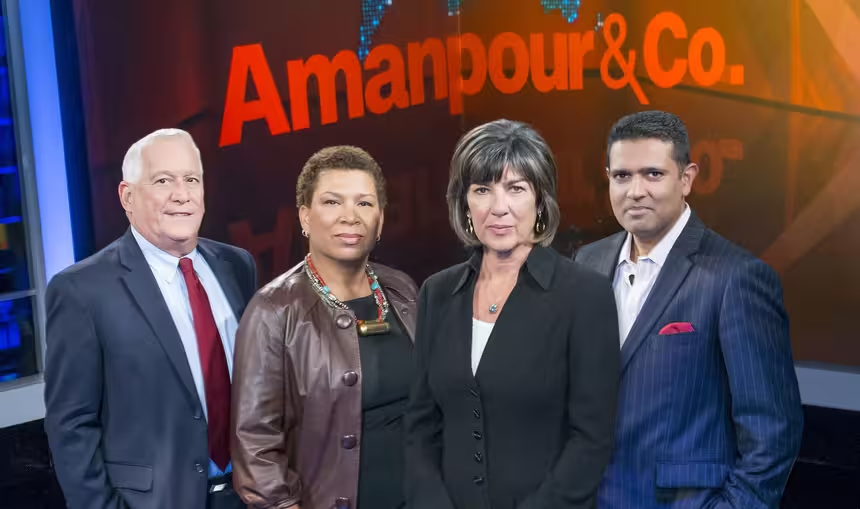
Watch Amanpour and Company on PBS
PBS and WNET, in collaboration with CNN, launched Amanpour and Company in September 2018. The series features wide-ranging, in-depth conversations with global thought leaders and cultural influencers on issues impacting the world each day, from politics, business, technology and arts, to science and sports.Providing Support for PBS.org
Learn Moreabout PBS online sponsorship♪ Christiane: Hello and welcome to "Amanpour and Company."
30 years since the Oslo peace Accords for the Middle East and yet it is endless death between Palestinians and Israelis.
As tensions continue to grow, the Palestinian Prime Minister joins me for an exclusive interview.
Then, 25 years since the Good Friday agreement for Northern Ireland, an imperfect peace holds there.
The leader of the centrist alliance party joins me.
Also ahead -- >> Districts are not giving teachers what they need to supply classrooms.
Christiane: A year inside the country's most needed and vulnerable profession.
The challenges facing teachers.
♪ >> "Amanpour and Company" is made possible by the Anderson family fund, Sue and Edgar Wachenheim III, Candace King Weir, Jim Attwood and Leslie Williams.
The family foundation of Leila and Strauss.
Mark J. Blechner, and Denise Schwartz.
Koo and Patricia Yuen.
Barbara Hope Zuckerberg.
We try to live in the moment, to not miss what is in front of us.
At mutual of America, we believe taking care of tomorrow can make the most of today.
Mutual of America financial group, retirement services and investments.
Additional support provided by these funders, and by contributions to your PBS station from viewers like you.
Thank you.
Christiane: Welcome to the program.
I am Christiane Amanpour.
Amid critical tension in the Middle East, Israel's far right national security minister has met thousands of settlers marching to the occupied West Bank to an illegal outpost.
This was condemned as an invasion, and there has been violence and injury.
It comes as Israelis and Palestinians are suspending some of their holiest days, morning and bearing children.
There is a growing human toll as tensions continue to rise after the Israeli military conducted a raid on Tuesday.
In addition, Iran backed militias have exchanged fire with Israel, and the U.S. has announced it has deployed a missile guided simmering to the region.
Joining me for an exclusive interview is the Palestinian Prime Minister, Mohammad Shtayyeh.
Welcome.
PM Shtayyeh: Thank you for having me.
Christiane: In the end, it comes down to people and death and mourning in the ongoing hopelessness.
We have a young 15-year-old Palestinian boy shot and killed by Israeli security forces.
We also have the mother of two Israeli British sisters, they were killed in a shoot and the mother has died of her injuries.
I want to know your feelings about this after all of your years and power.
How was your government working with the Israeli government to de-escalate tensions and restore security?
PM Shtayyeh: Well, by all means, occupation in itself is a source of violence.
Today, not only yesterday, but every day.
This is really government a particular has adopted a special policy that one could call a shoot to kill policy.
Since the beginning of the year, 96 Palestinians have been killed, including this morning, a 15-year-old boy and a 75-year-old man, and all in between.
Occupation is the source of every violence.
Incursions into the mosque and refugee camps, demolitions, colonization of settlements, this sort of marching today with a number of ministers and Knesset members calling for programs to be intensified, land expropriation -- all of this has been the main cause for this wave of violence and terrorist acts that the Israeli army has adopted.
On the other hand, you are 100% right that been rough ear -- that there have been calls for Israelis to hold arms and for settlers that are already armed to act immediately.
This policy of shoot to kill has brought very dangerous consequential -- consequent is on Palestine and the entire region.
What we saw was unacceptable.
The Israeli police in the mosque, rated the mosque, they were hitting people and so on.
These acts have created incredible anger among every Palestinian, wherever they are.
There is a mood of anger in the heart and mind of every Palestinian.
Christiane: Do you worry -- I know some of your neighbors, some of your allies worry that if this doesn't -- we were talking about the Palestinian side right now and you say anger and frustration and desperation.
If it does explode in a much more serious way, which many worry about, including the Israeli side, it could mean a huge risk to the Palestinian authority.
That it might be the end of the Palestinian Authority.
Because you don't have control over all of the people.
Even your security forces are not in security control there.
PM Shtayyeh: You are right.
The way one should look at it is the following -- Two policeman cannot stand on one square meter.
The Palestinian Authority and Palestinian police are there to defend the Palestinian people.
This Palestinian Authority is not a security agent for Israel.
Therefore the Israel incursions into refugee camps and everywhere, this is a total violation of the Palestinian/Israeli agreement.
Because of that, we have stopped all acts of security coordination between us and the Israelis because it has proven to be useless on the side of the Palestinians.
And also Palestinians cannot continue to obey security terms and they nothing in political terms.
The issue for us is political not security.
This will never bring peace to the Israelis.
What brings security is peace and security does not bring peace.
The Palestinians and Israelis, we are Palestinians looking for the end of the occupation, not living with occupation.
Palestinians don't want to see the occupying power, they don't want to see the occupying forces, they don't want to see settlers.
They want to live free like any other people in the world in the same way we want the whole region to live in peace and dignity and so on.
You are right that the Israel incursions into the Palestinian towns made the Palestinian security forces's mission impossible.
That's why they continue to go into the cities and this is at a time when they say they want to empower the Palestinian in 30 when in real terms they are destroying every foundation authority -- foundation of the Palestinian Authority.
Christiane: First there has to be a calming.
Many times when there has been terrible violence, your sides have spoken.
I want to know if you are engaged in any effort between your authority and the Israelis to calm the current tensions and violence.
PM Shtayyeh: The United States has been playing an important role in bringing things together.
As I said, it is all in the hands of the Israelis.
The Israelis declared the shots, they can escalate the situation or make it calm.
All we have seen, the incursions into the mosques and refugee camps, the killing, land expropriation, this is before disaster or violence.
When you have ministers calling for wiping out a whole town or every is really to hold arms and shoot whenever needed and so on.
This is really government has changed the rules of engagement to make killing easier and to make everything easier for the Israelis.
We are trying to calm the situation as much as we can what the Palestinians are under occupation, we are victims, and it is in the hands of the Israelis.
They dictate the shots.
They are the ones who can make the situation calm, and they are the ones responsible for any escalation.
Christiane: I want to ask you a follow-up.
You talked about a minister who talked about wiping out a city, and also said there is no such thing as Palestinian.
You remember the inaccurate map he showed on a trip to Paris.
But also a minister who has been given by Prime Minister Netanyahu, I guess to soften the issue overhauled in the judicial reform, this portfolio of the so-called National Guard.
What effect will that have on the Palestinian side?
PM Shtayyeh: If the minister had said what he said in any democratic state, he could have been put in jail by now.
To say Palestinians don't exist, this is wishful thinking, for the classical Zionist saying that Palestine is a land without people or people without a land.
We have known this and seen it.
I think for him to also say he wanted to wipe out a city, this is an expression of expansionist mentality, that the main coalition of the Israeli government has a special political program designed based on expansionism.
For them to show a map for all of historical Palestine including Jordan, they call that Israel, this is an affliction of loan you'll expansionist mentality.
For the under minister to be given the permission to form a militia, I think this is going to be a disaster.
For whom is this militia?
It has been designed for Mark killing's -- for more killings against Palestinians, whether inside Israel or on the West Bank and Gaza.
This is a situation in which every Israeli will be holding arms, every Israel is a soldier into the Israelis are adopting a new rules of engagement that will cause a lot of bloodshed for Palestinians we will pay a heavy price.
This militia is a compromise between Netanyahu and the minister.
The compromise, who will pay the price?
It is we.
This is something that should not be allowed, it is not only designed to kill Palestinians, but it will be an additional source of escalation, again in the hands of the Israelis, and by the Israelis themselves.
Christiane: You are prime minister of several million people who have lived in the occupied territories and obviously in Gaza, although I know your power does not reach their.
However, you have not had elections since 2005 for the presidency and since 2006 for the legislature.
I assume Palestinians are watching the Israeli people already in the streets to try to protect and defend their own democracy, and certainly separate from that, they are complaining loudly to pollsters about the corruption of the Palestinian Authority and that you don't meet their economic and human rights and human needs and there haven't been any elections.
How long can you continue like this and remain a credible leadership?
PM Shtayyeh: Look, the Palestinians have been calling for elections.
Our president issued a decree calling for elections on the 22nd of May 2021.
It is a pity that Israel has had five elections in four years and using a veto against our election.
Palestinians are ready for elections, we wanted elections, a new political system and so on, but the Israelis are denying the Palestinians the right to have elections in all of Palestine.
We cannot have elections in one part of Palestine and not the other, simply because Israel is saying Jerusalem, where 380 Palestinians live -- 380,000 Palestinians live, the Palestinians don't want to give these people the right to vote and be candidates.
When we had candidates, they were arrested.
When we wanted to send the Central election commission chairman to sit at stations, the Israeli said we will put him in jail.
It is not that we are refraining from our democratic rights.
We fight for our democratic rights, we fight for elections.
And when we, the Palestinians, one important issue is to oblige the Israelis and sign agreements.
On top of which a main chapter in the agreement has to do with elections, and you are right.
Palestinians had elections in 1996 and we participated.
In 2005 and 2006, and every elections.
We recently had local government elections, student union elections -- whenever it is possible we have elections.
We want to have elections in all of Palestine, including Jerusalem.
Unfortunately the Palestinians were put in a situation in which damn if you do and damn if you don't.
We had to choose between elections and Jerusalem.
We chose Jerusalem and we have postponed elections until it becomes possible.
Here I take the opportunity to call upon the European Union and United States to exert every pressure on the Israelis to allow the Palestinians to have their own elections for the presidency, for the parliament.
This is not something we are shunning our faces away.
On the contrary, this is an existential issue for the political system, for the political leadership, for the government, for the president, for all of us.
Christiane: I want to move on because I want to ask you finally, there seems to be a shifting public perception particularly amongst the Democrats in the United States with slightly more simply toward the Palestinians.
It is narrowing, the affection gap if you like, between Palestinians and Israelis for the Americans.
Can this be a source of, I don't know... political solution in terms of trying to get the international community to focus on this issue more and see whether there is any route for any kind of peace?
You talked about a two state solution but nobody seems to think there is any hope anymore, even on your side.
PM Shtayyeh: Well, you know we received President Biden here in Palestine, he was in Ethel him and he met with our president.
-- Bethlehem and he met with our president.
President Biden spoke and we appreciated that.
The question for him and all, what should we do to preserve the two state solution at a time when Israel is systematically destroying the two state solution?
Israel is systematically destroying the future possibility of a Palestinian state.
There are 750,000 Israeli settlers in the West Bank.
This is really government is eroding borders.
It is unfortunate that the United States, who we had hoped for this administration they would move things forward.
Until now, we did not receive or have a peace initiative from the United States.
We used to have the United States, United Nations, Russia, it is no longer functioning there is a political vacuum and we need to fill that with a series initiative.
The United States did not come up with that initiative yet.
We are hopeful this exercise and this peace process will be back on track.
Our problem today is we don't have an honest broker.
The international political arena has been very crowded.
Still, every day, events have proven Palestine is the center of the Middle East conflict.
Today we have Saudi Arabia in a compromising mood with Iran and so on.
The whole region is chaining -- changing and I think there's a lot of room for international intervention.
I think there's room for third-party intervention.
We need somebody to take things forward.
As I said, there is no bartering with Israel.
They are not about peace, the Israeli government is about colonization, settlement, killing, so on and so forth.
You are right, the two state solution is in danger.
Everybody today agrees politically on two states but on the ground tomorrow it will be too late.
Christiane: Tragically, the one thing both sides agree with or say publicly is they have no partner for peace.
We will see if that changes.
Thank you.
Next, to a peace deal that did have a huge amount of support from the U.S. and has held for a quarter of a century.
Today marks the 25th anniversary of the Good Friday agreement, the landmark peace accords between Northern Ireland's religious affections and the governments, shepherded by the U.S. and Clinton administration.
Take a listen to what then Prime Minister Tony Blair said about the deal 25 years ago.
PM Blair: I said when I arrived I felt the hand of history upon us.
Today I hope the burden of history can at long last start to be lifted from our shoulders.
It will take more of the courage we have shown, that it need not mean more of the pain.
In doing what we have done today, we have carried out what I believed to be the will of the overwhelming majority of people here in Northern Ireland.
The chance to live in peace, to raise children out of the shadow of fear.
Christiane: That pain was perfected in our reporting back then, the bitter and divided process but also the courage and a genuine sense of hope.
As I found a month later when people voted to approve the peace deal in a referendum.
Here is my report from back then.
Nationalist politicians celebrate a historic victory in a referendum designed to overcome decades of division, violence, and inequity.
A referendum designed to put Northern Ireland's affairs in the hands of all of its people.
>> The task now is to manage that change, to get the mechanism for change to deliver on equality, on justice, and all of the other matters that are required if we are to have a peace settlement.
Christiane: Protestant Unionist politicians celebrate too, those who campaigned so hard for the referendum and saw this fight because a bitter split within their own ranks.
>> We will do our best to implement and deliver that which was expressed in spirit today by the voters of Northern Ireland.
Christiane: But the vote won't silence the no's who despise the deal.
>> It will put the delegates of armed terror in government and permit those terrorists to retrain -- retain their weaponry, and release on the streets savage and homicidal maniacs.
Christiane: They vow to win seats in the new assembly and use their veto.
But the British minister in charge of Northern Ireland called on the no's to respect the will of the people.
>> All I've heard is them say they want a replay and I've never heard a replay when it is 3-1.
I hope they acknowledge what this Geordie of people have said.
Christiane: More people voted in Northern Ireland than at any time in history, and many say they have waited too long.
Of course, President Joe Biden will visit Northern Ireland tomorrow along with the British prime minister, Rishi Sunak, to celebrate the 25th anniversary of the Good Friday agreement.
But there are still testing challenges, not least the democratic process itself with no functioning government therefore a year.
Joining me is Naomi long, head of the centrist alliance party.
Welcome from Belfast.
Naomi: Good afternoon.
Christiane: I don't know if you heard that report from 25 years ago but it was really something to be reacquainted with the depth of the feelings back then.
Both scared and hopeful.
Do you recall that moment?
What were you doing then and how you feel 25 years later?
Naomi: Very much so.
I wasn't in politics actively then, I was a member of the party but I did not stand for election until 2001.
I recall vividly the emotions attached to the Good Friday agreement.
I was a child of the Troubles.
It was the whole backdrop of my life growing up.
For me, I suppose the first opportunity we had to see transformation was in 1994.
There was a huge amount of optimism at that time, where the people really believed this was a chance in a generation to bring the bloodshed to an end, to find an honest and just accommodation between people on this island, between these islands, and particular Northern Ireland and to govern ourselves as a people, which is hugely important.
I remember vividly voting for the agreement and I did not do it lightly.
What we heard from the detractors was true -- it required us to reach out to those who had previously been involved in violence.
It included allowing people who had been convicted of heinous crimes to walk three.
Albeit -- to walk free.
I'll be on license, but to walk free from prison.
It was very difficult especially with sensitivities for victims.
For me, the best way I could have honored those who lost their lives and loved ones during the Troubles Was to work as an individual and a politician to ensure we would not enter another cycle of that violence and I believe the Good Friday agreement was so we could start the move forward.
Christiane: You mentioned the Troubles, which is what it was euphemistically called.
So many killed and injured and families and lives and communities ripped apart.
I am staggered to report what you know very well, which is your democratic process seems to be stalled and in jeopardy.
It is difficult to understand how one party, one group, can veto government and cause it to come to a grinding halt.
Your country, your profits, your area, is now still again run and vanished by Britain.
That is not what was meant to happen.
Naomi: Precisely.
The Good Friday agreement talked about the opportunities presented, but not all of those opportunities have been realized in terms of reconciliation between our people.
I think much more effort needs to be put into that.
We still live in a deeply divided society.
We are starting to see, the growth in my party has shown that people are no longer so divided between orange and green.
There are other views on the situation here and people are drawn to that.
But also, whilst it was good in principle, the principles of the Good Friday agreement a good foundation to build, the institutions handed unionism and nationalism tools to use against each other.
We have tested our institutions.
I think 25 years on, with what we've seen in society, our focus has to be the next 25 years.
We have a much more fluid sense of identity in Northern Ireland.
People are more confident exploring that and likely to vote for parties that don't fit along party lines.
We need to allow those voices to contribute.
72% of a simile members voted to elect a new speaker and it wasn't enough, yet 71% of Northern Ireland voting for the Good Friday agreement was enough.
There's something fundamentally wrong with the structures we need to change.
Not to strip away protections because those are important, preventing people from being able to destabilize our institutions.
People in Northern Ireland need good government.
Christiane: You don't identify as either, or you are a neither, we describe you as the centrist alliance party, and you made a huge number of gains in the last elections last year.
You gained eight seats.
You just said what you hope will happen, this veto that was baked in 25 years ago can end and make this fit for purpose again.
You've got the votes, you've got people, young people presumably -- how difficult do you think that will be, to change this?
Naomi: We have changed the Good Friday agreement over the last 25 years, sometimes in ways where we were responding to ransom politics, where people threatened to collapse institutions or actually collapsed institutions to make demands.
But also it's not been for the betterment of the agreement or institutions.
I am not into destructive politics.
I want cooperation and collaboration across communities.
We've come up with the proposals we believe would stabilize the assembly, allow us to have government and to work through our problems as part of that assembly, rather than walk away and throw in the towel when things get difficult, which happens now.
We need to work with the two governments and I think we also need to include U.S. government, who has been hugely influential in terms of creating the opportunity for us to have discussions about these issues.
Get the parties together.
The two largest parties will not give up their veto, but we need to recognize the people who own the agreement are not the parties.
The people of Northern Ireland, North and South.
The people of Northern Ireland deserve a stable government and they don't get that at the moment with these vetoes.
We want to say that changes are evolutions that will allow us to provide for the next 25 years of stability whatever the future holds, that we can have government consistently year on year.
40% of the time since the Good Friday agreement was signed, we had no government in Northern Ireland.
That would not be acceptable to your listeners and it is not acceptable for us.
Christiane: You mentioned the United States.
President Biden will be there and the British prime minister.
Meantime, President Clinton, under whose administration the U.S. helped make this happen, has written in the Washington Post, "the events that lead to peace in Northern Ireland were a happy occasion of hope and history rhyming, but such achievements are still too rare.
All around the world, people are yearning for better, safer, more inclusive days ahead.
The challenge will be finding the leaders with the courage to meet the moment and make the hard choices necessary for peace within frameworks that give everyone a voice."
I guess he's talking to people like you, Naomi Long.
Naomi: Absolutely and I think people in other parts of the world still looked another -- Northern Ireland despite the flaws in the Good Friday agreement.
It's one of the most enduring peace treaties that's been done.
It's sad that I am talking to you against the backdrop of not having institutions and rioting, mainly from young people born after the Good Friday agreement, attacking our reformed police service on the streets today.
That to me shows we have a long way to go in terms of reconciliation and building for the future.
We now have an opportunity we did not have 25 years ago.
To have spaces that are peaceful, we can engage with each other across the community.
We have gone from having six seats to 17.
We've seen the growth and appetite but there's much more we can do.
But it requires political leadership and courage.
Every decision you take along the way, someone will criticize you and say you are taking their side and not mine.
We have this culture of them versus us.
I want to talk about people more about the fact that we need to create win-win scenarios where everyone can benefit and no one feels alienated, or ignored.
That takes creativity but it also takes a little bit of bravery.
There will always be those who say no to everything.
At some stage we have to be willing politically to face those people down.
Christiane: Yes, and I wanted to ask about a United Ireland, and maybe you don't want to think about this, but the facts remain that Catholics outnumber Protestants for the first time, and apparently gaining power in the Republic who want a United Ireland.
Do you believe that is in the cards, a possibility?
That you might have to get used to this evolution?
Or is that just not something that could happen?
Naomi: I think the first thing is, Catholic and Protestant are broader terms that don't fully reflect our politics.
There are a small number of Catholics that would be Unionist in a small number of Protestants would be nationalist, and there are people in my own party that don't identify as Christian at all.
They identify as Catholic Protestant.
Our identity is multilayered.
I am both British and Irish.
Northern Ireland is the place I call home.
I will take part without prejudice in any conversations around how a United Ireland might operate, how it would look, and do that without prejudice.
But I am pragmatic and I base my decisions on evidence.
What I will want to do is at the point we have a referendum, and so far the test for that has not been met, Unionism nor nationalism are a majority.
Alliance holds the balance.
We are in the situation where we are all minorities and I think there's an opportunity in that space for people to no longer feel threatened by these conversations, no longer feel threatened by their opponents.
We are all in the same boat, we are all minorities and we all belong here.
In the words of Martin Luther King, he said we either learn to live together as brothers or we perish as fools.
I think we need to learn that lesson.
We have an opportunity, for the last 25 years, and I don't want to squander another minute of it.
We need to live as brothers.
Whether we are part of the United Kingdom or a United Ireland, we are a united community and contribute positively irrespective of the constitutional situation.
Christiane: It is remarkable.
It is great to speak with you, as the third-largest party, and very different in terms of what we've heard from the others.
Of course, so many young people have so much vested in a successful future.
We wish all of you good luck on this 25 anniversary.
Naomi: Thank you.
Christiane: Turning to the teacher crisis facing America.
Staffing shortages, burnout, funding cuts and debates over curriculum are putting pressure on educators, not to mention school shootings.
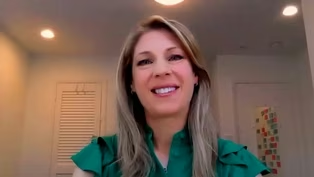
In her new book, the selling author Alexandra Robbins followed three teachers to see how these issues are changing how they work.
She joins Hari Sreenivasan to discuss the state of teaching in the United States.
Hari: Thank you for joining us.
In the past few weeks we seen headlines from the biggest school systems in the country, both in essential... and New York, about strikes, pensions.
It seems the entire system is going through big changes, and at the core of a lot of these concerns are whether or not there are enough teachers to do the job.
What is happening?
Alexandra: What's happening is that teachers are not being treated properly.
They say there is a teacher shortage, that's a popular term, it is misleading.
There is no teacher shortage.
There is no shortage of people who are wonderful, qualified and willing educators.
There is a shortage of teaching jobs that adequately treat, compensates and respects skilled professionals.
That's not a shortage of people, that's a shortage of support.
Hari: Give me an example, how much is the average teacher making?
What would you think of as the pay gap, if they could go out with the same level of education and get a different kind of job, how much more or less are they making as a teacher?
Alexandra: It depends where you go, on the district and states, but I will give an example.
One of the three teachers I followed for a year for my book, Penny, had 18 years of experience.
She was a veteran teacher, award-winning teacher, and after 18 years she was making $47,000 a year.
That is a problem.
She has to work extra jobs to afford to keep a teacher.
That's something that 70% of educators have had to do what they've had to work an extra job or two or sometimes three if you count summer jobs, just to afford to continue teaching our children.
Hari: What are we talking about, driving Uber?
Alexandra: Yes, actually, there is a teacher I spoke with in Texas that is petrified that at some point he will accidentally be called to pick up one of his students because he doesn't want them to know.
We were working retail, farming, dog walking, tutoring, a lot of waitressing, bartending, selling blood -- anything they can do to continue to afford to fulfill a role that is arguably society's most important role.
Hari: Tell me about the three teachers you followed for the year.
How did you pick them and what kind of positions are they in?
Alexandra: I followed Penny, who is a middle school math teacher in the South, Miguel, a special ed teacher out West, and Rebecca, an East Coast teacher.
So people can see behind the scenes and learn what school is like from the inside.
I chose them because their stories are both relatable and interesting and because I thought people would love them as main characters and enjoy the read with them.
Hari: What was fascinating to me is some of the parents during the kind of open house, one of them had a sense of entitlement that I am not going to bring or pay you anything for school supplies because guess what, I pay my taxes, I pay your salary and you should be doing that.
Give us an idea of how much or how often teachers are going into their own pockets to make the school system whole?
Alexandra: 94% of teachers pay out of their own pockets for classroom supplies.
They pay an average of $500.
Penny one year paid $2000 of her own money because there were so much she needed for her math classroom.
Districts are not giving teachers what they need to supply classrooms.
Hari: One of the things you illustrate so clearly is the amount of time teachers spend that the rest of us non-teachers might think is free time but really isn't, from the summer to even a single day.
Alexandra: Yeah, first of all, teachers aren't paid during the summer which is why so many of them take a summer job to make ends meet.
However they are still doing teaching activities during the summer, whether they are doing continuing education to retain their certificate, professional development, prepping lessons for the following year.
Districts tend to change curriculum often.
If a teacher is involuntarily transferred to a new grade or subject, they have a lot to catch up on.
That is just summer.
During the year, teachers work so much more often than people realize.
The job is impossible to handle during a school day.
Teachers maybe have 150 minute prep time/planning time, and maybe a 20 or 30 minute lunch.
That is not enough time to grade, prep, doing all of the parent calls that administrators put on their shoulders -- it is too much.
Middle and high school teachers can have 180 students easily.
I talked to a teacher in Utah, a Haeckel English teacher, who had 263 students.
-- an English teacher, who had 263 students.
Can you imagine correcting that many assignments?
Hari: The special ed teacher your profiling, whose name you use as my gal, what is interesting to me is how overwhelmingly taxed his schedule seems, how many different types of classes he was teaching.
Just reading it they've me stress and exhaustion -- gave me stress and exhaustion.
He's also facing burnout and a change of heart for this profession.
Alexandra: That's one thing I followed his story through during the year.
The beginning of the year he was thinking he could not take it anymore, so we followed him to see what happens.
But the phrase teacher burnout, it's so popular that Merriam-Webster dictionary provides textual examples for burnout and both of them are about teachers.
But it is misused.
Experts say it's unmanageable workload, pressure at work, not enough resources.
Instead of actually fixing these issues like any normal workplace you would think would do, schools instead tell teacher to relax, do a better job of self-care -- that's a common buzzword among districts -- as if the burden is on the teachers to pay for a massage or something to alleviate the stress caused by a job that is impossible to do.
I think instead of saying teacher burnout, we need to come up with something else.
Teacher demoralization may be.
The burnout is not on the teachers, it is not their fault.
Instead of saying teachers have the highest levels of burnout, we need to say school systems are the employer's and they are worse at supplying employees.
Hari: Also substitute teachers, which I didn't think about, because the market I assumed goes up and down when there are shortages.
You became one and that turned into a longer-term engagement.
Alexandra: I wasn't expecting that.
A couple of days before the August open house last year, a school was allotted a new class but had no teacher.
I had short-term subbed at that school before and so they asked me to fill it and so I did.
I was a full-time third grade teacher for that semester.
First of all, I loved it.
Substitute teaching for me was a gift, I loved being with the students, I left earning what it was like to connect with students and see their exhilaration when a science project works or they finally understand a math concept.
I can tell you why there are not so many substitute teachers.
Last school year, I worked in school subbing more than 150 days out of 180.
My paycheck for the entire year, including retention bonuses and the Covid sub raise, my paycheck for the entire year, including a fulsome master as a full-time teacher, was just over $6,000 with no other benefits.
That's a problem.
An administrator told teachers last year near where I live, it is really hard to find long-term subs, so I need you to not get sick or pregnant this year.
The problem is that if a district cannot find enough substitutes, the fault lies with the district for not making the job doable.
Hari: How much of the stress on teachers right now is coming from an increasingly political climate of what is taught in the classroom and how, depending on the community, how mobilized parents are to get involved?
On the one hand, every child succeeds if their parent is involved.
We know that is true.
But the ways that parents are now attacking school boards and districts about curriculum seems very different.
You would want all of those parents engaged but maybe not in this way.
Alexandra: Yeah.
Educators are the only skilled professionals trained and certified to develop and deliver age-appropriate lessons to students paired not -- students.
Not parents who think they know about schools because they went to school, and not politicians who have never taught in a public school classroom.
There is a line between involved and overinvolved.
Many of the teachers leaving classrooms today are not leaving because of students, they tell me over and over again that it is hard to leave teaching because you love your students.
Teachers all over the country told me they are tired of the adults.
Hari: Is there an increasing amount of politics coming into the classroom?
Alexandra: Yeah, we are seeing a dangerous step nationally that we've seen in some states leads to politicians and parents pushing to remove from schools books, school materials, and discussions involving race, LGBTQ identities, and racism in American history.
Republicans are pushing these prejudicial measures under the banner of parents rights, but which parents?
Their message is exclusion and a country and cater to a small fringe of parents.
Every child deserves to feel safe, comfortable and represented at school, in the classroom, in the bathroom, and in important sometimes lifesaving conversations with adults like teachers and guidance counselors.
Hari: If there are these forces at play here, whether it is a push to privatize, whether it is called increase of parental rights, or the decrease in teacher salaries, what is the net cost to a generation of students?
Alexandra: Their education will tank if we don't have enough teachers in the classrooms.
I think people are starting to see that.
A lot of long-term subs, if schools can manage to get them in the classroom -- some classes are empty.
Penny had to double upper class often.
The teacher in the South I followed for the book, she often had to combine other classes with her own because the classes didn't have enough coverage.
We will see more of that if we don't turn this ship around quickly.
Hari: One of the things I hope people realize is the general racial composition of what public education is in America today.
I wonder how you see this conversation about how to educate students about race and culture in America.
Because you have a lot of parents saying I don't want you to make my child feel ashamed for something that their ancestors might have participated in.
At the same time, you look at the composition of the classroom , shouldn't the children who are living in America today also have an understanding of what happened in the past?
Alexandra: Of course.
Every child should feel represented in the classroom.
How are we going to stop bigotry if children don't learn what it is?
How will we promote inclusion if students don't learn that not every family looks like there's?
The majority of public school students in the country are students of color and we need to make sure they feel like they are getting the same education as everybody else, like their history is presented and their culture represented.
Hari: What is the fix?
Is there a correlation between paying more for teachers and student outcomes?
There is so much of our system that is trying to be designed toward outcomes.
Based on the research and what is working, and the teachers you've spoken with, what works?
Alexandra: Test scores in math and English raise significantly in districts that give teachers higher base salaries.
There is a clear correlation.
So yes, number one, pay.
Even more than that, the majority of parents in this country do not want the culture wars in their schools.
Want everybody to be taught history as it happened.
It is a small subset of parents and politicians who happen to be very loud.
Now is the time that those of us who are educator allies need to stand up for teachers, speak up for them, and show up to board meetings to lobby for what they need.
Hari: A lot of challenges were facing the education system before the pandemic.
What happened that fired up so many parents in the culture wars and added these new stresses and what is the long-term consequence?
Alexandra: OK, so, to get a little into the politics, parents became upset -- they said schools were closed.
They were not closed, they were open, they were just virtual in some cases.
I want to say, teachers wanted to be in person too, but only if it was safe.
Before vaccines and before we knew anything about COVID, nobody knew if it was safe to be in school.
However, teachers ended up working longer days of to transfer lessons to virtual materials and online platforms than they would have had they been in school.
With that said, parents who were upset their children were in their own house instead of a building started being vocal.
They started being vocal about masks.
Glenn Youngkin used parents rights as the central part of his campaign in Virginia.
When Republicans saw his campaign worked, I think they started jumping on the bandwagon.
In the first part of I believe it was 2022, there were more than 100 bills proposed just in the first six weeks of the year to start meddling in schools and censoring discussions and have more parental control over items that may involve race or LGBTQ identities paid I think -- identities.
I think Republicans pounced on this as something that might work in their campaigns.
They galvanized parents by weaponizing the term CRT.
Critical race theory is not taught in K-12 schools but Republicans darted using it as a way to refer to any oppression or talk of racism in American history.
They use this umbrella term to rile up parents and it worked.
Those parents are now fighting for something that actually is not going to help students.
However, if you look at the surveys, most parents of school-age children do not want the culture wars in their schools.
In fact, the people who are more likely to say they are upset with their local schools are parents who don't have school aged children.
This has become a political thing rather than an education thing.
Hari: The book is called "the teachers."
Alexandra Robbins, thank you for joining us.
Alexandra: Thank you for having me.
Christiane: Finally, tears of joy as months of separation come to an end.
31 Ukrainian children are back in the arms of their parents and siblings and other family members more than six months after being sent to Russia.
The International Criminal Court has indicted President Putin and a key minister for illegally deporting Ukrainian children from areas under Russian occupation.
Kyiv believes tens of thousands have been kidnapped, Russia denies wrongdoing.
Here is the moment one Ukrainian mother holds her 13-year-old son in her arms again for the first time since they were separated.
A group of these mothers have embarked on several perilous journeys to find their children and bring them home, assisted by the save Ukraine organization, which is determined to make this happen for more families and to deliver more scenes of jubilation in this cruel war.
That's it for our program.
If you want to find out what is coming up every night, sign up for our newsletter.
Thank you for watching.
Join us again tomorrow night.
♪
Providing Support for PBS.org
Learn Moreabout PBS online sponsorship
- News and Public Affairs

Top journalists deliver compelling original analysis of the hour's headlines.

- News and Public Affairs

FRONTLINE is investigative journalism that questions, explains and changes our world.












Support for PBS provided by: