
April 9, 2026
Season 4 Episode 361 | 26m 29sVideo has Closed Captions
What a new poll shows in the Republican race for Kentucky's 4th Congressional District.
New polling is out on the Republican race for Congress in Kentucky's 4th District, a University of Kentucky diplomacy expert weighs in on the ceasefire between the United States and Iran and whether a peace agreement is realistic, and how a Kentucky city is rebuilding one year after being hit by an EF3 tornado.
Problems playing video? | Closed Captioning Feedback
Problems playing video? | Closed Captioning Feedback
Kentucky Edition is a local public television program presented by KET
April 9, 2026
Season 4 Episode 361 | 26m 29sVideo has Closed Captions
New polling is out on the Republican race for Congress in Kentucky's 4th District, a University of Kentucky diplomacy expert weighs in on the ceasefire between the United States and Iran and whether a peace agreement is realistic, and how a Kentucky city is rebuilding one year after being hit by an EF3 tornado.
Problems playing video? | Closed Captioning Feedback
How to Watch Kentucky Edition
Kentucky Edition is available to stream on pbs.org and the free PBS App, available on iPhone, Apple TV, Android TV, Android smartphones, Amazon Fire TV, Amazon Fire Tablet, Roku, Samsung Smart TV, LG TV, and Vizio.
Providing Support for PBS.org
Learn Moreabout PBS online sponsorship[MUSIC] Who's ahead.
A new poll asks fourth Congressional District voters about incumbent Thomas Massie and challenger Ed Gallrein.
>> We are in a position where it seems like any step we take takes us into in a worse direction.
[MUSIC] >> Why?
That diplomacy expert says he doesn't see negotiations with Iran going.
The United States is way.
[MUSIC] >> So it is like nothing happened here for ever.
About nine months things started happening and you're fine when you see progress.
[MUSIC] >> And see how one business is rebuilding.
A year after an EF three tornado.
>> Production of Kentucky edition is made possible in part by the KET Millennium Fund.
>> Good evening and welcome to Kentucky edition for this Thursday, April the 9th.
I'm Renee Shaw and we thank you for spending some of your Thursday night with us.
It's one of the most watched primary races in the country.
The Republican race for Congress in Kentucky's fourth district.
A new poll says Congressman Thomas Massie leads the challenger at Gallrein, but it's not an overwhelming lead.
The poll from Qantas shows Massey with just under 47% of the vote, with Gallrein just under 38%.
About 14% of the people surveyed said they were undecided.
Gallrein has the support of President Donald Trump.
Massey has clashed with Trump on the budget, foreign policy decisions and the Jeffrey Epstein files.
He has the support of U.S.
Senator Rand Paul of Kentucky.
The primary, of course, is Tuesday, May the 19th.
Today is the second full day of the two week cease fire between the U.S.
and Iran.
The price of oil is up again, and stocks were down because of concerns over whether the ceasefire would hold.
There's disagreement over whether the agreement prevents Israel from bombing Lebanon.
Israel says it does not.
And it bombed Lebanon yesterday, killing an estimated 300 people.
Talks are planned between Israel and Lebanon.
As part of the agreement, Iran promised to reopen the Strait of Hormuz passageway for 20% of the world's oil.
Media reports indicate there is very little, if any, traffic moving through the strait.
High stakes negotiations over reopening and securing the Strait of Hormuz are set to begin tomorrow in Pakistan between U.S.
and Iranian officials.
The white House says Vice President J.D.
Vance and President Donald Trump's son in law, Jared Kushner, will join the discussion Saturday.
We spoke with diplomacy expert Robert Farley from the University of Kentucky's Patterson School of Diplomacy about the ceasefire effort and whether an agreement is realistic, especially after President Donald Trump warned in a post Tuesday that, quote, A whole civilization will die if Iran refused a ceasefire.
>> I think that President Trump wanted to create, in the minds of the Iranians the belief that he might use nuclear weapons.
I think it was much more likely that their strikes were going to be conventional, but they were going to be targeted against Iranian civilian power stations and bridges and so forth.
You know, it is fortunate that the president decided to back down.
It is fortunate that we were able to come to a ceasefire before that happened.
But I think that it has also done some significant damage to, you know, really our diplomatic status around the world.
Right.
There's only there's only so much we can do when we're simply hated and feared.
There's a lot of confusion right now about what exactly the United States and Iran agreed to as part of the cease fire negotiation.
And and that confusion seems to exist not just in the media and the public, but also within the administration itself.
You know, Iran has agreed to a ceasefire.
The United States and Israel have agreed to a ceasefire.
But Iran has also expressed that it continues to control the Strait of Hormuz.
It's continuing to control traffic there, and it's continuing to exact tolls.
They can continue to control the strait, and they believe it's to their advantage to control the State the strait, they don't appear to be willing to budge on that.
And if they're not willing to budge on that, then, you know, the American the American diplomats have to budge.
But beyond simply threatening Iran with more of what's already happened, I'm not sure what it can accomplish.
And I think also the Iranians really perceive Tuesday night what happened on Tuesday night when President Trump announced the ceasefire, they perceived that as American capitulation, the Iranians, by all evidence, seem to think that Trump chickened out, which is going to make it that much harder for this administration to pursue any kind of credible military threats in the future.
The Trump administration has talked about a bunch of different possible objectives for the war.
The ones that we have accomplished are the destruction of the Iranian Navy, which was pretty substantial, and the degradation of Iran's command and control and the degradation of Iran's missile industry, its missile and drone constructing industry.
Beyond that, it's hard to say what goals that the United States has accomplished to this point.
And really going back to what we talked about before, the biggest problem is with the Strait of Hormuz, right before the war started, the Strait of Hormuz was open.
Now, even after the ceasefire, the Strait of Hormuz does not appear to be open.
And so there are a lot of objectives that the United States has not accomplished thus far.
And it's hard to see how we get from point A to point B. I think that the administration in Israel and the administration in the United States had both hoped that there could be some kind of regime change in Iran.
Right.
Whether on the one hand, you would have a popular uprising against the Islamic Republic or on the other hand, you kill enough people at the top and eventually they are replaced by reasonable people who are going to negotiate in good faith.
That has not happened.
It hasn't really come close to happening.
And it's really hard to say from this point that it's going to happen.
You know, in terms of reopening the Straits, which is really the biggest deal right now for the United States and for the global economy.
I mean, you can go with it two ways.
One, the United States can violently open the strait by invading parts of Iranian territory.
Or B, we can we can come to an agreement that the Iranians are willing to live with for reopening the strait.
I don't see any other option between those two, those two opportunities.
So I don't know how we negotiate our way out of this.
I also don't know how we fight our way out of this.
We're we are in a position where it seems like any step we take takes us into in a worse direction.
And I think that's a very dangerous position to be in.
>> On a related note, a fallen service member from Kentucky has returned home to Nelson County Technical Sergeant Ashley Pruitt of Bardstown was killed four weeks ago.
She was one of six Air Force airmen aboard KC 135 refueling aircraft that went down in Iraq while supporting Operation Epic Fury.
Her body arrived late this morning at Samuels Field Airport, followed by an escort to Hoogland Greenland Greenwell Funeral Home.
Community members lined the streets of the route to honor, service and sacrifice.
>> And I thank her and all of her comrades are heroes.
Every town ought to celebrate it.
>> She is from our hometown.
I graduated from Nelson County.
I have a nephew who is actually in the army.
Boyfriend is a Navy veteran.
Just wanted to come out and show our support for our veterans and our our people.
>> Visitation for Tech Sergeant Pruitt is tomorrow from 10 to 8 at the funeral home, followed by her funeral on Saturday at New Salem Baptist Church Cemetery.
We'll have more on today's tribute tomorrow night on Kentucky edition.
We're one week into the veto period of this year's state legislative session.
This is the time that the Kentucky General Assembly is in recess, as the governor has a chance to review bills passed by lawmakers, and then he can choose to sign them into law, veto them, or let them become law without a signature.
Our Mackenzie Spink brings us an update on the measures Governor Andy Beshear has vetoed and which were approved despite his objections.
>> Last week at an event honoring Tommy Elliot, a friend of Governor Beshear's who died in the 2023 Old National Bank shooting, Governor Beshear vetoed two bills regarding firearms House Bill 78 and 312.
House Bill 312 would allow 18 to 20 year olds to purchase provisional concealed carry licenses.
Supporters say if 18 year olds can carry weapons in the military, they should have the right to carry responsibly at home.
>> Citizens who are aged 18, 19 or 20 can legally vote sign contracts, join the military, serve in combat, start a family, own a business and possess a firearm.
Yet under current law, these adults are prohibited from carrying that same firearm concealed for self-defense.
>> House Bill 78 establishes liability protections for firearm manufacturers and sellers.
Sponsor representative TJ Roberts says these parties shouldn't be sued for actions taken by a criminal individual.
>> If you are injured.
If you suffer harm as a result of the actions of a criminal, you can sue that criminal whom you should not be able to sue are the people that had ultimately nothing to do with it.
We don't see this in other industries.
I think of an incident in Waukesha, Wisconsin, where a man drove a truck through a crowd of people.
I don't think the manufacturer of the truck was sued.
I don't think the dealer of the truck was sued.
>> Governor Beshear said this about his veto.
While I believe in the Second Amendment, we must take steps to protect our people and allow them to seek justice for deadly acts like those these families have suffered from.
Vetoing these bills was the right thing to do.
House Bill 78 and 312 were vetoed by the governor after lawmakers had taken their ten day recess.
Some of the bills vetoed by the governor have already been overturned by the General Assembly.
That includes House Bill one, which opts Kentucky into a federal tax credit program created by last year's big, Beautiful bill passed by Congress under HB one.
Kentuckians can receive a dollar for dollar tax credit for donating to a scholarship granting organization.
These organizations often provide tuition aid for private school students, but can also fund transportation and technology needs for public school students.
Kentucky Democrat's and the governor, in his veto message, criticized the measure as another form of school choice, allowing public dollars to fund private and charter schools, arguing Kentuckians made their opinion clear when they voted down a school choice amendment two years ago.
Supporters say it's not the same issue.
>> What amendment number two asks the voters of Kentucky is do you support state funding for nonpublic schools?
That's what was on the ballot.
It never said one single word about federal funding, scholarship granting.
Organizations are going to take applications.
They're going to review those, and parents on behalf of their children are going to be able to get scholarships that would allow them to parents that send their children to public school, private school, home school.
Not $1 of this is going to go directly to a school, public or private.
It is going to parents.
>> The veto on House Bill one was overturned and the bill was signed into law by Secretary of State Michael Adams on March 17th.
The law will take effect on July 1st for Kentucky edition.
I'm Mackenzie Spink.
>> The governor has signed roughly 50 bills into law already, including Republican sponsored Senate Bill 101, which increases the penalty for students who assault teachers to a one year expulsion.
Today, Governor Beshear signed House Bill five into law, serving as the first step toward creating Kentucky's first reentry campus in partnership with the Kentucky Community and Technical College System, the partnership seeks to increase second chance opportunities, boost public safety and the state's workforce.
The governor also signed House Bill seven to increase school bus safety for students and Senate Bill 102 to support retired Kentucky State Police.
Many Kentuckians still have landline phones.
Will they be forced to change?
And what do the numbers say about illegal immigrant arrests in the Commonwealth?
Our Toby Gibbs tells us more and this.
Look at headlines around Kentucky.
>> Ice agents have arrested about 3500 people in Kentucky during President Trump's second term, according to a Louisville public media report.
Based on information from the Deportation Data Project.
And of those 3500 people, 78% were then deported.
Ice Immigration and Customs Enforcement questions the accuracy of those numbers and says they haven't been given context, immigration attorneys tell Louisville public media.
Some of the people arrested have no criminal histories.
[MUSIC] Kentucky is using more coal mined outside Kentucky than inside, and that's been the case five out of the last six years.
[MUSIC] W EKU radio looked at data from the Energy and Environmental cabinet.
Part of the reason cost.
[MUSIC] Central Appalachian coal cost $87 a ton.
It's cheaper from other states.
In Wyoming, it's $15 a ton, not including the cost of shipping it.
[MUSIC] From the new era.
Some Kentuckians are worried about AT&T plans to phase out landline phones.
AT&T hopes to discontinue its landline service by 2029.
It's notifying customers by letter.
People in Trigg and Christian County are already receiving letters.
[MUSIC] One man in KDE says he's been told his landline service will end this November.
Some Kentuckians are worried about having to switch to cell phones in areas where cell service is poor.
[MUSIC] 18 veterans of the Korean and Vietnam wars now have quilts of valor, the Casey County News says.
Casey County Middle School students made the quilts through the Under Our Wings program with help from volunteers with so Casey.
During the presentation ceremony, students also sang songs, performed music, and put on a skit.
[MUSIC] With headlines around Kentucky.
I'm Toby Gibbs.
>> Thank you.
Toby Gibbs.
Universities say college ball has gotten a lot more complicated since they've been recruiting players with big figure contracts.
These payouts have only been allowed within the past year, since a college athlete class action lawsuit transformed the game is our June, Leffler reports.
Athletic departments are wavering between playing the money game and calling for reform.
>> A lot of money revolves around Kentucky football and basketball, but the University of Kentucky and the University of Louisville athletics departments have reported recent deficits of tens of millions of dollars.
That's in part due to the brand new cost of paying players.
>> The risk you run is that if you don't play the game right now, you fall to irrelevancy a whole lot quicker than if you do try to play the game for as long as you can and resource it at the highest level as you can.
If we don't play the game right now, Louisville football doesn't win and Louisville basketball doesn't win, and the Louisville city suffers because of that.
>> Athletic departments can now pay up to $20.5 million a year to athletes across all sports, due to last summer's settlement between college athletes and the NCAA.
>> So overnight we had to find $20 million.
So and at that point, you know, we already are trying to claw our way to meet our $140 million budget.
So then all of a sudden, where does this extra $20 million come from?
It's what it has done is created a new floor, and it is not the ceiling.
It is now the expectation.
Now the expectation is you fund rev share fully, and then it's the n I l dollars that really go and sweeten the pot.
>> N I l being the unlimited dollars athletes can make from corporate sponsors using their name, image or likeness.
It's all made college sports unsustainable, says U of L, the university's president, athletics director and a trustee wrote a lengthy rebuke of the current system.
They called for a ceiling on individual athlete compensation and for Congress to intervene in a number of ways.
UK is arguably buying into the system more than anyone, the Lexington Herald-Leader reports.
UK spent $22 million on this year's men's basketball team, likely the most of any college.
UK has also moved its athletics department into an LLC, so it can be run more like a business.
Not everyone is on board.
Bellarmine University, the largest private Catholic college in Louisville, does not pay its players.
>> Not opting in is what is currently best for Bellarmine and Bellarmine student athletes.
>> All Kentucky public universities except Kentucky State University did sign on to last year's settlement to receive NCAA funds and pay players for Kentucky edition.
I'm June Leffler.
>> Thank you.
Jim.
President Donald Trump issued a college sports executive order just days ago.
Among other things, it limits the number of times a student can transfer schools and still compete.
About a year ago, an EF three tornado touched down in Kentucky.
Much of that damage was concentrated in a commercial and industrial area in Jeffersontown that's just outside of Louisville.
Our June Leffler is back with more on how business has been since then.
>> Jefferson Town is one of more than 80 small cities in Jefferson County.
But it's not just some Louisville suburb.
It's an economic powerhouse in its own right.
The Bluegrass Commerce Park in J-town is the largest swath of businesses in Kentucky.
>> Roughly 38,000 employees travel there daily, so between the hours of eight and five, we become the largest the fourth largest city in the state of Kentucky.
And when we produce products not just for locally, we're producing products nationwide and worldwide.
>> White collar, blue collar dining and medical.
All kinds of businesses call this area home like J. S o wood products, which sells wood veneer flooring.
But the building was hollowed out a year ago.
After the tornado.
>> They found pieces of property eight miles away.
That way, you know, everything was just gone.
>> An EF three tornado hit J town businesses and Middletown homes on April 3rd, 2025.
>> I want to say the Jeffersontown has been devastated.
We have many, many buildings that have been totally destroyed.
But I can say that we are lucky because no one has lost any lives or had any injury here.
>> The National Weather Service says the EF three tornado touched ground for nearly ten miles and lasted ten minutes, with peak winds of 145mph.
>> The contents were blown out, the wall was blown out, so the wood veneer is very thin, very light.
So it just got sucked right out the door.
>> It leveled the daycare, which may or may not be rebuilt.
>> We were concerned.
Originally, FEMA said that there were $100 million in damage to the buildings.
Now, while that may have held true, it did not affect us the way we feared it might.
>> How did businesses survive this?
Steve kits kept selling products at a temporary location not far from home, though at a slower pace.
>> We had business interruption insurance, which I would highly recommend.
It really saved us.
It allows you time to regroup and take a look at your inventory and go through things and plan your your return.
>> The city offered what it thought might help most, waiving demolition and permitting fees for a year.
>> Now, that represents tens of thousands of dollars in savings to these businesses.
>> The city says.
Of the 38 businesses hit, only 4 or 5 have not resumed business in J-town.
>> With the exception of very few businesses that took that, their buildings were just flattened.
Most were able to continue on.
It did not move the needle, so to speak.
We are forever indebted to these businesses in Jeffersontown.
They are the lifeblood of of paying for the resources that we're able to distribute to the citizens.
>> With insurance battles settled and cold weather gone, construction is full steam ahead and kits is eager to move back in.
>> So it is like nothing happened here for ever.
You had three months where you were at a standstill.
About nine months.
Things started happening and you're fine when you see progress.
>> It might not look like it, but kits is just a few months out from returning to his old spot for Kentucky edition.
I'm June Leffler.
>> Researchers at the University of Kentucky are hoping to make the state safer for our children.
In a recent study about child sex trafficking, they've identified key challenges they say are limiting progress in prevention.
To move the needle, they have implemented what's called the C stop Now, a program aimed at reducing the risk, and also collaborates with researchers across the country.
>> With the rise of the opioid epidemic, we have seen more involvement of kids in child sex trafficking that's been perpetrated by their parents and that is caused this increased incident in our state, in more rural areas, in places where you wouldn't expect, if you look at those, where the family is family controlled trafficking, the family is the trafficker.
It's younger kids ages 13 and 14 and sometimes even younger than that.
And so because of that, we really felt like we needed to get to kids younger and we needed to get into schools, which is where kids spend the majority of their time.
And so we randomized schools into either an intervention condition or an attentional control condition condition.
Those in the intervention condition condition got C stop now and those in the attention control got just a one hour awareness about child sex trafficking.
The difference between the two is in the actual C stop intervention.
We were teaching very specific things you can do to stop child sex trafficking.
We buy.
We call these bystander actions how to disrupt myths, how to decide if it's happening, how to delegate to other professionals to come in and do further assessments.
When we got researchers together and we shared our experience, I think in the multi-site consortium, we identified several gaps in the research.
In general, the prevalence of child sex trafficking is very difficult to estimate.
The reason is, is we often say that these victims are hiding in plain sight, that we don't have good estimates of how often it's happening.
Another key thing that we identified as a gap is that for many issues like violence against women or child abuse in general, there is a coordinated federal effort to coordinate all the activities and all of the research in these areas and to pool data.
And without that coordinated federal response, it's difficult to allocate dollars towards child sex trafficking prevention.
It's also very difficult to develop policies and laws that actually respond to what's really happening.
>> The University of Kentucky is hoping to secure more funding to expand the C Stop Now program to high schools in the state.
[MUSIC] One of Kentucky's public universities is finding ways to support military students.
>> It can be very difficult to transition, especially from the military back to civilian life, getting started in education.
So this space kind of gives the opportunity for students to to meet others who have had similar experiences with them.
>> Now, Eastern Kentucky University is receiving national recognition.
Details about this tomorrow night on Kentucky edition, which we hope you'll join us again for at 630 eastern, 530 central, where we inform, connect and inspire.
Connect with us all the way.
As you see on your screen, you can send us an email at the number, at the email address on your screen, and always the social media channels are available for you to get in touch with us and us to you.
Thanks so much for watching tonight.
I'm Renee Shaw.
I will see you on Friday.
Same time, same channel, same anchor.
Have a good night.
[MUSIC]
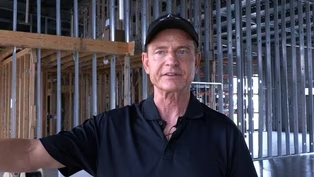
City Bouncing Back after EF3 Tornado
Video has Closed Captions
Clip: S4 Ep361 | 3m 27s | How a Kentucky city is rebuilding one year after being hit by an EF3 tornado. (3m 27s)
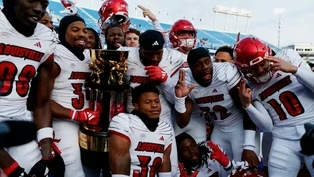
Colleges Struggle With Big‑Money Deals in Recruiting
Video has Closed Captions
Clip: S4 Ep361 | 3m 3s | Universities weigh big‑money recruiting deals as NIL era spurs debate on reform. (3m 3s)
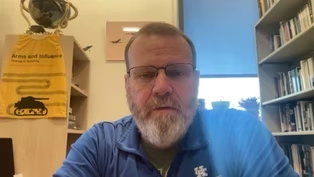
Expert Weighs In on U.S.–Iran Ceasefire Tensions
Video has Closed Captions
Clip: S4 Ep361 | 5m 21s | University of Kentucky diplomacy expert weighs in on U.S.-Iran ceasefire. (5m 21s)
Governor Signs Key Bills, Vetoes Others in Session
Video has Closed Captions
Clip: S4 Ep361 | 4m 38s | A breakdown of the bills Governor Beshear has signed and vetoed this session. (4m 38s)
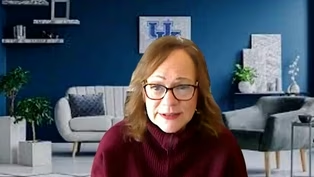
UK Researchers Target Gaps in Child Trafficking Prevention
Video has Closed Captions
Clip: S4 Ep361 | 3m 30s | UK researchers launch program to address key gaps in child sex‑trafficking prevention. (3m 30s)
Providing Support for PBS.org
Learn Moreabout PBS online sponsorship
- News and Public Affairs

Top journalists deliver compelling original analysis of the hour's headlines.

- News and Public Affairs

Today's top journalists discuss Washington's current political events and public affairs.











Support for PBS provided by:
Kentucky Edition is a local public television program presented by KET