
Arab American Museum, Climate Change, Shakespeare in Detroit
Season 7 Episode 48 | 26m 46sVideo has Closed Captions
The Arab American National Museum, climate change’s impact, and Shakespeare in Detroit.
One Detroit visits the Arab American National Museum for Arab American Heritage Month. Local environmental justice groups explore the disproportionate impact of climate change on Black and brown Detroiters. Shakespeare in Detroit returns for its summer 2023 season, with a performance on “Detroit Performs: Live From Marygrove.” Plus, upcoming events on “One Detroit Weekend.”
Problems playing video? | Closed Captioning Feedback
Problems playing video? | Closed Captioning Feedback
One Detroit is a local public television program presented by Detroit PBS
Arab American Museum, Climate Change, Shakespeare in Detroit
Season 7 Episode 48 | 26m 46sVideo has Closed Captions
One Detroit visits the Arab American National Museum for Arab American Heritage Month. Local environmental justice groups explore the disproportionate impact of climate change on Black and brown Detroiters. Shakespeare in Detroit returns for its summer 2023 season, with a performance on “Detroit Performs: Live From Marygrove.” Plus, upcoming events on “One Detroit Weekend.”
Problems playing video? | Closed Captioning Feedback
How to Watch One Detroit
One Detroit is available to stream on pbs.org and the free PBS App, available on iPhone, Apple TV, Android TV, Android smartphones, Amazon Fire TV, Amazon Fire Tablet, Roku, Samsung Smart TV, and Vizio.
Providing Support for PBS.org
Learn Moreabout PBS online sponsorship- [Announcer 1] Just ahead on, "One Detroit."
We'll visit the Arab American National Museum in Dearborn to see how it provides a unique perspective on the Arab-American experience.
Also coming up, a round table on the impact of climate change on communities of color in Detroit, plus Shakespeare in Detroit is getting young actors and Detroit audiences excited about the works of Shakespeare.
And if you are looking for something to do this weekend in Metro Detroit, we'll have some suggestions.
It's all coming up next on, "One Detroit."
- [Announcer 2] From Delta faucets to Behr paint, Masco Corporation is proud to deliver products that enhance the way consumers all over the world experience and enjoy their living spaces.
Masco, serving Michigan communities since 1929.
Support for this program is provided by The Cynthia & Edsel Ford Fund for Journalism at Detroit Public TV, The Kresge Foundation.
- [Announcer 3] The DTE Foundation is a proud sponsor of Detroit Public TV.
Among the state's largest foundations committed to Michigan focused giving.
We support organizations that are doing exceptional work in our state.
Visit DTEfoundation.com to learn more.
- [Announcer 2] Nissan Foundation and viewers like you.
(relaxing music) - [Announcer 1] Just ahead on this week's, "One Detroit, our Earth Month coverage examines how climate change is disproportionately affecting black and brown Detroiters, plus the professional theater company, Shakespeare in Detroit, teaches talented young people about the art of Shakespeare and Dave Wagner and Cecilia Sharpe of 90.9 WRCJ share a list of events taking place in Metro Detroit this weekend and beyond.
But first up, April is National Arab American Heritage Month and there's a one of a kind museum in Dearborn that's dedicated to documenting and sharing Arab-American stories.
"One Detroit," contributor, Sarah Zientarski, visited the Arab-American National Museum to learn about the unique exhibits from director Diana Abouali and to speak with artist in residence, Leila Awadallah.
(relaxing music) - People should come to the Arab American National Museum because they will get a sense of a chapter of American history that isn't told anywhere else.
We're trying to fill in the gaps of an incomplete narrative.
For Arab American Heritage Month, we offer free admissions all month and we encourage everyone to take advantage of it.
The Arab American National Museum is the only museum of its kind in the United States.
We present and share stories about Arab-Americans, their history, their culture and being the only institution of its kind in the country, I think we have a great responsibility to be very thorough in the way that we tell and share these stories.
We let objects sometimes speak for themselves but there's also a narrative that we're saying.
We're telling the history of Arab immigration to the United States.
We're showing how Arabs, once they came to the United States, how they sort of created a life for themselves here, how they engage with the society and through various aspects and sectors.
But we also use art as a way of showing that, there is a vibrant and active creative community in the Arab-American community.
So the permanent exhibits are the core galleries as we call them.
We have four of them.
The first one, which is in the, what we call the courtyard, sort of tells the history of Arab contributions to world civilizations.
There was a lot of contribution in terms of science, of mathematics, art, architecture.
So we try to set the scene in this first floor courtyard.
On the second floor is where we tell the history of Arab immigration to the United States.
So we have a gallery called Coming to America, where we talk about the various phases of immigration.
The next gallery is called Living in America and that's where we look at, you know, what is Arab-American culture like.
And then the final permanent gallery that we have is called Making an Impact, where we sort of showcase and shed a spotlight on Arab-Americans who have made an impact on this country in the various sectors.
Whether creative arts, politics, entertainment, literature, what have you.
In the temporary exhibits what we do is they're mostly exhibits of artwork by Arab-American artists.
And again, that's where we kind of show how Arab-American artists today kind of interpret the world around them.
So we are planning to open a rooftop garden.
We have a terrace on the third floor and that will be a what we call an heirloom garden.
So it's to sort of talk about and show how the Arab community here, like many other Arab immigrant communities, have brought plants or seedlings or seeds from their hometowns and cities and planted them here in the United States.
And to talk about that sort of practice and rituals around gardening and sort of putting in roots in a new home.
So that will happen in, opening will be in June.
(singing in foreign language) We are very keen to give a platform for Arab-American artists.
We have an artist in residency program that I believe is one of the only of it's kind in the country as well, where we try to support as much as possible, emerging young, newly starting emerging artists, giving them just, you know, some financial assistance a space to work and an opportunity to showcase their work as well.
(singing in foreign language) Leila Awadallah, I find a very special artist, dancer, choreographer.
We have a conference called MOVE, which is run by Access, our parent organization.
And as part of that conference we have a performance by Leila Awadallah called TERRANEA and I believe it's, it's about sort of the Mediterranean Sea as a kind of crossroads for immigrants.
(singing in foreign language) - Very interested in researching ideas about contemporary Arabic dance forms and what that might mean to look at rooting specific movement or ideas in the Arab world but then also exploring them in more contemporary or experimental dance choreography's.
(singing in foreign language) For me, choreographing or dancing is also really deeply related to my love for Palestine and my people and what it means to speak out about Palestine issues and Palestine realities and let that initiate a conversation with audiences and with artists.
The performance on April 28th is called TERRANEA: hakawatia of the sea.
It's a dance performance about the Mediterranean Sea, both as a mythological space where so many, you know mythologies have been told about that water but also as a site of loss.
The Mediterranean Sea is, you know, a space for grieving.
There's always every day life lost in the sea.
It's also about the land and what it feels like to be next to the sea and the the ways the land and water converse in our bodies and in our dances.
So our project is called Body Watani, Dance Project.
Watani means my homeland in Arabic.
So our dance project explores, you know what is home in our bodies.
So this is a performance that I would love to invite everyone to, to share that moment, to share that time where we think about, you know what do our bodies know about our home and our generations and what do our, what kind of stories from our grandmothers live inside of us.
(singing in foreign language) - It's a great way and a great, you know gateway into learning about this community, what they've done, what they've accomplished, their culture.
And I think if you're new to Dearborn, using the museum as a sort of stepping stone to discover the rest of Dearborn would be a great, it'd be a great way to do it.
- [Announcer 1] And you can see artist in residence, Leila Awadallah perform at the Arab American National Museum on Friday, April 28th.
Plus admission to the museum is free through the end of the month.
April is also Earth Month and American Black Journal teamed up with BridgeDetroit for a round table on the effects of climate change on black Detroiters.
Here's a portion of that discussion with host Steven Henderson and guests BridgeDetroit environmental reporter, Jena Brooker, Jamesa Johnson Greer, from Michigan Environmental Justice Coalition and Laprisha Berry Daniels, from Detroiters Working for Environmental Justice.
(relaxing music) - How do we know that the things that we're experiencing here in Detroit, that Detroiters are experiencing in particular and that black Detroiters are disproportionately affected by, how do we know this is about climate change?
How do we know that there's a connection between the way that, you know, the environment has altered and been altered and the hardship that we see in cities like Detroit?
- Yeah, we can definitely see it.
We see it every single year through the flooding events.
We can see it through our health even.
We know that from 2017 to 2019, 16.2% of Detroit adults and 11.11% of Michigan adults had asthma and that means that the asthma rates in Detroit were 46% higher than for, you know, for those Detroiters than Michigan residents as a whole.
So the fact that that's happening, means that people are being impacted by air quality issues, pretty, pretty predominantly in areas where black and brown folks are are living.
And that directly relates to climate change and how folks are impacted by air quality, specifically when we think about greenhouse gases, that we're trying to particularly get a handle on, as we're trying to mitigate those impacts.
- Yeah, yeah, Jena, in a lot of your reporting at BridgeDetroit, there's this evidence of the things that we do and tolerate in Detroit that already make it difficult for people who live here.
I mean, we create our own hardships with the amount of industry that we have, the lack of controls over air quality and things.
But this idea that climate is kind of adding to that makes it even more urgent, that we're seeing more of the consequences than we even would see in a city that was already really dirty.
- Yeah, I think it's hard because industry has helped build Detroit and you know we're the motor city and Detroiters have a close connection to that legacy and it's that same legacy that like you said, is polluting primarily black neighborhoods in Detroit and exacerbating the climate crisis.
- Yeah and talk about, some of the reporting that you've done, Jena and what it shows and how this plays out in people's lives.
- I think that my reporting has shown that climate change is impacting, like every aspect of Detroit's lives, from worsening their allergies to, you know increased asthma rates to basement flooding, extreme heat average, just increased temperatures, winter activities like ice fishing or skiing, you know, I think the first black ski club was founded in the Metro Detroit area or Detroit area.
So it's impacting every aspect of Detroiters lives from their health to their cultural experiences and their work, just everything.
- Laprisha, your group is dedicated to trying to make this better, to push back against, you know, the dirty quality of air and water and things here but also of course to account for climate change.
Talk about what this looks like from your vantage point, the things you see and the opportunities you think we have to make it better.
- So Detroiters Working for Environmental Justice is specifically focusing on reducing environmental health disparities and some of that Jamesa and Jena have already touched on.
So specifically we are focused on reducing asthma and other respiratory illness, lead poisoning, lead exposure, as well as cardiovascular disease.
And so there's a direct connection between, poor air quality, poor soil quality, poor water quality or access to water and those health disparities.
Jamesa started talking about the flooding events or the heavy rain events that we've had in Detroit.
And there are specific ways that that impacts the health and wellbeing of Detroiters for lots of reasons.
One reason is because there's not enough relief when there are emergencies like that in the city.
We know that we have lots of renters and the relief is not available to renters.
So there are ways that having these heavy flooding events exacerbate asthma because of mold now, that can be present in the home from the water being in the home, water intrusion in the home.
But there are other ways that this impacts folks that we may not think about as much.
One example is increase in lead poisoning among children.
When we find that there's not relief from these flooding events, then folks are left to their own devices to figure out how to dry out their homes.
One of those ways is beyond having neighbors and friends help to come and clean up, you also are opening and closing your windows to try to air out your home.
And so that is introducing more lead dust into the air.
80% of our homes in Detroit are pre-1978.
And so there's a lot of lead paint still existing in a lot of our homes.
And so it's not just what happens from the rain, right?
It's also what happens from residents being left to their own devices to try to solve the problems that come along with climate change.
- Talk about the Jemez Principles for Democratic Organizing.
I think that's an important part of this.
Yeah, we need government to do its job but part of that is about us as citizens figuring out how to get government to be more responsive.
- The Jemez principles are really, really central to the way that we have chosen to organize.
Our goal for the critical decade really is to take on this issue of climate justice with broad alliances and bold and unapologetic vision for justice and it really requires us to understand how we can reclaim and take on our own power, right?
And so what does it look like for us to seek our own representation?
So that's looking for us to be able to speak for ourselves, to be able to speak directly to our government about the things that we want to see in our communities as it relates to climate and our health and how do we work with other organizations as well in order to do that, other entities in order to do that.
So working in mutuality for example.
So those are just a few of those Jemez principles but those are the ways that we at NUJC like to see our work done.
- [Announcer 1] Turning now to Shakespeare in Detroit, a nonprofit theater company that presents the works of Shakespeare in live productions around the city.
The performances take place in spaces that include Detroit historical structures, venues and parks.
Satori Shakoor, host of Detroit Performs - Live from Marygrove, spoke with one of the actors in the company's youth program.
(relaxing music) - It's my pleasure to be sitting here with Evan Parrish one of the actors in the youth program.
Hi Evan.
- Hello.
- So what role are you playing in, "A Mid-Summer Night's Dream?"
- In Mid-Summer, I was playing the role of Lysander who in this adaptation was like a nerdy, geeky kid who had the heart of like, one of the other popular girls at school.
And in this role I got to explore a lot of like physicality.
I consider myself a very physical actor and I tend to find any opportunity I can to like use physical comedy.
And so with this role I got to take that just so very far.
There's so many scenes where I got to just look absolutely like almost cartoonish with like my mannerisms and the way I walked and talked and like posed and whatnot.
- What have you learned?
- I have learned mainly to investigate words more.
Like whenever reading in class like ELA or one of my first classes, Introduction to Theater, I always like, it's almost second nature to look for literary devices, metaphors, similes, things like that.
And it allows me to have a better understanding of English in general in like the nuances of different words and whatnot - So what would you say to youth like yourself who wanted to act or have an outlet for their creativity?
How would you tell them to be part of this?
- Don't be afraid to look a fool.
As crazy as that sounds, like the whole point of theater is making yourself look one way or another to give other people a show and some kind of joy or evoke some kind of emotion.
One of the biggest things I think holds people back from going into theater, is they're afraid of looking dumb on stage.
But that's kind of the whole reason why you're there, you're entertaining and eventually if you let go of that and you see the joy that your performance brings other people, you'll get that same joy like, wow, I did that.
I made someone smile today or laugh today or cry today or something like that.
- And in your view, what is the greatest contribution of Shakespeare in Detroit?
- Inspiration.
Without Shakespeare in Detroit, I don't think I would have fallen in love with acting the way that I have.
And I know a lot of people that I go to school with that can say the same.
Yeah, inspiration giving people something that they wanna pursue and whether it be like, performing onstage or trying tech, like lights and props backstage, inspiring people to do things that they may have never even thought of doing before.
- [Satori] Any last words?
- Tell someone that you love them today.
- It's been a pleasure sitting here with Evan Parrish from the Youth Conservatory of Shakespeare in Detroit.
And now we're going to the stage to see a performance from the professional company of Shakespeare in Detroit.
- [Witch 1] All hail, Macbeth!
Hail to thee, thane of Glamis!
- [Witch 2] All hail, Macbeth!
Hail to thee, thane of Cawdor!
- [Witch 3] All hail, Macbeth, thou shalt be king hereafter!
- Good sir, why do you start and seem to fear things that do sound so fair?
In the name of truth, are ye fantastical, or that indeed which outwardly ye show.
My noble partner, you greet with present grace and great prediction.
Of noble having and of royal hope, that he seems rapt withal.
To me you speak not.
If you can look into the seeds of time and say which grain will grow and which will not, speak, then, to me, who neither beg nor fear, your favors nor your hate.
- [Witch 1] Hail!
- [Witch 2] Hail!
- [Witch 3] Hail!
- [Witch 1] Lesser than Macbeth, but greater.
- [Witch 2] Not so happy, but much happier.
- [Witch 3] Thou shalt get kings, though thou be none.
So all hail, Macbeth and Banquo!
- [Witch 1] Banquo and Macbeth, all hail!
- Stay, you imperfect speakers, tell me more.
By Sinel's death I know I am thane of Glamis, but how of Cawdor?
The thane of Cawdor lives, a prosperous gentleman, and to be king.
Stands not within the prospect of belief, no more than to be Cawdor.
Say from whence you owe this strange intelligence or why upon this blasted heath you stop our way with such prophetic greeting.
Speak, I charge you!
- [Announcer 1] And you can see more of the Shakespeare in Detroit performance on Detroit Performs - Live from Marygrove next Wednesday, May 3rd at 7:30pm.
Plus you can watch more of their productions in person this summer at Campus Martius Park.
Now for a look at some of the events happening around town, here are Dave Wagner and Cecilia Sharpe of 90.9 WRCJ with today's, One Detroit Weekend.
- Hi, I'm Cecilia Sharp with 90.9 WRCJ.
- And I'm Dave Wagner, also with WRCJ.
Cecilia, can't wait for the weekend.
So what's on your radar?
- Well, I think I have something up my sleeve Dave.
The State Ballet of Georgia performs at the Detroit Opera House this Saturday and Sunday in downtown Detroit.
This dynamic ensemble dances with the program featuring music by Bach, Tchaikovsky and Georgian folk melodies.
- Fair, that's cool, you know, I always wondered with ballet dancers that are on their toes, why don't they just get taller ballet dancers?
(laughing) - Dave!
Are you or do you know a dancer between the ages of eight and 21?
Then we encourage you or them to head over to the auditions for The Carr Center Summer Dance Intensive, in partnership with the Debbie Allen Dance Academy.
Auditions are being held Sunday, April 30th from noon until 4pm at the Detroit School of Arts.
The doors open at 11:15am.
Cecilia, we have so many talented dancers in the cities.
Do you dance?
- Well, I've taken a few dance classes, a little bit of tap and jazz.
- [Dave] Nice!
- And ballet, but I didn't have the tall shoes.
- Okay.
- [Cecelia] You still have a couple days left to go see the classic musical, "Annie," at the Fisher Theater.
You can see it through Sunday April 30th at 7:30pm or go for the matinee Saturday or Sunday at 2pm.
I think my favorite song of the musical is, - [Dave] Oh yeah.
- [Cecilia] It's a hard knock life but really all the songs are so enjoyable.
- [Dave] And we can't forget that it's Jazz Appreciation Month.
So if you're in the mood for some great jazz this weekend, come on down to the Dirty Dog Jazz Cafe.
- [Cecelia] And this Saturday, April 29th at 1:00pm, the Detroit Public Library celebrates Cinco de Mayo at the Detroit Public Library main branch on Woodward Avenue, across from the Detroit Institute of Arts.
Kids can make an ojo de dios or dream catcher and also participate in other hands-on activities to celebrate Mexican culture.
- [Dave] Fantastic.
- [Cecilia] Yes.
Sounds like an interesting mix of things to check out.
- A great weekend here in Detroit.
- And here's more of what's happening ahead.
Hope to see you around.
Have a wonderful weekend.
(relaxing music) - [Announcer 1] That will do it for this week's, "One Detroit," thanks for watching.
Head to the one Detroit website for all the stories we're working on.
Follow us on social media and sign up for our weekly newsletter.
- [Announcer 2] From Delta faucets to Behr paint, Masco Corporation is proud to deliver products that enhance the way consumers all over the world experience and enjoy their living spaces.
Masco, serving Michigan communities since 1929.
Support for this program is provided by the Cynthia Edsel Ford Fund for Journalism and Detroit Public TV, The Kresge Foundation.
- [Announcer 3] The DTE Foundation, is a proud sponsor of Detroit Public TV, among the state's largest foundations committed to Michigan focused giving.
We support organizations that are doing exceptional work in our state.
Visit DTEfoundation.com to learn more - [Announcer 2] Nissan Foundation and viewers like you.
(relaxing music) (somber piano music)
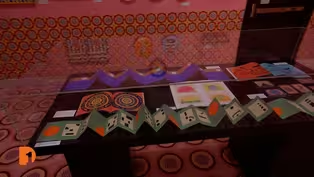
Arab American National Museum exhibits, artist-in-residence
Video has Closed Captions
Clip: S7 Ep48 | 7m 18s | Get free entry into the Arab American National Museum for Arab American Heritage Month. (7m 18s)
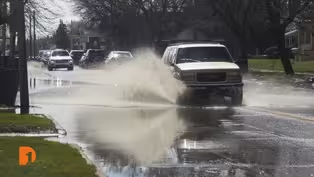
Environmental advocates fight climate impact on Detroiters
Video has Closed Captions
Clip: S7 Ep48 | 7m 41s | A community-focused roundtable on the impact of climate change on Black Detroiters. (7m 41s)
One Detroit Weekend: April 28, 2023
Video has Closed Captions
Clip: S7 Ep48 | 2m 31s | 90.9 WRCJ hosts Dave Wagner and Cecelia Sharpe share what you can do around Detroit. (2m 31s)
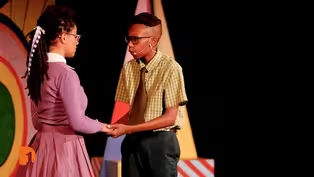
Shakespeare in Detroit Youth Actor Evan Parrish
Video has Closed Captions
Clip: S7 Ep48 | 3m 12s | Satori Shakoor talks with Shakespeare in Detroit youth actor Evan Parrish about acting. (3m 12s)
Providing Support for PBS.org
Learn Moreabout PBS online sponsorship
- News and Public Affairs

Top journalists deliver compelling original analysis of the hour's headlines.

- News and Public Affairs

FRONTLINE is investigative journalism that questions, explains and changes our world.












Support for PBS provided by:
One Detroit is a local public television program presented by Detroit PBS