Arkansas Week
Arkansas Week - April 1, 2022
Season 40 Episode 10 | 25m 54sVideo has Closed Captions
94th General Assembly Outlook
In 2023, we’ll have a new governor and an Arkansas Senate that will be nearly one-third new. Will the issues also be new, or will they be posed in a new way? We discuss with newly elected Arkansas Senate President Pro Tempore Designate Sen. Bart Hester (R) and newly reelected Arkansas Speaker of the House Rep. Matthew J. Shepherd.
Problems playing video? | Closed Captioning Feedback
Problems playing video? | Closed Captioning Feedback
Arkansas Week is a local public television program presented by Arkansas PBS
Arkansas Week
Arkansas Week - April 1, 2022
Season 40 Episode 10 | 25m 54sVideo has Closed Captions
In 2023, we’ll have a new governor and an Arkansas Senate that will be nearly one-third new. Will the issues also be new, or will they be posed in a new way? We discuss with newly elected Arkansas Senate President Pro Tempore Designate Sen. Bart Hester (R) and newly reelected Arkansas Speaker of the House Rep. Matthew J. Shepherd.
Problems playing video? | Closed Captioning Feedback
How to Watch Arkansas Week
Arkansas Week is available to stream on pbs.org and the free PBS App, available on iPhone, Apple TV, Android TV, Android smartphones, Amazon Fire TV, Amazon Fire Tablet, Roku, Samsung Smart TV, and Vizio.
Providing Support for PBS.org
Learn Moreabout PBS online sponsorshipSupport for Arkansas Week provided by the Arkansas Democrat-Gazette, The Arkansas Times and KUAR FM 89 got an hello again everyone to thanks very much for joining us.
Leadership changes at the top of state government just around the corner.
The eight years of Asa Hutchinson's administration will end come January, and a new governor will take the oath.
So will a new General Assembly.
All 135 members on the south end of the Capitol, perhaps as many as one third of the 35 senators could be new to the chamber, which already has chosen a new president on the opposite end of the third floor.
The House will continue to be led by its newly reelected speaker Both chambers will be overwhelmingly Republican.
Yes.
And if that isn't new, will the issues be?
We're joined now by the Senate president designate Bart Hester of Cave Springs, and also Speaker Matthew Shepard of Eldorado.
Gentlemen, thanks very much for being with for being with us.
Mr. Speaker, let me begin with you.
You and I want to put this question to both of you.
But you have just concluded we just concluded a legislative session about a $6 billion budget.
Are you satisfied with that?
Are you at all concerned?
Mr. Speaker, we'll start with you about the pressures of inflation Well, I think that obviously you have to be concerned about inflation and where we sit, not just here in Arkansas, but across the board.
But when it comes to the to the budgeting process and the budget that was produced in the fiscal session, I'm very pleased with the product I think it reflects the fact that that we were able to hold growth relatively in check.
I think the budget grew by about 2.9%.
But we also have seen that we've had increasing increasing revenue and so always we're going to be concerned about inflation.
But when it comes to the budget itself, I think that we that we did a pretty good job there at the state capitol.
The question, Mr. Speaker, though, is can inflation potentially move us into a recession?
And what would the impact be?
Are you still confident the Revenue Stabilization Act would have let I think so.
I think that even going back to COVID, we saw the value of the Revenue Stabilization Act and how that was utilized.
Two years ago when we had a bit of a downturn as we went into the COVID pandemic.
And so in Arkansas, I think we're very fortunate that we do use the revenue stabilization mechanism that provides for a balanced budget, but also allows and provides a safeguard in the event that there is a downturn in terms of our our revenue and the way that various categories are funded, and that if we don't it for some reason we don't have the revenue that we otherwise anticipated, that, you know, then that just the RSA ratchets down.
But again, keeps the state in a positive situation where the budget remains balanced.
Mr. President, our President designate us comfortable as the speaker.
I'm very comfortable right.
We've been really responsible over the last few years on the Senate side, led by Senator Jonathan Dismaying on the budget.
And Senator Hickey, as far as the president on being conservative working well with the House, we've had over $1,000,000,000 in savings.
We estimate to have a $500 million surplus at the end of June.
We've done a really good job saving money in case we have an economic downturn.
We're going to be prepared for the people to take care of the basic services that we've committed to the people of Arkansas to provide.
Do you see a different legislative agenda or what do you see as the legislative agenda if there is such a singular thing, Senator, come January?
Well, look, I think we're going to see a lot of the same things.
And those are we we need to continue to do better in our education systems.
Arkansas continues to lag towards the bottom.
We've got to do better.
And sometimes that's thinking differently.
We've got to do better with our health care systems.
As far as we've got to be able to find a way to encourage, educate and license more nurses, doctors and people in the health care field.
So I think those those two areas are going to be always talked about.
They'll continue to be talked about.
Well, there has been criticism of the general and the executive, to be fair about it, over the last several years for concentrating more on tax cuts than on putting additional revenues into education particularly.
Your response?
Well, the response is we have to have some cash reserves for when a down time comes.
And we've we've budgeted physically, physically, responsibly on that.
And I think we all know that at some point the downturn is going to come just like in our own homes.
We try to save some money back for the tough times.
And instead of spending where we want to think, so are we done?
I'm very pleased with where we're at.
Well, with revenues rolling in, as they have been even despite COVID, there was criticism that perhaps the tax cuts were ill advised, particularly the last round.
You supported them well, as did the generals.
That's right.
Well, we support the tax cuts because we know when done in a responsible way, it continues to encourage investment in Arkansas and drive growth, which broadening the base increases you know, the tax revenue coming in.
So we continue to do that.
It's continuing to work really well.
We don't know how much of it is just federal government coming in and how much of it just we're doing well.
What we know is we're doing well.
Well, there were, in fact, billions coming in from from the federal government over the last two years.
That's right.
But we're confident that even though that was so much devastating on our federal balance budget.
Right.
Or lack thereof, it's been really good for Arkansas as a balanced budget, which is our responsibility.
Yeah.
We took the money, of course.
Okay.
Mr. Speaker, your thoughts?
Well, Senator Hester makes a lot of great points.
Going back to your question about are we in a secure position, think about we have a $1.2 billion, what is now called catastrophic reserves.
But I think it was a year ago or two years ago that we were hopeful to get up to about I think it was up to 700 million is what we're trying to get to ends up we're now at 1.2 billion, which is roughly 20% of the budget, which is something that that has been somewhat of a goal of ours to try and have that just in case of any kind of downturn.
And then when it comes back to the point you made about there is a lot of federal money coming in when we rolled out this last round of tax cuts, one of the things we did last fall is we brought a consultant on board to take a look at that because there was a lot of concern on both both ends from the House and the Senate we wanted to cut taxes, but we also wanted to make sure we were doing so in a responsible way.
And so that's where you see the plan that came together that provides more tax relief.
You know, at the lower level, some Arkansans are no longer going to have to pay any taxes.
And then it provides that there is a bit of a safety net as we move towards a top rate of 4.9%.
And then even with all that taking place with regard to education and health care, there's still much more to be done.
But my recollection is, I think in the last regular session that we had that we made the largest percentage increase in educational funding.
That's the largest increase percentage wise that's ever been over the last 15 years.
And so there's still more work to be done.
But I'm really proud of the work that we have done, and we've been able to build up a reserve cut taxes, invest more in education.
And then that's, you know, there's plenty of other things that that need to be done.
And we've invested in broadband and I anticipate that we'll have more investment there.
But, you know, I've been very pleased with the work that we've done over the last several years.
Let me go back to Senator Hester for a second, sir.
When you say improvements to educate our continued improvements to education, what do you have in mind?
Well, you know, obviously more funding is always important, but sure choice.
We've got to give parents of not just kids of parents that are wealthy.
Wealthy kids already have choice.
We got to give kids from a lower income families better choice in Arkansas.
Well, that inevitably does it not mean less funding for public schools.
The public school sector?
Well, I don't think so at all.
Like I said, we have we have plenty of fun.
We talk about tax credits now, Senator.
Yeah, I'm talking about tech.
Yeah, tax credit, scholarships for four lower income students.
We have to really focus on what's important and is educating the student by far and away the majority and masses of kids from Arkansas.
Well, our best suited in a public school setting, not all students are all students aren't created the same.
They think differently, act differently, walk differently, talk differently.
And we should offer them more options.
Why not do that through the public schools?
Well, I think any time different options are better, right?
We have public schools.
We have charter public schools, which are doing that and doing it very successfully.
In Arkansas.
I think private schools, homeschooling are also very, very successful models that we should continue to look in and hopefully allow students those other options as well.
Mr. Speaker, let me go back to you.
You concur with your colleague regarding additional funding for options vouchers.
I think vouchers, credits.
You know, I think we have to look at each of the specific proposals.
I think you've seen over the last number of years.
There have been several different options that have been made available.
And, you know, I think that we've seen since we came into the majority that we that we've tried to provide additional options across the board you know, one of the things for me that that particularly being a representative from South Arkansas is also having trying to understand and figure out how do we deal with some disparities that exist across the state.
I mean, there's a lot of differences just in terms of teacher pay and otherwise between south and east Arkansas and maybe other areas in the state.
And so you know, I think that when it comes to education, you have to look at a number of different things, no different proposals.
At the end of the day, you try to do what do we believe is in the best interests of students of the state of Arkansas.
And so, you know, that that could be additional funding, could be additional funding for teacher salaries, which we've done over the last several years.
We've made advances to increase starting pay for teachers, which is also ultimately, I think, led to higher pay when it comes to teachers.
But there's still clearly much more to be done.
And so when it comes to education, I think we have to we have to look at a number of different options and have the discussion.
As you pointed out, every seat in the General Assembly is up this election cycle.
We're going to have a new administration.
And so undoubtedly that's a discussion that is very likely to be had over the coming months as we move into the next regular session.
And over the last couple of years, three, four, maybe even, we have seen the General Assembly, both chambers assert itself in a way well with a new vigor, a new spirit.
Mr. Speaker, do you think that's good?
Do you see that continuing Well, I think that it I think that it's to some degree, will will likely continue.
You know, I think that one of the things that probably brought more attention to that was just the situation when it came to COVID and that there were, you know, emergency declarations there was federal money that it was being that was coming down, that that involved additional action from the General Assembly.
And so there were just so many issues that were really brought about by COVID that it really presented a number of issues.
And no doubt about it.
When you think about 135 legislators, we were hearing from our constituents about concerns, whether it came to, you know, certain rules that may have been relaxed or the implication of certain laws that were on the books or certain funding that was being passed, that passed on by way of by way of the federal government through the state.
And so it just presented a number of things that we we necessarily needed to be a part of and involved with.
And, you know, I think that we think there are probably things as we look back, we went through really an unprecedented event in our state's history.
You saw in the last regular session that we passed legislation to modify some of the emergency powers and how how those things are handled and and the legislature's role that we worked on that with the executive branch.
I mean, I have to give Governor Hutchinson credit on that, is that he worked with us as we worked to to revamp the statutory provisions related there, too.
But, you know, I think at the end of the day, as the leader of the House, it's I think it's a very good thing for the legislature to be active and involved I think that that will continue.
But I don't know that you'll see it to the extent that we've seen over the past two years.
And that's just because of the fact that was hopefully turning the corner on COVID.
The issues and opportunities may not be as pressing as we've seen over the last number of years now, perhaps not as much over as over the past couple of years.
But Mr. President, as senator, some members told me this goes beyond COVID, that the legislative branch, frankly, was just feeling a bit slighted by the executive branch.
Your thoughts?
Well, I think anytime a governor has been around for a long time and been able to lead on a bunch of issues that sometimes the legislature didn't agree with much or didn't feel like they had enough input on, there is a rub there, and I think that's a healthy rub.
That's that's by that's by design from the designers of our Constitution that there's three separate but equal branches.
So the rub, I think, is healthy.
I think it's necessary.
I think it should be there to make sure the best policy for the people of Arkansas is there.
Well, Mr. Speaker, let me point out that it is about a quarter century ago now, I think a gentleman from Jonesboro named Bobby Hogue became the first speaker to win reelection to a second term.
You're now the first speaker to win a third term as speaker.
Do you see the institutional authority of the legislative branch growing in that sense?
You know, I think that with I think with the extension of term limits, as we've moved from particularly on the House in where when I came in, it was three, two year terms and now we've moved to term limits where in some instances you could serve up to six years.
I think that was that that is aided the role of the legislature and allowed us to be more active and involved.
I think that with regard to me, you know, serving a third term as speaker, I don't think that that necessarily reflects anything about legislative power or otherwise.
I think that it was I may be situated in kind of a rare place here that we're still being in a bit of a transition period from relatively short term term limits to a longer term limits.
Arrangement that it kind of allowed this opportunity.
And I think also the fact that we over the last two years so much of what we've dealt with has been focused on COBE.
And I view that it really is an opportunity, hopefully.
Since I was speaker prior to COVID, we had what I think most would agree was a very successful legislative session.
You know, what I hope to do is, is help help get us back on track.
Meaning coming out of code, we move back to more of, you know, business as usual.
But undoubtedly, I think the legislature's role has has expanded.
And I think to Senator Hester's point, that the rub between the three branches of government and even the rub between the House and the Senate, that's my design.
And it's very healthy.
And, you know, I think that at the end of the day, it produces, you know, better policy for the people of Arkansas.
Well, let's talk about the end for a chamber rub.
Senator, there was a bit of a rub a couple of years ago.
It was anticipated by many anyway, that you would be pro tem and it didn't go the other way, but now you will be the pro tem.
Is it possible for you not to consolidate your conference?
Well, I think that there were some hard feelings I mean, you there certainly were.
But, you know, that's politics, right?
And you have to you have to move forward and move on.
And right now, I feel like my number one job is is work making the Senate work well together with people and with every individual.
And I will tell you, Senator Hickey is he was the right man for the right job two years ago.
He was tough enough to deal with some really tough issues.
I feel like I'm the right man for the job right now.
Senator Hickey's been super gracious and helpful.
And I feel like we will we're going to work well together as a as the body will.
Well, can can the minority have a voice?
How will can you guarantee the minority a voice in legislation?
Well, you're overwhelming your chambers overwhelmingly read it.
It clearly is.
And look, the minority will have a voice read in a very simple way.
If a bill is filed in Arkansas, it is heard right there.
Always gets to heard.
Now, will it have the votes to pass?
Depending on what it is right but at the end of day, we always have a voice minority majority.
All 35 legislators have a voice.
They file a bill that will get its due day in committee You will be then president of the entire Senate and not just a super majority leader.
My goal is to be president of the entire Senate to make sure everyone there is felt like they are respected, treated as an equal senator, regardless of what side of the aisle they are on.
Let me go back to tax policy for just a second, if I may, gentlemen.
A leading candidate for governor has advocated a phase down phase out of the state income tax zero without eventually give up.
Can Arkansas afford that?
Well, I think it takes a I think it takes strong leadership.
I think it takes creative thinking and I think really just looking at how do we do it, like things cost money, right?
If we're going to take the money away from income tax, where are we going to get that?
Are we going to get it through savings or are we going to get it through charging somewhere else?
Like you look at Texas, they have 0% income tax, but what they charge businesses for their annual licenses are huge compared to Arkansas.
Well, their property, property taxes are huge, staggering.
That's right.
So there's a lot of different ways.
If you take it away from one place, you have to get it from somewhere else.
So, look, we're going to deal with a lot of smart people who are going to bring forth a lot of good ideas and if the leader of the state of Arkansas, if that's a priority for who I believe to be Sarah Huckabee Sanders, then it's something you ought to look out for.
Do I color you skeptical, Senator?
No, you do not color me skeptical.
I am I. I am looking forward to a House.
A Senate and a governor that's looking for pushing us towards a 0% income tax.
I feel like ASA Senator or Governor Hutchinson has done that.
He's moved us in that direction and we can continue to do more Mr. Speaker, and abolition of the income tax, your thoughts?
Well, I think that Senator Hester has made great points and to that final point he made, I think we were already on that track and that we made significant reductions to the state's income tax during Governor Hutchinson's tenure in office.
And so I think for for many of us, I think that is something we would like to see happen.
I think that, as with so many things, that the difficulty is going to be and the challenge that we have to work through is what's the timeline for that and what exactly does that look like?
And as senator has said, things things cost money.
And so we also have to take a look around that at, you know, at what what's going on, not just here in the state, but look at what other states have done, because we're not the only state that's that has reduced income taxes and is making significant reductions.
And so, you know, I think that that's that that's something that that there will be much discussion about.
But there's a lot of issues surrounding that that we will have to work through but, you know, I feel I, for one, feel like we've already started down that path with the significant tax reductions that we've seen occur over the last three to five years.
Gov.
Well, ask I think both of you gentlemen have had conversations with the gentlewoman who is perceived to be the leading candidate for governor.
Mr. Speaker, what are your thoughts?
How do those conversations go?
Tell us everything.
You can leave nothing out.
No, I look forward to to working with our next governor.
I look forward to working with Governor Sanders.
You know, she is she's like myself as a graduate of Washtenaw Baptist and we've our families have known each other through the years and certainly known her for some time.
And I look forward to the opportunity to work with her and look forward to her leadership for the state of Arkansas.
And so I'm excited about the opportunities presented with the new administration, and I'm excited about the opportunity to lead the House into another regular session.
Senator, so you've had conversations with MS. Sanders.
We have not about policy or what we're going to do.
We have talked about starting to meet on policy, and I intend to do that.
We're going to start meeting, hopefully on a routine basis.
And I look forward to that.
Right.
She's got a primary here in about 45 days, which is looking favorable for her.
But look, she gets through the primary.
We'll talk more.
And as the as November comes, we'll continue to talk more because I'm very excited about her leadership.
I'm very excited about how popular she's going to be in the state of Arkansas and her ability to maybe lead us through some tough, tough issues with the support of the legislature and the people of Arkansas, for example.
Tough issues, for example.
Well, I lowering the income tax rate, lowering it more funding, finding more options for poor and lower income kids in education.
Well, the social social issues consumed a lot of time over the last couple of several sessions.
They usually.
Do you expect that to continue?
And I'm talking about critical race.
Abortion, LGBTQ issues.
I think we're always going to talk about social issues because it's important to the voters of Arkansas.
And when we're getting this big a turnover of new members and a bunch of new members, maybe a third in the Senate come in, they're running, telling the constituents, I'm going to vote pro-life, I'm going to fight for the lives of the unborn.
I'm going to fight for these socially conservative issues.
So when they show up, they want to do that.
They want to deliver on a campaign promise.
And so it's not something we can avoid.
We're going to talk about them in Arkansas.
We're going to pass some legislation, but we're going to do it in a in a in a manner of which I think is respectful to the body in the state of Arkansas.
Senator Hester and Mr. Speaker, we thank you both very much for being with us once again.
And we hope you'll come back soon, please.
Thanks for having me.
Thank you, Steve.
You bet.
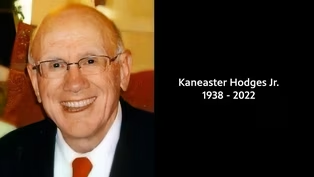
We conclude by noting a life concluded cancer.
Hodges, best known for the very important year he served as a United States senator from Arkansas, died a few days ago at age 83.
Few, if any, were the days that can Easter.
Hodges was idle at various points in his public career.
He was chairman of the US Board of Trustees.
He was a trustee of Lion College, a trustee of the ASU campus in his native Newport.
He believes in education good Easter Hodges and had a bunch of it himself.
Bachelor's degree from Princeton, a couple of master's degrees from Boston.
Dallas.
Oh, yeah.
And a law degree from Fayetteville.
He was a licensed attorney and an ordained minister, a deputy prosecutor and a Game and Fish Commissioner.
But history will remember him primarily as the man appointed to succeed John L. McClellan, who died in 1977 with a year remaining in his term in his Senate term five years earlier on Easter, Hodges had supported McClellan against the man who ran against McClellan, David Pryor, who as governor, was the man who appointed Hodges to succeed McClellan.
Yeah, this is Arkansas.
And that was going to Easter.
Hodges.
It was going to Easter Hodges.
Who helped give President Jimmy Carter some very important victories, including the Panama Canal Treaty, and at the same time becoming a friend of Ted Kennedy, who tried to defeat Carter, and that was going to Easter.
Hodges quite a telling for friendship.
He had quite a life.
He led That's it for us this week.
See you next week.
Support for Arkansas Week provided by the Arkansas Democrat-Gazette, The Arkansas Times and Q r FM.
89.
Video has Closed Captions
Clip: S40 Ep10 | 1m 39s | Kaneaster Hodges, Jr. (1m 39s)
Providing Support for PBS.org
Learn Moreabout PBS online sponsorship
- News and Public Affairs

Top journalists deliver compelling original analysis of the hour's headlines.

- News and Public Affairs

FRONTLINE is investigative journalism that questions, explains and changes our world.












Support for PBS provided by:
Arkansas Week is a local public television program presented by Arkansas PBS