Arkansas Week
Arkansas Week - April 8, 2022
Season 40 Episode 11 | 26m 42sVideo has Closed Captions
Arkansas Week — Economic Outlook and Good Roots
Based on state tax collections, the Arkansas economy is on fire, but with war in Eastern Europe, inflation threatening and high fuel prices, can we maintain that growth and consumer confidence? UCA Associate Professor of Economics Jeremy Horpedahl, U of A Center for Business and Economic Research Director Mervin Jebaraj and Talk Business and Politics Bureau Chief George Jared join us to discuss.
Problems playing video? | Closed Captioning Feedback
Problems playing video? | Closed Captioning Feedback
Arkansas Week is a local public television program presented by Arkansas PBS
Arkansas Week
Arkansas Week - April 8, 2022
Season 40 Episode 11 | 26m 42sVideo has Closed Captions
Based on state tax collections, the Arkansas economy is on fire, but with war in Eastern Europe, inflation threatening and high fuel prices, can we maintain that growth and consumer confidence? UCA Associate Professor of Economics Jeremy Horpedahl, U of A Center for Business and Economic Research Director Mervin Jebaraj and Talk Business and Politics Bureau Chief George Jared join us to discuss.
Problems playing video? | Closed Captioning Feedback
How to Watch Arkansas Week
Arkansas Week is available to stream on pbs.org and the free PBS App, available on iPhone, Apple TV, Android TV, Android smartphones, Amazon Fire TV, Amazon Fire Tablet, Roku, Samsung Smart TV, and Vizio.
Providing Support for PBS.org
Learn Moreabout PBS online sponsorshipSupport for Arkansas provided by the Arkansas Democrat-Gazette, the Arkansas Times and KUAR FM 89 And hello again, everyone, and thanks very much for joining us.
Another glowing report from the Arkansas State Treasury, another month of record or near-record tax collections Further evidence of a strong economy, a vibrant recovery of revenues exceeding expectations or above forecasts.
Can that momentum be sustained and for how long?
Inflation.
Fuel prices?
How big a bite?
War in Eastern Europe.
What impact here?
And will U.S. monetary policy dampen business and consumer optimism?
And what's the outlook for the Arkansas farm sector?
Questions for this week's edition and this week's panel.
Dr. Mervyn Jabour Raj, director of the Center of Business and Economic Research at the U.
Of A. Dr. Jeremy Hospital, associate professor of Economics at UC A.
And George Gerard, Northeast Arkansas bureau chief of Talk Business and Politics.
Gentlemen, thanks to all for coming in.
Mervyn, let's begin with you.
As you assess the economy, state and national and of course, they're intertwined.
What are you looking at?
What pops up first?
What leaps out at you?
I think what you know, the headline unemployment rate is what pops up first to think.
You know, if we looked at our path from the last recession to how we've dealt with this recession, the dramatic decline in the unemployment headline unemployment rate has been pretty good.
You know, it might get revised away, but it's currently at a record low of 3.1%.
But besides that, I'd look at, you know, labor force participation rate, which is two percentage points lower than where we were before we went into the pandemic.
And you know, we think some of that labor force participation could improve that child care situation, improving or people retiring.
But we think a larger component of that is likely not going to improve that labor force participation rate are going to remain fairly low or because a lot of people did retire during the pandemic and are likely not returning to work because that was what they planned to retire anyway.
Right.
Jeremy?
Yeah, I think that the unemployment rate is certainly one of the important variables to look at.
But also if we look at the employment data from a survey of businesses, that's actually hit record record highs in Arkansas as well.
So I looked at that.
The revenue collection data, Steve, that you mentioned, the fact that that's so high, especially the sales tax collection data has been so high, it's an indication that consumers are coming back and spending money.
And so those those are all very bullish signs, I think, because I look at the economy.
Okay.
And up George in northeast Arkansas, especially, not only there, but especially there, you're looking at the farm economy as well.
Yeah.
We've got a couple of factors that are dominating the ag sector up here.
You know, in northeast Arkansas this time of year, you know, the Warren in Ukraine, you know, there's a lot of side effects.
You know, a lot of people talk about fuel prices, which is a big input costs for farmers.
Those obviously have been on the rise for the better part of six months or longer and if they continue to rise because of that.
Now, another problem we have is that, you know, there's a lot of fertilizers are produced in Belarus, which is one of Russia's biggest allies.
And some of those supply chain lines have been shut down.
And specifically potash, which is used as a fertilizer you know, so those input costs are going up significantly because of that.
And another problem that we have here, you know, I've talked to several scientists about this.
You know, this season already, beyond all of the expanded input costs that we're going to be a problem for farmers weeds and they're always a problem for farmers.
But for whatever reason this year is going to be a is going to be a particularly bad year for weeds.
And so that's just going to add input costs.
It's going to more than likely drag yields down.
You know, farmers have to make decisions as to whether there's going to you know, they're going to farm some of their fields.
Well, let's stay with that for just a second.
What what's the driving?
What are the factors that are involving that or that are that are driving that?
You know, as far as as far as the weeds go, a lot of it has to do with weather.
And, you know, the you know, like the ability of farmers to, like clear their fields, so to speak, because clearing fields after harvest cost money and as the input costs go up, they can they aren't able to as efficiently clear those fields.
And what I mean by that is, is, you know, you go in and you burn those fields or you tell them.
And what happens is, is weeds are a problem.
You know, if it's a problem, if it starts to be a problem this year, it's going to be a worse problem next year.
It's one of those things.
It's like a snowball effect.
So, you know, we've had some really, really bad weather years, which also doesn't help, you know, and I'm sure everybody's familiar with the dicamba controversy and stuff like that.
You know, weed control is a problem up here, just as a general rule, because the soil is so good in northeast Arkansas.
It's good for crops, but it's also good for weeds.
And so as you know, these input costs go up.
You know, farmers can't afford to be out there doing all this as much weed control as they would like.
And so it's just a snowballing effect and it's all coming together, you know, you know, this spring.
Now, on the bright side of that, I mean, maybe not the bright side, but the fortunate side for Arkansas farmers is that, you know, a lot of corn and wheat is grown in the Ukraine and Russia, and they are going to export quite a bit less, is looking like than they normally do, which is going to cause prices for corn and wheat to go up in commodities and like soybeans right now, you know, another staple crop in the state of Arkansas.
You know, we're looking at, you know, a record or a near record for bushels right now.
So the prices, the commodity prices are up, but the input costs are up.
Too.
Okay, let's go back, if we can, to Mervyn.
Let's start with Mervyn.
What's driving is this a result of consumer confidence?
A lot of this federal money we're not going to see as much federal money, are we, as we as we have in the past couple of years?
Well, I mean, I think when we're talking about fuel prices in particular, that we've seen an increase in fuel prices over the last year.
And that was because the you know, people perceived it to be safer, to travel more, and they were traveling more and spending more on fuel.
And people are going back to work, going back to the offices, maybe not five days a week, maybe three days a week, but they are still driving more and commuting.
So all of that contributes to fuel prices.
That was even before the Russian invasion of Ukraine, and that contributed even more to increased fuel prices.
So I think consumer confidence is one of those indicators that's hard to read these days, at least since 2016.
It's become a partizan consumer confidence when there's a Republican administration, Democrats feel down in the dumps and when there's a Democratic administration Republicans feel down in the dumps.
So it's hard to read that in any useful manner going forward.
But I think just looking at people's behavior and as Jeremy pointed out, you know people are spending more money in the economy which means which indicates its own consumer confidence there.
Well one thing we can read and that's the Consumer Price Index and Mr. Powell, is that Chairman Powell says we're not going to put up with very much of this, as a matter of fact.
Get ready.
Buckle your seat belt buckles.
Is going to go up again.
The Fed is going to raise rates, one, I think, at least twice more this year.
He's projecting.
What impact is that likely to have here?
Well, yeah, we'll start with you.
More of I'm sorry.
Yeah.
Yeah.
I was in the room and he had this when the question was asked, you know, what's stopping you from a point 5% rate hike?
And he said nothing.
And I think there was an audible gasp in the room.
So I think when you look at the minutes of the Federal Reserve meeting from the last time, there were a lot of members that thought we should have raised 5.5.
But there were others that didn't want to because they were trying to wait to see what the impact of the Russian invasion of Ukraine would be on fuel prices and the contributing inflation from all of that.
So it's very likely that we're going to see a higher rate hike in the next meeting.
And I think we're looking at rate hikes that every time the Federal Reserve meets from here through to the end of the year and even longer.
So the immediate impact, obviously, is that it increases the cost of borrowing not only for banks, but businesses as well.
The Federal Reserve was listening to roll off buying Mortgage-Backed Securities, and we've seen the mortgage rate, which was, you know, in the low 3% at the end of 20, 21 is now maybe four or 75 and headed towards 5%.
So it should cool some of the Home-Buying market as well here in Arkansas.
Yeah.
Jeremy, Jeremy Harvard all your colleague Mervyn Term was cool.
Cool it down.
Obviously we don't want to freeze.
Do you concur with him or Yeah, I think the Fed is in a tight spot here.
I mean, we've really had a roaring recovery since the, you know, the bottoms of the pandemic and almost all indicators looking great except for price inflation, which is extremely important, especially that consumer price inflation has been exceeding wage growth.
And it's not just it's not just energy and gas prices.
So even if you take those out of the equation, inflation's still down about 6% over the past year.
So I think the Fed really knows that they need to start raising rates.
They're cautious, though, to to slow that roaring recovery too much and to send us into another recession.
So I think they're there.
They're looking at their toolkit and and not wanting to to raise too quickly.
But I think it almost seems like they need to, but they're very hesitant to do that at this point.
And so I think, you know, the the smaller rate hikes throughout the rest of the year, what we're likely to see going forward.
Yeah.
And as Mervyn pointed out, interest rates, the not retail of the housing sector, of course, feels that in the in an especially acute fashion.
Yeah, that's right.
As as the Fed raises the interest, the interest rates on on their on their issues, they then we then see mortgage rates going up.
And we've seen that as well.
Mortgage rates have been stuck at kind of historic lows throughout most of the pandemic.
But now they're starting to creep up again.
And so anyone who refinance at those lower costs took advantage of that.
But as those rates go up, that could slow the housing market as well.
We've seen significant growth across the country, but even in Arkansas, which is often kind of insulated from these housing price bubbles, we have seen pretty significant increases in Arkansas.
And so as we see those mortgage rates go up, that that's going to potentially cool the housing market as well.
But there's also just a lot of demand for people to move as people are changing jobs or people are working remotely and are just looking at a better place to live.
And this is this is all going on at the same time.
So it's a little hard to predict, but it's definitely something to watch.
Well, I mean, what do you want to make a prediction?
I mean, look at the trend.
As we noted, Mr. Powell says we're going to have some more money is going to cost more as the year goes on.
You want to make a prediction One prediction I'll make is that I think inflation is going to stay high for a while.
We've had we've had so much new money come in in the past two years in terms of the Federal Reserve expanding the money supply, increasing 40 to 50% by most measures of the money, money supply.
We've had a lot of new money come in through federal stimulus.
You also have a lot of states now talking about doing some sort of inflation or gas price stimulus.
There hasn't been really much talk of that in Arkansas, but a lot of states are saying that that's going to inject even more money into the system.
So my my what predictions inflation is going to stay high for a while.
Mervyn, I don't think you'll take issue with that.
No, I'm going to agree with that.
I think inflation is going to stay high for a while.
And that couple of more reasons.
I think the war in Russia and Ukraine is going to continue for a while, and that's going to keep fuel prices, fertilizer, prices, grain prices high.
But in addition to that, we're starting to see, I think, lockdowns again in China.
I think there are something like 23 cities currently under some form of lockdown including several major manufacturing hub.
So we're going to have the supply chain issues that we try to mitigate towards the end of last year, re-appear through this year unless China changes their lockdown policy to deal with COVID.
So for a variety of reasons, we're going to have elevated inflation through the rest of this year and probably a good part of that next year as well.
You want to go back to George Gerard up in northeast Arkansas, my friend.
We have as we just mentioned, supply chain issues which bedevil the economy for the last couple consumers anyway for the last couple of years.
And they are, in fact, are they not starting to appear again visible at the supermarket?
You know, they're they're not appearing again.
They just keep reappearing all the time.
You know, I talked to a lot of business owners, you know, and, you know, I talked to contractors who were, you know, just building houses and things like that.
They can't get windows.
They can't get doors.
You know, I talked to a guy who owns several hotels.
They have they had problems getting linens and shampoos.
And when they can find stuff that they need, they tend to buy in bulk as much as they can so that just exacerbates the problem.
You know, another problem that a lot of small businesses are having, you know, in addition to the supply chain woes, which I will everything that I'm hearing is that they're not going to get any better, by the way, that they're going to continue on into the next quarter and probably the quarter after that.
You know, another problem we're having is, is the labor force.
You know, I talked to a woman who runs a business here in town, and she said that for every five people that she you know, she hires, you know, it used to be she said maybe two would be good workers and they would be, you know, somebody that she would want to retain long term.
And now she said she can hire five.
And within a week, all five are gone.
And it's a real problem for businesses as far from a continuity standpoint.
You know, they don't you know, it costs money to train new people.
And so they're continuously having to do that.
And it's a real problem, you know, as far as the interest rates going up, I don't know how much that's going to impact this part of the state.
And right now, I'm sure it will when these rate further rates go up, I think the first round of rate increases, you know, didn't affect too much.
I talked to, you know, several real estate, you know, people who are doing some huge development projects right now.
And so far, it's not hitting them too hard.
But later on down the road, honestly, not being able to get doors and windows is a bigger problem for them at this point right now.
Well, let me start with George here on this one another with Jeremy on this one.
All the numbers anyway, involving the labor market seem to be improving.
And yet we have complaints persisting from the business community about, well, hiring issues.
Have we seen?
And will we continue to see the whole notion, the whole concept of labor shapeshift here?
Jeremy.
Yeah.
I think we're in an environment that we would call a very tight labor market, that there are just not enough people for all the jobs that businesses want to fill.
For workers this is actually great.
This means businesses have to raise wages.
And while I said that wages haven't been keeping up with inflation at the bottom end, actually wages have been so at the middle of the income distribution wages have been pretty close to inflation.
But at the bottom, they've been shooting up high because, you know, you drive around town anywhere and you see that, you know, fast food restaurants saying, you know, we're hiring $15 an hour plus bonuses.
This this is a challenge for businesses, especially because workers have lots of opportunities.
They can switch jobs.
But actually wages at the bottom have been doing great.
But, you know, I think the comment that Jared made that, you know, employers are having trouble keeping people long term, that's that is a tough spot for businesses.
But that's mostly because for a variety of reasons, workers just have a lot more options today.
And that's good.
That's good for them.
Okay.
And Mervyn, but let's try that same question to you.
Are we are we seeing the whole notion of labor change?
Yeah.
And as I pointed out earlier, you know, there are some people that are not working because of child care issues.
There are some people that are not working because they retired early.
And, you know, I don't have any expectation that the childcare issues that improve anytime soon.
So there's going to be a number of people out of the workforce that could be working they're going to remain that way and the retirement rate is improving.
So I do see some prospects for improvement there.
But on the other side of the equation, you know, there's just a lot more demand for labor as well.
In the last two years, we've seen a dramatic increase in new business applications here in the state of Arkansas and around the country as well.
So a lot of these businesses might be sole proprietorships, but there are several of those businesses that hire other people.
And so there's just more competition for labor in a situation where you have, you know, some people not able to work or not working for other reasons.
Well, Barbara, we'll stay with you.
We've got about a minute remaining, I think, in the broadcast or in this segment.
If you are a state legislator or and then and then come or an incoming governor, we don't know who that will be.
And you look at the Arkansas revenue picture as opposed to a world that is flat.
To borrow a phrase.
Are you confident that that our economy is in good shape, that state government is in good shape fiscally?
Well, I think our state government has always conservatively budget.
So we're not likely to run into issues that other states might run into.
But at the same time, as a result of that conservative budgeting, we've not been able to sort of make long term investments that we might want to make in infrastructure, education, or pick a topic of any interest.
So I think it's probably time during a proper legislative session to look at how we budget and how much money we build in surpluses every year and then try to spend it ad hoc and think about how we should handle that money on a long term basis.
A policy question, in fact.
All right.
Marvin, Jeremy, and George Garrett, thanks very much for coming aboard.
Thank you.
And come back soon.
And we'll be right back with good roots.
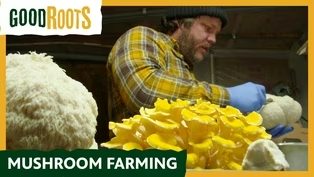
If you think agriculture and Arkansas, you think soybeans, rice, corn, cotton, wheat, peanuts, but mushrooms, it's our Good Roots segment.
For April.
Major funding for Good Roots is provided by Arkansas Farm Bureau, Arkansas Farm Bureau, advocating the interests of Arkansas's largest industry for more than 80 years.
Arkansas counts on agriculture, agriculture, accounts on Farm Bureau, additional funding for good routes provided by the Union Pacific Foundation People are always in farmers market to have a picture or something that, you know, a mushroom is growing in their yard and they want to know what it is.
I'm not great at identifying, you know, all the different species of mushrooms.
I know what we grow, but I always tell people that, you know, all mushrooms are edible.
Some are just edible ones.
My name is Terry Balcombe, and I'm a mushroom farmer.
My name is Zach Taylor.
I'm a mushroom farmer and I live in northwest Arkansas.
We both lived in south Arkansas and we moved up here and we were just really kind of in love with the community.
We were walking around the farmer's market one day and we thought, hey, we could be the mushroom guys.
There's nobody doing it.
And we didn't know what the yields were.
We don't know if we'd be profitable.
So we just decided to do it.
At least as a hobby.
And it kind of mushroomed into a business and mushroom This time of year, a fat farmer grows six types of mushroom, the gold oyster.
It's got a real distinctive flavor and taste to eat them raw they almost have like a melon taste, chestnut mushrooms that have kind of a nutty flavor.
They hold their texture really well.
And my favorite mushroom to put on a pizza.
This is a pink oyster mushroom there.
A tropical mushroom have a meeting similar to Canadian bacon, the blue oyster mushroom.
They're our favorite mushroom.
To grow.
They have the best shelf life.
It tastes great.
If we had to grow one mushroom, if it's out form, it would be blue oyster mushroom.
The best thing about being a mushroom farmer is influencing the way people keep expanding people's horizons just a little bit.
When I was a kid, at least in the single digits, I didn't like mushrooms.
I thought they only came from a can and I didn't like them at all.
One time my mom just she's really good at getting me to try stuff, and she had made some fried mushrooms, and she she was like, You got to try one.
Just have an open mind.
I did what she said.
I try to forget what I've thought before about mushrooms and just focus only on this experience right now.
And I liked it, and I was like, wow, wow.
So fast forward and just never lost the bug after that.
We grow off of stuff that would be considered waste.
It's soil holes and sawdust and water to And that's what mushrooms like to grow on.
That's what most things like to grow in.
We all look like this once they've soaked up the water and you can see where they they're starting that mushroom.
Mycelium is starting to leap off or expand.
This bag right here, it's it's fully almost fully colonized.
Or maybe it is fully colonized.
It's ready for fruiting.
Most everything out here is redneck engineered.
We we built it ourselves.
They spend most of their life in a more of a warm environment incubating.
And when they're all colonized, we move them into this room, which is cool with the lights on.
And that's those are all three kind of triggers to make them want to produce mushrooms.
This is probably three or five days into the process, but it all depends on the temperature.
So practically double in size every 24 hours at this.
It's kind of magical.
Watching on with varying demand with farmers markets raining out occasionally or or chef's canceling orders.
Last minute we find it hard to to exactly meet demand.
And so we overcame that by processing our mushrooms by making a food product.
Essentially how it works is we take the caps, we cut them off and we make jerky with them in the stems.
We roast and we make broth.
And so nothing goes away.
So that's a big deal for us.
And this is all thanks to the Arkansas Food Innovation Center at the University of Arkansas.
They've been great to us as well.
We're a state certified shared use kitchen.
We provide this service to the general community for them to make a retail product.
Our number one goal is food safety.
We show them all, teach them all about that.
Each product that trade does has a unique process.
So what we'll do now is we'll add a little bit of our our sauce and these mushroom caps, and they'll cook for about 45 minutes.
The sauce is a mixture of Tamari, which is a gluten free soy sauce, brown sugar and apple cider vinegar.
So where these mushrooms to this liquid, this in the kettle So we'll just spread this out fan, and it'll go in the dehydrator and it'll come out looking like this over here having an influence on the way people eat is kind of a big deal.
Then at the farmer's market here, and I've never seen that before here and that 100 times a day.
It's what makes you keep going when you're not making a lot of money or you can't afford to pay yourself Those are the things that keep you going It's not like to see us in a couple of hundred grocery stores with our packaged products At that point, you really you're doing more than just feeding your local community.
You may put yourself out there to the rest of the world.
And that's kind of a big deal.
Don't be afraid to experiment with our mushrooms.
You can do anything you want with them.
If you like soup, drop them into soup.
If you like.
If you like fried mushrooms, fry them up.
Just want to tell the world to eat more mushrooms.
And that does it for us for this week.
Thanks, as always for joining us.
And we'll see you next week.
Support for Arkansas Week provided by the Arkansas Democrat-Gazette The Arkansas Times and KUAR FM 89.
Video has Closed Captions
Clip: S40 Ep11 | 7m 1s | Mushroom Farming (7m 1s)
Providing Support for PBS.org
Learn Moreabout PBS online sponsorship
- News and Public Affairs

Top journalists deliver compelling original analysis of the hour's headlines.

- News and Public Affairs

FRONTLINE is investigative journalism that questions, explains and changes our world.












Support for PBS provided by:
Arkansas Week is a local public television program presented by Arkansas PBS