Arkansas Week
Arkansas Week - February 11, 2022
Season 40 Episode 4 | 25m 58sVideo has Closed Captions
Public Health Emergency: Crime, state budget, and an educator
Public Health Emergency: Crime, state budget, and an educator
Problems playing video? | Closed Captioning Feedback
Problems playing video? | Closed Captioning Feedback
Arkansas Week is a local public television program presented by Arkansas PBS
Arkansas Week
Arkansas Week - February 11, 2022
Season 40 Episode 4 | 25m 58sVideo has Closed Captions
Public Health Emergency: Crime, state budget, and an educator
Problems playing video? | Closed Captioning Feedback
How to Watch Arkansas Week
Arkansas Week is available to stream on pbs.org and the free PBS App, available on iPhone, Apple TV, Android TV, Android smartphones, Amazon Fire TV, Amazon Fire Tablet, Roku, Samsung Smart TV, and Vizio.
Providing Support for PBS.org
Learn Moreabout PBS online sponsorshipSupport for Arkansas provided by the Arkansas Democrat-Gazette, the Arkansas Times and KUAR FM 89.
And hello again, everyone, and thanks very much for joining us.
Crafting a budget in the billions.
Come Monday, the Arkansas Legislature meets to consider the governor's spending plan for the coming fiscal year and perhaps make some adjustments and perhaps take up some other matters.
That's in a moment first.
Lethal gunfire on the streets of Little Rock, a surge in violent crime has prompted a mayor seeking reelection and a city board not always in sync with him to declare a state of emergency.
How to proceed from there?
We're joined now by Mayor Frank Scott Jr. By the Reverend Billy Burrows, community adviser to the Little Rock Pastors Conference.
And Lavelle Jackson, founder and director of ROCCAT Inc..
Reaching our children and neighborhoods.
Gentlemen, thanks to all of you for for coming aboard this morning or this evening.
Mayor, let's begin with you.
Do you see any prospect at all for short term relief?
Always, first and foremost, I want to share our appreciation to the men and women of Little Rock police department, where they had been diligently working to address crime .
We know that we've seen an increase in crime over the past year.
I'm happy that our men and women in the police department were able to curb crime in 21 and towards the end due to our operation ceasefire, where we work with our federal partners, DEA at the FBI and U.S. Attorney, to really get rid of the most violent criminals off of our streets.
And so we're very grateful for them.
Clearly, the last couple of weeks we had a rash of shootings two or three weeks ago, which is not a common thing in Little Rock to have ten to eleven shootings in one weekend.
That is the reason why we stepped up even more measures because we had been doing the work.
But we wanted to take on even more measure to ensure that in the short term that we address the crime uptick, but the long term not only focus on proactive policing and predictive policing, but we also have to focus on prevention, intervention and treatment programs to truly focus on the systemic and root causes.
Being the son of Little Rock, but I've seen crime and blow, but we want to understand that we have to address the sins that systemic and root causes.
I'm focusing on a prevention intervention treatment program to truly address, particularly our youth and young adults between eleven to 24 that has been experienced most of the homicides over the last year.
Are we dealing here more?
Gentlemen, Mr. Burris, Mr. Jackson, are we dealing more with perception than reality or?
What well.
Well, I mean, I think the reality of what's going on in our city and I appreciate Mayor Scott for the birth of he's doing.
But I also think that that we have to come together as a community and make sure that we take responsibility as a community for that.
And you know, we we praise our law enforcement in the hard work they're doing.
But we as a community have to take responsibility for this as well and have started looking at just like, as Mayor Scott mentioned, the systemic issues within our community and take that responsibility for that.
one of the things I mean, we we keep pulling these babies out of the out of the river, but nobody wants to go upstream and see who's to me.
And so we have to start doing that as a community and look at where I mean, where are we going to come together and deal with this issue for our, for our families, for our younger, our young people?
And what can we do because we have children out there who have no remorse in their humanity is leaving and we have to gain that back and we have to look at how we can gain that back with our community and with our people and with our families , especially what we're talking about.
Long term solutions are we not are.
How long is the long term?
And we're recall, sir, this is going to require substantial investment, is it not?
I believe it is.
I believe it is the investment in I'm not just speaking of monetary investment, but why are people who really believe in this community ?
Time to put it to put plans together.
Time to come together as a community and stop all the blaming.
And all of that would come together as a whole.
Mr. Jackson LaFell Jackson.
Yeah.
Well.
And.
I believe that we've been here before.
I believe that there's definitely a cure.
Some of the things that the mayor and the pastor has talked about are things that we need.
Good policing.
Intervention and prevention programs, the City of Little Rock has something hit there right at their fingertips that could be used a whole lot more.
The street crew, I think, is very important.
That you push them out more.
Give them an opportunity to see things, did a lot of us don't see when we're at work, when we're in office, you know, dealing with the law part of running a city.
I would love to see them more engaged out front.
I do see that when young people look in, they see these interviews and they're able to see someone from their communities that they know speaking.
It has an effect.
They tend to want to listen a little bit more.
I also agree with the pastor here.
one of the things that's going to make the big difference is in all of the entities are separated even when we're in a bureau.
We have a pastor here.
We have a city official here.
We have the police chief here.
And all of them have different statements, can you imagine?
When everybody is moving in one unit since everyone moving is one.
The difference that that could have and really, really fast.
Some of those targeted areas.
Can you imagine all of the churches coming together?
The Police Department, the Pulaski County Sheriff's Office and start targeting the neighborhoods where all of the shootings are?
And everyone get out of certain days in this canvas, these neighborhoods.
And even if we just walk door to door and get to meet people, what that does is it lets the community know that they're being appreciated and that they're being looked out of.
And it also made people, the criminals, people that are doing criminal things know, Hey, we're going to have to beg back because we're getting a big light shined on us.
Yeah, the mayor seems to suggest, sir, if that's what's being done now, we thought, Well, are we falling short on that?
I think he's he's done.
And let me say real fast, he's the mayor has done an excellent job pulling all of these resources together.
Definitely.
I, my thing that I see that could be done better is his street crew.
He has an awesome street crew there.
And I think that, you know, mobilizing all at once all of the entities that the city has given finance to.
Can you imagine if you pull them all together and under the same umbrella and you're all movies one?
Can you just imagine how powerful that would be in a community?
Mr. Burris, not.
I'll go to the mayor and just like a Mr Burris, you want to pick up on that?
Yeah.
Thank you.
Yeah.
And I read about and I don't know that much about the ST crew, but I agree that if if we could have churches come together on on the same report because some of us have become too complacent and just relied on our building and we have to be a part of our community because we are a part of this community and we have to do all that we can to help these young folks to help these families in any way that we can.
And we missed that.
Along the way, we we we've overshadowed that along the way.
And that has to come back to.
And it comes back to our responsibility because it let me go to Mr. Scott here, Mayor Scott, and give him the last word.
Your honor, they.
Are we falling short here?
This is a state of emergency enough?
I see I think, Steve, I wanted it one reason I was trying to jump in earlier is that it's not an either or it's both.
And what Brother Jackson is sharing, he's totally correct.
And so I think I want to make sure that we're very clear what we've been doing has been focusing on protective predictive policing, proactive policing.
We've also been focused on prevention, intervention and treatment programs.
When we saw it after the public health emergency is because we said it's time to do even more than what we've already been doing.
And as we're doing even more and to agree with Brother Jackson is, he's right.
The City of Little Rock has a street team and we need it.
We actually, quite frankly, we need to increase the street team.
It needs to broaden out.
We have a great street team that's been doing a yeoman's job for many, many years.
And I want to say thank you to them, but it's also time to broaden out, have more of them.
And that's the reason why when we sought after the public health emergency, it allows us to go past traditional budgetary limitations.
That's the reason why today we already have job descriptions out for additional street team members.
We have job descriptions out for more mental health social workers.
We have now we've also taken out the overtime limits for our police officers.
And so we agree with Brother Jackson as well as Pastor Burris.
And so the public health emergency allows us one a few different things.
So you have more resources to divert towards prevention and treatment programs so we can do exactly what Brother Jackson is doing because it takes finances, but we have to be in unison when we do it.
And that's the reason why we're moving forward and focus on how we bring more hope to our streets.
And that's exactly both past Burris brother Jackson to talk about, and that's the reason why you hear we're all on one accord.
And I got it.
Your honor.
I got it.
I have to cut in your honor and say, we're just simply out of time.
We'll pick it up on a subsequent program.
Thanks to all three of you, thanks to all three of you for coming aboard.
See you next time.
Thank you so much.
Appreciate it.
We'll be right back.
And we are back the last scheduled legislative session, last scheduled session of Asa Hutchinson eight years as governor begins Monday.
He and the General Assembly are sitting on top of Treasury surplus in the neighborhood of 1,000,000,000 bucks and growing how to spend it and how much of it to spend and when.
And will a meeting created to consider only government finance consider only government finance?
Some views now from the legislative branch.
Representative Jeff Wardlaw, Republican of Hermitage.
Representative Vivian Flowers, Democrat of Pine Bluff.
And from the other end of the Capitol.
Senator Jim Mahendran of Gravatt, now an independent.
All three of you.
Thanks for coming in, Mr. Wardlaw.
Let's begin with you.
We've got a spending agenda, a plan outline from the governor.
How close will the General Assembly hew to that?
I think it stay pretty close to that.
I don't think we're very much from the budget, I think there be a few things brought up.
I think county jail reimbursement would be one of the issues that are outside of that budget.
I'm hearing a few more items as well.
All right.
Miss flowers.
I think that the recent announcement of the governor's proposal to expand the number of prison beds is it's a missed opportunity for us to address public safety on the front end and make an investment with those dollars rather than on prison prison beds in an environment and with over the years.
Is it really across the nation?
The mass incarceration has occurred because of changes in policy rather than crime.
Let me let me come back to that.
Just a second.
But first, let me go to Senator Hendren.
Your thoughts, sir?
No, I agree with the same law.
I've watched several of these fiscal sessions and almost always it's pretty much the executive that is stuck pretty close to, and that's because we have budget hearings.
We have several weeks of budget hearings leading up to this and the idea being we we settle our disagreements to that hearing process and negotiation process so that we don't spend a lot of time and unnecessary per diem and and money down here arguing about the budget issue.
So I don't think you'll see a lot of deviation from the executive branch.
Obviously, when you have the kind of surplus that we have now, there will be some attempts to capture that or different priorities.
And that's that's the legislative process.
And I would be it's a lot easier to argue about what to spend the excess on than what the cut in terms of shortfall.
So this should be a fairly smooth session with regard to fights about the dollars.
Yeah.
Well, with 135 members and $1,000,000,000 at stake are flying around the Capitol or you sometimes have 135 agendas even after hearings.
So still the same question I went I posed to to Mr. Wardlaw.
You can hew close to the limit.
There's not going to be a big fight over appropriations.
I don't see that coming, and again, that's not typically been the case.
The fighting is normally done up front in the budget hearing process, and those things are usually worked out.
I don't think anybody was fully expecting the kind of surplus numbers after the budget adjustment that we've already had that we see.
So if there is a fight, it's going to be about people wanting to grab some of that surplus money for projects that are important to them.
But as far as the agency spending, I think that's pretty well agreed to the OK back to Mr. Wardlaw serve.
We had the governor's announcement on Thursday that he is going to spend or wants to spend in the neighborhood of 100 million for additional bed space up in the Calico Rock unit.
Your thoughts on that and is there broad support for that in the General Assembly?
I think that's a subject that we ought to look a little deeper into.
We we just went through a prison contract for private prison in south Arkansas recently, and it was going to build about 500 beds for state inmates and the cost of it was in a neighborhood of 20 to 30 million.
So looking at $100 million for 500 beds concerns me a little bit that that's several million dollars higher now, depending on the severity of the inmates that are be held in those 500 beds.
That could dictate that cost difference.
But those conversations haven't taken place yet, and I look forward to being a part of some of that.
Well, Tim is flawed to your colleague.
Miss flowers point that we are missing an opportunity in terms of.
We should address this as a policy proposal on crime prevention.
If I'm interpreting these flowers correctly, your thoughts on that?
Mr. Wardlaw.
I think she's right.
There should be some sort of reform and some sort of change in the way that that we imprison people for drug crimes and nonviolent crimes.
And we should be looking at more reform instead of incarceration.
I can agree with some of that.
But the truth is our criminal population is increasing.
We're going to have to have more beds are we're going to have to do a better job reimbursing our county jails to hold some of those inmates.
So these are viable conversations that have to take place over the next year before we get to a regular session, in my opinion.
Yeah.
MS.
Flowers, the governor seems to present this as not an either or situation that in the near term, we need the beds no matter what we do in terms of of prevention and diversion .
Take it from there.
Mr. Yeah, I do think that even if we're looking at bed space and looking at the whole situation, we've had previous sessions and I think even with working with the parole board, there are some things that we can do to better utilize our know.
And when you look at.
It's who leave and return to prison because of their violations.
I just think that again, it's an time to expand on adequately funded reentry and deal with prevention instead of.
Dollars into incarcerating so many people instead of supporting families and supporting folks who can and want to stay out of prison and do better, and I'm not talking about people who get out and are repeat offenders of violent crimes or felonies.
I'm talking about people who can't get a driver's license and because of it.
And I know we kind of addressed that in the last session, but it's always housing and and those kinds of issues that feed the recidivism.
If we really dig into reentry, which really has been a huge priority for the governor.
Dan seems like a missed opportunity if we don't invest in making our system better for Arkansans rather than investing in storing people away.
Yeah, and to our audience and them is flowers.
We apologize for the gremlins that are running loose in the audio track there.
I think we got the gist of your message anyway.
OK. Yeah.
Senator Hendrina, there have been over.
There's always one or two or three or maybe several voices in every session that's saying additional bed space is fine, but it's terribly expensive, and we are committing the state to an enormous, ongoing expense that would seem to be accurate enough given the history of appropriations, the Department of Correction.
Is there an alternative?
Is there?
Is there something we can do in between the options that that we've outlined here?
Well, there needs to be, and but unfortunately, it's difficult to do that in the context of a fiscal session.
But I agree with representative flowers that just continuing to build more beds and build a huge ongoing cost to maintain that prison population without addressing the reason for that population and who's in the population is a failure to really address the fundamental problems.
I mean, there's no question we have to have space for prisoners who need to be in prison.
We can't have overcrowding and we can't have unsafe conditions.
But we also need to make sure that the right people are in prison and the other people that we can help and that we can have diversion programs and that we can find rehabilitation that we're spending, as you know, resources on that as well, because in the end, it's much cheaper option than it's continuing to build more and more beds.
So, you know, we've we've had several task forces over the years since I've been in the Legislature to adjust Medicaid expansion of health care, to adjust tax reform , to address teachers insurance.
I really think that it's going to take that type of an effort to develop a plan for the legislative session where you can have real reform coupled with increased space if necessary.
But it is a complex problem and try to address that in a two or three week fiscal session.
I understand the governor's point right now.
We got to have beds, we got overcrowding, we got unsafe conditions.
You've got to address that.
But you can't neglect the other.
Let me stay with Senator Hendren for a moment.
The other big question hanging as the session is about to begin is whether this will be restricted to fiscal matters or whether other issues such as, for example, abortion is likely to come up.
Well, you know, in the spirit of bipartisanship, when I was the majority leader as a Republican, Senator Ingram was the minority leader.
Both of us have been watching that legislature since our dads were back in the seventies.
And both of us saw it performed for over 100 years without even having a fiscal session, and we filed legislation to abolish it.
But because we knew what would happen, it would turn into another opportunity to become a full time legislature and to deviate from budget issues and begin to consider all other efforts.
And that's what's happened.
It's not just in the fiscal session.
We saw it in even the signing day adjournment.
We see it.
And every time we have a special session, members really want to continue to basically become full time legislators.
So there will be an effort to address other issues.
There is a process to do that.
It requires two thirds vote.
But I would prefer that if we're going to have fiscal session, that would that we do what the voters approved, which is come down here and address the budget and then go back home.
Mr. Wardlaw, to you, are we going to talk money and that money alone or we're going to expand the agenda?
Well, Steve, you've got to look at it this way, last session, we hired a consultant to look at the employee benefits division.
We had a major deficit there.
They went out and tried to cut benefits to save money.
The fall before that, and those bills are now ready.
And that is going to be brought up Monday.
Those resolutions have already been filed for this fiscal session.
The governor made it clear last week that he would rather see and addressed in the fiscal session instead of the special.
So those issues will be brought up to me.
Those issues are prudent because that is something the Legislature has been working on over the last year.
When it comes to abortion and all the other things, I feel the same way Senator Hendren feels.
I think those things should wait till next next spring and be brought up in a regular session.
I think we ought to do our business and we ought to go home.
100% agree with Senator Durbin on that.
OK, we're out of time on that.
Gentlemen, thank you.
And ladies, thank you very much for being a part of us.
Come back soon.
It's Black History Month, and we pause to note the extraordinary life and career of an extraordinary Arkansas educator, Dr. Rodney Williams was born and reared at Menefee , traveled a few miles southeast, who began higher education at Hendrix College, then drove a few miles southwest to begin a 30 year career at the University of Central Arkansas, which has honored him.
Here's a look.
I was given the awesome task and awesome responsibility of affecting the lives of young men and women in ways that will help them find their rightful place in our world.
As the first director of minority affairs and retired as vice president of student service and institutional diversity.
Ronnie Williams began developing and implementing diversity programs from the ground up, improving student retention, recruitment and graduation rates.
There was nothing more rewarding.
Than for you to engage students in ways that will help them find their place in recognition of his service to UK in August 2021.
The Board of Trustees voted unanimously to rename the student center in his honor to the Ronny Williams student center.
There's nothing greater.
There's nothing more humbling.
And I'm just thankful and blessed to have been a part of that of the University of Central Arkansas family after more than 30 years of service.
Ronnie Williams is ever mindful about how we continue moving forward together.
Rational people having difficult conversations will help to move us forward.
If rational people fail to have those difficult conversations.
If they leave the table, then we will have irrational people that would take comfort.
The narrative, and I do not think that's good for an institution.
A plea for rationality.
That's all the time we have.
Thanks for joining us.
See you next week.
Support for Arkansas week provided by the Arkansas Democrat-Gazette, the Arkansas Times and KUAR FM 89.
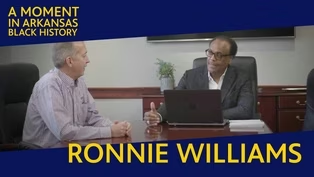
A Moment in Arkansas Black History: Ronnie Williams
Video has Closed Captions
Clip: S40 Ep4 | 1m 37s | A Moment in Arkansas Black History: Ronnie Williams (1m 37s)
Providing Support for PBS.org
Learn Moreabout PBS online sponsorship
- News and Public Affairs

Top journalists deliver compelling original analysis of the hour's headlines.

- News and Public Affairs

FRONTLINE is investigative journalism that questions, explains and changes our world.












Support for PBS provided by:
Arkansas Week is a local public television program presented by Arkansas PBS