
Arkansas Week
Arkansas Week - January 1, 2021
Season 39 Episode 1 | 30m 11sVideo has Closed Captions
Polling – Examining the View of Public Opinion
An in-depth look at how polling examines the view of public opinion and how we interpret it. Panelists: Dr. Janine Parry, Director Arkansas Poll Robert Coon, Impact Management Talk Business & Politics – Hendrix College Poll Jay Barth, Hendrix Emeritus Professor Talk Business & Politics – Hendrix College Poll
Problems playing video? | Closed Captioning Feedback
Problems playing video? | Closed Captioning Feedback
Arkansas Week is a local public television program presented by Arkansas TV
Arkansas Week
Arkansas Week - January 1, 2021
Season 39 Episode 1 | 30m 11sVideo has Closed Captions
An in-depth look at how polling examines the view of public opinion and how we interpret it. Panelists: Dr. Janine Parry, Director Arkansas Poll Robert Coon, Impact Management Talk Business & Politics – Hendrix College Poll Jay Barth, Hendrix Emeritus Professor Talk Business & Politics – Hendrix College Poll
Problems playing video? | Closed Captioning Feedback
Where to Watch Arkansas Week
Arkansas Week is available to stream on pbs.org and the PBS app.
Keep Exploring


Providing Support for PBS.org
Learn Moreabout PBS online sponsorshipMore from This Collection
Delve deeper into elections and campaigns across Arkansas through insightful analysis and conversations with journalists, law makers, candidates and more.
Video has Closed Captions
Common Ground Arkansas and Roundtable Commentary. (26m 59s)
Arkansas Week - April 30, 2021
Video has Closed Captions
Legislative Review, Redistricting, and Taxes (26m 58s)
Arkansas Week - April 23, 2021
Video has Closed Captions
Legislative Review, COVID Immunization Rate, and Governor Asa Hutchinson. (27m 16s)
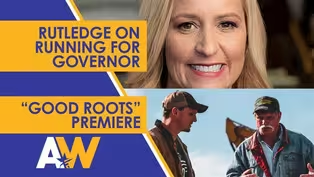
Arkansas Week - April 16, 2021
Video has Closed Captions
Arkansas Attorney General, Leslie Rutledge interview and “Good Roots” on Arkansas PBS. (25m 48s)
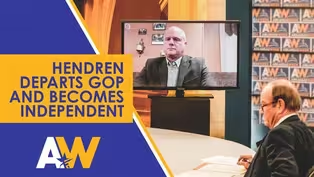
Arkansas Week - February 19, 2021
Video has Closed Captions
State Senator Jim Hendren announced that he is leaving the Republican Party. (26m 1s)
Arkansas Week - January 29, 2021
Video has Closed Captions
Gubernatorial Race and Legislative Update. Covid-19 in Arkansas update. (26m 44s)
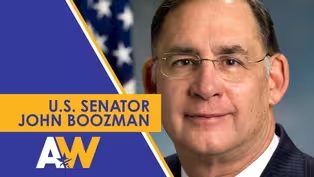
Arkansas Week Special: John Boozman - December 25, 2020
Video has Closed Captions
U.S. Sen. John Boozman (26m 38s)
Arkansas Week: Election 2020 Recap - November 6, 2020
Video has Closed Captions
Election 2020 Recap (26m 53s)
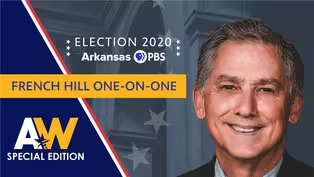
Arkansas Week Special: French Hill - October 23, 2020
Video has Closed Captions
Interview with Arkansas U.S. Congressional District 2 candidate French Hill (27m 32s)
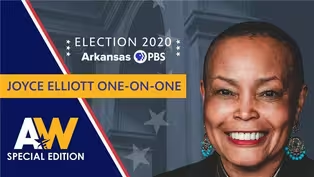
Arkansas Week Special: Joyce Elliott - October 23, 2020
Video has Closed Captions
Interview with Arkansas U.S. Congressional District 2 candidate Joyce Elliott (28m 16s)

Arkansas Week - October 16, 2020
Video has Closed Captions
A closer look at #AR2’s neck-and-neck race, reviewing “Election 2020: Arkansas PBS Debate. (29m 49s)
Providing Support for PBS.org
Learn Moreabout PBS online sponsorshipSupport for Arkansas Week provided by the Arkansas Democrat Gazette.
The Arkansas Times and KUER FM 89.
Hello again everyone and thanks for joining us the maneuvering, the campaigning for the next elections already underway.
So what's the temperature of the Arkansas electorate?
We're going to check over the next half hour with three people who?
Monitor the Mercury.
Dr Janine Parry, professor of political science at the University of Arkansas and director of its Arkansas poll.
Robert Kuhn, managing partner of Impact Management and he and Doctor Jay Barth, emeritus professor of political science at Hendricks, collaborate on the talk business and politics Hendricks Pole to all three.
Thanks for coming in and helping his kick off the new year, and I was trying to figure out are some some way to start a discussion.
In an odd numbered year in Arkansas about politics.
So let me start with Doctor Perry.
Will start with you.
What did November the 3rd in Arkansas leave unsaid?
Well, I'm not sure what it left unsaid.
I do know that it was just a status quo election for here.
That's the thing that's most striking to me.
The presidential outcome looked almost exactly like the outcome in 2016.
The Congressional delegation held firm in no small part because in most of those races there weren't competitive major party.
Candidates the legislature actually slightly became slightly more supermajority.
And I suppose because the redistricting measure didn't didn't get enough legs under it didn't land on on the ballot.
We're going to see more of the same for.
Very likely the next the next 10 years and beyond.
So I think that's the thing that stands out to me.
To me most is what a status quo election it was in this state.
Yeah, it's Jay Roberts.
I guess that's kind of what I meant was the news.
Was the status quo, which isn't the news, but it's the news.
The Africa, I mean, of course I agree with Janine that it is a status quo election in general.
There there were these very subtle an of course in an election that looks pretty much the same, you look for anything that feels a little different.
You know we did see in Benton and Washington counties.
These you know two of the best.
Counties with the best educated electorates in the state.
You did see some shifts to the Democrats.
They were single digit.
But where you have big populations in those counties single even minor shifts can have some some consequences.
Conversely, we saw some shifts in the other direction in rural Arkansas and you really we have reached a point where it's like these rural counties just simply cannot become more one party.
I mean, we're we're moving into Soviet era margins now.
In some of these counties.
In terms of their support for Republicans, and of course, that's where the changes in the legislature came, where a handful of more rural Democrats and there weren't many left to start with.
But the ones that were left are now all gone, and the Democrats the only place they had any chance of picking up.
And they did pick up one it appears, was in in Pulaski County in a more suburbanized area.
Yeah, JSA, if I'm reading the numbers correctly, some of the Democrats who survived and a Delta.
And legislative districts underperform from there.
The incumbents anyway they underperform from Lester.
Indeed, yeah, and I think it is a story.
I mean, I'm around the country, you know, we did see some shifts in heavily African American districts, and of course heavily lot next districts towards the Republicans.
We also saw some of those signs here in Arkansas.
I think the question is how much of that was true shift and how much of that was low turn out among Democrats in places where there's just not much competition at all.
And so I think we've got to do a little more untangling of the numbers to see exactly what the drivers were of those still pretty modest, but not insignificant shows.
Yeah, dig a little bit deeper.
Robert Kuhn.
What do you see I think the only thing that's really left unsaid is what is Donald Trump not being on the ballot and not being president?
How does that change the game going forward?
I think you know.
President Trump has really changed the composition of the electorate both in back in 2016 through today.
You know his presence has galvanized Republicans.
It's really, you know, increase the polarization that we're seeing, and Republicans being more involved in a lot of those areas that Jay and Doctor Period both talked about.
You know what is the future hold with him not being in that office with him.
You know not being on the ballot immediately, and does that have an effect when he's no longer kind of driving the message?
Well, I'm you know the the question has been you just asked it.
Not only in Arkansas but across country.
Is is the GOP.
Now, purely the Trump Party, will he continue to be the dominant?
Influence over the party in the next 2468 years.
Robert, I think I, I think in a lot of ways, you know there's been so many people that have invested into him that in some respects he will be and he still, whether he's in that office or not.
He commands a following.
I think his presence on social media gets attention, and I think there's still a degree of of office holders at the national level across the country that are scared of being on the wrong side of his momentum.
And so I think he will continue to play a role in less.
There's some other voice that comes out that.
You know picks up the mantle going forward.
I would say that right now that voice is not emerged and we might be awhile till we see somebody else try to pick up the torch.
Well, we have 123 announced Republican guvna Tauriel candidates already.
And to a person they seem to be doing everything that power to get as close to him literally as they can.
Janine Parry.
They do, and that's with good reason.
It's not only that he won by such a wide margin.
Again in this state, but it's also that his approval ratings, at least for a figure in Washington DC, have been consistently in the in the positive direction in Arkansas now since 2016, and I think a piece of companion evidence that's really important to consider, too, is, regardless of whether it's the party of Trump, so to speak, I think.
It's really important to note that in 22 years that we've been doing the annual Arkansas poll, we've seen this growth well for the first 10 years.
We didn't see growth and then starting in 2010, we saw this steady shift to people who identified as Republican Ann.
Finally, this year we got our highest percentage of identifiers for Republican an our lowest percentage identifiers for Democrats, and then the independence, who had for so long been as Jay well knows, the second party of Arkansas.
They made that same shift starting in 2010, and it was dramatic and they also are showing their highest percentage of lean Republican.
In fact, we've got fewer than 20% of those folks to say I'm truly independent, so there's this this widening gap nationwide and we're seeing it play out in Arkansas as well.
So that's a piece of evidence.
I think that speaks to what those candidates are doing, making sense to an Arkansas electorate.
Yeah, the vanishing center J bar.
Yeah, I think all that's accurate, but I also think.
That is important to recognize that Donald Trump has really grown the Republican primary electorate in this state, and that has big implications for 2022 or all these candidates are running, it's going to be.
I think it will be the biggest, at least in terms of state politics.
The largest turn out in the Republican primary electorate of primary Republican primary, and those folks are now increasingly from rural areas and exurban areas.
And while the plurality are still from Northwest Arkansas and the immediate suburbs and in Pulaski County, they are increasingly tenuous in terms of those more mainstream establishment Republicans hold.
The party this is now a Trumpist electret Ann.
You have candidates who are really going out of their ways to show in the show their connections there there how just how deeply tide they are to the President and I think that's only going to continue even if he's no longer.
You know, as visible on a daily basis as he's been for the last four years, yeah, it would seem Robert Kuhn to no small extent Mr.
Trump has defined republicanism.
Yeah, I think so.
And I think what we said earlier, but independence is really key.
You know you had a long period of time there where you had Republicans.
You had Democrats and you had independence and an and Republicans work taking the lion share of independence for a number of years.
You know, 6040, you know what?
What you kind of start to see overtime is and what we saw this year is independence as a group.
They may not be 6040 Republican anymore and you start to wonder what does that mean that there are buying into the other side.
Messaging, and I think the answer is there not.
They've gone ahead and graduated from being an independent to saying that there are Republican and so while the composition of independence looks different and might look a little bit more center or left leaning, it's not because they're changing their views, it's because they're changing their party, Janine Parry.
I think that's right on and it's something that I've been looking at for so long and Jay and I've been looking at for so long we saw what the statewide highest profile election outcomes have looked like in Arkansas, with the exception of the Clinton wins in the 1990s.
We were waiting for it to filter down into these other levels.
And we, it's like we we we know what you're doing.
We know how you're voting when your get when you're being primed with the information about the parties respective positions, at least at the national level.
And then in 2010, you know several factors kind of coalesced to finally, I guess, engage that process fully, and golly did it happen in a hurry.
Along with that, have we?
And I think I started seeing a friend to all of us.
The late Doctor Cole Ledbetter at ualr.
He and I used to go back and forth over.
We did it for 30 years over whether populism was being redefined starting with the Reagan.
Error Janine Perry.
Jump in on that if you will.
It doesn't seem to mean quite what it used to me.
I know an.
I think it's such an interesting and important concept.
An important idea.
Some people would say write a brand of ideology, particularly American politics.
And yet it can take both.
Left an right brands and the policy positions around which it circulates, change overtime and no one would have understood that better than Cole Ledbetter, of course.
But I, so I'm not sure how to add to it other than, other than to say.
That if populism is often associated with a single leader, a popular leader, a kind of top of the ticket as, as Donald Trump has been to the right in recent years.
I think that is important to note that while this party has been changing and while also by the way conservative ideology has been changing mainly by hollowing out those who say their moderates in Arkansas over this process of the last 10 or 15 years, our positions on the policy issues that I've been pulling for more than 20 years haven't moved hardly at all.
So it's something about the brand and or polarization and or probably negative polarization and negative partisanship.
As we see nationwide that's happening in Arkansas.
It's nothing exceptional is just really per pronounced here, I guess because of our relatively homogeneous, mostly white, an not college educated electorate.
Yeah, Jayanne Robert, you know the notion of economic issues taking a backseat to social and cultural factors in politics in recent years as the primary driver.
Yeah, yeah yeah, go ahead right.
And I do think that we've got this very interesting thing is that yes, I think it is the driver of public opinion.
And of course that then leads to the driver of electoral results at the mass level.
But when we talk still at the elite level, we do still have kind of business Conservatives.
Still with a great deal of influence over what happens at the state Capitol.
And of course over the political money, which is.
Of of course, a crucially important piece, so I think we've got this very interesting within within Republican Party, where all this kind of disconnect between elites and masses.
The question becomes when does that tension kind of reach up a boiling point and on what issues does it reach a boiling point an we may have seen it a bit around covid.
I think there are some signs that that was a point at which there's been some.
You know some tension an and it has been, you know, Governor Hutchinson.
Of course he's been the lead in Arkansas that issue and he's had a really walk that tightrope before between more moderate establishment Republicans who want to take moderate action, hits their name to be conservative but not over overreact versus those who really are advocating freedom that are more, you know, purely Trumpist in their in their worldview.
Yeah, Robert Kuhn.
I think that's that's that becomes the question of how you govern.
Is is how do you balance those interest?
I think you know Donald Trump's.
You know position on a lot of these issues has put you know freedom and the and the the word there all over.
A lot of the responses to how people deal with things like Kovid.
Clearly, from a populism standpoint, he identified very early, even back in 2016 with kind of blue collar Rust Belt worker that felt like they were being ignored and kind of channeled their frustrations.
And so I think that's a. That's a reason he's been successful.
I think that becomes a question of how that, like Jay said, where does that that more corporate elite wing of the party?
You know?
How does it balance itself with kind of what they have seen?
Which is, you know the this blue collar middle America worker type voter can be, you know, rained into the Republican side and how they balance those those interests?
Well, we'll start with Robert Kuhn.
If you or what is there a path forward that you see for the Democratic Party?
You know, I think in Arkansas.
I, I think if there is, it's going to take a lot of time, and Republicans obviously had been the minority party in the state for a long time and and we're talking hundreds of years so you know, I think patience is important.
I would say you know a couple of things.
One I will, I do think nationally an to some degree.
As Jay touched on earlier in Arkansas, they did do a little bit better in some of the suburban areas.
Obviously urban areas are always a Democratic stronghold that that proved across the country this year and I played into the presidential results.
Think suburban areas are the area where they saw some improvement over 2016.
There those are critical areas for them going forward.
I think what they what they really you know where they where they failed this year was letting a lot of the messaging around some of the issues that are important to them and issues important to lots of voters like police reform and things like that get way out of control, the whole defund the police movement and branding really at the branding problem and they can't get behind or be associated with things like that that will.
Completely undercut what they're trying to do in suburban communities, because that's going to be a loser form every time, right?
Janine Perry.
Yeah, it's just going to take a long time.
I heard some talk in my circles which tend to be left left leaning up here in Fayetteville and the academic set.
And there was talk about.
You know that if people would just register to vote and we could be the next Georgia.
But the reality is, we just don't have that kind of population center and that kind of population center is not coming here anytime in the next few decades.
An without that, we're just going to continue to see maybe a few legislative victories as we saw in the urban and or suburban areas for Democrats.
But this is not just going to be a Republican majority state for the foreseeable future, but we're actually going to be.
It looks to me actually just looking at data like this among the 50 states we're going to be consistently now in the top 10 or maybe even the top five most lopsided states in the country.
I was just looking at looking at Statehouse divisions.
The ratio?
Between the majority and minority parties, an on the Republican side only.
Idaho, Wyoming and both Dakotas are more lopsided at this point than Arkansas is.
And that's really telling on the Democratic side, it's Hawaii and Rhode Island, I think.
So this is this is our future that can't be easy for Democrats to hear.
It's probably quite satisfying for Republicans.
Or maybe they can pity them because they were out in the cold for so long.
But I think it's it's not going to change much for the foreseeable future.
Well and and I would not expect come January.
We've got a legislative redistricting and congressional reapportionment.
I would not.
Jay Barth, I would not expect a great deal of sympathy to be exhibited by the Republicans toward their loyal opposition.
No, I think it's a.
140 years of frustration in terms of who's had control of all of the election line drawing, and I think it's going to be pretty bad, I think we're going to see it's going to be pretty brutal, I think, especially in Northwest Arkansas where where Democrats have made some some some nice inroads.
Dairy along the the Interstate Corridor from Bella Vista down to down down to I-40, and there have been some inroads there, but you draw those districts out towards rural areas just a little bit.
Just do a little bit of slicing and those become emphatically Republican districts.
And that's why Janine referenced it earlier.
But that that legal decision regarding the redistricting measure that you know was headed for the ballot and probably headed for.
Victory, we've seen it passed all over the country of these nonpartisan redistricting efforts.
In the polling was very good for it here.
It made a big difference.
I think there may be another effort to come back and do it again to do amid another round of redistricting.
The question is, could that pass?
Because I think there's going to be some more that feels a little a little different than doing it just before a redistricting process.
In doing that, in a more what what voters do see is a more fairway.
But I do think we're redistricting is going to be something that really locks in these Republican advantages.
I think you really for for Democrats to go back to your last question.
You know, Democrats really just have to start at the total grassroots.
And that's what Republicans did here.
Back in the post Rocafella era, where they were on their way back.
They just started at the at the base level, often with some nonpartisan elections where the brand didn't matter but the but the personalities could then set the stage to run for higher office.
The other thing I would mention is.
I do think there's some interesting stuff going on with the youngest cadre of Arkansas voters who do feel a little bit like their peers in the rest of the country.
I think we've got a bigger disconnect at older ages between Arkansans and their peers outside the state, but but younger voters are more connected to through social media and other forces.
There a little more connected and we saw that of course, around Black Lives Matter in the summer before there were some, you know, the issue of defending the place really came online.
Younger voters in Arkansas were really.
Reacting to that issue, that moment a lot like their their peers were white and black around the counter.
2nd about public opinion polling but called political polling because it was a mixed year or or was it really any number of pieces indicated that?
Well, the pollsters really didn't weren't as off as they appeared as the numbers first appeared on election Night anyway, Janine Parry.
Let's start with you.
How did?
How did polling acquit itself in this year?
So this is something that I'm a member of.
the American Association of Public Opinion researchers and you wouldn't believe the traffic.
Or maybe you would.
Hours and days right after the election outcome.
And of course there's a lot of diagnosis.
An equally of course, it's hard to do, you know when when the body is still warm, so to speak.
So it turns out that, much like in 2016, we were more accurate than at first appeared as votes were counted.
That was even more true in 2020 than it was in 2016.
You can go back to that idea right of the red marozsan, the blue shift an.
An pollsters and forecasters were correct in that, at least with respect to the presidential election, when it came to the Senate election, however, the one thing that was wrong with presidential polling became even more pronounced, and this is really significant.
Is the kind of thing that makes us, you know.
Natera her out and Nash RT, which is the direction of the error, was in a consistent way and the best analysis I've seen so far, and we're going to need the validated vote studies etc to come out.
You know months from now when everybody's bored and already talking about 2022.
To know for sure, but the best results I've seen are that it appears that our samples are bad.
They're really hard to get good samples and even waiting now we can't math our way out of the problem.
To make the sample look as we think the electorate will look.
So now that the thing that happened this time was that highly educated Democratic leaning folks in most of the country seemed more likely to be willing to join these samples and even our waiting didn't overcome that result.
It's almost as if they were so opposed to this president.
It was they treated their polling responses as a vote.
Another way to be angry.
So that's the best analysis I've seen so far.
Is our response rates Anar samples have been so poor for so long and we've been kind of getting by on using the math to solve the problem, but that's just not working the way that it used to.
Yeah, Jayan Robert, of course the one the marquee race this past season was a second district Senator Elliott taking on Congressman Hill, and it looked like it was neck and neck.
Some of the several surveys were telling us it was absolutely neck and neck.
He wound up besting her by about about nine and a half 10 points.
Yeah, well, those are those were the public polls an I think Robert would agree.
That's also what the the campaigns were seeing inside with incredibly close races, so it was not just a public poll phenomenon, and that's what that's what's kind of, you know, Jenny's totally right in terms of the the challenges with getting a good sample and.
You know, campaigns you know just have to be really concerned over the the big national parties campaign operations because you know how?
How do they?
They're basically, you know, driving blind if they don't have good data and this is a real problem in terms of how they make their their strategic decisions moving forward.
That race, you know.
I think there were a couple of things going on.
Part of it was some challenges with with with sampling, but I do think there was.
A little bit of break at the end, you know, in the Republican direction in those congressional races.
And I do think it was primarily among these, typically Republican voters who just could not stomach Donald Trump and voted for Joe Biden.
But rather than kind of voting down the ticket, they they did a balancing act and there is some indication it's, I think a little less clear in the second district that is in some other districts around the country that that kind of that's where the the the.
The break was an what limit little bit of shift there was from undecided sided voters as they made a decision.
They went ahead and hung with the home team when it came to the congressional race.
Yeah, Robert Kuhn.
How do you see it?
Yeah, I I kind of agree with with some of the things have been said earlier on both fronts by Jay and Doctor Period.
I think one thing is pretty clear.
I do think that Democrats are or more willing to take surveys.
I think that that is not in dispute.
I think you are probably missing a couple of points on Republicans.
I don't necessarily subscribe to the hidden Trump voter factor that some people say is out there.
I think you know you can measure Donald Trump's favorability amongst Republicans an and a space like Arkansas.
And he's 95 to 97%.
You know popular, favorable so people aren't afraid to tell you that there for him, but you may be a couple of percentage points short on the number of Republicans that are in your survey or they're harder to get and Democrats are willing to take the survey.
So it's not like people are afraid to tell you the truth, it's just you know you've got a president who for years has said the polls are fraud.
The polls are not true, and all this and so you know there's going to be some component of his his base that just says I'm not taking a full.
I think that's part of it and I think that if you look at some of the results.
You know, particularly ones that talk business and Hendrix put out pretty pretty effectively measured the ceiling for Democrats in some of those races.
I think both you know in the in the Trump Biden race, I think they had Joe Biden at 30.
Three he got 35.
You know the Senate race had TomTom Cotton's opponent at 30.
Three he got 33.
So you're not quite there on the Republican side, but you're really measuring the ceiling.
I think the same thing is true in CD2.
All of the numbers that the talk business Hendrix survey had.
They had Joyce Elliott somewhere around.
45 to 47% she got 45%.
It's that other side of the equation that that you just quite didn't quite yet right.
I think that I think that the thing you gotta be careful of though is is trying to overcompensate for what you know is not there, and there are some pollsters out there that are doing that.
They are adjusting their numbers in order to say, hey, there's a piece of the electorate missing, and so we're going to.
We're going to shift our numbers or go over sample in order to get those an you know, while they may get a Florida right, they they had Trump winning Michigan by two and a half and he lost by 2.8 so.
Just just because you know that this missing vote is out there, you're still wrong if you overcompensate for it to to try to cook your numbers for what you think is missing, so it's not clear that that really anybody's got that part figured out yet, but I do think on the whole, as Doctor Perry said, I think most of the numbers were fairly close.
I think the the expectation maybe from the public is you gotta be within two points of the answer or you're wrong.
I think no one who you think is going to win a state in New Windsor State might be.
The takeaway is.
You know, at least you're calling the state right?
And you're within your close and people aren't completely surprised on how it turned out.
Wish we had more time, but we don't.
I gotta end it there.
Janine Parry.
Jay Barth, Robert Kuhn thanks very much for your time.
Come back soon.
Thank you, thank you for watching.
As always see you next week.
Support for Arkansas Week provided by the Arkansas Democrat.
The Arkansas Times and KUER FM 89.
 New Episode
- News and Public Affairs

Top journalists deliver compelling original analysis of the hour's headlines.
 New Episode
- News and Public Affairs

Today's top journalists discuss Washington's current political events and public affairs.
 New Episode
 New Episode

 New Episode


 New Episode
 New Episode

Support for PBS provided by:
Arkansas Week is a local public television program presented by Arkansas TV