Arkansas Week
Arkansas Week - January 20, 2023
Season 41 Episode 2 | 26m 14sVideo has Closed Captions
Education Reform and "Good Roots" - Mental Health in Agriculture
Governor Sarah Huckabee Sanders is prioritizing her education reform agenda. Host Donna Terrell speaks with Representative Stephen Meeks, who sits on the education committee, and House Minority Leader Tippi McCullough about the education reform bill legislators are drafting to align with that agenda. Then, “Good Roots” continues its discussion on mental health in agriculture.
Problems playing video? | Closed Captioning Feedback
Problems playing video? | Closed Captioning Feedback
Arkansas Week is a local public television program presented by Arkansas PBS
Arkansas Week
Arkansas Week - January 20, 2023
Season 41 Episode 2 | 26m 14sVideo has Closed Captions
Governor Sarah Huckabee Sanders is prioritizing her education reform agenda. Host Donna Terrell speaks with Representative Stephen Meeks, who sits on the education committee, and House Minority Leader Tippi McCullough about the education reform bill legislators are drafting to align with that agenda. Then, “Good Roots” continues its discussion on mental health in agriculture.
Problems playing video? | Closed Captioning Feedback
How to Watch Arkansas Week
Arkansas Week is available to stream on pbs.org and the free PBS App, available on iPhone, Apple TV, Android TV, Android smartphones, Amazon Fire TV, Amazon Fire Tablet, Roku, Samsung Smart TV, and Vizio.
Providing Support for PBS.org
Learn Moreabout PBS online sponsorshipSupport for Arkansas Week provided by the Arkansas Democrat Gazette, The Arkansas Times and K KUARFM, 89.
Hi everybody.
I'm Donna Terrell.
Arkansas lawmakers are working to craft details of an education reform bill to align with the goals set by Governor Sarah Huckabee Sanders.
One member of the House Education Committee says we can anticipate a near final draft will be ready within the next week or so.
During a rally in the capital on Thursday organized by Americans for Prosperity, Sanders reiterated her priorities.
We're working very closely with our partners in the legislature and we will reform education in a way no state has ever done in this country, and we will be the leader for the United States on this.
We are no longer going to make excuses, but we are going to make critical changes to address education in the state of Arkansas.
We will empower parents.
We will reward our teachers and we will create opportunity for every student in the state of Arkansas.
No child should ever be trapped in a failing school or sentence to a lifetime in poverty because of the school they are forced to attend.
Parents cannot be an afterthought in education.
They are the foundation for a child's success.
These will be guiding principles as we sit and make this legislation.
If we focus on these principles and these priorities, I know that we can set the standard, but we certainly cannot do that alone.
We need the help of every person that is here today.
Call on your Members, make sure that you are telling them that this is a priority for you and that they cannot come home to their districts until we get this job done.
And I assure you we will get the job done.
Thank you so much for being here.
So joining me now to have a conversation about education in Arkansas.
Our representative Stephen Meeks, a Republican from Greenbrier and sits on the House Education Committee and representative Tippy McCullough, a Democrat from Little Rock and serves as the House Minority Leader.
I want to thank both of you for being with me to talk about this and and Representative McCullough, I'm going to start with you on this.
You have worked.
As an educator, so first, what do you think of the proposed changes Governor Sanders wants to make?
Well, in response to the reality and in response to a lot of the rhetoric we've heard already so far, it's a little hard to respond completely because until we see a bill, you know, we've only heard what's what's been said.
And what's important in the end is the policy good policy, is it good policy or is it bad policy.
And we as Democrats are, education is a huge priority for us.
Also we're, we're thrilled that our governor wants to work on education.
Of course we've heard some things that are in the plan that we may not.
Agree with like what?
Vouchers for one that may go to private and parochial and charter schools with, especially if there's no accountability.
Once again, we haven't seen the bill yet, so we don't know if there's an accountability piece or anything there yet.
Because we we believe with children, with our children, as I've heard since or chestfield say often, there shouldn't be winners and losers.
They should all get to be winners.
And with choice.
We don't want there to be any losers.
We want to make sure that our public schools are as strong as possible.
And competitions, fine, as long as we're doing what we need to do because most of our children are in public school.
So representative Meeks, anything happening right now to craft some type of legislation.
So I'll agree with my colleagues, it's it's hard to comment exactly on the bill because today we've not actually seen a bill.
There's a lot of rumors have been floating around the Capitol about what's going to be in that bill.
I've heard that the bill could be 500 pages.
Long I've heard the bill could be 100 pages long.
And so until we actually see a bill, it's hard to speak in details.
Obviously, we can speak in generalities, but until that bill has been presented, it's hard to get into the details, to even know what's in there to be talked about to begin with.
So why don't you explain to me then the the process to make this take shape?
Since you're in the House Education Committee, I would think this bill would be drafted in that committee.
Am I wrong?
That the bill will be drafted by so that the governor is working with a couple of specific lawmakers, of which I am not one, but she's working with a couple specific lawmakers to get the bill drafted.
Once that draft is complete and then filed, then depending on what side is filed on whoever the prime sponsors are, it'll either start in the Senate Education Committee or the House Education Committee.
As I understand it, Representative Brooks is supposed to be the one who will carry it.
On our side, but there's also someone on the Senate side as well, correct.
There'll be someone on the Senate side.
I've not heard who that is supposed to be.
Obviously, this is all subject to change from what I understand.
I've been told we may start to see something as early as this week.
But again, when we're this early in the session, things are very dynamic and very fluid.
So, but we can rest assured that something is being done as we speak to prepare this legislation or this bill, I should say.
Yes.
To be presented and and you know I I have to wonder represented McCullough in terms of the Democrats because this is not a matter of when this bill will be passed it's it's it will be passed so.
How are the Democrats able to to have some input and maybe get some of the things that you want you don't have a supermajority you're you're really at the mercy of Republicans to to get what it is you want in this bill that that's correct.
I won't argue with that except that I I won't go ahead and say that it's it's going to pass I'm not going to give that up yet.
I do think there will be work with the with my colleagues and I do think they will all work.
The other, I'm not sure all of them will agree with every piece of it, especially if it's put in an omnibus bill where there are lots of pieces to it.
So they may also have some things to work through.
I'm not doubtful that it it will pass in the end, but I do think that there could still be arguments even with on it within their own caucus.
But but for us there's much to like.
I mean when you talk about literacy, you talk about pre-K.
There are many things in there you talk about teacher raises.
We we have pushed really hard for teacher raises.
We hope that teacher raises will be what they should be to get us out of the lowest in the South kind of category and to pay our teachers what they're worth.
So there's there's much to like in it the that's why we wish it wouldn't be an omnibus bill because you know it was said early on that you know.
Governors will tell us they would also like to we're going to disagree often, but when we can collaborate, let's you know, agree and collaborate and do those types of things and it just makes it really hard to collaborate and to agree on the parts that we we like.
When there's something that we are kind of really against.
What do you think the the rationale is to make this an omnibus bill to include so much into one bill?
Again, I can only speculate since I'm obviously not not been involved in those discussions.
But I I think part of the reason why they want to do an omnibus bill is because you've got everything done in one solid package.
Because a lot of times when you're trying to do things on this magnitude, when you change one thing, you by necessity or changing something else, changing something else, changing something else.
So the idea is, is that if you change the whole that you get.
A complete reform package.
Whereas if you try to do it piece meal some of those pieces might not get past that you're expecting to get passed and then that creates problems for our education and our school systems down the line.
So it's better to pass a whole complete package rather than piece meal when certain parts might not get passed.
And you know kind of going back to your to your previous question about getting the the Democrats input on something like this.
You know there's a lot of a lot of.
Times, especially in the news media, they'd like to highlight the disagreements that we have because you know that sensationalism sells news, right?
And we understand that.
But there's actually a lot of areas where we do agree on.
Like we would both agree that we want Arkansas schools to be their best.
We would both agree that we want our kids to excel and be the best in the nation.
Where the disagreement comes in at sometimes is, is how do we reach those goals?
And as she said, there are going to be areas within our own caucus where there's some things that are going to have to be worked out.
So once this package is finally put out, I have no doubt that there's probably going to be changes along the way to it that that's part of the legislative process to make sure that as many people's voices is heard so that in the end we get the best product for our state and for our students.
You know, every time I hear about education and and I would agree there's always room for improvement, always room for improvement.
But Governor Sanders said yesterday.
In her speech that 70% of the people who are incarcerated are illiterate.
How does that make you feel, knowing that you've been legislators all this time and Arkansas schools are, you know, kind of really struggling when you just think of something as simple as literacy?
I I can remember years ago we were talking about making sure that our children are prepared to graduate and move out into the world, and still today, that's not really happening.
In a way that it should be that we could be proud of.
Sure, sure.
And, and you know, part of the challenge with this is these changes take time to take place and then of course you throw the pandemic in and that only exasperated the problems.
Governor Hutchinson, as you know, had a huge impetus on reading the the rise program and trying to get educators trained on that system and get those systems into our school systems.
Kind of got derailed during the pandemic.
A lot of that's back on track now.
So that training is still ongoing because you're right.
I think as has been pointed out, literacy is a key, but we also have to understand that it's only a a part of the issue, a lot of the.
People that are incarcerated come from broken homes.
And so unless that part is also handled, it makes it hard for students to them come to school when they've got all these other issues in their home life that's making the learning process difficult.
So unfortunately, there's some things that government we just can't control, which brings up a very important issue because we're talking about doing all of these things for schools and making our schools better, but they're still the the social issue.
The, the, the family life issue, all of those things, mental health, mental mental health, the the mental health issue.
And, and I agree with my colleague on those, those other outside factors that factor in.
I think our teachers are doing their absolute best.
I think.
I mean I was a teacher for 33 years and in private and public schools and nothing hurt me worse than to think that we were losing a kid, whether it was leading down a road to crime or whether it was when I got them in high school that they couldn't read.
And we we while we have a lot of work to do.
I agree with representative makes.
There has been lots of work being done, but we can always do more.
And I think you have to look at all of that and add up the things that are happening in the home.
And that's one of the things that bothers me just a little bit about the parental choice things because many, many students have wonderful parents who are really interested in in the their educational experience and then being successful in life.
But then you also have children that don't have the best home situations or those.
Parents that are going to advocate for them.
So and and I do understand though empowering parents as as Governor Sanders says she wants to empower parents.
So you know and I know you don't have the answers yet because you haven't seen the any type of bills presented to you.
But how do you empower those parents that you're Speaking of and you know getting them invested into wanting to help their students.
I mean you talk about a number of things that they're challenges that they're dealing with you know, economic challenges.
Mental health challenges.
I mean, there are so many things, but then too there are those students that will be helped by empowering their parents.
Would you not agree?
I do.
I still think though since most of our students are in public schools, I still think that the parents that may have the resources and the the the know how or that are tuned in and not too busy will have a a, a better chance, a better opportunity to get their kids, maybe to have more of a choice.
But I think we still public school has always been.
For all kids, and we want to make sure that all kids are receiving the same types of opportunities and the same types of the same type of education, the same opportunity to have the best teachers and the best resources, the best facilities, all of that.
Because competition, if it's, if it's an uneven, you know, is, is, is not, especially with public schools, we have to have them strong to start with.
So with that said, any potential monies that come from the state that could end up going to parochial schools.
Or you know other schools outside of the public school system are would you support that?
I not, not at this point especially without seeing a plan yet especially not knowing about the accountability piece of that because with the with that money.
It's just hard to know exactly where it's going, how much of it's going.
Another thing I want to bring up.
Well, two things.
One, if we put all of this money into our public schools, I wonder what our public schools would be like instead of trying to spread it around like we are.
And then the other thing, there's talk also of tax cuts, further lowering our taxes, our income taxes.
And I just wonder when you start to add up this public education, I mean the the education piece and you start to add up the public safety piece with new prisons and then you're.
You're adding all this in together with a possible lowering a little more lowering of the taxes.
How do you do that?
How do you do that how mathematically does that add up representative makes any thoughts on that.
Sure and and before we before we go to that I want to kind of jump back on here to to the to the choice issue with the public schools.
I I talked to one of my superintendents about this at one point about his thoughts on the whole school choice and he made a comment to me that really I think kind of goes to this point that he he.
His big concern about school choice was that we have so many regulations on the public schools that they have to account for that some of the Charter and parochial schools don't have.
So these the private schools have flexibility that the schools, the public schools don't have.
And that's one of the things that I would like to see in this bill is as much as possible, unfortunately the Fed ties our hands on a lot of this, but where possible if there's ways where we can give more flexibility to our local schools.
So that they can, as she said, compete against the the private schools.
I think that's better for for everybody and it also allows teachers the flexibility to meet students where they're at.
I had a had a constituent for a couple of years ago who was attending a public school, a great public school, top notch.
No, no issues with the school itself, but for a variety of reasons, the students just didn't excel there.
There were some issues there and it's not important what they were there.
There were some issues there.
And so it was hampering that students ability to grow and to learn.
So the parents that thankfully they had the means, they were able to take the student out and send them to take them to a school that was a better fit for them.
And now that student is doing a lot better.
And so when we talk about school choice, that's kind of what we're talking about.
And I and I agree we we need to make sure you know if we're if we're taking money away from public schools we still need to make sure our public schools are held whole and that we are not hindering their ability to be able to meet the needs of their students because we're you know we're sending money elsewhere that that that's not going to happen.
The Arkansas Constitution says before we fund anything else prisons roads we've got to take care of our public schools and and and that that makes sense.
You can't help but wonder though some of the smaller communities where you have the the smaller.
Schools, we've already seen this happen where these schools have had to consolidate and we're sending kids from one city to another city, right, just to make sure they're getting that good Arkansas education, right.
But when you open the door to things like school choice or parents choice, you are taking kids out of the public school system.
Now you have fewer kids there, so that's less money.
Well, and I'm glad you brought that up because I did want to touch on that.
The the schools in the rural areas, they're just because of the.
Isolation and everything.
There's just not as much choice there.
There's not as much choice that's I'm I'm wondering how this affects our urban areas versus how it affects our rural areas and is that going to be equitable and and and you know we talk about adequacy and we often say we don't want to just be adequate we want to be world class education for everyone.
So we want to make sure that we're thinking about all of our all of Arkansas.
Great conversation.
I want to thank you both for being here.
We will be right back with good roots.
According to the Centers for Disease Control and Prevention, Farming is considered one of the most stressful occupations in the United States, with a suicide rate reaching about 50% higher than the national average.
The latest episode of Good Roots features Wendy Blackwood, a licensed professional counselor working to normalize the discussion of mental health in the agriculture.
Community.
I think sometimes people are hesitant to know when to have like some kind of intervention or intervene or just say something.
It depends on maybe how well you know a person.
The drought hay prices cost of pasture fertilizers 3 times more expensive.
It's costing more for farmers to do business.
The suicide rate for farmers and ranchers is about 50% higher than the general population, which is huge.
Most people don't realize it's that big of an issue.
My name is Wendy Blackwood.
I am a licensed professional counselor, and so I see quite a few ranchers farmers in rural Central Arkansas.
In general, there's a larger population of men that don't seek help as quickly and are more likely to lean into the idea of suicide just because depression and anxiety kind of overwhelms them.
They're also.
In our private way, they don't want to worry their family so they don't share.
The important thing about reaching them is first of all getting the people that have contact with them to be aware of what to look for.
Their feed suppliers, their veterinarians, anyone that's going to have contact with them on a regular, semi regular basis.
I'm doctor Sai shurtleff.
I practice in Moralton, Arkansas, Moralton veterinary clinic where mixed practice.
We do cattle, horses, dogs and cats.
We do a lot of sheep and goats, exotics, wildlife too when we need to.
We serve about 7 counties in Central Arkansas, so we have a pretty good influx of.
Farmers, ranchers coming in.
You know, we're dealing with the health of the animal, but it spills over into the economic issues and just everything that relates to that farm sometimes I say.
I think we need to sit down.
I think we need to go over your numbers because everybody's numbers are different and they're you know and I sometimes we just I really have to dig deep in their financials anyways.
We get the conversations for them to be able to just have those open crucial conversations of how you're doing because of if no one asked they're not going to just volunteer.
So getting people to just be aware oftentimes it's family members that start getting concerned.
There's a lot of isolation in farming.
You work alone a lot of the time and so it's.
Easy to isolate and not be seen as you struggle.
You know, farmers, they have a never ending cycle of work.
Most farmers, it's a legacy, it's their livelihood, their heritage and their identity.
It's a very interesting culture and if you're an outsider, they're not going to talk to you.
The average age of the ranchers and farmers is 57.5.
They're almost 60 years old.
There's a lot of younger generations that aren't interested in taking up this very hard type of work.
They feel it's on them.
So they're working later and later and later into life, just seemingly feeling helpless and hopeless.
There's nowhere to turn.
It's all on my shoulders.
People are hesitant to know and to have like a some kind of intervention or intervene or just say something.
It depends on maybe how well you know a person.
I think sometimes to just make the observation of, you know, you just don't seem to to have as much energy as you used to.
You seem a little different.
I'm a little concerned.
There's several reasons that that they won't reach out for help on their own.
There's a lot of stigma.
It's that idea that it's it's not OK to reach out.
You know, I should, there's a lot of shoulds.
I should be able to do it myself.
I should be able to manage it myself.
I'm going to look weak.
There's a lot of pull yourself up by your bootstraps kind of attitude and being tough and being resilient, which they all are.
There is availability now for a lot of telehealth, but they may not be technology savvy.
They may not even realize that that's an option.
I know sometimes I'm not the best person to talk to somebody like that, but I have had my employees talk to him.
Sometimes I got an employee there.
They'll confide in a little bit better.
So I'll, I'll try to get the employees to talk to them.
You know, sometimes they'll open up to maybe a woman will open up to a woman or she wouldn't talk to me.
There is a lot of stress involved with being the spouse, family of of a farmer or rancher because.
You you're there as support and also there's an unspoken privacy and you don't go telling family business and so you'll get a lot of spouses that are overwhelmed and scared for for their family members.
That's another part of the of the situation that the just the entire farm family because it is a typically a family business and the entire family is affected by the health of any one of them.
I think if it became part of the everyday conversation, we would see a huge difference.
What is really useful is to make it common to go to the gathering places where the farmers, the ranchers are, you know, a convention where they're selling equipment, whether that is the coffee shop where they hang out or the Barber shop, places where they can have these conversations and not be seen as taboo.
With the people I work with, it's all because they've talked to someone that's talked to someone.
And so word of mouth is really the way to to get that word out there because you know, they like to read the paper, they like to read the the Agri reports, put it in there, give them the options of their regions.
It's helpful for them to maintain themselves as much as they maintain their equipment.
If we can make that correlation for them that they can maintain themselves and be more able to take care of their farm, take care of their family, which is really important to them, they may be more likely to reach out.
To do it as if it seems like it is, you know, just part of the farm, if there's anyone that's struggling, one 800 farm aid is a really great resource.
Suicide hotline is 988 and every county has some local mental health facilities.
They will have people that they can contact, and if they're not the right fit, they can get you to someone that is more than anything.
Talk to the people that you know and that you love.
This program is funded through a farm and ranch Stress Assistance Network Grant provided by the United States Department of Agriculture and administered by the Arkansas Department of Agriculture.
And that's our show for now.
I'm Donna Terrell.
I'll see you next time.
Support for Arkansas Week provided by the Arkansas Democrat Gazette, The Arkansas Times and K KUARFM, 89.
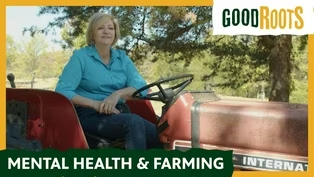
Good Roots: Mental Health & Farming
Video has Closed Captions
Clip: S41 Ep2 | 6m 14s | Discussing Mental Health in the Agriculture Community (6m 14s)
Providing Support for PBS.org
Learn Moreabout PBS online sponsorship
- News and Public Affairs

Top journalists deliver compelling original analysis of the hour's headlines.

- News and Public Affairs

FRONTLINE is investigative journalism that questions, explains and changes our world.












Support for PBS provided by:
Arkansas Week is a local public television program presented by Arkansas PBS