Arkansas Week
Arkansas Week - March 24, 2023
Season 41 Episode 10 | 25m 45sVideo has Closed Captions
Legislative Update / "Good Roots" Youth and Livestock
A panel of journalists recap bills that have passed during the legislative session and discuss what major legislation is on the agenda when lawmakers return to the Capitol next week. Guests: Josie Lenora, KUAR; Steve Brawner, independent journalist; Andrew DeMillo, Associated Press "Good Roots" features the Phelps family, from Paragould, about livestock opportunities for youth.
Problems playing video? | Closed Captioning Feedback
Problems playing video? | Closed Captioning Feedback
Arkansas Week is a local public television program presented by Arkansas PBS
Arkansas Week
Arkansas Week - March 24, 2023
Season 41 Episode 10 | 25m 45sVideo has Closed Captions
A panel of journalists recap bills that have passed during the legislative session and discuss what major legislation is on the agenda when lawmakers return to the Capitol next week. Guests: Josie Lenora, KUAR; Steve Brawner, independent journalist; Andrew DeMillo, Associated Press "Good Roots" features the Phelps family, from Paragould, about livestock opportunities for youth.
Problems playing video? | Closed Captioning Feedback
How to Watch Arkansas Week
Arkansas Week is available to stream on pbs.org and the free PBS App, available on iPhone, Apple TV, Android TV, Android smartphones, Amazon Fire TV, Amazon Fire Tablet, Roku, Samsung Smart TV, and Vizio.
Providing Support for PBS.org
Learn Moreabout PBS online sponsorshipSupport for Arkansas Week provided by the Arkansas Democrat Gazette, The Arkansas Times and KUARFM 89.
Hello again everyone, and welcome to the broadcast.
Come Monday, Spring break ends for the pupils and the politicians.
K12 and college students will return to the classroom and the legislators will return to the Capitol, the former looking to the end of a semester, the latter to the start of a fiscal year.
Thus far, it has largely been a session of social and cultural issues.
But it's time to start plugging in the numbers.
The 94th General Assembly with April approaching, that's this week's edition.
And joining us, Andrew D'mello, Capital Bureau chief of The Associated Press, Josie Lenora, KUA R's capital correspondent, and Steve Bronner, independent journalist.
Thanks to everybody for coming in with such speed, such velocity did the administration's education package Omnibus learns package.
With such speed today, and it was so little discussion or debate, did it just blow out of the General Assembly that it is difficult to imagine that we're in the third month of General Assembly and mostly it is social and and cultural issues, guys that have had of dominated and Andrew Demillo, there's more to come.
Yeah, that that's right.
You know this has been a session where we've seen a lot of.
Kind of cultural wars bills getting through.
This week Governor Sanders signed a school bathroom bill making Arkansas the 4th to enact such a restriction.
And when they come back next week, one of the first things on the agenda for House committee is a more far reaching bathroom bill that actually goes further than the North Carolina law that prompted that was repealed after it faced some pretty widespread boycotts and protests.
And yeah, we've seen other restrictions get through as well too, including basically an effort to try to reinstate the state's ban on gender affirming care for minors by making it easier to sue providers of of such care for for malpractice.
So this has been you know something we've we've seen I've seen a lot of and we we're still, I got some other things on the agenda and those include some new abortion bills legislation that just came in.
Representative Denise Gardner put forth a bill which would allow mothers to achieve or access an abortion if their health is at risk.
It would expand.
Currently you can only get an abortion if the life of the mother is at risk, but this would expand it a little bit because she's a Democrat and because it's a bill about abortion, I don't see it going through.
But there is also a second bill by Republican to make it so you can't access methopra stone, which is the abortion inducing drug.
Steve.
The odds are against any kind of legislation that would expand abortion rights which are essentially nonexistent.
I was not only against.
If they are, it is not going to happen.
You know, we just had a governor elected with 63% of the vote.
We just had Roe V Wade overturned.
Arkansas's very, you know, ban on almost all abortions just now went to effect.
This is not the time that there's going to be any kind of expansion.
Anything that is going to happen.
What happened in the court system, it is not going to happen legislatively.
Yeah, well, expansion aside, there are further constrictions for the limitations.
In new legislation that's that's been introduced Andrew, this is, this is aimed at physicians.
Yeah that that's correct.
And yeah I think that's going to be the the big test is you know does the state want to go even further with the restrictions that it has.
You know Arkansas already has banned you know effectively all abortions except with the exceptions of those two you know save the life of the mother in a medical emergency.
So the question is you know how much?
Given the legislature's, you know, conservative bent, do they want to focus on adding more, more restrictions or is there much appetite for that fight at this point?
And that includes potentially we're talking now about legislation that's targeting the oral contraceptives or oral forms of abortion, the pill.
Morning after pill is well that would that would impose if I am reading the legislation correctly would impose criminal sanctions on or certainly administrative sanctions on physicians that that assist in in any way on that legislation on that administering that pill that's you know a further constriction of of already very limited pathway toward abortion but.
One of the things that's so striking about it is that you find you got a veto proof supermajorities in both chambers of the General Assembly with Andrew very rare exceptions there has been absolutely no dissenting votes on the Republican Conference on any of these the socalled hot button issues.
Yeah you know that's you know that's that's right.
You know one exception is.
The, you know, the, the bathroom bill that's been sent to the house is it was a narrow, a narrow vote in the Senate where you actually had a Republican lawmaker getting up and speaking, speaking against it, kind of laying out some of the some of the issues that he saw with that legislation.
The big question is you know, are there you know are there Republican lawmakers in the House who see the see the same issues in terms of the enforcement you know, the fact that this would criminalize.
You know, transgender people using bath, using bathrooms that align with their gender identity.
And so that's kind of the been the exception to it.
But for the most part, these have been almost nearly, you know, party line votes every single time.
Well, you look at the Constitution and the overriding responsibility of any legislatures to write a budget.
Well, it's budget time.
We got a fiscal year starting and well, we've got a nice little budget surplus.
Treasury surplus built up, but it's time to start plugging in the numbers.
We have an administration that has pledged to try to at least begin if possible.
There's a little bit of wiggle room there to begin whittling away at the Arkansas income tax, the state income tax, but also some capital improvements on prison.
We have Medicaid still pending, and of course the big one takes more than half the general revenue budget, and that's the school fund.
Senator Brian King and Senator Hickey, when they voted against the learns bill, they've both, in interviews cited the fact that the bill was underfunded or they didn't know where the funding was coming from.
That's a huge, wide, sweeping piece of legislation.
There's a lot of money involved and everyone, including the Arkansas Department of Education and sponsors on the bill or have reassured people that the funding is going to come and that the money will be fine.
But we don't completely know exactly how the funding is going to work.
And with a lot of other things that are on the menu for the legislature in the next few weeks, I think a lot of people are concerned.
Well, a big hurdle was probably passed yesterday when the house that's in Education committee chairs filed a bill that would have the per People Foundation funding.
That is schools are half the budget and a big part of the budget of that part is the foundation funding it's in and it's about it was a $205.00 increase from from last year and and what that's going to amount to, that's actually less than the Adequacy Committee's suggested.
But their reasoning is that there's more money coming in from the learns act and what's going to be, it's going to come from other places.
So now that we've got that hurdle passed, we could at least move forward.
There has not been a lot of guidance from the Sanders administration on this.
They have not presented their own budget.
So we kind of started with Governor Hutchinson's budget, and now at this point it might be coming from the legislators themselves.
There hasn't been any kind of appropriations letters.
There's just been.
That this will probably be legislatively driven in some ways and now they got to get started.
This is, you know, the goal was April 7th to be done.
That's not going to happen.
We're looking more like April 13th or so at the very least.
But probably it's hard for me to even hard to see even that being done.
We still have to, we still have to do prisons, which is going to be a big issue.
We still have to figure out how we're going to pay for the learns act.
Got to figure out how to pay for everything else.
Got to go through all the appropriations now we're at the end of March, so.
They may be here for a while or they may just or they may hold up joint budget and just and and and get it done.
But it's hard to imagine that happening.
Yeah, Andrew that's quite an agenda for the next several weeks.
Yeah, that that's true.
You know, you look at the list of the To Do List that there is for the legislature right now of things they have to do.
You're looking at a massive crime bill, finding money for a new prison, which seat that seems to be part of this part of this agenda, but also, you know, tax, tax cuts, looking at school funding.
Big question about whether or not there's going to be a fighter or Medicaid and then you get to the budget and also get to whether you know what constitutional amendments are they going to put on the ballot.
This is you know a daunting list and the the idea of getting all this done by April 7th.
I think there's pre healthy skepticism from some lawmakers and you know even some who wonder if they can get this done by the end of April.
Well let's let's take learns here and the in the education budget we have over the last several weeks days actually.
Started to see some push back some serious questions on the part of of of educators around the state school board members particularly superintendents.
How is this going to affect my district my pay plan and and not all the superintendents are have been soothed let's let's say Josie.
Well, the Little Rock School district at their board meeting last week expressed dismay over the fact that they didn't necessarily have the highest salaries in the state anymore.
And although they have money, they might have money to pay for these minimum salaries, which are higher than usual.
They don't necessarily have the funding to pay for the same salary schedule.
So it's a completely different funding system than what they're used to.
And I know we were talking before the show about how the Bryant School Board expressed the same concerns in their board meeting.
Right.
What's that going to?
The learns act will be assuming that the money comes through, and it's hard to imagine it not coming through because this is the governor's signature program.
It funds what it says it will fund, which is the the minimum teacher salary going up to 50,000 dollars 50,000 and the $2000 raise for everybody.
It does not fund, just keeping their same salary schedules.
So what will probably happen is that while the beginning teachers, the new teachers are all going to make 50,000, which is a pretty good living.
In Arkansas for for veteran teachers for teachers who are getting have more education up there.
In the years experience they will make they will still make more money.
The difference between them and the beginning teachers will be compressed which means that there will be the salary schedules that have been in place will have to be changed.
And as also this is happening at a time, there's still a lot of uncertainty because this is about the time when school districts pass out do their their contract renewals.
In fact, Mountain Home typically does theirs by March 31st, which is next week.
And we still don't have the funding guaranteed for and it's not been signed into law.
So there's just a lot of uncertainty.
But on the plus side, you know, let it not be forgotten that teachers will be backing a minimum $50,000 next year.
Yeah, and Andrew too, this is going to, we are incurring here some ongoing obligations in terms of learns.
Yeah.
And what it, what it, what it imposes or on local districts.
Yeah.
And that's, you know, that's the concern that you heard from critics of the legislation and you're hearing from some of the districts.
Are the questions about not just, you know, year one, year two.
When you get into year three and and further out, what unfunded mandates might there be for districts in terms of the obligations?
You know, Steve's talked about the salary schedule issue.
And I think, you know, you're probably gonna hear more of this from districts as they start putting together their budget and start looking at their policies and looking at how to comply with all different parts of this.
Remember this is 145 page bill and there's still a lot that has to be worked out through the rules on it.
And Steve, yeah, the rules, I mean there's a lot of vagaries that will be determined by the Department of Education and the and the State Board of Education and so that.
You know, school districts are going to be entering in the next few months.
This is when they really, really planned for next year, still not knowing what they're going to look like.
Now the Secretary of Education, Oliva has said he's going to go around the state.
There'll be a lot of openness and discussions, the learns act part, passing the legislation was was done not so much in the public eye.
It was not done through the legislative process.
There was a lot of discussions and meetings, but not so much that people like us could see.
The rules process may be may be open and might be and it there could be some.
It could be interesting to watch over the next few months how this how this begins to be to be fleshed out on the on the on the vouchers lots to be determined homeschoolers you know who gets the money and how can it be spent and and who can it be spent on and how do they how's accountability kept all this is.
Major needs to be still determined and you know the next school year starts and not that far from it now.
So it could be a very busy, interesting really year to two years as we flesh this out.
2345 years.
Because what I'm hearing from some educators is that we really have no good idea as to how many students traditional public schools are going to lose to home schooling or to parochial schools order or to charters.
I counted about two weeks from the time that the bill was made available to the public and to the time that it actually ended up passing and it was 145 pages.
I had trouble getting through it.
And all that time a lot of legislators were honest about the fact that they had trouble getting through it and understanding all that ramifications.
I think one of the most interesting parts is the education freedom account, which is millions of dollars which will go from public schools to private schools so the parents can enroll their children in private schools.
But we know there's going to be a three-year rollout.
We don't really know the details.
We don't really know who goes first.
We don't really exactly know how much money goes for each student on to something else.
And that and we.
Exited earlier capital construction calls for any new prison.
They're going to be substantial on on what we're getting ready to build anyway.
But then you have M&O afterwards, you pay for that prison on and on and on.
It's kind of like any other big state function, right?
And you know, no matter what this is going to happen because our county jails are full.
So there is no debate that there needs to be some business space built.
There's no debate about that.
How much is the debate?
And they how can much can be afforded based on the fact that we just gave teachers a raise to $50,000 and because they're still wants, they're still a goal to cut taxes.
And all this is being done in the context of these huge budget surpluses right now that are unprecedented as far as I don't know, but kind of based on this weird COVID economy that we don't know how permanent it's going to be.
So there's just a lot of uncertainty.
But this is, you know, there's going to be prisons built, prison space built.
It might not be as much as was originally hoped for.
And one other thing, a huge budget item, and that's Medicaid, Andrew.
Guys, everybody you know in, in years past, when what became known as Obamacare was first introduced, there were a series of legislative sessions.
He's long drawn out massive fights over whether or not to renew the program, participate in it.
In the last couple of sessions it was more or less accepted.
Do you see that change again, Andrew?
I think it's still hard to tell at this point.
You know Governor Sanders announced that she is going to again pursue a work requirement for that for Medicaid, some for Medicaid expansion, something that's been attempted before the blocked by the courts.
And the issue with that is we won't know until after this legislative session.
You know whether or not Arkansas gets approval for that, that may help stave off a fight on this until.
Until next year, depending on what the Biden administration says.
But it's still unknown.
You know, you still have to get a 3/4 vote on it.
And as we've seen in nearly every single session since Arkansas expanded Medicaid is that can be very difficult and there's still a lot of unknowns with that.
So that's the big question mark and the thing kind of hanging over this whole idea of trying to get everything wrapped up, you know, by April.
Yeah, but it brings us, Steve brings in so much money.
It would be impossible to balance the budget and do tax cuts without the Medicaid expansion.
And that is what Governor Hutchinson discovered or found to be true.
And so and basically some would say he knew it going in, he did not campaign.
He did not mention when in his first campaign how he was going to get rid of Medicaid and neither did Governor Sanders and she basically has used the same play that he used.
Which is let me check with the feds, let me see if we can do a work requirement.
He did the same thing, bought time.
You know, it ended the the controversy and that's kind of that appears to be her place.
She is, I have not seen anywhere in the in during her campaign or during her early time in office that she has mentioned getting rid of the expansion.
And I cannot see legislators wrecking her budget or wrecking the budget this time.
And it it is.
It is now a part of the fabric of Arkansas Healthcare.
Not only that but we are going to be getting rid of people recipients.
There will be a repair the rolls now that the COVID pandemic is the national emergency is over officially there.
There will be people taking up, we're going.
So we're going to be getting people off the rolls anyway that there will be momentum that would be enough in that direction.
So hard to see there being a big controversy.
Mark, Steve and Josie and Andrew, thanks very much as always for coming in back soon.
Learning, education, growth, intellectual development.
It's not restricted to the classroom.
When the barn doors swing open, so can other doors.
And we go to Greene County for this month's edition of Good Roots.
I'm Dylan Phelps, and we're today we're at Crowley Ridge Classic in parallel, Arkansas at the Green Canyon Fairgrounds.
Me and my brother were kind of born into it.
We've been in barns since we were one and two years old, with goats, calves and hogs, all kinds of things.
We've always had some form of livestock.
We had beagles that we raised.
They had dogs that they took care of from the time they were, you know, little guys.
You can learn all types of life skills within this industry.
Teamwork, leadership, hard work.
I've met plenty of friends all over the nation just showing judging and all things livestock.
We bought a beef master bowl.
Stay with that for a while and learn about Gil the kettle.
Main goal has always been to raise well-rounded children, to teach them work ethic and how to take care of things.
We grew up that way and it's something we enjoy as a family.
Our parents both showed livestock on the county and state level.
So I know it goes back three generations.
There's, you know, a few different levels of shows.
There's like these jackpot shows are pretty local.
There's state shows like State Fair and AYE and then there's national shows.
Like katamas, Congress, Dixie National Open show, it's really big show.
They got multiple barns full of cows, full of goats, full of pigs, lambs, everything you can think of.
Sometimes you get a trophy, sometimes you get a ring, you get belt buckles and just all kinds of things that you can win.
Well, I show market usually I have a steers, he shows the breeding, breeding stock we we raise and the steers, you know.
You want muscle, you know muscle.
And with you know, you want a big wide top in them.
You want some rib to them.
You want to look nice from the side you know, and be long fronty and long necked and tying high at their shoulder.
And some bones, big legs, a lot of hair.
They'll kind of judge you based on how good your animal looks and how good it is in terms of breeding standpoints and structural standpoints.
Keep it all, you know, this medicine, medicine free as we can, you know.
Low antibiotics and all that.
But you got to have vaccinations to get them healthy, raise it, you wean it and you get it pretty, I guess you could say.
And you feed it, make it look good and then bring it to the show and see what it does.
I like spending time in the barn, you know, getting them ready for the shows.
I think like the day you really, you know, like the most.
When you get here and you get them ready, got them looking their very best and you go in there and you win a banner.
There's a lot of blue ribbon effect, I guess you could call it, and it's there's a lot of thrill that goes into it when the judge comes up to you, shakes your hand and tells you you won.
There's a lot of emotions going through there because you think about all the hard work that you've put in and how much your family's put into it.
And there's all kinds of different things you can do besides just showing and breeding livestock.
And I think that's overlooked a lot because things like FFA in the name, it's future farmers of America.
But you can do a whole lot more than just.
Being a farmer and whatnot, it's not just about the cattle and raising the cattle.
They also do livestock judging.
Public speaking.
My dad went to college judging livestock collegiately, and I kind of want to go down that same path.
Their scholarships for everything.
You know, there's LDE's, which are leadership development events where you speak.
You know I did, except for any speaking where you get a topic and you have 30 minutes try to speech and deliver it, scholarships for public speaking.
And then there's stuff like this where you get scholarships for winning big shows.
That's my favorite part of it, is seeing them progress.
Watching how much they've learned and you know, what they picked up.
All hard work pays off always, you know, it's just what you get out.
What you put in is what it boils down to.
During the school week, get up about 5:30 and go out.
Feed the heifers, feed the Bulls, you know, get everything taken care of for the morning.
Make sure if our cows had a calf that it's healthy and doing well and just check on everything in the morning.
Go to school, come back home.
And, you know, do it all again.
You just take care of you, feed them your water and check on them.
Make sure they're all doing well.
You know, when sick, you gotta get up and doctor it.
Whether it's nice outside or whether it's cold or whether it's hot, it's it's something that has to be done.
Sometimes it's going to be rough.
It's good days and bad days just like everything else.
Just like sports, you have to learn to prioritize.
Figure out how to make it to baseball practice, how to get the judges done, test how to get your homework done.
I mean, there's a lot of people that feed once a day after school and don't do anything in the morning.
But us, we feed morning and night.
She had a cow at home and you don't take care of it.
You don't feed this.
You don't feed it and you're supposed to feed it.
You know it gets a little skinny show up here and you kind of you don't do well 3B is 3 Brothers Cattle Co so we me and my brother Thompson and my brother Garrett all started this about four or five years ago.
They wanted it to be 3B because there are three brothers.
I think it's important to kind of you know if you want to stay in this industry for a while get your name out there.
You know get you win some shows.
Yeah, there's some rivalries, like on a baseball field, you know, you can be playing with your buddies in a friendly game and if it's a state championship, you're out to win it.
The rivalry between us, when it's our cows that were showing, you know, we breed those, raise them together.
We're always hoping for the other to win or us to win.
If we win our cows to do well.
But in showmanship, that's when they judge you on how well you exhibit your animal.
That's always been a rivalry between us, but there's always that showmanship class that you're judged on your showmanship and how you're, how you actually present your animal.
And I think there's plenty of cavalry there.
What we've tried to instill in these boys is regardless of who's there that weekend, you're there to help.
It's amazing to go out there and compete against someone you love.
I love it.
I've been in it my whole life and I really can't picture my life without it, whether they want to go be nurses or farmers or doctors or whatever this.
This program prepares them for whatever lies ahead.
It instills a lot of values and instills a lot of work ethic.
And regardless of what direction they go, it prepares them for it.
I hope that we've got grandkids that are here showing one day, hopefully a lot of years from now, but it's a common goal.
I think with most people in this industry we're we're trying to raise better young men and women, and we're using the cattle to do that.
That does it for us for this week, as always, thank you for watching.
See you next week, support for Arkansas Week provided by the Arkansas Democrat Gazette, The Arkansas Times and KUARFM 89.
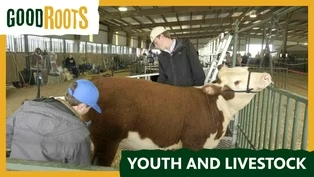
Good Roots: Youth and Livestock
Video has Closed Captions
Clip: S41 Ep10 | 6m 15s | Youth and Livestock (6m 15s)
Providing Support for PBS.org
Learn Moreabout PBS online sponsorship
- News and Public Affairs

Top journalists deliver compelling original analysis of the hour's headlines.

- News and Public Affairs

FRONTLINE is investigative journalism that questions, explains and changes our world.












Support for PBS provided by:
Arkansas Week is a local public television program presented by Arkansas PBS