
Armadillos in the Bluegrass
Clip: Season 31 Episode 10 | 9m 35sVideo has Closed Captions
A critter associated with Texas is now calling Kentucky home. How have Armadillos ended up here?
Kentucky is known for all sorts of wildlife, but in the last few years, there’s been an animal more closely connected to Texas making appearances around the Bluegrass. Armadillos first started appearing here around 40 years ago, entering through Western Kentucky and now being found as far north as Louisville. So how did they end up here? And what should you do if you encounter one?
Problems playing video? | Closed Captioning Feedback
Problems playing video? | Closed Captioning Feedback
Kentucky Life is a local public television program presented by KET
You give every Kentuckian the opportunity to explore new ideas and new worlds through KET. Visit the Kentucky Life website.
Armadillos in the Bluegrass
Clip: Season 31 Episode 10 | 9m 35sVideo has Closed Captions
Kentucky is known for all sorts of wildlife, but in the last few years, there’s been an animal more closely connected to Texas making appearances around the Bluegrass. Armadillos first started appearing here around 40 years ago, entering through Western Kentucky and now being found as far north as Louisville. So how did they end up here? And what should you do if you encounter one?
Problems playing video? | Closed Captioning Feedback
How to Watch Kentucky Life
Kentucky Life is available to stream on pbs.org and the free PBS App, available on iPhone, Apple TV, Android TV, Android smartphones, Amazon Fire TV, Amazon Fire Tablet, Roku, Samsung Smart TV, and Vizio.
Providing Support for PBS.org
Learn Moreabout PBS online sponsorshipBut first, Kentucky is known for all sorts of wildlife.
But in the past few years, there's been increased sightings of an animal making appearances around the Bluegrass State that's more closely connected to Texas.
Armadillos.
Yeah, armadillos first started appearing here around 40 years ago, entering through Western Kentucky and now being found as far north as Louisville.
So, how did they end up here?
And what should you do if you encounter one?
We took to the woods to find out.
[music playing] When you work on a show like ours, one thing that's guaranteed is a lot of time crisscrossing the state in a van.
And not too long after I first started this job a few years ago, I was stunned to see armadillos in Kentucky on the side of the road.
Now we wanted to do a story on them, but there was one problem.
Most of the ones we saw were dead on the side of the western Kentucky parkway.
[music playing] All that changed late one night when our crew checked into the lodge at Lake Barkley State Resort Park in Cadiz.
After a long day on the road, we were all tired, but several of us heard something rustling outside of our rooms.
And there we saw them.
Armadillos paying no attention to us as they burrowed around looking for insects.
It was the first time we'd seen them in their natural habitat.
And this really made us want to tell the story about how they had ended up in Kentucky.
That led us to Second Chances Wildlife Center in Mount Washington.
It was there we met Alan, the armadillo.
He'd been found injured after an attack.
A blood disorder prevents him from being released back into the wild.
So, now he's an armadillo ambassador of sorts, getting to spend part of every day in his favorite place, the bathtub.
[music playing] So tell me about his life now.
He goes out to schools and does outreach and everything?
Allen is a licensed education ambassador with USDA.
So, we go into school groups and libraries and scouts and do environmental education.
And the reaction to him is what?
Oh, people love him.
People are surprised that we have armadillos in Kentucky.
So, there's a whole ‘nother teaching component there.
We can teach about climate change, but not only do the kids enjoy him, but the adults enjoy seeing him just as much as the kids.
That's so cool.
In the early 1980s, anecdotal armadillo sightings were first reported in Western Kentucky.
Our state's Department of Fish and Wildlife had its first confirmed sighting in Marshall County in 1986.
They then began a slow march eastward, stretching all the way to Russell and even Jefferson Counties.
Then, in February of 2019, Pike County, our state's easternmost county, had its first sighting of armadillos thought to have crossed over from Virginia.
Now this bunch was predicted to move north and west where sightings did indeed take place.
And they eventually met up with their Western Kentucky brethren in Central Kentucky.
Even our friends at Kentucky Afield have encountered them.
What is this?
Armadillo.
[music playing] Right here.
I was wondering what the one I was looking at right here.
I've heard armadillos have been moving into Kentucky, and I've seen them dead on the road, so I know 100% for sure they are.
But I never expected to walk right up on one like that.
Sure enough, that's what that was, an armadillo.
We wanted to learn more, so we went to the folks at the UK Department of Forestry and Natural Resource Sciences.
Allen and his brethren in Kentucky are called Mexican long-nosed armadillos or nine-banded armadillos, which reflects the number of bands on their shell.
So, it's just a coincidence that when we started studying these about a year-and-a-half ago, the first armadillo that we got was between Lexington and Frankfort on I-64, which was kind of a surprise to us.
We knew that they were getting close, and then we started to find them in Nicholasville.
We found them most recently here in the summer near Rupp Arena.
Cox says he wouldn't be surprised if armadillos were in every Kentucky county by the year 2035.
Even he admits they're fun to watch.
Armadillos have a lot of attention and a lot of focus in their smell.
So, their sense of smell is very strong and a lot of their effort is really dedicated to pointing that nose to find insects and that's where they get their busybody attitude is that they're digging through things all the time.
They're wandering around aimlessly looking for food, and that just takes up a huge amount of their time.
And that's also how they get into trouble.
They just cross roads and they're not really thinking very well.
There's a variety of theories on how armadillos ended up here.
They're good swimmers and some think they stowed away on barges coming up the Mississippi River to the Ohio River from Louisiana.
As to why they're here, climate appears to be playing a role.
They tend not to have great survival when you get really hard freezes.
So, as the colder weather tends to retreat further north and we're having warmer and longer winters, we are seeing them colonize further and further north.
So far the biggest issue armadillos like Allen pose is their destructive nature.
Their eyesight is poor, so they rely on smell to find food.
They dig and root around for the bugs and insects on which they feast.
Most people consider them a lawn nuisance more than anything and businesses, etc.
I've had golf courses reach out to me already sending me pictures of armadillos digging up their greens and whatnot.
So, it's more so just something that you're gonna have to get used to.
They're gonna get more common it seems like.
A bigger issue is that armadillos can carry leprosy.
UK researchers have tested 22 of the armadillos they've come across for the disease so far.
Three of those have come back positive.
I would not go up to any armadillos.
I would not try to pet them.
Don't try to get too close because of the leprosy issue.
Although it's not very easily transmissible, it is transmitted through droplets from the nose and mouth of an infected animal.
The unique thing about these armadillos is that the leprosy that they carry can be transferred to humans.
So, armed with this knowledge, we headed back to Lake Barkley to see if we could observe armadillos in their natural habitat.
We set off with Park Ranger, Shannon Keller.
He said we may be in for quite a show.
Actually, armadillos are very fast creatures.
They can run like you wouldn't believe, and they can jump over six feet high.
So, when you encounter one, if you startle it, it may jump six foot up in the air, or it may take off like a rocket or it may just stand there.
You really don't know.
It depends on the armadillo itself.
I feel like each one of them have their own personality.
They are not gonna hurt you at all.
So, you can sit there, take a picture of it.
If it starts walking to you, just back away from it.
Give it its space.
Let it do armadillo things.
Now occasionally we'll have them come up to the front door of the lodge.
They'll walk up the steps and they're moseying and meandering around, and we try to shoo them off a little bit to get them back into the grassy areas.
So, Shannon, we're out looking for the armadillos tonight.
Tell us what we're on the lookout for.
Well, when you're driving through the park, you wanna look for a small gray hump, almost rock-like and a little bit of movement.
It can be right on the edge of these woods right here.
We can walk right by it.
They're camoed so well.
You could walk right by it and never see it.
So, they're easier to pick out on the side of the road because the grass is shorter.
Once they get off in the woods, it is very difficult to find them.
What do you think the odds are of us seeing any tonight?
I would say it's pretty good.
Okay.
Pretty, pretty good.
We're gonna give it our best shot, I can tell you that.
We'll keep looking.
[music playing] And so, off we went.
We looked and looked and looked, but over several hours, we only spotted a few from a distance that immediately took off.
So, we headed back to where all this began, the lodge at Lake Barkley, where we'd seen them the first time.
We came across one that promptly headed into a hollow log.
After literally hours of searching, around 1:00 a.m., we gave up and started heading back to our vans.
And that's when one of our crew members saw something out of the corner of his eye.
There he is.
Yeah, he's coming right at us.
Here he comes.
[music playing] Yeah, here he comes.
[laughing] We got him.
That's a good shot there.
Can you get over here by me?
You got a perfect lane at him, at his face.
[music playing] So, what did we learn?
As interesting as they are to watch, armadillos pretty much just want to be left alone.
But they are fascinating, and as their numbers across the Commonwealth continue to expand, they may be coming to a yard or garden near you.
So, keep your eyes open.
The official state mammal of Texas could be your newest neighbor.
[music playing]

Video has Closed Captions
Clip: S31 Ep10 | 5m 17s | An introduction to working with clay with Quinn Maher. (5m 17s)
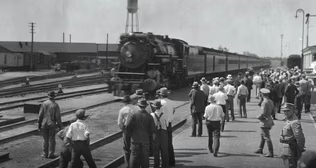
Iron Horse Capital of Kentucky
Video has Closed Captions
Clip: S31 Ep10 | 5m 36s | When the steam locomotive came along, Lexington found itself at the crossroads of a nation. (5m 36s)
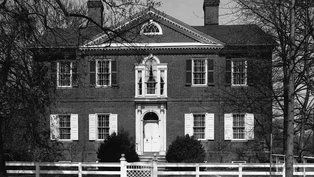
Video has Closed Captions
Clip: S31 Ep10 | 3m 12s | Chip visits Liberty Hall in Frankfort, Kentucky, to learn more about this historic home. (3m 12s)
Providing Support for PBS.org
Learn Moreabout PBS online sponsorship













Support for PBS provided by:
Kentucky Life is a local public television program presented by KET
You give every Kentuckian the opportunity to explore new ideas and new worlds through KET. Visit the Kentucky Life website.