
Armadillos in the Bluegrass, Iron Horse Capital of Kentucky, Liberty Hall, Clack Mountain Clay
Season 31 Episode 10 | 27m 15sVideo has Closed Captions
Learn about armadillos in Kentucky, Lexington as a crossroads, Liberty Hall and Clack Mountain clay.
Learn why Kentucky is seeing an increase in armadillos; Lexington became a pivotal crossroads during westward expansion with the invention of the steam locomotive; Chip visits Liberty Hall in Frankfort, the historic home that belonged to U.S. Senator John Brown; Quinn Maher harvests clay from Clack Mountain in Rowan County and demonstrates his creative process. A 2026 KET production.
Problems playing video? | Closed Captioning Feedback
Problems playing video? | Closed Captioning Feedback
Kentucky Life is a local public television program presented by KET
You give every Kentuckian the opportunity to explore new ideas and new worlds through KET. Visit the Kentucky Life website.
Armadillos in the Bluegrass, Iron Horse Capital of Kentucky, Liberty Hall, Clack Mountain Clay
Season 31 Episode 10 | 27m 15sVideo has Closed Captions
Learn why Kentucky is seeing an increase in armadillos; Lexington became a pivotal crossroads during westward expansion with the invention of the steam locomotive; Chip visits Liberty Hall in Frankfort, the historic home that belonged to U.S. Senator John Brown; Quinn Maher harvests clay from Clack Mountain in Rowan County and demonstrates his creative process. A 2026 KET production.
Problems playing video? | Closed Captioning Feedback
Where to Watch Kentucky Life
Kentucky Life is available to stream on pbs.org and the PBS app.
Providing Support for PBS.org
Learn Moreabout PBS online sponsorshipby the KET Millennium Fund.
This week on Kentucky Life... Armadillos in Kentucky?
It's absolutely a thing, and we hit the woods to find out what this Texas critter is doing in the Bluegrass State.
We'll look at how trains made Lexington one of the primary crossroads in our nation as the westward expansion took place.
We'll explore the setting for this week's show, Liberty Hall in Frankfort.
And we'll introduce you to a Rowan County artist who creates works by using what he digs out of a mountain.
All that's next on Kentucky Life.
[music playing] Hey, folks, and welcome to Kentucky Life.
I'm your host, Chip Polston.
It's good to see you again.
As we continue to celebrate America's 250th birthday this season on our show, our travels have brought us here to Liberty Hall in Frankfort.
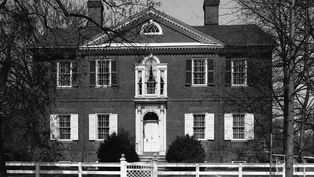
In 1796, John Brown bought this property to build a home along four acres of the Kentucky River.
He also built a ferry here, effectively giving himself control over this crucial part of the waterway.
Now, family lore claims Brown served under General George Washington and was an aide to General Lafayette.
After the war, Brown was elected to the United States House of Representatives and while there introduced the bill, which granted Kentucky statehood.
After becoming Kentucky's first senator, he rose as high as the position of President Pro Tem of the United States Senate.
The home is a remarkable repository of Kentucky history, and like many old dwellings, even comes with its own ghost story.
We'll learn more about Liberty Hall a little later in our show.
But first, Kentucky is known for all sorts of wildlife.
But in the past few years, there's been increased sightings of an animal making appearances around the Bluegrass State that's more closely connected to Texas.
Armadillos.
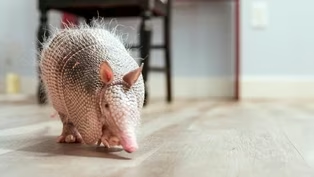
Yeah, armadillos first started appearing here around 40 years ago, entering through Western Kentucky and now being found as far north as Louisville.
So, how did they end up here?
And what should you do if you encounter one?
We took to the woods to find out.
[music playing] When you work on a show like ours, one thing that's guaranteed is a lot of time crisscrossing the state in a van.
And not too long after I first started this job a few years ago, I was stunned to see armadillos in Kentucky on the side of the road.
Now we wanted to do a story on them, but there was one problem.
Most of the ones we saw were dead on the side of the western Kentucky parkway.
[music playing] All that changed late one night when our crew checked into the lodge at Lake Barkley State Resort Park in Cadiz.
After a long day on the road, we were all tired, but several of us heard something rustling outside of our rooms.
And there we saw them.
Armadillos paying no attention to us as they burrowed around looking for insects.
It was the first time we'd seen them in their natural habitat.
And this really made us want to tell the story about how they had ended up in Kentucky.
That led us to Second Chances Wildlife Center in Mount Washington.
It was there we met Alan, the armadillo.
He'd been found injured after an attack.
A blood disorder prevents him from being released back into the wild.
So, now he's an armadillo ambassador of sorts, getting to spend part of every day in his favorite place, the bathtub.
[music playing] So tell me about his life now.
He goes out to schools and does outreach and everything?
Allen is a licensed education ambassador with USDA.
So, we go into school groups and libraries and scouts and do environmental education.
And the reaction to him is what?
Oh, people love him.
People are surprised that we have armadillos in Kentucky.
So, there's a whole ‘nother teaching component there.
We can teach about climate change, but not only do the kids enjoy him, but the adults enjoy seeing him just as much as the kids.
That's so cool.
In the early 1980s, anecdotal armadillo sightings were first reported in Western Kentucky.
Our state's Department of Fish and Wildlife had its first confirmed sighting in Marshall County in 1986.
They then began a slow march eastward, stretching all the way to Russell and even Jefferson Counties.
Then, in February of 2019, Pike County, our state's easternmost county, had its first sighting of armadillos thought to have crossed over from Virginia.
Now this bunch was predicted to move north and west where sightings did indeed take place.
And they eventually met up with their Western Kentucky brethren in Central Kentucky.
Even our friends at Kentucky Afield have encountered them.
What is this?
Armadillo.
[music playing] Right here.
I was wondering what the one I was looking at right here.
I've heard armadillos have been moving into Kentucky, and I've seen them dead on the road, so I know 100% for sure they are.
But I never expected to walk right up on one like that.
Sure enough, that's what that was, an armadillo.
We wanted to learn more, so we went to the folks at the UK Department of Forestry and Natural Resource Sciences.
Allen and his brethren in Kentucky are called Mexican long-nosed armadillos or nine-banded armadillos, which reflects the number of bands on their shell.
So, it's just a coincidence that when we started studying these about a year-and-a-half ago, the first armadillo that we got was between Lexington and Frankfort on I-64, which was kind of a surprise to us.
We knew that they were getting close, and then we started to find them in Nicholasville.
We found them most recently here in the summer near Rupp Arena.
Cox says he wouldn't be surprised if armadillos were in every Kentucky county by the year 2035.
Even he admits they're fun to watch.
Armadillos have a lot of attention and a lot of focus in their smell.
So, their sense of smell is very strong and a lot of their effort is really dedicated to pointing that nose to find insects and that's where they get their busybody attitude is that they're digging through things all the time.
They're wandering around aimlessly looking for food, and that just takes up a huge amount of their time.
And that's also how they get into trouble.
They just cross roads and they're not really thinking very well.
There's a variety of theories on how armadillos ended up here.
They're good swimmers and some think they stowed away on barges coming up the Mississippi River to the Ohio River from Louisiana.
As to why they're here, climate appears to be playing a role.
They tend not to have great survival when you get really hard freezes.
So, as the colder weather tends to retreat further north and we're having warmer and longer winters, we are seeing them colonize further and further north.
So far the biggest issue armadillos like Allen pose is their destructive nature.
Their eyesight is poor, so they rely on smell to find food.
They dig and root around for the bugs and insects on which they feast.
Most people consider them a lawn nuisance more than anything and businesses, etc.
I've had golf courses reach out to me already sending me pictures of armadillos digging up their greens and whatnot.
So, it's more so just something that you're gonna have to get used to.
They're gonna get more common it seems like.
A bigger issue is that armadillos can carry leprosy.
UK researchers have tested 22 of the armadillos they've come across for the disease so far.
Three of those have come back positive.
I would not go up to any armadillos.
I would not try to pet them.
Don't try to get too close because of the leprosy issue.
Although it's not very easily transmissible, it is transmitted through droplets from the nose and mouth of an infected animal.
The unique thing about these armadillos is that the leprosy that they carry can be transferred to humans.
So, armed with this knowledge, we headed back to Lake Barkley to see if we could observe armadillos in their natural habitat.
We set off with Park Ranger, Shannon Keller.
He said we may be in for quite a show.
Actually, armadillos are very fast creatures.
They can run like you wouldn't believe, and they can jump over six feet high.
So, when you encounter one, if you startle it, it may jump six foot up in the air, or it may take off like a rocket or it may just stand there.
You really don't know.
It depends on the armadillo itself.
I feel like each one of them have their own personality.
They are not gonna hurt you at all.
So, you can sit there, take a picture of it.
If it starts walking to you, just back away from it.
Give it its space.
Let it do armadillo things.
Now occasionally we'll have them come up to the front door of the lodge.
They'll walk up the steps and they're moseying and meandering around, and we try to shoo them off a little bit to get them back into the grassy areas.
So, Shannon, we're out looking for the armadillos tonight.
Tell us what we're on the lookout for.
Well, when you're driving through the park, you wanna look for a small gray hump, almost rock-like and a little bit of movement.
It can be right on the edge of these woods right here.
We can walk right by it.
They're camoed so well.
You could walk right by it and never see it.
So, they're easier to pick out on the side of the road because the grass is shorter.
Once they get off in the woods, it is very difficult to find them.
What do you think the odds are of us seeing any tonight?
I would say it's pretty good.
Okay.
Pretty, pretty good.
We're gonna give it our best shot, I can tell you that.
We'll keep looking.
[music playing] And so, off we went.
We looked and looked and looked, but over several hours, we only spotted a few from a distance that immediately took off.
So, we headed back to where all this began, the lodge at Lake Barkley, where we'd seen them the first time.
We came across one that promptly headed into a hollow log.
After literally hours of searching, around 1:00 a.m., we gave up and started heading back to our vans.
And that's when one of our crew members saw something out of the corner of his eye.
There he is.
Yeah, he's coming right at us.
Here he comes.
[music playing] Yeah, here he comes.
[laughing] We got him.
That's a good shot there.
Can you get over here by me?
You got a perfect lane at him, at his face.
[music playing] So, what did we learn?
As interesting as they are to watch, armadillos pretty much just want to be left alone.
But they are fascinating, and as their numbers across the Commonwealth continue to expand, they may be coming to a yard or garden near you.
So, keep your eyes open.
The official state mammal of Texas could be your newest neighbor.
[music playing] For much of its history, Lexington found itself as the crossroads of a nation, first for pioneers from colonial America who were often in need of replenishing their supplies as they explored the new territories.
And after the American Revolution, more travelers came through looking to expand the new nation.
As the city grew and the steam locomotive came along, Lexington once again found itself at the crossroads of a nation as Americans continued to move westward.
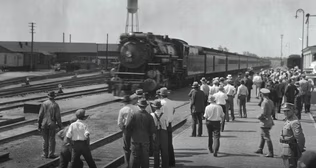
[music playing] [music playing] Shortly before the Civil War, Lexington, Kentucky became a crossroads for our nation, where the growing network of railroads crisscrossing the country would pass through and often stop.
It was a role the city would play until after World War II.
In 1835, the first train to leave Lexington, named the Daniel Boone, would travel to Frankfort, making the run to the state capital in just two-and-a-half hours.
Well, in the 1830s, the first railroad was authorized in Kentucky, and the logical place to begin building a railroad would be Lexington.
[music playing] As the industry grew, Lexingtonians watched rail tracks guide trains down main thoroughfares like Broadway, Vine Street, even Main Street.
In 1907, a large train station, Union Station, was completed in the center of town.
Situated next to what was then the Walnut Street Viaduct, this commanding structure would alter the face of Lexington.
Departing Lexingtonians would unload at a large circle facing Main Street and then board trains on tracks lining Vine Street taking them to destinations across the country.
To accommodate the many out-of-towners arriving every day, filing out from under the station's two-storey stained glass window, downtown businesses would develop and grow, changing the economy of downtown Lexington.
[music playing] The hotel rooms of the longstanding Phoenix Hotel were no longer enough, and the skyline saw the rise of the $2 million Hotel Lafayette.
After dinner at a hotel restaurant, visitors could attend the new Ben Ali or the Strand Theaters.
One business, the Lexington Laundry Company, opened on Main Street.
Built to clean, steam, and press so many suits wrinkled after the wear of traveling.
Perhaps one business person who benefited during this time was Belle Brezing.
Her house of ill repute was within walking distance of downtown, and by the time the station was built, Belle had gained great popularity in Lexington.
She would earn national acclaim for running one of the finest bordellos in the land until 1917 when political pressures forced Lexington's red light district to close.
Union Station became the heart of Lexington, where soldiers marched off to war, national politicians arrived to solicit Kentucky voters, and the first NCAA championship Kentucky Wildcat basketball team would be wildly greeted by adoring fans.
It is something that really provides a sense of place, and all sorts of people going off to World War I, returning from war, going to World War II, returning from war.
You could take daily trains to Washington, all sorts of places, and get there on an overnight sleeper and be in Washington the next morning.
But progress would catch up with the railways and with Union Station.
Air travel surpassed the age of trains.
Blue Grass Field was established on Versailles Road, and the last train left Union Station in 1957.
Three years later, the building would face the wrecking ball, and the train tracks that once filled Vine Street would be ripped away.
[music playing] Today at the west end of Lexington, the locomotives of R.J.
Corman are on display and remind townspeople of this age of the iron horse, but the memories of Union Station have faded away.
The Fayette County Clerk Office stands where so many would go to catch a train.
The Phoenix Hotel, where so many out-of-towners stayed, was torn down, giving way to the Fayette County Public Library, and the Hotel Lafayette has been revived as a city government building.
As for Bell Brezing, well, the legend remains.
But for today's Lexingtonians, there is one last reminder of the great Union Station, though it often goes unnoticed.
Etched in the concrete over the heads of pedestrians passing by on Main Street is the name of the company that served so many of the travelers brought here by train, the Lexington Laundry Company.
[music playing] [music playing] We're having a great time here today at Liberty Hall in Frankfort, exploring this fantastic old home.
This is John Walker.
He's the curator of collections here.
John, thanks so much for letting us be here today.
Absolutely.
Thank you for being here.
So, tell us the story of John Brown and his wife.
Why are they such important and influential figures in Kentucky history?
Well, the main reason is because John Brown was our representative when we were still a part of Virginia, and he was sent to Philadelphia and New York and Washington as the capital changed time and time again to represent our interests.
And our interests were specifically to get trade navigation on the Mississippi River and to create a state.
They wanted independence from our mother state, Virginia.
And he was instrumental in the creation of Kentucky as a state, correct?
Absolutely.
As Isaac Shelby and Daniel Boone and all of our known founders are here at Danville and eventually Lexington, fighting to create this independent entity on the ground here.
John Brown is our representative in Congress.
And in fact, he went to Congress in 1788.
His roommate was James Madison, and he was pushing for these things.
And Madison said, “Wait, wait.
We can get you all in, but we have this new government coming."
So, he was present when the Constitutional Congress was convening to create the Constitution that we have today.
Such a remarkable figure in history.
And when he built this place, Liberty Hall was really ahead of its time when it was constructed, wasn't it?
It really was.
In a way, it was actually more of a retirement home for him.
He was living on the road most of his life.
When he started building this place, he knew he wanted to be in the Capitol.
Frankfort had just been chosen as the capital city, and he wanted a place that was open and accessible, but also made a statement.
This is a man who was sending private letters to Washington and Jefferson and Madison.
And he knew that people would be coming West.
This was a very small capital city.
When they came here, this building said, “This is a place where power resides.” It was a statement piece.
It really was.
And a lot of famous people came through here back in the day.
Extremely.
People we don't even know, because it was the place you stopped off.
If you went to the old governor's mansion today, you also came here.
This is where you came.
And we've been to a lot of old houses this season, a lot of older structures.
They all have a great ghost story, and you've got one as well.
We do.
So, the Browns had a daughter, and she passed away very young.
Margaretta, the wife, grieved for a long time.
And her aunt came from New York to help her through that grief.
Helped get the house in order, in a way.
Helped her get back on her feet.
And the aunt came here, and her name was Margaretta Varick.
And she passed away three days after getting here.
Since then, there have been stories of people who have seen this figure, this ghostly figure throughout the home.
She is kind of a benevolent helper within the home.
Well, it really is a remarkable story and a remarkable place.
John, thanks so much for letting us be here today.
We look forward to continuing to explore the place.
Yeah, thank you so much.
[music playing] Our next story is brought to us by a professor at Moorhead State University.
It takes us to Rowan County there, where Quinn Maher has been harvesting clay from Clack Mountain.
Let's check out his process of working with clay as he demonstrates the intricacies of this art form.
[music playing] [music playing] I've lived in Morehead for about four years now.
We're trying to plant a garden, and we found that there's just a whole lot of clay.
Not a lot of topsoil in this area.
I found a spot up on Clack Mountain where I had a pure vein of clay, and I started harvesting.
I started collecting, and I started testing and researching to find the clay that was going to be best to use and be safe to put out in the world as well.
As a potter, I was really excited to collect some of that clay and pinch it out and make a little pinch pot and test it and see how hot I could fire it and for it to survive.
Lo and behold, all of those little tests survived.
Not only did those tests survive, but it was a really wonderful clay to work with.
Fresh out of the ground.
[music playing] Wedging is important because it prepares the clay.
It puts the particles of clay where they need to be.
And it also forces out any pockets of air that might exist, moving that clay into itself until all of the air gets pushed out.
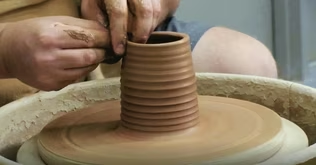
[music playing] First thing is I'm going to center this clay, get it smooth as the wheel's spinning.
Get it all right and I'm going to open it up, establish the inside depth of my cylinder here, and establish the diameter of the inside of the cup.
Here, I'm going to start pulling the clay up.
And once I get the majority of this clay up into a cylinder, now I can start to stretch the clay or change the volume a little bit and create a little bit more of a complex form.
Or I can rough up the form a little bit.
[music playing] After everything's made, it's got to rest and it's got to totally dry out.
All the water has to evaporate.
Now ready for the first firing, which is called the bisque firing.
The first firing is basically to turn the clay physically and chemically into ceramic.
[music playing] Glaze is a number of elements and minerals, metals suspended in water.
That's all been formulated to live on the side of your pot and be that last decorative and protective and functional.
For the most part, glaze is going to be applied by brushing or spraying.
But what we generally do is we dip.
Fill a cylinder and pour it out, and then dip it and submerge it for two to three seconds.
And you've got a lovely coat of glaze.
[music playing] The final kiln is fired with gas.
It's got six Venturi burners.
A kiln from start to finish, generally I start at 8:00 p.m.
at night.
Let it ramp up in temperature very, very slowly overnight with a number of turn ups.
And I start firing the kiln really at about 7:00 a.m.
the following day.
I usually have the kiln off or to temperature at about 3:00 p.m.
And then from there, you turn off the gas and you close the damper and it's just cooling naturally.
It's going to take about 36 to 40 hours to cool back down to a temperature that you can unload and handle.
[music playing] I do believe that ceramics is an art form.
As a craftsman, I think that I have to make something engaging, like visually beautiful or ugly or otherwise.
I have to make something that somebody wants to engage.
Just like a painting, right?
Or a sculpture or a photograph.
I also have to make something that someone's going to want to use after they've touched it.
I'm most interested in functional utilitarian ceramics.
I like making things that people are going to use.
It's all about that connection.
It's all about the materiality of using something handmade.
Growing up, I was just always interested in objects and the way that they are used and the way that they hold meaning and the way that they hold connection to people, to places.
I liked objects that got used for specific reasons and even more for specific events.
[music playing] My greatest success is if you had a piece of mine, you were using it.
It's an honor.
It's an honor to make things and then have people use it.
[music playing] We've had a great time here today at Liberty Hall in Frankfort.
Now, it's one of the many places in Kentucky with connections to America's 250th birthday that we'll be celebrating this year.
If you've never been, it's in a great part of Frankfort for exploring, so I really suggest you check it out.
Now, if you've enjoyed our show, be sure to like the Kentucky Life Facebook page and subscribe to the KET YouTube channel for more of what we like to call Kentucky Life Extras, where you'll have access to lots of other great videos.
Until next time, I'll leave you with this moment.
I'm Chip Polston, cherishing this Kentucky life.
[music playing] [music playing]
Video has Closed Captions
Clip: S31 Ep10 | 9m 35s | A critter associated with Texas is now calling Kentucky home. How have Armadillos ended up here? (9m 35s)
Video has Closed Captions
Clip: S31 Ep10 | 5m 17s | An introduction to working with clay with Quinn Maher. (5m 17s)
Iron Horse Capital of Kentucky
Video has Closed Captions
Clip: S31 Ep10 | 5m 36s | When the steam locomotive came along, Lexington found itself at the crossroads of a nation. (5m 36s)
Video has Closed Captions
Clip: S31 Ep10 | 3m 12s | Chip visits Liberty Hall in Frankfort, Kentucky, to learn more about this historic home. (3m 12s)
Providing Support for PBS.org
Learn Moreabout PBS online sponsorship












Support for PBS provided by:
Kentucky Life is a local public television program presented by KET
You give every Kentuckian the opportunity to explore new ideas and new worlds through KET. Visit the Kentucky Life website.