Art Elevated: The Governor's Mansion Artist Awards
Art Elevated: The Governor's Mansion Artist Awards 2022
Season 2 Episode 1 | 52m 28sVideo has Closed Captions
Meet the talented recipients of the 2021 Governor’s Mansion Artist Awards.
Meet the talented recipients of the 2021 Governor’s Mansion Artist Awards.
Problems playing video? | Closed Captioning Feedback
Problems playing video? | Closed Captioning Feedback
Art Elevated: The Governor's Mansion Artist Awards is a local public television program presented by PBS Utah
Art Elevated: The Governor's Mansion Artist Awards is made possible in part by Zion's Bank, The Church of Jesus Christ of Latter-day Saints Foundation, The Larry H. & Gail Miller Family Foundation, Thomas A. & Lucile B. Horne Foundation.
Art Elevated: The Governor's Mansion Artist Awards
Art Elevated: The Governor's Mansion Artist Awards 2022
Season 2 Episode 1 | 52m 28sVideo has Closed Captions
Meet the talented recipients of the 2021 Governor’s Mansion Artist Awards.
Problems playing video? | Closed Captioning Feedback
How to Watch Art Elevated: The Governor's Mansion Artist Awards
Art Elevated: The Governor's Mansion Artist Awards is available to stream on pbs.org and the free PBS App, available on iPhone, Apple TV, Android TV, Android smartphones, Amazon Fire TV, Amazon Fire Tablet, Roku, Samsung Smart TV, and Vizio.
Providing Support for PBS.org
Learn Moreabout PBS online sponsorship(gentle music) - [Narrator] Art Elevated.
The Governor's Mansion Artist Awards is made possible in part by Big-D Construction, the Church of Jesus Christ of Latter-Day Saints Foundation, the Larry H. and Gale Miller Family Foundation, Zions Bank, and the contributions to PBS Utah from viewers like you.
Thank you.
- It is so incredible to see all of you here to help us honor Utah's greatest artist.
- Art is a creative expression and it can happen through any way.
It can happen like me through sculpture or through painting, music or dance.
- These are really important concepts on what makes us human and how do we connect with one another.
- It makes people pay attention to the past and makes people pay attention to each other.
- Art speaks to us in a language that everyone understands.
It's a connecting point.
The Artist Series Awards are a way for us to honor artists in the state that are doing amazing things, but also it's a way to raise funds to beautify the mansion.
It's a way for us to do both and celebrate artists and have an incredible moment here together at the Mansion.
- The arts in Utah are phenomenal.
The Governor's Mansion Artist Awards actually is a group of incredible individuals who are very knowledgeable about the arts.
Some of them are artists themselves and then some of them are just community people who actually sit around a table and they make recommendations.
They don't pick them.
They make recommendations and the Governor and the First Lady essentially decide on who will be the artist that year.
It's a magical night.
You have your family and your friends and incredible champions of the arts who then expect you to show your art.
- We are thrilled to introduce our performing artist, awardee Paisley Rekdal.
Paisley served as our state's poet laureate for five years from 2017 until 2022 and directs the creative writing program at the University of Utah as a distinguished professor.
Now I do have to interject here.
I did not fire Paisley as being our poet Lauret.
It is a five-year appointment and so that's why it ended in 2022.
Her writing is poignant, witty, personal and universal.
Touching on themes of identity loss, history, community and memory.
We are so glad that Paisley is here in Utah, contributing so thoughtfully to our spoken and written culture and we are honored she is here tonight to accept this award.
- It's a hard question to figure out what excites me about poetry because it seems so natural to me.
It seemed to mimic the way my own mind would flip back and forth between different subjects, memories, impressions of what's happening around me.
I think our minds are already sort of metaphor machines.
We're always trying to figure out the combination between something we've experienced and something that we're thinking about or going through right now, and it's that connection between two dissimilar things.
That's the heart of metaphor.
How is it that two things can sort of transfer their qualities onto each other so that something else that would seem to be just purely anecdotal and meaningless suddenly takes on great symbolic weight for you?
I was asked in 2018 to write a poem about the Transcontinental Railroad and I was very happy to do that because I'm half Chinese.
I wanted to think about what the transcontinental meant for us all culturally.
But I also wanted it to link to another event in American history, which is the Chinese Exclusion Act, which took place 13 years after the Transcontinental was completed and it was something that affected my own family personally.
I decided to take a poem that had been carved into the walls of Angel Island Immigration Station by one of those detainees.
It's a Chinese poem.
I decided to take that poem and use that as the spine for my Transcontinental Railroad project.
So every single one of these characters opens up into a different poem about the Transcontinental Railroad.
Here are the topics for your delectation and selection.
So we've got adoption, we have Chinese death rituals, immigration, prostitution, but you know, you can choose whatever you like.
There's more.
People like-- - [Audience] Archeological funds.
- Archeological funds for two points.
These are archeological finds from Leland Stanford's mansion in Palo Alto, California.
Some of you probably know that Leland Stanford owned the Central Pacific line.
Hand-painted plaster with floral pattern, French-style rose and gold paper and the dining parlor.
Sage green, Venetian glass, German beer pitcher, Japanese kutani teapot and mayolika hardeners, sofas, bookshelves, brass rail hooks, hanging pictures, porcelain sinks, two bidets, stained-glass window with adorned fenestrations, lampshades, castor wheels, British neoclassical vase with scene of hunters, spearing lions, oriental rug, gilded flower pot.
Anyone wants something light Hollywood or hobos?
- [Audience] Hobos.
- Hobos.
Good choice.
This is another story that I sort of kind of created out of some other interviews I took with people who are riding the rails illegally and it's a little hard to read as you're going to hear because it takes a certain rhythm.
Dead is what they call a torn up track who's living rails.
I jumped to bed down in the wells and field.
The thud hit every trestle steam at dawn like horses at the track I trained before the Phillies founder is sick.
They fired the agents vets, they fired the rider.
Me, I love how (indistinct), well you thrown with sound until your bare lips start to bleed.
The canisters of oil is stole inside, the train you'll find a nation what it wants to eat and where and what it likes to buy a ring of phones and cheese of pour.
There is no reason why to jump a train except to lose the edges of yourself.
The time like casing moxie at the ring that beat, that almost tears your hands up at the risk she was the last to go, her tendon boat and worthless in the injuries.
No one rides a racehorse just for pleasure.
No one hops to train if they can take a plane of car whose engine speed is gauge by horses kept alive in memory for sentiment.
I guess there's ghost of what we were and are.
We cannot bear to leave out in the desert where I'm going home, just not right now.
I said of Moxie, not right now before the race, she hasn't many left in her.
You know she trusts you, right?
The owner said, then let me two grand down the shots.
- You know, I have to say that there's something about reading and there's something about hearing.
And so when Paisley stood at the Governor's mansion podium knowing of her Chinese-American descent, who better than a poet to tell us that story and to give it a poetic license that we could both look back and think with a little trepidation, but also with the moment of now in a time that we live with a lot of celebration.
- [Paisley] Like any machine, we translate the magnitude of human force to change where history, not silent, not invisible, not a dream, not oil.
They told me, the first trains ran on steam.
- [Announcer] Ladies and gentlemen, good afternoon, good evening and welcome.
- I think that poetry does have a deep power over us.
I forget that myself because I'm so busy writing and cleaning a poem up or sending a poem out, I tend to start thinking of it as a kind of work.
But I had my own experience of that pretty recently when I was, but I had my own experience of that pretty recently when I was, the governor's mansion and there was a descendant of one of the original Chinese railroad workers who was in the audience.
She came up and she was crying afterwards.
She was just so deeply moved.
She just said, you know, this is so important.
This is a history that doesn't get told a lot.
And I think that's one of the most important things that art in general does.
It makes people pay attention to the past.
It makes people pay attention to each other.
So I really see it as a community effort.
We think of the writer as working in solitude, but no writer really does that.
We're always working with all of us behind each other.
- We are delighted to honor a young female artist in the midst of her professional practice and recognize her artwork full of visual delight and significant meaning.
Paige, congratulations.
(audience applauds) - There's this idea that every action that we have in our life and every relationship is informing our presentness.
It's who we are right now.
I never really have a grand vision for my paintings will look like in the end.
Sometimes I'll lay out a little study or a composition, but I can't plan it super detailed because there's too much serendipity in the process.
That's a lot of seeking in little tiny steps and not really knowing what the end is.
I like that I just have to respond to what comes because it feels like daily life.
- What impressed me about Paige's art is that even though it's abstract, when you understand the meaning behind it, it's very motivating.
We all face challenges and we may feel our life isn't going in the direction we'd hoped, but small daily steps in the right direction can make for growth over long periods of time.
- Life is daily.
Life is a lot of maintenance and a lot of like dishes and toothbrushing and that kind of stuff.
And we are lucky when we get these little vistas of like, oh my gosh, like all this work is leading up to something.
And we get moments of that.
And so in my process I lay down several layers of paint and then I take a power sander and sand to it.
And all of that texture and all of that, sometimes not very beautiful parts come through, but it feels so reminiscent to just what it's like to be a person that like you're making mistakes constantly.
You're trying things again, you're readjusting, you're covering things up, you're revealing things and through trying again, things get more beautiful.
- Paige's work, it is injected with so much beauty and I can really see the feeling.
When we refer to her work, we call it a sacred geometry.
Her work is full of her own spiritual beliefs in a way that is very accessible.
- She's working with kind of an old visual precedent.
They look like quilts and she herself has a heritage of women who have quilted for a long time.
So she's using these really interesting patterns, but using them to say really thoughtful messages.
Paige entered fitting fragments into our 11th international art competition.
And one thing that was wonderful is she responded to the theme meditations on belief.
With her peace, she has some spots that are solid and sure and some places where she seems to be working out color and pattern that mimics belief, right?
That some things we know and some things we're still exploring.
There's a lot of spaces in that process.
But as those things come together, there's a lot of beauty in that journey.
- There's a lot of depictions of prayer and people praying and I can see someone praying and go, yeah, that's what it looks like to pray.
And usually you're kneeling down.
Usually you know, people have their eyes cast up or they're folded or you know, but I don't feel like I get any new insights about my own relationship to God through prayer when I look at them.
But I hope that someone can look at a piece of mine and say, gosh, you know what prayer feels like?
Prayer feels like laying down 10,000 triangles day after day after day after day and it doesn't really feel all that efficacious a lot of times.
Then when you look back you can see there's like little beauties things or little insights or little pieces of inspiration.
There was a point in my life where we were really seeking some answers about one of my daughters and I was just really like, it was just a really hard period of time.
So I was only spending a couple hours, maybe 90 minutes a day in the studio.
My kids would either be in school or napping, but she woke me up super early 'cause she wanted to make a flower crown and it was stupid.
I was so annoyed and I was like, you know what?
Because I'm doing this painting where I'm trying to like, really focus on her and focus on how I've been, you know, helped and carried, I'm just gonna do it.
And it was just like a beautiful positive experience with her when it was at a time when there were very few of those.
So I named the piece Repeated Miracles because it just helped me see like they were small, but they were there the whole time.
- These mother artists are amazing.
Paige, she rarely delivers art to me without at least two children in tow (laughs).
- Lots of times my kids will start paintings for me and it started out as just a way to buy time in the studio, like here, take this, paint it and kind of make yourself busy.
But there's something really beautiful too in the lay down colors that I would've never put together and it's really beautiful as you sand them and sometimes they leave really big blobs and they get kind of gooey and it's like a mess and hard to deal with and all of that like the gooeyness and the beauty is so like reflective of just motherhood to me.
You know, there's just like good parts and hard parts and it informs me.
I can't ever not be a mom and some of my favorite paintings have been the ones that have started that way.
I was told when I received this award that I was an atypical recipient.
Doesn't usually go to a young mother and it doesn't usually go to someone who shows up at the mansion with two children, one in pajamas and one in a princess dress.
Both of them not wearing shoes to check out the space before the events.
But I feel like I also kind of represent many of the mothers who I believe are the beating heart of this state, who are doing the hard work of building communities, checking on neighbors, taking people meals, volunteering in schools.
All of these efforts are continual and they're important and sometimes they feel small and I think that smallness can feel defeating, but I hope my work serves to remind us that they're important and they're beautiful efforts that really do the work to bind and stitch together our community.
- It is not every day, in fact, it is not any day that we have an organ here at our home.
But we are so excited today to celebrate one of the great artists of our time.
Richard Elliott is the principal organist at the Tabernacle on Temple Square.
- I was raised in a very music loving family and my mother played the piano.
My parents were subscribers to the symphony in Baltimore and in that kind of environment, you know, music is just like food and water, you know, you just have to have it to live.
- Rick Elliott was just amazing to watch.
He is moving two hands across multiple keyboards and at the same time playing pedals with his feet.
- I always say that Richard Elliott is a gold medal Olympic athlete on the organ.
I don't know of any other instrument that is as complicated.
You've got both of your hands going, you've got your feet going, you've got all these knobs and dials and pistons to push and at the same time you have to make music.
Organ playing is a lot like juggling.
You kind of have to ease into it slowly, but there comes a spot where suddenly you get to the point where your brain is connecting and it's saying, yes, my feet are gonna be able to make this sound that's lower than the sound that my hands are making.
And then eventually by building on that you get to where it's just second nature.
I really had my epiphany as a teenager when I heard certain performances and I saw the power that music had, not just the power over people's emotions, but the power really to, you know, evoke changes in people.
Coming here to the tabernacle, there was a dream job in many ways.
'Cause of all the performing opportunities and also because of the variety of what we do here.
There's no job like this on the planet.
The tabernacle organists are indispensable to the work of the Tabernacle Choir and to the work on Temple Square.
They wear many, many different hats, accompanying the choir is just one of the hats they wear.
There are daily organ recitals every day at noon, 365 days a year in that sacred building.
And so that's a lot of preparation.
Here on Temple Square, we have two primary organs that we play on most of the time, the one here in the tabernacle and the one in the conference center across the street.
This one in the tabernacle was built by Alien Skinner of Boston, which was the premier American organ builder at the time in the 1940s.
But it also has parts of the earlier organs, including the pioneer organ of Joseph Ridges.
It's an amazing musical instrument.
It can play a wide variety of literature and it has a signature sound which people can identify and which a lot of people.
We decided when the conference center opened, this is to be a cultural center for the whole world.
So that's when we started to make this a PBS Christmas special.
Craig Jessop, who was the music director at the time, came to me and said, Rick, we need a filler here.
It needs to be about two minutes long, just something that's kind of upbeat and a little bit showy on the organ.
And my gosh, it got a standing ovation in the middle of the show and has become one of the highlights of the Christmas season.
What is he gonna do next?
It just turned out to be much more enjoyed than I could have ever imagined.
It's become a little challenging to come up with something different every year, but I enjoy it.
So he can play a bachata and fugue or turn around and play with a country bluegrass band.
He's amazing.
He's a rockstar in the organ world.
The organ really is unique among, I think all the musical instruments because of the fact that it's the most mechanical and in some ways unhuman.
And a lot of people associate it really with the divine, not only because organs are found primarily in churches, but also because it's just so otherworldly.
And that's what appeals to me about it.
Yeah, I played one recital here and there was a woman who approached me afterwards and said, weren't you the organist I heard just a few minutes ago inside the tabernacle?
And I said, yes.
And she said, you know, I just felt like it was God speaking to me through the organ just because of the majesty of the sound and because it was so different from all the other sounds in my life.
So I think about that often and I think that gives us an added responsibility to try to utilize that really to help people.
- I think an artist has to be aware that, it is a profession of service.
It's not about them, it's about service to your community, to humanity.
- My personal mission in my music is definitely to help lighten people's burdens and to give them hope and to give them courage and help them feel that they can do what they want to do and especially that they can be better people because that's what music has done for me.
- Being creative requires us to make a lot of choices and a lot of decisions.
There's not a right or wrong answer.
You can't let that slow you down or stop you from moving on.
Improvement comes with every time that you make a mistake and learn from it.
- Tonight we also recognize the fine art and teaching achievements of glassworks artist Carrie Trendhome.
Her artistic journey began while watching her father carefully create stained-glass windows.
- We are always watching him cut glass.
We learned to cut glass.
It was something that really happened in the family.
And my dad brought down all his stained glass because he wasn't doing it anymore.
And so I started learning to cut glass again and I made a dining room table.
- She continues to explore new techniques of capturing color and light in glass.
Carrie's artworks represent the striking diversity within Utah's fine art museums and our state's deep connection with our unique geographical landscapes.
We are so grateful to Carrie Trendhome.
She's here tonight to accept our Governor's Mansion Artist Awards.
- Carrie has always been a wonderful creative artist, but when she discovered fused glass, it was just a springboard for her.
Something that just triggers her imagination.
I used to run with her and she would stop and pick up things or she would stop and look at something, but she's just a collector of beautiful moments and then she translates those through her fused glass creations.
- It's really interesting when working with glass where your ideas come from.
My ideas can come from being out in nature, which I am with my husband a lot.
We do a lot of river trips, we have our own gear.
Sometimes I'll sketch those out.
Other times I just want to get into the studio and start cutting it.
- And if you go into her workshop, she has more than rainbow of colors, but then I think it just is she gets into a flow and just pulls these creations together.
I'm in awe of what she does.
- I really am drawn to water.
And when you're in a raft, as you're going down through the water, the water up above the rapid is very calm.
So you can see every rock underneath the water as you move over it.
- The piece behind me is one of her natural abstractions.
You can see that she's got that water moving around and over.
It's translucent and it's flowing.
I find it wonderful.
- There are some people who have been purchasing my glass over the years that I'm just so thankful that they're finding joy.
Several years ago, the owner of Iron Gate Winery contacted me and asked me if I would make a chandelier.
He wanted something really different with glass.
It was a grapevine coming from the ceiling and then the bowls represent grapes.
It's nice to have a piece up in the community where people can enjoy it.
- Carrie's presence is everywhere in the community.
Many people own her artwork.
When we have the annual auction at Southern Utah Museum of Art, Carrie is always the person whose peace goals top price.
- One item that caught my eye with Carrie was not only was, she an amazing artist, she's also passionate about teaching art.
Carrie was a secondary arts educator, chair of the elementary arts education at SUU and has taken her skills as an educator to classrooms all around the state.
- I'm a fourth generation teacher in my family.
I worked on a project at North Elementary School and the whole idea was to help teachers learn how to integrate art, dance, music, theater.
And I wanted to do this project where we were integrating a science concept.
Each kid got to make a two by three inch animal or a plant or an insect, and they could decide if it was gonna be an (indistinct) net.
And we talked about the thorax in the head and the number of legs that they needed.
And did it live in the ground or was it up in the sky?
Did it fly?
- They learn a lot through art.
They really do.
And by practicing and being actively engaged in the project, you know, that's how they make the connection.
It's not just enough to tell them how many body parts it has, but they need to be able to make the connection by doing it and making something.
- And then we did that with kids talking about different seasons.
They did the solar system.
It was a lot of work, but I think it turned out great and I think it's so fun for the kids to go back and visit the school and still see it.
- Carrie is one of the best educators I have ever known.
She shares her talent, she shares her knowledge, she shares her design skills.
She conducts numerous workshops all over the state.
Her heart and soul is generosity.
- I really believe that we all have that creative ability inside of us.
And so when I do workshops, it's helping them find what their creative voice is, helping them be confident in decision making.
If I think it's good to challenge ourselves, I think it's good to learn new things and art isn't going to always make you feel comfortable and you're not going to love everything that you make, but you keep trying.
You keep giving it your best.
There's such joy that can be gained from creating something.
We need to do that for ourselves.
I am so incredibly honored to receive this award in this beautiful home and be allowed to bring artwork to share with this incredible crowd.
So thank you for this special moment in my life.
- Art would not exist without the generous support of individuals in our community.
Each year in addition to showcasing Utah artists, we recognize supporters of the arts and award, a lifetime achievement award.
- This year's lifetime achievement award goes to Dr. Marcia Price.
She has passionately advocated and elevated Utah's art and cultural landscape over the last 50 years.
- Marcia Price's influence in the arts community is really second to none.
The Marcia and John Price Museum of Art at the University of Utah is a preeminent collection of incredible art that is made possible because Marcia believes so strongly that the arts are so valuable to all of us.
- There's been a collection of fine art on the campus of the University of Utah, we think beginning in about 1914, and we're sitting in the Marcia and John Price Museum building, which opened in 2001.
It was the largest gift to the arts in the history of the state of Utah at that time.
That really is a wonderful home for this collection in which today numbers almost 21,000 works of art.
You can engage students at any age in learning about the history of the world in different moments and different cultures in this beautiful building.
- The Capitol Theater was built in 1913 here in Salt Lake City and it is a home for us Ballet West, for the Utah Opera, and for many, many visiting shows and performing arts of different kinds.
On any given performance night, we can have upwards of thousands of people in this lobby.
And the original design of this lobby was just not built to sustain that many people.
What is really wonderful is we're standing right here in the Price Family Lobby.
Thanks to Marcia's generosity and making this lobby possible, we've been able to expand it to accommodate all the different people who come to any given show.
Knowing that Marcia Price believes in Ballet West, that she believes in the art and culture of Salt Lake City makes me feel confident that we can continue to bring great art into the future.
- She's always helping us all to imagine and envision and work toward an arts community here that is truly world class.
So when we are able to bring people to these experiences for the first time, I think Marcia really knows and believes that art can make people better.
- In 2002, the Olympics had a cultural Olympian.
One of the ideas was to actually have Chihule have art installation and that piece was actually set up for the Utah Symphony and we just fell in love with it.
Everybody fell in love with it.
It's this gorgeous red, beautiful Chihule.
And you know, we all knew that that was part of the Olympics and that it would be displayed and then it would go away.
But there was one person who was determined, we are not letting that go away.
And of course everything has a little bit of a price, no pun intended, but it was really Marcia and John Price who said, we want that to stay.
We want to actually create the funding that would allow it to stay permanently in a Bravo Hill Hall.
The reason the Governor's Mansion Artist Awards wanted to honor Marcia Price was just because of her timeless service.
Whether you're looking at Utah symphonies or Brail Hall, or whether you go up to the university and see the museum, or whether you go to the ballet or the symphony, all of those incredible expressions of art have been supported by Marcia Price.
- Marcia impossible to describe with words.
How a privilege has been to know you, to feel welcomed by you in Utah, what you have done for the symphony, and even more importantly for the arts in Utah.
It's an example for all of us, which will be never forgotten.
- What a privilege it is to be able to say thank you to you for the difference you have made in the arts broadly in Salt Lake City and across the state of Utah.
Your commitment, your dedication, your willingness to always be there for the arts made so much difference.
Marcia, from my heart to yours, thank you so much for all you've done.
- The arts are so important.
They educate us, they inform us, they belong to everyone.
It's who we are.
It's part of us.
(audience applauds) - [Speaker 1] Get a picture together.
- [Speaker 2] Oh yes, come here.
- The Mansion Artist Awards have helped me see that artistic talent can develop anywhere, even when circumstances may not be ideal.
- My name is Leroy Transfield.
I'm originally from New Zealand and I moved to Utah with my young family a long time ago, more than 20 years ago (laughs).
And I opened up my studio here in Provo.
When I came here and I saw Utah and I saw the opportunities here, I said, this is as good a place as any.
I opened up my studio, I didn't have any money, and then I would go to houses and I didn't say any, it wasn't a hard sell.
I just said, hi, my name is Leroy Transfield, I'm a sculptor.
And I'd have my portfolio and I say, so if you're interested in any sculpture, just let me know.
And I give them a pamphlet.
And I did get success from that.
Art to me is a creative expression.
People are my subject.
It can be any kind of a person, old, young.
And then I use that as my vehicle to express a feeling, create a scene.
What I look for as an artist is how to make the ordinary extraordinary.
I was commissioned to do a sculpture for a track station.
When they commissioned me, they didn't give me a specific subject.
And so I got on the tracks train and started riding it to get no idea.
And it just so happened the day that I was doing it was a cloudy day.
I was stopped at a station and I was looking out at people waiting and it started to rain and half the people reached into their bags and pulled out those little compact umbrellas and put them up and then half of them didn't.
So, that's how I came up with that idea.
It's where you have one guy with an umbrella and the other guy who's trying to get shelter under it.
I've done a lot of pieces.
In a year I could do up to a hundred pieces from sketches to finished pieces.
The sculpture I did for the Orem Veterans Memorial, I knew a lot of veterans.
I had done a couple of veterans memorials before then.
And so I wanted to evoke an emotion with that one, the human side to war, having a human touch to it.
So having a nurse helping a soldier.
And when the veterans came to saw it, they just gave me the thumbs up and said it was a nice piece.
So, that was a good experience.
It's a privilege to do this.
I get to be creative every day and I get to express myself every day.
I feel very lucky and fortunate because like I told you, when I came here, no one knew me.
So to get to a point where I'm getting recognized an award at the governor's mentioned that, that's pretty amazing.
- I have to say I've had a lot of door-to-door salesman come to my house and I've never had someone coming to show me their portfolio of sculptures and going from that to again, a world-famous sculptor where people from other countries are seeking you out.
Thank you for sharing your gift with the world.
- I just always loved to dance.
Whenever I would dance, I was happy.
And so when I taught, I think that my students caught that enthusiasm, the total physicality of it gives you a sense of aliveness.
I came from a very small town, Cannata, Utah.
My mother was very encouraging.
She actually was raised across the street from the old MGM studios and I think she had that in her mind that I would become a movie star.
- What is amazing about Clytie's story was the support of her mother.
She saw the love that Clytie had for dancing and wanted to help her grow.
So she made arrangements for her to catch a ride to Salt Lake with the town grocer where she took dance lessons.
This would lead to Clytie receiving a scholarship to the University of Utah and eventually starting her own dance studio.
- My first studio was in my neighbor's basement and my husband put up the bars and the husband didn't know that I had asked permission from his wife and he came home and he saw my husband putting the bars on the wall and said, may I say, what the hell are you doing?
And it was just children from the neighborhood and I realized they were not really quite ready for ballet because when I said point your toe, they used their finger and pointed at their foot.
I only taught on Saturdays and I would dance and holler and it took until Tuesday before I could wrap my tongue around ordinary conversation.
- Mom is very detail oriented.
She sees things that no one else sees.
She has this vision of how it should look and what will make it beautiful.
And she just goes for little tiny details.
How is the handheld, how is the head?
Those little tiny extras that are so much more important than the steps.
She made a ballet doll, it's a balanced doll and it's made out of blocks.
She painted a little face on it and a little leotard and little ballet shoes and it's just blocks, but it teaches them how to shift onto one leg that's so hard to understand for children, but she does it in a fun way.
- We moved to Main Street Kaysville in the early sixties.
It's very exciting to me to see these little ones develop and become not only technically proficient, but confident.
It does seemed to encourage that confidence.
And one thing I've come to believe is that the first time a child has to move from one corner of the studio to the other by herself doing whatever, maybe it's just a skip or a run or something quite simple, but they get to the other end of the studio and they think, okay, I did it all by myself.
And that's where the confidence begins.
- To me, it was always a safe place.
It is huge to let someone teach you to be teachable, to let someone say, no, not like that.
You gotta do it like this.
Oh, you gotta jump higher.
I've heard her say, if I'm correcting you a lot, that means you've got my attention.
Or when you do get it, her response is yes and excitement.
Yes, that was it.
Yes, you are doing it.
So it's you.
You feel that accomplishment.
That's what mom will say.
Give them a a way to see that they went from here to here and that you did that.
- The production Clytie is most known for is the Nutcracker, which is performed by students from her ballet studio each fall at Weaver State University.
It's become a tradition for hundreds of families in the area since 1995.
- The Nutcracker started because the New American Symphony wanted to play the Nutcracker, but it's so much a ballet.
So they came to mom and said, would you do the Nutcracker for us?
And she said no, because it's huge.
I mean, it's a huge undertaking.
- We had no costumes, no money.
Talk about starting from scratch.
And there was a parent and she said to me, I will help you with the parent committees, whether it was makeup, costuming, and it turned out to be a good system.
Some of those people are still involved, they love it.
And it's purely volunteer even though their children are no longer in the production.
- We start the week after Labor Day, they rehearse once a week and then they have to commit to every single rehearsal, the photo sitting, the costume fitting.
- And each costume has a story, the costumes for the Arabian dance.
I went to Los Angeles and I remember I found fabric that I liked and he said, we don't have any more of that.
I said, may I have that that's on the wall.
And I brought it home and we were able to make part of the Arabian costume, and I think we had perhaps a half an inch left.
That was it.
And then I wanted the sheer gold legs to go with it and I couldn't find the color I wanted.
While I was out to dinner with our friends and she said, I think that's like my bedroom curtains.
And whenever she comes to Nutcracker and that part comes out, she'll say, those are my bedroom curtains (laughs).
- I just love that she has brought this art to this community that she has established just such, I guess my sister always refers to it as a legacy.
You know, something that has continued for parents to have their children and their children's children be a part of.
I'm teaching daughters of students that I taught originally and I'm sure that she has taught daughters of daughters who have come through the school.
I was walking out from having taught in the evening, and there was a family that stopped me and said, we love what your mom does.
We just are so grateful to have her in this area.
But that's, I think, such a compliment.
You know, when people are grateful for what she has brought to this area and they say it's not even just the teaching, it's the whole atmosphere they love.
I think her greatest accomplishment is people, parents, children, teachers.
I don't think the community would understand the arts as well as they do.
You know, there's a lot of sports in our community and a lot of competition type things, trophies and awards, and she didn't want any of that.
I think her greatest accomplishment is bringing art into a place that maybe wouldn't have access to that kind of quality ballet.
- I'm very honored to be here.
Fortunate am I and have been for many years to watch children, young people feel accomplishment through dance.
- In conclusion, I just want to maybe share something that Marcia Price shared with us earlier tonight.
She said there is art in everything.
There is art everywhere.
And so tonight we celebrate these incredible artists who have reached deep into their own souls and in so doing bind us together.
And we love them for it.
- [Narrator] Art Elevated, the Governor's Mansion Artist Awards is made possible in part by Big-D Construction.
The Church of Jesus Christ of Latter-Day Saints Foundation, the Larry H. and Gale Miller Family Foundation, Zions Bank, and the contributions to PBS Utah from viewers like you.
Thank you.
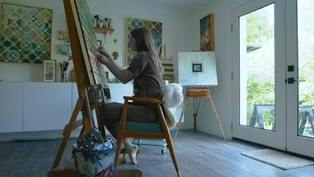
The Governor's Mansion Artist Awards 2022 | Preview
Preview: S2 Ep1 | 30s | Art Elevated: The Governor's Mansion Artist Awards 2022 premieres June 15 at 7PM. (30s)
Providing Support for PBS.org
Learn Moreabout PBS online sponsorship

- Arts and Music
The Best of the Joy of Painting with Bob Ross
A pop icon, Bob Ross offers soothing words of wisdom as he paints captivating landscapes.











Support for PBS provided by:
Art Elevated: The Governor's Mansion Artist Awards is a local public television program presented by PBS Utah
Art Elevated: The Governor's Mansion Artist Awards is made possible in part by Zion's Bank, The Church of Jesus Christ of Latter-day Saints Foundation, The Larry H. & Gail Miller Family Foundation, Thomas A. & Lucile B. Horne Foundation.