
Art Walk, Trains and Bad Plants
Season 4 Episode 8 | 26m 47sVideo has Closed Captions
Explore Boulder City’s artwalk, historic trains, and wildlife habitat restoration in one full day.
Join Outdoor Nevada host John Burke in Boulder City for a day of art, history, and conservation. Explore 65+ public art pieces on the Boulder City Artwalk, visit the Nevada State Railroad Museum, and help remove invasive plants at the Henderson Bird Viewing Preserve with the Nevada Department of Wildlife.
Problems playing video? | Closed Captioning Feedback
Problems playing video? | Closed Captioning Feedback
Outdoor Nevada is a local public television program presented by Vegas PBS
Art Walk, Trains and Bad Plants
Season 4 Episode 8 | 26m 47sVideo has Closed Captions
Join Outdoor Nevada host John Burke in Boulder City for a day of art, history, and conservation. Explore 65+ public art pieces on the Boulder City Artwalk, visit the Nevada State Railroad Museum, and help remove invasive plants at the Henderson Bird Viewing Preserve with the Nevada Department of Wildlife.
Problems playing video? | Closed Captioning Feedback
How to Watch Outdoor Nevada
Outdoor Nevada is available to stream on pbs.org and the free PBS App, available on iPhone, Apple TV, Android TV, Android smartphones, Amazon Fire TV, Amazon Fire Tablet, Roku, Samsung Smart TV, and Vizio.
Providing Support for PBS.org
Learn Moreabout PBS online sponsorshipToday on Outdoor Nevada, I take a walk and soak in some culture in Boulder City and head to the Nevada Railroad Museum to take a peek at some new exhibits.
Then I meet Anthony Miller from the Nevada Department of Wildlife and remove some invasive plants.
All this today on Outdoor Nevada.
♪♪♪ Nevada.
It's an adventure waiting to happen.
Waiting for you.
What do you say, you ready?
Because I am.
♪♪♪ (John Burke) A lot of people know Boulder City, Nevada for its connection to the Hoover Dam.
But you come here and you find some world-class biking, ziplining, lots of great restaurants, things to see and do, and if you love art, this is a place you got to be.
Come on.
Let's go take an art walk.
♪♪♪ The Boulder City Artwalk is a semi-guided walk through downtown.
You can download a map or you can just wander along and take in the works.
There's even an audio element you can take advantage of.
With over 65 sculptures, murals and other pieces, you can walk throughout the town and always be within a stone's throw of a unique creation.
It's a great opportunity to get outdoors, get in some steps and some culture, plus the antiquing, shopping, local eateries and pubs aren't half bad either.
The pieces along the walk been curated over time, and some are from local artists.
I had the opportunity to meet up with one of the artists and was given a personal tour of her work.
Meet the one and only Connie Burnett Ferraro.
Boulder City really is a charming town, isn't it?
-Oh yes, very.
It really is.
-Okay.
This is you.
You painted this?
-Yes.
-That's just incredible.
Connie was a dancer on Broadway, eventually making her way to the picturesque town of Boulder City.
She was the town's first lady and then became a resident artist.
Her murals and work are really eye-pleasing and a comforting reminder of a time past and worth remembering.
I would have the dancers, in between dance numbers, because we had a big period of time, I would get the other dancers and we'd sketch each other and it was fun.
-And it was fun.
Did you find that you were pretty good at it?
-No.
When I first did a face, I just did an oval.
I didn't know what to do next.
You know, you just work at it, work at it, work at it.
-Okay.
So this, I'm guessing the theme of this was the history of-- -Boulder City.
-Of Boulder City.
All right.
Let's start with the gentleman behind you.
-Frank Crow.
-Yes.
Who's he?
-He was the superintendent.
They had a contest that they were putting out for people to come up with the history of Boulder City.
So I said okay, I'll try that.
So there were five people that entered the contest, three of them were children, and I got it.
I got it.
-Okay.
Had you ever painted-- did you know what you were getting into?
-No, no, no.
(laughter) Well, it was for just a poster.
But then they were going to have someone do the mural, and that fell apart.
And I said-- chutzpah, I don't know where that came from-- I said well, I'd be happy to do it.
And they-- unbeknownst to them, I had no idea what I was doing.
-Who are these people?
Because again, the faces... -That's Rag Town.
That's Rag Town down by-- they lived outside in the tents before they built the houses.
They're called "dingbat houses," the ones for the workers, because they thought there's not going to be a city here.
There's not going to be a town because this is all temporary.
So they took maybe 12 days to put it together, and they called them dingbat houses because they were so flimsy and stuff like that.
-That's why.
-Yeah.
But it's better than living in a tent.
-Well, see?
You did your homework.
-I did, I do.
I did my homework.
Connie has an amazing grasp of the story of Boulder City.
In her murals she includes accurate details, people and moments throughout Boulder City's history.
This is her home.
Its story in history is very important to her, and she's also very honest about her personal challenges.
I am afraid of heights.
I have a history of vertigo, and it was so scary up there.
It was horrible.
And I would get a ladder, climb up the ladder, crawl onto two pieces of board that kept moving every time, nothing to hold on to.
So my left hand I painted, and I held on.
I just put my hand against the wall and I felt safe.
-Do you ever look back on that and think, what in the world was I doing?
-Yes.
For the ones even after that, the one over there, I started crying one afternoon.
I was so scared up there.
I was so scared, I just started crying and said what am I doing?
-Did you freehand this?
-Oh yes, that's another thing.
Not knowing how to grid, I didn't know, and then I came to that one big spot up there and it was blank, and I thought oh my gosh, what am I going to do, and I put the mountain sheep in there.
♪♪♪ Connie, another masterpiece.
And this was in 2009?
-I guess so.
-Please tell me that you're happy with this.
I mean, this is unbelievable.
Are you happy with it?
-I see so many things wrong that I could do better.
-So what's in the future for you?
What is your appetite for continuing with art?
What do you think you'll be doing?
-I'd like to do portraits.
I'm done I think climbing up ladders, but you never know.
-But you never know?
-I might get some more chutzpah.
-I have to tell you, Connie, I have so thoroughly enjoyed spending time with you today.
-Oh, so have I.
Thank you.
-I have loved learning about your artistic brain, and you've also given me courage to say yes to something that I probably have no business doing.
-Right on!
-Thanks, Connie.
-Thank you.
-And I want to encourage you to come to Boulder City for yourself.
Maybe you're on the way to the Hoover Dam or you're just coming out here for an afternoon.
When you do, make sure you experience the Boulder City Artwalk.
Come see some of this for yourself.
It'll make your day.
You'll be glad you did it.
♪♪♪ (bell clanging) ♪♪♪ The Nevada State Railroad Museum, Boulder City.
This is a place that is so incredible, so beautiful, so filled with American history.
And you know what?
There's always something new happening, so I'm making a return visit to see the bossman.
(Randy Hees) I love the history, you know, the story.
You know, the objects tell stories.
My name is Randy Hees.
I'm the director of the Nevada State Railroad Museum in Boulder City.
In previous years, trains were all about possibilities.
They were the way you would go somewhere.
They were the way you would get things.
You know, your Christmas catalog from Sears Roebuck would arrive by train.
You know, the things that you wanted out of that catalog would arrive by train.
If you were going to go somewhere, you would go by train, and then gradually cars took away some of that business and trucks took away some of that business.
But trains were still in our everyday life; probably the 1960s was that moment when we ended most passenger service and we closed down depots.
And now trains are something of an inconvenience when the gates come down and you get to count boxcars going by.
Las Vegas was 250 people before the railroad came, and when the railroad came, it brought 400 employees to be stationed in Las Vegas.
They had to build a city to be Las Vegas.
They built houses and one of the amazing things, when they built the houses in 1908, they had indoor plumbing and electricity at a time when less than 10% of American homes did.
So it comes into your life, you know, it isn't just the train tracks, but here's the railroad bringing you water and electricity and modern principles and jobs that pay money.
The railroads built America.
Randy's passion and knowledge translates into an incredible museum experience.
The collection of locomotives and railcars will transport you to a time past.
Some of these exhibits carry a significant amount of history, specifically to Nevada.
Randy's especially proud of this amazing piece of history.
-This is called a forty-and-eight or a Merci car.
So this is just a French boxcar, but it has a Nevada history.
This car during World War I would have taken the doughboys to the front and it would have been just a regular boxcar.
And then during World War II, it would have taken prisoners of war to prison camps or potentially Jews to be executed.
But after the war, the magic happens.
After the war, the U.S. put together a relief train, and they put together this train of 800-- or 600 boxcars full of relief supplies.
It started in Los Angeles and Seattle and San Francisco, shows up in New York.
They're put on a ship, and they're distributed all over Europe.
A French railway worker, seeing this, decides a year later things are getting a little better.
He gathered 49 of these cars, had them painted, decorated with symbols of the French provinces, filled with gifts for Americans, one for each state, and there were only 48 states at the time, and one to be shared by Hawaii and Washington D.C.
This is the French car.
-This is the Merci.
This is the gratitude car.
-It's a thank you car.
Yeah, so we're really pleased.
It was restored by our sister museum in Carson City, and now it's here for now.
-And real quick, just tell me about the individual insignias here.
-So these are the insignias of the old French provinces, so these are actually-- they were renamed after the French Revolution-- but all of the various places in France.
Bearn is near Switzerland.
We've got-- Orleans, Compte du Foix.
So literally-- and there on the other side, it tells you about all the places in France, all the places that contributed to the gifts in the car.
-That just proves the point that what it looks like is a beautiful boxcar, but it really is American history.
I mean, that's an incredible story.
-Well, one of the things museums do is they take objects and they tell stories, and this one has such a great story.
-Such a great story.
Yes, you've really added some things to the museum here.
I'm really impressed.
-There's another car you might want to see, but it's not here.
It's down in our shop building where all the good stuff happens.
Would you like me to take you down there?
-Did you just ask me that?
-Yeah.
-Let's go.
♪♪♪ Randy, you have been busy.
There's a lot going on here.
What about this baby right here?
-So this one's particularly special.
It's a private car.
So before somebody had their own 767, you had a private railroad car, and this was considered to be the most elegant private car at the time it was built in 1899.
-1899?
-It was built by the Wagner Palace Car Company.
-Now, first off, the thing is huge.
To be a private car is just-- -It's 85 feet long.
-Unbelievable.
Well, the detail inside-- and I know you're still working on this-- but man, it's a thing of beauty.
Tell me about some of this.
-One of the things is this car was never painted inside.
So many of these cars, the interior was butchered and this one wasn't.
The first room, the observation room, is English oak.
The next bedroom is primavera.
The dining room is mahogany.
The third bedroom is bay laurel.
It has a bedroom for the hired help.
It has a kitchen.
The dining room could seat twelve.
This was luxury.
But it was donated to us in 2016, so we're now starting the rehabilitation.
-Well, you know, you said it was luxury.
I would still ride across the country in this.
Wouldn't you?
-Yes, and it rolls.
It works.
I mean, this is not a restoration, this is a rehabilitation.
The interior is getting-- -And yes, explain the difference.
-Actually, we use the Secretary of Interior Standards for Historic Preservation.
So under that if you take a piece of wood off and replace it with the same kind of wood, you're repairing, which is rehabilitating.
But if you try to bring something back, if you have to add a new porch because the porch was torn off your house, that's restoration.
So this car doesn't need restoration.
It needs rehabilitation.
-What else needs to be done with this, and how long will this restoration take?
-So we're hoping that this primary phase is less than a year.
-Less than a year.
-Less than a year.
We'll re-side the car, letterboard, paint the car, and we'll continue-- the cleaning will probably take years, but we'll have the public in while we're doing it.
It was one of the things-- we don't like to make it beautiful and then put it out.
We believe the public likes to see it while it's happening.
But this car has also another interesting story.
-Tell me.
-Well, we found this picture from a Chicago newspaper taken in 1917.
So here's this car, and there is Teddy Roosevelt.
-Holy cow!
-At the time Taft would have been president, but here's Teddy Roosevelt using this car.
-This is too good.
This is too good.
I got to recreate this.
Teddy Roosevelt was right here.
-Right there.
-Vote for me, will you please.
-Bull Moose Party.
-I promise cold beer and free pizza for everybody.
Whatever it takes.
This is an absolute thing of beauty.
How satisfying is it to you to see it go from point A to point B, to really come back to life?
What does it feel like?
-It's probably the part of my job I love best, doing the planning, the historic research and working with the volunteers who are rebuilding and actually doing the work.
We have a group of about eight volunteers actively working on this car.
-I can see where the passion comes from and I can see the look in your eye, and I think I get it.
Do you have more going on here?
-We actually do.
We have another new car out back.
It's not near as pretty as these, but it might be more historic.
-Well, you know, if you need somebody to help out around here... -We might find something for you to do.
-Come on, let's go.
I want to get my hands dirty.
♪♪♪ Well, what do we have here?
-So right here are two of our most important artifacts.
They aren't the prettiest, but they're working pieces of equipment and what makes them so special is both of them were right here in Boulder City.
-Tell me about that.
-Well, the dump car-- -That's this one down here?
-Yes.
It was owned by six companies and was used to carry the sand and gravel to build Hoover Dam.
-No kidding.
-Yes.
So there were 57 of those operating literally 24 hours a day for four years.
-Where did you find these?
-We found this one in Fremont, California in a railroad museum.
It had been sold to a railroad as a piece of work equipment, and they'd collected it out of a junkyard after they threw it away.
They gave it to us.
-That's amazing.
So this actually helped build the Hoover Dam.
-Absolutely.
So it just arrived.
We've been cutting pieces off it, straightening them, starting to put them back together.
It'll get a coat of glossy paint and six companies in big block letters, and literally be one of our most important artifacts.
-This is wood, the original wood.
-Yes, 1927.
-Where are you ever going to see this stuff?
-Yes, but this is here.
This is a piece of the true cross for this place.
-Randy, you know me, buddy.
I'm here to help.
Is there anything I can do?
We'll get to that in a sec.
Now, this piece... -Oh, you want to talk about this piece.
-I want to talk about this piece.
So when they finished the dam, six companies moved out but there was still a track to the top of the dam, and they needed a locomotive.
So the Bureau of Reclamation bought this one in 1936.
It's a 30-ton gasoline locomotive.
It has a four-speed transmission and a clutch.
If you've hiked the Tunnel Trail down by the dam, this is the locomotive that ran through the tunnels.
-That's incredible.
-These two pieces, they're not the prettiest, but they absolutely are the most important about this place.
-I totally get that because without these guys, this place doesn't exist.
-Yes.
-Wow.
Well, how can I help you?
-Oh, let me show you.
And that's how the day wrapped up.
I learned about international cooperation and appreciation, luxury from a time past, and how the foundation of Southern Nevada was built, all involving trains.
The Railroad Museum in Boulder City, make sure you visit.
Make sure you say hi to Randy.
Hey, if you're lucky, he might even put you to work.
-Looking good!
♪♪♪ I have somebody I want you to meet.
It's my new best friend, Anthony Miller, from the Nevada Department of Wildlife.
Anthony, come on in, sir, nice seeing you.
-Hi, John, good to see you.
-How's everything?
-Good.
-Now, you guys are very active in this space here, right?
What is it you guys do?
(Anthony Miller) We are.
Well, what the Nevada Department of Wildlife does is we manage and protect, and not only manage and protect, but restore wildlife and its habitat.
So what we're doing here is we're restoring.
It's important to know that part of the restoration project involves removing invasive plants such as the salt cedar behind us here, or tamarus.
It's important to know also that it's good to bring in native plants that replace those.
-All right.
So we're going to be fixing nature here today, and I'm at your service.
What's the first thing we got to do?
-Well, the first thing we have to do is remove that tamarus, or salt cedar.
-Let's go take a look at it.
When you say "tamarus," now what I see is something that is not like the other ones.
Is that this one?
-That's this one with the pink flowers on it.
It has really deep tap roots, and it uses a lot of water.
It's a waterhog.
It's called a phreatophyte, means water-loving, tree.
It's a deciduous tree that drops its leaves, and these leaves are very salty.
So as it drops its leaves, it kills everything else around it and outcompetes the native vegetation.
-Interesting.
Well, free labor.
What do I got to do to help you, Anthony?
-Well, one of the ways we call mechanical removal is with chainsaws, and this is a small enough one today I think we can just use a handsaw.
So I've got a couple different handsaws here.
You can pick your weapon.
-I need the left-handed one.
-Okay, this one's for both.
So be careful, it's sharp.
-All I got to do is go in and cut it down, right?
-I just would grab it and just saw on it and it should just cut right off.
One of my challenges with the project here at the Henderson Bird Viewing Preserve is removing these.
-And then what you do is you replace these with native plants that are friendlier to the environment.
-We do, yes.
The native plants here like the willows next to us or this desert broom, they all have flowers and the coverage you need for wildlife.
There's some bees flying around here for pollinators and then cover for birds, seeds for birds.
-Well, you don't just destroy things, you like to plant new ones, right?
-Yes.
-Is that our next step?
-It is.
-All right, what do we got to do?
-Well, this plant right here is a willow.
It's a coyote willow, and believe it or not, this tree can get up to almost 100 feet tall.
If you look behind us, there's some trees on those islands over there that are the same species.
So the idea is to plant this and then it will slowly take over the area and out-compete the invasive tamarus.
So these trees we have grown locally here by the Nevada Division of Forestry.
They grow plants for me that I bring on my projects, so they're high-quality habitat for wildlife.
-Okay.
So what do we do, just dig a hole?
-We're going to dig a hole.
We brought some...
So that's what we did-- well, that's what I did.
I dug a hole and planted a willow tree.
This is what I love about Outdoor Nevada.
I get to meet the people who keep the Nevada environment healthy and thriving, guys like Anthony.
They have a true love for what they do, and more importantly, they do it for all of us.
Okay, that was pretty easy.
What about the care and feeding of this?
What happens next?
-What we like to do is first and foremost, we need to protect the plant from herbivores, and herbivores are plant-eating animals.
There's a lot of desert cottontail rabbits out here that would love to munch on this.
It's just like popcorn to them.
It's almost like they can tell it's fresh.
I've caught birds picking at them.
I actually caught a coyote one time chewing on one.
So we fabricated plant cages that we put over these to protect them, and I'm going to have you install one to do it.
-Let's do this.
If we're going to do this, let's do it right.
How long do you have to keep the cage on it?
-You know, I keep it on anywhere from a year to two years.
It just depends.
Some of the plants grow really fast.
Just go ahead and slip that over the top.
-This is just basic wire that you add fasteners to.
-Hardware cloth is what I found to be the most effective because it has smaller quarter-inch holes where even really small rodents can't get through and chew on it.
And then to secure it we use rebar, and we just put them on the outside here.
-And drive them in?
-And just drive it in with a hammer.
-Just making enemies of rabbits everywhere.
So this stays for about a year.
-About a year, until the plants-- some of these plants are just bursting at the seams and we've got to take them out, so it really does help.
Without it, you never know.
You might come back the next day and you've just got a stick left.
-And are you worried about watering these?
Because there's so much water here.
-Yes.
You know, the soil is really moist here and we're really close.
Normally if I was out in the desert farther away, higher and drier, we would put water on it.
But usually I'll come back later and water these.
-I'm curious because I know you're a guy that's outdoors all the time.
You're hiking on your days off.
What does this place mean to you, and what do you think it means to the community?
-You know, it's just a real oasis in the desert in a Southwestern desert city.
It's just a place where people can come and enjoy wildlife.
It's a real sanctuary, it really is, in the middle of the city.
-Well, I hope that when people come here for free and enjoy this, if they see you riding around doing work like this, they stop and say hi and say thanks for everything that you're doing, because that's how I feel.
-Well, thank you.
I appreciate it.
♪♪♪ Support for Outdoor Nevada comes from Jaguar Land Rover Las Vegas.
♪♪♪ Inspiring the spirit of adventure with confidence in any terrain or condition.
We're proud to help introduce a new generation of adventurers to the diverse experiences that our state has to offer.
Information at jlrlv.com.
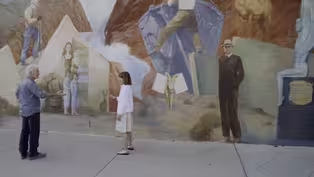
Boulder City Art Walk: Murals, Sculptures, and Small-Town Charm
Video has Closed Captions
Clip: S4 Ep8 | 6m 36s | Explore 65+ sculptures and murals on Boulder City's vibrant self-guided Art Walk. (6m 36s)
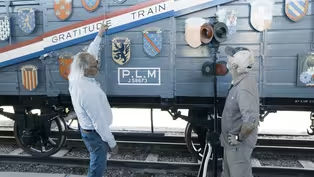
Exploring Train History at the Nevada State Railroad Museum, Boulder City
Video has Closed Captions
Clip: S4 Ep8 | 11m 21s | Explore historic trains in Boulder City, including Roosevelt’s private 1899 railcar. (11m 21s)
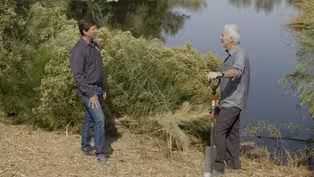
Habitat Conservation & Protecting Ecosystems with the Nevada Department of Wildlife
Video has Closed Captions
Clip: S4 Ep8 | 6m 13s | See how native habitats are restored and protected at the Henderson Bird Viewing Preserve. (6m 13s)
Providing Support for PBS.org
Learn Moreabout PBS online sponsorship












Support for PBS provided by:
Outdoor Nevada is a local public television program presented by Vegas PBS