Art With a Purpose | Carolina Impact
Clip: Season 13 Episode 1313 | 4m 32sVideo has Closed Captions
A local artist remembers victims of the Holocaust through his work.
January 27th is International Holocaust Remembrance Day, commemorating the victims of the Holocaust and marking the liberation of Auschwitz. We share a story about a Davidson sculpture artist that’s dedicated his career to making art that honors and keeps alive memories that shouldn’t be forgotten.
Problems playing video? | Closed Captioning Feedback
Problems playing video? | Closed Captioning Feedback
Carolina Impact is a local public television program presented by PBS Charlotte
Art With a Purpose | Carolina Impact
Clip: Season 13 Episode 1313 | 4m 32sVideo has Closed Captions
January 27th is International Holocaust Remembrance Day, commemorating the victims of the Holocaust and marking the liberation of Auschwitz. We share a story about a Davidson sculpture artist that’s dedicated his career to making art that honors and keeps alive memories that shouldn’t be forgotten.
Problems playing video? | Closed Captioning Feedback
How to Watch Carolina Impact
Carolina Impact is available to stream on pbs.org and the free PBS App, available on iPhone, Apple TV, Android TV, Android smartphones, Amazon Fire TV, Amazon Fire Tablet, Roku, Samsung Smart TV, and Vizio.

Introducing PBS Charlotte Passport
Now you can stream more of your favorite PBS shows including Masterpiece, NOVA, Nature, Great British Baking Show and many more — online and in the PBS Video app.Providing Support for PBS.org
Learn Moreabout PBS online sponsorship- Well, while higher education prepares students for the future, remembrance teaches us why the past still matters.
January 27th is International Holocaust Remembrance Day, commemorating the victims of the Holocaust and marking the liberation of Auschwitz.
Tonight videographer Doug Stacker shares a story about a Davidson sculpture artist that's dedicated his career to making art that honors and keeps alive memories that shouldn't be forgotten.
- At the age of 75, I still can't comprehend it.
This manmade industrial extermination of 6 million people.
(somber violin music) Okay, my name is Roy Strassberg.
I'm an artist who works in clay, otherwise known as a ceramist or ceramic sculptor.
Vessel maker.
My work is a reflection of my interest in the Holocaust.
I grew up in New York City in the 1950s.
My recollection of my childhood is that I'd experienced a certain kind of ethnicity and culture extremely vividly.
My father and I switched on a television show.
It was called "Remember Us," and it was black and white videos of the concentration camps.
Now I had grown up in a family that was very protective, so I had never seen anything like this.
It created a lifelong interest on my part for the history of our people.
(tape ripping) (energetic violin music) I transformed the work I was doing from kind of a decorative postmodern sculpture and started working on pieces that were reflective of my interest in the Holocaust.
That transition was extremely powerful for me, and I never turned back.
I never looked back, to go back to the work that I had been known for.
And that was a big sacrifice.
I gave up a part of my career that was really meaningful to me in order to focus on something that was even more meaningful.
(energetic violin music) My job as an artist is to reconcile the disparate components that going to make up the entirety of the object I'm working on.
How does this look placed here?
Where should I put this letter?
Where should I put this number?
Where should I put this large fragment that's attached to the form that might represent brokenness?
Most of the surface imagery in my pieces are derived from aerial photographs and blueprints of the killing sites.
I often use numeration in my work, what I call the generic concentration camp number, 0123.
But there's another number I use, 845.
The number of Strassbergs that are contained within a Yad Vashem database of Strassbergs who were murdered in the Holocaust.
That number has very personal significance to me.
- [Vintage Narrator] Auschwitz, a place of unequal horror.
4 million died here in the gas chamber.
The crematory chimneys belched their black smoke.
- I had an Aunt Ceil who had concentration camp numbers on her arm.
The survivors, there are very few left, most of them are gone.
There's an irony of me using a gas kiln to fire my work.
(gentle piano music) People have oftentimes referred to my work as beautiful and then apologized immediately.
The apology is completely unnecessary.
It means I've done my job because it's drawing that viewer in and perhaps allowing them to see the subject more clearly than they otherwise would have.
I've probably made over a thousand pieces.
Someone has to commemorate, memorialize this event, so that in future generations people will understand what happened so it's not repeated.
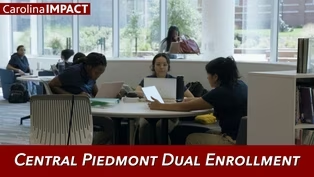
Central Piedmont Dual Enrollment | Carolina Impact
Video has Closed Captions
Clip: S13 Ep1313 | 7m 21s | Central Piedmont's Dual Enrollment allows students to take college classes for free. (7m 21s)
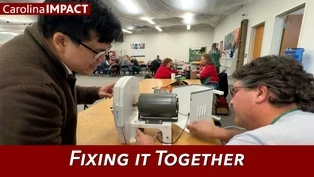
Fixing it Together | Carolina Impact
Video has Closed Captions
Clip: S13 Ep1313 | 4m 36s | A community Repair Café fixes everyday items and shares skills that reduce waste. (4m 36s)

January 27, 2026 Preview | Carolina Impact
Preview: S13 Ep1313 | 30s | Central Piedmont Dual Enrollment; Art With a Purpose; Fixing it Together; & Legacy Through a Lens (30s)
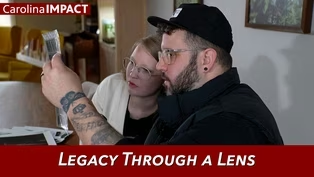
Legacy Through a Lens | Carolina Impact
Video has Closed Captions
Clip: S13 Ep1313 | 5m 30s | A local photographer uses a vintage picture processing method to preserve the past. (5m 30s)
Providing Support for PBS.org
Learn Moreabout PBS online sponsorship
- News and Public Affairs

Top journalists deliver compelling original analysis of the hour's headlines.

- News and Public Affairs

FRONTLINE is investigative journalism that questions, explains and changes our world.












Support for PBS provided by:
Carolina Impact is a local public television program presented by PBS Charlotte