
Artists and Musicians in Detroit with a Message
Season 6 Episode 10 | 26m 46sVideo has Closed Captions
Artists and Musicians in Detroit with a Message | Episode 610
One Detroit presents 'Best Of: Artists and Musicians with a Message,' featuring conversations with Detroit contemporary artist Tylonn Sawyer, Musical nonprofit Common Chords Co-Founders Rev. Robert Jones Sr. and Matt Matroba, and Detroit Opera Artist-in-Residence Davóne Tines. Episode 610
Problems playing video? | Closed Captioning Feedback
Problems playing video? | Closed Captioning Feedback
One Detroit is a local public television program presented by Detroit PBS
Artists and Musicians in Detroit with a Message
Season 6 Episode 10 | 26m 46sVideo has Closed Captions
One Detroit presents 'Best Of: Artists and Musicians with a Message,' featuring conversations with Detroit contemporary artist Tylonn Sawyer, Musical nonprofit Common Chords Co-Founders Rev. Robert Jones Sr. and Matt Matroba, and Detroit Opera Artist-in-Residence Davóne Tines. Episode 610
Problems playing video? | Closed Captioning Feedback
How to Watch One Detroit
One Detroit is available to stream on pbs.org and the free PBS App, available on iPhone, Apple TV, Android TV, Android smartphones, Amazon Fire TV, Amazon Fire Tablet, Roku, Samsung Smart TV, and Vizio.
Providing Support for PBS.org
Learn Moreabout PBS online sponsorship- [Narrator] Just ahead on One Detroit, a look at some of the interesting people we've met in the fields of music and art.
We'll talk with a Detroit artist whose paintings center around contemporary issues.
Plus, we'll introduce you to the acclaimed African American classical singer serving as the artist in residence at the Detroit Opera.
And we'll catch up with two musicians who teamed up to create a non profit that uses music to bring people together.
It's all coming up next on One Detroit.
- [Narrator] From Delta faucets to Behr paint, MASCO Corporation is proud to deliver products that enhance the way consumers all over the world experience and enjoy their living spaces.
MASCO.
Serving Michigan communities since 1929.
- [Narrator] Support for this program is provided by: The Cynthia & Edsel Ford Fund for Journalism at Detroit Public TV.
The Kresge Foundation.
- [Announcer] The DTE foundation is a proud sponsor of Detroit Public TV.
Among the state's largest foundations committed to Michigan-focused giving.
We support organizations that are doing exceptional work in our state.
Visit DTEFoundation.com to learn more.
- [Narrator] Business Leaders for Michigan.
Dedicated to making Michigan a top 10 state for jobs, personal income, and a healthy economy.
Nissan Foundation.
And viewers like you.
(calm music) - [Narrator] On this week's One Detroit, we're bringing you some of the fascinating conversations we've had with people in the arts.
Coming up, he's been called one of the most powerful voices of our time.
And he's taking on the role of Malcolm X at the Detroit Opera, formerly known as the Michigan Opera Theater, in May.
American Black Journal talks with award-winning bass-baritone Davone Tines.
Plus we'll take a look at the friendship that sparked the creation of a non-profit organization, focused on bringing together diverse groups of people with music as the common denominator.
But first up, Detroit artist Tylonn Sawyer tackles modern day issues that impact African Americans in his works.
One Detroit talks with Sawyer about the inspiration behind his paintings and the audience he's trying to reach.
(calm music) - So, Tylonn, the themes of your work delve into the cross sections of race, politics, identity.
When you create this work, who is it for?
And what do you hope that they get out of it?
- I guess you could specifically say like white people, but that's not necessarily the case because I consider myself American.
And when I refer to like the founding fathers, I notice that I put our in front of it, right?
So like, obviously that's a type of ownership that I take on.
Some other people may not, but even, I would say, I bet you if they're American, somehow, subconsciously, they still maybe think that way.
And so creating works like that, similarly that to most things that I do, I think that it's about getting the viewer to engage with our history, and even recent history, in a more thoughtful way than just a romanticized way that we become accustomed to it, you know?
I hope that my art does sort of influences younger people or people to think a much more nuanced way about these problems.
'Cause we have heavy handed problems, but they're so intricate.
It's hard to just say, do this and this will fix that.
Defund the police, that's going, that's what's gonna stop all of the, you know?
- [Will] Yeah, yeah.
- Like I get where it comes from, but I mean, it's such a complicated problem, you know?
Like you can't just use, like something that needs a scalpel, you come in with a sledge hammer or something like that.
Like that's, unfortunately, that's the way I think that how we've gotten to where we are socially in this country.
And so a lot of my work kind of deals with that.
Like you mentioned that painting, A Gentle Reminder, and it's a black power fist with butterflies on it, but instead of the monarch designs, it's a Confederate flag.
And butterflies are metaphor for reincarnation in certain Eastern religions.
And so racism kind of similarly reincarnates itself in a different way.
It's not that good old boy, mass lynching, pickup truck, or like angry like Southern Confederate sort of thing now.
Now, it takes place subtly in boardrooms, it's policies that disproportionately affect people of color.
It's the way that we may not see people who look like us on television shows.
When we do see folks that look like us on television shows, it's a script written by a person who never lived our life.
So when we hear the dialogue, there's a disconnect from like who I am versus like, who they're presenting on television.
And so, yeah, when I, and on my work, I try to pay attention to like those little subtleties, the little things that are causing these bigger problems, you know, like 'cause a lot of times that's what it is.
It's just a bunch of little things that compound themselves into these big mass problems.
- So as an artist with a resume like yours, what advice do you give to artists who, you know, want something similar for themselves?
- Usually it's young people and I would say, you have to have hard work and you have to have passion.
Like all these things have to kind of coalesce at the same time.
Like my work is heavily research driven.
My paintings are very laborious.
I spend a lot of time working on them.
Sometimes it happens quick, but that isn't the case the majority of the time.
Like I say, how many books I have to read, the networking aspect of it.
It's a lot of hard work, it exhausts you.
And sometimes you have to be pushed and you have to push yourself 'cause no one else is gonna do it.
We live in a time where a big chunk of the messaging to younger people about safe spaces, take your time, you know, like your anxiety, like take care of yourself, your anxiety, self care, you should have been doing.
You should, yes, you should take care of yourself, but all humans have anxiety.
I don't know.
I have a lot of anxiety right now.
Just from teaching and my job and I can imagine what you do.
Like this is just a part of the human condition.
And I've often, I don't know, like from what I see, the narrative seems to make these aspects, which are the tribulations, but they are average parts of the human condition.
And they're given like the special credence to stop people from putting their best foot forward.
I do think that you should address those issues via therapy or whatever it takes, what is considered self help, self care.
But simultaneously man, I get in the studio and I work.
Like I come from a blue collar family who went, you know, they go to work every day to take care of their families, their homes.
And so I have to go to work every day.
Rather I'm teaching, when I'm not teaching, I need to be in the studio doing the same thing with that type of ethic.
Yes, it's a lot of hard work and I am drained at the end of the day.
But man, what a labor of love.
What great problems to have to be exhausted from painting rather than filling out TPS reports in a office.
And I made a very conscious decision to change my life to what it is now and be an artist and be an educator.
And I'm a thousand times happier.
(calm music) - So it's exciting to have you here with us in Detroit, as a artist in residence at the Michigan Opera Theater, tell us what that means and what you'll be experiencing while you do that.
- Completely.
It's a role I'm really excited to take on.
And part of that has to do with the fact that I was invited into a conversation about how to create that role.
And it all began with accepting a different role as Malcolm X in X: The Life and Times of Malcolm X by Anthony Davis and Thulani Davis.
And I was deeply excited to, you know, start on the journey of what it means to portray that figure in this city particularly.
And then it made me think, well, what does that actually mean?
What does it mean for me, someone who grew up in Virginia, but also travels around the world singing opera to come here and portray a very Detroit person.
I didn't want to just show up and put on some sort of show without having a larger understanding and connection to the lives and the communities and the histories here.
So I wanted to make it a really critical point of this residency to be about meeting people in the Detroit area from many, many different walks of lives, from many different modes of working, creative and otherwise, in order to see what it meant for MOT, Michigan Opera Theatre, to interact with the larger Detroit community over time to build real relationships so that when we do this show, there's actually a community connection to what's happening.
- Malcolm X set to opera.
Right there, that's a provocative statement.
Tell us what that's been like pulling this all together.
- Completely.
So the incredible Anthony Davis, Pulitzer prize-winning composer, and actually his cousin and common collaborator Thulani Davis, I think that they have made a really unique mark in opera in telling black stories.
Anthony Davis won the Pulitzer for his opera, The Central Park Five, and just tackling a number of critical stories in that form.
And as I was saying, I think what that form brings is attention and scale.
So a character like Malcolm X deserves that attention and that scale.
And I think the way that they've worked out how this piece exists does that in an incredible and special way.
Anthony writes in a jazz idiom, essentially, but you know, co-mingled with classical, which some people would say are, you know, different branches of the same tree.
But I think it's gonna be really incredible for audiences to experience.
What does it mean when you take a full symphonic orchestra with a jazz quartet or jazz ensemble embedded in the middle, and have that kind of expression blasted to that scale?
All with the purpose of saying, you know, this man's life and furthermore, his mission are even beyond the scale of the resources we have available.
- Yeah.
Yeah.
And for you personally, playing this role, talk about how that feels.
- Completely.
I continue to find that, you know, being a performing artist is a deep blessing and a privilege.
In order to live out on stage emotions and ways of being that don't necessarily exist or that I wouldn't have the opportunity or venue to express otherwise.
And being a black man in America, being a black person or marginalized identity in this country, as James Baldwin says, could fill someone with a sort of madness.
And taking on this role, you know, it allows a place to put all of that energy, not to say that Malcolm X is mad, but I think he's often misconstrued as a person who had ill intent or malice.
And one thing I continue to deeply respect in looking into his life and his work was that I think he really just aimed to be a mirror.
He aimed to be a reflecting point of the world and of the time that he lived in, you know?
The first aria in the opera, titled You Want the Truth, But You Don't Want to Know, talks about how his family and he had been through so much degradation at the hands of white people, his father being killed, his mother not being able to collect insurance on that hate crime of a death.
And later being, you know, driven to her own madness and his family being disassembled by a white system that didn't have space for their particular quote unquote problems.
All of what he did was motivated as a reaction, as a reflection of the energy put towards him.
So he said, you know, if my life had been torn asunder at these forces, why shouldn't I have access to those same forces in order to save or continue my life?
But even more altruistically, the lives of my people.
- You know, the relationship between Detroiters and the arts has always been really strong.
And of course we've produced lots of great art in many different forms here in Detroit.
I'm not sure everybody thinks of classical music or opera, though, when they think about that.
I imagine you would like to change that.
- Completely, something I've been really, really interested in for a long time is trying to figure out what is opera really, or what is the greater potential of opera?
And I think part of that has to deal with going back to a deeper root of what opera was.
and it has to deal with, you know, the word opera in Italian means work.
And a part of that definition has to deal with, how can you bring together different mediums, different aesthetics, whether that's in orchestra or lighting or the grandiosity of a theater to work, to focus on telling a story?
So opera is, in essence, a really incredible way to tell a story.
And often the stories that people know from opera are not something that people can really connect to.
You know, maybe it's in German, maybe it's telling the story of people that one doesn't see themselves in.
So I'm trying to make it a priority for people to understand that opera is anything with intentional storytelling.
And I think, especially with this piece, X, it's an opportunity to put a story that isn't normally engaged, a story that I think many people today, especially black people, can connect to and saying, this is opera too.
This deserves those resources.
This deserves that sort of consideration.
And so I think a way to save or redefine opera is to change what stories and what people are in the middle of it.
- In addition, of course, there are not as many African Americans who work in the classical music space or in the operatic space as we'd like.
But tell us how you became interested in this and decided that this is how you wanted to spend your life and express your art.
- Definitely, well, I grew up in Northern Virginia and singing in the Baptist church there.
My grandfather was a church choir director, but also in the Navy for a long time.
And he discovered that I had a unique voice.
One day, he sang kind of jokingly, how are you?
And I said, I am fine.
And he thought, oh whoa, you have something else going on there.
And I didn't think that I wanted to sing or had anything to do with it, you know, in a professional way.
But he really encouraged me to figure out, you know, what is classical singer?
What is a way of training my voice in order to communicate something?
And then I also played violin for about 14 years and also sang in a lot of different church contexts, be it the Baptist church or the Greek Orthodox church, or even the Catholic shrine in Washington DC.
And what I respond to, I think, most in music making is when it's done for a reason.
And in the church, music is always made for a reason.
It's in order to connect to our human and lived experience.
So walking into an operatic context or the classical music world, I never fully saw it for what those stories were or what the content was, I saw it for its possibility.
I saw, you know, what is it, if we can take an orchestra and put it with gospel, as people like Kirk Franklin have so brilliantly done.
Or what is it, if we take, you know, the grandiosity of the theater and pay homage to stories that we just don't lift up as a society?
So I've always been trying to engage it for the tools.
And I think that also has to deal with a larger tradition of black people in America taking what's available to us in order to get along and do what we need to do and what we need to do right now, I think, is tell stories that are going to change perspective on how we exist.
(gentle piano music) ♪ Where there is darkness ♪ ♪ We'll bring light ♪ ♪ Where there is darkness ♪ ♪ We'll bring light ♪ ♪ Where there is darkness ♪ (calm music) ♪ Well, this little light of mine ♪ ♪ I'm gonna let it shine ♪ ♪ Lord, this little light of mine ♪ - [Robert] Maybe the main underlying message of Common Chords is that we want to tear down the things that separate us.
♪ I'm gonna let it shine ♪ ♪ Let it shine, let it shine, let it shine, ♪ - We're more separate than ever coming out of George Floyd, coming out of the election, coming out of the pandemic.
And so there's so little communication that we often talk about, okay, what is the one thing that we see that people don't have pushback?
Among those things is art, music, and stories.
Through your music and your art, I can experience your humanity.
♪ Oh, tell me what I say.
♪ ♪ Tell me what I say, tell me what I say ♪ ♪ Tell what I say, tell me what I say ♪ ♪ Tell me what I say, oh, I think we should do that again.
♪ - Common Chords did not spring out of nothing.
it sprang of 30 years of traveling around the country with my best friend, reminding people that there are more things to celebrate than there are to fight about.
- So we have this friendship and, you know, it's just our friendship, but then we start to see that there are people who can't get past their differences, who cannot communicate unless they are carbon copies of each other.
And I think we started to realize that the same love of shared values that made us friends were applicable to other situations in the society.
- One of the things we started to notice about the work we did as a duo was the stories we told, the educational aspects of the stuff we did, turned out to be the thing that actually makes us unique.
- With bluegrass, you had a guitar player by the name of Lester Flat and Lester used to play something called the G run.
Mr. Watroba, would you demonstrate the G run?
- Every bluegrass guitar player at the end of the phase, would go.
- [Robert] Oh, that's pretty.
Would you do that again?
Now you notice, - So basically when we decided to actually formalize it into like a nonprofit organization, the idea was to take what we've already done over three decades and put it into words and make an organization around it.
- So part of the idea of art and storytelling and songwriting is that I can put my story into that song.
You experience a song, you learn more about me, I learn more about you, and then we can have a conversation.
So this song is for my great-grandfather.
His name was Will Cunningham.
(soft guitar music) Conecuh County, Alabama, 1925.
Will Cunningham rode into town to get his week's supplies.
Now Will was a black man who'd fought in World War I.
And he'd face the smoking powder, but he never chose to run.
- You know, when it comes to choosing songs for the performance, sometimes we don't even do full songs.
We'll just do snippets of songs that are examples.
We use the metaphor of a tree.
So we'll say, imagine this big tree out in the middle of the forest and on this tree are all these different branches.
And each branch is a different kind of American music.
New branches off that tree seem to pop off every time people from diverse places share their music with each other.
- So we get a guy by the name of Son House who's down in Comal county, Mississippi, and he's doing a song called Death Letter Blues.
It's like, (bluesy guitar music) ♪ I got a letter this morning.
♪ ♪ How do you reckon it read?
♪ ♪ Said, hurry, hurry, 'cause the gal you love is dead ♪ ♪ Got a letter this morning.
♪ ♪ Oh, lord, I reckon read ♪ - Rap is old, rap goes back to slavery time.
Then it came up through gospel, people literally rapping.
And then jazz is called scatting.
So Matt and I can show you that this stuff has a 200 year old plus foundation that's based in the idea of using the rhythmic word.
And that's just one genre that you can do that with.
♪ You know, I packed up my suitcase ♪ ♪ Took up down the road ♪ ♪ When I got there, she was laying out on the cooling board ♪ ♪ I inch up closer and I look down in her face ♪ ♪ I say, hey, you know, I love you ♪ ♪ But I just can't take your place ♪ ♪ You see, like 10,000 was standing round ♪ ♪ the funeral ground ♪ ♪ I didn't know how much I love her ♪ ♪ 'til he put the paper in the ground ♪ ♪ And then I walked away and said, hey, you know what?
♪ ♪ Love, you have to see your judgment day ♪ ♪ You know, I woke up this morning ♪ ♪ It was about the break of day ♪ ♪ I was huggin' on the pillow where my baby used to lay ♪ ♪ And no, I went to church, bowed down, I tried to pray ♪ ♪ But the blues come along and they blow my spirit away ♪ - And for me that message boils down to this idea that if it wasn't for the sharing of different cultures in our country, we wouldn't have the music we have.
And I think we hone that down into a presentation that has the ability to really have people leave a little different than they were when they got there.
- Hopefully when you leave, you start to think about how many things that I thought were set in stone are now fluid.
- One of the things I got really excited about is this idea of not just saying, we hope that this fosters conversation, but we'll facilitate the conversation.
And what is it that drives fear?
It's the unknown, you know?
If it wasn't for us meeting, we would've never probably had the courage to do it under any other circumstance.
So I think one thing we can all do in honor of Dr. Martin Luther King is to step out of that comfort zone.
- One of the ideas is to get to the point to teach perhaps like-minded younger artists that the music is a tool for change and that sort of coming off of that seed, we end up growing a garden that everybody can enjoy.
♪ Could you love me if I don't look like you?
♪ ♪ Is it deeper?
Is it stronger?
♪ ♪ Something hidden, something true ♪ - Use the music for healing.
Use the music for social change.
Use the music to tell a great story, to create bridges between communities.
- Everything Common Chords does will always have that idea is how can we bring diverse people together to get to know each other, to hear each other's stories, to sing each other's songs.
- Common Chords doesn't solve all of those problems, but hopefully it causes us to question our answers to the point where maybe that little germ of a song or that story or that concert causes us to rethink some other things and reorder some things in our world.
♪ Oh, deep in my heart ♪ ♪ I do believe that we shall overcome someday ♪ - [Narrator] That will do it for this week's One Detroit.
Thanks for joining us.
Make sure to come back for One Detroit Arts and Culture on Mondays at 7:30 PM.
Head to the One Detroit website for all the stories we're working on.
Follow us on social media and sign up for our weekly newsletter.
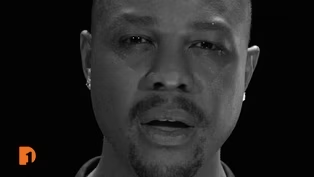
Portraying X: Davóne Tines Discusses Detroit Opera Residency
Video has Closed Captions
Clip: S6 Ep10 | 10m 25s | Portraying X: Davóne Tines Discusses Detroit Opera Residency, His Role as Malcolm X (10m 25s)
Providing Support for PBS.org
Learn Moreabout PBS online sponsorship
- News and Public Affairs

Top journalists deliver compelling original analysis of the hour's headlines.

- News and Public Affairs

FRONTLINE is investigative journalism that questions, explains and changes our world.












Support for PBS provided by:
One Detroit is a local public television program presented by Detroit PBS