
Arts in the Region
Season 3 Episode 5 | 27m 15sVideo has Closed Captions
Meet the Movers & Makers inspiring artists and fostering diverse collaborations.
Meet the Movers & Makers inspiring artists and fostering diverse collaborations in our region. Brandywine Workshop makes access to art-education more equitable. Intercultural Journeys uses the power of the performing arts to catalyze social change. Photographer John Singletary creates an immersive exhibition. Plus, IDEA in Camden serves as a welcoming space to nurture talents of the area youth.
Problems playing video? | Closed Captioning Feedback
Problems playing video? | Closed Captioning Feedback
Movers & Makers is a local public television program presented by WHYY
Arts in the Region
Season 3 Episode 5 | 27m 15sVideo has Closed Captions
Meet the Movers & Makers inspiring artists and fostering diverse collaborations in our region. Brandywine Workshop makes access to art-education more equitable. Intercultural Journeys uses the power of the performing arts to catalyze social change. Photographer John Singletary creates an immersive exhibition. Plus, IDEA in Camden serves as a welcoming space to nurture talents of the area youth.
Problems playing video? | Closed Captioning Feedback
How to Watch Movers & Makers
Movers & Makers is available to stream on pbs.org and the free PBS App, available on iPhone, Apple TV, Android TV, Android smartphones, Amazon Fire TV, Amazon Fire Tablet, Roku, Samsung Smart TV, and Vizio.
Providing Support for PBS.org
Learn Moreabout PBS online sponsorship- [Andrew] On this episode of movers and makers explore the world's first free online database of contemporary art, collaboration, and experimentation with photographer John Singletary, fostering connection and understanding with intercultural journeys and visit a creative oasis in Camden.
(upbeat music) Hello and welcome to the show.
I'm your host, Andrew Eraci.
Almost 20 years ago, this strip of broad street in Philadelphia became designated the Avenue of the Arts.
The city's official arts and culture district.
(upbeat music) Built in 1849, this historic building at 730 South broad street was once the home of Harmony Fire Company Number Six, a volunteer firehouse.
In 1993, it became the new home of the Brandywine Workshop, a nationally and internationally recognized institution dedicated to the art of printmaking and the first new arts organization to open on the Avenue of the Arts.
In this episode, we learn about Brandywine's digital journey and introduce you to other stories of creativity from the region.
(upbeat music) (classical music) - [Allan] People are engaging with art in a different way.
It's not that art is this precious thing that sits in a museum or sits on a wall of wealthy people.
It's something that can engage with it's social statement, it's a political statement, it's cultural sharing, printmaking, It's a democratic medium.
It doesn't have to be as expensive because there's multiples.
I saw it as a tool to engage people in making art.
We started out on Brandywine street.
That's where we got our name in spring garden.
The initial function was to train kids in the neighborhood teenagers in how to do edition printing for artists.
There were no art programs.
So you're lucky if you had an art teacher in school in organizations like we have now, in 1971, early seventies and you also have the end of the civil rights movement.
There was corporate and foundation interest in supporting things in communities.
We operated out of 36 different neighborhoods even while we were still doing print making.
And we did that probably until the mid eighties.
And then we made a really hard shift because of a group coming along doing similar to what we were doing.
We wanted to compete in a much higher environment but we never gave up on the education.
We kind of shifted from being out in the community and teaching and working to development of the location that we now have on broad street.
So now what our kids do, they all get paid.
They come and work when our digital database which is the Artura.org website.
Artura is a free open-source resource to the public.
It's a database.
It has all the images in our collection.
We have some really outstanding local, national and international artists that have worked here.
I can fill off your Barkley Hendricks.
His work is selling for millions of dollars now.
Stan Whitney, who was in Philadelphia at the time, he worked with us.
He's big time in New York right now.
And you got people like Michael Platte from Washington Emma Amos Camille Billops We got Atlanta Suit.
One of the most famous artists in the world.
About five years ago, we decided to change the name from Brandywine Workshop to Brandywine Workshop and Archives.
We realized that we had amass, not only the collection from the work that was being produced but donated work and then individual artists would come and like what we're doing and want to donate some work to some too.
Some, we were fortunate to get at the time in which they were fully recognized.
With some, they were on their way up and we caught them early on.
- I really appreciate all the work that Alan has done because he has really been a leader in printmaking not just in Philadelphia, but in the country.
- [Allan] Around 2008, when we had the economic crash, nonprofits were hurting too.
But one of the benefits of founder driven organizations we're constantly thinking about how to move it forward.
We needed to really situate ourselves in a strong way in a digital realm.
And the board said, number one priority is financial sustainability.
Number two, build a database that will be free and open to the public.
It's a virtual Institute, but it's called the Institute for Inclusion and Diversity in Education and the Arts IIDEEA.
That's the banner under which we come together and Artura.org is the first concrete project that the Institute has put out there.
The image library, which includes all the visiting artist prints and permanent donated pieces.
It has the videos.
- This print shows an image that came to me in a dream.
I don't remember what the dream was about, but the thing that I held on to after the dream was this image.
- [Allan] It has files on artists.
It has descriptions of artwork.
It is a relational database.
If you go to search for one thing and you want to find something that's related to it, you can do that.
So it's used for an art education studio, art, art history.
It's useful to museums.
We have museum educators on our advisory.
We published a 64 page, Artura teacher guide to show teachers how you can connect looking at the images that these artists have produced and understanding how the context, the subject matter and a way to express it can be used to teach in an art classroom, but it's also cross curriculum.
If you're teaching a math class, you can do it by introducing them to a video we have of an artwork created entirely in geometric shapes.
We also look at history.
History re-imagined we have an artist that did a portfolio on the Holocaust.
(energetic music) We have a section on language arts, where we present the poetry of outstanding poets with an image how the image is a visualization of what the poet is talking about.
I got grand hopes for Artura, where it becomes a requirement in the curriculum, just like recently, they made media studies a requirement in the art education.
Art functions differently in our world than the way it did decades ago.
And so it evolves and the technology evolves.
Our country is extremely diverse and we have to respect that diversity, embrace it, not split it apart.
That's where art comes in.
That's why I'm so passionate and I'll preach because art can say society.
(splendid violin music) (upbeat music) (upbeat guitar music) - [John] Describing my work is always quite a challenge.
I normally just show people pictures.
I describe it as kind of a collaborative hybrid of dance and music and photography and technology all kind of synergized together into this melting pot.
My process in creating bodies of work in images is very much intuitive and comes from a place of instinct.
I'll just start sketching something out.
And then it's sort of a matter of almost like reverse engineering of how do I take what's in my mind and put that on a piece of film or put that on a digital sensor, make it tangible.
The word Anahata is a Sanskrit word which translates loosely into unstruck or unbroken or also the sound of the celestial realm.
The word came to me happenstantially and I was wondering if it was even a word and I looked it up and I was like well, that's exactly what I'm doing.
One of the main things we were trying to address and speak to is the universality of human experience.
That we're all a lot more similar than we may feel.
There's this eternal place that we can all tap into.
And this is what it looks like for me.
I wanted to create something that was an all encompassing experience that people could really step into to surround and hit every part of the senses to a degree that an installation allows for.
I have a long background as a traditional silver gelatin printer, as well as a pigment printer.
And originally it was going to be an exhibition of pigment prints.
It was really just a big experiment.
We rented a room in a old house in Germantown and made a makeshift studio just lined the walls with velvet - I feel like Edward Scissorhands.
- [John] It was a lot of just talking to people and proposing this seemingly outlandish idea and seeing who it resonated with.
It all just fell into place in a magical sort of way.
- We appreciate similar things that art can offer as a vehicle for communication and expression.
But we also appreciate, you know, the beauty side of it too.
I've always been very into the human figure as an expressive element, especially the female form and how that can mimic different aspects of nature.
- [John] I had no previous experience working with dancers.
My idea and conceptualization of dance was very narrow - Being a mover, I was really interested in how that can translate to photography when you're a dancer and you're performing on stage, timing is kind of related to the people around you and to music for this per se was not to music.
It was kind of an internal timing and a relationship with the camera.
I remember one of the shoots we go in and he was like we're going to paint you an orange.
I was like, pay me an orange, you know, like who knew?
And I was covered in this latex paints which then to my surprise, I couldn't really move in.
- [Kate] Luckily all the dancers we have worked with have been amazing and so flexible and understanding we did this photo shoot where the movement of the dancers was supposed to be very restrictive.
And I based my designs off old medical devices and even like medieval torture devices.
So the point of it was to constrict their movement even to the point of pain.
The reason why the costumes and the body painting are so colorful.
And the final image is in black and white is we wanted to enhance the three dimensional space.
And when using UV body paint, you use different colors and they offer different tonality to the image All the dancers and models and the costumes are all sensitized to just bio-luminesce under a black light.
And that effect is crucial to creating ethereal kind of ghostly trails.
There's a lot of misconception that there's a lot of Photoshop work or post-production work, which there is but it's within the realm of traditional exposure and contrast, and you know what you would do in the dark room.
So here you're just matching sort of the choreography of the dancers with the choreography of the lighting.
We had assistance kind of moving around with mobile flashes.
So it's very much a performative element.
The first showing of Anahata we just wrapped the entire gallery in black felt and made the walls extremely dark.
So the images were appearing and receding like apparitions to allow the viewer to have this internal meditative experience.
I want to make things as adventurous as I can and push as many boundaries as I can.
I want people coming out of a show to just experience that sense of connectedness just to feel a little bit less alone in the world.
- [Carly] We are bringing in these artists who are phenomenally talented who have this beautiful global perspective whether you are someone who sees yourself in the cultural or artistic performance that is onstage or whether you are someone who is outside of the genre and you're interested in learning more.
There are so many ways to feel that type of connection and to really understand the beauty and the diversity that is Philadelphia intercultural journeys was founded in 2002, the original founders were Philadelphia cellist Udi Bar David, Carole Haas Gravagno, Sheldon Thompson and Majid Alsayegh.
(violin playing) Udi, who is Israeli, was playing and people who were from the Palestinian villages were hearing this music and understanding him as a brother, was the word That they used, as someone who is very much more human than the dividing lines they had drawn around themselves would allow them to see Udi as.
This idea that we do have these identities that are so important to us, right?
But they can either be used to bring us inward and to be used as a shield, or they can be used as a beautiful place to springboard from to show the depth and the grace of your humanity.
IJ has sort of three chapters.
And that was the first chapter.
The second chapter was with artistic director, Alex Shaw.
He brought in a much wider variety of genres, a much wider variety of global perspectives, and it really in many ways reflected his background as a world percussionist.
Over the last year or so the seeds have started to be planted for what his ideas third chapter- New artistic director Marla Burkholder, a real looking at the city to see who is here and who is creating and who is working in these excellent connective ways to produce really phenomenal, really compelling art Good evening, everyone.
My name is Carly Rappaport Stein, and I'm the executive director of Intercultural Journeys.
Thank you so much for tuning in tonight to Love is a Rebellion.
In spring 2020, all of our big plans for our concert season came to a slamming stand still with the really devastating pandemic.
So as a small organization, one of our assets is that we are nimble.
We put our two spring concerts online.
We created a playlist where we pulled in different videos from the artists, some of which had been shared publicly as well as interview snippets into one large public playlist.
That was then followed by a question and answer session with the artists.
I think that education overall is really central to what we're doing.
We are bringing audiences in who may or may not have a familiarity with the artistic and cultural background of the artist on stage.
We had a really wonderful cross-gender dancer, Didik Nini Thowok, Indonesian gentlemen, come to Philly.
One of the members of the Indonesian community described him as a cost between Michael Jordan and a Disney princess which gave me a sense of just how special Didik was and how big a deal he was.
But what was really lovely is that one of our friends and contacts spent time talking with us about what folks in the Indonesian dance community would be particularly interested in seeing.
And helping us develop what would turn into a week long set of programs with masterclasses and really learning from Didik in multiple ways.
In terms of educational programs, though we've done a multi-day residencies at different high schools.
We usually match up a lead teaching performing artists with teachers already in the school to create really interesting and powerful learning opportunities.
- 'Cause I believe that like, I believe in the power of words to heal.
- I'm from the district of Columbia city of imperfection, where homeless people sleep beneath the monuments erection type of place decisions made by what you'd be affected.
And mayors caught smoking a rock might still get reelected.
- [Carly] It was a really powerful, final experience, especially listening to the students and what they came up with and what they shared and the different ways that they found to connect to each other.
- [Omar] Where are you from?
Now, I know that can be a difficult question for some people.
- [Carly] This season is just complete 180 from what we would normally do because of the format.
To participate this year, it's just as simple as going online.
The tickets are free though, of course, as any non-profit, we hope that the music and the stories and the performance will move folks to contribute.
And that's where we are now, really looking at Philadelphia really bringing in powerful voices and really looking at how we keep the creative heart of our city feeding.
(upbeat music) - [Andrew] Just across the bridge in Camden, the ideas center for the arts has become a hub for everything from graphic design to music production.
In today's profile, we need founder, Cynthia Primus, who has spent two decades fostering a tight knit creative community.
(upbeat music) - I am Cynthia Primus, founder of IDEA, which stands for Institute for the Development of Education in the Arts here in Camden, New Jersey.
In 1987, I married my husband who is from Camden and we moved here.
And in 1989, I attended graduate school at Temple University and doing those years in graduate school, I got a chance to work on a project called museums and the life of the city around the issue of cultural pluralism.
And in that process, I decided to start IDEA My arts organizations, since then, has been 25 years.
We have embarked on a very unique and innovative path to allow young people, to discover their creative spirit to help them understand how they can use the arts to create value in their lives.
One of the things that we always wanted to do was to be an anchor, a safe space for creators to come to.
Hello everyone.
(clapping) You know, I'm really pleased to see a couple of kids that we worked with the summer.
It'll give them a chance to really talk about their experience.
So this is great.
One of the things that I'm wanting to talk with you about is a particular program that we've been doing in the Camden area, in the Camden school district called the IDEA multimedia training program.
And we give kids like you, the opportunity to be trained in media arts.
If you had the opportunity to be as creative as you wanted to be, and you had the tools to do it what would you create?
Anybody?
- [Student] A clothing brand.
- A clothing brand.
Wow, that's great.
Anybody else?
- [Boy in green Jacket] Skits like storyteller.
- [Cynthia] Storytelling.
Okay.
Theater, all of that monologues.
Great.
We've worked with quite a few kids here at Camden high.
So we're excited that this year we're opening up the IDEA center for the arts and it'll be creative oasis for our kids.
Having the opportunity to recruit these kids and talk to them about careers in the arts is a wonderful way to introduce them to the world of the arts.
- A brand new arts center, the idea center for the arts opened in June of 2020.
We worked throughout the, to bring programming that would allow us to focus on creating virtual classes.
And those virtual classes will be broken up into six to eight week series and allow the community to really begin to see some of the kinds of things that our kids did this summer.
- One of the things we've been working towards for the summertime are masterclasses.
We'd be training the kids how to use the camera so they can actually film the masterclasses.
So, the masterclasses will be taking place up on the stage.
We have keyboardist pianist named Suzette Ortiz.
And once she's set up, the students will be filming that masterclass.
And those masterclasses will actually be streamed online.
You know, once we edit them and things like that we'll put them on our Facebook page.
- Camera rolling action.
- My name is Amina Faulkner and the person I chose was Dorothy Dandridge.
Dorothy Dandridge was like the black Marilyn Monroe.
Absolutely gorgeous.
- [David] Also the kids have been working towards putting together their like history of vignette positive black figures in American history that have contributed in various ways.
The graphic arts people are creating graphic arts that will be used and some of the black history vignettes and also for the masterclass.
And then we have our music production group that creating like music beds for those vignettes and masterclasses.
Another thing the young people are learning are how to fly drones to really help the kids learn that technology.
- [Scott] We're actually teaching them how to use the drones, not only for cinematography, but you can get your certification.
So it's a really great way to get them engaged in the technology and some of the applications for business.
So this is part of that workforce development project as well.
(trumpet playing) - The idea center for the arts will be open for you to learn 21st century media skills will be open for seniors to come in and take a drawing class, a painting class.
We will be open for the entire community.
The arts center is a place where we really want to continue to keep the creative spirit alive in the city of Camden.
Organizations like idea are helping to strengthen the arts community of Camden and are developing and nurturing the talent that will keep the Avenue of the arts thriving for years to come.
We hope you enjoy this artistic tour, our region.
I'm your host, Andrew Eraci.
I'll see you next time on movers and makers.
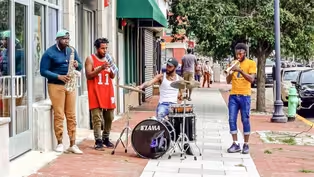
Arts in the Region: Camden IDEA Center
Clip: S3 Ep5 | 1m | IDEA in Camden serves as a welcoming space to nurture the creative talents of area youth. (1m)
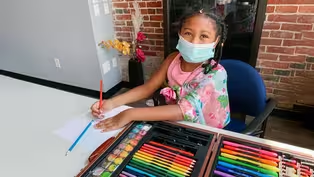
Preview: S3 Ep5 | 30s | Meet the Movers & Makers inspiring artists and fostering diverse collaborations. (30s)
Providing Support for PBS.org
Learn Moreabout PBS online sponsorship

- Arts and Music
The Best of the Joy of Painting with Bob Ross
A pop icon, Bob Ross offers soothing words of wisdom as he paints captivating landscapes.












Support for PBS provided by:
Movers & Makers is a local public television program presented by WHYY