
ASCO: Without Permission
Season 2026 Episode 1 | 1h 25m 37sVideo has Closed Captions
Meet the groundbreaking Chicano collective that made the streets a canvas for art and resistance.
Meet the groundbreaking Chicano art group that transformed 1970s Los Angeles streets into canvases of defiance and expression, now recognized as one of the 20th century’s most influential collectives. Produced by Gael García Bernal and Diego Luna.
Problems playing video? | Closed Captioning Feedback
Problems playing video? | Closed Captioning Feedback
ASCO: Without Permission
Season 2026 Episode 1 | 1h 25m 37sVideo has Closed Captions
Meet the groundbreaking Chicano art group that transformed 1970s Los Angeles streets into canvases of defiance and expression, now recognized as one of the 20th century’s most influential collectives. Produced by Gael García Bernal and Diego Luna.
Problems playing video? | Closed Captioning Feedback
Where to Watch VOCES
VOCES is available to stream on pbs.org and the PBS app.
Buy Now
Providing Support for PBS.org
Learn Moreabout PBS online sponsorship♪ ♪ [Film rolling] [Ambient music playing] ♪ [Indistinct chatter] Gamboa Jr: Uh, well, in 1972, Gronk, Willie Herron, Patssi Valdez, and myself started working together.
Valdez: When I was 17, I got together with a group of friends and we formed the art group ASCO.
♪ Gamboa Jr: You know, a great element of a lot of our work was essentially conceptually political.
To creatively have something to say about the situation of what is taking place in our lives.
Valdez: We were out to break stereotypes.
We're sick and tired of the image that we've been represented with.
Gamboa Jr: We tried to-- We tried to communicate this in ways that will have a universal appeal.
And our hope would be, of course, to have essentially a global audience.
Herron: Violence was something that I really thrived off of in the early '70s.
I chose to express it in the form of art.
Gamboa Jr: To give a lot of younger people a lot of new ideas.
Senger: And action.
ASCO didn't have Hollywood, so they gave themselves Hollywood.
Their work was a call to action.
We decided to answer their call by collaborating with a group of artists to carry their tradition forward.
This was an experiment.
This was a series of questions.
Gamboa Jr: Passing on ideas that would give people the idea that they could change things in their own lives.
They weren't just helpless victims in their environment.
♪ Senger: OK, cut.
Reyna: When I was a teenager, I went to this bookstore and I picked up an ASCO book.
And I looked through the pages and I was like, damn, this is-- I connect with this because-- I mean, at the time I actually didn't know why.
But now, thinking back on it, I understood that it was because of this energy and this action to break something open.
And so ASCO, I think, is one of the pivotal moments in culture where us as Mexicano Americanos, were able to be like, wait a minute.
Is this how we really feel?
Like, is this where we really belong?
Gamboa Jr: I think one of the ideas that we had as young people, that it was very uncertain whether we would live another day.
And if you're given one more day, what would you do with that one more day?
[Upbeat rock music playing] ♪ The only thing my parents actually instructed me to do was not to go to jail.
And I immediately understood that I would be free to do anything as long as I didn't get caught.
So I would hop on the streetcars.
And I was able to traverse the entire urbanscape, constantly saw beautiful people, and then at the same time was able to witness firsthand actual racism and brutality.
[People shouting] Valdez: Growing up in East LA, there were a lot of issues.
And then being a woman, you didn't have a lot of freedom.
You had to be careful the way you look.
I remember getting on a bus one day.
And the bus driver said, "Young woman, "why are you dressed like that?"
And I'm thinking, "how?"
Gronk: I went to a high school where you had the queer table.
It was where all the queers would sit.
And for me, that was fascinating.
Herron: I elected to go to Garfield.
It was because I was suspended from Wilson.
So I was suspended for defying the dress code, because most of the high schools had a dress code.
It just seemed a little too flamboyant for the principal or whatever.
So all those little things, to me, just kind of started to push me into being kind of rebellious.
Gamboa Jr: There was sort of a very subgroup of a subgroup which was known as Jetters.
And we were the people that always dressed up kind of '60s mod Chicano-style, and just kind of everything exaggerated in a way.
Gronk: We were the kids that were contemplating how they were going to get out of this prison, which was called high school.
Mexican Americans have been called the invisible minority.
Until recently, they've been inaudible as well.
Today, however, there are voices within the Mexican-American community which are clamoring for recognition.
They're the voices of those who call themselves Chicanos.
Here in Los Angeles, the Chicano movement has become a growing and dynamic force.
Woman: Chicano!
Valdez: Here I am this young girl.
And all of a sudden, the walkouts are going to happen that year.
Reporter: Walkouts such as this were staged at three high schools.
Man: We want our rights!
We're Chicanos!
Reporter: The students wanted more teachers and administrators of Mexican descent.
Joan: They want smaller classes, more instruction in reading, additional counselors, as well as more emphasis on the Mexican-American's key role in Southern California history.
Valdez: I had a homemaking teacher.
And she'd go, "You better pay attention in this classroom "because someday you're all going to be cooking and cleaning "for other people."
And I remember thinking, "Really?"
Gamboa Jr: In that period, military was always on campus convincing young people to get their parents to sign a consent form so they could join the Marines and they could be taken away to go to Vietnam and then coming back in body bags.
And so we would become the student leaders for the walkouts at Garfield High.
That's why we're not going to be here like separate schools.
We're all united together, right?
[Cheers, applause] Herron: It just seemed really appropriate to have an attitude, walking out and showing solidarity with each other.
Woman: Chicanos!
Herron: The students felt more empowered.
I was inspired by that.
Gamboa Jr: To go out and peacefully protest and then to be immediately confronted with violence by the police kind of set a particular parameter.
But it would be the first time that Chicanos would publicly protest in mass in the 20th century.
Castro: Well, the Mexican American community has long been referred to as the sleeping giant.
And today, he's getting his wake-up call.
Peña: Our history as Latinos, it's not in the history books.
You know, the movements that we've had, they're not in the history books.
My son can't find them anywhere.
He's entering seventh grade.
I'm like, he's not learning about anything.
[Chanting] Herron: The police hasn't yet in my life and experience done any good for me.
Gronk: The police came into our community, they started beating people up.
Well, our mural was sort of like a message to our community and to the outside world as to the conditions that we feel as being a minority in the United States.
The police, the sheriffs occupied East LA.
You were not allowed to gather in groups.
There was a repression that was happening.
Reporter: Chicanos are marching to protest the high casualty rate of our people in Vietnam.
Gamboa Jr: The Moratorium was a very large political demonstration against the Vietnam War.
[Shouting] Gamboa Jr: Tens and tens of thousands of people protesting peacefully towards what's known as Laguna Park, which would have a name change based on that particular day.
[Shouting] [Drumming] Woman: There were supposed to be speeches by Cesar Chavez.
There was music.
You know, people took their kids.
Gamboa Jr: I decided that I would traverse the neighborhood a little bit and noticed that there were hundreds and hundreds of police officers with special weaponry in riot gear beyond the view of people.
Once everyone had been surrounded, they eventually emerged and attacked everyone in the park.
[Gunshots and shouting] [Sirens wailing] There I saw children getting beat up.
I saw women getting smashed.
I saw people getting gassed.
Of course, I was tear-gassed.
It's against the law.
It's forbidden to be used in warfare.
But you can use it against Mexicans in East LA.
And this is something that was underreported and falsely reported.
Newscaster: A gathering in East LA turned raucous and police had to intervene.
Joan, what are your thoughts on this?
It feels like a tragedy for our city and another scar on the Mexican-American community.
Joan: Well, one question raised by the riot is whether the people in the crowd, political radicals or run of the mill hoodlums who came to rally, were there intending to provoke violence, or worse, equipped for violence.
[Acoustic guitar playing] Ramona: ♪ ¿Y si soy algo mejor?
♪ Herron: I was on my 10-speed going to the front, going to the back, in the middle, and just seeing all the tear gas and the places being looted and lit on fire.
Ramona: ♪ ¿Y si no sé adónde voy?
♪ People were actually dying and getting killed.
We were pretty scared.
Like, wow, what's going to happen now?
Ramona: ♪ Cuando cante esta canción ♪ ♪ Que brotó de las cenizas ♪ ♪ Me recuerda lo que soy ♪ ♪ Un transitante de... ♪ Valdez: The whole Whittier Boulevard was in disarray.
It never looked the same again.
Ramona: ♪ Los colores de mi piel ♪ Herron: A lot of things went through my mind that really helped me, I think at that time, to really crystallize a purpose for my art.
Ramona: ♪ Que hay distancia es real ♪ ♪ Y que hay días que nos... ♪ Gamboa Jr: And in the midst of this tear gas, I encountered Francisco Flores, who I hadn't seen in a couple of years.
And she handed me a magazine, which was Regeneración.
And she says, now you're the editor.
[Indistinct conversations] Gamboa Jr: And I looked at it.
And I knew many of the people who had written material in it.
It kind of occurred to me that there wasn't any art in the publication.
And I knew a few people that I felt would work well for this.
I went out and I invited Willie Herron to work with me on the first issue.
Herron: Harry and I teamed up.
Gamboa Jr: And for the second issue, we had located Gronk.
Valdez: I used to see him in the neighborhood on the curb sketching in, like, a glitter top.
Gronk: So I was beginning to get a reputation of, he's this kid that is on the streets.
He's doing this.
He wears capes.
He's in hot pants.
He's doing all of these things.
But it's interesting.
Gamboa Jr: And then Willie Herron introduced me to Patssi.
Herron: Then we started to see each other at parties and stuff like that.
So we just started talking about a lot of the same things.
And we just started to collaborate and work on the magazine in the garage at my house in City Terrace.
Gronk: For me, it was a learning experience with the notion of collaboration.
It was stimulating.
With Patssi, there was an element of glamor.
Valdez: Gronk loved unusual film that he turned me on to.
Willie was just a natural craftsman and talent.
Harry liked to write.
Gamboa Jr: My interest always was to generate myth.
So I was always moving things around, things that didn't belong in one place or another.
I would always leave messages that led to nowhere.
Herron: When we were consulting with each other, we were almost complaining about the art around us, the kind of art everybody was making.
It just seemed to draw us together.
Gronk: We would see each other on almost a daily basis and talk about the world.
It was like a family.
Gamboa Jr: And so the idea was, might as well really turn this into something that we can be in control of and this notion of absurdism, this idea.
Because everything was absurd at that time.
Gronk: They started to really kind of take over the magazine, and it really began to develop the ASCO aesthetic.
Herron: When you say, who inspired you to do this?
Well, there's a whole group of musicians, writers, artists.
Man: [Indistinct] It's only a quarter.
Constitution entitles you to one.
Oosel: ♪ Heavy rain is going to fall ♪ ♪ Fall, fall on your side ♪ Gamboa Jr: We had a sense of satire, but we were all invested in pop culture also.
So we listened and watched what everyone else listened to.
But we added our little take to it because we were at the receiving end of this kind of oppression that was taking place.
And rather than to confront it directly, it would be much more interesting to affect people's perceptions and ideas.
And we did that through art.
Herron: It just seemed to draw us together to become a group and do things together and no longer do artwork separately.
Gronk: They went into a garage.
And instead of coming out a band like many other young people did at the time, they came out an artist group.
Valdez: So we create our own exhibitions.
To get people here, we're going to call it a party.
So they come to our so-called party, and we bombard them with our art.
Herron: I said, I want this to be an exhibit of our worst works.
I really want to retaliate.
I don't want nothing that looks beautifully painted or whatever.
So in 1974, the exhibit was called ASCO.
Valdez: And I remember we were looking around.
And we went, oh, my god, this work gives us ASCO.
Herron: And then after that, we were coined, oh, look it.
There's ASCO.
There's the ASCO group.
I liked the word "ASCO" attached to our group because, again, politically speaking, that was kind of our gut reaction to a whole generation that we were losing.
It was always in the back of my mind, was performances, where we could drive this ASCO group into becoming something new.
[Distant sirens wailing] Valdez: Before the riots, we used to have a Christmas parade that used to go down Whittier Boulevard.
And after the riots, it ended.
So we decided we were going to bring the Christmas parade back to the people.
Gamboa Jr: The Walking Mural took place right as muralism turned out to be a major thing in Los Angeles.
Willie Herron and Gronk had already become kind of known.
Gronk: And already I was against muralism.
[Laughs] We had all become bored of murals.
And we decided that we would turn muralism, one of a static medium, into one of action.
Valdez: Nobody knew what each other was going to come as.
And my mother goes, "Mija, Gronk's here."
I look, and there comes Gronk in chiffon, with Christmas bulbs bouncing.
Gronk: I was dressed like a Christmas tree.
Valdez: And I'm going, "Oh, my God."
It was so fun and exciting.
Gamboa Jr: And Patssi Valdez had become the Virgen de Guadalupe in black.
Valdez: And then we go to meet Willie, and he's like Christ carrying these people on his back.
It was made out of tinfoil and pain.
Herron: And I came up with the idea, well, I could be a walking mural, almost creating a human float.
[Energetic music playing] ♪ Gamboa Jr: I recognized that it would be important for me to be behind the camera and to help direct and to move it forward along Whittier Boulevard and to capture it using 35-millimeter film.
Valdez: I remember elderly women going, santo niño, or dear God, what is this?
♪ Gamboa Jr: It started off with three people walking.
And by the time they got to the end of it, it might have been 150 people following.
Chavoya: Thinking about their early performances, it's really interesting how there's an emphasis on mobility and mobilization and procession, but it's also about occupations.
It's so risky what they're doing.
[Sirens wailing] They're marking sites of political violence, and they're marking sites of spilled blood.
♪ Gronk: For me, it was important to have a voice that expanded that notion of what a Latino artist in Los Angeles was possible to do.
Maea: I think when you feel capable of that level of play and trust within a community, that's when you get to radicalize.
[Dogs barking] Valdez: Wow, your piece looks incredible.
Maea: So good to meet you.
Valdez: Nice to meet you.
Maea: I'm very excited.
Valdez: It looks like-- Maea: Yeah.
Valdez: It's fabulous.
Maea: I'll show you the front a little bit.
Valdez: It almost looks like you could live in it.
Maea: I'm trying.
[Laugh] Valdez: It has a good structure.
Maea: I have a palm tree in the back of my house that's pretty short.
Valdez: Uh-huh.
Maea: Cut one down and, you know, just started learning.
Valdez: You were inspired.
Maea: Yeah, I started learning.
It's just become a big part of my practice.
Valdez: It's in your immediate environment.
Maea: Right.
But that's what I love about your work, is it's all, you know-- Valdez: Yeah.
Maea: You can make anything just turn into this fabulous, fantastical world.
Valdez: What inspired you?
Maea: So, this whole piece has been about immigration and the fantasy of immigration.
We've been talking about just what it is and multigenerational-- Valdez: The reality of it?
Maea: Yeah, and multi-- well, it's like this fantasy of arriving in space, right, in a new place.
Valdez: Mm.
Maea: And that duality of, like, how it exists for people who are already here.
Valdez: Yes.
Maea: How it exists for people who are coming here.
These kids are hanging out in the garage, you know.
Ode to you guys, our ASCO family, you know, our ASCO legacy.
Valdez: It looks fantastic.
And I'm glad someone is carrying on the tradition.
Senger: 2, 3.
Take 3.
Marker.
[Chatter] Son: No, polyamorous is two girlfriends.
[Crash] [Shrill scream] Dad: Hey, guys, step back!
What the ---- is that thing?
- ¿Qué --------- es esto?
- Get the ---- out of here!
- ¿Qué está pasando?
Maea: I have brought the past and the future.
Follow me.
Son: Dad, just go inside.
- ¿Qué es eso?
- ¿Estás bien?
Mom: Se comportan, ¿eh?
[Ominous music playing] ♪ [Laughter] Vega: They put Chicano art on the map, you know?
Like, nobody ever thought of us as having anything besides lowriders and, you know, music.
But we have a lot of artistic talents and stuff, and ASCO really put that on the map.
Even if people didn't want it, they threw it out there.
Tuilaepa-Díaz: Yeah.
Like, no community is perfect.
And so ASCO brought that to the light, like, "Hey, we can do better as a community and include everyone else.
Sanford: Yeah, yeah.
I feel like guerilla art moves culture, period.
You know what I mean?
Like, from everything, like, even like other facets of, like, identity.
Senger: Cut.
I love it!
Gronk: Patssi, she was very glamorous.
She was kind of like the Sophia Loren of Garfield High School.
So all the boys were enamored by her.
But they wouldn't ask her for a date because she just looked out of their league.
Valdez: One day, this new student came to Garfield High School.
And I remember thinking, "Oh, that's a cool, handsome guy."
I said, "Oh, he's going to be my boyfriend."
And I remember bragging, saying, I'm an artist.
And he opened his sketchbook.
And I looked at those drawings and I'm like, "Oh, my God."
[Funky music playing] Herron: I think we gravitated to each other in a way that was deep.
And so that's why I think we then started to just hang out.
♪ And sometimes we would just end up back at her house, you know, just smoking pot, listening to the music.
I remember she played a lot of Joni Mitchell.
She loved patchouli.
Valdez: His mother threw him out of the house.
She felt I corrupted her son, where it was either he stopped dating me, or he had to get out of the house.
So my mom let him come and live with us.
You're 18 years old, so you're at the peak of exploring your sexuality.
Well, it was first love, really.
Gronk: In the early part of ASCO, for me, I was seeing somebody whose name was Jerry Dreva.
And I met him at a talk that an artist was doing.
And Jerry goes, "Well, I have a group of artists "that I work with."
And I said, "Well, I have a group that I'm involved with, and they're called ASCO.
He goes, "Well, can I have your address and your number?"
And I said, "Sure."
And then I met him again.
And he said, "Well, I do mail art.
"I send things in the mail to all kinds of people."
And I said, "Yeah, I do the same thing."
And all of a sudden, we just started corresponding almost on a daily basis.
And I thought, "Oh, this guy is really going to be an interesting character in my life."
Valdez: Your gender, your sexual preference within the group didn't seem to even-- that didn't matter.
We had other things we had to deal with.
[Radio static] Herron: A lot of the times, I think what ASCO rejected, in many ways, was its limitations.
For us, there were no limitations.
Correspondent: Artists and members of the Arts Council held a demonstration today in front of the Los Angeles County Museum of Art on Wilshire Boulevard.
They're here protesting what they say is discrimination in the museum.
Gamboa Jr: One day, I went to the Los Angeles County Museum of Art.
When I get to the last work of art, it just occurred to me that there's not a single work of Chicano art in this major museum that represents Los Angeles County.
And I decided that I would just start pounding on doors and managed to find myself in the inner sanctum of this individual.
And I demanded to know, why isn't there any Chicano art?
And he was pouring his Martini at the time, and turned around and he goes, "Well, you know, Chicanos are in gangs.
"They don't make art."
And then he took a sip and then slammed the door.
And then I kept thinking, "That's pretty good, "but maybe I've got one better."
Herron: I talked to this guy at LACMA, and I don't think we're going to be able to get a show there.
[Rock music playing] Gamboa Jr: We decided to come back later that evening and signed the lower right-hand corner of the museum.
Herron: We spray painted our names.
Gamboa Jr: Authoring the museum itself to be the first work of conceptual art to be exhibited at the museum.
Herron: And then the next day, that's when Patssi stood on the bridge.
Valdez: We weren't going to be just passive.
We were going to do something about it.
And it really was all a state of mind.
Chavoya: They wanted into that museum not asking for entrance, but demanding it.
Gamboa Jr: Particularly at that point, as artists, we could do anything and it would still be ignored.
Noriega: If you were a Mexican American, you were not going to be shown in an art gallery or a museum.
That just was not going to happen.
Gamboa Jr: So what happens when you're completely excluded from society and we do it anyway?
[Soft fuzzy music playing] Noriega: Only a handful of images tend to be circulated about ASCO.
And they're largely the street performances that are about a certain politics.
But I think the greater portion of the imagery really speak to Hollywood and how to take up Hollywood and use it for your own ends.
Valdez: You know, when I was younger, trying to pick a career, I remember thinking, "Wow, maybe I could be an actress.
"Well, there were no roles for people like me."
You didn't even see yourself on television.
[Psychedelic music playing] Miranda: When you think of ASCO growing up just a few miles from Hollywood but how Latinos just don't figure in mainstream film, and that when they do, it tends to be on the basis of stereotype-- Bandito: We don't need no badges.
I don't have to show you any stinking badges!
Noriega: The stereotypes that were predominant were the bandido... [Shots] The maid... and the gangster.
Gangster 1: I know a tune.
It's called "Stick and Cut."
Gangster 2: Ah!
Noriega: We see actors in brown face, famously Brando in Viva Zapata!
Man: What is your name?
Zapata: Emiliano Zapata.
[Shots] Castro: If all you see in media are drug dealers and people in prison that look like you, then you start limiting a child's imagination.
Montana: Say hello to my little friend!
Peña: When I first started acting, there was breakdowns of character and who they wanted.
Like, the lead, Caucasian.
Co-lead, Caucasian.
Strong, supporting, Caucasian.
And it would literally just go right down to--right down.
And then I would have to turn the page and it was like, 13th or 14th, open to other ethnicities.
Gamboa Jr: Negative stereotypes were very overt in the early years and continue today.
Saldaña: You read a script, you're excited about it.
You memorize every moment of this character that you believe you are qualified to deliver.
And they don't--they won't even let you get past the door because they don't want to see you.
They don't want you.
Valdez: Where am I in all of this?
That's not what I look like.
That's not what my friends look like.
So why aren't we being highlighted in movies?
I think that they were around and young at a time when nobody wanted to listen.
Gronk: ASCO did not have access to film.
But they looked just as glamorous as anything that was being in film at that moment in time.
And the influences are coming from Mexico, they're coming from East Los Angeles, and they're coming from Hollywood.
Herron: A lot of movies that we saw when we would go together, I mean, we would come out of there, like, so inspired.
And the ideas keep going.
They just keep going.
Valdez: So we took it in our own hands.
Gronk: You don't begin to complain and say, "Gee, I'm not in movies."
No, you create your own movie.
And you could create a movie with just the suggestion of a film.
Gamboa Jr: But then I've always watched movies.
And I would always walk away with a singular image in my mind of that movie.
And it occurred to me that I could always create that singular image without making the rest of the movie.
Gronk: The still photograph became the film itself.
Valdez: So that was the premise for creating the no movies.
Gamboa Jr: And so the idea was to incorporate cinematic stock, to give it sort of that feel that there was an implied narrative in the film.
And of course, there never was a movie.
Valdez: The world is a stage.
We get in the car and we drive around.
And we find different locations that looked interesting and just play these different roles.
Rivas: They were taking the city over, and it becomes their set.
[Dance music playing] They really were being renegades.
And they could be arrested for doing what they were doing.
They were not getting permits.
Gamboa Jr: Search and Seizure involved Patssi Valdez and an individual by the name of Billy Starr.
And I decided that I would have them pose inside of the 2nd Street Tunnel, which is a very famous tunnel in Downtown LA.
It's appeared in many films.
While we were doing that, a LAPD detective came out and pulled his .38 caliber revolver on me, telling me that my camera was a gun.
If it was really a gun, I never would have heard that.
And so his idea was to interrupt the shoot and try to threaten us.
And in the end, he went away unsatisfied.
Gronk: The helicopters would come, and we'd try to escape.
You'd have to have a dime in your back pocket just in case you had to make a phone call because you were arrested.
They did catch us a couple of times, but we lied our way out of it.
Valdez: It was a true collaboration, and that's what I loved about it.
We would brainstorm on an idea.
We'd go away, we'd come together, and we'd usually surprise each other on what we came up with.
Gamboa Jr: Patssi had a way of being able to create this iconic character.
Valdez: I loved fashion.
I started creating my own fashion out of found objects.
Herron: Her perspective as a woman really almost allowed us to even be more flamboyant, like, more out there with our androgyny.
Valdez: I loved exchanging clothing with Gronk.
I'd have on a fur coat, and he'd want to wear it.
And I'd let him use it.
Gronk: We knew that there was something special about the glamor aspect with a queer element to it.
[Dance music playing] Chavaya: I love the image of The Gores.
It's a no movie that represents a kind of Chicano sci-fi movie at a time when Chicano sci-fi movies didn't exist.
There weren't any.
The image is so beautiful and kind of seductive.
And it looks like something that really could have come out of a Hollywood production.
Gamboa Jr: You would look at Patssi and think, "Oh, she's our Anita Ekberg in 'La Dolce Vita.'"
Valdez: What I decided to do is to bring a contemporary image to the screen.
Trying to break with these stereotypes, I created this image.
And I'm gazing at you with that so-called ASCO stare.
It was sort of like an "I dare you" kind of thought in my mind.
To me, I was addressing the world as a Latina, as a Brown person.
Look at us, my culture.
Look at not so much me, but look at us.
We're more than what we've been perceived as.
Ramona: ♪ Quiero ser de tu piel ♪ ♪ Escuchar tu silencio ♪ Noriega: The no movie, it's iconic photographs that they circulate.
But it also--it exists through Super 8 film that they're shooting and showing.
The no movie took many other forms.
It brought to bear the storytelling tools of cinema with a celebrity culture and marketing that surrounded Hollywood.
Man: ♪ Say yeah!
♪ Gamboa Jr: You'd have to understand that I would take photographs, but they would not wind up in mainstream media.
They would wind up in alternate media, sometimes get reproduced by us.
Chavaya: They would then stamp them with a rubber stamp and circulate those as well.
Occasionally, I would be interviewed on live television.
All of Los Angeles got to see these ASCO no movies while they were being created.
Announcer: Good evening, Los Angeles.
You're watching "Hollywood Access."
Tonight, we have filmmakers Gronk and Harry Gamboa Jr.
Gamboa Jr: Gronk and I were still broke, but we wanted to make a movie.
So we decided to make one about two artists with a nickel each who spent it foolishly.
Interviewer: Do these movies have titles?
Gronk: Yes and no.
Gamboa Jr: "A La Mode," "ASCO FiASCO," which is a no movie remake of the original celluloid version.
We don't discuss our flops.
Chavaya: And they were highly edited.
They became like literary objects in and of themselves.
Gamboa Jr: What artists do you admire?
Gronk: Camus and Daffy Duck.
I think that was the beauty of my relationship with Harry, was the use of language jokes.
And I think both of us hit it off in such a way that we made fun of the larger picture of the art arena and not being a participant, but maybe a saboteur.
[Both chuckle] [Applause] Why not do a parody of the Academy Awards, and I'll call it "The No Movie Awards" based on the no movie?
So if I go to a cheap place that has plaster cobra snakes, spray-can it gold, it becomes this award.
And of course, I give the first one to Patssi.
And I said, you just won the Best New Movie Actress Award of the Year.
"I did?"
"Yeah, I give it back to me because we have "to give it to other people."
Chavaya: It does so effectively simulate or emulate a kind of Hollywood-style glamor that one would associate with a kind of an award ceremony, an Academy Award ceremony.
Castro: The courage that it took back then to do something like this is mind-blowing.
Because even to this day, I mean, you know, Emmys award shows, all these places, Latinx presence isn't huge.
Chavaya: The new movie is trying to kind of imagine all the different types of roles that Chicanos and Chicanos could play in the media when given the opportunities and when given the opportunities to make and tell their own stories.
Saldaña: They created these outlets for themselves because their environment was failing them.
And I feel like they were ahead of their time.
But we also take inspiration from what they did.
Director: And cut.
Cha: Hello.
Gronk: Hi, how are you?
Cha: Hi, I'm San Cha.
Gronk: Good to meet you.
Cha: Nice to meet you.
Hug?
This is based off of a dream that I had of my friend.
And it's us running away from an ex-lover.
Gronk: Right.
Cha: You have a lot of drama, a lot of made up drama.
Director: OK, here we go.
Gronk: The no movie actually had many components to it.
And people were free to develop it as they went along.
Gronk: Some wrote maybe a scenario.
Others took more just of a visual sense.
Cha: Mm-hmm.
Gronk: And it was about makeup.
It was about design.
Cha: Mm-hmm.
Gronk: It was about costuming.
Cha: See how you can make things look like something and it's not-- Actually happening.
Cha: Yeah.
Gronk: The important thing was just to do it-- Director: Quiet on set!
Gronk: ...and see what happens in the future.
[Mellow music playing] Ramona: ♪ En esta habitación ♪ Reyna: Damn, I love this song.
Ramona: ♪ Escucho el eco ♪ [Horn honking] Cha: What?
Reyna: ----!
Cha: ¿Qué?
Reyna: San Cha, stop the ------- car.
Cha: What is going on?
Reyna: Stop the ------- car!
I'm going to ------- kill you!
What the ----?
Why the ---- are you here?
---- you, you-- Cha: Fabi.
Reyna: ---- you!
Cha: Fabi.
Reyna: Go, San Cha.
Go, go, go!
They're right behind us.
Cha: No, I got this.
Reyna: ------- go!
Come on.
Go, go, go!
[Horn honking] Woo!
[Laugh] Reyna: Damn!
[Folk music playing] ♪ Cha: ♪ Luna, tú que guardas la que se fue ♪ ♪ Déjamela otro momento ♪ ♪ Luna, recuérdame que ella nunca se me fue ♪ ♪ Y cada momento será eterno ♪ ♪ Luna, luna, luna ♪ All: ♪ Luna, luna, luna ♪ ♪ [Gunshot] ♪ No me dicen que esto es solo un sueño ♪ ♪ Y fantasía... ♪ ♪ Dicen que no existe en otro lado ♪ ♪ Pero en tu casa me lo han presentado ♪ ♪ Dicen que es solo un sueño ♪ ♪ Que no se puede caminar ♪ ♪ Y que en la Luna nadie vive ♪ ♪ Pero ella vive ♪ ♪ Dicen que es solo un sueño ♪ ♪ Que no se puede caminar ♪ ♪ Y que en la Luna nadie vive ♪ ♪ Both: Pero ella vive ♪ ♪ Luna, luna, luna ♪ ♪ Luna, luna, luna, luna ♪ ♪ Luna ♪ Gutiérrez Senger: Cut.
Ok, we're going to do one last one.
I think the lighting is kind of-- [Laughing] Cha: The thing about ASCO that has been inspiring is the way that they... they have done a lot without a lot of resources, which is doing things with your friends, doing things with the people around you.
[Laughing] When I started calling myself "San Cha," it was about freedom.
And at first, it's like... like, sexual freedom that also feeds into everything else.
Reyna: I think growing up, I witnessed so much pain come from not having a place to belong and not having the space to be experiencing life and to be yourself.
One of the things that has to always be challenged in Mexican culture is the anti-queerness, anti-gay, and also the sexism.
Cha: My goal is for everyone to be able to see all of this together and relate to it in some way.
Gronk: This is actually better than the Academy Awards.
Not very many people have won the No Movie Award.
Cha: [Chuckles] Gronk: Here is the No Movie Award.
Cha: Oh, my God.
I didn't expect this.
Gronk: I know, and I'm taking it back.
Cha: [Laughs] Yes.
[Laughs] I love that.
[Film rolling] Valdez: I feel that I was not the best girlfriend in the world to have.
Herrón: I kind of felt that she was psychologically, like, a little bit unstable.
I'm not quite sure that it had a lot to do with her upbringing.
Valdez: You're having plans to marry.
I was too young and I still needed to work on myself.
I wasn't healthy.
And I think I was just mean.
He was very sensitive.
And again, he'd make me gifts and make me beautiful things.
I just didn't know how to accept that.
I had a very troubled childhood, with a lot of obstacles.
My father started drinking.
On Fridays was the worst days, when they'd get paid and he'd come home drunk.
And he would chase us with a butcher knife.
[Glass shatters] It was horrifying.
And my mom would gather us and we'd lock ourselves in a room.
And then we'd have to jump out the window.
And the next day, he wouldn't remember a thing.
The doctor told my mom, it's either your daughter or your husband, because this little girl is going to have a nervous breakdown.
So my mom had to ask him to leave.
I didn't realize at the time that I had trouble accepting love.
So I made it difficult for him.
And I think he just had it.
Herrón: I just got to be on my own.
So we basically just stopped hanging out with each other.
Valdez: When I finally realized that I did love him, it was too late.
We could never come together again.
It just didn't work.
Herrón: We would still be friends and that we would be around each other, but not lovers.
Gamboa Jr: My mother was largely absent.
And I was allowed freedom.
Gronk: Growing up, I was a kid that other parents from other kids would always say, "Doesn't he have a home?"
Because I was always allowed to roam the streets or be anywhere at any time, really.
I think in modern-day sense, it's probably, you know, "neglect" would be the word.
Growing up with my two brothers and both of them being part of the crew of course, you know, affected me.
I just kind of felt like I was just some novelty character.
I couldn't wrap my head around living like that and thinking like that.
One night I had driven back from a party.
And as I was pulling into the alley, my brother, he just said, "They got John, they got John."
I put the car in park and got off, and then he showed me where he was at.
And I just said, "Wake up.
Wake up, John.
Wake up."
He was totally just riddled with icepick wounds.
So they got him in the front and they got him in the back.
[Siren blares] The ambulance came, and I went with him in the ambulance.
[Beeping] And on the way home, I just started to draw.
And they went over and knocked on the back of the family bakery.
And my aunt answered the door and she started crying.
And I asked her, "I did this drawing, is that ok?
"Can I paint it on the wall "where I found John under the stairs?"
And she says, "Yeah, go ahead, m'hijo.
Go ahead."
And so by the morning, when the sun was coming out, I had already finished the mural.
It just was something that was flowing through me at the time, and then just hope that my brother lives.
And my brother lived.
I collected all these images and different things just passing through my head and decided that a way of possibly getting my revenge would be through... through art.
Gronk: Meeting with like-minded characters, Patssi, Willie, Harry, it was just a natural gravitation to make them my family.
We created a family within that group.
Chavaya: I think they recognized a lot of one another in each other.
The very things that have made them kind of fall out in other circles is what brings them together.
Gronk: We never always got along.
We never always were like-minded in many ways.
Valdez: We'd have our days we didn't like each other that much, or there were difficult days.
Gamboa Jr: There was no reprieve from the conditions we were in.
It was sort of an enhancement of it all.
And so... and that actually made us stronger.
♪ Quiero decir tantas cosas, pero no puedo ♪ Rivas: I think of ASCO as being fearless.
It's a constant reinvention, without all of the tropes that they may have been brought up with coming out of a very conservative Catholic background perhaps.
And they just move past it.
They move through it all.
Valdez: Latino culture is definitely conservative.
When we did the Instant Mural, we decided we were going to create a mural that could be attached to the wall, make a statement, and then removed.
Gronk: It didn't necessarily have to be like a Diego Rivera or Siqueiros or anything along those lines.
But it can be as simple as using everyday objects.
Valdez: A car drives by with these guys.
And they're like, "Do you need help?"
And I'm in character because I'm a piece of art today.
Herrón: I took some photos.
Harry was taking photos.
Valdez: I wasn't the only one taped to a wall.
Herrón: Herb was taped up there with them, too.
Sandoval: It was interesting, because that's the spontaneity of it all, right?
And so there's all these manners and ways and forms in which we were trying to basically slap people into looking at things differently.
And to laugh about it and have fun was so important to our survivability.
Herrón: Some people thought it threatening.
Valdez: The ASCO art making was even controversial within our own culture.
We were misunderstood.
Herrón: The criticism and the putdowns, we accepted it.
But at the same time, it helped to inspire us because what we were doing was more exciting.
And it helped to fulfill our lives and to fulfill our souls.
Valdez: In my life at that time, I felt tied down.
I felt like I didn't have a voice or people weren't listening to me.
So in a way, that was a metaphor for the way I was feeling.
But I broke free.
I didn't allow myself to stay tied down.
Gamboa Jr: To do anything that would really denote that you were in any way different from mainstream America would generate such a harsh response, meant that you were endangering the entire community, which then propelled people to respond in a conservative way.
And of course, with ASCO, we kind of pushed that to the max.
And I had witnessed so much violence in my youth.
And so I was primarily interested in, how do you counter injustice?
The news media outlets, they decided to latch onto the idea that gangs were overrunning Los Angeles.
This is the other side of the Sunshine City.
This is East LA, a 7-mile square area, an easy 10-minute ride from downtown.
It's the home for more street gangs and more street gang-related violence than any neighborhood in any city in this country.
Gamboa Jr: The news media would introduce the names of victims, the addresses of where they worked, where they went to school.
In the end, providing a roadmap for the next act of violence.
I decided to pick up a bunch of road flares and a big red lamp.
Herrón: I went and laid down.
And it looked like somebody had just died.
And there was police kind of ominously in the background.
Gamboa Jr: I photographed him, making it appear as though he were a dead gang victim.
[Radio crackling] Within a few days, I went off and got a haircut, got a suit and went to all the different local television stations.
This image actually appeared on live television.
And I convinced them that this was the last gang member to ever be killed in Los Angeles.
This photo, taken in East LA of a gang member dead in the street, is reportedly the last gang member to have died in battle.
After years of bloody battles in Los Angeles, Americans of Mexican heritage fighting each other, terrorizing the neighborhood, the gang wars are finally over.
This comes as a relief to at least one newscaster here in Los Angeles.
Godspeed, Los Angeles.
Gamboa Jr: There was also myth generated.
It would be really kind of interesting, because it was countering it with a different myth in which everyone kind of understood that it's all one bad joke.
Director: Ok, we're getting ready to shoot.
Let's go, guys.
Gamboa Jr: And so the idea was, "Let's make it even more absurd."
On some level, it's kind of the drive, the anarchistic drive, but also the uncertainty and magic of art.
Montoya: Hi, Harry.
Gamboa Jr: Hey.
Montoya: Welcome to the nightly news.
Gamboa Jr: Yeah.
Montoya: There's an animalization in the way that people that are crossing over get represented in the media.
This is a way to counteract that.
Gamboa Jr: The media will turn it into entertainment, actually.
It's important to disrupt established media.
And sometimes that requires counterintuitive responses, like a no movie... some action that will disrupt the pre-existing narrative.
Director: And action!
Jessica: Rob, more tragic news today.
This is a very troubling development.
Rob: That's right, Jessica.
We are reporting on a group of possessed migrants that are moving through the country.
This group of mutant migrants, as large and dangerous as any we've seen, is burning through this country and leaving behind a trail of blood and tears.
A mass exodus from Central and South America and our neighboring Mexico has turned into a nightmare here in the States.
They are destroying this country that we love so much.
That's right, you heard it here.
They are taking over.
Jessica: We suggest all families stay inside and arm yourselves.
♪ Who's doing that?
Rob: What is going on?
Hello?
♪ [Screaming] ♪ Ramírez: Buenas noches, América.
Soy Oscar Alberto Ramírez.
Huerta: Y yo soy Valeria Huerta.
Ramírez: Seremos sus nuevos anfitriones, trayéndoles las noticias de la noche.
Huerta: Cada noche estaremos en sus casas, trayéndoles las historias más relevantes de América.
Ramírez: Manténganse sintonizados aquí en U.S.
Networks.
Huerta: Donde la verdad cuenta.
♪ Montoya: In the larger sense in the way that we see migrants crossing the border, we sort of... that narrative stops there.
So we don't really talk about where migrants end up as.
The gravitas of my work is that these turmeric imagery comes from that sort of toxicity and that breaking apart of body and body dysmorphia that we take on.
Gamboa Jr: Well, the only way to get kind of through some of this is through humor.
Director: Action!
Ramírez: Buenas noches, América.
Gamboa Jr: And so humor has always been very important with ASCO.
In all the imagery and the work was always in a manner to not address the market, not address politics directly, but to touch on the human desire to enjoy every moment.
And it transforms the pain into positive energy.
DIRECTOR: Ok, let's do it again.
You're blinking.
I know, you're alright.
Ramírez: Aquí en U.S.
Networks.
Huerta: Donde la verdad cuenta.
A great element of a lot of our work dealt with developing our refined sense of sarcasm and working with Gronk, Willie Herrón, Patssi, and now the larger ASCO group... We started bringing other people in.
Valdez: The group has gotten a lot larger.
We've added a lot more members.
Chavaya: ASCO was continually kind of contracting and expanding.
And at one point, it kind of grew into, like, 30 people.
And I think they would start to characterize it... it became like a traveling circus.
Miranda: But it seemed like there were a lot of happenings.
A lot of new faces came into the mix.
It becomes a little bit punk.
It becomes a little bit new wave.
Teresa Covarrubias from the Brat makes her way into some of the work.
Covarrubias: So you had the musicians, you had the artists.
There were writers.
And they all seemed to come together at this one moment.
So for a couple of years there, any time there was an art show, the same people would show up.
Because we were all kind of part of this... I guess they called it a scene, right?
They called it "the East LA Renaissance."
It was special because it felt like community.
Carrillo: I was very young.
I was 18 when I met them.
I was flipping through the pages of a magazine And I saw a... I remember very distinctly a woman taped to a wall.
And their names were in Spanish.
Covarrubias: I mean, they broke all the boundaries, right?
There was nothing like them at that time.
But for me, as a young Chicana, looking around and seeing what was out there to emulate or role models, nothing like them ever.
There weren't that many Spanish names in normal newspapers and magazines anyway, unless it was in the crime section of course.
We were artists being featured.
Before you present any idea to anyone, you have to get their attention.
I learned it from ASCO actually, because they got our attention.
I think that we've all been sort of in the ASCO school of art.
Essentially, that's what a lot of our work has been, has been to instigate people to take an active role in their own lives, changing it, controlling it, and to take an active role in the arts also, and to create cultures, not to become simply consumers of the residue.
Hansen: My first encounter with ASCO, there was a "déjà vu" to it.
Because I instantly felt that recognition of just extraordinary work being done that was really unique in all the world.
But also, it was incredibly fun.
♪ Reporter: Which one?
[Laughing] Valdez: Thinking about their collaborations with others, Gronk and Jerry Dreva, there's just a lot of different avenues.
Gronk: Well, I think for me and Jerry, our relationship, it was something that lasted for a long time.
Now, all of that was done alongside of what ASCO was going through.
Like a marriage, it sometimes doesn't last forever.
There was competition within the group.
I think they pushed one another.
By the mid '80s, all of us were taking different directions.
Willie indicates that he's kind of no longer a part of the group.
Announcer: En un porche, rocanroleros muy buenos y se los recomiendo.
Ellos son Los Ilegales.
Herrón: And I felt like my transition to then forming Los Illegals, getting a record deal and touring, was an extension of ASCO, in my opinion.
♪ Because it was like putting something together that could or may interest Hollywood.
And we were lucky because it eventually did.
I consider myself a multimedia artist.
I'm involved with video, photography.
I paint.
Gronk: With Patssi, she had a bevy of guys around her all the time.
They wanted to dance with her.
They wanted to be alongside of her.
Gronk used to take us to the art school parties.
And I remember all these young people talking about art, but with certain terminology that I had no clue what it meant.
And the goal was not so much to leave the group, but I had to study.
Going to art school opened up a whole other world for me.
♪ Dentro de nosotros ♪ ♪ Lágrimas ♪ ♪ Confusas ♪ I was eventually able to go off and study in New York for a while.
That was just a real exciting time for me, and a time to grow even more as an artist and as a person.
Carrillo: Patssi was in art school by then and developing her own works.
And Willie was doing the band.
So the two members that we interacted with the most at that time were Harry and Gronk.
♪ The group kind of transitioned into more of a theatrical performance.
Gronk: Harry was writing scripts for us.
It was an exciting time to be creative.
Carrillo: So that we would actually make flyers, sell tickets, do publicity to whatever extent we could.
And that's how the group sort of transitioned.
This LA trance was enough to make anyone dance.
It was a bit like that, kids just getting together and putting on a show.
Now, throw in some sex, some drugs, some music, put them in a van and take them on the road, you're having a good time.
♪ We're doing drugs, we're drinking, and we're enjoying each other's company in all the ways possible.
"Sweet Nothings from Pomona."
[Laughing] "Have mercy on us."
[Honking] I lived at a place called the Grand Hotel.
The Grand Hotel was not grand at all.
It was a transient type of hotel.
Drug addicts, prostitutes.
And then I get a call from MOCA, the major museum here in Los Angeles.
For some reason, when they asked me, "You could do anything you want, what do you want to do?," out of my mouth came the words, "I want to do a painting."
And all of a sudden, I was called a painter by many people who never called me a painter before.
And there were dynamics that came into ASCO.
Working with a lot of people, sometimes you couldn't depend on them.
So I think Harry and I just knew that we would end up together.
But working with Harry, at times, it was challenging.
Because he would give you a script the day before, if ever, maybe even that day.
And I think that was kind of a challenging moment in our professional lives, because I was already beginning to do other things.
So I think he saw that as somebody that was not cooperating in many ways with his ideas.
♪ Valdez: Why all the ice cream?
Gronk: Because I think ice cream is a symbol for me that... uh... that's only temporal in life.
And ice cream is only temporal in life.
And our relationships with people are only temporal.
So I was immersed in the painting.
Now, something's going to suffer because of that.
And I think ASCO kind of suffered because I was backing away from a lot of things.
Um... Yeah.
You know, it kind of ended in a very interesting way.
♪ I think it's kind of classic, people start believing their own press.
So you get a lot of accolades.
And maybe you get one or two people to buy things.
You suddenly realize there's a different avenue for you.
And whoever it is that you've been associating with you, they might be considered dead weight.
So you have to cut them free.
♪ Gronk: Perhaps there's a person that would say that there was a jealousy or a rivalry, but I didn't see that at all.
There was more of, OK.
It's like, "You're in a band.
Go do it."
"You're going to school.
Go do it."
And for me, it was like, "Ok, "you're going to be traveling and doing "all these exhibitions.
Go do it."
It was a kind of very tumultuous period.
♪ Gronk: The power of the group just fizzled out.
Gamboa Jr: I know that I met Willie and Patssi at the age of 15.
Maybe I met Gronk a couple of years later.
You're a young teen, full of energy.
You're trying to really establish yourself in a conflicted environment and basically penniless.
And so to walk away from the group, it just was the... it was the end.
♪ It was almost as though the tectonic plates of culture started to shift.
♪ I honestly didn't think that we would have seen this in our lifetime, in my lifetime.
♪ Saldaña: They manifested something so strongly by graffiting their names out on the walls of LACMA.
30 years later, they were asked, they were invited to walk in the front door because they do belong.
So much of what they did was about saying, "No, "we are here and you can't ignore us.
"And we're not only going to tag up your museum, "but we're going to turn it into our work of Chicano art.
"And then years from now, "you're going to show that photo in your museum."
It's just like, what artist wouldn't want to do something like that?
Tomkins Rivas: By the time the retrospective happened, it gives weight and meaning to people that couldn't see that work before.
And I mean that they didn't have access to it, but they also maybe didn't even have the eyes for it.
Fajardo-Hill: If you're interested in art, you need to have the broadest, richest vision possible of what art is.
I really think about the work that has happened to expand the canon of art history.
There's been a lot of pressure that's been put on the canon to open it up.
Art history has left a lot of voices out, and it has not been inclusive.
Hansen: You can see Dada in ASCO.
You can see there's similarities between Fluxus and ASCO.
And yet ASCO is utterly unique.
I mean, they're absolutely vital to the world art scene.
Gronk: The attention that I think ASCO has gotten was necessary.
It established that the work that you were doing was important at that moment in time.
And it was unlike so much that was taking place.
ASCO was ready made for the media, in a way, because that had been the intention all along.
Herrón: That proves that Chicanos could be those kind of artists who were world renowned and make world-class art.
Valdez: People would make fun of me because I'd say, "I'm going to be an artist, I'm going to be in museums, "I'm going to do this, I'm going to do that."
And they'd go, "Yeah, right.
"A Latina in a museum, Patssi?
"Really?
Really?"
I just think, "Yeah, watch me."
Esparta: I was maybe 19 when I first heard about ASCO.
And to know that I could imagine a group of young, radical, intelligent, Brown teens from East LA doing these incredible works, it was mind-blowing.
It was like, "Wow, I could do that.
"That's a possibility."
Bustamante: One of the really, really brilliant things about ASCO is that they were just making statements, making work with the things that they had around them, those processions, those beautiful costumes.
Fajardo-Hill: People need to see that.
Because that type of creative disobedience is actually a good model for actually thinking of yourself and for feeling that you have a right to exist and to exist creatively.
Miranda: That debate that ASCO was putting forth in their art 50 years ago, it's still happening and it's still being dealt with.
I mean, I still think we're fighting that same war, not to be invisible.
Chavaya: ASCO gives us some insight into what's at stake and to imagine what could and might be possible.
♪ Tomkins Rivas: Good evening, everyone.
How are you this evening?
[Cheering] We're really, really thrilled to welcome you this evening to ASCO And the Next Gen.
We have a lot of incredible people here from our community who have made this city what it is.
[Clapping and cheering] Gutiérrez Senger: Thank you, Pilar.
And thank you so much for helping us put this incredible event together.
[Clapping and cheering] What we discovered was any group of outsiders can take ASCO's model and make revolutionary cinema.
They can make cinema where they're the protagonist.
ASCO gave us a blueprint to do that.
But the work's not done.
[Clapping and cheering] Maea: What ASCO did and what ASCO framed up for us was really special.
We got to imagine ourselves in those spaces.
We got to imagine ourselves collectively in those spaces.
We're just getting to be in conversation about what it meant to make something.
And that feels, I think, really empowering, you know?
♪ Montoya: ASCO as a collective, they were really punk and they were really raw.
And so there's something about this, an artistic practice that doesn't have to do with the commerciality of things.
And there's something in my work that I see and emblematic to what they represent.
And so for me, that's something that I'm taking with me.
[Indistinct conversations] Cha: It felt very natural.
It felt like, this is what I need to be doing more of, you know?
It was really fun to collaborate with you and figure out the story that was hybrid of our ideas, you know?
Gronk: No way.
Cha: No way!
Gronk: How shocking.
Oh, my god.
Cha: We want to come up.
[Cheering] Maea: We've all gotten to consume that information, these images, and synthesize it in our own ways.
We're standing in a really historical moment, and I feel proud to be a part of that.
Miranda: Well, I think ASCO gives agency to future generations, agency to do whatever the hell you want.
Their work becomes a way that others can structure their practice.
♪ Maea: What I've learned and relearned and unlearned over and over is that I don't do this alone, none of the work.
Collectivity is power.
Collectivity is change.
Collectivity offers the ability to rethink structures, not to just be subjected to them, not to just be bullied by them, but to really say, "These are what I have.
"These are the options I have.
"What if I want to give myself something else?"
♪ Dicen que por las noches ♪ ♪ Nomás se le iba en puro llorar ♪ ♪ Dicen que no comía ♪ ♪ Nomás se le iba en puro tomar ♪ ♪ Juran que el mismo cielo ♪ ♪ Se estremecía al oír su llanto ♪ ♪ Valdez: I felt an honor to be working with such creative and brilliant individuals.
Gronk: I wasn't thinking of a legacy.
And I wasn't thinking of, "Oh, historically, this is where "it's going to be placed into."
I think it was more in just the doing of and participating in an adventure, in many ways.
Gamboa Jr: I feel that the work, although constantly referred to as being kind of dark and darkly humorous, was exceptionally optimistic, and that we felt that it would one day be able to reach out and be included.
Herrón: So we came together.
We developed.
We evolved.
We learned together.
And now we're all off on our own, still exploring our talents and bringing interesting things to society.
Gronk: There was times where you miss that back and forth dialogue that is unfolding.
And that creativeness, it lingers with you.
♪
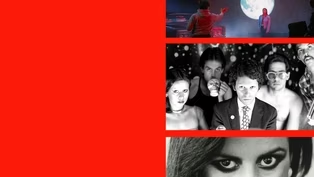
“ASCO: Without Permission” Trailer
Video has Closed Captions
Preview: S2026 Ep1 | 30s | Meet the groundbreaking Chicano collective that made the streets a canvas for art and resistance. (30s)
Providing Support for PBS.org
Learn Moreabout PBS online sponsorship










Support for PBS provided by: