
Asian Americans Rally/Fixing In-Home Healthcare
Season 4 Episode 24 | 26m 46sVideo has Closed Captions
Asian Americans Rally/Fixing In-Home Healthcare | Episode 424
Earlier this week, a protest & vigil were held in Detroit to denounce the spa shootings in Atlanta that left 8 dead, including 6 Asian American women. For some, coming to the event marked their first time to speak out in public against violence and discrimination against the AAPI community. At the federal level, the minimum wage is still stalled at 7.25/hr, but the debate continues. E424
Problems playing video? | Closed Captioning Feedback
Problems playing video? | Closed Captioning Feedback
One Detroit is a local public television program presented by Detroit PBS
Asian Americans Rally/Fixing In-Home Healthcare
Season 4 Episode 24 | 26m 46sVideo has Closed Captions
Earlier this week, a protest & vigil were held in Detroit to denounce the spa shootings in Atlanta that left 8 dead, including 6 Asian American women. For some, coming to the event marked their first time to speak out in public against violence and discrimination against the AAPI community. At the federal level, the minimum wage is still stalled at 7.25/hr, but the debate continues. E424
Problems playing video? | Closed Captioning Feedback
How to Watch One Detroit
One Detroit is available to stream on pbs.org and the free PBS App, available on iPhone, Apple TV, Android TV, Android smartphones, Amazon Fire TV, Amazon Fire Tablet, Roku, Samsung Smart TV, and Vizio.
Providing Support for PBS.org
Learn Moreabout PBS online sponsorship- Hi, I'm Christy McDonald, and here's what's coming up this week on One Detroit.
Fighting back against hate, the Asian-American community rallies in Detroit.
Plus a closer look at the push for the $15/hr minimum wage.
What's behind the number, and the impact.
Also ahead, Michigan's aging population, and the large need for caregivers.
Then the Tuskegee Airmen National Museum, now opening in the Charles H. Wright Museum in Detroit.
It is all coming up on One Detroit.
- [Woman] From Delta faucets, to Behr paint, Masco Corporation is proud to deliver products that enhance the way consumers all over the world experience and enjoy their living spaces.
Masco, serving Michigan communities since 1929.
- [Man] Support for this program provided by the Cynthia and Edsel Ford Fund for Journalism at Detroit Public TV, the Kresge Foundation, Community Foundation for Southeast Michigan.
- [Woman] The DTE Foundation is a proud sponsor of Detroit Public TV.
Among the state's largest foundations, committed to Michigan focused giving, we support organizations that are doing exceptional work in our state.
Visit DTEFoundation.com to learn more.
- [Man] Business Leaders for Michigan, dedicated to making Michigan a top 10 state for jobs, personal income, and a healthy economy.
Also brought to you by, and viewers like you.
(upbeat music) - Hi there, and welcome to One Detroit.
I'm Christy McDonald, happy spring.
Thanks so much for joining me.
We have a lot coming up this week, including the debate in Michigan, and at the federal level, to raise the minimum wage to $15 an hour.
Coming up, a closer look at that number, and the impact it may have.
Then Nolan Finley talks business, and Michigan's economy with Jerry Anderson.
Also ahead, the crisis of caregiving in Michigan, as our population gets older, how to fill those jobs.
And then the Tuskegee Airmen National Museum finds a new home at the Charles H. Wright Museum of African-American History.
It is all ahead on One Detroit.
And we're starting with reaction to increasing violence against Asian-Americans.
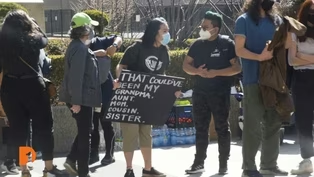
A protest and a vigil was held in downtown Detroit to denounce the spa shootings in Atlanta, which left eight dead, including six Asian-American women.
The shootings come at a time of increasing attacks against Asian-Americans, and Pacific Islanders.
According to the group, Stop A-A-P-I Hate, there have been 3,800 hate incidents recorded since the beginning of the pandemic.
Hundreds gathered, people from many Asian American communities, and their supporters, to voice their concern.
For some coming to the event marked their first time to speak out in public against violence and discrimination against the A-A-P-I community.
- There are people walking the neighborhood, random people will come up and tell them "Go back to China."
It's just, it's been fueling into all the anxiety, and this is tipping point for us.
- I've been name called, I've been bullied, and I grew up in Southwest Michigan, you know, so, and then living in Detroit, you know, it's one way or the other, it's all white, or it's all black.
And, you know, it's challenging being the only one, right?
And so gathering here today in Detroit, this is, for me, the first time.
- This is my first time going marching like this.
And I say, you know what, We have to do something, we got to stand up, we cannot sit, we cannot be silent anymore.
- There is a swarm of emotions today.
It really is so beautiful for all of us to be out here, to be here, gathered today in unity, but unfortunately for such a devastating purpose.
However it is a mix of anger, frustration, sadness, mixed with feeling eager, feeling liberated, but truly the reason why we are here is bittersweet.
One thing that I really want to know about the Atlanta shooting, is that it really seems to parallel the Charleston church shootings in 2015, when hate crimes against black people began to spike.
The shooter was coddled and protected, just like now, the news and the media downplayed it, downplayed the severity of the event until people rallied together.
Just like now.
- One of the things that is so painful is to know that we've been talking about this for a year, and that it took a mass shooting for America to wake up.
- It's going to be different this time, because this time we know it's not okay to remain silent.
We know that remaining silent is not an answer.
We know that we are American, we know that we are not stereotypes, and we know that we belong here just as much as everyone else.
- None of your political standings have anything to do with today.
Today is about us, as humans.
- My family and I came to the United States because our people were being persecuted because they were helping American soldiers in the Vietnam War.
And like all parents, ours wanted to have a better opportunity at life.
But in 2021 Asian-Americans across the country do not feel safe at all.
- Over the beginning of Corona, after the first couple of months, I could say three, or five times a day, you know, people would tell me that we started this, you know, "How dare you ruin our lives?"
You know, "Go back to your country."
Well, to be frank, this is my country.
You know, I was born in Detroit, and I'm not going anywhere.
(crowd cheering) (crowd clapping) - Words matter.
It's called the Coronavirus, and nothing else.
We let it happen by racial slurs, normalizing the fact that it's so common, and so normal, to say slurs towards Asian-Americans, and not say anything to fix it.
Whether that's in the workplace, in your friend groups, on social media, come on, we've all seen it.
- We deserve the respect, we earn it.
(crowd clapping) That's why we come here to get our voice heard.
We're not begging for it, we earn it, we deserve it.
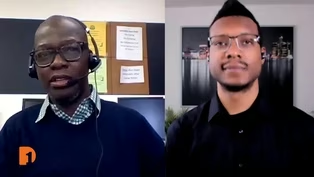
(crowd cheering) - Turning now to the minimum wage, and the debate across the country on $15/hr.
We wanted to take a closer look at how advocates landed on that number, what it could mean to jobs, and the economy, as well as helping pull families out of poverty.
One Detroit's Will Glover has more.
- [Will] President Franklin Roosevelt brought the federal minimum wage to life in the 1930s.
Today there's a federal minimum wage of $7.25/hr, that hasn't changed since 2009.
And we have one here in Michigan that's higher, at $9.65/hr.
But the number of most working family advocates are pushing for now, is $15/hr.
- Sean Egan, Deputy Director of Labor and Economic Opportunity for the State of Michigan, explains why.
- So a family of four in Michigan is determined to need about 61,000 a year, just to get by.
So when we start to think about a $15 an hour minimum wage, times two, that's around that number, right?
- [Will] It's estimated almost a million workers make $12/hr, or less.
And the fight for workers to have higher wages has been an ongoing battle for Dr. Sekou Siby, Head of Restaurant Opportunities United.
- The statistics are those in the area where you increase the minimum wage, what happen is those workers now, those millions of workers, now increase their purchasing, you know, potential.
What happen, when they can buy more, it improves the economy as a whole.
And that when that economy improves, those businesses can hire more people.
- [Will] But not everyone supports a higher minimum wage.
Citing potential job loss, and larger costs for small business, former Reagan White House Council member, Peter Wallison, questions whether we should have a minimum wage at all.
- I have some real questions about whether in this day and age, it is really necessary anymore, and I think it does much more harm than good.
Fewer people would have jobs.
- Um-hm.
- There would be fewer businesses started.
Every time it becomes necessary to raise the wage, it makes it more difficult for people like that, in 95% of the businesses, to hire anyone.
- [Will] According to the Congressional Budget Office, if the federal minimum wage rose to $15, projected job losses could be as high as 2.7 million, or as low as zero.
- So I think we would find similar to the Congressional Budget Office, that there may be some impact to employment, but it's so negligible, it's hard to even find.
- [Will] What about hiring?
Critics argue if a worker's pay is more than their employer thinks their work is worth, businesses won't hire, and may even fire their low wage employees.
That would disproportionately impact women, immigrants, and Black low wage workers.
While barriers to education, job training, and wealth creation have held back many in these communities, forcing a higher minimum wage could add to the problem.
- We have a very large group of people in the United States who are unemployable, it seems.
No matter what policies we follow, We find these people, mostly people of color, who remain unemployed.
And the reason for that, in my view, is that they are trying to enter the labor system, they are trying to enter the system of production in this country, but they don't get a chance.
And the reason that I think they're not getting this chance is that wages are too high for the skills that they have as entries.
- Being a server requires tons of skill.
Being a cook also requires tons of skill.
The idea that because we are Black, because we are brown, because we are immigrant, we shouldn't pay them.
And using this narrative, according to which it is because we are low skilled that they should be paid that low, it is just not true, and it need to be debunked.
- [Will] Detroit native, Sarah Coffey, is also an activist for restaurant workers, and is currently with the National Lawyers Guild, and Restaurant Opportunity Centers United.
- Well, as a woman who's first job was at Little Caesars, and who has worked in the restaurant industry, off and on, I would say that if someone can not afford to pay their workers a living wage, that they should go back to the drawing board with their business model.
- How do you respond to people who make the argument that the minimum wage is okay because it's restaurant workers, because it's high school students, college students just getting, you know, their first job, and they need to learn, you know, the basic tenants of what it is to be a part of the workforce.
- That's an absolute miss.
There are many parents, working families, who are making the sub-minimum tipped wage, and the minimum wage, and it's not enough to survive on.
- [Will] Although the policy debate is primarily split down party lines, overall Americans are in favor of a federal minimum wage hike.
According to a 2019 Pew Research Center survey, two thirds of Americans favor a $15 minimum wage.
- In Florida, a state where the majority of voters voted to re-elect Donald Trump, the minimum wage referendum passed by over 60% of the vote.
And I can't actually think of that many things that 60% of Americans agree on these days.
- [Will] Professor Luke Schaefer at the Ford School for Public Policy at the University of Michigan says even with a wage hike, solving poverty will remain a major challenge.
- If you really want to target poverty, you know, there are these other ways to do it.
And the Child Tax Credit being one of them, that say raising kids is expensive, and no matter what your earnings are, you should be able to put food on the table, you should be able to pay your rent.
And so the Child Allowance basically does what most other countries do, that says the government has a reason to make sure that children are cared for, right, and help parents to do their job of raising their kids as best as they can.
- A federal minimum wage hike to $15 was part of the most recent COVID Relief Package, but was removed in order to get the bill passed.
At the federal level, the minimum wage is at a standstill, but major corporations like Target, and Costco, have committed to paying their employees $15/hr.
In Michigan, earlier this month, House Bill No.
4413 was introduced to amend the Improved Workforce Opportunity Wage Act, which would raise the minimum wage to $11 by 2022, and $15 by 2026.
- So do we want to continue to live in a society that values money over people, and that unfairly advantages the wealthy over the poor.
- The only path out of poverty is work.
And when we have low minimum wages, low unionization rates, big inequality, that path is not that clear.
So you can be working in this country and still living in poverty.
That is a shame, and that is something that as a society we should not accept, or tolerate.
- And speaking of wages and work, COVID has drastically changed business and work for millions of people.
We wanted to get a sense of what Michigan businesses are focused on now, and the future of the state economy.
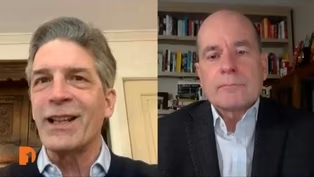
Our One Detroit contributor, Nolan Finley, spoke with Gerry Anderson, DTE Energy Chairman, and the Co-Chair of the Michigan Economic Recovery Council.
- So the members of the various business organizations you're involved with, and your fellow members on the Economic Recovery Council, do you have a strong sense of optimism now?
- You know, we surveyed the members of Business Leaders for Michigan, in the third quarter, and then essentially at the end of year, or early this year.
Close to 85% felt that this coming year was either going to be stronger, or at minimum, level, to this year.
And that had moved significantly from only months earlier.
And the same was true of employment, that on the order of 85% said we're going to either be level, or increasing employment levels.
Again, more bullish than they'd been months earlier.
So sentiments improving.
And I think, as we get the final stage of this pandemic worked through, it will only strengthen.
- How near are we to the point where we'll see a broad reopening of office buildings, and factories?
- Essentially every business has been thinking for months about the pace at which they'll reintroduce people into their offices.
I think it will be gradual, and staged.
Generally people have been saying that that's likely to be end of the second quarter beginning of the third quarter.
But I suspect as well that we may see that moved up a bit, if the pandemic really quiets down as we work our way through vaccinations.
- How hard has the Michigan economy been hit?
- Large businesses, across all sectors, were hit hard early, along with employment, but they rebounded surprisingly fast.
It's the small business sector, in particular parts of the small business sector that have really been hard hit.
And that's the part that's really waiting for this pandemic to end, so that our offices can fill back up, our restaurants, and theaters, and so forth, can fill back up.
- What will change permanently because of the pandemic?
- The look of the work place is going to change a lot.
The look of offices will be in some cases radically different.
The idea of a permanent office may not exist in many companies.
I think it's gonna introduce more flexibility into people's lives, and in a way may be really good for family life.
And it's going to have impact on things like how much we drive, and our use of energy.
- What will be the impact on commercial real estate, on downtown Detroit?
- As people rethink their office architecture, everybody's concluding they need fewer square feet, and they're beginning to move to rationalize their holdings.
You could, for example, potentially see conversion of commercial space into residential uses, enabling you know, more people who've been wanting to get into cities to do that.
But there are questions about whether that trend to move into cities will continue.
Unquestionably, there's going to be significant impacts on the commercial real estate markets, and I think we're just going to have to watch that to see how it plays out.
- There is one profession that is in dire need of workers, and that's home health aids.
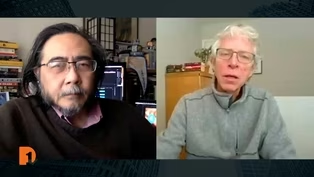
The need for caregiving in Michigan is rapidly growing, with our aging population.
One Detroit's Bill Kubota has the story.
- We're an old state, and we're getting older.
Somewhere along the line in that equation, we're going to need more people to take care of us, as we get older.
(calm music) - So we focused on caregivers, there's going to be a national shortage.
- [Bill] Sarah Rahal, the Detroit News, Ted Roelofs, Bridge Magazine, reporters, they looked into the world of home health aids.
Caregivers on the front lines with a collaborative media investigation into the massive shortage of these specialized workers.
- And it's compounded by an issue that's been there for a long time, which is really substandard pay for this kind of work.
So it's hard to attract and retain people to do this over time, and COVID-19 has only made things worse.
- The industry had an estimated 82% turnover rate in 2018, another estimate, in Michigan we're short 34,000 workers out of a workforce of 120,000.
Five years from now, a shortage of 200,000 workers as our aging population keeps growing.
- Were you surprised with what you found?
- No, frankly, I've been reporting on issues touching on this for quite some time.
And it's one strand of many that Michigans been dealing with for a while.
- [Bill] With wages averaging $13 an hour, fast food workers can make more.
To get enough hours, caregivers need to travel to multiple clients.
- 90% of people would love to stay in their own home, and grow, and die in their own home.
- But in many cases that process is only possible at some point, if someone can come in the home and help with basic needs, in some case greater needs.
- But a lot of people have turned to nursing homes, which have taken a very hard hit during the pandemic, and nursing homes have just not been an option for many people.
- Some people need help just with cooking and cleaning.
People need help bathing, maybe getting, you know, getting up in certain situations, without someone to do that work, then people are forced to leave their home when they really don't want to.
So this is a vital part of our workforce.
- It's not always just taking people to the grocery store, and getting their groceries for them, or helping them to and from places, it's feeding them, caring for them, being there for them when their family isn't, and being a part of their family.
And the caregivers that we talked to felt more stress than ever.
- [Bill] Direct care work can be dangerous, not just the risk of COVID.
Moving and lifting old, disabled people can cause injury.
- Detroit was so much different, you know, there's one in five caregivers lack transportation.
- [Bill] Car insurance costs, mass transit struggles, childcare issues.
But now because of the pandemic, the government provides battle pay of sorts.
- We've had a temporary $2/hr increase for direct care workers in Michigan, going back into last year, and there's discussions now about extending that out, maybe through September.
That helps, but that alone will not solve this problem.
- Everyone that we've talked to has said that there is a need for a program that works.
- [Bill] One in five home health workers is now between the age of 55-64.
How long can they keep going?
- In Detroit, they want to encourage more people to join the industry when they're younger.
And that's one of their outreach solutions, is to reach out to these kids instead of saying, "Hey, don't go to work at McDonald's, "come do a very valuable job "that can make a real difference in the world, "and can really build your resume, in terms of healthcare," and it's somewhat working.
They're getting a lot of people in the ages of 21-28 who want to take this on as a part-time job.
- Rahal and Roelofs reports were supported by the Solutions Journalism Network.
They've revealed some ideas not much seen in the news until now.
So did you find much coverage in recent years about the home care?
- We rarely found articles that really dove deep into caregiving solutions, and agency solutions, and what people were doing that was unique.
We really had to dig and hunt for things that we could refer back to.
- In looking in this project, we tried to find some concrete solutions, you know.
What are some hopeful things that can be done?
And one of the things I looked at was there's a cooperative out of New York City that was started, I think, way back in 1985.
Basically this is a home healthcare agency.
- [Bill] The co-op gives aids at least 30 hours a week, pays $15 an hour, with benefits.
It's turnover rate, around 20%.
That's four times lower than the industry average.
- They been able to piece together foundation grants, and other federal, state assistance, and that's not going to be something that's going to be easily done everywhere, but it's a good sign that if you support these people, if you give them good benefits, they're going to be more loyal, they'll be better workers, and they'll stay in the job.
- [Woman] Our service area.
- [Ted] Some of the area agencies on aging were doing creative things.
- [Bill] In Bay City, funds were found to help 80 of their workers.
- There was one agency that were paying workers a thousand dollar bonus if they stayed on the job for a year.
That might sound crazy, but this is what they need to do to try to get people to stay on the job.
They had success with that.
- The experts that we talked to say the majority of people don't want to do the job because they don't feel appreciated.
There's just a lack of respect.
- Unless we're suddenly willing, as a society, to say we value this work so greatly that we're going to increase the pay by, pick a number, $5 an hour, $10 an hour, where's that money going to come from?
So it's a difficult issue.
- And finally, this month marks 80 years of the Tuskegee Airmen, and it coincides with the celebration of the new home for the Tuskegee Airman National Museum.
It is moving into the Charles H. Wright Museum of African-American History in Detroit.
Stephen Henderson spoke with Pam Alexander, from the Ford Fund, which supports the museum, and Lieutenant Colonel Alexander Jefferson, an original member of the famed Red Tails.
They spoke on American Black Journal.
- We have the airmen, then we also have the Charles H. Wright, so what an incredible opportunity to combine those treasures, and bring this history into an amazing facility so that so many people can see what the airmen are about.
They're legends.
People think they know the story, but they don't know all of the story, so Ford is really excited to be a presenting sponsor of this museum inside the Charles H. Wright, that will tell their story to so many from around the world.
- The program itself, the nine months, the war took all the men who were college graduates, and then they had to take high school graduates, and put them through three months of concentrated math and science to get them along.
And it was interesting, exciting, awfully exciting.
- And we are honored to be able to hear from Lieutenant Colonel Jefferson, and his story.
He is 99 years old.
For more information on the exhibit, and American Black Journal, and for all of the stories that we are working on, just head to our website at OneDetroitPBS.org, and find us on social media at OneDetroit.
That's going to do it for me this week.
Have a great weekend.
I will see you next time, take care, and be well.
You can find more at OneDetroitPBS.org, or subscribe to our social media channels, and sign up for our One Detroit newsletter.
- [Woman] From Delta faucets, to Behr paint, Masco corporation is proud to deliver products that enhance the way consumers, all over the world, experience and enjoy their living spaces.
Masco, serving Michigan communities since 1929.
- [Man] Support for this program provided by the Cynthia and Edsel Ford Fund for Journalism at Detroit Public TV, the Kresge Foundation, Community Foundation for Southeast Michigan.
- [Woman] The DTE Foundation is a proud sponsor of Detroit Public TV, among the state's largest foundations committed to Michigan focused giving.
We support organizations that are doing exceptional work in our state.
Visit DTEFoundation.com to learn more.
- [Man] Business Leaders for Michigan, dedicated to making Michigan a top 10 state for jobs, personal income, and a healthy economy.
Also brought to you by, and viewers like you.
(calm music) (upbeat music)
Video has Closed Captions
Clip: S4 Ep24 | 4m 2s | Hundreds gathered in Detroit to denounce hate against the AAPI community. E424/S1 (4m 2s)
Video has Closed Captions
Clip: S4 Ep24 | 6m 12s | The need for caregivers is rapidly growing along w/ MI's aging population | E424/S4 (6m 12s)
Video has Closed Captions
Clip: S4 Ep24 | 7m 23s | Minimum Wage Debate | Episode 424/Segment 2 (7m 23s)
Video has Closed Captions
Clip: S4 Ep24 | 3m 10s | Gerry Anderson on how businesses are progressing one year into COVID-19 | E424/S3 (3m 10s)
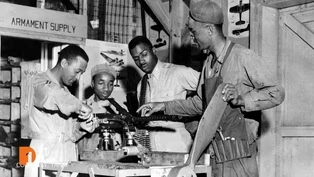
The Tuskegee Airmen National Museum Finds Its New Home
Video has Closed Captions
Clip: S4 Ep24 | 1m 3s | The Tuskegee Airmen National Museum celebrates a monumental move and an 80 year milestone. (1m 3s)
Providing Support for PBS.org
Learn Moreabout PBS online sponsorship
- News and Public Affairs

Top journalists deliver compelling original analysis of the hour's headlines.

- News and Public Affairs

FRONTLINE is investigative journalism that questions, explains and changes our world.












Support for PBS provided by:
One Detroit is a local public television program presented by Detroit PBS