
Asm. Brian Bergen (R); Fmr. U.S. Sen. George Helmy (D)
12/21/2024 | 27m 20sVideo has Closed Captions
Asm. Brian Bergen (R); Fmr. U.S. Sen. George Helmy (D)
Asm. Brian Bergen (R), Minority Whip and U.S Military Veteran, discusses legislative efforts to support disabled veterans and the future of the U.S. Military under the incoming Trump administration. Then, Former U.S. Senator George Helmy (D), reflects on the lessons learned during his time in the Senate, youth mental health, and his ongoing commitment to humanitarian aid in the Middle East.
Problems playing video? | Closed Captioning Feedback
Problems playing video? | Closed Captioning Feedback
Think Tank with Steve Adubato is a local public television program presented by NJ PBS
Asm. Brian Bergen (R); Fmr. U.S. Sen. George Helmy (D)
12/21/2024 | 27m 20sVideo has Closed Captions
Asm. Brian Bergen (R), Minority Whip and U.S Military Veteran, discusses legislative efforts to support disabled veterans and the future of the U.S. Military under the incoming Trump administration. Then, Former U.S. Senator George Helmy (D), reflects on the lessons learned during his time in the Senate, youth mental health, and his ongoing commitment to humanitarian aid in the Middle East.
Problems playing video? | Closed Captioning Feedback
How to Watch Think Tank with Steve Adubato
Think Tank with Steve Adubato is available to stream on pbs.org and the free PBS App, available on iPhone, Apple TV, Android TV, Android smartphones, Amazon Fire TV, Amazon Fire Tablet, Roku, Samsung Smart TV, and Vizio.
Providing Support for PBS.org
Learn Moreabout PBS online sponsorship- [Narrator] Funding for this edition of Think Tank with Steve Adubato has been provided by The Turrell Fund, a foundation serving children.
Operating Engineers, Local 825.
Eastern Atlantic States Regional Council of Carpenters.
New Brunswick Development Corporation.
IBEW Local 102.
Lighting the path, leading the way.
Horizon Blue Cross Blue Shield of New Jersey.
Here when you need us most.
Kean University.
Where Cougars climb higher.
NJM Insurance Group.
Serving New Jersey’s drivers, homeowners and business owners for more than 100 years.
And by Community FoodBank of New Jersey.
Promotional support provided by NJ.Com.
Keeping communities informed and connected.
And by New Jersey Globe.
[MOTIVATIONAL MUSIC] - Hi everyone.
Steve Adubato.
We kick off the program with an important conversation with a member of the state legislature.
Assemblyman Brian Bergen is the assembly Minority Whip.
That means he's a leader in the state assembly.
And more importantly, no disrespect to your service in government, assemblyman, a West Point graduate, served in the US Army from 1997 to 2008 as an officer and Apache helicopter pilot in Iraq earning a Bronze star and a combat action badge.
Needless to say, thank you for your service, assemblyman.
- You're very welcome.
- Speaking of thanking veterans for their service, what the heck is the disabled veterans proportional property tax bill and why is it stuck in the legislature?
Please, Brian?
- Oh my God, I could yell and scream about this bill all day long.
It's a great topic.
- What is it and why is it so important to so many veterans?
- So I'll boil it down to this.
Disservice disabled veterans get relief from the federal government based on their disability rating.
So if you're a hundred percent disabled, let's say you get $3,000 a month.
If you're 90%, you get $2,500 a month, et cetera, et cetera, all the way down.
So they get relief from the federal government.
In New Jersey, a hundred percent disabled veterans do not pay property taxes, but everybody else pays the full boat.
So what happens is the federal dollars that are meant to give relief to these disabled veterans are eaten up by the highest in the nation property taxes we have.
So a solution to that would be, a hundred percent disabled veterans already do not pay property taxes.
Let's have the 90% disabled veteran only pay 10%.
The 80% only pay 20%, and so on and so forth.
That way, those federal dollars that are being allocated to them are being used to help them not to pay New Jersey property taxes.
And so the bill's been around the legislature for 16 years.
- How long?
- 16.
It's been sponsored by everybody.
It was sponsored by Speaker Craig Coughlin until he became the speaker.
It was sponsored by Assemblywoman Cleopatra Tucker.
It was sponsored by everybody in power.
The bottom line is they were doing it, in my opinion, they were doing it because it sounds good.
I want it to actually happen it.
- So why is it?
Hold on.
If two previous Democrats had sponsored the bill, now you as a Republican and a veteran who served our country is sponsoring the bill, why would anyone be against this and on what grounds?
- So they initially say cost.
Majority Leader Greenwald typically brings up the cost.
- Senator Greenwald.
Lou Greenwald.
Go ahead.
- Greenwald.
It'll cost $300 million a year, which is a lot of money.
But lemme put that in perspective for a second.
The average disabled veteran in New Jersey receives $23,000 in federal compensation for their disability.
That's on average.
It's $1.5 billion divided by 66,000 people.
So every disabled veteran who moves out of the state of New Jersey, 'cause they can't afford to live here, the property taxes, takes that money with them.
So it's advantageous for us to incentivize them to stay here in New Jersey because that's so... On a fiscal analysis, it makes sense to do.
So their arguments really don't hold much water.
The reality is, Steve, they prioritize the Stay New Jersey program, which I'm sure you're familiar with, which I've been pretty vocal, I think is a scam on seniors.
- What is it?
- So the Stay New Jersey program is-- - Oh, the Stay New Jersey program.
- Yeah.
- Why would?
No disrespect Assemblyman.
Why a scam if it gives money back to seniors?
- There's no way it's gonna happen.
No chance.
No chance.
It costs $1.3 billion a year.
In the first two years, they've only saved up 300 million to pay for it starting in 2026.
There is no chance, Steve, no chance that that bill ever materializes.
And if it does, I can guarantee it would only be for a year or two.
'Cause the senior population in New Jersey is gonna double by 2050.
Double.
So this bill that's $1.3 billion a year now, to give property tax relief to seniors is gonna double in costs over time.
And the reason why it's so egregious, and I was the only no vote in the state legislature, was because you could make up to $500,000 a year, be 65 years or older and get half off your property tax.
That's just stupid.
So what I think is gonna happen, and I'd bet on it, is that no senior will ever see this benefit ever.
And if they do-- - Hold on one second, Assemblyman.
You're saying the Democrats who advocate for this and the Republicans who voted for it are voting for something that's never gonna happen.
- That's a fact.
That's a fact.
And if it does happen, and I hope everybody and their brother watches this and hears this coming outta my mouth.
If it does happen, it may be for a year, may be for two years, it will eventually fail.
And that's even worse.
- All right.
Switch gears.
I've been wanting to have this conversation with you for a while because you understand the military better than most.
You understand public life better than most.
And I think my sense is you understand, Assemblyman, the connection between elected officials at every level of government in the military.
So, and again, we don't know what's gonna happen with the Department of Defense secretary on the federal level.
And someone could say, "Why are you asking the assemblyman that question?
"He's a state official."
But you understand these issues and your opinion matters and you're a leader in the Republican Party.
- Thank you.
Appreciate that.
- Well, it's just true.
It's a fact.
Question, what do you believe the appropriate role of the United States military is vis-a-vis as it relates to the mass deportation of those who are undocumented?
Does the US military in your position, knowing what you know, have a role in that regard?
And if so, what is it?
- In my opinion, no, they should not have.
They do not and should not have a role.
The role of the US military is to protect the nation, the borders of the nation and beyond.
It's not to-- - Against foreign enemies.
- Yeah, that's true.
Now, our oath does say foreign and domestic.
- Okay.
- We do take an oath to that.
We protect the constitution against enemies, foreign and domestic.
However, it's a very dangerous slippery slope to begin to do any military action on US soil.
It's very dangerous.
It should not happen.
It's reserved for the National Guard and disasters and that type of thing.
If you're talking to me, if you asked me do I think there's a role for the military to secure the borders, I would say yes.
That would be the extent of their-- - But deporting undocumented-- - No, I don't think that's a good use.
- No.
- No, no.
- Well, how about this.
Do you believe, and again, Pete Hegseth as we do this program, we don't know what's gonna happen.
Okay?
Let's leave it at that.
He's not the issue.
But you have a perspective that I, as a journalist, as a person who never served, I don't have any sense of this.
He has said publicly, unless he recants this, "Women should not serve in combat."
- Couldn't disagree more.
I think that is an absolute terrible and dangerous position for that man to take.
I mean, I respect his military service.
I don't think he'd be bad in the role.
I don't know a whole lot about him, but that one issue in particular, he is dead wrong.
Dead wrong.
And I gotta tell you, I have served with-- - Tell us why.
Tell us because of what you've seen, Assemblyman.
- Yeah I served with-- - As a military leader.
Go ahead, I'm sorry.
- Yeah, I've served with many women overseas in combat.
And this idea that women can't perform to a certain level or a certain standard as men, I mean, it's ludicrous.
Anybody who tells it.
And I do occasionally have people say that kind of stuff to me.
I'm like, hey, I'll tell you what.
Fine, let's go this weekend, run a triathlon together.
Or how about you come with me to my jujitsu class for tonight?
And I mean, come on.
You're gonna get smoked by all these women all over the place.
So it's not about competence, it's not about ability.
It's not about ability to maintain standards.
Some men do take argument with the fact that they see a different role, societal role.
Okay, I can't argue with them against their beliefs on that, whether or not women-- - But in the military and in combat, you say.
- In terms of of competence and ability and standards, definitely, a hundred percent.
Definitely.
- Okay.
One more on the federal level and we come back to Governor Murphy and COVID.
You're not giving him high grades for how he handled COVID during that time.
- No, not at all.
- I promise we'll get to that.
How about this?
Gotta get rid of quote, "the woke generals".
President Trump has said it.
First of all, do you know what a woke general is, A and B, how do you get rid of them?
- No, no.
I have complete total confidence in our military and in our military generals.
You don't just accidentally become a general, you don't necessarily...
There is some politics involved, of course, a little bit.
But you can't just purely politic your way up to becoming a general.
These are high quality military officers, many of whom, I know a lot of colonels now.
I'm of that age where my West Point classmates are all colonels.
These are incredibly competent people.
The military is not woke.
And when I go around to different places, I explain to people, our military is unbelievably effective, competent, and not woke at all.
- Hold on assemblyman.
I'll do a governor in a second on COVID.
Do you know you can get in trouble with some of your Republican compatriots for being openly critical on the merits of certain policies that are being advocated by the Trump administration?
A, do you know it?
And B, do you care?
- Yes, I know it and I don't care.
Because when it comes to the military, I'm just speaking reality.
So look, in the military, it is very important to be extremely well-rounded, particularly for leadership.
So I have read, before I deployed to Iraq, I read the Qur'an cover to cover.
I read as much as I could about ancient Mesopotamia to understand there.
I think it's important for military officers to read different points of view on different things.
And sometimes some of the further right folks point to those teachings as being quote unquote "woke".
And they're wrong.
What it's more about is having a well-rounded understanding of the world around you.
And that's important.
And look, that's just the truth, and I know it to be the truth.
- How dare you try to have a well-rounded understanding of things.
Real quick.
Governor Murphy not get a high grade for handling, five years after, the pandemic.
Why?
I got a minute left.
Go ahead.
- Well, I mean, it was a train wreck the whole time.
He abused his power, cut the legislature completely out.
It's not only his fault.
The legislature had a role here to play and an ability to do it legally and just abdicated all responsibility to the governor.
- But wasn't the governor flying the plane and figuring it out as it was happening?
I mean, who knew?
What was the game plan?
- Yeah, okay.
Yeah.
All right.
Now we're talking first couple weeks.
First couple months.
Yeah, but after that, he should have relied on the advice and consent of the larger legislative body to get a more well-rounded view of what the populace needed.
And he didn't.
He relied on a small bubble of people in the governor's office to make decisions that ultimately weren't good for others.
- We'll continue the conversation with a whole range of people looking back at the governor's leadership and how the state handled it, its impact on us.
Assemblyman Brian Bergen, Minority Whip, thank you for joining us.
Thank you for your candor and your service to our country.
Thank you, Assemblyman.
- You got it, man.
Thank you for having me.
- You got it.
Stay with us, we'll be right back.
- To watch more Think Tank with Steve Adubato, find us online and follow us on social media.
- We are honored to be joined by George Helmy, who as we do this program, is a United States Senator on the 4th of December.
For a few more days, he will be a senator.
Good to see you, George.
- Steve, so great to be with you.
And frankly, it's my honor to be on the program again with you, and thank you again for what you and your team do.
- Appreciate that.
George, let me ask you this.
As we were joking before, there's so many things about you in the news as we're doing this program.
You are leaving the Senate after the governor, Governor Murphy, appointed you.
Big picture question.
Number one lesson you've learned about leadership slash how the Senate works or doesn't work.
- You know, Steve, it goes back to conversations.
The lesson I've learned is the lesson you and I have discussed many times privately and publicly.
Is we are all in the relationship business.
And you can get here, get into your own camp, and scream into the cave and rile up those who are already on your side, or you can go outta your way, leave your office, go down the hall, shake somebody's hand, ask them for a cup of coffee or a drink, and get to know them and find the areas where you're gonna have agreement.
You know, everybody comes to this building, I believe, with the intention to create change for the people in their state or their district.
And if you can meet them on their field, you're likely to find some common ground.
You'll still disagree with them on 98% of things, but I didn't think I'd have relationships with some of the Republican senators just based on who I thought they were based on who I saw on CNN, or Fox News, or MSNBC.
And you get here and you say, "Hey, why are you here?"
And, you know, I've been able to advance real conversations that I think long after I take off this pin.
In a few days, I'll be able to really help New Jersey with the relationships we've built.
And so, the lesson in leadership is meet people where they are, get outta your bubble and go build relationships.
- You know, it's so interesting you say this, Senator, because, and again, this will be seen for several months into 2025, and the lessons in this conversation will be just as relevant.
But I'm curious about this.
A couple of your priorities in the 90 days you will have been in the Senate, youth mental health, and also talk about humanitarian aid to Gaza, Lebanon, and the West Bank.
First, youth mental health, I'm curious, and even when you leave the Senate and go back into the private sector, this will still be a priority for you.
Why youth mental health?
You have two young children, teens, if you will.
We have one who's at that age, and then some who are older.
But this youth mental health thing, an epidemic, George?
- An epidemic, a significant crisis that I felt was being undertold.
The story was being undertold in these incredible halls.
And, you know, being chief of staff to Governor Murphy during the COVID Pandemic, we already saw what kids were facing before the pandemic.
You and I, Steve, were talking about our children on the lead into the story, and our children, what they're experiencing.
And, you know, when we were kids, it wasn't that the world was great, but we didn't wake up to political turmoil, climate change, mass casualty events in schools.
The kids are being bombarded with negativity all day.
Then they get on their social media and big tech's creating algorithms that targets them.
They create massive revenue streams off of them.
So, kids are constantly in comparison mode, where are my friends versus where am I?
Whose life am I watching on a stream versus what my life looks like?
So, it's the thief of joy.
And I really do believe, honestly I believe it, the data is telling us our kids are not okay.
And you know, as you know me well, I am data oriented.
And I wanted to come here in 90 days and find an issue, or I thought that there was bipartisan ability to move the conversation, actually drive legislation.
And in those meetings that I mentioned earlier say, "Hey, look at this data on how many of our kids are creating suicide.
Look at the data just in 10 years about the doubling of kids being seen in emergency rooms, because of self-harm."
We have a problem, and it's our obligation as policymakers, whether it be at a local, state, or federal level to do something about it.
And I have just been so encouraged by the bipartisan support, and frankly, the uplifting that many of the members here have given me on that issue.
- To the Senator's point, please go on our website SteveAdubato.org.
We've done numerous interviews with experts in the field of youth mental health.
Put in the youth mental health name and under topic, and you'll see those interviews, check them out.
Senator, let me ask you this.
You talk about bipartisanship, making friends or building relationships with people both sides of the aisle.
But as we do this program leading up to a new president, new Congress, taking over, again, be seen in January, February, March, are we as polarized as it feels?
- I believe that the country may be that polarized, and I think there's a number of reasons for it.
I will tell you in the United States Senate, while you do have those folks at the polar edges, and that's just who they are and what they believe.
I still believe the majority of this body is able to meet somewhere in the middle, and to make progress.
And I think that's the importance of rules like the filibuster, the role of getting to know people down here.
And so, yeah, I have to agree, Steve, with that comment that I do think there's real polarization.
And I think it's driven, and, you know, by a number of factors, including sort of a 24-hour news media that really doesn't, unlike you and some of your colleagues, really get to the heart of issues and discuss policy and substance.
That has really become sort of an entertainment system in my opinion.
But I still believe having now come back from my third tour, as you know, I did two tours as a staffer here.
But doing this 90 days and getting to really, you know, sit with all these members, the body still is capable of doing big things on behalf of the American people.
And I leave here actually, more optimistic than where I came in.
- Really, more optimistic?
- I do, and look, I have significant, you're not gonna find me here as a defender of what the President-elect's policies are or many of his cabinet nominations so far.
But I've gotten to know Leader Sue, and I've gotten to know people around him, and I clearly know Leader Schumer and our leadership team, which now includes New Jersey Senator Cory Booker elevating to the fourth position in Democratic leadership, which is just tremendous for our state, and for the party.
And I do leave optimistic that the people here care about this institution.
They care about the obligations of duly-elected senators.
They're not gonna be rolled over.
And they're gonna try and find consensus on many of these issues that are troubling our nation and including obviously, the future and wellbeing of our children.
- You know, obviously, there are issues like youth mental health affecting our nation, and then there are issues that impact the world.
Your commitment, Senator, to more humanitarian aid to Gaza, Lebanon, the West Bank.
You come at this from a unique perspective.
People will say, "Which side are you on?"
That's not how you see it.
I know enough about you to know that it's not picking sides.
When you talk about more humanitarian aid to the people not places, but people there.
Why is that so personal for you?
- Yeah, and I appreciate the way you asked that question.
And it speaks also to the polarization question.
I refuse and have always refused in my public policy service to get boxed in to be told you're on this side.
The issues that we face are more complicated than that and the American people are smart enough and deserve, frankly, for us to speak to the complexity of complex issues.
And so, being on the Senate Foreign Relations Committee, much of the conversation that was happening about the issue in the Middle East was defense, armaments, and really the armed conflict.
And I said, "Okay, you know, I'm gonna immerse myself in that I have foreign policy experience."
Clearly I worked under Senator Booker, who's a member of that committee, but I said, "Where is the commentary on the 50,000 lives lost in Gaza and the devastation that is currently happening in the West Bank?
And then when the crisis escalated into Israel's efforts against Hezbollah, what's happening with Lebanon, which already had an influx of Syrian refugees who had left the crisis there.
And so, you know, look, leadership requires courage and requires you to be bold and requires you to know that when you speak up on these issues, you're gonna get hit from both sides, because one side's gonna tell you're not doing enough here and the other side's gonna tell you how dare you.
But we spoke up with boldness and I can't tell you how much praise we got from, frankly, all sectors of the Democratic Party and Republicans who thanked me after my floor speech on Gaza.
And said, "Thank you for saying that, and we hope more members will come to the floor and speak the devastation."
We're seeing the decimation of the human population, because we can't get supplies that I personally saw on a trip to Jordan.
And I'm meeting, just so you know, with the king of Jordan, actually very soon.
Just so the New Jersey people know that we are truly running through the tape here in the honor they've given me in serving.
We saw in Jordan warehouses full of supplies, these is food, medication, winterized tents, as winter was approaching, that couldn't get over, because the checkpoints were really choke points and they weren't safe.
And from the checkpoint to the distribution center, we couldn't get the supplies.
And so, being a United States senator, one thing you have is you are one of 100 in the United States, and when you raise your voice, people take notice.
And, you know, so thankful that the team and we stepped up and said, "Hey, we're gonna take a position, we're gonna make a statement, we're gonna bring some attention to it."
I was able to advance that conversation with Secretary Blinken.
I'm talking to the Israeli embassy, literally right after I hang up with you, Steve.
And so, we're gonna continue to make progress, right?
I can assure the people of New Jersey.
My public service doesn't stop the day I give up the pin.
You know, I'm gonna continue advocating for these really important issues.
- Senator, the pin you refer to being in the Senate, the Senate pin, I don't mind the club of 100, this very special elite.
I know you don't like that.
I know you don't like the senators only, I know I've read that about you.
But I was a member of the state legislature of 120 for literally one term.
And then, bye Steve, you're out.
It's called losing an election.
But I have to ask you this on a, I don't have to, I choose to ask you this on a personal level.
I'm sure it was not part of your plan, your career plan to be in the US Senate.
How much of the appointment to the Senate, the serving in the Senate, is personal for you, because of so many reasons, but also because of your heritage?
- Without question, I mean, it's personal to me for all the reasons I think you just alluded to.
One, is when the governor came to me, and you're right, it wasn't my plan.
I had left government service.
I was enjoying more time home with the kids, you know, attending the games.
But, you know, a number of things came to mind.
One, is I knew I would be the only Arab American serving in the United States Senate during this Congress at a time in which there was a significant conflict in the Middle East, in which the humanitarian piece of it wasn't getting enough attention.
Second, is to be the first Coptic Orthodox in New Jersey, New York.
Pennsylvania have a huge Coptic Orthodox population, but to be the first to ascend from my heritage and my faith to serve in the Senate was just an incredible honor.
But I actually, I would tell you more importantly, is just my experience in New Jersey, working alongside you and many other leaders for so long, just knew the issues.
So, coming in at a time where there are important bills being considered, appropriations are taking all their steps, being able to advance the issues that I know Senator Kim will be able to carry on.
And to back up Cory on things that are important to us in terms of grant funding and our military bases, that was critical.
That we had somebody who, like it wasn't a learning curve for me.
I knew these issues.
I knew them from the Senate perspective and clearly, as the longest-serving chief of staff in the state's history, I knew these issues in and out.
So, for those reasons, it was just really important for me to say yes.
You know, one of my favorite passages from the Bible is in Isaiah, and where the Lord is seeking somebody.
And Isaiah says, "Here I am, send me."
And I've sort of looked at life that way.
When called upon, be ready to go.
- Well said, Senator, and on a professional and personal level, thank you for your service in the SenatE, thank you for your service in government, and public service for a long time.
And most importantly, wish you and your family all the best in the new year.
Thank you, Senator - Steve, thank you.
And honestly, thank you for what you do.
It's so important, well beyond the borders of New Jersey.
I applaud you and I applaud your team and appreciate our friendship.
- And you know better than most, it's really the team.
Thank you, Senator.
That is Senator George Helmy as we do this program, make sure you watch it over the next several months.
This conversation will be just as relevant as when we're taping it.
I'm Steve Adubato, that's George Helmy.
See you next time.
- [Narrator] Think Tank with Steve Adubato is a production of the Caucus Educational Corporation.
Celebrating 30 years in public broadcasting.
Funding has been provided by The Turrell Fund, a foundation serving children.
Operating Engineers, Local 825.
Eastern Atlantic States Regional Council of Carpenters.
New Brunswick Development Corporation.
IBEW Local 102.
Horizon Blue Cross Blue Shield of New Jersey.
Kean University.
NJM Insurance Group.
Community FoodBank of New Jersey.
And by these public spirited organizations, individuals and associations committed to informing New Jersey citizens about the important issues facing the Garden State.
Promotional support provided by NJ.Com.
And by New Jersey Globe.
Here at Kean University, everyone gets their chance to climb higher.
Michael came to Kean and found his passion for health care, and now he's a doctor.
After Tricia graduated, her graphic design work was featured in The New York Times.
Samantha is studying athletic training and finding her path to an internship with the New York Giants.
Real Students.
Real Stories.
Real Success.
Cougars Climb Higher.
Kean University.

Asm. Brian Bergen addresses the future of the U.S. Military
Video has Closed Captions
Clip: 12/21/2024 | 13m 13s | Asm. Brian Bergen addresses the future of the U.S. Military (13m 13s)
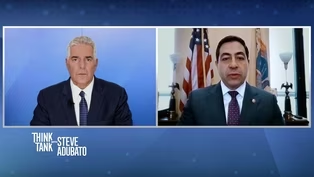
Former U.S. Sen. George Helmy addresses youth mental health
Video has Closed Captions
Clip: 12/21/2024 | 13m 59s | Former U.S. Sen. George Helmy addresses youth mental health (13m 59s)
Providing Support for PBS.org
Learn Moreabout PBS online sponsorship
- News and Public Affairs

Top journalists deliver compelling original analysis of the hour's headlines.

- News and Public Affairs

FRONTLINE is investigative journalism that questions, explains and changes our world.












Support for PBS provided by:
Think Tank with Steve Adubato is a local public television program presented by NJ PBS