State of Affairs with Steve Adubato
Asm. Louis Greenwald (D); Sen. Jon Bramnick; George Helmy
Season 9 Episode 34 | 27m 21sVideo has Closed Captions
Asm. Louis Greenwald (D); Sen. Jon Bramnick; George Helmy
Asm. Louis D. Greenwald (D), Assembly Majority Leader, examines some of New Jersey’s top issues. Sen. Jon Bramnick (R), 21st Legislative District, discusses the New Jersey gubernatorial election and civility in politics. George Helmy, EVP, Chief External Affairs and Policy Officer, RWJBarnabas Health, discusses the key areas a candidate needs to prioritize to make a successful shift as governor.
Problems playing video? | Closed Captioning Feedback
Problems playing video? | Closed Captioning Feedback
State of Affairs with Steve Adubato is a local public television program presented by NJ PBS
State of Affairs with Steve Adubato
Asm. Louis Greenwald (D); Sen. Jon Bramnick; George Helmy
Season 9 Episode 34 | 27m 21sVideo has Closed Captions
Asm. Louis D. Greenwald (D), Assembly Majority Leader, examines some of New Jersey’s top issues. Sen. Jon Bramnick (R), 21st Legislative District, discusses the New Jersey gubernatorial election and civility in politics. George Helmy, EVP, Chief External Affairs and Policy Officer, RWJBarnabas Health, discusses the key areas a candidate needs to prioritize to make a successful shift as governor.
Problems playing video? | Closed Captioning Feedback
How to Watch State of Affairs with Steve Adubato
State of Affairs with Steve Adubato is available to stream on pbs.org and the free PBS App, available on iPhone, Apple TV, Android TV, Android smartphones, Amazon Fire TV, Amazon Fire Tablet, Roku, Samsung Smart TV, and Vizio.
Providing Support for PBS.org
Learn Moreabout PBS online sponsorship- [Narrator] Funding for this edition of State of Affairs with Steve Adubato has been provided by South Jersey Industries.
The parent company of South Jersey Gas, and Elizabethtown gas.
IBEW Local 102.
Celebrating it’s 125th Anniversary.
The Turrell Fund, a foundation serving children.
Stockton University.
New Jersey Manufacturing Extension Program.
Congress Hall.
A Cape Resorts property.
Horizon Blue Cross Blue Shield of New Jersey.
New Jersey Public Charter Schools Association And by Eastern Atlantic States Regional Council of Carpenters.
Promotional support provided by NJ.Com.
Keeping communities informed and connected.
And by ROI-NJ.
Informing and connecting businesses in New Jersey.
[INSPRATIONAL MUSIC] - Hi, everyone.
Steve Adubato.
We kick off the program, back-to-back, two leading members of the state legislature.
In a little bit, we'll be joined by Jon Bramnick, Senator Bramnick.
We kick off with Assemblyman Lou Greenwald, who is the Majority Leader in the Assembly.
Good to have you with us, Assemblyman.
- Thanks, Steve.
Nice to be back with you guys.
- You got it.
We're taping this a week after a very important election.
Governor Sherrill will take office January 20th.
Top two or three issues you believe she faces, we face as a state?
Go ahead, Lou.
- Number one issue we face is how do we navigate the cutbacks coming from Washington?
Significant impacts.
I know during the campaign, it was a common refrain of Jack Ciattarelli that, you know, these aren't New Jersey issues, but very clearly, cuts to Medicaid impact our number one employer, hospitals and healthcare, it impacts our residents.
Hundreds of thousands of New Jerseyans rely on Medicaid plans to provide for their families, many of them are small employers.
That's the number one issue.
I think the second issue is something that has popped up recently, which are the utility rate increases that the governor-elect has talked about and starting to implement a plan.
I, myself, and my friend Craig Coughlin, have been meeting with industry leaders to start to put together a program to attack the rate increases, and make New Jersey a sending district for utility, as opposed to receiving.
And then the third is the ongoing issue in New Jersey, throughout my career and many of our careers, is the issue of property taxes that ties in directly to affordability.
- Yeah.
Assemblyman, one of the things about you that's always interested me is your interest in media.
This may not sound like a natural segue, but for those of us in public media, those of us in media, and understand the importance of media, you'll see a graphic that will come up.
It simply says, "Media matters," because we do, we do for a whole range of reasons.
But Assemblyman, what I'm fascinated by is you didn't just talk about it, you sponsored an initiative, which turned out to produce $2,500,000 for the New Jersey Civic Information Consortium.
What the heck is the Civic Information Consortium, why the money, and why do you care so much about the future of public media in the state, Assemblyman?
- Steve, it's a great issue, thanks for bringin' it up.
Again, this is a unique area where the cooperation between federal and state government is really, I think, being put under a spotlight.
President Trump and Washington have cut funding to programs like PBS and outlets to media, Journalism has been under attack.
journalists have been under attack.
That's a scary world.
You know, I've enjoyed my relationship in my 30-year career with journalists from papers across the state, many of them are gone today.
Ya know, the relationship that I used to have with press row, press row is not there anymore.
The opportunity to get public policy out to the public, to have elected officials be known by their constituents, to have candidates that just ran for office be able to be identified by their constituents in a way that they can share their ideas on public policy versus a 30-second commercial that maybe distorts who they are and what they stand for.
The reality is the Civic Consortium was a mechanism that Chris Daggett brought to me, I was proud to champion.
It's a bipartisan effort that has put, since 2021, $11,000,000 into building journalism directly in communities and grants that are sponsored by Chris Daggett and his organization under the Civic Consortium.
No government intervention of any kind, no weighing in, an absolute hands-off approach.
Ironically, Steve, when the program was started, there was a fear that government, much like you're seeing in Washington, would step in and pick winners and losers, and only award those who said nice things about us.
We have stayed completely hands-off on this and done a couple things.
One, try to encourage young people to go into this profession, as the profession changes.
The second is to invest in those local outlets, so that news, local journalism, can be directly conveyed through true journalists.
I tell young people all the time, newspapers used to be this resource that came to your home, left on your front step.
I was a paper boy back in the day, when I was a kid, and that's how we used to convey information with journalists.
I still love to hold a paper in my hand, Steve, and read the box scores, right?
- Yup.
- And the reality is that those journalists were trained professionals that had to get resource, they had to get sources that confirmed their stories, not just write opinions.
And the last thing I'll say on it is, look, we all watch the cable news stations of our choice, it's entertainment.
It's cloaked in news, but it's got opinions.
And they're good resources to spark your interest in something, but then it's left to you to dig deeper and do the research.
I've had a lot of friends say, "Oh my God, that's so boring."
Well, yeah, but that's what news was intended to be, it was supposed to be factual and 20 minutes that piqued your interest.
- So to the Assemblyman's point, and listen, I won't get on my soapbox, it's not my place, it's not appropriate, but I'll say this.
There's a reason why Lou Greenwald kicks off the program and Senator John Bramnick, a leading Republican in the state, comes after him.
Because folks know we don't have a horse in the race, we don't have an ideology, we don't have a point of view.
That's why different people with different perspectives, and opinions, and ideologies, and parties come on and join us.
There's somethin' to be said for that, but it's a lot easier to have people on who say rotten things about your, quote, "enemies."
And P.S., the President has called those of us in the media, "The enemy of the people."
I know you don't believe that, but finally on this... Excuse me, our graphic will come up, "Democracy in danger."
Without being too self-serving, Assemblyman, why do you believe calling those of us in the media "the enemy of the people" is dangerous for our democracy?
Assemblyman?
- Our most fundamental principle, our first amendment is freedom of speech.
And that freedom of speech needs to be conveyed in a nonpartisan way, in a factual base.
You're not my enemy if you disagree with me, and you're certainly not my enemy if you just are reporting facts, but I need outlets for people to be able to do that.
1/3 of people in New Jersey today, Steve, for your listeners, are getting their news from social media outlets, or friends and family; that's dangerous.
- You can get a quick, on TikTok, by the way, you can get an algorithm that tells you you're right about everything you think you believe, and that's dangerous why, Assemblyman?
- It's dangerous because those are based on algorithms, Steve.
Look, they're wonderful tools, I use them.
- Same here.
- I enjoy the entertainment aspect of it, but I know it's entertainment.
I also know that when I search something, it's based on an algorithm that continues to push similar content to me that is just reinforcing my belief, which may not be based on facts.
It is difficult.
And what journalists have always done traditionally is dissect those facts and present them to the listener or the reader in a way that allows you to form your opinion, not push your opinion to you over, and over, and over again to reinforce what may be a false narrative.
It has taken the curiosity out of the American people, and I think that jeopardizes our democracy.
- Assemblyman Lou Greenwald is the Assembly Majority Leader.
Next time he joins us, we'll talk about a whole range of other issues as we move into the Sherrill administration, and she, along with her administration and leading members of the legislature, attempt to tackle those issues.
Assemblyman, thank you so much for joining us, we appreciate it.
- Thanks for having me, Steve.
- You got it.
Stay with us, we'll be right back.
(grand music) - [Announcer] To see more State of Affairs with Steve Adubato programs, find us online and follow us on social media.
- We're now joined by State Senator Jon Bramnick of the 21st District, considered to be the funniest lawyer in New Jersey.
He has a comedy act.
You can check him out.
He doesn't do it in the state legislature though.
How you doing, Senator?
- Not considered.
I won the contest and I trademarked it.
So let's rephrase that.
"He is the funniest lawyer in New-" I'm like the Muhammad Ali of funny lawyers in New Jersey, okay?
- Yeah, do not throw the name Muhammad Ali around easily.
But I will say this, what was funny about the election, we're taping this a week after election, maybe nothing funny, but what was significant, Senator?
- What was funny is everybody thought it was close, and the Republicans go, "Oh, Jack's gonna win, Jack's gonna win."
I go like this, "He ain't gonna win."
I mean, stop, okay?
You know, Republicans had an echo chamber.
They must have forgotten that Donald Trump wasn't popular here.
And they must have forgotten that, you know who wins governor races in New Jersey on the Republican side?
Moderates.
- Name them, Tom Kean.
- Christine Whitman, and your friend Chris Christie ran against Steve Lonegan.
He was the moderate, at least at that time, before he ran for president.
- Hold on, Jack Ciattarelli, I've interviewed him a dozen times.
You've known him for years.
He's not a moderate Republican?
- Well, maybe years ago.
But then, hey, President Trump said he's 100% MAGA and he gave Trump an A, and he didn't deny he was a MAGA guy.
So how are you gonna win, okay?
- Do you think it's true that Jack Ciattarelli gave, and I don't like doing political insider garbage, but I've heard this by many sources, and I knew you heard it as well, Senator, that even though Jack Ciattarelli gave Donald Trump an A, Donald Trump was peeved, because he didn't get an A+ from Ciattarelli, and then was upset with him.
Could that possibly be true?
- Look, anything could be true with Donald Trump.
I don't know.
But that wouldn't-- - But you heard the same thing?
- Not officially.
I mean, look, that had nothing to do with the outcome of the election.
- But does it have to do with the loyalty the president expects from, or the fealty, whatever you wanna call it, of everyone around him, including Jack Ciattarelli?
He expected that.
- I'm not arguing with you.
I mean, that might be true.
I just don't know officially, right?
So that may be true, I don't know anything about it.
- How did it hurt Jack being so tied to Trump?
- Well, it's pretty simple.
President Trump is not really well liked in New Jersey, let's start with that.
He generally lost independents.
Now, when you run in New Jersey as a Republican, not only do you need some Democrats, but you need to win the independents big time.
So I always look at unaffiliated voters, right?
If unaffiliated voters are not voting for a Republican, you're going down.
So bottom line was, you know, this idea of a MAGA candidate is gonna win in New Jersey, I mean, that's as insane as you can get.
- Mikie Sherrill, new governor, top two or three issues she faces starting on January 20th, 2026, as governor?
Go ahead, Senator.
- Affordability, affordability, affordability.
Look, she talked about it.
Everybody knows that people are struggling.
You know, I know people who have really good salaries and they can barely make ends meet.
Everyone knows that's the most important issue.
Well, it's almost the most important issue.
The overwhelming problems with the Republican brand is why she won so well.
But what's most important to people is affordability.
- Connected to another issue we're involved in, the graphic will come up, it'll say Start Strong NJ, it's part of a public awareness effort we're involved in around childcare.
Affordable, accessible, quality childcare.
We've talked to you about this issue before, Senator.
How should the governor attack and deal with that, together with the legislature, starting in the new year?
- Well, you have to prioritize.
And working families need the most help, because they need childcare, they need housing, they need reasonable property taxes, meaning they can't continue to go up wildly.
So I have to tell you, there's no question that there's a big burden ahead of the new governor, whether it be Democrat or Republican.
So it's going to be a slow process to try to change the affordability situation in New Jersey.
But how do you solve that problem?
I guess you gotta do your best to stop spending, and it's very difficult.
She's got a lot of challenges, and I like her personally.
- So, let me ask you, you and Senator Cryan, Joe Cryan, have been out there on a civility campaign, if you will, talking in college campuses around the need for civility.
Help us understand, Senator, why demonizing those who disagree with you, calling them your enemy, no disrespect to President Trump, but he has called those of us in the media, "the enemy of the people," why is that a problem?
And why the heck are you and a Democrat, Senator Cryan, promoting civility in politics?
Senator?
- Well, you just said it.
Let's start with the fact that now we have the media, which is either on the left or the right.
It's very difficult to be in the middle.
- You know we're not.
- No, no, no.
Yeah, of course.
I get that.
But most of the time people turn off the TV unless it's exciting.
They wanna see a blog that tells them what they think their politics are or is, right?
So bottom line is, we went out there because, after Charlie Kirk was murdered, it was actually Senator Cryan who called me and said, "You know something?
We gotta go onto college campuses and say we don't hate each other."
And we talk about everything from the death penalty to guns, we talk about taxes, and the kids or the students ask really good questions.
We need so much more of that.
Because if you look at your own app, or you look at only your station, you know, Fox versus MSNBC, you're gonna never hear the other side.
So we go out, and I can't tell you how mesmerized students are.
They go like this, and you could drop a pin in the room, 'cause they don't see that anymore.
What they see is us versus them, and I'm tired of that nonsense.
- They are not our enemy, those who disagree, those who have different points of view.
They're just other Americans who have a different point of view.
I'm not on my soapbox, I'm just saying if we debate that or argue that, we're gonna be in serious trouble, which is why the graphic democracy and danger was up when the Senator talked about that.
- We're in serious trouble.
We're in serious trouble.
- As we speak?
- Absolutely.
This is really dangerous times when people say, "I hate my opponents."
Let me tell you, the future, if we continue down on this road where Democrats and Republicans hate each other, can't talk to each other, they can't compromise, that's not what democracy is.
There'll be a point where, you know, it will get really, really bad, in my opinion, unless somehow some great leader comes along and says, "Stop," and we're gonna need that.
- We'll keep talking to Senator Bramnick, as we have before, Assembly Majority Leader Lou Greenwald and others, both parties, different points of view.
Thank you, Senator, we appreciate it.
- Thank you, Steve.
- Stay with us, we'll be right back.
(grand music) - [Announcer] To see more State of Affairs with Steve Adubato programs, find us online and follow us on social media.
- We are honored once again to be joined by George Helmy, Executive Vice President, Chief External Affairs and Policy Officer at RWJ Barnabas Health.
Also, previously the chief of ctaff to Governor Murphy, and formerly a United States Senator.
George, great to have you back with us.
- So great to be back with you, Steve.
Thanks for having me.
- You have a unique vantage point.
I actually mentioned this to you offline, that as we speak, a new governor, Mikie Sherrill, is taking over January 20th.
There's a transition.
You came in as chief of staff, but you're not the original chief of staff to Governor Murphy, what that, but you understand transitions.
Long-winded way of getting to this.
What the heck are the key things that need to be accomplished in a transition from a campaign to governing for a governor?
- Yeah, I mean, you move from, as you said it well, you move from campaigning to immediately thinking about how you're going to govern.
Running an operation in the state of New Jersey, that's 60,000 employees, and basically a $60 billion business with a number of key divisions and authorities.
And so you go as a chief of staff or an incoming chief of staff, or someone running the transition, you're immediately looking at what are the governor's priorities over what period of time?
How do you effectuate that?
That's your first bucket.
And the second is how do you build a fully functional office?
And the third, after you've figured out what the front office looks like, is your key cabinet appointments and the sub cabinet positions that help them execute their mission, which obviously is also the governor's mission.
- How many people are in your ear as new governor?
- Oh, it's, you know, infinite.
How many people that matter with any experience?
A very small number.
But how many people have something to say to you as somebody who talked to you on the campaign, or wants an issue to be on your first hundred days?
That number is probably something I don't know, in the thousands.
- So what fascinates me is Dale Caldwell, our good friend from the higher ed world, who's gonna be the lieutenant governor, but then there's the chief of staff.
Here's my question, and I don't know if there's a clean answer to this.
What the heck is the connection between the governor, the lieutenant governor, and the chief of staff?
- That's a great question.
I think it really, it's a great question, and it's a different answer in every administration I've seen.
And also you could take that example and say the connection between a president, vice president, and chief.
- I was just thinking the same, sorry to interrupt.
That's unique, this will be unique.
- That's right.
- I'm sorry.
Sorry for interrupting.
- No, it's well said, Steve.
It's the relationship between the two principles.
The way we did it with, God rest her soul, Sheila Oliver, and our current LG, Tahesha Way, you know, we were the core team.
You have the governor, obviously, it was tip of the spear.
And then you have the lieutenant governor, his or her chief of staff, the governor's chief of staff, and the governor's chief counsel.
And that's your core apparatus.
And the mission there is to advance the agenda of the governor.
How do you execute?
How do you separate what's important from what's not important?
And how do you execute on the mission of the governor.
- As chief of staff, and obviously, we're not asking you to divulge anything, 'Cause you're also, you work with Mark Manigan as part of the executive team at RWJ Barnabas Health.
Let me disclose a longtime underwriter of public media in the state as well as our production operation.
But how important is it for the chief of staff, whether in a corporate setting or in a government setting, if you believe it's different, please share, George.
To push back in certain situations against the chief executive when you believe he or she is not on the right track?
- It may be one of your most important A, qualifications for the job to have that spine, that backbone, that confidence and that you are.
Usually the first voice and the last voice in the room that that governor takes.
And being able to confidently, with precision, and with information behind it, give that governor the best counsel you can give them, even if it is contrary to what they wanna do.
But what I always tell you know, leaders who, you know, as you said, and we're very proud of supporting, you know, this show and other community efforts, whether it's me giving advice to our CEO, or when I was giving advice to the governor, once the governor says this is the direction we're going and he's heard all of the options out there, that's the way you're going, and your job then is to execute it.
But in that closed room, you're the most trusted confidant, and you're not there to be a yes man, or a yes woman.
- You got me thinking about a lot of things.
And I'm curious about this.
For you, George, where do you believe loyalty begins to no longer being loyal to the chief executive by executing a policy, versus fealty, meaning it's blind loyalty?
And you know what I'm talking about.
What's healthy loyalty?
- Yeah, it's a great question.
I think the way I would answer that, Steve, is the guidance I give to young people who always, you know, ask me how did you achieve, you know, what you were able to do in your time in government?
And I always start by saying, you know, work for people who you believe in.
Don't chase the title.
If you're chasing the title of chief of staff, there's such a small percentage that will get it.
And you'll probably be unhappy.
If you're just chasing the title, and you'll do whatever to get that title, you will then devolve into fealty, but if you work for people you believe in, and you're willing as your prior question to have the confidence in your value, and what you're willing to bring to the table, and being that true confidant, you'll end up doing the job the right way, and you will be remembered for it.
And what I always say is, being in the room requires you to know when you need to exit the room.
- Give us more, please.
- Well, when you see things like that, you know, when loyalty is the number one requirement when I served as a senior staffer for Senator Booker, or a senior staffer for Governor Murphy or now in my current role, sure, you have to be loyal to mission and to the CEO, but that doesn't mean that you compromise your own values.
And it definitely doesn't mean you compromise anything against an ethical or legal code.
And the second, your principle is taking you down the road, I assure you, you are working for the wrong person.
- Wow, people can take that and extrapolate and think that through about the leaders who you're around and ask yourself the question, "Should you leave the room?"
And I appreciate what George is saying 'cause if you don't trust and believe in that leader at the core, that doesn't mean you don't disagree.
But this is an issue of integrity and character, not a bunch of other things.
Before I let you go, and thank you for joining us, and again, acknowledging RWJ Barnabas Health's involvement in public media in the state.
Self-serving question.
We're in a state where we don't know where public media is gonna be.
And I've talked to you about this offline as well.
Why do you believe it is so important that an independent public media entity exists in the state of New Jersey?
Please.
- I've answered this to you, I think in the most unique way.
You know, when I came to RWJ Barnabas Health of the options I had leaving government, it was because of our investment in community programs.
And I think it's strange for people to hear of public media and programs like this compared to our programs in food insecurity, or homelessness, or food pantries, 340B pharmacies, but the reality is, public media and independent journalism is so vital to the fabric of our communities and information sharing, that we do see it as an investment in making healthier and more vibrant communities.
And so that's how I feel so strongly about the work that you and your team do, to the other public programs that we participate, and our community health footprint.
It is who we are in the communities we serve.
- And final point, go on our website before we leave.
We're doing a series on trust in public health, and the reason for the need of trust in public health, and a vaccine, what you need to know about vaccines initiative in cooperation with the State Department of Health.
To George Helmy, the Executive Vice President, Chief External Affairs and Policy Officer at RWJ Barnabas Health.
George, thank you so much for joining us.
We appreciate it.
- Thank you, Steve, and thanks to your team again.
- You got it.
I'm Steve Adubato, we'll see you next time.
- [Narrator] State of Affairs with Steve Adubato is a production of the Caucus Educational Corporation.
Funding has been provided by South Jersey Industries.
IBEW Local 102.
The Turrell Fund, a foundation serving children.
Stockton University.
New Jersey Manufacturing Extension Program.
Congress Hall.
A Cape Resorts property.
Horizon Blue Cross Blue Shield of New Jersey.
New Jersey Public Charter Schools Association Eastern Atlantic States Regional Council of Carpenters.
And by these public spirited organizations, individuals and associations committed to informing New Jersey citizens about the important issues facing the Garden State.
Promotional support provided by NJ.Com.
And by ROI-NJ.
- Energetic music
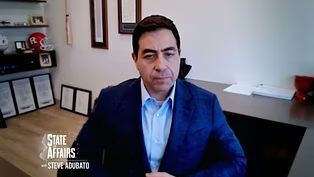
Addressing priorities needed for the governor-elect of NJ
Video has Closed Captions
Clip: S9 Ep34 | 9m 33s | Addressing priorities needed for the governor-elect of NJ (9m 33s)
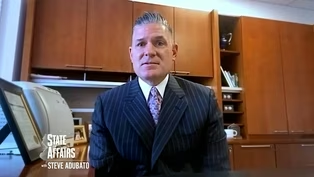
Asm. Greenwald examines independent media in New Jersey
Video has Closed Captions
Clip: S9 Ep34 | 9m 28s | Asm. Greenwald examines independent media in New Jersey (9m 28s)
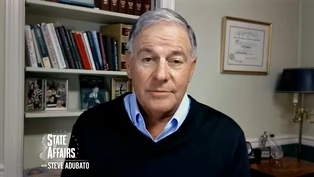
Sen. Bramnick discusses improving civility in politics
Video has Closed Captions
Clip: S9 Ep34 | 9m 26s | Sen. Bramnick discusses improving civility in politics (9m 26s)
Providing Support for PBS.org
Learn Moreabout PBS online sponsorship
- News and Public Affairs

Top journalists deliver compelling original analysis of the hour's headlines.

- News and Public Affairs

FRONTLINE is investigative journalism that questions, explains and changes our world.












Support for PBS provided by:
State of Affairs with Steve Adubato is a local public television program presented by NJ PBS