
Asw. Eliana Pintor Marin; Asw. Nancy Muñoz; Yannick Wood
8/12/2023 | 27m 4sVideo has Closed Captions
Asw. Eliana Pintor Marin; Asw. Nancy Muñoz; Yannick Wood
Asw. Eliana Pintor Marin, Chair of the Assembly Budget Committee, joins Steve to discuss Governor Murphy’s FY2024 Budget, including the StayNJ program; Asw. Nancy Muñoz, Deputy Minority Leader, examines why a large number of women are leaving politics; Yannick Wood, Director of Criminal Justice Reform at NJ Institute for Social Justice, discusses racial bias during traffic stops.
Problems playing video? | Closed Captioning Feedback
Problems playing video? | Closed Captioning Feedback
Think Tank with Steve Adubato is a local public television program presented by NJ PBS
Asw. Eliana Pintor Marin; Asw. Nancy Muñoz; Yannick Wood
8/12/2023 | 27m 4sVideo has Closed Captions
Asw. Eliana Pintor Marin, Chair of the Assembly Budget Committee, joins Steve to discuss Governor Murphy’s FY2024 Budget, including the StayNJ program; Asw. Nancy Muñoz, Deputy Minority Leader, examines why a large number of women are leaving politics; Yannick Wood, Director of Criminal Justice Reform at NJ Institute for Social Justice, discusses racial bias during traffic stops.
Problems playing video? | Closed Captioning Feedback
How to Watch Think Tank with Steve Adubato
Think Tank with Steve Adubato is available to stream on pbs.org and the free PBS App, available on iPhone, Apple TV, Android TV, Android smartphones, Amazon Fire TV, Amazon Fire Tablet, Roku, Samsung Smart TV, and Vizio.
Providing Support for PBS.org
Learn Moreabout PBS online sponsorship- [Narrator] Funding for this edition of Think Tank with Steve Adubato has been provided by Rowan University.
Proudly serving New Jersey for 100 years.
The North Ward Center.
Prudential Financial.
The Turrell Fund, supporting Reimagine Childcare.
New Jersey Sharing Network.
Horizon Blue Cross Blue Shield of New Jersey.
Here when you need us most.
PSEG Foundation.
Community FoodBank of New Jersey.
And by Newark Board of Education.
Promotional support provided by New Jersey Monthly.
The magazine of the Garden State, available at newsstands.
And by The New Jersey Business & Industry Association.
[MOTIVATIONAL MUSIC] - Hi, everyone.
Steve Adubato.
Way more importantly, we are honored to once again be joined by the honorable State Assemblywoman Eliana Pintor Marin, who is the chair of the State Assembly Budget Committee.
Assemblywoman, great to have you with us.
- Thank you for having me, Steve.
- Right outta the box, let's talk about this.
We're taping this toward the back end of July 2023.
Two great things from your perspective about the Murphy budget that was approved by the state legislature, both houses, please.
- Listen, the all time, once again consecutive full payment of the pension and more school aid.
- Okay, now, I know you're not gonna say this, but I have to ask you.
The Murphy budget, the state budget under Governor Murphy has gone up exponentially, dramatically.
It's incredible and record-setting.
A good thing?
- Look, there's always yes and nos to everything, right?
Especially when you talk, you know, about budgets, it's not that clear.
You know, we've been very lucky, very fortunate and had a large surplus.
We've also been able to, whatever money that we've been really receiving, put out a lot of money when you talk about property tax relief, school funding, the pension payment.
I mean, you name it.
So a lot of what we've received, we've been able to put out, and that's really been very helpful in the economy overall for the state of New Jersey.
- One of your colleagues in the Senate who knows a lot about fiscal issues, Declan O'Scanlon, Senator O'Scanlon has said, "This is an irresponsible budget for many reasons, but one of them is it anticipates money that's no longer coming in, that the federal government will no longer be sending to New Jersey COVID money and that the budget is just too big to sustain, spending too much, and we should be more fiscally prudent."
You say?
- So I think we have been fiscally prudent.
That's why we've been able to spend what we have.
That's why we've been able to put forth, you know, some of the tax relief that we've talked about, some of the K to 12 funding that we've been wanting to do for so many years, right?
And really, we've, the last year, had really tapped into that structural deficit, right, in trying to fix some of it.
These are issues that prolonged, you know, under many different administrations, right?
It's not to blame one over the other, but during the last administration when you cut to the bare bones, the economy just can't run if you're not putting money back in.
- Can we talk about Stay NJ, the Stay NJ initiative advocated by your colleague, Speaker Coughlin, Assembly Speaker Craig Coughlin?
Governor originally not for it.
Then whatever compromise took place.
Who really knows what goes on behind closed doors in Trenton?
There's an agreement.
Here's the question.
If in fact the Stay NJ program is a tax credit program for people who earn less than a $500,000 a year, correct?
- Yes.
- It goes up to $6,500 a year to help reduce your overall property tax burden.
If it's such a great idea, why the heck are we waiting till January, 2026 to implement it?
- So there is an implementation issue, Steve.
All the current programs that we do have, they're based on different tax years.
They're based on a different threshold of how much you make.
So in order to have treasury... Oh, and the other issue is two-thirds of the municipalities do not have live tax data, right?
So the state receives it after the fact.
So there is some implementation time in helping the municipalities get live data and then transmit that to the state.
And then the application process, right?
That's why there's a panel set up in order to coordinate the dates because if you're doing the senior tax freeze, you're doing it based on one date.
If you're doing the Homestead rebate, which is now the ANCHOR program, you're doing that on another tax date.
So it's really to have a coordination of benefits.
- But the bill will come due for the next governor and that administration, to be clear, because Governor Murphy will no longer be in office by then.
Correct?
- Correct, and that's why we've been trying to put money away.
We have been putting money away.
- We've had you on so many times in the past, and one of the issues we have talked about, Assemblywoman, and I want you to touch on this again, our Reimagine Child Care initiative.
The graphic will come up right now.
In the Murphy budget, what exactly is the status of the so-called Child Tax Credit?
What is it?
Why does it matter?
Please.
- So the tax credit is if you are making a certain amount of money and there's the threshold, then you receive a credit based on that and how much your child care is for.
So there's an offset there.
Does it help 100%?
No.
To be quite honest with you, Steve, I do budget, but I'm not the sole one that's in charge of this.
I think you know that from my perspective, we should've put in a lot more.
And we can always criticize everything, right?
There's never enough to go around.
But that is super important because without the Child Tax Credit, you cannot have moms or working families go to work and pay their bills.
- Hmm.
One more quick follow up on economics.
Your former colleague, the former State Senate President Steve Sweeney has an institute down at the Sweeney Institute at Rowan University.
He has argued that there's a, "Looming fiscal crisis, that we are about to fall off the fiscal cliff."
Hyperbole or reality?
- I think it depends on where the economy goes in the next year and a half to two years.
- Meaning what?
Help us understand that.
- Meaning because we've been fortunate.
Our unemployment rate is still down.
I mean, you go to any downtown area, especially mine, there's a help wanted signed on every window pretty much.
- Right.
- There's more need for different types of workers, not just highly educated, but just all thresholds of workers.
And I think that we've seen a slight adjustment in the inflation, a slight steady.
But if there's a real downturn, meaning that if people stop working, I think we're gonna be in trouble.
- State Assemblywoman Eliana Pintor Marin, not just representing the 29th Legislative District, but the chair of the Assembly Budget Committee, an incredibly important and some would argued the most powerful committee in the lower house or the upper house because it involves real money.
Assemblywoman, thank you so much for joining us once again.
- Thank you for having me, Steve.
- You got it.
Stay with us, we'll be right back.
To watch more Think Tank with Steve Adubato, find us online and follow us on social media.
- We're joined by State Assemblywoman Nancy Munoz, who's the deputy minority leader in the assembly.
Assemblywoman, you joined us on another segment talking about a whole range of issues, largely about nursing, and a little bit on childcare as well, but I wanted to make sure we talked about this topic.
There are many women who have left the state legislature, and I don't mean just members of the assembly running for the Senate.
I mean people who just quit.
There's a young assemblywoman, A woman of color, who served one term in the legislature and then dropped out along with many others.
What is going on, Assemblywoman?
- Well, obviously I can't speak for Assemblywoman Jaffer.
It was a personal decision.
I was on an interview with Assemblywoman Reynolds-Jackson, and she said that it's hard, but I say that this work is hard, and we should stick it out, and we need to do the work.
Many of the women on my side of the aisle were taken out not voluntarily.
Some of them were taken out because they were replaced by people within their own party at the primary level, and that's unfortunate because we lose years of experience, and that experience brings with it an understanding of how the process works and how to get things done.
Unfortunately, people go after in the election the woman oftentimes.
- What do you mean?
I'm sorry, Assemblywoman.
What do you mean go after the woman?
- Well, for instance, they will target Assemblywoman X and say, "You know, we're gonna run a primary against her rather than her running mate, who may be a male."
And I think that goes back maybe to the county line, to the county chairs- - The old party bosses?
Is that what we're talking about?
- Yeah, I mean, county chairmen or however you wanna call them.
And we have two really very, very effective women in District 11, which is Monmouth County, and they're working really hard, and their targets are on their back, and so I don't know if it's a perception, but I really think that the women do bring a unique perspective.
I worked in a profession, that was male-dominated for many, many years, meaning like healthcare.
Not nursing, 'cause nursing is still predominantly female.
But, we worked with males, which Medicine was predominantly male back in my early days.
And we learned to fight and stand up for what we believe in.
And the women who I know who have decided not to run, one of them it was decided for her, it wasn't her choice.
And so I think that that's an issue, and we have to look at that more than, I don't think that women- I wouldn't say the women are being more harassed or anything like that because I think that we're in a different world than we were years ago.
- But how is it in a party's interest, be it the Democratic or Republican party, to target women in office when more than half of the people who vote are women?
- I absolutely agree.
And, again, the women in 11 are being targeted not by my party but by the other party.
So, it'’s not... Perhaps it's a perception- - Excuse me, is it about running men against them?
- Actually, you know what?
I don't know.
I think that they may be females, but the point is, like ... in my district when I was the only female, I would be the person that would be targeted.
Now, I was there for less time, so perhaps that was why.
But you know, now I have- It's about raising money too, Steve.
- Is it harder to raise money- I'm sorry for interrupting.
Is it harder to raise money, in your opinion, as a woman in elective office, particularly in the legislature, than it is for a man?
It's hard to raise money any level on public television.
Trust me, I know.
But it's harder, and, if so, why is that?
- Well, I believe it's harder to raise money depending on your profession.
If you have certain professions, it's easier to raise money.
As a nurse, it's harder to raise money because there's no incentive, like I can offer nobody anything.
However, that being said, being the deputy minority leader and also being a member of the Budget Committee, having powerful positions, and the way you get there is by length of service, and we don't have length of service for very many females, and that's part of the problem is we need length of service to get you to the point where you could raise the money.
We only had four or five of us before this last election.
Now suddenly there were seven and two of them are not running for reelection, so we're losing females, so we don't have that length of service, and, again, it depends on what your profession is.
Certain professions have a much easier time raising money than others.
- Before I let you go, you, your family, your late husband, Dr. Eric Munoz, a great family friend of ours and just an extraordinary physician leader at University Hospital for many years in the Trauma area, and just look up Dr. Eric Munoz, also a member of the state legislature.
There's something you wanna share about University Hospital.
What is that?
- What I wanna share about University Hospital.
As a member of the Budget Committee, I'm appalled and it's unconscionable the way that they're treating University Hospital in this budget process.
University Hospital is only public hospital in the state of New Jersey.
It's a Level One Trauma Center for the northern part of the state, and it's renowned as a trauma center.
When this budget came down, it's only budgeted for $35 million for operational needs.
That doesn't even meet what they need for operational needs.
When I questioned the treasurer about this, I said, "Where did you come up with that number?"
They said, "It's flat-funded from last year."
I said, "It was inadequate last year."
Their hospital emergency room, which serves so many of us and could serve every single person in this state, if necessary, if needed, as a victim of trauma, it was built for 50,000 patient visits per year and is seeing over 100,000 patients.
- Why would the governor and the governor's office do that?
- Well, I asked that question.
I was simply given a blank look.
Steve, their HVAC system does not work if it's less than 17 degrees or greater than 88 degrees.
That means that if it's freezing out, the staff is running around putting blankets on patients.
The operating rooms are too small.
The trauma units, which have saved countless numbers of people, are too small and they're separated by curtains.
I was told by a plastic surgery resident, much of their work is done in the emergency room, that a police officer had to hold a flashlight so that she could suture a prisoner in the hall.
The lack of privacy, the lack of dignity in that place where the patients deserve it.
University Hospital deserves more, and shame on the State for not allocating more money.
They're asking for $400 million just for operational costs just to get started.
But at the very least, have a sit down, have a conversation.
We have one public hospital in the state, a place where any one of us who gets in a car accident, and I pointed this out in every single committee meeting I had with every commissioner, could end up there.
We need to do better for this.
Newark deserves better.
- Assemblywoman Nancy Munoz, I assure you we will ask the governor those questions and the Commissioner of Health and any other member of the Murphy administration involved in that decision.
We're taping this right before the end of the budget cycle, which is June 30th.
We'll see what's actually in that budget.
Assemblywoman, thank- - Just to be clear, as the minority party, we have not seen those final numbers, so that was the number that was given to me when they came before us initially.
- Got it.
We'll stay on top of it.
- Thank you, Assemblywoman.
- Thank you so much.
- Stay with us.
We'll be right back.
To watch more Think Tank with Steve Adubato, find us online and follow us on social media.
- We're now joined by Yannick Wood, director of Criminal Justice Reform at New Jersey Institute for Social Justice.
Their website will be up.
Yannick, great to have you with us.
- Yeah.
Thanks for having me, Steve.
- Let's jump right into this.
So, racial disparities on our road.
The Attorney General Matt Platkin announced a new pilot program that has to do with New Jersey State Police under his purview and the stops going on on our roads.
A couple of numbers, if I can put them out there and you can respond.
People can decide whether this is, quote, racial profiling or not.
Black motorists are 89.8% and Hispanic motorists are 46.4% more likely to be searched once stopped than white motorists.
Black motorists are 88% and Hispanic motorists 57% more likely to be arrested once stopped by New Jersey State Police than white motorists.
Finally, Black motorists are 130%, Hispanic motorists 28% more likely to experience force once stopped by the state police.
Yannick, please talk about where we are and how bad this is.
- Yeah, well, first of all, I just wanna give Attorney General Platkin credit for acknowledging something that motorists of color have known to be true for a long time, and that's that there's racial bias in traffic stops.
But I think the most important thing is what is the attorney general going to do about it?
And we'll see what happens at the end of this pilot program.
- What's the pilot program supposed to do?
- Well, you know, I'm still learning what's gonna actually happen in the pilot program along with the public, but it seems like they're going to try to come up with a system where state troopers could advance traffic safety without perpetuating racial bias.
- Okay, so let's talk about this.
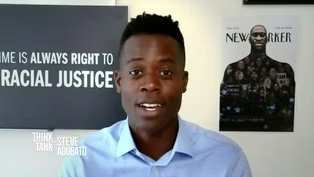
And you have the "New Yorker" cover over your left shoulder with George Floyd.
Let's talk about this.
Let's not talk about particulars of policy, let's just talk about real-life experiences.
To what degree have you experienced, quote, unquote, driving while Black?
- Well, I actually have a very interesting background, 'cause I used to be a part of law enforcement.
I used to be a prosecutor in Queens in New York City.
So, you know, I had that perspective.
I'm also a Black man, the most targeted group as it were, with respect to, you know, these traffic stops.
And I personally have not been pulled over as a result of, you know, racial bias, but, you know, as a prosecutor, you know, I could just think back to, you know, a particular case of mine where, you know, I had an officer make a comment, saying that, "Oh, this person didn't look like they belonged in this neighborhood."
So those are the types of things, you know, that I observed.
Aside from the motor context, you know, I've been racially profiled in convenience stores, and just walking down the street I've been racially profiled.
And that's the reason why I began this segment, by talking about that this is something that people of color, people in New Jersey know to be true.
And so this report is just confirming something.
It's not new.
This type of profiling has existed for a long time.
What I thought was very interesting in some of the statistics that the attorney general put out there is, that even though they're more likely to search Black motorists and Hispanic motorists, Black and Hispanic motorists are less likely to have evidence of whatever they're trying to find through these searches.
So it shows you that the racial bias is not even furthering public safety, it's not even furthering traffic safety.
So I think that it needs to be a hard look at the reason for why we do these traffic stops and to come up with recommendations for how we could further traffic safety and not just be reduced to these racial biases that we've seen for generations.
- By the way, in the 1990s, the racial profiling issue exploded in the state of New Jersey under the Christie Whitman administration, Governor Whitman.
You can go back and read about how bad things were.
And to be so far along, 30 years after that time when things were pretty bad, we're still talking about this.
Let me stay on this, if I could Yannick.
George Floyd, I mentioned the "New Yorker" cover behind you.
From your perspective, what does George Floyd, what does the George Floyd case represent to you, not just professionally, but personally?
- Well, I think George Floyd's murder was a disruption of the status quo of how law enforcement unnecessarily just preys upon people of color, particularly Black men.
It was a disruption of that status quo and it was a racial reckoning where we could see all sorts of systems of racial oppression in all these other types of government institutions and in industry.
And it was a moment where we were all jolted to action to see how we could disrupt these things.
I think when it comes to traffic stops, there needs to be a new philosophical approach to how officers do these traffic stops.
- What do you mean?
- And what I mean by that is, you know, when I went to law school and when I was, you know, in the prosecutor's school, you know, when we were doing the initial training, they spoke about pretextual stops.
That was a term, a legal term that they used, where it was allowed for an officer to pull somebody over for, you know, a code violation or something like that, some moving violation, and then to use that as the opportunity to launch an ad hoc investigation, to escalate the case into something else.
- So it's a pretext.
- As a pretext, exactly, right?
- What's wrong with that approach?
What's wrong with that approach?
- Well, you know, that unnecessarily escalates benign traffic stops into something that shouldn't have to be escalated.
You know, the statistic I mentioned before is that Black and Hispanic motorists in New Jersey who are stopped by state police, more likely to be stopped than white motorists, are less likely to have evidence of crimes.
So it seems like this escalation of trying to search vehicles, trying to ask people, "Hey, you don't have anything that you're supposed to have, or that you're not supposed to have?"
or, "You don't mind if I search your vehicle?"
it seems like that type of conduct is leading not to public safety, but leading to harassment of people of color in New Jersey.
I think the new philosophical approach needs to be that officers should issue more warnings.
If it's truly about traffic safety, then they should use this as a teachable moment, to say, "Oh, you know what?
Your taillight is out."
And I'll do you one better, other states, I know in Long Island they've been doing this, in California and other states around the country, they've been allowing officers to hand out vouchers so that way people can get their taillights fixed, their brake light fixed, or their headlights fixed, because nobody wants to be driving with a broken taillight.
But that's not something- - But we don't do that in New Jersey, we don't do that in New Jersey?
- As far as I know, we're not doing that.
- We're not.
- But I think that that could be part of this pilot program.
I mean, we're coming up with ideas right now for how we could solve the issue, that's one way of solving the issue.
- Complex stuff, to simply call it racial profiling, saying we have to fix the problem of racial profiling, we have to understand it and we have to acknowledge it and we have to break it down and be committed to dealing with it.
And those of us who say, "Hey, it's not a big deal," it's usually because it's not happening to us.
That being said, Yannick Wood, Director of Criminal Justice Reform at New Jersey Institute of Social Justice, I wanna thank you so much for joining us.
We appreciate it.
- Thank you so much.
- I'm Steve Adubato, thanks for watching, and we'll see you next time.
- [Narrator] Think Tank with Steve Adubato has been a production of the Caucus Educational Corporation.
Funding has been provided by Rowan University.
The North Ward Center.
Prudential Financial.
The Turrell Fund, supporting Reimagine Childcare.
New Jersey Sharing Network.
Horizon Blue Cross Blue Shield of New Jersey.
PSEG Foundation.
Community FoodBank of New Jersey.
Newark Board of Education.
And by these public spirited organizations, individuals and associations committed to informing New Jersey citizens about the important issues facing the Garden State.
And by Employers Association of New Jersey.
Promotional support provided by New Jersey Monthly.
And by The New Jersey Business & Industry Association.
How do you create change?
By cultivating hope.
And we see that every day, in the eyes of our preschoolers, in the souls of the seniors in our adult day program, in the minds of the students at Robert Treat Academy, a national blue ribbon school of excellence, in the passion of children in our youth leadership development program, in our commitment to connections at the Center for Autism, and in the heart of our community, the North Ward Center, creating opportunities for equity, education, and growth.
Analyzing Racial Bias During Traffic Stops
Video has Closed Captions
Clip: 8/12/2023 | 9m 56s | Analyzing Racial Bias During Traffic Stops (9m 56s)
Asw. Pintor Marin Talks Murphy's FY2024 Budget
Video has Closed Captions
Clip: 8/12/2023 | 8m 33s | Asw. Pintor Marin Talks Murphy's FY2024 Budget (8m 33s)
Why Are Such a Large Number of Women Leaving Politics?
Video has Closed Captions
Clip: 8/12/2023 | 9m 39s | Why Are Such a Large Number of Women Leaving Politics? (9m 39s)
Providing Support for PBS.org
Learn Moreabout PBS online sponsorship
- News and Public Affairs

Top journalists deliver compelling original analysis of the hour's headlines.

- News and Public Affairs

FRONTLINE is investigative journalism that questions, explains and changes our world.












Support for PBS provided by:
Think Tank with Steve Adubato is a local public television program presented by NJ PBS