State of Affairs with Steve Adubato
Asw. Nancy Muñoz; Roger León; Robert Torricelli
Season 7 Episode 12 | 26m 51sVideo has Closed Captions
Asw. Nancy Muñoz; Roger León; Robert Torricelli
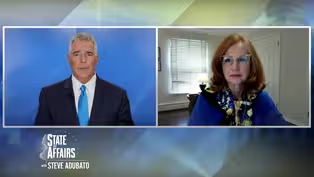
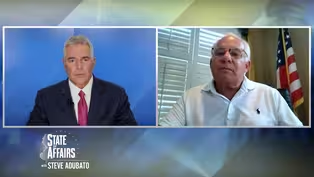
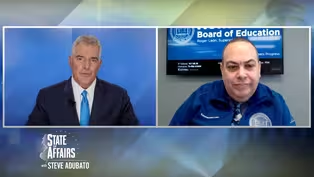
Assemblywoman Nancy Muñoz (R), Deputy Minority Leader, sits down with Steve Adubato to address the nursing shortage and nurse and physician burnout; Then, Superintendent of Newark Public Schools, Roger León, discusses the ways the pandemic impacted learning loss; Former U.S. Senator Robert Torricelli (D) talks about the need for a third party and why the nation needs more political options.
Problems playing video? | Closed Captioning Feedback
Problems playing video? | Closed Captioning Feedback
State of Affairs with Steve Adubato is a local public television program presented by NJ PBS
State of Affairs with Steve Adubato
Asw. Nancy Muñoz; Roger León; Robert Torricelli
Season 7 Episode 12 | 26m 51sVideo has Closed Captions
Assemblywoman Nancy Muñoz (R), Deputy Minority Leader, sits down with Steve Adubato to address the nursing shortage and nurse and physician burnout; Then, Superintendent of Newark Public Schools, Roger León, discusses the ways the pandemic impacted learning loss; Former U.S. Senator Robert Torricelli (D) talks about the need for a third party and why the nation needs more political options.
Problems playing video? | Closed Captioning Feedback
How to Watch State of Affairs with Steve Adubato
State of Affairs with Steve Adubato is available to stream on pbs.org and the free PBS App, available on iPhone, Apple TV, Android TV, Android smartphones, Amazon Fire TV, Amazon Fire Tablet, Roku, Samsung Smart TV, and Vizio.
Providing Support for PBS.org
Learn Moreabout PBS online sponsorship- [Narrator] Funding for this edition of State of Affairs with Steve Adubato has been provided by Holy Name.
This place is different.
The Turrell Fund, supporting Reimagine Childcare.
New Jersey Sharing Network.
Horizon Blue Cross Blue Shield of New Jersey.
Here when you need us most.
PSEG Foundation.
Operating Engineers, Local 825.
New Brunswick Development Corporation.
The New Jersey Economic Development Authority.
And by NJM Insurance Group.
Serving New Jersey'’s drivers, homeowners and business owners for more than 100 years.
Promotional support provided by Northjersey.com and Local IQ.
Part of the USA Today Network.
And by Insider NJ.
[INSPRATIONAL MUSIC] - Hi, everyone, Steve Adubato.
We kick off the program with a distinguished member of the state legislature, State Assemblywoman Nancy Muñoz is deputy minority leader.
That would mean, Assemblywomen, that's the minority leader, that's the Republican Party, right?
- Correct.
- Just checking.
- Minority that is the key there.
- Exactly, Assemblywoman, you've been with us many times, but in addition to your work as a state legislator, particularly focused on health care issues, 35 years as a nurse, fair, is that accurate?
- More than that as a nurse, but probably years working as a nurse, yes, that's accurate.
Actually, I graduated a long time ago, and I still have my nursing license.
- The most significant challenge facing the nursing profession today is?
- Right now the biggest challenge I believe is seeing, we have a tremendous shortage of nurses.
And having this tremendous shortage of nurses impacts the ability to deliver care, 'cause we simply don't have enough nurses.
I think COVID had an impact on it, people who were, you know, nearing retirement decided that it was time to retire, people were stressed out because of COVID, and young people aren't entering the profession.
The other problem we have, Steve, is that we probably don't have enough slots for professional nursing education in the state, which is an issue.
You know, I've been working, for the 14 years I've been in a legislature, on how we can help that issue.
You know, the community colleges are in a position to do the preliminary education of the nurses, the pre-science courses, the chemistry, the biologies, the microbiology, et cetera, and then transition into the baccalaureate program.
So, you know, we need a very coordinated and smooth transition from one to the other.
And I've actually worked with several of the community colleges, i.e.
Union County College, to allow them also to to grant a bachelor of science in nursing.
The courses would be the same, qualifications would be the same, they would take the same test.
So I think we need to be more flexible in our thinking on how we educate the nurses.
I'm a real strong believer in a bachelor of science in nursing should be what everyone should strive for, and I think that we can do it if we work together.
- The other issue that I think about, 'cause we've had so many health care leaders on talking about this, is the pay for nurses.
And that there are many who argue that these traveling nurses who are not staff nurses, they're getting paid so much more moving from hospital to hospital, hospital system to hospital system, on a day rate, or based on a day rate, that allows them to make more than if you were a staff nurse.
So the question becomes where's the incentive to be a staff nurse?
- That's a really good point.
Traveling nurse is not for everyone, obviously, because a lot of nurses, you know, have families and they need to be able to, you know, live near their family.
And the traveling nurse program actually lets you move around the state also.
And, you know, the traveling nurse program was set up initially so that we could fill in those slots where we had shortages, and then when they can overcompensate, meaning they pay much more.
You know, and I think we have to factor in, and I don't know the answer to this, you know, all the benefits that nurses get who work within the hospital system.
So, you know, you have to add in another 30% on, 33% on to your pay when you talk about benefits such as health care, and vacation time, et cetera, et cetera.
So we have to look at that.
You know, I've been a strong proponent that hospitals should offer continuing education for nurses who wanna get their bachelor's degrees, loan forgiveness programs for nurses who will come to work for them, especially in those hospitals that are in most in need, underserved areas such as, you know, our urban areas where we need more nurses.
You know, loan forgiveness programs, we do it in other professions, we do it in medicine, we do it in psychiatry, you know, we should be doing it in nursing as well.
You know, if you commit to five years in a underserved area, you know, we'll take off, you know, whether it's whatever the X number is per year off your student loans, that would incentivize nurses to come and stay.
- Real quick, follow-up on this, burnout, I mean, I think a lot about the issue of wellness, you know, and for physicians and nurses, how hard is it to calculate, Assemblywoman, the burnout factor?
Burnout is such a ridiculous word.
The impact, the psychological, emotional, physical impact of COVID on nurses.
- That's a really good question, because it really is hard to quantify.
And I think for every person its personal.
I believe that every, depends on how every institution handled the issue of Covid.
You know, I have lots of friends in nursing and a lot of places set up teams that I think that the teams worked together.
You know, they brought nurses who worked on the floors and brought them to the intensive care units, and they worked in four-member teams so that they had each other to depend on.
I think that people who were broad thinking and could actually look at ways to make sure that those people who don't have a background in intensive care nursing had the backup that they needed.
And I think that that's where we need to be as far as like supporting, you know, the new nurses with backup from longtime nurses to work collaboratively as a team rather than throwing people into a system that says like, you know, "Sink or swim."
And I really feel like that backup, that teamwork is integral to health care delivery.
'Cause, you know, the nurses and doctors, and all the health care professionals work together.
We should be looking at that and how we can better facilitate that to prevent that burnout.
- Real quick point before I ask you about child care.
Assemblywoman Muñoz volunteered during COVID, jumped in onto the front lines, if you will, to help out.
She's not gonna say that, but it needed to be said.
Nancy, let me ask you this, child care, our initiative Reimagine Child Care, the graphic goes up right now talking about the need for more affordable, accessible, quality child care.
How high a priority on your legislative agenda is this issue?
- You know, it's an issue I've definitely been working on for many years now.
And I think it is a priority if we wanna get people back to work.
You know, I put in a piece of legislation with Assemblywoman Pintor Marin, you know, who's from Newark.
- The Ironbound, that's right.
- It is, you know, to have child care available at the State House for those who work.
You know, how do we get more women into the legislature?
Partly by allowing them to be able to get to work.
So, you know, we're looking at all of these things.
You know, if we go back to health care, many hospitals figure out ways to provide child care at the facility if they have the room, which, you know, will bring us to the topic of hospitals having the ability, or any business, to provide access to child care.
And also we have to be mindful that most of the child care providers in this state are small businesses run by women.
And we must do everything we can to help these small businesses both in facilities and in ways that we tax people, and ways that we present this.
We wanna make sure the state doesn't move it away from these small businesses.
'Cause this is really a leg up for many, many people is to start a small business, and to succeed, and to be part of the solution to this issue.
- Next time we have the Assemblywoman with us.
we're gonna try to, we will not try to, we'll have a comprehensive conversation about the number of women who have left the state legislature, and the need to have more women involved in elective office, particularly in the state legislature.
Assemblywoman Nancy Muñoz, who is the deputy minority leader that is the deputy leader of the Republican Party in the State Assembly.
Thank you so much, Assemblywoman, we appreciate it.
- Thank you very much, thank you.
- Stay with us, we'll be right back.
(grand music) - [Announcer] To watch more State of Affairs with Steve Adubato, find us online and follow us on social media.
- We're now joined by Roger León, who is the superintendent of Newark Public Schools.
Superintendent, good to have you with us.
- Thank you for having me.
- We are actually doing this at the end of the school year, the end of June, 2023.
Number one lesson that you have learned in this year where unmasking has taken place and we're further away from COVID than ever.
Biggest lesson that you've learned as the leader of the school system?
- Oh my goodness.
There are a number of important lessons that have obviously been learned.
The urgency of the moment has just been reaffirmed.
There's a lot of work that needs to be done to challenge our students to move the work, and that just continues to be a reality today.
- Talk about learning loss, I mean, there's a lot of rhetoric around it, but what's the reality of the degree to which students in the Newark public schools have lost in terms of where they should be, where they need to be, grade-wise, academically, please, Superintendent?
- Yes, we put things into perspective.
So today's reality, you take a senior in high school, their last normal schooling, with the exception of their return back last year, was in eighth grade.
So the disruption to their freshman year, their high schooling, has been unlike any other graduating class ever, not having its full compliment, learning from home a good portion of almost 50% of their high school years.
The national trends are happening here in Newark as well where we see older students impacted a little less than our younger students.
That English language arts is the area where growth is demonstrated far quicker than in math.
So the disruption for a good year and a half to schooling has had a significant impact that we're still realizing today, even though there are signs of hope that clearly show that we're moving in the right direction.
- Superintendent, and by the way, the math piece, I just wanna mention this 'cause I wanna talk to you about social and emotional issues as well.
Standardized tests, which there's a whole range of discussion about that, debate about it as well.
6.8% of Newark students scored at grade level in math compared to 24% statewide.
Explain to folks what some of the primary reasons for that would be.
- Well, we first look at what are we comparing?
So we're comparing scores from 2019, which is pre-pandemic.
No one was even thinking about the amount of learning from home, the impact on social, emotional learning needs of students, regardless of whatever school type that they were attending.
And then the impact of the assessment that actually was administered last school year.
So the majority of those students were not even in school or at least 62% of our students were just returning back to school last school year.
We had 38% of our students that actually returned in April of 2022.
So while we do a lot of analysis, we're looking at students who have been with us during those entire two different time periods, students that have been with us during the entire duration of the actual pandemic.
So when we do all of these comparisons, we see students who are with us the longest actually did far better than students who were just coming into our school system, meaning that the impact of the response to the pandemic did differ from school types outside of the city of Newark.
So when you're comparing those two time periods it's convenient to forget what actually has in fact happened.
The inequities that did exist.
The issues that we needed to address that were quite profound, like making sure the students had technology at home.
- I was just gonna say technology, which is an economic issue for many.
- Well, technology is just one aspect of it.
'Cause there's actually having the hardware, but if you don't have wifi access it doesn't matter how many computers you actually have in your household.
So making sure that students actually had that as well.
And then just given the way that the city is organized, we had a number of students, over 2,500, that we issued hotspots for because not only technology, but the wifi access was just not accessible to them.
So that's one aspect of it.
One of the things that I think I previously shared was that there are 8 million meals that we distributed during the height of the pandemic.
So food inequities that were also impacting our students.
And I would also wanna highlight that while many people had the luxury of working from home, many of our parents were the first responders, were essential workers and they're the ones who actually made everyone's reality of working from home more of a reality.
So we had several issues at like, and I'm not talking about any excuses, I'm just saying that to understand the magnitude of what we are addressing, you need to actually not forget any of the factors that actually got us to where we are right now.
- Got a couple things, I'm gonna ask about teachers and summer school in a second, but I also wanna disclose that in collaboration with Newark Public Schools, we're doing a series of Powering Equity and Social Justice, part of our Stand and Deliver series.
Superintendent, summer school.
Is it mandatory for certain students in Newark right now?
- Absolutely.
So we have a cohort of students at the elementary level where summer school is mandatory.
We're gonna intensify during the month of July and August, accentuate some of the work that we were doing during the course of this year and really focus on literacy and mathematics skills for the next two months.
- Got it.
- That's just one aspect of it, I didn't want everyone to think that our summer program, so we call it summer program.
There are basically three components to it.
The intensified mandatory program for elementary students, the accelerated programming that we're affording students that are in our high schools, and then just a lot of fun activities whether it's during the day or way into the evening, opportunities that we've increased for students of all grades.
- Got it, Superintendent, to what degree is there a significant teacher shortage in the public schools in Newark?
- Well, the national teacher shortage is real.
One of the realities that impacted us in Newark was the creation of new positions because there are two trends that are occurring nationally that we are experiencing its impacts but not as profoundly.
The teacher shortage and enrollment.
Our enrollment has increased incredibly, way close to about 40,000 students over the course of the last eight years or so with about 35,000 being our lowest in around 2013, 14.
So our enrollment is going up which means we had to create new positions.
So over the course of the summer our creative strategies as well as what we call the NTU Reopener were essential towards addressing the 700 teachers that we needed to hire, and did so over the course of this past summer.
So we've had about 60 or so vacancies that we've carried for the year.
- A daunting responsibility.
That's the Superintendent of the Newark Public Schools, Roger León.
Superintendent, thank you so much for joining us.
We appreciate it.
- Thank you for having us.
I appreciate you.
- You got it.
Stay with us.
We'll be right back.
(grand music) - [Announcer] To watch more State of Affairs with Steve Adubato, find us online and follow us on social media.
- We're now joined by Robert Torricelli, former United States senator in the great state of New Jersey.
Bob, good to see you.
- Nice to see you, Steve.
- You are still engaged, involved, and care deeply about representative democracy.
Our series, "Democracy at a Crossroads," the graphic will come up.
You were advocating together with the former governor, Christine Todd Whitman, a third party.
Seriously?
Could it work, A, (Robert laughs) and B, why is it so necessary?
- Well, having given my entire life to the Democratic Party, it is a little bit of a man bites dog story.
You know, Steve, I think a lot about my 20 years in the Congress and the years before that in the White House and what I saw and what I learned and the current state of affairs, and it's led me to a few strongly held beliefs.
One, that despite the rancor in American politics, the debate is awfully stale.
There are ideas expressed, but very few new ideas, very few new points of opinion and no new interests.
It's the same interests with the same arguments back and forth.
And one way that you deal with that is, it may be a third party, if not a third party, fusion voting.
And that- - What does that mean?
- Well, there are times, believe it or not, against all evidence, that the Republicans can have the best candidate.
It can happen.
And I would like to be able to vote for that person without voting for a Republican.
As there are people who would vote for a good Democratic candidate without necessarily voting for the party.
The best example of this in our lifetime, of course, is John Lindsay, where you had both parties in New York City stale, New York City was in crisis, most New Yorkers were not going to vote for a Republican for mayor.
(indistinct) - Which Lindsay was, but he was also, wasn't he a part of the Liberal Party?
- He's the Liberal Party.
So New York is a good guide on this, and it's one of the reasons why I think New York politics has been more vibrant, sometimes it's more ideological and easier for new forces to break in.
Now, it's worked both ways.
John Lindsay became mayor of New York because the Democratic Party got stale, really should've lost the election.
But as I say, people weren't gonna vote for a Republican.
The opposite happened when Buckley became a US senator for New York on the conservative line.
The party was changing, the Reagan revolution was starting- So a lot of Republicans did not wanna vote for the Rockefeller Republican Party in New York.
They were conservative, this was part of the new Reagan revolution, and they voted for Buckley.
All I'm suggesting in this is that mixing this up more, getting more points of view involved, I think's healthy for everybody.
- But Bob, you understand politics better than virtually anyone I know.
To what degree would the Democratic and Republican Party, and those who are in elective positions from those two parties, be in favor of that?
How would that even happen?
- Well, it kind of depends where you are in the party.
For example, where I now live, in Hunterdon County, my Bergen roots now behind me, in the big race last year between Tom Kean and Malinowski, you simply couldn't get enough independents in Hunterdon County to vote for Malinowski.
They would not pull a Democratic left.
So I think a lot of liberal Democrats argued at the time, and were right, had they had the chance to vote for Malinowski on a liberal line or a different line, independent line, he would've won.
It would've mixed it up more.
So I think you will get elements of each party that will do this.
You certainly will with Republicans 'cause there are many Republicans who are more for conservative doctrine than they are for the Republican Party as an institution.
Many more.
So I- - For Donald Trump and the MAGA movement.
- And now you've got that.
You've got many principled Republicans who simply will not vote for Donald Trump but would like to vote on a conservative line.
I don't, in a democracy, I think, by and large, options help in getting more people and more points of view.
- Bob, I've heard Governor Whitman say this, and then I think you're in the same place on this... First of all, is there a name of the party?
- Well, the people are different parties.
I mean, they're already is a Workers Party in New Jersey, a Peoples' Workers Party.
There's been an Independent Party some have formed.
I'm not part of that.
I am and will always be a Democrat.
But I think you would see, if this were to open up, that you could run on multiple lines, you undoubtedly would say the Workers Party and you'd see a liberal and a conservative party.
- But if an independent, if a third party candidate ran for president and people who are ideologically where you are on most issues were then to realize that that third party candidate, if that third party candidate was more ideologically aligned with you and some other folks who believe some of the things you do, those votes would, say they came from the Democrat, Joe Biden, and Donald Trump, if he's the Republican nominee, were elected.
- Ah, but if you have fusion voting.
- Go ahead.
- I can vote for the Liberal Party in New Jersey, which can be committed to the same electors or the same candidate as the Democratic Party.
The best example of this would be, in the Republican Party if somebody wants to vote Republican but doesn't wanna vote for Donald Trump, they could vote for someone else who is claiming both lines.
It's the John Lindsay case all over again.
I can vote for a liberal, I don't have to vote for a Republican, but I want John Lindsay.
- Do you see this happening, Bob, before the next presidential election?
- No, but I think we do get there.
Which kind of leads me to, I said there were two things I've been thinking about- - Go ahead.
- One is related, but different.
You should do this 'cause you were in public office too.
A lot of people sit back and think about- - But Bob, one term in the legislature doesn't even count, but go ahead.
(both laughing) - So a lot of people sit back and think about all the good things they did in government, okay?
I spend more time thinking about the mistakes I made.
What were my bad votes?
And I've noticed something about every bad vote I cast.
Contrary to public belief, it's where there was consensus, not opposition.
People think the principal problem in American politics today is that no one can get along, there's no bipartisanship.
Well, that is a problem.
Make no mistake about it, it's a problem.
But so is stampeding, where both parties align.
Think about, in our lifetime, the worst policies of the United States government.
Vietnam, initially bipartisan.
Far and away, the second Gulf War was a bipartisan disaster.
The PATRIOT Act.
And I could go through six or seven of these that I was a part of.
I'd give my eye teeth to get those votes back.
But at the time, it was everybody.
And when I talk about a fusion voting and getting two other parties, you know, you could be a Democrat but you would know you had another line to run on if you went against the leadership on one of these votes.
- Bob Torricelli, giving us an awful lot to think about, and staying engaged and involved, making a difference.
Former senator, United States Senator Bob Torricelli.
Bob, thank you so much for joining us.
(Robert speaks indistinctly) We'll make sure we continue the conversation.
All the best.
I'm Steve Adubato, that is Bob Torricelli.
We'll see you next time.
- [Narrator] State of Affairs with Steve Adubato Is a production of the Caucus Educational Corporation.
Funding has been provided by Holy Name.
The Turrell Fund, supporting Reimagine Childcare.
New Jersey Sharing Network.
Horizon Blue Cross Blue Shield of New Jersey.
PSEG Foundation.
Operating Engineers, Local 825.
New Brunswick Development Corporation.
The New Jersey Economic Development Authority.
NJM Insurance Group.
And by these public spirited organizations, individuals and associations committed to informing New Jersey citizens about the important issues facing the Garden State.
And by Employers Association of New Jersey.
Promotional support provided by Northjersey.com and Local IQ.
And by Insider NJ.
- I am alive today thanks to my kidney donor.
I am traveling and more active than ever before.
- I'm alive today thanks to my heart donor.
I'm full of energy and back singing in my church choir.
- I'm alive today thanks to my lung donor.
I'm breathing easy and I'm enjoying life'’s precious moments.
- They are about 4,000 people in New Jersey waiting for a life-saving transplant.
- Donation needs diversity!
- For more information or to become an organ and tissue donor, visit NJSharingNetwork.org.
Asw. Muñoz Addresses the Nursing & Physician Shortage
Video has Closed Captions
Clip: S7 Ep12 | 9m 30s | Asw. Muñoz Addresses the Nursing & Physician Shortage (9m 30s)
Former Senator Talks About the Need for a Third Party
Video has Closed Captions
Clip: S7 Ep12 | 9m 2s | Former Senator Talks About the Need for a Third Party (9m 2s)
Newark Superintendent Talks About Learning Loss From COVID
Video has Closed Captions
Clip: S7 Ep12 | 9m 23s | Newark Superintendent Talks About Learning Loss From COVID (9m 23s)
Providing Support for PBS.org
Learn Moreabout PBS online sponsorship
- News and Public Affairs

Top journalists deliver compelling original analysis of the hour's headlines.

- News and Public Affairs

FRONTLINE is investigative journalism that questions, explains and changes our world.












Support for PBS provided by:
State of Affairs with Steve Adubato is a local public television program presented by NJ PBS