State of Affairs with Steve Adubato
Atiya Weiss & Debra Lancaster; John Farmer
Season 8 Episode 21 | 26m 43sVideo has Closed Captions
Atiya Weiss & Debra Lancaster; John Farmer
The Co-founders of the First 1,000 Days Policy Coalition, Atiya Weiss, Executive Director of The Burke Foundation, and Debra Lancaster, Executive Director of the Center for Women and Work at Rutgers University, discuss their mission to provide NJ families with equitable access to child care. Professor John Farmer, Rutgers University, examines the Supreme Court ruling in Trump v. United States.
Problems playing video? | Closed Captioning Feedback
Problems playing video? | Closed Captioning Feedback
State of Affairs with Steve Adubato is a local public television program presented by NJ PBS
State of Affairs with Steve Adubato
Atiya Weiss & Debra Lancaster; John Farmer
Season 8 Episode 21 | 26m 43sVideo has Closed Captions
The Co-founders of the First 1,000 Days Policy Coalition, Atiya Weiss, Executive Director of The Burke Foundation, and Debra Lancaster, Executive Director of the Center for Women and Work at Rutgers University, discuss their mission to provide NJ families with equitable access to child care. Professor John Farmer, Rutgers University, examines the Supreme Court ruling in Trump v. United States.
Problems playing video? | Closed Captioning Feedback
How to Watch State of Affairs with Steve Adubato
State of Affairs with Steve Adubato is available to stream on pbs.org and the free PBS App, available on iPhone, Apple TV, Android TV, Android smartphones, Amazon Fire TV, Amazon Fire Tablet, Roku, Samsung Smart TV, and Vizio.
Providing Support for PBS.org
Learn Moreabout PBS online sponsorship- [Narrator] Funding for this edition of State of Affairs with Steve Adubato has been provided by Johnson & Johnson.
The Turrell Fund, a foundation serving children.
The Fidelco Group.
The New Jersey Economic Development Authority.
Atlantic Health System.
Making healthy easier.
New Jersey Children’s Foundation.
Giving all Newark students the opportunity to achieve.
Robert Wood Johnson Foundation.
Working for a more a healthier, more equitable New Jersey.
New Jersey’s Clean Energy program.
Lighting the way to a clean energy future.
And by NJM Insurance Group.
Serving New Jersey’s drivers, homeowners and business owners for more than 100 years.
Promotional support provided by Meadowlands Chamber.
Building connections, driving business growth.
And by New Jersey Monthly.
The magazine of the Garden State, available at newsstands.
[INSPRATIONAL MUSIC] - Hi everyone, Steve Adubato.
We kick off the program talking about a really important topic we've talked about before, affordable, accessible, quality childcare.
And we're honored to be joined by Atiya Weiss, Executive Director of the Burke Foundation, and Debra Lancaster, Executive Director of the Center for Women and Work at Rutgers University.
They are both co-founders of the First 1000 Days Policy Coalition.
Right out of the box, Atiya, tell us what the Coalition is and why it's so important.
- Yeah, thanks Steve.
You know, we at the Burke Foundation have been, we were founded by Jim Burke, longtime CEO of Johnson & Johnson, who cared deeply about children, especially mothers and babies.
So we've been investing over the last five years in mothers and children in New Jersey and have made a lot of progress by investing in doulas, working with the Murphy administration to get every new family a newborn nurse that visits the mom and baby shortly after birth.
So we're seeing some great progress, fewer preterm births, less costly healthcare interventions, and mothers having better healthcare when they're giving birth.
We know that investing in this very pivotal time for children and for families is so important, and that's why we also wanna continue building a movement for affordable quality childcare in New Jersey.
And for the very first time, we've brought together New Jersey advocates, researchers and leaders like Deb, nonprofits, philanthropic entities to come out with a unified agenda for children and families in New Jersey.
- Well said, and let's do this.
I talked about people watching.
So for those watching, Deb, right now, explain to them why a Rutgers University scholar as the Executive Director of the Center for Women and Work, why you and the university and your Center would be involved in a Coalition of the First 1000 Days, I believe, from pregnancy, and Atiya, let me get this right, to age two?
- Second birthday.
- Second birthday.
Go ahead, Deb, jump in.
Debra, excuse me.
- Yeah, so, sure.
So for over 30 years, the Center for Women and Work has been committed to excellence in research and programming that advances women's equity in our communities and in the economy, and we know that childcare is linked very closely to that both, and so we're looking at this both as the childcare workforce, which has challenges, and thinking about families having challenges accessing childcare in our state.
But the other reason we're involved in addition to, we think this is the type of programming and policies that advance equity is that it's also a, we know that when families have access to affordable quality childcare, that there's enough research evidence out there now that we know it's good for kids, it's good for families, and it's good for the economy, and so that's the real reason we're involved.
- And Atiya, let me ask you this.
We've been doing this programming for several years now around childcare, affordable, accessible childcare.
To what degree, Atiya, do you believe this is largely, it's no one sector is involved, which is why the Coalition has so many different players from so many different places involved.
How much of this, from your perspective and from the Burke Foundation's perspective, Atiya, is a question of government policy, state and federal government policy?
- Yeah, it's a great question, Steve.
I think the demand is there.
We know that this is a very important issue for working families.
Families spend something like 20% of their income on childcare.
Too many live in childcare deserts in New Jersey, and those that are low paid are more likely to lose their job due to the lack of childcare.
So absolutely policy, our government officials, the state, federal government, they're at the center of this.
We need to make greater investments in childcare, and one of the things that we want to do in partnership with the Coalition after, as they're developing a wonderful plan for childcare, is get this on the agenda for the gubernatorial race coming up, get it onto the election cycle.
We wanna make sure, like you've been doing, pressing our elected officials on what their positions are around childcare and what they're gonna do about it.
- To Atiya's point, check out our website.
We've interviewed so far virtually every candidate, major party candidate, for the governorship.
That's 2025.
We've asked them about childcare, not just generically, but what specifically would you do if you were a governor as it relates to making childcare more accessible, affordable, quality childcare.
A real issue.
Continue to watch those interviews.
Debra, let me bring you back into this from a Rutgers perspective.
How much of improving the childcare situation in the State of New Jersey is also a quality of the research?
Meaning a lot of research has been done already.
Anecdotally, we know it's true.
We had a member of the legislature, Al Barlas, check out that interview, he said $30,000 for childcare for their two kids.
He goes, he said, "Steve, that money," he can relatively afford it, but the truth is, he said it should be going to other things.
Translation, we know it anecdotally.
How much more research needs to be done?
- I don't, you know, I think part of what we're doing here is putting together a repository of existing research that's already been done, both in New Jersey and around, and also looking at other states and jurisdictions around our country, looking at the innovations that have taken place that are having an impact.
So, I think that that's, when we say research, it's not necessarily, and we are doing a bunch of primary data collection on other projects that are related to this work that will certainly inform this work, but I think one of our roles is kind of bringing together that existing research already and disseminating it in a way that policy makers and Coalition members can get their heads around.
So it's kind of, you know, we don't need 50-page papers, but like a two-page fact sheet.
And you know, just an example, right, so is, you know, sometimes if you're looking at graphs and charts, you know, they don't mean a lot, which is why we also need people's lived experience.
You know, your eyes can glare over them after a while.
But if you picture a three-member household in New Jersey.
You know, one parent's a certified nursing assistant, one parent's working full-time in one of these warehouses that we have in New Jersey, and their average, their income, combined income is about 80K.
That family, assuming they're welcoming, let's say they're welcoming a new child, they take advantage of our wonderful paid family leave program in New Jersey.
So they've been home a few months with their child and they're looking for childcare for a six-month-old.
That family will pay well over 20% of their household income and there's no support available for a family like that in our state, which is really the large majority of our families.
And so I think that helps paint a picture, and that's the kind of like, we have the research and let's put this into real terms that folks can understand because we're really trying to get at some innovative solutions here that will really support families that are struggling right now.
- So Atiya, I wanna follow up on the point that Debra just made.
She also mentioned other states.
To what degree do you have a sense?
I mean, this is what you and the foundation do, the Burke Foundation.
Let me also disclose that Turrell has been a long-time underwriter of our programming around childcare.
I just wanna fully disclose that for transparency purposes, but I'm also curious about this.
To what degree are you finding, we traveled to a couple of other states to try to find out who's doing what.
Are there other states that are getting this, I don't wanna say right, but doing it better, and if so, what are those things?
- Yeah, thanks Steve.
A big part of this Coalition in terms of coming together is being creative and looking around the country to see what else is going on.
What I think is exciting is that childcare is becoming a national topic.
It's becoming a visible issue everywhere.
People, businesses are realizing they can't work without parents and parents can't work without childcare.
It makes good sense.
And what we're seeing and what I really appreciate about Deb's leadership and the research coming outta Rutgers, what's going on in other states that we're learning about.
So, a state like Vermont, they have made this their signature issue.
You know, it's the Republicans, Democrats, it's a bipartisan issue.
They don't want anyone in the state paying more than 7% on childcare, and they're getting it done.
- Seven?
- Deb just said 20%.
Go ahead, Atiya.
- Yeah.
- Yeah, I mean, we gotta find the right targets that makes sense for New Jersey.
And through this process, through talking with providers, talking with parents and marrying that with the data around what does the state of childcare look like in New Jersey, we do hope to come up with some great recommendations as part of this Coalition.
- And also check out previous interviews we've done with State Senator Teresa Ruiz, who's been a leader.
There have been other legislators, but Senator Ruiz has been the most significant outspoken legislator on this issue.
It's personal and it's legislative and professional for her.
Check out the interview.
She has a package of legislation on this.
Learn about what that is and learn about what your legislator is doing or not doing in that regard.
Deb, final word on this.
How confident are you that we're gonna make through the Coalition's work the First 1000 Days Policy Coalition and others who care about this issue, that we're gonna make real, sustainable, impactful progress around childcare, Deb, Debra?
- I am fairly confident that we are gonna make some progress.
You know, this is an issue, you know, the COVID crisis is over, but during that crisis, I had an opportunity, as many of our Coalition members did as well, and people that have been advocating for childcare for decades were down at the Legislature meeting with bipartisan groups of policy makers, and it's clearly an issue that people are ready to work together across the aisle.
It's an issue where never of a time have I heard more policymakers across the aisle exchanging stories about their own childcare- - Their own experiences.
- From 20 years ago.
Some of their current childcare crises, but also the childcare that they see their children and grandchildren- - That's right.
- you know, confronting, and many of them themselves jumping in to support their children and being sticker, you know, having sticker shock at the cost.
It's not just the cost, it's the availability, quite frankly.
We were one of the slowest to recover during the pandemic.
You know, following the pandemic, New Jersey's childcare workforce really lagged behind, and we know that's because of the challenges with wages and compensation, even when they are well-educated.
And compared to their public school peers, they make low wages that make it challenging for them to live in our state.
And I think we're ready for some change and ready to kind of put our heads together and think about, what are the right kinds of investments that we can make in New Jersey?
- Well, to Debra and to Atiya, I wanna thank you for joining us.
They are both co-founders of the First 1000 Days Policy Coalition.
I assure you that our programming will continue to create greater public awareness, create a dialogue, a meaningful dialogue so that people can really not just complain about the childcare situation, but let's see what policy makers are willing to do.
Atiya and Debra, thank you so much for joining us, and we appreciate everyone continuing this conversation.
Stay with us, we'll be right back.
(grand music) - [Announcer] To see more State of Affairs with Steve Adubato programs, find us online and follow us on social media.
- We are honored once again to be joined by our good friend John Farmer, university professor at Rutgers University, former Attorney General in the state, and formerly the head of the Eagleton Institute of Politics, where I was proud to graduate from, and also the former dean of Law School at Rutgers.
We have 17 different former titles, John.
- I can't hold a job.
That's been my history.
- Yeah, no, you just keep doing good things.
Hey listen, graphic coming up, Democracy in Danger.
We've been doing this for a couple years now.
It's in danger.
Talk to us about the piece you wrote, was Nixon right after all when Nixon said, "When the president does it, that means it's not illegal."
Connect it to the Supreme Court decision, the current United States Supreme Court decision, as it relates to presidential immunity and what that has to do with democracy being in danger.
Please, John Farmer.
- So for those of you who may or may not remember President Nixon's departure from office, it was over the Watergate scandal.
And infamously at the time, in an interview with journalist David Frost, asked to explain and account for his actions, the former President Nixon, basically said, "Well, if the president does it, it can't be illegal."
At the time, that was greeted with horror by people on both sides of the aisle.
When I read the Supreme Court's decision at the end of the term this year on presidential immunity, in which Chief Justice Roberts basically said that a president acting within his "core functions" as president has absolute immunity, it reminded me of that quote and how far we've come from a situation where there was general agreement that that was an outrageous statement by Nixon to it now being at least partially enshrined in Supreme Court precedent.
What Chief Justice Roberts did in that opinion was basically say that there are a couple zones that give presidential actions immunity.
One is if it's pursuant to his core functions as outlined in the Constitution, like his Commander-in-chief function and his ability to negotiate treaties and engage in foreign affairs, the president enjoys absolute immunity.
With respect to other "official acts" of the president, his immunity is not absolute, but it's presumptive so that it would take a lot to overcome the presumption that the president's actions are immune from any kind of lookback later.
I think giving Chief Justice Roberts his due, I think what he was concerned about frankly was getting to a cycle where the successors in office look back and prosecute their predecessors.
So I think that's what he was trying to avoid, but I think in doing so, he created a lot of confusion and carved out really an area of absolute immunity that is unprecedented.
- So hold on.
Help me understand this.
I remember I back in the day, and you'll appreciate, former United States Congressman Peter Rodino, the Watergate hearings connected to Nixon, he shared judiciary committee, and I remember asking the late congressman why it mattered so much that the Judiciary Committee did its job in the House.
And he said, "Because no one is above the law, including the president of the United States."
Okay, so whether it's Donald Trump, Joe Biden, whomever, does that mean that if a president in office were to have a disagreement with the president of the Senate or the leader of the majority leader of the Senate or of the other party, the House, whatever, and they wanted to have that person, I don't even want to say killed, but do something to that person in the official conduct of their office, they're immune?
I'm confused, John.
- Well, I think that's not clear.
And in fact, the scenario you just- - How could it not be clear?
- I'm sorry?
- How could it not be clear?
- Well, I think there's going to be a lot of litigation now over what constitutes an official act.
If having somebody killed is deemed a private act, then it's not immune.
But obviously, any president who engaged in that conduct would claim that it was an official act.
And so the idea that this decision was going to resolve these questions, I think was shortsighted on their part.
The scenario you outlined was outlined in one of the descending opinions, basically saying exactly that, so what exactly does this mean?
And we're seeing it now in the special prosecutor's attempt to figure out exactly what conduct that President Trump engaged in respect to January 6th would be considered "official," and what conduct, if any, would be considered private and therefore subject to prosecution?
There's going to be a lot of litigation over this and it's going to go on for years.
- John, as the former Attorney General, as the former Dean of Law School at Rutgers, as someone understands law and government, you're not obsessed by politics.
I know I've known you long enough now, you're not that interested in politics.
You're interested in government and government functioning well and the judiciary being fair in the way it metes out justice, if you will.
That being said, why do you think the Supreme...
I understand the rationale you said before because they didn't want, you prosecute that one because he or she was in an election with you.
Okay.
Why do you really think they did it?
A and B, what do you think it has to do with Donald Trump, who appointed three of those Associate Justices of the Supreme Court who have had a significant role in changing the course of American history?
Please, John.
- Well, there's no question now that the conservatives enjoy a substantial majority in the court.
That's a six to three court now.
And so they're a little bit unmoored from trying to reach agreement with the other side and I think that's very dangerous.
I think the federal government could benefit from having a system of judicial appointment that's like New Jersey's where there's partisan balance.
And so it's always going to be maybe one seat advantage or the other.
And that's worked really well in New Jersey where you have, you know, Democrat governors appointing Republican judges, and it tends to have a moderating influence on everything.
But the reality of the situation is how do you get to be on the Supreme Court no matter what your party?
You get there by being a hard partisan and that's what we have.
And I don't think it's asking an awful lot of human nature to ask people to stop being partisans once they're on the court.
I think it's a partisan decision.
It definitely helps President Trump.
It explicitly took some of the counts out of the indictment, saying that any consultation that he was involved in with the Justice Department, including the consultation about nominating fake slates of electors is now not subject to prosecution.
- Hold on one second.
People may have missed that, that the effort on the part of President Trump and those connected to him to create a slate of fake electors in states that had voted a certain way more specifically for Joe Biden and the electors were then bound, I believe by law, to then cast the vote for Joe Biden, which is the electoral college, these fake elector slates, which is illegal, that that's legal now because the president was in...
He was doing it as a candidate.
- So the Chief Justice Roberts's opinion basically singles out those consultations with the Justice Department are a core function of the president and therefore, he can't be prosecuted for those consultations.
And so it takes away those counts of the indictment.
They're out and it was a, I think a pretty significant overreach in my opinion.
- Listen, the rigging of the election, we ask all kinds of people who come on, people running for governor, US Senate, other offices, people in office, did Joe Biden win the election legally?
Is he a legally elected president, and did Donald Trump lose?
We get all kinds of answers, believe it or not.
- Really?
(laughs) - Yeah.
Yeah.
Yeah, no, we do.
That being said, you said, "You know, it'd be really hard to rig an election," because many will say the election was rigged, particularly supporters of the former president Donald Trump.
You said, "rig an election?
", what does it take to "rig" an election, John?
- Well, first of all, we have a federated system of elections.
So they're each run at the state level and largely by volunteer.
- Ironically means state run.
It doesn't mean federal run, it means the federalist system is the state run system.
Go ahead.
- It's federated so that the states each have authority to run the elections and they differ slightly in every state in the way that they conduct the elections.
And most of the work is done by volunteers, by your neighbors.
I mean, you would have to have a conspiracy so vast in order to rig an election nationally.
It's simply not credible, and frankly, you know, speaking just personally here, these attempts to undermine the integrity of our election system are one of the most dangerous aspects of the threat to democracy.
Because once we stop believing in the fairness of our elections, what's your alternative but January 6th.
And that to me is really irresponsible.
I was involved in some of the lawsuits after the 2020 election.
There was nothing there.
You had situations where the crowd outside were saying, "Stop the steal," and the lawyers inside the court and were saying, "We don't have any evidence."
I mean, it was a cynical- - You mean the Trump lawyers?
- Yes.
Yeah.
- We don't have evidence.
And what did the 60 plus courts, some of whom were led by judges appointed by the former President Donald Trump.
And for those of you who think that we're being unfair to the president, these are not opinions, they're facts.
What did the 60 plus- - They were dismissed.
- Dismissed?
- There was one lawsuit that went to some kind of settlement in Pennsylvania that was very minor.
The other lawsuits came to nothing.
And look, several of the lawyers who brought those lawsuits are being disciplined now by their state bar associations for having committed unethical acts and filed frivolous complaints.
- Why does January 6th still matter so much to us?
We're taping this toward the back end of September 2024.
There's a presidential election coming up on November 5th.
This will be seen before and after.
Why does January 6th, 2021 matter so much?
- Well, I can just speak personally.
It was shocking to see American citizens smashing windows of the Capitol and forcing their way in in an attempt to block the peaceful transfer of power.
Never thought I'd see that happen in our country and hopefully it never happens again.
Although, you know, the same efforts now are underway to say, you know, that there's phantom voting, that the results are unreliable.
And it's almost like they're preparing the ground for a defeat they can challenge.
- I hope you're wrong, John.
- I hope I am too.
- You worried?
- Yes, I am worried.
I mean, look, there's a climate of rhetoric really on both sides, that if the other side wins, it's a disaster for our country.
That's new in American political history, I guess as recently as 2008.
I don't know if you remember the scene with John McCain when some woman was trying to say that Obama was evil.
McCain says, "No, no, he's not.
We have differences of opinion.
He's not evil."
- He's an American.
- That level of understanding.
- Civility.
Civility, John.
- Civility, it seems to have disappeared and we really need to find a way to restore it or I'll remain worried.
- Hey, John, we'll continue having you on because every time you join us, you challenge my thinking.
You provide new insight and perspective, and I know you do that for our audience as well.
John, I want to thank you so much for joining us.
We appreciate it.
- Thanks for having me.
- I'm Steve Adubato, that is John Farmer.
Worth listening to.
See you next time.
- [Narrator] State of Affairs with Steve Adubato is a production of the Caucus Educational Corporation.
Celebrating 30 years in public broadcasting.
Funding has been provided by Johnson & Johnson.
The Turrell Fund, a foundation serving children.
The Fidelco Group.
The New Jersey Economic Development Authority.
Atlantic Health System.
New Jersey Children’s Foundation.
Robert Wood Johnson Foundation.
New Jersey’s Clean Energy program.
And by NJM Insurance Group.
Promotional support provided by Meadowlands Chamber.
And by New Jersey Monthly.
- Hi, I’m Doctor Jones, and I’m encouraging all women 40 and over to schedule their mammograms.
Mammograms detect breast cancer early when it’s easiest to treat.
As a woman of color, I know the instance of breast cancer Including the most aggressive type, triple negative, is higher for us, and we’re often diagnosed later when treatment is more difficult.
So it’s important to start annual screenings at age 40.
Please don’t skip your mammogram, schedule yours today and ask all the women in your life to schedule theirs.
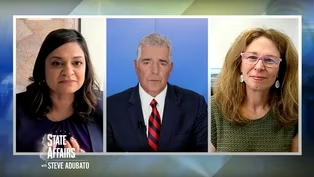
First 1000 Days Policy Coalition is fighting for child care
Video has Closed Captions
Clip: S8 Ep21 | 13m 2s | The First 1000 Days Policy Coalition is fighting for equitable child care (13m 2s)
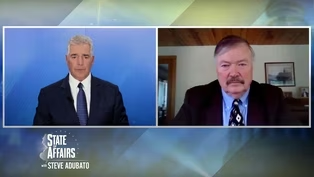
The historical ramifications of Trump v. United States
Video has Closed Captions
Clip: S8 Ep21 | 13m 20s | The historical ramifications of Trump v. United States (13m 20s)
Providing Support for PBS.org
Learn Moreabout PBS online sponsorship
- News and Public Affairs

Top journalists deliver compelling original analysis of the hour's headlines.

- News and Public Affairs

FRONTLINE is investigative journalism that questions, explains and changes our world.












Support for PBS provided by:
State of Affairs with Steve Adubato is a local public television program presented by NJ PBS