
Atlanta Spa Shooting, Author Rae Chesny, DakhaBrakha Band
Season 6 Episode 12 | 26m 46sVideo has Closed Captions
The Atlanta spa shooting, Author Rae Chesny, Ukrainian band DakhaBrakha's protest music
One Detroit reflects on the Atlanta spa shooting one year later, talking with the activist group Whenever We're Needed about the progress they've made in Detroit. Then, One Detroit learns about the Ukrainian band DakhaBrakha, their protest music and their connection to Detroit. Plus, author Rae Chesny joins the show for Women's History Month to discuss the legacy of Zora Neale Hurston.
Problems playing video? | Closed Captioning Feedback
Problems playing video? | Closed Captioning Feedback
One Detroit is a local public television program presented by Detroit PBS
Atlanta Spa Shooting, Author Rae Chesny, DakhaBrakha Band
Season 6 Episode 12 | 26m 46sVideo has Closed Captions
One Detroit reflects on the Atlanta spa shooting one year later, talking with the activist group Whenever We're Needed about the progress they've made in Detroit. Then, One Detroit learns about the Ukrainian band DakhaBrakha, their protest music and their connection to Detroit. Plus, author Rae Chesny joins the show for Women's History Month to discuss the legacy of Zora Neale Hurston.
Problems playing video? | Closed Captioning Feedback
How to Watch One Detroit
One Detroit is available to stream on pbs.org and the free PBS App, available on iPhone, Apple TV, Android TV, Android smartphones, Amazon Fire TV, Amazon Fire Tablet, Roku, Samsung Smart TV, and Vizio.
Providing Support for PBS.org
Learn Moreabout PBS online sponsorship- [Announcer] Coming up next on One Detroit, a popular Ukrainian band with a Detroit connection, uses music to protest Russian president Putin's regime and the war in their country.
Also ahead, we'll check in on two friends who teamed up one year ago to denounce violence and hatred against Asian Americans.
Plus, it's women's history month and we're looking at the life and legacy of the late African American author, Zora Neale Hurston.
It's all coming up next on "One Detroit."
- [Illustrator] From Delta faucets to bear paint, Masco Corporation is proud to deliver products that enhance the way consumers all over the world experience and enjoy their living spaces.
Masco, serving Michigan communities since 1929.
- [Instructor] Support for this program is provided by the Cynthia and Edsel Ford Fund for Journalism at Detroit Public TV, The Kresge Foundation.
- [Illustrator] The DTE foundation is a proud sponsor of Detroit Public TV.
Among the state's largest foundations committed to Michigan focused giving, we support organizations that are doing exceptional work in our state.
Visit dtefoundation.com to learn more.
- [Instructor] Business Leaders For Michigan, dedicated to making Michigan a top 10 state for jobs, personal income and a healthy economy, Nissan Foundation, and viewers like you.
(upbeat music) - [Announcer] Just ahead on this week's "One Detroit," the community comes together to remember Asian Americans who were victims of hate crimes and violence.
We'll catch up with the co-founders of the local activist group "Wherever We're Needed," which was created after six Asian women were murdered in Atlanta, Georgia, one year ago.
They talk about where things stand in their efforts to fight racism against Asian Americans.
It's part of our AAPI stories here on Detroit public TV and WDET.
Also ahead, the late Zora Neale Hurston is described as one of the most prolific writers of the 20th century.
"American Black Journal" looks at her impact on African American literature as seen through the eyes of another black female author who is greatly inspired by Hurston's writings.
But first up the story of a Ukrainian quartet, delivering powerful world messages through their music.
DakhaBrakha's unique music styles familiar to audiences at the Detroit Concert of Colors and DWET radio listeners, but these days the band has gone into hiding in Ukraine as Russia wages war on the country.
One Detroit senior producer, Bill Kubota, has the story.
(gentle music) - [Bill] DakhaBrakha liken to Russia's pussy riot, persecuted for their fight against political oppression, but DakhaBrakha they're Ukrainian with a Detroit connection.
- The music is out there.
It has a Ukrainian traditional base, but goes every which way.
They're big into jazz, they're big into rock.
They even do a little bit of Ukrainian rap, but it also has a very classical sound.
It's really hard to pinpoint the style because it's their own style.
(sings in foreign language) - [Bill] DakhaBrakha's made appearances in the local concert of Colors Music Series seen here on Detroit Public TV, thanks to Ismael Ahmed.
Ahmed created a series.
He got to know the band through his public radio program.
- Given that I work at WDET, I do this Island Earth which is, I guess, a world music show, but a show that is allowed to go everywhere and that's unusual for radio.
It's a good fit.
And so I play that quite a bit.
(flute music) - [Bill] Performances like these perhaps at risk part of the culture many Ukrainians believe the Russians would like to do away with.
Ahmed's talking with the band's artistic manager on the line from Ukraine.
- Yes, have you been affected by the bombing?
- [Iryna] We can hear it all the time.
Sometimes it's closer, sometimes it's far, but my house is still safe.
- I was talking to Iryna Gorban.
She's very much part of the band.
She travels with them, she faces everything they face.
- [Iryna] We sleep in the bathroom or in the basement because they have this air a lot of the time.
- [Bill] DakhaBrakha has been protesting war in the Putin regime during their shows for years.
The band members are hunkered down in undisclosed locations.
They're okay for now.
- It's a Baley women's group and so I don't think men could make that kind of music.
They conquer their audiences over and over that the word spreads.
They're now a major world performing group.
(singing in foreign language) Turns out that their agent Bill Smith is an old friend of mine and he is a, I don't know, a discoverer.
He finds some of the best music on the planet and not your normal music.
So he's the one that turned me out to them.
(singing in foreign language) - [Bill] DakhaBrakha first toured North America in 2013, returning often until COVID hit.
There were plans to come to the US again in late March, but then came war.
- They are literally shelling right now.
And one of the things I was warned is that they might have to duck for cover in the middle of the interview or maybe it wouldn't come off.
The Russian authorities are trying to take down internet and all possibility of communications.
So this was done under duress, but they are brave and Iryna is brave.
And so they want the world to know what's going on.
- [Iryna] I don't how to explain this, but people get used to it.
So now, we are all in this kind of stress when we try to be united, try to be calm, try to help each other.
We really believe that as long as we can stay here, we will stay here.
And I tell this now, because now I am like calm and confident, but in several hours, I don't know what what will be.
So maybe I change my mind in several hours or (indistinct) this night or tomorrow so nobody knows.
(singing in foreign language) - Whether it's Concert of Colors or this Island Earth on WDET, we're living in a world where this music is being made where horrible things are going on and people are struggling, but they're also struggling to tell us.
And they do that through their music.
Music is a powerful force.
I'm happy that I'm able to help get out the word through these musicians.
We have to understand what kind of world we live in.
We can't stay numb to things like starvation and refugees and immigration problems and war.
I mean, literally there is war happening all over the planet, some smaller wars, some huge wars like this one.
We've got to be involved and the music helps us to do that.
(sings in foreign language) Do you think that you will ever be playing music again?
- [Iryna] For sure and in no way any doubt.
And I think we will do it even sooner than it's expected because I'm sure now the world needs Ukrainian culture to understand the difference between Ukrainian and Russian people and to see the deepness of Ukraine and Ukrainian culture.
(singing in foreign language) - They are a direct target.
And they've been told that they are one of the most powerful voices in Ukraine against what is happening both cultural and politically.
And so they do these interviews at a great risk.
Well, we'd love to have you back in Detroit.
- [Iryna] Thank you.
We are really also just, we miss there so much because of these too where some great (indistinct) there.
It's really very moving and very great to hear this.
(upbeat music) (audience cheering) (upbeat music) - [Dorothy] After a gunman killed eight people, including six women of Asian descent last year in Atlanta, Zora Bowens called her best friend Ceena Vang.
She wanted to check in how she was feeling, but Zora had also started to notice a pattern similar to what led to the George Floyd protests, instances of violence escalating the murder.
The two of them felt called to action and created the activist organization "Whenever We're Needed."
They sat down together in conversation to reflect in the impact they've had since organizing their first rally and the work that's still needs to be done in the latest story in DPTV's and WDET's AAPI stories.
- So how did you feel last year and the year before when all of this tension started building up around hate towards the Asian community?
- I honestly felt very desensitized to it.
Of course when it became like an ongoing thing, it was shocking, but I think that naturally like it's so easy to just become desensitized to hate crimes that everyone witnesses on a daily basis, but I feel like it wasn't until you had called me that day where you brought it up to my attention.
And that's truly what inspired me to feel that we should do something like that's when I felt called to action because if my friend who isn't Asian, but is also a person of color can see something that I know exists and is kind of reminding me like, hey, let's do something, like that for me was the push to get up and do something with you.
- Especially with social media it's like a constant bombarding of things that are happening, but after the George Floyd protest kind of settled down and we started following the trials and everything like that.
So the night before I called you, I actually got stopped by the police in Hamtramck and I was so scared because obviously everything that happens with black people and police interactions sometimes.
And the police interaction was actually so nice.
It was the most polite police interaction I've ever had.
And that's when I realized like the work that we've done has maybe had an impact.
And also I felt like my community was going to be okay.
When I saw the news about the spa shooting, it felt like I had the capacity for it now, like a divine message was happening.
We both just felt like this was like some divine like you guys need to do this kind of thing.
Seeing the crowd was just like overall.
It was nice to see that the consensus was I'm ready to do this for my community.
And it was just an overwhelming number like I did not think that that many people were gonna be there.
- To be here gathered today in unity, but unfortunately for such a devastating purpose, however it is a mix of anger, frustration, sadness mixed with feeling eager, feeling liberated, but truly the reason why we are here is bittersweet.
- So proud moment.
I wasn't expecting you'd there.
I remember like it was kind of standing on that like podium thing.
It wasn't an actual podium, but just like looking into the crowd and seeing so many familiar faces and like faces we've never met before, but it was really nice to be able to bring so many people together that really cared about a cause, about stopping hate and just unity in general.
It was definitely a big first time for a lot of the older generation there and it was nice to have them come out especially like when the older Asians have been like such a big target in all of the hate crimes.
You and I, we just see each other as just two individuals just trying to give a platform, but it was nice to be able to receive that recognition from the Asian community and be able to give back to them.
- One thing that I really wanna know about the Atlanta shooting is that it really seems to parallel the Charleston church shootings in 2015, when hate crimes against black people began to spike.
The shooter was coddled and protected just like now.
Some things that stuck with me were like people talking about the history of like Asian Americans in this country and just like the contributions and like really it's a problem because we really are not taught a lot about Asian American history in our classes.
And like how long Asian people have been in America and what they've done to help build this country.
I feel like the Asian American communities place in America and in our mind has not been solidified that they belong in America because we're not taught that they've been here forever.
- It does not matter who you are, where you are and where you come from or what you believe in.
We all want the same thing at the end of the day.
We want peace, we want love, we want acceptance.
We want respect and we all strive for a better world.
(audience clapping) Thank you.
(crowd chanting) - First of all, we weren't even expecting to turn into an organization.
So then we definitely weren't expecting to host more protests, but it all kind of just like one thing I've learned with also talking to other protest leaders too is like, we all have a similar story.
You don't choose to be protest leader, you just fall into it and the pieces just come one after another.
- Yeah, you just figure it out as you kind of go along.
I mean, I think that's what just life is is just we're all just winging it.
- What do you think the biggest challenge is moving forward?
- I think that a big challenge is getting people to stay involved and to stay engaged because there's always so many ongoing things happening in the world.
Like I said, it's easy to become desensitized, but how do we find other activists or how do we change like the hearts, the minds of people who like only see like tunnel vision.
- We've been thinking more deeply about like, how can we really impact our communities in a way that like creates some like physical change and some really grassroots change that people can actually truly be impacted by in their day to day.
When you have so many emotions in the beginning of a protest like everyone's talking about it and you protest and you feel good and you protest again and you feel good.
And then the protest die out and it's like people tend to forget.
- Exactly, like how do we continue to channel like the anger and the frustration.
Just because you don't hear about it anymore, doesn't mean it's gone away.
- Right.
- So like what I want to do is to give it relevancy.
So this is where it all started a year ago.
We are commemorating the lives of the victims that were lost due to the spa shooting, but not just them.
Everyone from then until now and it's important we do that to make sure that everyone is remembered and to make sure that things like this don't happen again.
- I just think that over the last year there's been so many victims of anti-Asian hate crimes that we need to have a moment for, but not only just a vigil, but to celebrate these lives of these people and really bring them back to the forefront of our minds and our hearts.
- I think it makes sense to have our one year there tying in like our one year of existing as an organization and our one year of commemorating like the memories of these victims.
- I hope that everyone will join us.
I just want everyone to know like we have been working.
We haven't forgotten that this is still important to us and that we should be together to remember that day and remember these lives that were lost.
- [Announcer] March is women's history month and we're paying tribute to one of the most well known African American female authors, the late Zora Neale Hurston.
She was also an anthropologist whose novels short stories and plays often focused on racial struggles and black life in the south.
Hurston influenced many writers and American Black Journal's Stephen Henderson spoke with one of them, author and Zora Neale Hurston's scholar, Rae Chesny.
(upbeat music) - I feel like Zora Neale Hurston is both a well known figure in literature and history and all kinds of other things, but also kind of an obscure figure in some ways.
Like people don't know as much about her as they think they should.
One of my favorite kind of trivia things about her is the number of little black girls I knew growing up whose names were Zora.
And I always kind of assumed that that's why they were named that way and speaks to her influence, but let's start with your fascination with Zora Neale Hurston.
What is it about her and her work that draws you to her?
- Yeah, so I agree with you.
It's funny because if you bring up Zora's name, people will say, oh yeah, the lady who wrote "Their Eyes Were Watching God."
I love that book, but there's so much more to her that we need to know.
And we're right between Black History and women's history month.
And so I think this is a perfect time.
My fascination actually started in 2018, when a professor at Michigan State invited me to do a Black History presentation.
And as a writer, I have been working with children.
We had collaborated through partnership with afterschool programming and summer camps.
He said, the kids love you.
My students love you come to a Black History presentation on the person who most influenced your career as a writer.
And I was actually a reluctant reader as a child so I didn't have anyone who really influenced me.
I just always loved to tell stories, but Stephen he gave me this magical word that really changed my mind.
He said, I will pay you in honorarium.
- That is a magic word.
- Yes, I had never heard that word in conjunction with my name so I felt very inspired.
And so I set out to do the presentation on Langston Hughes because I love the Harlem Renaissance.
Of course, Langston is probably the most popular person from the Harlem Renaissance.
And I love that he was a poet, used everyday language and focus on working class black men, but as I kept researching Langston, I didn't find a personal connection.
Instead, I found Zora Neale Hurston and I started going down this rabbit hole.
I'm like, oh wait.
She was raised in the first all black incorporated municipality which just means legally established town in the history of the United States.
Her father was married three times.
She was a trained anthropologist in 1928.
She interviewed the last person to live on slavery and be enslaved.
How come we don't know about her?
And she was best friends with Langston Hughes during the Harlem Renaissance.
And so I was like, well, how come we don't learn about her?
But then I asked myself a hard question, how come I wasn't presenting Zora Neale Hurston.
And so that first year I tacked her on to the end of the presentation as an and with Langston Hughes.
In the sensation as I was present her, I would start sweating and everything.
And I joke that it was probably Zora jumping up from the grave, telling me don't ever make me an and and I promised her in that moment if I ever got another chance to do a Black History presentation, she would be the star of the show.
And she has been since that moment.
Funny enough, I was assigned 'Their Eyes Were Watching God" in high school and I did not read the book.
- Well, that's pretty common.
That's a pretty common thing to happen, right?
We all kind of skim in high school.
- Yeah.
- I feel like a lot of the work that she did is especially relevant right now given the things that we're talking about and given our renewed focus on the importance of Black History to the present and to the future.
- Absolutely, she was typically out of step with the black thought leaders at the time.
She had a lot of pride at that time.
W.E.B.
DuBois coined the phrase "The Talented Tenth."
And so Zora really opposed that ideology because it separated a certain class of black people, this upper echelon, away from the roots, the history.
And so she did fight to preserve that and to also share it in creative ways, one of the interesting things about Zora is that she often did not want to write full length novels because it takes so much time and I can tell you as a writer, it's a lot of investment.
It's a long shot, it's out of investment of time, of resources.
You can't fully work a full-time job.
And so she actually took her anthropological field work and staged it as plays.
And so she was very focused on theater.
And if she could have had her choice, that is what she would've wanted to do.
When it came to writing short stories was kind of her sweet spot and she felt, hey, I could turn some of those out and still do the plays, still do the anthropological work, but showcase authentic black life.
And even beyond that life throughout the African diaspora, she traveled to Jamaica and Haiti.
Her first application for the Guggenheim was actually to go to West Africa, the Gold Coast as it was called back then to trace these roots to say, hey the Southern Negro is not as far from these original west African spiritual practice, cultural practices that still exist in black culture today.
- [Announcer] That will do it for this week's "One Detroit."
Thanks for joining us.
Make sure to come back through "One Detroit" arts and culture on Mondays at 7:30 p.m. Head to the "One Detroit" website for all the stories we're working on.
Follow us on social media and sign up for our weekly newsletter.
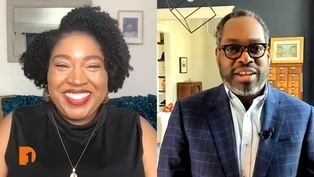
Author Rae Chesny Discusses Zora Neale Hurston's Legacy
Video has Closed Captions
Clip: S6 Ep12 | 6m 23s | Author Rae Chesny discusses the legacy of Zora Neale Hurston and her new book 'Dear Zora' (6m 23s)
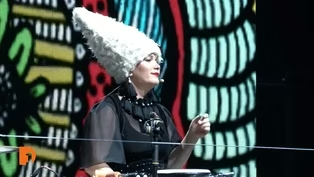
DakhaBrakha Uses Music to Protest Russia-Ukraine Conflict
Video has Closed Captions
Clip: S6 Ep12 | 7m 21s | Ukrainian band DakhaBrakha uses their music to protest Russia's invasion in Ukraine (7m 21s)
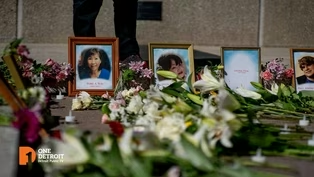
Whenever We're Needed on a Year After Altanta Spa Shooting
Video has Closed Captions
Clip: S6 Ep12 | 9m 13s | Activist group Whenever We're Needed reflects on the Altanta spa shooting a year later (9m 13s)
Providing Support for PBS.org
Learn Moreabout PBS online sponsorship
- News and Public Affairs

Top journalists deliver compelling original analysis of the hour's headlines.

- News and Public Affairs

FRONTLINE is investigative journalism that questions, explains and changes our world.












Support for PBS provided by:
One Detroit is a local public television program presented by Detroit PBS