Traverse Talks with Sueann Ramella
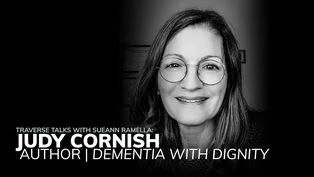
Attorney Judy Cornish
1/10/2022 | 48m 15sVideo has Closed Captions
Judy Cornish On Dementia Care Through The DAWN Method.
Judy, talks about the confusion around diagnosing dementia and she explains the DAWN Method which is her approach to dementia care. Being a licensed attorney in Moscow, Idaho, Judy is not your classic dementia professional, but with over ten years of experience helping those experiencing dementia, Judy has grasped how to help families enjoy companionship with their loves one experiencing dementia.
Problems playing video? | Closed Captioning Feedback
Problems playing video? | Closed Captioning Feedback
Traverse Talks with Sueann Ramella is a local public television program presented by NWPB
Traverse Talks with Sueann Ramella
Attorney Judy Cornish
1/10/2022 | 48m 15sVideo has Closed Captions
Judy, talks about the confusion around diagnosing dementia and she explains the DAWN Method which is her approach to dementia care. Being a licensed attorney in Moscow, Idaho, Judy is not your classic dementia professional, but with over ten years of experience helping those experiencing dementia, Judy has grasped how to help families enjoy companionship with their loves one experiencing dementia.
Problems playing video? | Closed Captioning Feedback
How to Watch Traverse Talks with Sueann Ramella
Traverse Talks with Sueann Ramella is available to stream on pbs.org and the free PBS App, available on iPhone, Apple TV, Android TV, Android smartphones, Amazon Fire TV, Amazon Fire Tablet, Roku, Samsung Smart TV, and Vizio.
Providing Support for PBS.org
Learn Moreabout PBS online sponsorship(ambient music) - [Sueann] It's quite possible at least statistically, if you live long enough, you'll get a form of dementia, and dementia isn't just Alzheimer's, though Alzheimer's gets a lot of the attention.
And as you may have seen, caring for someone with dementia can be financially and emotionally draining, but it doesn't have to be.
Judy Cornish started the DAWN method of dementia care.
You'll learn about types of dementia, how to care for your loved ones, and hopefully, listen to ways to avoid or offset risks of getting dementia yourself in this conversation of "Traverse Talks".
Let's start with, if you don't mind, can you give an overall idea of what dementia is?
- [Judy] Yeah, well, dementia is the condition.
And here in the United States, we've been confused for a couple of decades.
And people do this all the time, even doctors.
Somebody goes in for diagnosis and you go in and you say, "Here we are, my wife and I, and I'm concerned about my wife's cognition and she seems to be becoming extremely forgetful."
And so, you have this meeting with your GP and you get a diagnosis, "Well, it looks like Alzheimer's."
And then, quite often, if I'm the one who's taking the person in for diagnosis, what I say then is, "Well, Dr. Smith, do you mean Alzheimer's or do you mean dementia, one of the other types of dementia?"
And the doctor quite often, three times I've had doctors say, "Oh, Alzheimer's dementia, it's all the same thing," - [Sueann] But it's not.
- [Judy] But it's not.
And so, we need to understand.
And part of the problem is that we've had the Alzheimer's Association for decades trying to get public attention on the disease, Alzheimer's disease.
Now, Alzheimer's disease is one of the diseases that can cause dementia, just one.
So, when you think about what dementia is, it's a condition.
It can be caused by any number of diseases.
And now we're hearing more about Lewy body, we're hearing more about Parkinson's, we're hearing more about cardiovascular disease.
There are many diseases that can cause dementia, which is a condition, a syndrome, a series of symptoms.
- [Sueann] And so, it's a bigger umbrella is dementia.
And then under it are specific things.
- [Judy] Right, and not just disease.
And so, our most recent research coming out tells us that one of the biggest factors in someone developing dementia is their lifestyle choices during their adult life.
- [Sueann] Wait, okay.
So please tell us more.
- [Judy] Well, let's see, Sherzai, the Sherzais put out a book called "The Alzheimer's Solution".
Tom Rifai, The Reality Meets Science MD, those three people, what they do is they point out that exercise, nutrition, sleep, brain health, and a general approach to life is what will greatly affect whether or not you're going to develop it.
- [Sueann] Okay, so I assume that if you do those things, you reduce your risk of developing dementia.
- [Judy] Most of the baby boomers have already lived through adulthood, which is when you can make a difference.
- [Sueann] Right.
- [Judy] And we now are elders.
And so, we as elders do not have the option of avoiding these lifestyle choices that are precursors to dementia.
So we have a huge number of people in the United States that will be experiencing dementia, because it's too late to avoid it via lifestyle changes.
So then we have the Alzheimer's Association pursuing a cure, but it's really important to realize that Alzheimer's is merely one of the diseases that can cause dementia.
So we're never going to cure dementia.
We are going to always have dementia in our communities, in our families.
And if you're talking about how many people are going to experience dementia, I think the last thing the Alzheimer's Association was saying was, by the time you're in your eighties, it's about a 50% chance.
Well, most of us live 'til our eighties.
So I think that means if it's not me, it's my husband.
If it's not me, it's you.
And yet, as a society, we don't put much effort or money into figuring out the best ways to care for people and understanding what we can do to support them and their quality of life when dementia comes into the picture.
- [Sueann] Judy, is it safe to say that no matter how old a person gets, eventually you will have a symptom of dementia?
- No.
- Okay.
- [Judy] No, 'cause dementia is not normal aging.
- What is normal aging?
- It's abnormal.
Well, that's another topic of discussion.
- [Sueann] In this country, what is normal aging?
I mean, you look like Zsa Gabor.
Is that the normal aging or Sophia Loren or yeah, or is it Betty White?
- [Judy] Well, so when I teach, when I'm doing a presentation, I mean, that's within five minutes of me starting to talk about dementia, somebody's hand will creep up and they'll say, "Well, how do I know the difference between normal aging and whether or not I'm developing dementia?"
And dementia, and this is how I became involved in it, 'cause I'm not a medical professional, I'm not a social worker.
I'm a lawyer.
- [Sueann] Okay, Judy, but if you're trying to say that you are not a professional person, when it comes to "Dementia With Dignity", I don't know- - I'm not your classic person- - [Sueann] Okay, there you go.
- [Judy] Because I'm not medically trained.
And I think that allowed me to look at dementia from a different perspective.
- [Sueann] Oh, yes.
- [Judy] And that's what I brought to the world of dementia.
Dementia care is if you are not thinking about dementia within the medical box, using a biomedical model, well, if you don't have that model through your education and training, you'll look at it differently.
And what it looked like to me, when I got sidetracked, back in 2010 in Moscow, Idaho, and I'd come to Moscow thinking I was gonna practice law, just 10 or 20 hours a month, that was my goal, elder law.
And I got to know a neighbor and I became completely sidetracked.
And I just couldn't walk away from what I saw occurring for people who were aging, my elders, living in the community, and then gradually beginning to demonstrate what we call the symptoms that of dementia.
And so, I spent five years from 2010 to about 2015, spent most of my time with people who had been diagnosed with dementia and were living at home.
And that was a really rare opportunity for somebody, who didn't have classical medical training.
And so, what came out of that is the two books, "Dementia With Dignity" and "The Dementia Handbook".
And all of my work with DAWN, all the education programs for families, the certification program for caregivers.
- [Sueann] Can you tell us what DAWN stands for?
- [Judy] Dementia and Alzheimer's Wellbeing Network.
- [Sueann] How did DAWN start?
I mean, you mentioned that you met your neighbor and you were a lawyer and then sucked into it, right?
- [Judy] Well, within, because Moscow is Moscow, I volunteered to help her.
Her daughter dropped by and said, "Oh, you know what?
Mom keeps losing the car.
She drives over to the Safeway's, leaves it in the parking lot, walks home, calls the police, that'd be Paul Kukowski.
And so, he comes over and he walks over to Safeway's.
When he gets her keys, he goes to Safeway's, gets the car, drive it back and puts it back.
This is just too much trouble for the community.
We can't be, mom, can't be doing this.
We're gonna put her in a care facility.
And I said, "Oh please, no, I'm not working, your mom needs someone to go grocery shopping with.
I'll do it, I'll buy groceries."
"Oh, she likes getting up early in the morning, going swimming."
"I'm an early riser, I'm not working.
I'll take her over there, I can read a book."
And then, within a week or two, my phone kept ringing and it would be, "Hello, is this Judy Cornish?"
"Yeah, I hear you're looking after so-and-so's mom.
Well, my dad, he's a retired professor, he still lives in Moscow.
I live in New York city, can ya check in on my dad?"
And within weeks I had, I sat down one weekend and I thought, "Well, this might be a business.
So I guess, I'll Google business plan and see if I can fill in all the blanks, then I must have created a business."
And I was already just completely enthralled with these people.
And so, I had to learn all about business, which is not the type of life to have, except with...
I took family law and disability law, trusts in the states and wills and all that kind of thing, but yeah.
- [Sueann] And Judy, just for our listener, your approach to care is different than what the mainstream is.
Can you give an example of that?
- [Judy] Right.
Well, what it is actually, is habilitative, person-centered, strength-based dementia care.
So we have in the world of dementia care, I'm a lawyer, so I can explain it.
I can quantify it for ya.
In the world of dementia care, there is appropriate care approach, which is your biomedical model.
And one of the keystones of that is reality orientation.
But the caveat is only in the United States.
This comes out of American medical journals circa maybe about 1950, 1952.
And so these, they're techniques that are excellent medical techniques and reality orientation is critically important for mental illness, PTSD, that kind of thing, but somehow we in America began applying it to dementia.
So that's your classic traditional approach in the United States.
- [Sueann] Which is to try to force them to come back to this moment.
- [Judy] Well, reality orientation means, I'm gonna correct your false beliefs, and I'm gonna reorient you to time and place.
And if it's a dream, I'm gonna tell you it's a dream.
So picture if somebody's having a PTSD flashback, oh please, let's do that.
It is the most kind of thing you could possibly do where if I'm having a delusion or hallucination due to a mental illness or condition, oh, please do that, because that will really help me.
But now, step aside and look at dementia.
What happens with dementia?
Well, we say people lose their memories.
Well, actually the difference between normal aging and dementia is that you don't lose your memories, you lose your memory skills.
You lose the ability to get them to go back and retrieve them to find them.
Sometimes depending on the disease that caused your dementia, you might be not recording the memories properly, and that's why you can't get to them.
But the key difference is dementia takes away my memory skills, normal aging just makes it a little harder to use it, because I've got so much information and experience and knowledge in my brain.
It just takes longer to find it, like a big library compared to a smaller library.
But now, so if I'm losing my memory skills, we know that we accept that, but I am also losing my rational thinking skills.
Now it depends which type of dementia I'm experiencing and which disease brought it into play or life events is another reason people experienced dementia like TBIs or a bad reaction to chemo, bad reaction to anesthetic.
There's all these different causes, but I will not only experience the loss of my memory skills will also experience a loss of rational thinking skills.
What are rational thinking skills?
That's the ability to analyze compare, consider, interpret, come to a decision, use good judgment.
If you go to a neurologist, you're gonna hear executive functions, but now let's go back to reality orientation and it's my wife or it's my husband and he's experiencing dementia.
And he says something that clearly is untrue, couldn't possibly be true.
And so I say, "Oh honey, no, no, no, no, no, no.
You're wrong, that did not happen.
Here's what happened, this, this and this.
So therefore, you see I'm right, you're wrong."
Well, if he doesn't have any rational thinking skills, how is he ever to interpret, analyze and conclude that my reality is correct and his is wrong?
- [Sueann] It doesn't compute.
- [Judy] Doesn't make any sense at all.
It's exactly as if what we were doing is saying, me saying to my husband, "Well, look honey, I know we had that minor car accident and I know you bumped your head and I know as a result, you've lost your vision, suddenly it's gone.
But look, darling, I know, I know you used to see, so I'm gonna point, you look in that direction, you'll see what I'm telling you about, just do it, just look."
I mean, this is illogical, but does anybody realize it?
No.
- No.
Judy, that is a great example.
- [Judy] Yeah, so, what I'm describing now is not the biomedical approach.
It's not classical American dementia care, well, classical since the 1940s or '50s.
What I'm describing is let's think about dementia, let's learn about, let's identify the skills that are lost and understand that.
Then, let's think about the skills that are not lost.
We don't lose all your skills to dementia.
You will not lose your intuitive thinking skills.
And the good news is, your intuitive thinking skills are the primary thinking skills.
- Good.
- They're not secondary, they're primary.
It's the seed of our humanity.
It's our ability to feel and recognize our feelings, to know how we feel.
That's profound.
I can't imagine losing the ability to feel joy or love, or to recognize love on the face of the companion, and people with dementia don't lose that.
What they lose is the ability to see cause and effect, the ability to sequence, the ability to prioritize ideas or actions, executive functions, tools, not the primary thinking skills, and that's just one, so we lose one set of thinking skills, not two, but here's the truth.
I lose my remembering self, but I don't lose my experiential self.
So now think about it.
I've got my intuitive thinking skills and I have my experiential self.
Oh my goodness, what's bad about that?
If you're my companion, figure out what I like, what music do I like?
Play that music for me.
I've lost my rational thinking skills, so I can't initiate, I can't put the music on for myself, but if you can figure out what music I like, get it on an MP3 player and give me a set of headphones.
And anytime I'm not feeling very happy, you can play my favorite music for me.
Oh, does Judy light birds and flowers?
Oh my goodness, turn on YouTube.
Yes, you will be filling my experience with beauty, with what is beautiful to me.
Does Judy light fuzzy sweaters?
Get her some.
Does she like the color blue?
Well, make sure there's lots of blue stuff around, because when we lose the remembering self, we do not lose the experiential self.
So once you understand which skills go and which don't, well, then you're going to be better able, much better able to just spend time with somebody and support them, companions do it.
- [Sueann] Yes.
- [Judy] But if I'm constantly attempting to make somebody who has lost rational thinking skills, and constantly asking for you to use them, where if I back to them to be able to do things they can no longer do, I'm constantly embarrassing them and frustrating them and putting them on the spot, what do we humans do when we get embarrassed and frustrated and put on the spot, especially by the people who are supposed to love us?
- Like get angry.
- Right.
So what I'm describing really is that in my example, my husband is experiencing dementia, therefore, I'm spending time with someone who is experiencing changing cognitive skills.
In his case, he's losing skills.
When else in life, do we spend time with people who are experiencing changes to their cognitive skills and their emotional needs?
- [Sueann] Teenagers?
- [Judy] Absolutely, children from birth, right?
Because that's what childhood is.
- [Sueann] But we don't think about elderhood doing that do we?
- [Judy] Nope, not at all.
But we look at childhood and we look at children and we say, "This infant in my hands, in my arms here, brand new baby, this little person doesn't know my name."
It can't say, "Mom", it doesn't know all the relationships with everybody in the family, but we accept that, that's okay, because we understand this little person here is changing.
In infant's case and child's case they're growing and eventually will become adults with all the skills of adulthood, but we accommodate their changing emotional abilities and they're changing cognitive abilities.
- [Sueann] There's the word accommodate.
- [Judy] Accommodating.
So this is what humans have used for eons or since whenever we began.
We use habilitative care with children.
And that's what the DAWN method is about.
(ambient music) - [Narrator] This podcast, like so many programs on NWPB is brought to you, courtesy of donors, people who watch and listen to NWPB for thought-provoking programs like "Traverse Talks".
People who give what they can to pay for current programs and technology for future programs.
You can join them, donate any amount that's right for you at nwpb.org.
- [Sueann] Judy, this is reminding me of when we discover that our children are into something.
- [Judy] Right.
- [Sueann] And then we go buy that for them, and we encourage that for them, and we explain lessons through that item.
Like my son went through a tank phase, so everything was about tanks and we counted tanks.
And so, this makes total sense to me.
The part that's difficult I think is I have been trained to think that elders are when you're losing your mind, that it's just a lost cause and you're telling us, "No, that's not the case."
- [Judy] That is not the case, not the case at all.
Yeah, and actually I should just put in also of the five types of attention skills, we lose three, not all of them, just three of them.
And that boy, that's another whole discussion, 'cause we could talk about ADHD and how society views changes or people who are differently-labeled than most of us regarding attention skills.
But that's how people who are experiencing dementia become fixated on something.
It's not that they had a personality change developed OCD, developed mental illness.
No, it's just that they've lost the ability to redirect their attention.
So the metaphor to me, what's really true.
When somebody begins to experience dementia, they become less able to take part in a fast-changing, highly technological society, that values accomplishment and doing alone.
- [Sueann] Oh my gosh, there's so much you just said there, because that is, I mean post-COVID, I feel like we are trying to address this.
- [Judy] Right, COVID came to us and forced us to reevaluate whether or not running the fastest on the treadmill is really of value.
Are things really more important than being, than relationships?
So here's our problem in America.
Talk about metaphors.
We think life is a trajectory.
I began as that infant in arms, down here in the bottom and oh, my goodness, I'm gonna be the first one to the top.
And I'm gonna have all the skills and all this stuff and all the toys and all the great life experiences.
I'm gonna chalk them all up, and I'm going to possess all this great stuff and be the best, that will make me happy.
Well, that's not what life is.
Life is a bell curve.
We begin at the beginning with very, very little skills.
I think they're latent, but they're not patents yet.
And as we go through childhood, we were allowed to learn and grow.
In fact, we adults even expect that.
And so, we allow play, because we understand that play, which is not ordered, play is a really great way to work and grow.
Why do we allow that?
It's because it's on the uphill, it's on a trajectory, it's increasing skills.
We like that, because we're a society of achievers.
Then we step out of a childhood into adulthood.
All right, what's the time in adulthood for?
That's for doing, that's because adults are well-equipped.
They do have all those skills.
They're in the middle part of life.
They're on the top of the bell curve.
Part of being an adult though, is caring for those who are not on the top of the bell curve.
- [Sueann] And most of the time we only think of children, we don't think of elders.
- [Judy] But why don't we think of elders?
Because we think elders are broken adults.
- [Sueann] Oh, my god.
- [Judy] We think they are adults who are failing.
And that's how we talk about them.
- [Sueann] Hold on.
- [Judy] Oh my goodness, my mom, she keeps losing her keys, - [Sueann] Wait, Judy, Judy.
- [Judy] My dad, he just can't drive very well anymore.
And do you know, we think they're just, we start thinking about them as if they're falling apart.
- [Sueann] A failed adult.
Judy, hold on, I need a moment, because that just really hit home.
We think of them as failing adults.
What a terrible, and yes.
- [Judy] And are you that terrible?
- [Sueann] I do, and I feel horrible about it.
- [Judy] That's why we fear it.
That's why nobody wants to grow older, - [Sueann] Because we only think of it as not making it anymore or no more success.
- [Judy] Right, no more accomplishment, no more doing, no more gathering of things, or skills, or accomplishment, whatever it be, we are stuck in this mode and it's because we are technological and it's because we're capitalist.
And we think that the ultimate human achievement is to get stuff.
- [Sueann] Oh my gosh.
- [Judy] He who dies with the most toys wins.
You know we say all these things.
- [Sueann] We do.
I can sleep when I'm dead.
- [Judy] Right, right, but that children are learning and growing and playing, we accept that.
Adults, they are doing, it is the time to do, to accomplish, to gather, that's true, but for goodness sakes, let's be clear, life is not a trajectory.
It's the bell curve or a circle, depending how you like to look at it.
But the adult, that time of doing and gathering and accomplishing, should come to an end, because life does, we die, we are mortal.
- [Sueann] Oh, now you're bringing up another topic.
- [Judy] But now we get to step into another phase of life, the third phase, we get to be elders.
There is nothing more beautiful than allowing yourself to be an elder and having your companions allow you to be an elder.
'Cause guess what?
Being an elder is about being, not doing.
It's about sharing, not gathering and it's about thinking.
And boy, if you've just gone through an adulthood, a whole lot of accomplishment and gathering and doing, doing, doing, my goodness, you'd better slow down, you'd better take a break, and you'd better start thinking about everything that went before and it's time to share, share your time, share it with children, share it with adults, share it with your community, share it with your friends.
Stop trying to do.
Don't let people judge you by your abilities or what you're capable of.
Have people see you, the human being.
We're human beings, right?
- [Sueann] Not human doings.
- [Judy] Yeah.
But let's say I am now an elder and I begin to experience dementia.
Now I am losing my ability to do things.
I am becoming much more capable of experiencing the present, because I don't have memories or rational thinking.
My memories aren't dragging me into the past and distracting me with the past.
Without rational thinking, I can't plan for the future or anticipate the future or initiate, I'm stuck in the present, but I'm stuck there with what?
All of my abilities to receive sensory stimulation, sensory stimuli, anything I can see, hear, taste, touch, or feel.
That's where you find beauty, in the present.
- [Sueann] That's what the yoga instructors are always telling you to be in the present.
- [Judy] We'll see, it's easy if you have dementia, 'cause you can't leave.
So, to me, when I discovered and maybe it's because I spent 10 years hanging around with lawyers, lawyers love rational thinking, rational thinking.
It's not that fun, it's not very companionable, it doesn't make for good friendships.
All the good stuff we keep when we experience dementia.
And my goodness, when I in Moscow there in 2010, and all of a sudden I had the opportunity to hang around with this lovely, I don't know, mid-sixties, late sixties woman, curly white hair, a great sense of humor, no memory.
It was great, because it didn't matter if I repeated myself, nobody had to be correct.
It was all about companionship and beauty.
- [Sueann] And being.
- [Judy] And being.
- [Sueann] I like what you said there, that you didn't have, nobody had to correct.
I feel like we're always in that mode of correcting.
- [Judy] Yeah, yeah.
- [Sueann] How exhausting.
- [Judy] And that's so small.
- [Sueann] It is.
- [Judy] Yeah, I just got an email from somebody I talked with, Zander Keegan, he's just this incredible person.
He was a 2020 social worker of the year, I think.
- [Sueann] Wow.
- [Judy] But on the bottom of his email, he had a really good quote and it was anonymous stated, but it was basically, "Let's leave right and wrong behind, I'll meet you in the field of togetherness, of openness."
That's like saying, let's stop being so hung up on who's right, who's best, who has the most.
And let's go beyond all of this black and white thinking and all this focus on correctness, let's go beyond and be humans together.
There's so much more.
- [Sueann] There's so much more.
Thank you for opening my mind to this idea of becoming an elder and aging and that we really simplify dementia as Alzheimer's.
Now I'm wondering when we go into elderhood this idea of failing adults, how do we look at becoming older and becoming an elder as a positive thing in this country where we're so focused on youth?
- [Judy] I don't know.
When I turned 60, it was like, "Woo-hoo, hey, Lord yay!"
When I was in my thirties, I worked for this state bank in Oregon.
But you can get all the senior benefits when you turn 50.
And at the time, I was probably mid-thirties and I had young children and I thought, "Wow, yeah, 50 great," yeah, that's a great time to be a senior.
And then, they upped it to 55 and then they upped it to 60, and now we have social security is constantly being moved further into the future.
People receive it at later times, but how to change it, I don't know.
But I am loving it, absolutely loving it.
- [Sueann] Oh, that's so great.
- [Judy] Because I've let myself off the hook.
- [Sueann] Like what do you mean?
- [Judy] I wanted to quote Zuni.
I couldn't remember it exactly, but I did it anyways.
I still got the idea across, to appear as I was correct.
- [Sueann] I see what you mean, yeah.
Yeah, I see that.
I got an idea as you was talking.
I think one way I will try to look forward to it is to stop myself and my girlfriends from being sad as we have another birthday.
- [Judy] Goodness, celebrate.
- [Sueann] It's so silly really or sad that we have more gray hair.
- Great.
- Yeah.
- [Judy] Let's celebrate.
Normal aging includes having poor recall.
Our memories get worse, and our physical abilities start to fade away.
When I was in my fifties, I could out-ski anybody on the mountain.
Now I might be able to, I'm not gonna take a chance, right?
'Cause I don't have that flexibility I have, but we need to turn our focus away from correctness.
The use of the rational thinking that we so, so prized.
Who could write the best article?
Who could be the top?
Who gets the awards?
And we need to turn our focus back to being, just being ourselves to relationships.
And when you do that, none of that matters.
None of it does matter anyways.
It all fades away.
It's not what you get to keep.
You get to keep your friendships, you get to keep each other.
You don't get to keep your youth.
And are you sure you want to.
- [Sueann] No, there was some very bad moments.
- [Judy] Yeah, yeah.
And that's why our memories become slower, poorer as we age.
It's because our brain is more like a library than a computer, it just fills up.
And aging forces us to slow down.
And that is a good thing.
- [Sueann] It's just like COVID did.
- [Judy] Yes, it's very good to think.
It's good for children to be bored.
- [Sueann] Amen.
- [Judy] We need to be bored.
We humans, we need to be bored.
It's because when we are bored, we start to notice the relationships between things rather than things.
(intense music) - [Narrator] Do you know a child who's interested in the world around them and how it all works?
Then check out one of NWPB's local productions, "Ask Dr. Universe", a series that answers kids most baffling science questions in a fun and engaging way.
Head on over to askdruniverse.wsu.edu to learn more or submit a science question of your own.
- [Sueann] Okay, now I would like to talk about this idea, because we know that we're such a capitalist society.
Let's take it back to money Judy, and this idea of elder care, if you have an elder who is experiencing dementia, traditionally in my head, you just put them away and you pay or find a way to make them have no money, so the government will get them into the system and then you're done.
But that doesn't look into the fact that there is a lot of loss of family money and inheritance.
So can you speak about that?
- [Judy] When I was practicing elder law in Oregon and there were really only, very quickly I realized there's only two types of clients that would come to me to have an estate settled.
There was the family that had, the parents had not experienced dementia or a major medical illness.
And that would be the great independence people who were in there would now be in their nineties or over 100, 'cause this was back in the early 2000s.
But the family that didn't experience dementia, there was money, there's a couple of hundred thousand and the estate would be settled and the kids would pay off mortgages, pay off, buy cars, send the grandkids to college, and there's plenty of money to pay the attorney to settle the estate.
And then, there was the other clients, the ones where dementia had come into the picture and they did have to pay for longterm care, or they ended up bankrupted even before they went into longterm care facilities.
That family, nobody got to pay off mortgages, nobody bought cars and no grandchildren got sent to college.
It was paid out of pocket and they had to pay the attorney out of pocket too.
So dementia is incredibly expensive from a financial point of view, true, but it's far more expensive from the perspective of family relationships, the cost to the family, the cost to the individual, the pain, the cost of emotional pain and broken relationships and years of not understanding each other, not understanding how to stop constantly causing conflict and risk, risky behaviors.
And it's because we don't understand what dementia is.
So we think, "I can't do a thing about it.
She's had a personality change.
She's got all these weird behaviors now," but is that really what was happening?
If we look at dementia and understand, we're just using the wrong model.
If you look at dementia from a medical perspective, you've got a real problem.
So you have to identify the type of dementia your loved one is experiencing, you need diagnosis.
Generally, we can't give you absolutely firm diagnosis until we can do a biopsy post-death.
So all diagnoses are, well, it looks like she's also experiencing Parkinson's disease so this is probably a Parkinson's dementia.
She may have also been experiencing high blood pressure.
So it could be her dementia is more related to cardiovascular disease then Parkinson's, but we won't know until we see how she reacts.
So there we are, the first thing, what type of dementia is it?
Then you need to know which area of the brain it's affecting.
And with cardiovascular disease, best of luck with that one without a biopsy.
And then, you have to consider the person's personality, because when there are changes occurring in our brains, our personality will determine our reactions to a great degree.
Not enough.
Now you also have to take into account the fourth factor, one that's really hard to pin down, you need to understand the person's early childhood experiences and now actually all of their life experiences, because we interpret the present based on these subconscious learned behaviors from the deep past.
How on earth do you solve that problem?
How on earth can a doctor do all of that and say to the family, "Here's the picture of your mom's dementia, now you should do this, this, this, and this."
And that's why we have our society, we're using a biomedical model, we are using a model that fails us, it doesn't work, and we end up throwing up her hands and crying and saying, "I can't do it, you're gonna have to take her and lock her up, put her behind locked doors, so she's less risk to self and others," which is debatable.
And we have no treatment.
Well, we've got these psychotropic drugs that we use for other people who we would like to mute their behaviors and their reactions.
And so, that's what we do and it doesn't work.
It's incredibly expensive.
Nobody's making money off of this, except for some major corporations.
The government and families are paying the price.
So that's why I advocate this doesn't work, let's use an experiential model.
let's recognize the skills lost and the skills kept, because losing skills is gonna cause me certain emotional reactions that all human beings experience.
And if you really look at those so-called dementia-related behaviors, I can show you people of all ages of life that have never been diagnosed and never will be, that behave in those same ways, exit-seeking, wandering, being restless, combative behaviors, it's not related to dementia, that's related to human beings.
So let's not try to make them look like symptoms, let's say that the experience of losing cognitive skills, we are used to using, causes emotional distress.
And if I find myself unable to do something I always could do, I'm going to be embarrassed and frustrated.
If I don't have rational thinking, but I do have intuitive thinking, I've got fight or flight that's intact.
And so, I'm going to be constantly embarrassed and constantly frustrated and I'm gradually losing more and more skills all the time.
So of course, I'm gonna have these reactions, emotional reactions.
So what do I need?
I need the people who love me the most, not a corporation, not lowly paid, minimum wage people who don't even have so much as benefits for what doing, I need the people who love me and understand which skills I'm losing in which I'm keeping so that they can stop embarrassing me and frustrating me and help me live in my new intuitive world, take care of the rational thinking for me, use their own memories on my behalf, so that I can live in the present fully experiential with my intuitive thinking and be, and enjoy companionship and beauty.
- [Sueann] Judy, for a family who's listening to this and you gave many things to look at the brain and who do they go to to have a loved one evaluated, if they wanna go outside of the medical model?
Do they do that themselves after reading the book?
- [Judy] Everything that I teach with the DAWN method is I teach people who are not medical professionals who love someone, who's experiencing dementia, how to understand what our human cognitive skills are.
And if you understand that, you look at your loved one, you can see why they're doing it, you can see what they're doing, you can see when they're reading your non-verbal communication skills, with those intuitive thinking skills they still have.
And that's why you come to understand that it's really important that you don't communicate fear and concern and outrage and guilt, because they're gonna pick it up.
They're picking it up very, very, very well, because they don't have the distractions we have cognitively.
- [Sueann] Just like children pick it up.
Children pick up what's happening.
- [Judy] Yeah, we're born with really intact, intuitive thinking skills.
We learn about those tools the rational thinking.
We gather memories as we go, but we have to use a different model.
Biomedical is not working.
- [Sueann] Right, so an example would be you, your loved one is going through cognitive change and it is a form of dementia.
I'm trying to picture what this would look like.
So let's say they see monkeys outside the window, then what do you do?
- [Judy] You know, it's that might be something that would be a symptom of Lewy body, but it's not a symptom of dementia.
- [Sueann] Okay, 'cause they're saying they're seeing something.
So that's not the same thing as- - [Judy] It depends.
I can only give you a legal answer, but here's the problem.
People are not simple, we're not machines.
A machine is simple, it's got parts.
If a part breaks, replace it.
And it's simple to see that we need to add oil here.
A human being is a complex system.
And so, you could ask me, "Well, Judy what do we do when somebody won't take a shower?"
And this is pretty typical of most dementia care training programs.
And they will make suggestions, "Well, if your own loved one won't take a shower, try this, try this, try this, try this."
But we're not machinery, we're human beings.
We have emotional needs and we have personalities.
Your loved ones know you best.
And so, if you want to help me be willing to take a shower, you need to understand what my emotion is, is preventing me from agreeing.
So you've got to think about what is it?
Emotionally, what's going on for Judy right now?
So I can't just give you a pet answer for a situation.
- [Sueann] I see.
- [Judy] Because when I'm working with somebody who does experience delusions or hallucinations in connection with their dementia, what I tell the family and what we do is we try to understand where that's coming from, because your delusions will be a result of earlier life experiences.
I had one man who had spent his adult years as a forest ranger, his delusions were children, children were always in the room and he couldn't get them to do what he was telling them to do.
Well, that sounds a bit like being a forest ranger, right?
That you got to deal with kids and you have no authority and you can see a whole lot of risk.
So that was the source of his delusion.
What do you do when somebody is having a delusion?
I have people, I had one woman whose delusion was giving birth, why?
Because she lost babies, because she was living remotely and gave birth alone.
And so, her delusion was, she was imminently giving birth.
What do you do?
Well, I know they've got intuitive thinking skills.
I know they're experiential and I know that they still have some attention skills.
What am I gonna do then?
As the companion, as a person who loves them and wants to help them, I'm gonna activate intuitive thinking, come up with sensory stimuli for the woman who thought she's giving birth.
I sat down with her and I said, "Oh," she'd wake up poor thing, so exhausted, and she'd wake up, "Oh my goodness, oh my goodness, the baby's coming, the baby's coming."
And everybody correct her, "No, it's not.
No, no, no, that's not."
And I sat down beside her, I said, "Oh, my goodness, quick, put your hands on your belly," sensory stimulation.
Hands go to her belly," I'm copying what she's doing, "Hands on your belly."
She puts them on her belly and she'll go all surprised, like a moment of doubt.
And I said, "Yes, hands on your belly, hands on your belly.
There's no baby, see?
No baby."
Relief, oh, such relief.
And she'd fall asleep, because she was so exhausted.
- [Sueann] Wow.
- [Judy] Work with the skills people have.
Don't try to plug us like machines into situations.
You ran out of gas, you need gas.
It's too cold outside, well, we need to warm up the engine block.
We're not machinery, we are human beings.
And so, we have to think about what's my emotional reaction right now?
What am I experiencing right now emotionally?
And the DAWN method, the seven of tools, the seven tools to meet the seven emotional needs.
The first three are security needs, because that's primal.
Our brains scream out four times a second, "Am I safe?"
That never goes away, that's part of the intuitive.
So first we need to know we're safe.
If we learn that we're safe, even though we're experiencing dementia, then there's the wellbeing needs.
And so, the last four tools are meant for wellbeing.
So if mom won't take a shower, does she need to have a bit more of a sense of control today?
'Cause the best way to take control of the situation is to simply say, "No."
What about a sense of value?
Does she feel like nobody loves her, nobody cares, she can't offer anything?
There's nothing she can do, she's a complete failure as a human being.
Well, if you give her a sense of value, she might actually have enough joy and acceptance of life to bathe, right?
- [Sueann] Yeah.
Judy, do you see a time when we will acknowledge elderhood and change like we do with childhood development?
- [Judy] Yeah, I mean, you have to hope.
I'm gonna keep on talking about it.
So as long as people give me the opportunity, I'll be saying it.
- [Sueann] I feel like modern day families are very segregated from their elders and grandparents live so far.
They're all in Arizona or Florida.
- [Judy] Well, you know, there's another whole discussion of the evils of social security and what happened in 1962, when we empowered the generation that had lived through The Great Depression to not be a burden on their children.
- [Sueann] Whoa.
- [Judy] Oh yeah, I know, I'll get cheap feedback on that, but think about it.
Everything you do has good consequences and detrimental.
And when you empower a generation that knew, that grew up knowing that when they needed something, somebody they loved went without and off they go and if you do that in a country of geographic size of this one, you will have generational segregation.
And what's the result?
The result is that children grew up with parents and all you have is children and adults and guess what?
We all forget what elderhood means.
- That's us.
- Yeah.
We did that, there's other countries that have good social support programs like Germany, but it's smaller.
If you end up living in the Seattle of Germany and your grandparents live in the Florida of Germany, you can still get there every weekend on the bullet train.
It's just not that big a stretch of land.
So, there's some drawbacks to what social security does for us.
- [Sueann] Wow.
Again, learning so much from you Judy.
This has been, I feel like we could do five, 10 episodes.
(ambient music) - [Judy] Gee, wow, yeah, we could.
- [Sueann] I hope the millennials are listening, because they're the next big group of generation people, right?
Let's get things fixed and in place so we can all age and enjoy elderhood together safely and have community support and programs that are ready to take care of each other you know?
- [Judy] Yeah, and family members.
- [Sueann] Yes.
Thank you, Judy.
- [Judy] You're very welcome.
- [Sueann] That's Judy Cornish with the DAWN method of dementia care.
You can find out more about it at thedawnmethod.com.
That's D-A-W-N thedawnmethod.com.
Thanks for listening to "Traverse Talks".
I'm Sueann Ramella.
Video has Closed Captions
Clip: 1/10/2022 | 3m 40s | Conversation highlights from dementia care activist and attorney Judy Cornish. (3m 40s)
Providing Support for PBS.org
Learn Moreabout PBS online sponsorship













Support for PBS provided by:
Traverse Talks with Sueann Ramella is a local public television program presented by NWPB