
Aug. 31, 2026 - Full Show
8/31/2026 | 26m 50sVideo has Closed Captions
Watch the Aug. 31, 2026, full episode of "Chicago Tonight."
What is a TIF district and why are some researchers calling it a runaway tool? Plus, mosquitoes and ticks are breaking records this year — what you should know.
Problems playing video? | Closed Captioning Feedback
Problems playing video? | Closed Captioning Feedback
Chicago Tonight is a local public television program presented by WTTW
WTTW video streaming support provided by members and sponsors.
Aug. 31, 2026 - Full Show
8/31/2026 | 26m 50sVideo has Closed Captions
What is a TIF district and why are some researchers calling it a runaway tool? Plus, mosquitoes and ticks are breaking records this year — what you should know.
Problems playing video? | Closed Captioning Feedback
Where to Watch Chicago Tonight
Chicago Tonight is available to stream on pbs.org and the PBS app.

WTTW News Explains
In this Emmy Award-winning series, WTTW News tackles your questions — big and small — about life in the Chicago area. Our video animations guide you through local government, city history, public utilities and everything in between.Providing Support for PBS.org
Learn Moreabout PBS online sponsorship>> Hello and thanks for joining us on Chicago tonight.
I'm Brandis Friedman.
Here's what we're looking at.
This so-called Magic want is a financial tool called tax increment financing.
Better known as tips.
>> What exactly is a TIF district and how has the whole system evolved a new you?
I see report looks at the difference between intent and impact.
>> And it's not just you.
Chicago winds are reporting an increase in mosquito and tick bite as West Nile virus reaches Cook County.
How you can stay safe.
First off tonight, a former Loretto Hospital executive accused of fraud and money laundering appears in federal court today to plead not guilty.
I know made allegedly flew to Dubai after being charged in a separate embezzlement scheme but was taken into custody in Serbia.
Earlier this year in Chicago today amid faces 15 counts in an indictment returned against him last week.
I'm Ed left Loretto in March 2021.
Amid multiple controversies around improper vaccination events related to the safety net hospital last year.
He was accused along with 3 others of submitting fraudulent reimbursement claims to the federal government for hundreds of millions of dollars in COVID-19 testing materials.
A federal judge has ordered him to be held in custody at the Metropolitan Correctional Facility downtown.
Men being held in solitary confinement in at least one state prison say they've lost another way to access the outside World W T Tw News has been in touch with nearly 20 men in restrictive housing at Menard Correctional Center and learned that communication will be shut off last year.
The Illinois Department of Corrections provided tablets to incarcerated people as the as the agency moved away from distributing paper mail except those in segregated housing.
The tablets allow individuals to access outside communication, legal materials, educational programming and scanned mailed.
And I see spokesperson says due to an error, men in restrictive unit at Menard were accidentally provided tablets.
And that access has recently been revoked.
Prison watchdog group, the John Howard Association says the change is deeply concerning as behavior can devolve.
The more people are denied access to support.
For more on this story, visit our website.
It's a record that only Chicagoans would want to claim.
Chicago's Allard fans gathered last night to set a record for most people to take a shot of the love it or hate it.
Drink.
The sold-out event took place at recess in the West Loop with thousands more live streaming the event.
The event was not an official Guinness World Records attempt, though organizers say the official tally was 1969 in-person shots.
Who knows how many at home the event dubbed a bad decision for a good cause.
Also served as a fundraiser bringing in more than $25,000 for Ravenswood Community Services, a nonprofit that offers a food pantry and community kitchen.
Here's Chicago.
Up next, you hear about tip dollars a lot.
But how do they work?
explain right after this.
>> Chicago tonight is made possible in part why the Alexander and John Nichols family.
The Pope Brothers Foundation.
And the support of these donors.
>> A new report suggests it may be time to look at Chicago's tip system and perhaps institute some reforms.
We'll hear more about that report in a moment.
But how exactly does this decades-old funding program work Haddish around answers.
The question in this edition of WT Tw News explains.
>> Once upon a time the king mayor of the mystical land named Chicago came across a magic wand that possessed truly awesome powers was on.
This so-called magic want is a financial tool called tax increment financing.
Better known as with just a flick of the wrist that he's one makes a giant of taxpayer dollars to pay as long as they promise to use that money to make the city a better place to live.
Tiff wasn't invented in Chicago, but former Mayor Richard Daley perfected and as he worked to transform Mud City into the leaning much Trump.
here's how deceptively simple tool works.
City officials determine an area is particularly Blake.
Maybe its roads sidewalks are in bad shape for its air is right.
pollution or it's true.
It's taken to >> They declared it district.
>> A distinction which stays in place for 23 years and is there to promote public and private practice.
Let's make it simple.
>> Say you buy house for $100,000 and set aside $2500 to cover your annual property.
Every cent will go to critical services like police, fire, libraries and schools.
But just as you sign on the dotted line, city officials, including your home a poor and new >> 10 years go by.
If your home has doubled in value and your property tax bill has gone up.
The original share is still funding crucial city services just as it did a decade But the rest, the tax increment or the amount your taxes have gone up since was declared has been flowing into a special account.
The mayor and his friends on the Chicago City Council can use to subsidize projects in your area.
>> Millions for new You've got it.
A new housing development.
No prom.
And the people of Chicago.
>> Maybe not.
>> Has more than a billion dollars every year flows away public parks and libraries and each counts.
Instead, everyone's taxes go up its agents.
Us all.
At the same time, what tips are meant for the lighted areas sometimes already a slew parts of the city make it onto that.
list getting a boost from the funds alongside any private investors seizing on the opportunity and growing area.
>> I often lead to gentrification.
Tif districts are a powerful tool to be that there are no magic wand.
>> A fairytale ending isn't guaranteed around the corner.
>> A budget deficit dragon sometimes.
>> You can see more of our Emmy award-winning series W T Tw News explains on our website.
And as you just heard, you now know how TIF districts work and that they are a powerful tool, but no magic wand.
>> And with districts generating record amounts of money, could it be time to re-evaluate when where and how that tool gets used?
That is one of the recommendations in a report from the UIC Great Cities Institute.
Chicago's runaway development tool who paid and who gained from 40 plus years of tax tax, increment financing in the report, the director of the Great Cities Institute Teresa Cordova writes, quote, Over time public policies evolve.
Tools created to address specific challenge is often expand beyond their original scope.
As this occurs, periodic reassessment becomes not only appropriate but necessary.
Joining us is an author of that report, Matthew Wilson, the associate director of the Great Cities Institute at UIC.
Thanks for joining us that so great to be with So as we said, the title of the report is Chicago's runaway Development tool.
What are you all mean by runaway?
So 40 years ago when tip was first created, it was it had a more narrow goal of revitalizing downtown and blighted areas and >> over time, the number of tips expanded at its peak more than a 3rd of Chicago taxable properties were actually covered by tips.
It's closer to about a quarter today.
But over time, as you downtown received money and received a lot of revitalization.
The program continued and continued leverage a lot of money downtown, not as much neighborhoods that we would today.
Think of his more blighted.
>> What kinds of data to collect for this for this research and where the challenges with collecting that data.
>> There was a lot of challenges.
So one of the recommendations that we make is that the city should do a better job of accounting for tiff expenditures and where the money's coming from.
So we had to piece together a lot of different sources of data in order run our models and ultimately try to come up with some of the accounting for where the dollars have flowed and how much has been leveraged and ultimately what the implications are for Chicago taxpayers.
What were some of the pieces of data are some of what was?
Yeah.
we look how much money the tip system collects.
So collected a record.
1.5, 9 billion dollars in 2025.
So if you think of, you know, the just scale of this program, it's huge.
we think that in doing this report, you know, we want you know, inform the public about this public financing tool that as leverage is so much money and ultimately what the impacts of it are.
So we look at where the money comes from is a big part of this report.
So we estimate what the implications are for taxpayers.
So because as the graphic showed, a portion of taxes are frozen, everything that occurs above that due to any sort of increase in property value, whether it is because of the tip or not because of the tips.
So there's a crucial distinction that we make between creating value and capturing value.
So we see creating value is only a small share of what if tiff creates one dollar for every 55 it captures.
And by that, we mean that because the property taxes properties go up in value over time due to inflation, urban real estate markets, I'm sure if you know, deserved property prices in Chicago have gone up a lot and it's not necessary because of tips, but because TIF as it freezes the value, everything above that goes into the TIF district, it just sort of organically gets all this money put into its funds without actually having create.
And to that point, how were you able to separate the effects of TIF developments versus the other factors that you just named to that cause?
My money that used to go up.
>> Yeah.
So we really sophisticated modeling.
So we look at properties that are within certain proximity of TIF projects and we compare him to ones that are slightly further away within the models.
We can account for some of the stable differences between properties.
Ultimately what we want to make sure is when we do these accounting exercises that were comparing sort of apples to apples variance.
So we do that by ensuring that the areas we're comparing were on parallel trajectories in terms of how they were appreciating before tip and when the to project comes around, we can see afterwards how much they diverge if at all.
So from that, we can account for how much of the property growth is actually attributable to the TIF versus how much was just growth that was going to happen anyway.
And from that, we get our creation first captured ratio or put another way tiff captures 98 points to 2% of property tax increases where can only be attributed to 1.8% Having created okay.
How is this report different from previous studies of a tip system?
>> I think it's a lot more broad in terms of we look at sort of a longer history of the programs we look at over 40 years of what's happened with Tiff.
I think the set of critical questions we ask about where does the money come from?
Where has it gone?
So we trace a lot of the expenditures to downtown.
So if we think of areas we might want to direct public investment today, we sort of want inform the public of how much is going downtown for some, which is going into neighborhoods.
And then we have recommendations about the accounting and the management of TIF.
And finally, some recommendations that we think can be important for the program moving forward.
Yeah, we're gonna get some of those as well.
>> What did you all find out about how tips have impacted downtown?
>> Yeah.
So a huge amount of so over time and the last to believe 20 years, 51% are sorry.
In the 40 year history of TIF, 51% of TIF expenditures have been concentrated 10 downtown tips.
So more than half of all the spending and tips is concentrated downtown from The city in the city's history.
So sort of one of our recommendations.
We think that.
The downtown a sort of met its stated purpose of having tips and having revitalize.
If you think about what downtown was like 40 years ago, it certainly wasn't of the very vibrant very shiny and glittery place that it is today.
So we think that it's sort of met its purpose in those areas and that those out to be expired in, we think about how to not be taking those in capturing those.
Those tax isn't and keeping them downtown.
So the report, though, you will do not recommend phasing out tips entirely.
You just recommend to that.
Some of those downtown tips should probably be allowed to expire.
But what types of developments would be appropriate for Yeah.
So I mean, one we're definitely not opposed to public subsidies for development.
We think that.
>> You know, the market has left a lot of places behind.
And we think that, you know, it's it's responsible to have public subsidies.
Create market creates, you know, crucial investments to improve people's quality of life.
So for those there's a lot of tips that have supported a lot of important developments that have, you know, improve quality of life in places that the market was overlooking.
So we think that, you know, we're not against any particular developments.
We just think TIF as the mechanism and sort of the default program that is the public subsidy to let's use in Chicago can use reform and it's for those sort of structural reasons of how it captures money that we think so the city's the past 3 city budgets have all declared record tip sweeps.
First.
>> What is that?
If sweep?
>> So a tip suite is when there's a large surplus and some of that surplus pay the tax 11 bodies like the video said the police schools, fire parks, things like that.
Some of that money is swept back to pay for those things.
So comes off of record surpluses.
So the tips have a balance and a lot of money that is not spent.
So there's 3.4 billion dollars in surplus in 2025.
So that's money that, you know, is levied from property taxes and people are paying and it just goes into tough accounts not spent.
>> So I mean, you say all of that at the same time, the city and CPS, for example, other taxing bodies they have had, you know, a budget shortfalls of the last few years to just kind of putting that in context with that.
But what does the report recommend for more oversight of that tip money?
For more, we say we think that because this is such a large share.
17.8% of collecting property taxes in 2025, went into a tiff district.
>> So we have such a large share of property taxes going into it.
We think that there should be a really close accounting and really easy ways of accessing where this money is going.
So we think that the management and also things like independent oversight committees will be really important for tracking that money just about out of time.
But up to that point, how else can the city be more transparent about tip money?
I think revisiting the stated purposes and seeing asking these questions of the monies that are being spent today is does this really align with the stated purpose?
And I think, you know, the public and I hope that we, you know, inform to not just the public, but a lot of elected officials and public policy.
People can look at this report be more informed about how operate in.
Ask those critical questions about if there needs to be reforms and if so, what they are OK, Matthew Wilson, Great Cities Institute at UIC, thank you so much for joining us.
Appreciate it.
Thank you so much.
>> Coming up, if you've noticed more mosquitoes and ticks this year, you're not alone.
Look at what's behind the rise in pest populations in Illinois.
Do you feel like you've been getting more bug bites than usual this summer?
Me, too, because if yes, you're not alone.
Chicagoans have reported a greater number of mosquito and tick bites than previous years.
Thanks to changes in weather patterns and a new breed of mosquito making its way to our area.
These bloodthirsty insects are having a busy year.
Joining us to talk more about this are Christina Lopez, a research entomologist at the North shore Mosquito Abatement District and Dr.
Kiran, Joshi chief operating officer of the Cook County Department of Public Health.
Thanks you both for joining us.
Welcome just thank Christina.
So we just mentioned the weather is playing a big role why mosquito and tick bites are so high this summer.
Tell us more about that.
Yeah.
So a lot of it is due to climate change, unfortunately.
So we have shorter winters and longer summers.
>> Which is increasing the time that mosquitoes and ticks no active.
It can be biting us.
And then also the ranges expansion for expanding for different mosquito and tick species.
And then we also have, you know, invasive mosquito tick species as well.
Okay.
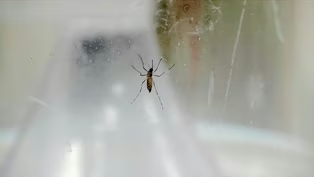
Yes, is a new kind of mosquito, Chicago, who is what it Yes, so we have some right here.
These the Asian tiger mosquito or 80's albopictus invasive mosquito species.
So this was introduced into the United States in the 1980's.
kind of in the southern part of the U.S.
And it's just been slowly making its way up North 2 were now it's very, very well established here in the Chicago Land area.
All right.
And viewers at home, I think they're getting a closer look at this.
They can see like the little bugs flying around in the top section.
Are these larva in the bottom?
we have adults up here and then down here we have the larva and the Okay.
exciting.
>> Dr the first 4 cases of West Nile virus were reported in suburban Cook County last week.
How big of a concern as West Nile this season?
Yeah, that's a great questions.
So just zooming out a little bit.
Wanted to speak to West Nile.
So first, West Nile virus is just out.
>> It's a virus.
It's mosquito-borne say it's not transmitted person to person.
It's the leading cause of mosquito-borne illnesses in the continental United States.
And mosquitoes may pick up the virus by biting birds and then transmitted to human beings.
Now in terms of the disease that it causes symptoms can be very mild to nonexistent.
But in rare cases you can get what's called Niro invasive West Nile disease.
And so that can result in people getting really sick, needing to be admitted to the ICU, be put on a breathing machine and in rare cases even death.
So it's all the more reason to pay attention to all the common sons prevention measures that I know we're going to talk about and go ahead.
Sorry of some because we were also talking about severity of it this season.
That's right.
Cook County Department of Public Health has announced that there are have been 4 cases of West Nile virus in suburban Cook County this season, all cases are under medical care.
2 of them are narrow invasives.
So that means it's the type of disease that can potentially make you very, very ill.
So again, really critical to think about prevention and some of the common sense prevention measures that we recommend, right, right.
And we're definitely to get to some of those common sense measures as well.
Christina, where we see the most mosquito and tick activity.
Yeah, so it kind of depends on we see a lot of mosquito activity, at least for the tiger mosquito and even for West Nile and a little bit more urban areas where there's lots of people really close together.
>> And then ticks, you know, kind of need natural area.
So we see them a lot of like forested type where yeah.
And for those kiddos that standing water, yes, yes.
All the standing water.
So for the Asian tiger mosquito, it's a lot of containers in people's yards.
So that could be tires.
That could be plant saucers gutters.
That haven't been cleaned out.
Children's toys that are holding water, anything that that can potentially cold water in your backyard is probably breeding mosquitoes, Dr Joshi ticks also can transmit diseases like Lyme disease and Alpha Gal syndrome.
Tell us a little more about that leaves.
Sure.
So I think they're to tick borne diseases that have been widely covered in the media.
Both are caused by different ticks.
One is Lyme disease.
>> Which initially originated in the northeastern part of United States.
But partially because of climate change partially because of the migration of the blacklegged tick or the deer tick has started to migrate into this region.
And so we know that those blacklegged ticks are now established in Cooke County.
That tick needs to be attached for 36 hours in order to pass on the bacteria.
So really important to do tick checks.
If you've been out and about if you've been hiking, if you've been in areas where there's tall grass, early symptoms of Lyme disease can show up within a few days to a few weeks.
They can include fever, headache, fatigue, and this distinctive rash.
It's sometimes known as a bull's eye rash but doesn't have to be it generally is a rash that starts around that tick bite and expands.
If it's untreated, it can cause even more severe symptoms.
Sometimes it can affect your heart in those cases.
Again, it can also cause death.
So again, really critical to do to do tick checks and remove those takes if caught early Lyme disease can be treated with very standard antibiotic treatment.
So again, if you think you've been bitten by a tick, please have a conversation with your primary care provider, OK?
That's good to know.
Christina.
What should people trying stop mosquitoes and ticks from breeding?
>> Around their homes, businesses, whatever.
Yes, for mosquitoes.
The number one thing to do is to eliminate standing water.
So, you know, removing anything from your yard that could be holding water.
>> Dumping things that kind of thing and then also taking personal protective measures like wearing repellents is really important.
That's a great visual of just some areas in your backyard that might be breeding mosquitoes and then using personal protection like repellents, that either DEET, picaridin oil of Lemon eucalyptus or permethrin treated clothing is really long sleeves pants.
Yes, we have long sleeves out.
Yeah.
>> Just a couple of things I might add.
I think really good advice to wear repellent.
Also important to take a walk around your home to see if there any screens that might be broken, a simple fix with just some duct tape can prevent mosquitoes from entering the home.
I think we talked about getting rid of standing water.
I think it's also important to address defensively and watch the clock.
So a lot of mosquitoes that cause West Nile bite during the evening and in the morning.
So particularly if you're out and about that important to wear that repellent and also to wear long sleeves and pants.
And these little guys, they're big bite during the day.
Yes, okay.
Yes.
On a very different before.
this is what this conversation is run out of time.
Got about 15 How do you If you've been bitten by a mosquito?
>> Do 10 seconds So you can some stirring cream that you purchase over the counter.
Some people will recommend just rubbing with 2 fingers just north of where you got that and that can sort of help distract the I think that distraction technique can be really helpful, particularly with young ones for the Yeah.
Yeah, that's where we'll have to leave it.
Best of luck to everybody out there.
Christina Lopez, Dr, Kiran, Joshi, thank so much.
Thank Thank you.
Christian.
And that's our show for this Monday night.
You can stream Chicago tonight on our W T Tw YouTube channel every evening and catch up on any programs you may have missed.
>> And join us tomorrow night at 5, 30 10.
We look into a new state law that expands training on para menopause and menopause for health care professionals.
Now for all of us here at Chicago tonight and Brandis Friedman, thank you for watching.
Stay healthy and safe and have a good night.
>> A closed captioning is made possible by Robert a cliff and Clifford law offices, a personal injury law firm, working to preserve the
 New
NewChicagoans Reporting Increase in Tick, Mosquito Bites
Video has Closed Captions
Cook County has reported its first four West Nile virus cases of 2026. (7m 48s)
 New
NewTIF Districts Boosted Property Taxes But Failed to Spur Development: Report
Video has Closed Captions
No other city in the United States has more TIF districts than Chicago, records show. (9m 8s)
Providing Support for PBS.org
Learn Moreabout PBS online sponsorship New Episode
- News and Public Affairs

Top journalists deliver compelling original analysis of the hour's headlines.
 New Episode
- News and Public Affairs

Today's top journalists discuss Washington's current political events and public affairs.
 New Episode

 New Episode
 New Episode
 New Episode
 New Episode
 New Episode
 New Episode
 New Episode
Support for PBS provided by:
Chicago Tonight is a local public television program presented by WTTW
WTTW video streaming support provided by members and sponsors.