
Aug. 4, 2026 - Full Show
8/4/2026 | 26m 46sVideo has Closed Captions
Watch the Aug. 4, 2026, full episode of "Chicago Tonight."
Advocates push for two shuttered hospitals to reopen. And a new report says Chicago can’t keep trying to poison its way out of its rat problem.
Problems playing video? | Closed Captioning Feedback
Problems playing video? | Closed Captioning Feedback
Chicago Tonight is a local public television program presented by WTTW
WTTW video streaming support provided by members and sponsors.
Aug. 4, 2026 - Full Show
8/4/2026 | 26m 46sVideo has Closed Captions
Advocates push for two shuttered hospitals to reopen. And a new report says Chicago can’t keep trying to poison its way out of its rat problem.
Problems playing video? | Closed Captioning Feedback
Where to Watch Chicago Tonight
Chicago Tonight is available to stream on pbs.org and the PBS app.

WTTW News Explains
In this Emmy Award-winning series, WTTW News tackles your questions — big and small — about life in the Chicago area. Our video animations guide you through local government, city history, public utilities and everything in between.Providing Support for PBS.org
Learn Moreabout PBS online sponsorship>> Hello and thanks for joining us on Chicago Brandis Friedman.
Here's what we're looking at.
2 Chicago area safety net hospitals close their doors.
This past year.
How advocates are working to get them reopened.
In Chicago, playing defense instead of offense in its fight against with a new audit shows about the city's abatement efforts.
>> And sweeping changes are taking effect for student loan borrowers.
What you should know.
>> First off tonight, the governor and the mayor won't say whether embattled Illinois House Speaker Chris Welch should keep his job speaking at separate news conferences today, Governor JB Pritzker and Mayor Brandon Johnson both praised the recent release of the legislative Inspector General report into harassment accusations against former state Representative Harry Benton.
Welch has faced heated criticism for helping fund Benton's reelection after he knew of the claims as well as questions about his own communications with a female staffer.
Pritzker says the report demonstrates gaps in the system to curb harassment and looks forward to lawmakers coming up with fixes.
>> Victims of harassment.
Want to have a process that is clear and that investigate and hold accountable.
People who are guilty of perpetrating these acts.
>> I'm grateful.
You know that.
That more transparency has been brought to light, not just this incident, but I think of those of any elected leader that has to be held to.
right says standard, quite frankly.
>> Johnson added that he trusts the speaker will do what's right for his constituents and the state of Illinois drivers and homeowners may see some relief from steadily rising insurance costs.
Under 2 new bills signed into law today.
>> painfully aware that insurance premiums have become increasingly unaffordable.
We know, too, that there are legitimate reasons for insurance rates to rise.
Climate change is real and the Midwest is now experiencing its effects.
More acutely.
Inflation and actions of the current federal administration that have driven up the cost of imports are also significantly contributing to the cost of insurance claims.
>> Under the 2 new laws home and auto insurance companies must justify proposed homeowners and auto insurance rates.
The Illinois Department of Insurance can object to those rates if they're found to be excessive, inadequate or unfairly discriminatory.
And insurers can't raise rates on Illinois.
Policyholders to cover losses associated with disasters in other states such as hurricanes or wildfires.
The city's budget director is stepping down from the position.
The latest in a series of top officials to leave the Johnson administration and that Guzman who has held the job since 2023 is resigning to care for her family.
Mayor Johnson says despite this, his office will be ready to present a balanced budget in October.
The city's first deputy budget director under Guzman will fill in on an interim basis.
Chicago is projected to end 2026.
With a budget shortfall of around 89 million dollars.
Up next, efforts to reopen to Chicago area safety net hospitals right after this.
>> Chicago tonight is made possible in part by the Alexander and John Nichols family.
The Pope Brothers Foundation.
And the support of these donors.
>> Community advocates are pushing for to shuttered safety net hospitals in the Chicago area to reopen their doors.
Park's west suburban medical center and Uptown twice hospital both closed this past year following federal funding cuts and reports of poor infrastructure and working conditions.
But there may still be hope for the hospitals.
As a judge weighs a proposed deal that could pave the way for new ownership.
Joining us, our Reverend Robin Hood of Redeemed Outreach Ministries and co-founder of Mothers opposed to violence everywhere and Lily Lake community organizing director of the Vietnamese Association of Illinois.
Thanks to both.
Welcome back to Chicago tonight.
Thank So river in west suburban Rice, they've both been closed for months now.
Weiss, sometime last year.
Have the community's been affected by this closures?
It's with affected very badly because both hospital served thousands of people.
And if pay attention to where those hospitals Yeah, I'm black and brown communities.
that works.
That makes middle money.
either the unemployed so anytime that happens, it puts a strain on the whole system.
The county can't take it anymore.
So when you close with a west Suburban will the west the wife on off that?
>> You get us in the middle and everything in the middle costs money.
So it's a very negative to impact.
Not What are you hearing from people?
I'm here for people, things totally makes to me.
Now.
7 grocery stores close last week.
Uk eat a salad without getting in trouble and now you can't go to the hospital.
All this is happening that mean, that been a conspiracy theory.
Now I'm a What we've been told for the last few years that these things was coming down and that's why we formed the coalition, the Safe Safety Hospital.
We had this problem wife's me alone.
Moshi Kohl's back during the middle of a pandemic.
We had this problem with Bethenny Advocate.
House will close on the West right before epidemic.
So it is devastating to what's happening.
And know it sounds like people people feel like it is just stacking up on them with that.
The number of different things that you mentioned, the grocery store can salad or fear cyclists for really walk us through how we got here.
How did these hospitals into closing their doors?
>> Yes, so really the first warning sign was few years back with the parking lot sell happened for the Weis Hospital.
>> As you know at the time parking lot sale happened and it was redeveloped into high income luxury apartment buildings.
And we had warned the community have warned back then that this was the beginning of the end for the Weis hospital.
And we saw the current owner Dr Persaud step in and run the hospital to the ground.
No proper management the facility is now shut down as it's no longer in meeting, the code.
few months later west by Ben also shuts down.
And we're seeing those as private equity, private business owner coming in exploiting the resources of these 2 major institutions in our communities.
And as Robin Hood said, the folks that suffer are the patients, the staff and the communities that don't have their safety nets to go to.
>> So there's a legal settlement settlement that's been proposed by the landlord of the 2 hospitals.
It would remove the CEO minutes per side and resilience.
Health care from managing the hospitals allow InSight Health, which operates Mercy Hospital in Bronzeville to take over management southwest Suburban and Weiss and potentially great a path to reopening both hospitals under new leadership.
Now.
side and resilience which owns west Suburban, as we've mentioned, have reportedly backed away from this deal, saying that they no longer want to proceed.
But attorneys for the landlord argue that the settlement was already finalizing, that the judge now needs to come to a determination of whether or not this is legally enforceable.
Lily, what concerns do you have as this legal fight drags on?
>> We know from the past almost 4 year of fighting to reopen Weiss and now fighting to reopen west of Burbank.
There's been so many convoluted conversations with both between the elected and the owners, also with the communities.
We're constantly asking what is the plan to reopen these hospitals?
And we're not getting a clear answer.
There's been radio silence from the ownership.
No communication or transparency around what their actual plan is.
And the same time the governor's office has also been largely silent on the issue.
And we know that the hospital's own millions of dollars in state taxes, theirs.
No accountability mechanism to hold these owners accountable before running down these hospitals.
And this is why we're seeing that how important it is for the government to now to have to step in to work with the communities to listen to us and have a credible plan to invest in and fund fireball, sustainable health facilities in our low income but only by brown immigrant communities.
Do you think that this proposed settlement is the best opportunity to reopen these hospitals best way to do This is just the beginning.
the conversations have been stalling for so long.
It's been months and we know that.
No matter what happens with these hospitals under new responsible ownership, the community has to be at the table.
Any action moving forward has to include the input from the community side from the worker's side on the futures of both of these hospitals in partnership with State Leadership.
Reverend Hood, you've warned and you've got concerns that more safety net hospitals could be on the chopping block as well.
Which ones are you concerned about?
>> Moos said rose to have hospital have already said they the out of money couple weeks ago.
The thing that, possibly the most legislators pass and the bill.
That protects hospitals from lack of transparency.
That's a big issue.
We get here because there was no trash parish.
Now there's actually a that allows lows to not tell the community there about the cold, say anything.
So we're a town hall meeting.
this month, August 31st.
That map scholarships.
68.
And inviting every last one.
I legislate because they have to tell why table for this.
We the trespass.
So now every a hospital close workers will come to work and going do with clothes that no longer have a patients coming.
This is life or death.
This is not a. So there needs to be higher accountability coming from the governor.
So so you've call you can call them.
The governor in the governor's office says that the situation is ultimately a private business failure.
In a statement from his office, he says, quote.
>> Despite intensive financial and operational support from the state of Illinois throughout resilience, health 10 year west Suburban and white hospitals are ultimately private facilities whose leadership is both unable and unwilling to do everything in their power necessary to keep their facilities in operation.
And they never presented the state with any formal request or viable plan to continue operations at this time.
All former west suburban patients have been safely transitioned to new providers.
Lily, why do you think the state still bears responsibility here?
When it comes to hospitals, especially safety net hospitals that serve low-income patients without turning people away based on their ability to pay.
>> When the governor says that this is a private matter, this is not just private dealings.
There's a real impact on the public.
So we're viewing this as a public health issued a public health emergency where the state and the governor is responsible to the community to the public on how these health facilities, these hospitals will continue to operate.
So the and well, it sounds like, you know, until the state's, you know, decides to step in.
It doesn't like for now, it is in the hands of the courts.
>> Where we will have to keep waiting.
Reverend Robin Hood and really lay thanks to both for joining us.
We appreciate it.
Good luck to Thank you so much.
Up next, a push to redraw the battle lines in Chicago's war on rodents.
>> Chicago has a rat problem and it is unlikely to improve if the city doesn't come up with a new playbook.
That's according to a new report by the city's watchdog in here to tell us more about it is our own Patty wet Lee.
Patty, what are the ID's audit?
Find?
Well, in short, they took a look at the Bureau of Road in Control July 2023.
To July 2024.
And and the topline findings were that.
>> The bureau relies far to have Lee almost exclusively on call.
So 3, 1, one report's to 3, 1, one for complaints to follow up for abatement.
And they're saying those calls are also put in a queue sort of in the order in which they're taken not necessarily triage, which ones are more severe or important and then other key finding was that the bureau takes very much poison first approach when best practices in pest management now are moving toward poison as a last resort in rather than addressing the root cause, which would be rats source of food and shelter.
They're going with the poison approach and then not necessarily knowing if that was effective or not.
So what were the report's recommendations, one that they should be far more proactive in do more of a survey in data collection go around the city.
You know, New York surveyed some like 35,000 properties and then assigned sort of a danger level to them or an intensity level.
And then you follow-up in the order in which the issue was the most severe.
Also integrate with all the other departments that might have a hand in pest management, whether it's removing weeds or building code violations and things like that.
While acknowledging that all of U.S.
citizens or residents of Chicago have a role to play because that trash is clearly coming from somewhere and you know, if we're not throwing it away properly, if we're not picking up dog waste, you know, that's just the buffet that rats are dining out on.
rats will be attracted to that 10 seconds left.
What's next?
They said they will follow through with a lot of these recommendations, but that some of them would be depending on funding and non technology upgrades.
If you want a database of what to where to find the rats you need somebody to build that database and you're going pay for it.
OK, patty, what we thanks so much.
Thanks.
Brandis.
And you can read patties full story on our website.
It is all a W t tw dot com slash news.
>> Millions of federal student loan borrowers are facing changes that could cost them thousands of dollars as of July.
First, the one big beautiful Bill Act marks the elimination of the Save repayment plan.
New borrowing caps for parents and professional degree changes and students, graduates and families are feeling the impact.
Joining us now to talk more about these changes are Jennifer Reed Davis, executive Director.
Bottom Line, Chicago, which provides academic personal financial and career counseling for first generation and low income students.
And Natalia Abrams, president and founder of the Student Debt Crisis Center, nonprofit organization working to end student debt crisis.
Thanks to you both for joining us.
Thank So the Office of Federal Student Aid recently reported that about 9.5 million borrowers are currently in default on their student loans.
That includes nearly 20% of loan recipients in Illinois.
Jennifer, to you first.
What's your reaction to that?
I mean, it's really unfortunate.
We Illinois has series of great colleges and universities.
>> To offer are thousands of families and students in the state of Illinois.
And yet if it is not affordable, that means that it is not accessible for those families at scale.
And we know that they want to be able to have colleges the option for them.
>> Natalia water, default rates so high for Illinois ends.
>> They're as you mentioned there, high across the country.
You have about 250,000 student loan borrowers in Illinois alone.
That means more than 50,000 people are the fog.
And this been the position of seeing debt crisis center.
The chaos and confusion going on with both the lending side, but then trying to pay it back.
There been so many changes over the last 5 years, sometimes changes day by day.
Hour by hour.
It's almost impossible, Christine virus to keep up.
I recalled.
covering a lot of these over the years as well.
That tell you how long on average is it taking borrowers to pay back their loans today?
>> It's technically there is a 10 year standard plan.
And then there's a new tiered standard plan.
This is post changes, which is now up to 25 years.
But it takes far long much more than that.
We're looking at 2025 years on the standard 10 year and borrowers taking 30 plus years to pay off their bones.
The majority of our supporters, debt crisis center are far worse over the age of 45 and have been borrowing more than 20 years.
Cheese.
Jennifer costs are rising across multiple industries.
Of course, you know, I can talk about groceries and gas and of course, housing.
>> How are all of these rising costs impacting graduates abilities to pay those loans back?
Well, I think if we speak about our students and what their real life terms, they have all of those bills that you are talking about.
So they are thinking about rent thing about groceries.
They think about transportation.
All of those costs are going to come before college tuition.
That is the world that we live in.
And so what is happening as I think our students don't even believe that college is not a viable option for them because it feels on affordable.
And what I think will eventually happen is that we will see a decline in students applying to college because they don't believe that is actually a real missed that opportunity for them to even pursue right.
And there's some other parts of act that could also have an impact on that that hopefully will have time to get tell you.
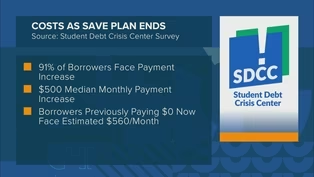
>> A recent survey by the student debt crisis center, you all found that 91% of borrowers will face increased payments with the end of the save plan as well as an estimated $500 average monthly payment increase.
Remind us what to say plan was and why do you think?
You know, it was so important for borrowers.
>> a plan is what's called an income-driven repayment.
Plans said this is plan based on your income versus your overall students and those with high road balancers or have low incomes really benefit from these plans.
State was by far the most generous repayment plan out there that also paint the unpaid interest borrowers didn't see their payments balloon and increase.
This isn't struck down by the courts BB ba is now ended.
Borrowers have been on a 2 year long for parents and they are waking up to payments that are not $500.
re than 0 mind you.
$500 more than what their payment was when they were on the same plan and that is just the median I talked up Iowa's every day.
They're looking at $1000 payments and about.
What options do bars have for repaying their loans.
Now.
So if haven't taken out a new round after July, 1st of this year 2026, there is a legacy income-driven repayment plan called Income-Based repayments.
That probably going to be the best plan for you.
There's also a new plan that came out called the repayment Assistance Plan or lot acronyms here.
The best thing for student borrowers to do is to go to the repayment calculator that student aid dot Gov to see what plan is best for them.
But by all means get on a repayment plan or what's called an extended or graduated repayment plan.
It is so much better than falling into default or delinquency, even a loan forbearance, which is a temporary measure.
But it's still better than adding to those Devon members because we expect that the ending of the same plan and changes to see that the phone number to skyrocket.
So another new policy outlined in Bba.
>> loan limits to graduate programs that no longer meet the professional degree nursing physical therapy, social work, education supporters are arguing that students should not take out how federal loans for degree programs because expected expected salaries are not enough to pay those loans back.
Jennifer, with the reaction to I'm a former teacher.
I should say that up front a very proud classroom teacher.
And so my first reaction to that is actually >> that many of those professions that you just named are underpaid to begin with.
So we believe that not worth the investment.
Actually wonder if we are investing.
Can paying those careers what they actually are valued and how they contribute to society.
The other thing that I want to say is that, you know, we here in our country, we encourage our young people to pursue their own dreams.
And so we want those dreams to not come at a price tag, but they cannot afford.
All right.
And and, you know, American dream like if we're talking about people pursuing dreams that all you do, you think these low capsule impact whether prospective students, you know, pursue degrees in those fields and then what does that mean for those industries?
Health care, education?
>> absolutely think it's going to impact people from going into these incredibly vital careers.
Thank you, Jennifer, for being a teacher.
My mother is a teacher super important career.
You I believe in Chicago.
I'm in California.
I need to have a doctoral degree be a physical therapist that's going to cost hundreds of thousands of dollars.
But when you have all-time acts $100,000 limit for graduate students, that's not going to cover that professional degree and they're going to have to go and get the private loan if they can't even get one.
recent study per project for us and 45% of borrowers won't even be able to apply for private loans so they just won't have any options.
We are reversing what Lyndon Johnson did with the Higher Education Act of 1965, which was to allow low-income borrowers, women and borrowers of color to be able to go to school and expand their American dream and be able to get education.
And we're going backwards now this country.
All right.
That is unfortunately where we will have to leave Jeffery Davis, Natalia Abrams, thanks to you both for joining us.
Appreciate it.
Good luck to Thank you.
>> And that is our show for this Tuesday night.
Check out our website for our Chicago Summer Festival guide from Street Fest.
And art shows to outdoor concerts and cultural celebrations.
We've got you covered.
It's all at www dot com slash festivals and join us tomorrow night at 5, 30 10.
Why some communities across Illinois say they're interested in landing new nuclear facilities as the state lifts its moratorium.
Now for all of us here at Chicago Brandis Friedman, thank you for watching.
Stay healthy and safe.
Have a good night.
>> Closed captioning is made possible by Robert a cliff and Clifford law offices, a personal injury law firm, working to preserve the
 New
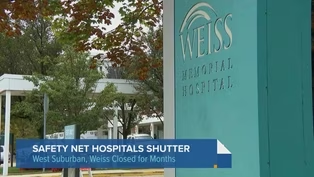
NewAdvocates Push for Two Safety-Net Hospitals to Reopen
Video has Closed Captions
A judge is weighing a proposed deal that could pave the way for new ownership. (9m 16s)
 New
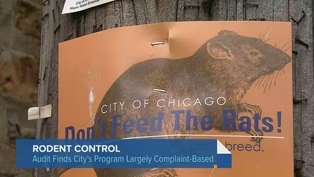
NewChicago Can’t Keep Trying to Poison Its Way Out of Rat Problem: Report
Video has Closed Captions
Chicago's rat problem isn’t likely to improve if the city doesn’t come up with a new playbook. (2m 27s)
 New
NewWhat to Know About Trump's Sweeping Changes to Student Loans
Video has Closed Captions
Students, graduates and families in Chicago and nationwide are feeling the impact. (8m 17s)
Providing Support for PBS.org
Learn Moreabout PBS online sponsorship New Episode
- News and Public Affairs

Top journalists deliver compelling original analysis of the hour's headlines.
 New Episode
- News and Public Affairs

Today's top journalists discuss Washington's current political events and public affairs.
 New Episode
 New Episode
 New Episode
 New Episode
 New Episode
 New Episode
 New Episode
 New Episode
Support for PBS provided by:
Chicago Tonight is a local public television program presented by WTTW
WTTW video streaming support provided by members and sponsors.