

August 10, 2026 - PBS News Hour full episode
8/10/2026 | 57m 46sVideo has Closed Captions
August 10, 2026 - PBS News Hour full episode
August 10, 2026 - PBS News Hour full episode
Problems playing video? | Closed Captioning Feedback
Problems playing video? | Closed Captioning Feedback
Major corporate funding for the PBS News Hour is provided by BDO, BNSF, Consumer Cellular, American Cruise Lines, and Raymond James. Funding for the PBS NewsHour Weekend is provided by...
August 10, 2026 - PBS News Hour full episode
8/10/2026 | 57m 46sVideo has Closed Captions
August 10, 2026 - PBS News Hour full episode
Problems playing video? | Closed Captioning Feedback
Where to Watch PBS News Hour
PBS News Hour is available to stream on pbs.org and the PBS app.
Providing Support for PBS.org
Learn Moreabout PBS online sponsorshipGEOFF BENNETT: Good evening.
I'm Geoff Bennett.
Amna Nawaz is away.
On the "NewsHour" tonight: A powerful earthquake shakes Colombia, collapsing buildings and trapping residents under the rubble.
Yemen's civil war threatens to reignite between the government and Iran-backed Houthi forces.
We examine the risks of further destabilization in the region.
Secretaries of state from across the country meet with the Trump administration to discuss voting security, with only a few months remaining until election day.
And Meta releases an open-source version of its most powerful artificial intelligence model, potentially changing the technology's landscape.
MIKE ISAAC, The New York Times: This kind of flooding the zone with open-source software and allowing anyone to use it is a kind of way for them to catch up.
(BREAK) GEOFF BENNETT: Welcome to the "News Hour."
We begin tonight with a powerful and deadly earthquake that hit Colombia today, killing at least 111 people, toppling buildings, and leaving a trail of destruction.
In Colombia today, homes and buildings crumbled as a deadly 7.4-magnitude earthquake rocked the country.
In Manizales, about 160 miles outside the country's capital of Bogota, smoke filled the air as pieces of this building came crashing down.
A woman stumbled as she ran for safety, strangers quickly rushing in to help her.
Outside the city's famed Cathedral Basilica of Our Lady of the Rosary, strangers clung to one another as the ground beneath them shook.
When it was over, they were among the first to see the damage to Colombia's beloved nearly century-old church.
In the city of Pereira, rescue workers searched the rubble for survivors.
Street vendors and delivery drivers scrambled to safety as this four-story building buckled in a matter of minutes.
And outside this apartment building, a woman prayed for the shaking to stop as people watched helplessly while the structure swayed.
The quake was centered near San Jose del Palmar, south of Medellin, but stretched across Western Colombia, including the country's famed coffee-growing region.
In Santiago de Cali, where Colombia's new president was inaugurated just days ago, a celebratory atmosphere quickly gave to crisis.
ALEJANDRO EDER, Mayor of Cali, Colombia (through translator): At the moment, we have at least 20 collapsed structures in Cali with people trapped.
I have requested support from the mayor of Bogota and the mayor of Medellin with rescue workers.
Check if your buildings have apparent structural damage.
If you don't feel safe, if you see very large cracks, please exit the building.
GEOFF BENNETT: Even the city's emergency services were hit, chunks of this building crashing down on ambulances parked below.
ABELARDO GABRIEL DE LA ESPRIELLA, Colombian President (through translator): You are not alone.
Colombia has a president who cares about the people and who will do everything in his power to help them in the most difficult moment, strong for the homeland.
GEOFF BENNETT: And, tonight, Colombia's president, just three days into the job, said he would lead the emergency response efforts and travel to the hardest-hit areas.
Also today, heavy rains caused major flash flooding after Tropical Storm Dolphin made landfall in Eastern China.
More than 300,000 people were evacuated ahead of the storm, and Shanghai's airports canceled more than 1,300 flights.
Meantime, in the Philippines, rescue operations are under way after the storm intensified the country's seasonal monsoon rains, triggering landslides and killing at least five people,flooding submerged homes and businesses in Manila.
Officials say at least five other people remain missing.
President Trump's Board of Peace says it's in ongoing discussions with Israel after Prime Minister Benjamin Netanyahu rejected Mr.
Trump's new Gaza peace plan in yet another public break with the White House.
Speaking to his Cabinet, Netanyahu said Israeli forces won't withdraw from the territory until Hamas is -- quote -- "actually disarmed."
BENJAMIN NETANYAHU, Israeli Prime Minister (through translator): We're talking about a true dismantling, not a fictitious dismantling.
We're speaking with the Americans about this subject.
They have ideas.
Some of them are acceptable to us, and some are unacceptable to us.
GEOFF BENNETT: Despite the impasse, operations continued in Southern Israel today to build a base for international peacekeepers if and when they are deployed to Gaza.
Hamas, meantime, says it remains -- quote -- "committed to the road map for peace."
President Trump today signed an executive order calling for fewer childhood vaccines and spacing out shots across separate doctor visits.
DONALD TRUMP, President of the United States: Proof of it, where they have a vaccination that looks like the size of a bottle of soda poured into a little child's body.
And bad things happen in many cases, in too many cases, because this is an explosion.
This is an epidemic.
GEOFF BENNETT: The facts do not support the president's claim.
His order calls for splitting the measles, mumps, and rubella vaccine into three separate shots, though those individual vaccines are not currently available in the U.S.
It also directs HHS to reassess the timing and sequencing of childhood vaccines.
During today's signing, Mr.
Trump also repeatedly suggested vaccines could be linked to autism.
That's despite decades of research, including large-scale studies involving hundreds of thousands of children finding no causal connection.
Attorney General Todd Blanche was sworn in today after being narrowly confirmed by the Senate over the weekend.
TODD BLANCHE, Acting U.S.
Attorney General: That I will support and defend the Constitution of the United States.
GEOFF BENNETT: Press were excluded from this swearing-in.
This video was posted to social media by the White House press secretary.
Blanche, who was Mr.
Trump's former personal lawyer, served as acting attorney general since Pam Bondi's firing back in April.
Blanche was confirmed by the Senate early Saturday morning by a slim margin, 50-49.
Two Republican senators joined all Democrats in voting against his confirmation, citing concerns about the Justice Department's independence.
South Carolina's Joint Base Charleston has been officially renamed Joint Base Lindsey Graham in honor of the late Republican senator.
MAN: With a shared vision for the future and deep respect for our past, together, let us mark this new beginning in three, two, one.
(APPLAUSE) GEOFF BENNETT: Defense Secretary Pete Hegseth was among the officials gathered to pay tribute at the renaming ceremony.
Also there, Graham's sister, Darline, who was appointed to fill his remaining time in Congress.
The 24,000-acre base is home to more than 90,000 service members, civilians, retirees, and their families.
Last month was officially the hottest month ever recorded for the contiguous U.S., in other words, all the states except Alaska and Hawaii.
That's according to the National Oceanic and Atmospheric Administration.
Last month officially eclipsed July 1936 during the Dust Bowl by an eighth-of-a-degree.
Scientists said one of the biggest drivers of the record heat was hotter nighttime temperatures, an indicator of human-caused climate change.
On Wall Street today, all the major indices moved lower to start the week.
The Dow Jones industrial average dropped by 60 points.
The Nasdaq slipped by more than 80 points, as several large tech stocks weighed on the market.
The S&P 500 suffered a minimal loss.
And many across the sports world are mourning the death of Hall of Famer Don Nelson, the second winningest coach in NBA history.
His 1,335 wins are just behind Spurs legend Gregg Popovich for the most all time.
Nelson also won five championships as a player with the Boston Celtics.
He died Sunday at the age of 86.
And Ben Jones, who played the mechanic Cooter Davenport on the hit TV series the "Dukes of Hazzard," also died yesterday.
BEN JONES, Actor: Breaker one.
I might be crazy, but I ain't dumb.
Crazy Cooter coming at you.
GEOFF BENNETT: Jones turned to public office later in life, serving two terms as a Democratic congressman for the state of Georgia.
Ben Jones was 84 years old.
Still to come on the "News Hour": what you should know about Meta's newest open-source A.I.
model; Tamara Keith and Amy Walter break down the latest political headlines; and the family of a Marine veteran imprisoned in Russia warn, he's near death.
Today, Iran again insisted it will keep the Strait of Hormuz closed until the U.S.
meets a sweeping list of demands.
President Trump scoffed at those conditions, especially paying reparations to Iran for damage caused by five months of U.S.-Israeli bombardments.
The impasse over the strait comes as war appears closer in Yemen between a Saudi-backed coalition and the Iran-backed rebel Houthis.
Here's Nick Schifrin.
NICK SCHIFRIN: If the U.S.
thought it was close to a deal that would allow ships in and out of the Strait of Hormuz, this weekend, that hope appeared dashed.
Iranian national security officials issued a sweeping set of demands for Iran to open the strait.
The U.S.
must lift the naval blockade and withdraw nearby troops, remove sanctions on Iran, and release Iranian frozen assets, pay Iran reparations, and end attacks on Iranian proxies, including Israel's strikes on Hezbollah.
Those are dead on arrival, especially before Iran takes its own steps.
But they were echoed today by Foreign Ministry spokesman Esmaeil Baghaei.
ESMAEIL BAGHAEI, Iranian Foreign Ministry Spokesman (through translator): As long as other U.S.
violations continue, the necessary conditions will not be in place for us to say that the Strait of Hormuz has become a safe waterway.
NICK SCHIFRIN: That's not the message Iran sent last week, when four regional and U.S.
officials told "PBS News Hour" that Iran and Oman agreed that ships entering the strait would sail near Iran and ships leaving the strait would sail near Oman in a temporary deal that would restart the cease-fire and was supported by the rest of the members of the Gulf Cooperation Council.
DONALD TRUMP, President of the United States: Can they make trouble?
Yes, they can make trouble, but they're broke.
NICK SCHIFRIN: Today, President Trump tried to flip the script on Iran's demand for reparations.
DONALD TRUMP, President of the United States: They asked for money for the damage that we have done.
And I said, that's a good idea.
Well, we're going to ask for money for the damage they have done over a 50-year period.
NICK SCHIFRIN: The president cited the thousands of American service members killed or wounded by Iranian bombs in Iraq,as well as tens of thousands of Iranian protesters killed by the regime and the 2000 bombing of the USS Cole, although that was led by al-Qaida.
But Iran's security apparatus is responding to U.S.
pressure by consolidating power, this weekend naming a 71-year-old former Revolutionary Guard Corps commander as its new top national security adviser.
ABBAS MILANI, Stanford University: The ones who have the upper hand right now are the ones who think they send the bargain for a much, much, much better deal.
NICK SCHIFRIN: ABBAS MILANI is Stanford University's director of Iranian studies.
ABBAS MILANI: They know Mr.
Trump doesn't want a prolonged war.
They know he wants out of this at best he can.
So they think they have some leverage there, and they're using that leverage.
NICK SCHIFRIN: A senior U.S.
official tells "PBS News Hour" the administration is patient and considers this not a setback, but a step in the process.
As President Trump told Axios' Barak Ravid this weekend: "We are low-keying it.
We are only semi-negotiating with them.
We are just watching Iran with its huge inflation and the fact they have no money."
ABBAS MILANI: As an American commentator said, it's the economy, stupid.
It is the economy, stupid.
If you can't feed your people, if you can't feed your army, if you cannot make payroll, the Iranian regime has actually literally had problems.
You can't fight a war with the world.
But the leverage they think they have is that they think they have won this battle with the United States, won the battle with Israel.
NICK SCHIFRIN: And it's not just Iran itself.
The Iranian-backed Houthis are also trying to exert maximum leverage.
The Houthi rebels in Yemen released this footage showing its first attacks in more than four years on multiple fronts.
The Houthis struck the Port of Mocha, controlled by the internationally recognized Yemeni government, killing both soldiers and civilians.
The Houthis have also attacked in Southern and Eastern Yemen at Yemeni troops and what the government called camps for displaced civilians.
Yemen's military vows to respond.
COL.
MAJED AL-NAZILI, Yemeni Military Spokesman (through translator): We emphasize that any attack on one front or axis is considered an attack on all fronts and axes of our armed forces.
NICK SCHIFRIN: The Houthis have also launched cross-border attacks at Saudi Arabia's energy facilities.
The Houthis and Saudis fought a nearly-decade-long war that for the last four years has been in a tentative cease-fire.
The U.N.
warns the strikes over the last few weeks threatens to restart that war.
MOHAMMED AL-BASHA, Founder, Basha Report: The Houthis here are assuming that nobody is ready for ground operations and nobody wants to escalate to full-scale war.
And so they're pushing the boundaries, hoping that this maximum pressure tactic will get them what they want.
NICK SCHIFRIN: Mohammed Al-Basha founded the U.S.-based risk advisory Basha Report and has advised governments in the private sector.
MOHAMMED AL-BASHA: I call this missile and drone diplomacy, where they're using military tactics for negotiating.
But I think they have to be very careful right now because the Saudi-led coalition and the government forces on the ground have already started losing personnel.
They're not going to just sit back and be sitting ducks for the Houthis to shoot whenever they want.
They will have to retaliate eventually.
NICK SCHIFRIN: And as Iran maintains its choke hold over the Strait of Hormuz, the Houthis are threatening to shut down the Bab al-Mandab right next to territory they control and a vital shipping route that's a gateway to the Red Sea.
MOHAMMED AL-BASHA: They're sending a signal to the U.S., they're sending a signal to the international community that they could close the Bab al-Mandab Strait, that they could disrupt the Red Sea traffic in the Gulf of Aden.
And, by doing that, it is definitely serving Iran and serving Iran's interests, but it's also serving the Houthis' interests.
NICK SCHIFRIN: And making it more difficult for the U.S.
and its allies to extract itself from a war they started, but now have no way to end.
For the "PBS News Hour," I'm Nick Schifrin.
GEOFF BENNETT: This afternoon, CISA, the federal agency tasked with protecting the cybersecurity of the nation's critical infrastructure, to include voting equipment, held a conference call with state election officials to discuss the upcoming midterm elections.
Despite President Trump's claims about the risk of foreign hackers targeting U.S.
voting systems, this was one of CISA's first broad outreach efforts to state election officials, and that's with Election Day just 85 days away.
Our White House correspondent, Liz Landers, joins us now with more.
So, Liz, we should say for the unfamiliar CISA is the Cybersecurity and Infrastructure Security Agency.
They had this conference call.
You have been reporting on this all day.
What happened?
LIZ LANDERS: I spoke with three sources who were on the call, lasted about an hour, and this was hosted by the National Association of Secretaries of State.
And it included these two CISA officials.
The acting director of CISA, Nick Andersen, primarily spoke, I'm told, and also Jim Harrell, who's the head of integrated operations, was also on the call as well.
And one source that was on the call said that they really appreciated the National Association of Secretaries of State and the administration talking with election officials on this call, but that it is 85 days away, as you mentioned, from Election Day at this point, and that election officials have already made plans to fill in the gaps that they see CISA has left behind.
I'm told that there were a number of topics that were covered on this call and that CISA committed to providing physical and cybersecurity assessments upon request, which is standard, that CISA also talked about the workflow and recommended that election officials work through regional directors, which is also something that has been in place in past election cycles.
CISA did acknowledge, the officials on the call acknowledged outside foreign actors who are trying to influence the elections here, but did not talk about specifics.
And, Geoff, we have known and reported on in the past that Iran, Russia, and China have tried to influence the last several cycles of American elections here.
There was also some talk on this call about voter registration systems, which is -- as one source pointed out to me, was, in particular, of interest to them because that is something that the president has talked about a number of times recently.
GEOFF BENNETT: And how did those state election officials react?
LIZ LANDERS: I'm told that several secretaries of state asked questions on this call, and one of the more pointed questions and heated exchanges was about comments from the DHS secretary, Markwayne Mullin.
That is the agency that oversees CISA, of course.
And he made comments just a few weeks ago threatening to prosecute election officials if they didn't cooperate with the Trump administration.
And one of these election officials on the call said, why should we trust working with you all as an agency when your boss says that he wants to jail us?
Another secretary apparently made a comment that the briefing felt more like security theater than actually helping these election officials.
And I'm told that another secretary also asked about some specific assistance that CISA could offer, like tabletop exercises, penetration testing, and intelligence briefings, and that some of the officials on the call felt like the response to that was kind of noncommittal.
Like, will they get that in time for the November elections?
It wasn't really clear.
I think the most concise thing that I heard from a separate source on the call was that they said that the agency was sort of covering their butts with this.
GEOFF BENNETT: So, remind us, what is CISA's role in an election year typically?
LIZ LANDERS: CISA traditionally has a broad role in securing both the cyber and physical infrastructure across many agencies in the government, including water systems, which is something that has been in the news recently, with those being hacked in several states, and they also secure election systems.
And their election role, as defined on their own Web sites, is that they're supposed to share threat information, they're supposed to deploy sensors to detect malicious activity.
They're supposed to foster robust processes for coordination across the federal, local, state partners there.
But the Trump administration has gutted this election security apparatus in the last few years.
CISA has lost about a third of its work force in the second Trump administration, and other agencies have also lost their election security specialized work force, including the national -- the director of national intelligence gutted the Foreign Malign Influence Center.
And also the FBI has downsized their election security work.
Geoff, of course, we are going into an election cycle that the president has talked about constantly.
So we will see if CISA is able to provide more support to these states.
GEOFF BENNETT: Liz Landers, thank you for this reporting.
LIZ LANDERS: Of course.
GEOFF BENNETT: Meta, the company behind Facebook and Instagram, has released a new free artificial intelligence tool today.
The release was accompanied by a 14-page essay from Meta CEO Mark Zuckerberg championing his view of how artificial intelligence could transform our world and what protections are required.
Our William Brangham as more.
WILLIAM BRANGHAM: That's right, Geoff.
Meta's new program is called Muse Glimmer.
And it's what's known as an open-source model, meaning that anyone can download it, modify it, and use it however they want.
In his essay, Zuckerberg makes the case that A.I.
tools should all be like this, widely available and open, rather than walled off and controlled by a handful of powerful individuals or companies.
He argues that the way forward is through -- quote -- "openness and putting the power of tech into more people's hands, not fewer."
This puts Meta at odds with rivals like OpenAI and Anthropic, who argue that these increasingly powerful A.I.
tools need to be tightly controlled because of the potential risks.
So, for more on this growing debate, we are joined again by Mike Isaac, who's The New York Times' Silicon Valley correspondent.
Mike, thank you so much for being here.
Help us understand a little bit more.
What do we mean when we say something is open-source versus the opposite?
What's the distinction here?
MIKE ISAAC, The New York Times: Yes, so open-source software has been around basically as long as Silicon Valley, but it's the idea that you're creating a computer program or coding language that can be sort of freely shared, copied, used, and manipulated to build your own types of programs, which is pretty different than companies like OpenAI and Anthropic, which build so-called closed-source, closed programs that people can't replicate.
And the idea being the more people with access to the code, the more different types of programs or companies perhaps that you could build in the future.
WILLIAM BRANGHAM: And it seems that Zuckerberg is arguing that it's more egalitarian, and that if you have more eyes on an open-source system, you will spot problems sooner, rather than later.
But, as you mentioned, OpenAI and Anthropic, some of Meta's chief competitors, have an opposite view and think this stuff is too dangerous.
What are they arguing as to why it should be closed?
MIKE ISAAC: Yes, this debate goes for as long as computing has kind of been a thing.
But it's exactly that.
The folks of open-source say, hey, more eyeballs equals safer, we can figure out different security issues.
The closed-source people, OpenAI and Anthropic, in particular, say, look, we love open-source software as much as anyone, but how A.I.
is developing, how quickly, how powerful computers are becoming really is different than any sort of other computer program we have ever encountered.
And so their argument is, a lot of this stuff, especially Anthropic, a lot of this stuff should stay closed, should not be replicable, and if used by the wrong folks or people who let's say don't have American interests in mind, for instance, they might be used to harm people on the planet.
And so essentially what they're saying is, you should trust us and the American government to produce the right type of A.I.
software, which clearly Mark Zuckerberg has taken issue with.
WILLIAM BRANGHAM: I mean, I know we are early days with A.I., but is there any evidence one way or another that open-source systems are more inherently safe and less likely to fall into dangerous hands?
MIKE ISAAC: I mean, I do think there are legitimate trade-offs and arguments on both sides to this.
On the one hand, if anyone can see how a computer program performs or how it's operating, the idea being, like, the whole world can pick it apart faster and improve upon it, let's say.
But it also, in terms of open-source programs, if anyone can use these things, and particularly very advanced software, if someone wants to cause havoc or do things that are really potentially disruptive to any different part of the economy -- or now there's talk of being able to develop biological weapons or computer programs that do hacking of different companies.
That's really dangerous.
Those are real risks that I think folks are wrestling through right now.
And I think the American government, I will say, is trying to grapple with a balance between who should have control and how much control is too much control when developing these programs.
So I honestly can see both sides of this.
WILLIAM BRANGHAM: I mean, Zuckerberg is pitching this partly as a philosophical argument, but Meta and his competitors are all for-profit companies.
There's an economic side to this as well.
So -- and Meta's new tool comes as the Chinese have been putting out open-source inexpensive and quite effective A.I.
tools.
So, how much of this is philosophy and how much of this should we see this as competition?
MIKE ISAAC: I think you nailed it.
Everything that comes out of Mark Zuckerberg's, I guess, pen in this instance, is always a little bit self-serving, if not very much self-serving.
Look, I think he actually does believe in this sort of egalitarian stance around code and who should have access to these tools.
It's why he preaches everyone should be able to share on Facebook or Instagram or media should not be controlled just by a few outlets and everyone can sort of express themselves online.
But I think, in this case, Meta is very behind in this A.I.
race.
They have spent billions of dollars developing data centers, they have hired top talent across the industry, and they're still getting beaten by Anthropic and OpenAI.
So this kind of flooding the zone with open-source software and allowing anyone to use it is a kind of way for them to catch up.
And, essentially, the more people that use these types of programs, the better opportunity they have to kind of unseat Anthropic and OpenAI and get people to at least try to use Meta's programs in the future.
WILLIAM BRANGHAM: All right, Mike Isaac of The New York Times, thank you so much for sharing your reporting with us.
MIKE ISAAC: Thank you for having me.
GEOFF BENNETT: Voters head to the polls tomorrow in six states.
For more on the races to watch this week, we turn now to our Politics Monday duo.
That's Amy Walter of The Cook Political Report With Amy Walter and Tamara Keith of NPR.
It's always great to see you both.
So, Amy, I will start with you, because Michigan Democrats, they spent the weekend trying to mend fences after a bruising Senate primary.
Now you have Michigan -- or, rather Minnesota, and we were talking earlier about how hard it is to keep all this straight.
Now you have Minnesota and Wisconsin Democrats.
They might soon have to do the same after a tough primary to come.
AMY WALTER, The Cook Political Report: Yes.
GEOFF BENNETT: The question is, how much do these tough primaries matter once you get to the general?
AMY WALTER: Well, I think for bringing the Democratic base together, no one is better and more helpful to Democrats than Donald Trump.
He is the great unifier and organizer of the disparate factions within the Democratic Party.
I think the challenge, especially in a state like Michigan or Wisconsin, which are swing states -- now, they are bluer today, in part because Donald Trump is much less popular in those states today than he was in 2024, let's say.
But if the election in those races is about Donald Trump, and that's the focus of the election and the economy and frustration about it, that's beneficial to Democrats.
The challenge with Michigan and potentially Wisconsin is that the conversation is also going to be about the liabilities of the Democrat.
So it's no longer just a referendum on an unpopular president.
GEOFF BENNETT: And, Tam, Wisconsin might be a revealing test on that front because you have Francesca Hong.
She's a Democratic Socialist.
She's the Democratic front-runner for governor, despite concerns among many folks in the party about whether or not she's electable.
What would a Hong victory tell us about where Democratic primary voters are right now?
TAMARA KEITH, National Public Radio: Yes, I think this is a really interesting case.
Bernie Sanders, who has endorsed a lot of the progressive candidates, hasn't actually endorsed in this race, which I think is somewhat telling, in that sort of the progressive wing is not necessarily always pushing this forward as the perfect example of what they can do in a swing state.
It is also the case that the establishment lane has been a multicar pile-up in this race.
There were a number of more establishment candidates.
There have been dramatic issues, people dropping out.
One of the people who dropped out got back in, and that's David Crowley, who is now endorsed by Governor Evers, who was trying to push him over the finish line.
It has been -- it has been quite the dramatic series of events.
Meanwhile, Francesca Hong has been powering forward, though, recently, having several interviews where she has said some pretty wild things that could end up being problematic as there were a lot of undecided voters out there.
AMY WALTER: You know, I think what we're going to see, and that's the difference of these cases, in Michigan, the establishment said, oh, no, that we're splitting the establishment vote.
Somebody has to drop out, we're going to all unite around one candidate.
They did that around Haley Stevens.
She still came up short.
In Wisconsin, the establishment lane got really messy, as Tam pointed out, and they were unable to quickly coalesce around a candidate.
But in either case, if Hong wins, whether they were coalesced or not, it just goes to show that, at least for now, in some of these Democratic primaries, there's enough energy behind this these outsider candidates, whether they're DSA-backed or not, who are seen as being against whoever the establishment, in this case, the sitting governors and in some cases the sitting senators have endorsed.
TAMARA KEITH: And I will just add that Francesca Hong has had a very strong focus on A.I.
data centers, which is a sleeper issue that is starting to show up in all kinds of races all over the country, sort of capturing that voter backlash against these centers.
And that -- talking to swing voters in Wisconsin, they were like, oh, all I know is that she's against data centers.
AMY WALTER: Right.
GEOFF BENNETT: And on the Republican side, in Minnesota, President Trump is backing Mike Lindell for governor.
He's a close ally, prominent figure in efforts to overturn the overturn the 2020 election.
And his candidacy has divided Republicans in Minnesota.
If Lindell wins, what does that tell us about President Trump's continued ability to shape the Republican Party?
AMY WALTER: Yes, we're going to have two tests of that tomorrow night in South Carolina, where he's endorsed Senator Lindsey Graham -- the late Senator Lindsey Graham's sister to replace him, and then here in Minnesota.
In both cases, it's not a total given that his endorsement will be enough, but it's also such a reflection of where Donald Trump's interests are, right?
His interests are really with, who's going to be the most supportive of me, who's been the most loyal to me?
The issue of whether this candidate is electable or not becomes less important, though I will say, regardless of who came out of and who comes out of the Republican primary in Minnesota, that is a very, very tough race for a Republican to win.
And, in South Carolina, it's going to be a very tough race for a Democrat to win, regardless who comes out of that primary.
So it doesn't have as much impact as, say, Trump's endorsement in Texas, where he endorsed Paxton, and that has helped to make this a very, very tough race for Republicans in the fall.
GEOFF BENNETT: Yes.
In South Carolina, Darline Graham, known quantity, she shares the same last name, President Trump has endorsed her, and yet that hasn't cleared the field on the Republican side.
Why not?
TAMARA KEITH: Yes, he endorsed very quickly, I think before the field was even clear, and he didn't clear the field.
I think that there are a lot of people who are like, yes, we know Lindsey Graham, but we're not sure we know Darline Graham.
And we have already seen negative campaign ads and all kinds of other things.
I will just point out that, in South Carolina, President Trump endorsed a candidate for governor who made it to the run-off, but then the president, seeing the writing on the wall, endorsed the other candidate also and said, I endorse them both.
Whoever wins will be a great Republican.
So, he has shown that with this sort of run-off system that is in South Carolina, he maybe doesn't have all the juice that he would like.
And so I think I'm watching that closely and to see whether he does another double endorsement come the run-off.
GEOFF BENNETT: And then there are the two Republican incumbents who are creating problems for House leaders.
You have got Max Miller.
He's staying in his Ohio race, despite calls for him to step aside.
And then you have got Cory Mills.
He's facing a DOJ inquiry and a House Ethics investigation.
And now two fellow Florida Republicans are backing his primary opponent.
These are Republican-leaning districts.
How much does candidate trouble change the political math here?
AMY WALTER: Well, as a matter of fact, it changes it so much that The Cook Political Report actually changed the rating in the Max Miller seat that's in an Ohio district that Trump won by 10 points from one that was likely Republican to one that is now a toss-up.
In both cases, what you have are Republicans who believe that, like Donald Trump, they can withstand whatever is thrown at them.
They believe that they have been maligned.
They believe that they're standing up against the swamp or the system, and that they are going to follow the Donald Trump playbook of deny and change the subject and win a race.
I think it's a lot harder to do that when you're not named Donald Trump than they think.
And both of these races are going to be -- again, these are races that should be safer.
I do think character does matter in these congressional races, and it's going to make it very difficult for Republicans to be able to make the race about anything other than the character issues.
TAMARA KEITH: And I have said for a long time that shamelessness is a superpower.
It gets you pretty far, and we will see just how far it gets these candidates.
But the only person who is truly wrapped in Teflon, it seems, is President Trump and others in his party don't have quite the same shield.
GEOFF BENNETT: Tamara Keith, Amy Walter, thank you both.
AMY WALTER: You're welcome.
TAMARA KEITH: You're welcome.
GEOFF BENNETT: The family of a U.S.
Marine veteran imprisoned in Russia says his health is rapidly deteriorating and that he may be on the brink of death.
They are pleading for his release.
Robert Gilman was first arrested in Russia in 2022 for allegedly hitting a Russian police officer.
Gilman was sentenced to 4.5 years in prison, but that sentence has since been extended to a decade.
Stephanie Sy has more.
STEPHANIE SY: That's right, Geoff; 32-year-old Robert Gilman is from Massachusetts and went to Russia to teach English.
The U.S.
government has recently escalated its pressure, with Secretary of State Marco Rubio personally raising Gilman's case with his Russian counterpart recently.
He is among at least 10 Americans that we know of currently imprisoned in Russia.
I'm now joined by Kieran Ramsey, Gilman's advocate in the United States and chief investigator of global reach, an organization dedicated to bringing imprisoned American citizens abroad home.
Kieran, thank you so much for joining the "News Hour."
So I understand that Robert Gilman has been transferred from prison to a psychiatric hospital.
Is that right?
And what can you tell us about his current health condition?
KIERAN RAMSEY, Chief Investigative Officer, Global Reach: That is correct.
About 50 days ago, he was transferred from the prison to the hospital in what's been described as a state of a dissociative stupor.
Some might say a catatonic state or a vegetative state.
He's being fed through a tube that runs into his nose, down into his stomach.
And we are literally on an hour-by-hour basis hoping that Mr.
Gilman hangs on and that we can secure for him some kind of lifesaving medical evacuation out of Russia.
STEPHANIE SY: Do we know what put him in this state?
Does he have an actual diagnosis?
KIERAN RAMSEY: Well, the tragedy of this whole story starts with the fact that, over 1,600 days ago, he started his detention in Russia, his wrongful detention in Russia.
In fact, he was never even supposed to visit Russia.
He had false charges leveled against him, and then his experience, if not mistreatment, out-and-out torture while in a Russian prison for four years.
And we have heard reports, continuous reports, over the years of not only harsh physical abuse, but mental abuse, to include ridiculous disinformation campaigns saying that Russians were en route to Boston to assault his father and that his family and his country had totally forgotten about him.
That mental pressure, plus the physical abuse he suffered, is likely what contributed to his current medical jeopardy right now.
STEPHANIE SY: And, of course, there's no way for us to independently verify that, but we have seen those same reports.
Who has been able to see him?
And does he have meaningful legal representation in Russia?
KIERAN RAMSEY: He has legal representation in Russia.
But to the question of who's been able to see him, one of the troubling aspects of this right now is that his mom traveled to Russia at great personal risk to be by his bedside in the hospital.
She even got a Russian court order to be able to do so.
Yet Russian authorities have not allowed that to occur so far.
So we don't actually have an eyes-on verification.
We have been receiving reports from the embassy and through his family all this time.
But the fact is, the U.S.
government agrees with us his life is in jeopardy.
He needs a humanitarian release right now.
STEPHANIE SY: A Trump administration official has sent us a statement on background saying that -- quote -- "The Trump administration is closely tracking the case and has made repeated concerted outreach to the Russians calling for his return to the U.S."
But, as you know, Kieran, the State Department has not yet decided to say he was wrongfully detained.
Why won't they?
And what do you make of the government's current efforts to gain his release?
KIERAN RAMSEY: So we are definitely comforted by the fact and encouraged by the fact that the White House at the most senior levels we know are working right now behind the scenes, along with teams of quiet professionals across the State Department, to get Robert home.
But this issue of wrongful detention revolves around that Robert Levinson Hostage Recovery and Hostage-taking Accountability Act that officially labels an American being held in a foreign country as wrongfully, unlawfully, unjustly detained.
Now, Mr.
Gilman has been in this situation for over 1,600 days, four years at this point.
The fact is, there is a debate inside the State Department whether Mr.
Gilman or five other clients that we have that are suffering right now in Russian gulags should be designated as such.
But the fear on one side is that, well, that will raise the cost in securing their release.
We disagree with that.
We know that that wrongful detention designation tells those families, no, your loved one is a top priority, and it tells those countries you better let these people go, or else there will be severe consequences.
STEPHANIE SY: You have been investigating these cases for a number of years, Kieran.
As you said, Mr.
Gilman's sentence has gone beyond 4.5 years at this point and has been extended to a decade, which is controversial in itself.
How would you characterize this case?
What makes it stand out?
KIERAN RAMSEY: So, Mr.
Gilman is actually the third Marine that we have seen targeted by the Russians in recent years, if you look back at Trevor Reed and Paul Whelan.
But the treatment that he has suffered at the hands of the Russian prison guards has been far worse than anything else we have seen before.
And the troubling aspect of all of this is that right now, as we sit here, we're not sure that Mr.
Gilman's going to make it.
So we're pleading with the government of Russia to take this opportunity, see it for what it is.
This is not some geopolitical power move.
This is simply a humanitarian release.
And we know that if Mr.
Gilman perishes in a Russian prison after being wrongfully detained for four years, the American public's not going to forget that.
STEPHANIE SY: That is Kieran Ramsey with the advocacy group Global Reach joining us.
Thank you so much.
KIERAN RAMSEY: Thank you.
GEOFF BENNETT: And we will be back shortly with a look at the history being revealed by a European river that is drying up.
But, first, take a moment to hear from your local PBS station.
It's a chance to offer your support, which helps to keep programs like the "News Hour" on the air.
For those of you staying with us: Drug-resistant infections are a major public health threat around the world, responsible for more than a million deaths every year.
So, scientists are constantly trying to find and develop new antibiotics.
Miles O'Brien reports in this encore report on how A.I.
is helping speed up their search.
MILES O'BRIEN: This is the front line in a biological arms race to salvage the crumbling foundation of modern medicine, antibiotics.
They make surgery routine, protect cancer patients, and turn once deadly infections into minor inconveniences.
MAN: Let's take a look at gonorrhea first.
MILES O'BRIEN: The discovery of penicillin changed everything, not least the treatment of sexually transmitted disease.
MAN: It is a great boon to the private physician, the clinic, and, of course, to the patient.
MILES O'BRIEN: But success comes with a fatal paradox.
DR.
MELIS ANAHTAR, Massachusetts General Hospital: The more we deploy this lifesaving medicine, the less effective they are in the long term.
MILES O'BRIEN: Melis Anahtar is a clinical microbiologist at Massachusetts General Hospital.
DR.
MELIS ANAHTAR: It's unlike any other drug where, when we use antibiotics, we, by definition, lose them because we're in this constant race with bacteria, where the bacteria can evolve resistance to our antibiotics in real time.
MILES O'BRIEN: Bacteria develop resistance to antibiotics through a simple process of evolution.
In any infection, there are millions of bacteria, and some have mutations that help them survive a drug.
When antibiotics are used, they kill the vulnerable bacteria, but the resistant ones survive, multiply, and spread.
Over time, these resistant strains become dominant, making the drugs less effective or even useless.
There's kind of this never-ending war.
DR.
MELIS ANAHTAR: Absolutely.
MILES O'BRIEN: These microorganisms are -- they're just not going to quit.
DR.
MELIS ANAHTAR: They do not quit.
MILES O'BRIEN: But neither does she or her colleagues here at the Broad Institute of MIT and Harvard.
Historically, to find and test new antibiotics, researchers would gather up some molecules stored in a deep frozen library of compounds and then apply them one by one to a pathogen to see what can either stunt its growth or kill it outright.
Biomedical engineer Jim Collins runs the lab.
JIM COLLINS, Massachusetts Institute of Technology: It's a laborious process.
It's very much kind of searching for a needle in a haystack that's an expensive haystack.
MILES O'BRIEN: They would find a promising molecule less than 1 percent of the time.
Enter artificial intelligence.
Collins and his team trained a deep neural network to analyze the chemical structures of molecules.
JIM COLLINS: And bond by bond, substructure by substructure, so kind of these ball sticks that we all remember from our high school chemistry days, could associate those properties with being antibacterial or not antibacterial.
And now a model was trained that you could feed a new compound structure, these balls and sticks, and the model could calculate, could this make for a good antibiotic?
MILES O'BRIEN: They applied the A.I.
to the library of 6,000 compounds here at Broad to find molecules that would make for antibiotics that are effective, are not toxic to human cells, and have not yet been discovered.
JIM COLLINS: Of the 6,000, only one molecule satisfied all three criteria, and it's a molecule we call halicin.
And halicin turns out to be a remarkably potent new antibiotic that kills multidrug-resistant, extensively drug-resistant and pan-resistant bacteria through a new mechanism of action.
MILES O'BRIEN: Then they deployed A.I.
and computing power to virtually generate and screen 70 billion theoretical molecules to test how they might behave.
In this case, A.I.
is doing something computational chemist Andreas Luttens does intuitively, instantly seeing what molecules might work against a pathogen based on how the balls and sticks line up.
ANDREAS LUTTENS, Computational Chemist: I usually work with a bucket system and -- or a scoring system.
Like, there's stuff that I really like, stuff that I hate.
No, no, no, no, no, maybe, no.
MILES O'BRIEN: This is like small molecule Tinder.
You kind of swipe right, right?
ANDREAS LUTTENS: Yes.
Yes, exactly, yes.
ANDREAS LUTTENS: It is a molecular dating app.
You're trying to find compounds that you like, and you can go quite fast in the selection procedure.
MILES O'BRIEN: He may be fast, but he can't match the scale and persistence of a machine.
ANDREAS LUTTENS: Depending on how much coffee I get, how long I can stay awake, but it will beat me eventually.
MILES O'BRIEN: Which brings us back to Melis Anahtar and the pathogen she is focused on, Neisseria gonorrhoeae.
That's gonorrhoeae right there, huh?
DR.
MELIS ANAHTAR: This is gonorrhoeae.
MILES O'BRIEN: Wow.
Looks nasty.
DR.
MELIS ANAHTAR: So you see these little colonies, grayish.
MILES O'BRIEN: Yes.
Untreated, the sexually transmitted disease can escalate into serious, sometimes irreversible health problems.
The bacterium is resistant to nearly everything, outsmarting new drugs about every five years or so.
The currently prescribed antibiotic Ceftriaxone is nearing the end of its efficacy.
Finding something new and potent is an urgent problem.
The A.I.
system screened 45 million chemical fragments from that vast universe.
The most promising chemical seed was used to generate an additional seven million candidates.
After rigorous filtering, two of these new compounds were synthesized and tested against real bacteria in the lab.
DR.
MELIS ANAHTAR: Is it really killing the bug in vitro?
And is it not harming human cells?
Pink means there's bacterial growth, and blue means that the growth is inhibited.
So we want to see lots of blue.
MILES O'BRIEN: This looks like a home run here.
DR.
MELIS ANAHTAR: So this one looks good.
This one was not as successful.
MILES O'BRIEN: Oh, not so good, yes.
In the end, there was one novel compound that killed drug-resistant gonorrhea without causing serious harm to human cells.
DR.
MELIS ANAHTAR: Not only can we find these antibacterial compounds, but they're actually inhibiting new targets.
This was created from scratch based on what it learned from existing small molecules and drugs.
MILES O'BRIEN: Globally, drug-resistant infections kill more than one million people each year.
And if nothing changes, the experts predict that number will increase by 50 percent by 2050.
So is resistance right now moving faster than the research to try to address it?
JIM COLLINS: Resistance had been developing faster than the research and development that had been under way.
But I believe that this infusion of A.I.
has now changed the game.
We now have tools that have dramatically expanded our ability to both discover and design new antibiotics.
MILES O'BRIEN: None of this will increase the speed of clinical trials in human beings, nor should it.
And it does nothing to incentivize big pharma to manufacture new antibiotics, which don't generate big profits.
But artificial intelligence might be one way to begin recharging a crucial pipeline that has dried up.
For the "PBS News Hour," I'm Miles O'Brien in Cambridge, Massachusetts.
GEOFF BENNETT: In Europe, a climate crisis is unearthing history.
Months of brutal heat waves have left the Danube River at a critically low level.
But, as the water vanishes, it's revealing relics from the past, including warships and even fossilized bones.
Our Deema Zein has our report.
DEEMA ZEIN: World War II era shipwrecks are emerging as one of Europe's biggest rivers disappears.
Months of heat waves have left the Danube River's water levels at critically low levels, revealing islands, animal fossils, and the remains of sunken warships.
Now, the river is Europe's second longest, flowing through 10 countries and spanning 1,700 miles.
But as the water level falls, World War II era Nazi warships are emerging from the riverbed, revealing a part of history hidden beneath the water for years.
In Serbia, at least 20 of the 200 German ships intentionally scuttled during the war can be seen from the banks of Prahovo, a village located on the river.
Now, while some of the ships had been previously removed by the communist Yugoslav authorities, many remained due to the dangerous explosives on board.
Now, the warships aren't the only historic relics resurfacing from the past.
In Bulgaria, some residents discovered the bones of a woolly mammoth.
The animals coexisted with ancient humans and were hunted for food, tusks and bones before they went extinct.
For "PBS News Hour," I'm Deema Zein.
GEOFF BENNETT: Well, over the past few weeks, our Judy Woodruff has been speaking to a host of experts about the country's 250th anniversary for her "In Pursuit of Happiness" podcast.
That includes conversations about the role satire, national parks, and music have played in our history, as well as the latest episode looking at how American English has evolved.
As it turns out, there's more than one way that the English language reveals a lot about the way we speak.
I think a really accessible example of how these kind of intrinsic tendencies we have towards change is in the way that we pronounce butter.
VALERIE FRIDLAND, Professor of Linguistics, University of Nevada: So, if you're a British southern British English speaker, a standard Southern British English speaker, you will say something like butter.
VALERIE FRIDLAND: If you're an American, you will say butter.
And there's a natural tendency in language when you have an unstressed syllable because it doesn't get as much attention and love for things to reduce, for sounds to reduce.
And so in British English, especially southern British English, you drop the R. But in American English, we kept the R. So we didn't do that to reduce.
Instead, we reduced with the T. But they start to be imbued with social meaning, so that if you say butter, you're standard southern British.
If you say butter, you're American.
And so you see a difference between social status in Britain, where it's not geographic distance, but it's social distance.
And then you see geographic distance that separated people, leading to the difference between the butter and the butter pronunciation.
JUDY WOODRUFF: You know, I'm listening to the two of you.
I have so many, so many other questions, and I'm thinking about how much Americans move around now.
You may be born in the North, but you move to the South, and vice versa, born in the East, move to the West.
Of course, media, movies, television, radio, listening to other voices, what kinds of -- how has all that, and especially the media, the presence of the media, begun to change, or has it changed, or is it changing how people talk?
ANNE CURZAN, Linguist, University of Michigan: There are the changes and things that people really notice.
So, new slang comes out and everybody wants to talk about six, seven or rizz or what -- these sorts of things.
But one of the things that I study is the more subtle changes that are still happening that tend to go below the radar.
So they're the sorts of vowel changes that I was talking about.
But, for example, I think some people have noticed that the word shall is not healthy.
It is dying out of the language.
What many people have not noticed is that the word must, in the sense of obligation, like I must run errands -- and you can you can hear I do it very seriously, I must run errands.
Because what I would tend to say is, I have to run errands or I need to run errands.
JUDY WOODRUFF: Or I need to run errands.
ANNE CURZAN: So have to and need to are replacing must in this sense of obligation.
These -- if you hang out with young people, as Fridland does as well, that on accident is coming into the language, and by accident is moving out of the language.
Like, we're getting a prepositional shift there.
GEOFF BENNETT: All six episodes of "In Pursuit of Happiness" are out now.
You can watch them on our PBS News YouTube page or wherever you get your podcasts.
And that is the "PBS News Hour" for tonight.
I'm Geoff Bennett.
For all of us here at the "News Hour," thanks for spending part of your evening with us.

7.4-magnitude earthquake rocks Colombia
Video has Closed Captions
7.4-magnitude earthquake rocks Colombia, crumbling homes and buildings (2m 26s)

Danube's critically low level reveals relics from the past
Video has Closed Captions
Danube's critically low level reveals relics from the past (1m 20s)

Family of Marine veteran held in Russia says he's near death
Video has Closed Captions
Family of Marine veteran imprisoned in Russia warns he's near death (6m 15s)

How pop culture and social media are changing how people talk
Video has Closed Captions
How pop culture and social media are changing how people talk (3m 17s)

Iran demands U.S. pay for war damage before reopening strait
Video has Closed Captions
Iran demands U.S. pay for war damage before agreeing to reopen Strait of Hormuz (6m 7s)
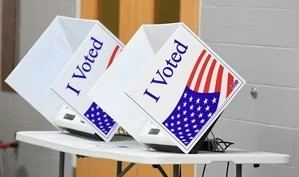
State voting officials join CISA election security call
Video has Closed Captions
State voting officials join CISA security call with election 85 days away (4m 36s)

Tamara Keith and Amy Walter on outsider candidate success
Video has Closed Captions
Tamara Keith and Amy Walter on the energy behind outsider candidates (8m 45s)

What Meta's open-source model means for the future of AI
Video has Closed Captions
What Meta's new open-source AI model means for the future of artificial intelligence (6m 42s)
Providing Support for PBS.org
Learn Moreabout PBS online sponsorship
- News and Public Affairs

FRONTLINE is investigative journalism that questions, explains and changes our world.
 New Episode
- News and Public Affairs

Today's top journalists discuss Washington's current political events and public affairs.
 New Episode
 New Episode
 New Episode
 New Episode
 New Episode
 New Episode
 New Episode


Support for PBS provided by:
Major corporate funding for the PBS News Hour is provided by BDO, BNSF, Consumer Cellular, American Cruise Lines, and Raymond James. Funding for the PBS NewsHour Weekend is provided by...