
August 11, 2023 - PBS NewsHour full episode
8/11/2023 | 57m 46sVideo has Closed Captions
August 11, 2023 - PBS NewsHour full episode
August 11, 2023 - PBS NewsHour full episode
Problems playing video? | Closed Captioning Feedback
Problems playing video? | Closed Captioning Feedback
Major corporate funding for the PBS News Hour is provided by BDO, BNSF, Consumer Cellular, American Cruise Lines, and Raymond James. Funding for the PBS NewsHour Weekend is provided by...
Support provided by:

August 11, 2023 - PBS NewsHour full episode
8/11/2023 | 57m 46sVideo has Closed Captions
August 11, 2023 - PBS NewsHour full episode
Problems playing video? | Closed Captioning Feedback
How to Watch PBS News Hour
PBS News Hour is available to stream on pbs.org and the free PBS App, available on iPhone, Apple TV, Android TV, Android smartphones, Amazon Fire TV, Amazon Fire Tablet, Roku, Samsung Smart TV, and Vizio.
Providing Support for PBS.org
Learn Moreabout PBS online sponsorshipAMNA NAWAZ: Good evening.
I'm Amna Nawaz.
Geoff Bennett is away.
On the "NewsHour" tonight: The Maui death toll rises, even as the fire is increasingly contained and the long recovery process begins.
Attorney General Merrick Garland appoints a special counsel to investigate the FBI case against Hunter Biden, as former President Trump's attorneys spar with the Justice Department.
And the Supreme Court blocks Purdue Pharmaceuticals' bankruptcy plan that would have shielded the Sackler family from legal liability for the opioid crisis.
BRIAN MANN, NPR: Within the victim community, the opioid victim community and among these communities, many of them have said, we don't really think this looks like justice where the Sacklers are concerned.
(BREAK) AMNA NAWAZ: Welcome to the "NewsHour."
At least 55 people are confirmed dead tonight after fast-moving wildfires ravaged the island of Maui.
But the search operation is far from over.
Those who did manage to survive now face the daunting task of piecing their lives back together.
Stephanie Sy has our report.
STEPHANIE SY: The smoke has all but cleared over Lahaina, revealing what's been lost.
The beloved, centuries-old town on the coast of Maui was once the capital of the Hawaiian kingdom.
Today, it's a burnt-out shell of itself.
KEITH HUNTER, Lahaina Resident: This is going to take years, years to recover.
And it just breaks my heart that all the history from back in the waning days of the 1800s dust, ash and dust.
STEPHANIE SY: Firefighters worked to extinguish the lingering flames.
Several wildfires erupted on the island this week, with Lahaina bearing the brunt of the damage, homes, businesses and historic landmarks, many built out of wood, reduced to gray piles of ash.
The street signs melted.
Satellite images show how the area looked before and after the fire tore through.
GOV.
JOSH GREEN (D-HI): When you see the full extent of the destruction in Lahaina, it will shock you.
It does appear like a bomb and fire went off.
STEPHANIE SY: Yesterday, Hawaii's Governor Josh Green said it's the worst disaster the state has seen since 1960, when a tsunami claimed the lives of 61 people.
GOV.
JOSH GREEN (D-HI): It's a heartbreaking day, without a doubt.
What we have seen today has been catastrophic.
We are seeing loss of life here.
As you know, the number has been rising.
And we will continue to see loss of life.
STEPHANIE SY: Governor Green insisted today that evacuees will return home, even as search-and-rescue efforts continue.
Bodies are still being found in the rubble of the some 1,000 buildings that the fire leveled.
Business owner Tiffany Kidder Winn shared this video as she walked down Lahaina's main drag.
The gift store she owned, established in 1971 is gone.
TIFFANY KIDDER WINN, Lahaina Business Owner: It's everywhere.
Looking up the hillside, all the homes are gone, all the buildings are gutted.
STEPHANIE SY: Kidder Winn has lived on Maui for 20 years.
She says the fires will have lasting impacts.
TIFFANY KIDDER WINN: Lahaina is such a special place and not just for the people that live there, but for so many people that -- sorry.
I'm holding it together, but I'm on the edge - - for the community and for all of the islands.
STEPHANIE SY: Over the past few days, the Hawaiian Army National Guard has dropped more than a hundred thousand gallons of water on the flames.
With the fire 80 percent contained, residents are starting to ask why they didn't get more warning.
Hawaii boasts a state-of-the-art outdoor warning system, but the sirens never went off.
Officials say widespread power outages disrupted other attempts to notify the public.
As it was, many were completely caught off guard.
They ran for their lives and, in some cases, swam for their lives.
VIXAY PHONXAYLINKHAM, Survivor: We had to get out.
We left our vehicle, and myself and my wife and our five kids, we all got in the ocean.
We found a floating board that we hung onto.
The ocean almost swept away my kids a few times.
STEPHANIE SY: Even with nerves frayed, the community came together to gather food, water and other essentials for displaced residents.
MAN: Blankets, diapers, water, come on and get it.
STEPHANIE SY: The aftermath of the disaster has left Maui to grapple with physical and emotional scars.
But the spirit of aloha is alive.
For the "PBS NewsHour," I'm Stephanie Sy.
AMNA NAWAZ: For more on the fires, we turn now to Chad Blair in Honolulu.
He's a reporter and editor for Honolulu Civil Beat.
Chad, welcome and thanks for joining us.
The images and stories just seem to get more and more horrifying by the day.
You have a number of reporters fanned out covering this.
Tell us, what kinds of stories are they hearing from folks on the ground?
CHAD BLAIR, Honolulu Civil Beat: Well, the grief has just been overwhelming, as you can imagine.
I mean, Maui, although it's a separate island from Oahu and the others, we have all been there.
We all have family and friends on the various islands.
One of Civil Beat's own reporters, Marina Riker, she had to evacuate along with her husband at 1:00 in the morning that Tuesday.
Her rental unit was destroyed.
Fortunately, she and her husband are safe now.
But everyone in the state has been touched by this terrible tragedy.
The video speaks for itself.
It's a war zone.
It's an apocalypse.
AMNA NAWAZ: What about you're hearing -- what you're hearing from authorities right now?
Do you have a sense that they have a full picture of the damage and the loss yet?
CHAD BLAIR: No, we don't know that right now, certainly not a dollar figure placed on that.
We do know that at least 1,700 structures have been destroyed.
There's at least 1,000 people unaccounted for.
Hopefully, we will learn more about that.
And you heard the governor early.
It's very, very likely that those casualties, those fatalities are going to increase from 55 and up.
But, right now, we're not getting much more information.
The focus for the emergency people has been recovering, getting people to safety, making sure those fires are contained.
AMNA NAWAZ: I understand you have been trying to get some more information.
Now, we just heard my colleague Stephanie Sy report on that warning system that never seemed to go off.
Have you heard anything from authorities in the way of a timeline?
Were evacuation orders issued?
Was that warning system supposed to go off?
CHAD BLAIR: Every indication so far is, the warning system did not go off at all, that people were self-evacuating.
But we are not getting any full answers from officials.
There was no official timeline that has been presented.
We're not hearing from the electric company, for example.
Is there a utility pole that perhaps sparked a fire?
We don't know those things.
That's very frustrating.
All of us are trying to find out more information.
We do believe there will be more info in the days to come.
But, so far, we're not learning much more.
AMNA NAWAZ: Tell us about other supplies on the ground, what people are going through.
We have heard about the number of buildings that have been destroyed.
What about medical services, hospitals, clinics?
Are they still functioning?
Can people get medical support, or even medicine if they need it?
CHAD BLAIR: They are functioning.
They can get medical support, although there had been initial reports that perhaps the hospitals on Maui were overwhelmed.
That is not quite the case at all.
There have actually been few reports of injuries.
That's encouraging so far.
Hopefully, that won't change.
What we have heard is a concern about morgue space, a place to store the bodies, a cold place, obviously.
But, so far, the medical facilities and operations are fully functioning.
AMNA NAWAZ: Chad, what would you say are the biggest challenges right now?
We have heard, of course, some of the -- the fire seems to be mostly contained, correct me if I'm wrong, but the search-and-rescue still continues.
What are officials up against?
CHAD BLAIR: I think the biggest challenge, in part, is communication.
Fiberoptic cables were melted.
There were at least 29 utility poles down.
Here at Civil Beat, we're using satellite phones to communicate with our teams on the ground.
In terms of the officials, the emergency responders, they're using radios.
You just can't use the cell phone to get through.
So that communication has been part of the challenge.
Given the terrain as well, there were a lot of roads blocked by cars that were burning.
Much of that has been cleared out of the way.
But these things continue to be concerns.
AMNA NAWAZ: It's just imaginable, the scale and the suddenness of that loss.
We see these pictures and these aerials, and it's hard to imagine how quickly this all unfolded.
Chad, for people on the ground there, what is the greatest need?
A lot of people are seeing these images and wondering: What can I do?
What's your message to them?
CHAD BLAIR: Oh, there's a lot of folks that are donating to charity.
You can go to the Red Cross.
You can go to any number of organizations that are bringing food and water and clothing, all sorts of supplies.
That aloha spirit that was mentioned earlier is strong.
And relief is coming.
And if you need to find someplace to donate to, go on Google and look forward to Maui fires and charity.
You will get plenty of -- plenty of offerings, plenty of suggestions.
AMNA NAWAZ: I just have to ask.
I know it's difficult sometimes for reporters who are covering a story at the same time they are living through it.
Tell us what that's been like for your team.
CHAD BLAIR: Well, they're just terrific.
And I should say Marina Riker is already back on the job, if you can believe that.
Brittany Lyte, another one of our reporters who covers the neighbor islands, is still there on the ground.
Several other photographers and reporters have since returned to our offices in Oahu.
But they're still there, and they're still working to get the story out.
AMNA NAWAZ: And we are so grateful to all of them and to you.
Chad Blair of Honolulu Civil Beat, we will be following your reporting.
And, of course, we're keeping everyone down there in our thoughts and prayers.
Thank you for joining us.
CHAD BLAIR: Thank you, Amna.
AMNA NAWAZ: In the day's other headlines: A federal judge in Washington overseeing the election conspiracy case against former President Donald Trump warned that his right to free speech is -- quote -- "not absolute."
U.S. District Judge Tanya Chutkan agreed to a limited protective order banning Mr. Trump from publicly disclosing sensitive evidence in the case.
She said that will help protect witnesses and prevent interference in the trial.
FTX founder Sam Bankman-Fried is in a New York jail tonight.
A judge revoked the disgraced cryptocurrency mogul's bail for allegedly tampering with witnesses at least twice in the run-up to his October trial.
The 31-year-old has been charged with orchestrating one of the largest financial frauds in U.S. history.
He'd been under house arrest at his parents home in California.
In Syria, Islamic State gunmen ambushed a bus carrying Syrian soldiers overnight, killing at least 20 people.
It happened in the eastern town of Mayadin, which is split in control between Syrian troops and Kurdish fighters.
The Syrian Observatory for Human Rights said ISIS has ramped up attacks in recent months in areas it once controlled.
Russia and Ukraine exchanged a fresh wave of aerial attacks today.
In Kyiv, Ukrainian air defenses shot down a Russian missile that broke up and landed near a children's hospital.
No casualties were reported.
Meanwhile, Russia said it intercepted a Ukrainian drone on the western outskirts of Moscow.
Blurry video caught the moment of impact as it startled witnesses nearby.
MARIA IVANOVA, Eyewitness (through translator): My heart is still pounding.
I was going to work when a forceful explosion happened.
The tarmac shook.
The shockwave was so strong that it almost blew my clothes off.
I was shocked.
I ducked down, looked up and saw an enormous explosion.
AMNA NAWAZ: Back in Kyiv, President Zelenskyy announced he's firing the directors of all of Ukraine's regional army recruitment centers to crack down on corruption.
The country's Security Services recently revealed more than 100 criminal cases had been opened against recruitment officials suspected of taking bribes.
The U.N. announced it has finished transferring more than a million barrels of oil from an aging tanker near Yemen.
The ship is moored off the war-torn country's Red Sea coast.
Last month, an international team began pumping the oil to another ship amid warnings that the decaying vessel could leak or explode and cause a massive environmental catastrophe.
Tens of thousands of early-career doctors in England have walked off the job again in a fifth round of strikes.
They're demanding a 35 percent pay hike which they say will restore their salaries back to 2008 levels.
But the government is only offering 6 percent.
The National Health Service says the strikes could cost them more than a billion dollars by the time doctors resume work next Tuesday.
And stocks were mixed on Wall Street today.
The Dow Jones industrial average gained 105 points to close at 35281.
The Nasdaq fell 76 points.
And the S&P 500 slipped five.
Still to come on the "NewsHour": Republican presidential candidates make their pitch to Iowa voters at the state fair; David Brooks and Jonathan Capehart weigh in on the week's political headlines; chronicling the history of hip-hop on its 50th anniversary; plus much more.
The long-running federal investigation of President Biden's son Hunter entered a new phase today with Attorney General Merrick Garland's appointment of a special counsel.
John Yang has more.
JOHN YANG: Amna, the new special counsel is David Weiss.
He won't need time to get up to speed, because, as Delaware's U.S. attorney, he's run the investigation from the beginning.
He was a Trump appointee who was held over and given full authority over the case.
Now, as special counsel, his independence is guaranteed by law.
MERRICK GARLAND, U.S. Attorney General: This appointment confirms my commitment to provide Mr. Weiss all the resources he requests.
It also reaffirms that Mr. Weiss has the authority he needs to conduct a thorough investigation and to continue to take the steps he deems appropriate independently, based only on the facts and the law.
JOHN YANG: Later, Weiss said in a court filing that prosecutors and defense attorneys in Hunter Biden's tax and gun case are at an impasse and are not in agreement on either a plea agreement or a diversion agreement.
So, on those charges, Hunter Biden may be headed for trial.
NPR justice correspondent Kerry Johnson was at Garland's announcement.
And, Carrie, the attorney general said that Weiss asked for this.
Why would he ask for this?
And what change -- what happens?
What's the change here?
CARRIE JOHNSON, NPR: Justice Department policy says, don't tell people in the public what you're doing exactly before you decide to file criminal charges.
So, exactly what changed is unclear.
But we do know that the attorney general, Merrick Garland, said, David Weiss came to him, called him on the phone on Tuesday, and said he had entered a new stage of this investigation, and he believed it was important to appoint him as special counsel.
Merrick Garland said that was in the public interest., He agreed.
And now that has been done as of today.
All we know is that, since 2019, Weiss has been investigating Hunter Biden, and, according to the appointment paperwork, others as well, but we don't know who they are.
And it may be that this investigation has entered a new phase as to Hunter Biden, and maybe as to unnamed others, including possibly Biden family members.
JOHN YANG: What do we know about the scope?
I know the order has now been published.
What does it say about the scope of what Weiss can do?
CARRIE JOHNSON: Weiss is basically going to keep charge of this Hunter Biden investigation.
And, also, he's able to prosecute other people, including Biden and others potentially, or other crimes he uncovers in the course of his investigation.
Typically, that would mean any kind of obstruction or just destruction of evidence or the like.
There's no evidence that it's happened here at all yet.
JOHN YANG: Since we're getting the special prosecutor now, is it an indication that this investigation is going to go on for a while?
CARRIE JOHNSON: You know, some people think so.
But the attorney general, Merrick Garland, in his announcement today, said he expected Weiss to act with urgency.
He's clearly familiar, as you point out, with the nature of these allegations.
He's been looking at them for years and years, since the Trump administration.
And we do know that the other special counsels - - there are two others on the job, John, including Jack Smith, who's been prosecuting former President Donald Trump.
Jack Smith has been acting with great speed.
So it's possible, given Weiss' familiarity, that decisions are made relatively soon.
JOHN YANG: Hunter Biden's attorney issued a statement saying that this doesn't change anything as far as they're concerned.
But with the prosecution saying they're at an impasse on this plea deal on the other deal -- on the other charges, what's that mean going forward?
Could he be on trial for some charges while being investigated for other things?
CARRIE JOHNSON: He absolutely could, John.
And, at this point, given the impasse and what appears to be a rather broad gap between Hunter Biden's lawyers and the Justice Department over whether his initial plea deal conveyed him broad immunity for foreign lobbying activities or other business activities, I don't know how you resolve that gap and the Justice Department does either.
So it's quite possible Hunter Biden winds up going to trial, although his lawyer, Chris Clark, said he expected today a fair resolution, devoid of politics.
JOHN YANG: So also, today, you were a couple blocks away from the Justice Department at the federal courthouse, a hearing on the order that Jack Smith, the special counsel in the 2020 election case, is asking for to limit what Trump can talk about leading up to the trial.
The defense offered an alternative.
And, today, Judge Chutkan tried to reconcile the two.
How did she do that?
CARRIE JOHNSON: Yes, Judge Chutkan, Tanya Chutkan, a former public defender, issued a protective order late in the day today.
That paves the way for Donald Trump's lawyers and Trump himself to get over 11 million pages of documents in this case the government has collected.
But what the judge says is that Trump just can't blast out sensitive information about potential witnesses, witness interviews and recordings of witnesses to DOJ made to the public.
She says that could intimidate witnesses and also taint this jury pool here in D.C.
So he's going to have to follow certain rules, even though he's the former president.
Judge Chutkan said Donald Trump, in some ways, is like any other criminal defendant with a day job.
His day job happens to be running for the White House in 2024, though.
JOHN YANG: From what Judge Chutkan did today, is there any clues or signs she gave about her approach to this case?
CARRIE JOHNSON: She was quite cordial to both sides, the government lawyers and Trump's main lawyer, John Lauro.
And she said basically to John Lauro, after she heard that there were 11 million pages of documents coming his way: I can't wait to see your trial proposal.
This judge wants this trial to happen soon.
The special counsel wants it to start in January of 2024.
And John Lauro certainly is going to try to delay.
But I think this judge is a no-nonsense judge with a lot of experience.
She's going to want to try to bring this case to trial before the election, if she can.
JOHN YANG: And she's asked the defense to propose their date for the trial late -- next Thursday.
You say she wants to go to trial.
Do you expect her to -- that result show up when she picks the trial date?
CARRIE JOHNSON: This judge is not messing around, John.
She says to both sides, they're on notice that, on August 28, the day that they have a long hearing scheduled in this case, that she is going to set a trial date.
So we may know by the end of the month when Donald Trump is going to face charges in Washington, D.C., related to the Capitol riot and the events before that.
JOHN YANG: NPR justice correspondent Carrie Johnson, thanks so much.
CARRIE JOHNSON: Thank you.
AMNA NAWAZ: The Supreme Court has temporarily blocked a bankruptcy plan for drugmaker Purdue Pharma, a plan that would have paid out billions of dollars to address the opioid epidemic, but would have also shielded the company's owners, the Sackler family, from legal liability.
William Brangham has more on the implications.
WILLIAM BRANGHAM: Amna, this controversial bankruptcy plan was stalled because the U.S. Justice Department argued that shielding the Sacklers from all future lawsuits was an abuse of the bankruptcy system.
The Sacklers themselves did not declare bankruptcy.
But that delay means that at least $6 billion in relief is not going to communities all over the country to help them address the addiction and overdose crisis.
NPR's Brian Mann has been covering all of this closely.
And he joins us now.
Brian, welcome back to the "NewsHour."
We thought this was a settled issue.
Several judges had signed off on this.
So help us understand, what happened at the Supreme Court yesterday?
BRIAN MANN, NPR: Yes, this surprised a lot of legal experts that the Supreme Court was willing to take this on.
In the past, the Supreme Court has often been reluctant to wade into issues dealing with bankruptcy.
It's a messy legal area.
But this -- the Department of Justice, the DOJ had repeatedly made strong legal arguments that what was happening here would create a kind of road map where more and more nonbankrupt companies, very wealthy individuals, like the Sacklers, could begin using the really awesome power of bankruptcy to avoid accountability, to limit their liability.
They would essentially pay in billions of dollars, as in this case, but, in exchange, be able to walk away free of all future civil claims.
And the DOJ convinced enough justices to look at this that now we're going to see a full hearing in December.
WILLIAM BRANGHAM: Is that a legitimate fear?
I mean, are there examples of other companies that have done what they're -- what they're talking about?
BRIAN MANN: Absolutely.
Over the last five to 10 years, and really more intensely over the last two to three years, a lot of very wealthy corporations and individuals have begun finding loopholes in federal bankruptcy law, maneuvers in federal bankruptcy law that allowed them to kind of tap into this.
We saw Johnson & Johnson, for example, the fabulously wealthy corporation, create a subsidiary, push it into bankruptcy, and then try to piggyback on that bankruptcy in order to block tens of thousands of lawsuits linked to claims that it's baby powder -- talc baby powder caused ovarian cancer.
Maneuvers like that are more and more common.
And you have a lot of legal scholars, a lot of members of Congress saying, wait a minute.
Wasn't bankruptcy just supposed to be for actual bankrupt, insolvent companies?
And now we see the Supreme Court saying, yes, maybe this is a question we need to look at.
WILLIAM BRANGHAM: Back to this, the particular case with Purdue Pharma.
This original deal as agreed to was liability for the Sacklers, but the Sacklers will put in $6 billion and give that out to communities all over the country to address addiction and overdoses.
What are those communities and states and tribes all saying now that this deal has been put on hold?
BRIAN MANN: You know, it's been fascinating, William, to see the conflict within the victim community, the opioid victim community and among these communities.
Many of them have said: We don't really think this looks like justice, where the Sacklers are concerned, that they will get to now walk away from this opioid epidemic essentially free after paying out this money.
On the other hand, they desperately need the cash.
You know, $750 million was supposed to go to families of people who died from OxyContin overdoses, people who lost years of their lives to this addiction epidemic, billions going to communities for addiction health treatment programs.
And, right now, there's a lot of dismay that that money is going to be on hold, again, at least through December, when the Supreme Court is going to review this, and likely much longer.
This deal has been held up for years with legal wrangling and delays.
And people are impatient.
WILLIAM BRANGHAM: I mean, this has always been the central tension with this struggle, the very tangible anger against the Sacklers, because there's a fairly good documentary trail that they knew how much problem their drugs were causing, and yet they continued to push them, and yet these communities all over the country who are desperate for this kind of aid.
Will the Supreme Court in the end make a resolution about this?
What are we likely to see when they make a ruling?
BRIAN MANN: What we're likely to see is pretty - - pretty big.
This is really -- in some ways, it could change the way justice works in America.
Right now, a lot of people are using the -- again, the really awesome power of bankruptcy that can force people to make settlements, force people to give up lawsuits.
And, again, usually that's reserved for bankrupt companies, insolvent individuals.
But, in recent years, some parts of the country, appeals courts have allowed bankruptcy judges to approve deals like this.
And in some parts of the country, bankruptcy judges have said, no, this power isn't in the law.
And so what the Supreme Court is now likely to do is resolve this nationally, either open the door to bankruptcy courts being able to do deals like this, cut arrangements like this with people like the Sacklers, with companies like Johnson & Johnson and Purdue Pharma.
They may say yes, and open the floodgates.
Or it's possible they will say, no, this is not what bankruptcy was meant to do.
This bankruptcy was meant for insolvent companies, not for wealthy people trying to essentially pay their way out of a lot of lawsuits.
WILLIAM BRANGHAM: Brian Mann of National Public Radio, thank you so much, as always, for helping us get through this.
BRIAN MANN: Thank you, William.
AMNA NAWAZ: Butter cows, corn dogs and politics, these are just a few of the things top of mind for Iowans as they kick off the country's third largest fair this weekend, in attendance, nearly every major GOP presidential candidate vying for the hearts and minds of the Hawkeyes and of the state's January caucus.
Our own Lisa Desjardins has been catching up with these candidates, as well as voters on the ground.
She joins me now.
Lisa, it's good to see you.
So, we're still months away from that caucus.
But what kind of separation are we already seeing emerge in that Republican field?
LISA DESJARDINS: I think what you find from voters here is something that we see in polls.
So, talking to them on the ground here in Iowa, Amna, I hear three categories of Republicans emerging, one, former President Trump in a category by himself way out ahead, and then the governor of Florida, Ron DeSantis, a lot of folks talking about him.
And then, honestly, the third category is everyone else.
So let's look at the entire Republican field, or at least the top 11 candidates as it stands right now.
This is a big field.
We have seen bigger in the past, but still plenty for Iowans to talk about.
One separation happening right now, who has qualified for the first Republican debate coming up in a couple of weeks?
Just eight of these candidates, you see them there, have qualified.
And, Amna, that's one reason events like this state fair are so important right now for candidates like, let's say, Miami Mayor Francis Suarez, who's not on the debate stage yet.
He has to get out his message here to try and get there.
Here's what he told me today.
FRANCIS SUAREZ (R), Presidential Candidate: It's critical because, for me, it's the first opportunity to be on an equal footing with eight other national figures.
I'm probably the only one that's not a national figure.
So I'm the one that needs the most volume and the most time, not that I will get more volume and time than them.
LISA DESJARDINS: Now, that's really one of the first hurdles here.
But there's others who are going to be on the debate stage, Amna, who know that they need momentum in this state.
One of those is, of course, the former Vice President Mike Pence.
He's from Indiana, two states over.
If he can't do well in Iowa, he knows he's got a major problem.
And I asked him, how does he gain ground against the president who he was vice president for?
He initially said, just stay tuned.
So I followed up.
LISA DESJARDINS: What exactly are you going to do here in Iowa?
What do you -- tell me what you mean?
MIKE PENCE (R), Presidential Candidate: You know, when I got my first job at a gas station when I was growing up at one of my dad's gas stations, I was trying to figure out how to get the people there to respect me.
And my dad gave me a piece of advice.
He said, "Outwork them."
And I did.
And they all became my best friends.
And I promise you, nobody's going to work harder in Iowa, New Hampshire, South Carolina, Nevada, or any state in this country than Mike and Karen Pence.
LISA DESJARDINS: So many dynamics right now in Iowa.
He says he's going to outwork everyone else.
But, Amna, he was actually asked a question about someone who said, "You were a traitor."
A Trump supporter called him a traitor at this fair.
So, he's dealing with many layers of dynamics and a lot of doubt if the Republicans who right now are thinking more about the president he served with.
AMNA NAWAZ: So, Lisa, when you talk to voters there on the ground in Iowa, what are you hearing?
Who are they paying attention to and which candidates are piquing their interest?
LISA DESJARDINS: You know, the state fair is all about, like, what is your favorite new food?
And so the Iowa Republicans, it's sort of the same kind of thing.
They like to browse around.
Even if they talk about the front-runners, they are thinking about everyone else.
And there are two names that I keep hearing more and more, one, North Dakota Governor Doug Burgum.
His name has come up from a number of voters here today, saying they are considering him.
Why?
They like his Midwestern sensibility.
They think he's a can-do guy, not a career politician, someone who's had success in North Dakota, and has a very straightforward message.
They don't see him as a bomb-thrower.
They see him as someone who could compete with Joe Biden.
He is down in the polls right now.
But he's making a name for himself.
The other name we have heard a lot as a team here, Amna, is Tim Scott.
The South Carolina senator has not been at the state fair yet.
He will be here in about a week or so.
But he's someone a lot of Republicans like.
They say they like that he's kind of got a message that's more on the positive side.
They think he doesn't have all the baggage and drama, as one person told me, of former President Trump and even Governor DeSantis.
So I think we're going to watch and see if those two -- either of those get some momentum.
AMNA NAWAZ: So, Lisa, as you know, there are a number of court cases, including also former President Trump's indictments, now hovering over this election.
And we now also have a special counsel who has been appointed to investigate the Hunter Biden case.
How do folks on the ground that you talk to there look at all of those issues?
LISA DESJARDINS: Right.
This happened, this was breaking while we were here.
And we happened to see the ranking Republican on the Senate Judiciary Committee, Chuck Grassley, at the fair, and we asked him what he thought of it.
Here's what he told us.
SEN. CHARLES GRASSLEY (R-IA): Well, it's the first time I have heard of it.
It sounds to me like it should have been done a long time ago.
LISA DESJARDINS: And I will say, that was generally the reaction early this morning, as the news was breaking, that Republicans and most everyone here was applauding this.
There is a sentiment from many voters they know about the Hunter Biden case.
It's a phrase that is in the minds of Iowans here.
And we talked to some who just generally felt that things are not fair.
Here are two voters we talked to from Pleasantville, Iowa.
JENNIFER HAYES, Republican Voter: I think there needs to stop being two sets of rules, some for Republicans, some for Democrats.
It should be the same for everybody.
RUSS HAYES, Republican Voter: It's way too biased.
It's way too biased.
LISA DESJARDINS: It was interesting, Amna.
Initially, there was a lot of applause for this decision.
As I think new stories came out, there was more skepticism about what it would mean.
But, of course, what may affect Iowa more is the date potentially of former President Trump's trial.
There's a proposal for it to be in January.
And President Trump put out -- former President Trump put out a statement saying that that, he sees, as election interference in the Iowa caucuses.
And, of course, no one here in Iowa wants to see their front-runner candidate in a trial two weeks before their caucuses.
I spoke to the chairman of the Republican Party here, Amna.
He said he thinks that trial in January, if it is scheduled for January, would only help Trump with his name recognition.
AMNA NAWAZ: That is our Lisa Desjardins reporting from the Iowa State Fair as campaign 2024 is now well under way.
Lisa, good to see you.
Thank you.
LISA DESJARDINS: Thank you.
AMNA NAWAZ: For more on the fight for the Republican nomination and the appointment of a special counsel in the investigation into the president's son, we turn to the analysis of Brooks and Capehart.
That is New York Times columnist David Brooks and Jonathan Capehart, associate editor for The Washington Post.
Welcome to you both.
Good to see you.
JONATHAN CAPEHART: Hey, Amna.
DAVID BROOKS: Good to be with you.
AMNA NAWAZ: Let's pick up where Lisa left off there.
Just want to get your reaction, Jonathan, her reporting and specifically this idea of the people she's talking to in Iowa, the two names she's hearing more often than others, Doug Burgum and Tim Scott.
What does that say to you?
JONATHAN CAPEHART: Well, before I answer your question, I want to start off the evening by saying, happy birthday, David.
AMNA NAWAZ: Happy birthday, David.
(CROSSTALK) DAVID BROOKS: World historical event.
(LAUGHTER) JONATHAN CAPEHART: Now to the question at hand.
I think it gets to something that Lisa said in her report, which is, when she talked to people about Donald Trump, that they don't like the drama.
You don't get any drama with Senator Tim Scott or with Governor Burgum.
There are a lot of people who are finding out that he's actually the governor of North Dakota and that he's a real person.
And I think that, if anything, I will be watching to see how well they do as the state fair goes on and as we start focusing in on Iowa, because I do think -- I hope.
This is what I hope, that the Republican Party and the party faithful will gravitate to leave the drama behind.
Fine, stick with the conservatives, but a conservative who actually cares about American democracy and the foundations -- foundations of our democracy.
That's what I would like to see.
And it seems to me right now that Senator Tim Scott and Governor Burgum are two -- are those two people.
AMNA NAWAZ: Is Iowa the place where one of the other candidates could break through?
DAVID BROOKS: It should be.
I mean, covering Iowa and cover the state fair used to be one of my favorite things to do in politics.
I was there.
I saw, I think it was 1999, the Last Supper carved out of butter, big life-sized statue.
That's... AMNA NAWAZ: That stuck with you, didn't it?
(LAUGHTER) DAVID BROOKS: I think Gary Bauer, who was a presidential candidate, was -- I saw him - - or something.
So, what was fantastic about Iowa, and maybe still is for all candidates but one, is that it really is small.
You're in small groups.
You're in living rooms.
You're around eight, 10 people.
I think, this year, it may not be like that.
I think Trump may just be too big.
He's barely been to the state.
He's polling super well in the state, and he may just decide, I'm not going to debate.
I'm not doing anything.
I'm just going to win.
AMNA NAWAZ: Yes.
DAVID BROOKS: And so it may be we don't get to experience the Iowa experience because Trump is just going to just bigfoot it.
AMNA NAWAZ: We talk a lot about Iowa because they're first, obviously, but do we put too much stock in Iowa?
I mean, they picked Ted Cruz in 2016, Rick Santorum in 2012, Mike Huckabee in 2008.
JONATHAN CAPEHART: Their track record on the Republican side isn't very good.
And you would think that Republicans would look and go, maybe we should shake things up, the way the Democrats did.
However, Iowa looks more like the Republican Party than Iowa looks like the Democratic Party.
And so that's why I think you see the shifts that are happening within the Democratic Party to shunt Iowa aside and no conversation at all about doing the same for Iowa.
AMNA NAWAZ: What do you make of that?
DAVID BROOKS: Pat Robertson won the Iowa caucuses many years ago, but Barack Obama did too.
AMNA NAWAZ: Yes.
DAVID BROOKS: And so if you're a candidate who's back in the field or people don't really know you, and then, suddenly, you do really well in Iowa, which you can do it with relatively little amount of money, and then you zoom up, then that makes you.
And there is a possibility -- I'm skeptical it'll happen, but if one of the non-Trump candidates zooms up, that would be earth-shaking, and that would make Iowa -- put it right back on the center of the map.
AMNA NAWAZ: I want to ask you about the breaking news we were covering earlier today about Attorney General Merrick Garland's decision to appoint a special counsel into the investigation into Hunter Biden.
That is David Weiss, who's already been investigating him, leading the investigation for the last few years, now elevated to that role.
Jonathan, the White House has been referring all questions related to this to both the Department of Justice and to Hunter Biden's personal attorneys.
This is clearly going to continue to be a political issue for Republicans.
Could it be a political problem for the president?
JONATHAN CAPEHART: I mean, it could be.
Anything is possible.
But I do think that the White House is doing the right thing.
You have got questions about Hunter Biden, don't ask us.
Go to the Justice Department.
Go to Hunter's lawyers.
The president is making it and the administration, I believe, is making it very clear: We are not interfering in this.
We have nothing to do with this.
And, in fact, if the attorney general wants to appoint a special counsel to investigate the president's son, well, so be it.
And I was struck by something also in Lisa's reporting, where folks -- she said, folks there are like, well, it's about time.
Why hasn't this happened?
AMNA NAWAZ: Yes.
JONATHAN CAPEHART: And you know why they're thinking that way?
Because they have been fed a steady diet, anti-Hunter Biden, anti-Biden family diet for months, if not years, and trying to equate what's happening with the president's son to what's happening with the former president of the United States, who now has three indictments against him for very serious crimes, two of them, and maybe another one coming next week.
So they're not equivalent, but when you get that steady diet of anti-Hunter Biden news from a particular cable network, I get why they think, what took them so long?
AMNA NAWAZ: Well, David, this is why it's worth looking at the Republican response to that appointment today.
We saw former President Trump has already issued a statement questioning the independence of David Weiss.
House Speaker Kevin McCarthy also tweeted that House Republicans will not only continue their own investigations and their own probes into Hunter Biden, but he also added this: "If Weiss negotiated the sweetheart deal that couldn't get approved, how can he be trusted as a special counsel?"
It's worth pointing out Weiss was appointed by former President Trump.
He was a -- he was confirmed by a Republican-led Senate.
Why so much mistrust?
Why this message from Republicans?
DAVID BROOKS: Well, the Republicans are mistrustful.
You can imagine, from their point of view, it's political administration indict -- or trying to defend the son of the president.
I mean, that story sort of tells itself.
I guess a couple of things about this position.
First, it can't be good news for the White House, because, a couple of weeks ago, it seemed like this thing was all going to peter out in a deal.
And now, apparently, the investigation is going to go on for some significant amount of time or else they wouldn't have done this.
So that means the story still lives.
The second thing is that I don't -- in the plea deal, it was about gun charges and tax charges.
AMNA NAWAZ: Right.
DAVID BROOKS: Those don't seem like the big deal here.
The big deal is, Hunter Biden made a lot of money telling people he was going to peddle influence.
Did he peddle influence?
And that seems to me the core question that I would like to see somebody answer.
And reporters have gone into this and they have found he received money.
They haven't found any evidence that he's peddled influence.
But I think that's what I'd like to see investigated.
AMNA NAWAZ: I want to ask you both too about your takeaways from a big special election that I don't know if many people expected it would be as big as it was in Ohio this week during the summer, in a nonelection year.
Hundreds of thousands of people turned out because abortion rights were ostensibly on the ballot.
Ohioans voted not to allow a threshold change that would have made it harder to enshrine abortion rights later in November in the state Constitution.
Jonathan, what does that turnout and this result say to you?
JONATHAN CAPEHART: It says that people are still angry.
A year ago, we were talking about the Dobbs decision by the Supreme Court that overturned Roe v. Wade, and then Kansas voted.
Kansas was the Ohio of 2022, where folks were like, whoa, ruby-red Kansas did this thing that protected abortion rights.
Then came Kentucky.
Then came Montana.
Now is Ohio, a state that Donald Trump won by eight points in the last presidential election.
What that tells me is that people are really angry and they're concerned about Republicans taking the overturning of Roe and then in various states and jurisdictions turning that - - like, doing bans on steroids, to the point where Florida has a six-week abortion ban.
There are other abortion bans that have no exceptions at all for the life of the mother, rape or incest.
And people -- and women not being able to get the reproductive health care or just plain health care that they need, and left up to a board, and we're reading stories about people being disabled or losing their lives as a result of this.
People are reading these stories.
People are seeing what's happening.
And, again, in the midterm elections, we learn that the American people are very nuanced.
They can care about inflation and gas -- high gas prices, but also erosion of their fundamental rights.
And that is still the case, as we saw in Ohio.
AMNA NAWAZ: David, it's been more than a year since Roe was overturned.
Is this going to continue to mobilize people into '24?
DAVID BROOKS: So, the turnout numbers were eye-popping, I mean, just huge turnout.
So people really did care.
Second, it wasn't just Democratic strongholds.
I think Biden won, like, five of the counties in Ohio, and this thing passed by -- in 20 of -- or more than 20 of the counties.
So it was independent voters.
And if you look at where the polling is on independent voters, they don't want a six-week ban.
They don't want any of that kind of stuff.
And so what you see in state after state is the state legislature in red states, which is supposed to be broadly representative of opinion, is doing the six-week, and -- but opinion does not want to go there.
I think 15 weeks.
And so the Republicans, if they're going to look at this politically, are going to say, look, we're way out over here.
And our people, even our people, are at somewhere around 15 weeks.
And we have got to, like, reconsider, I would think.
But if it's a life issue for you, you're not going to consider the politics.
But the political costs will be significant if they stay where they are.
AMNA NAWAZ: And do you think Republicans have a cohesive message of some kind?
Are they moving towards something?
DAVID BROOKS: Well, it's hard to -- they have taken a moral pro-life stand, and so then it's hard to scale it back once you have taken that moral -- and if you're a person who's absolutely convinced that abortion is murder, you shouldn't take a political stance.
You should just stick with your pro-life stance.
But it is -- it will probably wind up politically costly.
AMNA NAWAZ: And, Jonathan, I'm sure we can expect to see this become a more and more central part of the Biden campaign, and specifically messaging from Vice President Harris as well?
JONATHAN CAPEHART: Oh, absolutely.
Vice President Harris has been out on the road talking about this issue since the leak of the draft of the Dobbs decision went out early in 2022, so absolutely.
AMNA NAWAZ: We will continue to follow it all.
We're so grateful to have you both here.
Happy birthday, David Brooks.
DAVID BROOKS: I have had so many of those.
(LAUGHTER) DAVID BROOKS: It loses some of the fun when you get up to my numbers.
(LAUGHTER) AMNA NAWAZ: Happy birthday.
Thank you for being here, David Brooks, Jonathan Capehart.
JONATHAN CAPEHART: Thanks, Amna.
AMNA NAWAZ: For our arts and culture series, Canvas, today, we celebrate 50 years of hip-hop, a genre that's influenced every aspect of pop culture, fashion and music across the U.S. and the world.
It all started with a back-to-school party thrown by a young woman named Cindy Campbell on August 11 of 1973 in an apartment rec center in the Bronx and New York.
To keep costs low, Cindy asked her brother, 18-year-old Clive Campbell, better known as D.J.
Kool Herc, to play music, improvising and playing break beats on two turntables in a continuous loop.
And hip-hop was born.
To help us appreciate the contributions of hip-hop, I spoke recently with Nelson George, author and filmmaker.
He served as co-executive producer of VH1's "Hip Hop Honors" television show and also wrote the book "Hip Hop America."
I began by asking him about hip-hop's birth in the Bronx.
NELSON GEORGE, Author and Filmmaker: This was the '70s, where people say the famous headline Daily News: Ford to City, Drop Dead.
There was a huge outflux, white flight out of the Bronx, Brooklyn, particularly in Manhattan.
New York became one of the epicenters of the sale of heroin.
You had a lot of economic downturn.
You had a lot of social ills.
You had a lack of city services, right?
You had a kind of city where what that meant that there was a lot of freedom.
So you had the parties in a park, where kids learn to break-dance.
They practiced emceeing.
They played records.
And you had graffiti, which was widespread throughout the city.
So the things that made people say, New York, drop dead, some of those same things gave a freedom to the city that allowed a lot of these street or, almost, you might say folk expressions to happen.
AMNA NAWAZ: So the music eventually evolves, right, to include lyrics.
And I know a lot of folks will think of songs like The Sugarhill Gang "Rapper's Delight."
But you have not just talking deejays now, but rapping emcees.
And you think specifically of songs like Run-D.M.C.
's "It's Like That."
They're talking about really serious stuff.
They're talking about unemployment.
They're talking about financial troubles.
They're talking about what it's like to not be heard and seen by society.
NELSON GEORGE: Right.
AMNA NAWAZ: How did those kinds of lyrics change the cultural place of hip-hop at that moment?
NELSON GEORGE: Well, hip-hop started as party music.
But as it evolved, the idea that you could write about your personal condition outside the party, you could write about the world that was happening outside in the streets of New York and in your house, and then you had a movement that really happened mid to late '80s in New York, what a lot of people call the golden age, which is people like Chuck D and Public Enemy KRS-One, Boogie Down Productions, Rakim, Big Daddy Kane, these were emcees who took the language, the language of speaking in rhyme over a beat, and added a level of poetry, added a little politics, added a level sophistication and artistic ambition that was different from the previous generation.
So that's when you really had this really drilling down into the sociology of America.
AMNA NAWAZ: You know, there are those in American music circles who were convinced that, in this country, rock 'n' roll would always reign supreme.
But it's fair to say, by the '80s and into the '90s, you have these megastars, some of whom you listed there.
You have others like Tupac and Biggie and Dr. Dre, and hip-hop is firmly in the mainstream, not just in this country, but really globally.
Why do you think that happened commercially the way that it did and when it did?
NELSON GEORGE: Well, I think the big turning point is the '90s, because the late '80s was always about, can I -- there was always the first.
And the first rapper on American Bandstand.
We have the first hip-hop show on MTV.
Then, by then, there was a -- by the '90s, there was a critical mass.
And there was a number of artists you named - - and can't leave Diddy out of this conversation.
All of these artists were able to -- and had the support -- I think the key point, I would say, is, they had the support of the record labels to go farther.
In the case of Dr. Dre, Tupac, you had Interscope Records distributed Death Row.
In the case of Diddy and Biggie and a lot of their artists, they had Arista under the - - under the control of Clive Davis.
They saw that hip-hop was not just a music that could sell a million units or two million units.
It could be something bigger.
I think the other thing to be mentioned that everyone kind of leaves out of the conversation is M.C.
Hammer.
M.C.
Hammer is kind of the bridge artists, because he's not a great emcee, but he's a great video artist.
He's a great entertainer, performer.
He sells a ton of records, and I think almost like 10 or 11 million, his first album.
I think Hammer's phenomenon was very important in the dissemination of hip-hop as a pop expression.
AMNA NAWAZ: Nelson, what about the role of women?
I mean, it's worth pointing out that it took until the late 1980s until the first solo female rapper got -- released her full album.
That was M.C.
Lyte back in 1988.
How do you see the role of women in what was largely a -- and is still largely a male-dominated field?
NELSON GEORGE: Well, the women are doing very well right now.
I just think it wasn't -- it wasn't it was hip-hop was very much a boys club.
And we used to say in the '80s that hip-hop made girls and the boys, in the sense that you saw the baggy clothes.
It wasn't -- there wasn't, into my way of thinking -- maybe I'm old guy -- it wasn't very feminine.
It seems like women were forced to conform to what was the standard of how people dress.
As time went on, more and more women began to express their sexuality, express their individual vision.
I think, obviously, Queen Latifah was a huge part of that.
Lauryn Hill's impact, when we -- you ask about female emcees, I think she's probably the greatest female emcee, to my -- because -- both because of the -- her actual artistry as a emcee, her actual rhyme skills, and the range of topics in her writing, from the work she did with the Fugees in "The Score" through her own album.
And I think, in many ways, her album "The Miseducation" is a landmark of the era.
And it speaks to the -- it sort of sets a template in terms of actual sales success that so many other female artists, singers and rap and emcees have followed in.
I think that Lauryn is a towering figure, both because of the -- her skills as an artist and the fact that she has such a wide range of emotional and political observations.
AMNA NAWAZ: So here we are marking 50 years of hip-hop.
What do you think the next 50 years bring?
NELSON GEORGE: I think probably other waves of music.
Nothing is -- nothing is dominant forever, not -- and particularly in pop culture.
There will be new expressions, stuff coming out of Africa.
Afrobeats is really a very powerful for us.
So it will evolve.
I mean, for me, as a guy, I -- like, I go back to, like, '78 with seeing Herc in the park.
The hip-hop that I love and that my generation came up on is nothing like what's on the radio now.
So, whatever we call hip-hop depends on where you enter into the journey of hip-hop.
AMNA NAWAZ: Nelson George, this conversation was a real treat.
You reminded me some of my favorite albums over the years.
Thank you so much for joining us.
We appreciate it.
NELSON GEORGE: Be well.
AMNA NAWAZ: Be sure to tune into the all new "Washington Week" tonight right here on PBS.
The historic program has a new name and a new moderator, Jeffrey Goldberg, the editor in chief of "The Atlantic."
And Jeff joins me now with a preview.
Jeff, welcome to the family.
We're very excited about this partnership.
Tell us about it.
JEFFREY GOLDBERG: Well, it's a it's a great partnership.
It's a marriage of two great journalism institutions, and two institutions that are really devoted to intelligent conversation and deep reporting.
So I'm just -- I'm thrilled to be here, thrilled to be here with you.
AMNA NAWAZ: We're thrilled to have you.
So tell us about the new show, debut show tonight.
A lot of news to cover.
JEFFREY GOLDBERG: Yes, well, lucky enough for us, we have a lot of news, especially for an August -- August Friday.
Obviously, we will be talking about Hunter Biden and the new developments.
We will be talking about Donald Trump and the multiple indictments and possibly more to come and what it all means for the Republicans and for the Democrats.
I have a familiar face for your viewers on tonight, Laura Barron-Lopez out of the White House.
Peter Baker from "The New York Times" is with us and my colleague Adam Harris from "The Atlantic."
So I'm hoping we have a great conversation.
AMNA NAWAZ: I'm sure you will.
I can't wait to see it, as I'm sure many more will as well.
Jeffrey Goldberg, welcome.
And we will be tuning in tonight.
JEFFREY GOLDBERG: Thank you.
AMNA NAWAZ: And watch "PBS News Weekend" tomorrow for a look at the rising cost and limited supply of childcare afflicting families across the U.S. And that is the "NewsHour" for tonight.
Remember, there's much more online, including a "NewsHour" family tribute on our TikTok account to D.J.
Casper, creator of the Cha Cha Slide, who died earlier this week.
(MUSIC) AMNA NAWAZ: Yes, we report the news and we dance here at the "NewsHour."
Send us your Cha Cha videos, if you can, too.
In the meantime, I am Amna Nawaz.
On behalf of the entire "NewsHour" team, thank you for joining us.

Bankruptcy plan shielding Purdue Pharma owners blocked
Video has Closed Captions
Clip: 8/11/2023 | 6m | Supreme Court blocks Purdue Pharma bankruptcy plan shielding owners from lawsuits (6m)
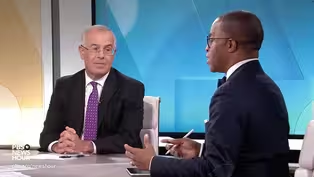
Brooks and Capehart on special counsel in Hunter Biden case
Video has Closed Captions
Clip: 8/11/2023 | 10m 51s | Brooks and Capehart on the appointment of a special counsel in the Hunter Biden case (10m 51s)

GOP candidates try to win over voters at the Iowa State Fair
Video has Closed Captions
Clip: 8/11/2023 | 6m 15s | GOP presidential candidates try to win over voters at the Iowa State Fair (6m 15s)

Nelson George on the 50-year evolution and legacy of hip-hop
Video has Closed Captions
Clip: 8/11/2023 | 7m 54s | Hip-hop was born 50 years ago. Nelson George discusses its evolution and legacy (7m 54s)
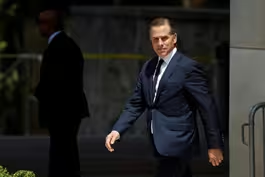
What special counsel appointment means for Hunter Biden case
Video has Closed Captions
Clip: 8/11/2023 | 6m 34s | What the special counsel appointment means for the Hunter Biden case (6m 34s)
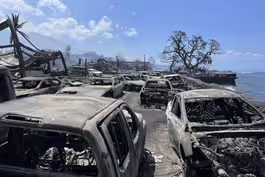
Why people in Maui were caught off guard by deadly wildfires
Video has Closed Captions
Clip: 8/11/2023 | 8m 58s | Why people in Maui were caught off guard by the deadly wildfires (8m 58s)
Providing Support for PBS.org
Learn Moreabout PBS online sponsorship
- News and Public Affairs

FRONTLINE is investigative journalism that questions, explains and changes our world.

- News and Public Affairs

Amanpour and Company features conversations with leaders and decision makers.











Support for PBS provided by:
Major corporate funding for the PBS News Hour is provided by BDO, BNSF, Consumer Cellular, American Cruise Lines, and Raymond James. Funding for the PBS NewsHour Weekend is provided by...