Vermont This Week
August 16, 2024
8/16/2024 | 26m 45sVideo has Closed Captions
Primary election results | Drug use and safety concerns in Burlington
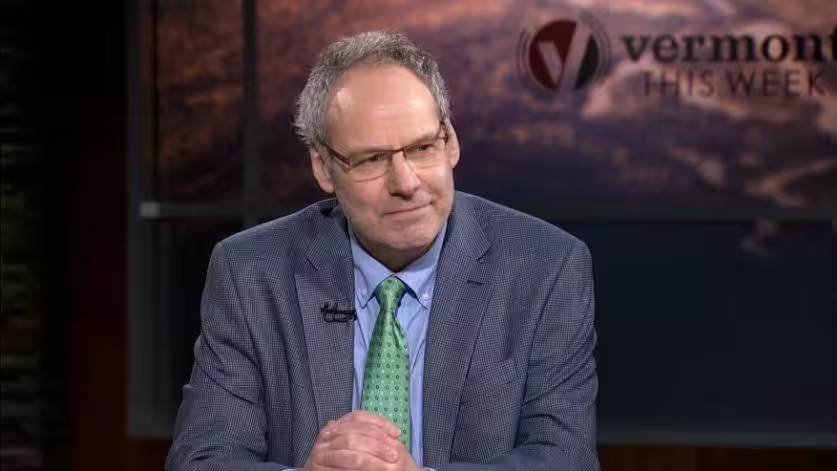
Lt. Gov. Zuckerman wins Democratic primary, GOP picks Rodgers | Drug use and safety concerns in Burlington | GMCB approves double-digit health insurance increases | Panel: Mikaela Lefrak - Moderator, Vermont Public; Kevin McCallum - Seven Days; Lexi Krupp - Vermont Public; Courtney Lamdin - Seven Days.
Problems playing video? | Closed Captioning Feedback
Problems playing video? | Closed Captioning Feedback
Vermont This Week is a local public television program presented by Vermont Public
Sponsored in part by Lintilhac Foundation and Milne Travel.
Support provided by:


Vermont This Week
August 16, 2024
8/16/2024 | 26m 45sVideo has Closed Captions
Lt. Gov. Zuckerman wins Democratic primary, GOP picks Rodgers | Drug use and safety concerns in Burlington | GMCB approves double-digit health insurance increases | Panel: Mikaela Lefrak - Moderator, Vermont Public; Kevin McCallum - Seven Days; Lexi Krupp - Vermont Public; Courtney Lamdin - Seven Days.
Problems playing video? | Closed Captioning Feedback
How to Watch Vermont This Week
Vermont This Week is available to stream on pbs.org and the free PBS App, available on iPhone, Apple TV, Android TV, Android smartphones, Amazon Fire TV, Amazon Fire Tablet, Roku, Samsung Smart TV, and Vizio.
Support the crew
Help Mitch keep the conversations going as a member of Vermont Public. Join us today and support independent journalism.Providing Support for PBS.org
Learn Moreabout PBS online sponsorshipWith primary day in Vermont having come and gone, candidates set their sights on November's general election.
It feels good.
You know, it's been a rough couple of weeks.
And, folks, you know, I do look at our track records.
Look at who we were.
And, look at what I've done for Vermont and Vermonters.
It's going to be busy.
We're going to start, regrouping tomorrow and, you know, refocus.
We feel that we can win handily.
If we can get out every corner of Vermont and meet Vermonters, plus drug use and safety concerns in the Queen city, and the state looks to build a new women's prison in Essex, prompting protests.
That and more ahead on Vermont this week.
From the Vermont public studio in Winooski.
This is Vermont this week.
Made possible in part by the Lintilhac Foundation and Milne Travel.
Thanks for being with us.
I'm Mikaela LeFrak in for Mitch Wortley.
It's Friday, August 16th.
Joining us on the panel today, we have Lexi Krupp from Vermont Public, Courtney Lambdin from Seven Days and Kevin McCallum also from Seven Days.
Thanks everyone for being here.
Well, as we just heard, Vermont's primary elections were this week.
They were relatively quiet.
No huge surprises.
The lieutenant governor's race has been a pretty exciting one to watch.
Kevin, what's been of interest to you with that one?
Right.
You know, the lieutenant governor's race was one of the few interesting statewide, races.
There's just very few contested primaries at all at the statewide level.
And so there was instantly a lot of focus on the only two races that had any.
And that was lieutenant governor's race and also one primary in the governor's race.
And the lieutenant governor's race had primaries for both the Democrats and the Republicans.
So that was unusual.
And Lieutenant Governor Zuckerman was able to handily beat his, primary, opponent, Thomas Renner.
There was a lot of interest in that Democratic primary in particular, because, you know, Zuckerman has been around for a long time, and he is very well, regarded he's he's got a lot of fans in the state.
And to have another Democrat step up and say, look, he's become kind of a career politician.
He needs to kind of step aside and let some new leadership come forward.
That was what Thomas Brenner's pitch was.
And he had several Democrats, prominent Democrats in the state, come forward and say, that's what the time is right for that.
And it didn't fly.
It didn't get anywhere.
He didn't have a lot of momentum.
He didn't have a lot of money.
And so he only got 40% of the vote.
And so Lieutenant Governor Zuckerman is again going to be the primary lieutenant governor candidate in November.
And he's going up against someone who's very interesting as well, because John Rogers, as I think most people know, was a Democrat.
from from Glover.
when he was in the House and when he was in the Senate.
And now he's saying my values align more with Republicans.
So he ran in the Republican primary and he'd be a Republican candidate named Gregory Thayer from Rutland, who's much more of a Trump oriented Republican.
So there was a lot of focus on how the Republican primary would shape up.
And and which wing of the Republican Party holds more sway in the state.
Right.
Is it the sort of moderate Phil Scott, Republicans, or is it more of the Trump aligned Republicans and the results of that with, John Rogers winning, I think shows that, Trump's influence on the Republican Party in the state of Vermont is very limited.
Right.
And John Rogers was endorsed by Governor Phil Scott.
He said during our Vermont public primary debate that he wants to build the party of Governor Scott back up again.
But on the board, down ballot races, Governor Scott did try to to, you know, sway or at least to, endorse some candidates down ballot didn't didn't quite work out though.
No, no it didn't.
That was another interesting dynamic in the primaries was the willingness of Republican donors and Republicans, prominent Republicans like Phil Scott, to get involved in Democratic primaries.
Right.
And so you had these big donors, corporate donors and longtime Republican supporters giving money to people like Thomas Renner in the lieutenant governor's race, trying to get Zuckerman out of there, trying to get a more moderate Democrat into that position.
You had a similar dynamic in, Chittenden, Chittenden Central, where you had you had, why am I blanking on incumbents?
Stuart Ledbetter had Stuart Ledbetter, getting a lot of money from Republicans.
And he's a Democrat.
He's clearly a Democrat.
But there were three, there were three incumbent Democrats in that district, and they were able to fend him off rather easily.
And there were some people who thought that he would actually do pretty well.
And he came in fourth, unfortunately.
Yeah.
So.
Well, at the top of the Democratic ticket, Esther Charleston of Middlebury won the nomination ahead of Peter Duval of Underhill.
She she did very well, but she has quite the road ahead of her now against Governor Phil Scott.
Right, Kevin?
For sure.
Yeah.
Now, Esther is an interesting character.
She's, you know, in many ways a historic candidate.
She's the first female black woman to be nominated from a major party in Vermont, and only the second in the nation to have that distinction.
So there's a lot of pride.
There's a lot of excitement about her candidacy.
Peter Deval was not really a super challenging candidate to go up against.
So it doesn't really say too, too much that she won the primary.
But what will be really interesting is how she how she fares against a a governor like Phil Scott with such popularity and a state that seems to sort of like this balance of, you know, a Republican in charge of the executive branch and the Democrats in charge of the legislature.
So, are are Vermont voters ready to have a Democrat running the, you know, the state and, the Democrats are running the legislature?
I'm not sure.
Yeah, yeah.
Well, you mentioned the historic nature of Esther Charleston's win.
also interesting that's happening the same year that, Kamala Harris, a woman of color, the current vice president, is running for president right now.
Well, it takes a lot of hands to pull off a local election.
As we all know, Vermont public's video team went out this election day, to meet a longtime poll worker from Plainfield.
Let's take a look.
Oh, yeah.
There we have this official thing, and they're put on.
We carry this.
Even though people know me, they used to many years ago, you had the state every time, whether you were a Republican or a Democrat.
Everybody knew how everybody voted.
And this is changed.
Now.
You give them all the ballots.
It's more like, privacy forum 3.0.
I think it's just greeting the people and seeing the people, and sometimes they will, you know, stop and talk to you.
And I've, I work on the, so, you know, it's nice to get out and I have been doing this probably close to 40 years, but this is what democracy once said.
That is exactly what makes our democracy work here.
Great story from Plainfield about Dale.
Lexy, what do we know about turnout out of this year's primaries?
Yeah, governor Scott talked about this on Wednesday at his press conference.
And he was like, I'm disappointed.
the turnout, he said, was around 15%.
and that's half of the last August primary we had in 2020.
So, not not much, not great.
But, you know, as Kevin said, a pretty, pretty quiet election year.
So maybe not that surprising.
Yeah.
Yeah.
Well, let's turn to an issue that came up a lot in our Vermont public debates for lieutenant governor and governor.
That's health care.
just this week, the Green Mountain Care Board approved double digit health insurance increases.
This is the third health insurance rate increases.
Excuse me.
This is the third year now in a row that this has happened.
Lexi, you've been reporting on this for Vermont public.
and I want to get into some of the nitty gritty of this with you because it can be a complicated issue.
But first, let's let's take a look at a short clip from Owen Foster, the chair of the Green Mountain Care Board.
Hospital budget submissions again highlight the need for hospital system redesign and transformation.
the difficulty we're seeing at the financial level for hospitals and insurers continues to persist, and the headwinds are not abating.
Lexi, let's start with the basics here.
What is the Green Mountain Care Board and why the increase?
Great question.
So compound care words state office.
That's a whole job is to control health care prices.
so when hospitals in Vermont they submit budgets the Green Mountain Care Board says yes.
No.
and same month insurance companies that that they can regulate.
So it's only like a subset of all the insurance companies out there.
But, insurance companies say this is how much we want to increase our rates for next year.
And the Green Mountain Care Board looks at their books and says, yeah, or like, no, you know, watch out.
and so, yes, as you said, this is the third year in a row that there is double digit increases for insurance companies where, it's like the Vermont marketplace.
So if you do not have insurance through your employer, this is where you would go to buy insurance.
Or if you are a small business owner, and you have under 100 employees, this is where you could go.
It's the only regulated insurance marketplace.
So someone has look to say like, yes, like these.
This insurance is like cool.
You know, the government says this is all right.
and and so that sort of varies depending on what company and if you're an individual or, you're a group, you're one of these businesses.
But those rates vary between 11% and 23%.
for 2025.
And that'll be starting in November is when there is open enrollment.
So when you can go and actually like purchase this insurance okay.
Well that that rate hikes give me a tough pill to swallow for many folks I know.
Does this tell us anything about health insurance premiums for folks who get their health insurance in other ways.
Yeah.
So this is one of the only this is like a very transparent way that, you can look at insurance rates and it's indicative of what's happening elsewhere.
So, and the reason that these rates have gone up so much, the insurance companies are paying a lot more.
Their, the I think it's Blue Cross Blue Shield.
Oh, and foster told me Blue Cross Blue Shield paid like 30% more in 2023 versus what they were paying in 2022.
A lot of that is because of hospital prices and drug prices.
and that's something that's affecting, you know, the cost of health care generally, all insurance companies.
yeah.
So, so even though this is like not not everyone in Vermont gets their health insurance from this way, it's it's indicative of like the how, how teachers get their health insurance or how state employees get their health insurance.
has you know, those those costs are all going up and everything is interrelated, as we have learned this year.
I mean, the cost of health insurance for teachers connects right back to some of those inflated school budgets that were causing property taxes to go up.
So they're all very interrelated and very important issues.
Briefly, Lexi, how does this compare to what's going on in other states, or is this a Vermont specific issue?
I was so surprised by this.
I was like, oh, surely health care prices are terrible everywhere.
But no, I mean, there was this study looking at, a report looking at these premium increases, for like 250 insurers all across the country.
So 50 states and DC, the average percent increase for next year is about 7%.
and some, you know, most are between like five and 10%.
so we are at the very extreme of, of these pricing creases.
We, you know, our price increase.
It's not it's not the most.
But given that this has been the third year in a row of these price increases, like it's a lot.
Yeah.
Yeah.
So that that was like very surprising to me.
Yeah.
Well thank you for that.
That context Alexandra.
It can be a complicated issue for many folks, myself included, who appreciate your expertise on it.
I want to turn now to another health related issue facing many states, many cities, including ones here in Vermont.
and that is the the drug crisis specifically involving opioids.
This week, Courtney, seven days published a cover story that you wrote looking at how Berlin Antonians are working to address drug and safety concerns.
Tell us about what you learned.
Yeah.
So the story looks at how different entities in the city are sort of adapting to what is becoming a new normal, because everyone knows there are not any quick fixes to this.
As, the mayor I'm a mulvaney, Stanek said.
If someone had a quick fix, they would have done it by now.
so Burlington is kind of in this place where it's dealing with, you know, huge rates of homelessness.
There's more than 300 people living outside in the greater Burlington area, most of them likely in Burlington.
That's a number that we've never seen before.
the the drug supply has become more toxic, not just opioids, but also, xylene and animal tranquilizer and methamphetamine.
So there's a lot in the supply that that doesn't even respond to things like Narcan that have been a very long time, part of a harm reduction strategy.
So it's they're really deeply entrenched issues that the city's, you know, dealing with.
And the story looks at how is the city adapting, how our businesses adapting and churches really those are those are some places that have become sort of hotspots for public drug use.
Yeah.
Yeah.
In reporting this story.
one thing that I was struck by in your work is how many different people you talked to from all walks of life, and how much time and effort that much have taken to meet all of these folks, everyone from people who are experiencing homelessness and addiction to the mayor, as you mentioned, to law enforcement officers and more.
You tell us a little bit more about the people that you decided to speak to.
Yeah.
You know, once we've we kind of narrowed the scope of what were we going to look at?
Because when you talk about public safety downtown, it can get very unwieldy very quickly.
So, I spoke to probably ten or so business, owners.
Some of them have been more outspoken over the years, so they were kind of easy to pick.
they're they're more likely to speak out about what they're experiencing with things like shoplifting, theft, things like that downtown.
But in other situations, I kind of got lucky by being in the right place at the right time.
for example, when I was visiting one of the churches downtown, I was there to speak to them about how are they, how are they struggling with, you know, showing these folks compassion because they are churches.
They're driven by this mission to do acts of kindness, but also keep their grounds safe for their, you know, congregants.
and while I was there, you know, it was, there was some people that were, there was a woman who was overdosing on the front lawn, and the fire department responded.
And, you know, that's as far as reporting goes.
That's something you can't plan.
It was obviously something I didn't think I would see, but when I did, I was able to speak to some of the folks that were there.
And this woman spoke to me about her, her friend.
They were both homeless.
They were both being asked to leave the church grounds because they had been sleeping there.
so I think I really got to hear kind of all sides of, of the discussion in Burlington right now.
Yeah.
Wow.
Courtney, reading your story.
well, another thing that struck me was the the ways in which people are, for lack of a better phrase, could throw spaghetti at the wall right now and try to figure out, like what?
What could possibly work to address this seemingly insurmountable crisis?
There's one person I'm hoping you could tell us about very briefly.
a I believe he's the owner of of a bar or restaurant who is now doing something totally different, to kind of aid in the city's efforts.
Can you tell us about him?
Yeah.
You're referring to this gentleman called Andrew le Sturgeon.
Yes.
His name.
He used to operate monarch in The Milkweed, which was a cafe on Saint Paul Street in Burlington.
And he became, I guess he has a background, like a degree from John Jay College.
and also a background in hospitality, obviously from, running the cafe.
And so the Burlington Business Association, which, you know, advocates for business interests downtown, got in touch with him based on his experience and said, could you serve as this downtown ambassador?
That's kind of the his newest title.
And his job is essentially, people can summon him with a text message and he will respond in minutes.
He has a little closet sized office right on Church Street, so he can just kind of run wherever he's needed.
If someone feels uncomfortable.
A lot of times, you know, these smaller shops, it's just one person.
Sometimes a young person who's working by themselves.
And so if they don't feel comfortable, he can come and, you know, walk them to their car if it's dark out or whatever they might need.
He's also helping folks make police reports for shoplifting.
there's a, I think, general consensus that the amount of shoplifting is underrepresented in data, like people aren't reporting it because they know that Burlington doesn't have enough police to respond.
So they kind of say, some of them say, why bother?
So this guy Andrew, part of his job is to collect more accurate data about theft.
It was a fascinating story.
Courtney, thank you so much for reporting it.
You can find it on newsstands right now in seven days.
let's get some updates from the world of flood recovery.
Many communities across our region are still trying to work to dig themselves out of the damage that occurred in July from the flooding, and continues to occur almost weekly.
It seems like, Kevin, you had a story recently about the particular issues that people living on private roads are facing.
Can you tell us about it?
Right.
So this year, unlike, unlike last year's flood, which saw our large rivers rise to dangerous levels and actually flood lots of communities horribly, this year's floods were very bad, but they were very bad in a different way.
They were very bad in a sudden flash flood type way.
And that just overwhelmed lots of culverts all around the state, or certainly in central Vermont.
And private roads were particularly vulnerable to that.
There's a lot of private roads in the state of Vermont.
You know, you go out into the communities and there's just these dirt roads that lead up into the hills, and there might be three, 4 or 5, ten houses up there.
And that's a private road and therefore responsible for maintaining that road.
Most of those roads were never designed with the culverts and other infrastructure to be able to withstand the type of flash flooding that we saw.
The same goes for a lot of municipal roads too, right?
They're not private owned roads, but they're they're dirt roads through most of the state.
And most of them weren't designed either with the type of culverts to let that water pass through the road without destroying it.
So we just had a huge number of washouts of these dirt roads around the state.
And private homeowners are particularly vulnerable to this, not only because their roads are small and dirt, but the finances of that.
How are they going to fix these roads?
Right?
These are normal.
These are often just a handful of homeowners who are now faced with tens of thousands of dollars of repair costs just to be able to get to their own homes.
And so, I mean, I went to one site.
I had driven past it several times on the way to Middlesex from my home in Waterbury, and I had seen these big piles of dirt on the side of the road.
And I thought to myself, oh, I bet you that's just someone who's allowed some dump trucks from somewhere else to dump Phil here.
No, it wasn't that at all.
It was this just massive canyon that had been carved, into the hill in Moore Town.
And it had deposited just huge amounts of of of dirt, of of the mount of the hill, basically into the valley.
And when I went up and talked to the homeowner, I knew there was no his road was gone, his road was gone.
He and a neighbor, can only get to their home with their cars, on this road.
It wasn't there.
It was a it was a it was a 15ft deep, 100ft long gully.
So like, he's looking at this damage, thinking to himself, how the hell am I going to be able, just me and my neighbor and one other neighbor at the base still can afford a 50 6000 thousand dollar repair bill for their own driveway.
So those kind of things are happening around the state, and FEMA has some resources for people.
But, you know, there's there's a lot of frustration with the pace of the FEMA recovery funds, flowing.
And so homeowners are really on edge.
Private homeowners are really on edge about whether they're going to get the money they need to fix their homes, fix their roads to their homes.
And, Lexi, you've been keeping a keeping an eye on, the federal funding that could come in.
Governor Scott, requested federal disaster assistance.
do we have any news on that yet?
Yeah.
So there's three separate, sort of applications in the pipeline here.
one is for the end of June, when a flooding hit Stowe town of Stowe and some surrounding areas.
there's like the state has just got an extension from FEMA to collect a little bit more data to say, was there enough damage to reach this, major disaster declaration is like what they're looking for.
So they're waiting on that.
The, you know, flooding that a lot of the state, in central Vermont, northern right.
Experienced on July 10th, the the white House recently told the governor like they're they're in touch.
And the governor said we're going to hear about it really soon, on Wednesday.
So he, you know, it's indicated that that could come any day.
and that would be to say, can the federal government assist do this, public assistance?
So help, town and state governments cover about three quarters of the cost of damage to public infrastructure.
That's sort of one bucket of money that could be unlocked.
Another is the individual assistance.
So if homeowners, renters had damage to their properties, to their driveways, that's that's sort of like another level, another designation.
And we're we'll see if, that's something that Vermont gets from that July 10th storm and then that third storm that there's an application for.
Right now.
or they're in the process of applying for, this major disaster declaration that was for July 30th and 31st.
A lot of the flooding that hit, a lot of the Northeast Kingdom, which, you know, had, if you look at some of those photos are just insane, the level of damage.
So, the state said last week they had finished.
They were they were still collecting data, for to see whether that individual assistance we could sort of reach that threshold at so much to keep track of, especially for folks who have been through something so difficult.
Imagine if you're in that place where you're in the waiting game, just listening to press conferences where state officials tell you that there's really nothing you can do but wait until the federal government determines that the damage was bad enough for you to begin.
What's a months months long application process for maybe years, to be made whole again?
So it's it's nerve wracking and heartbreaking.
Yeah.
Well, thank you both for your reporting on this issue.
It's and they will be keeping a close eye on throughout the rest of this summer and moving forward.
before we go, I do want to note a special holiday today.
It is Bennington Battle Day.
That is a holiday that is unique to Vermont.
I'm looking for my notes here, so I want to make sure I get this right for the history buffs that I'm sure are watching right now, it's a state holiday that commemorates the victory of American forces over British forces at the Battle of Bennington during the American Revolutionary War in 1777.
And a fun fact I'm sure many of you already knew this, but I did not.
The Battle of Bennington took place in New York, not in Vermont, but it's named because the British were headed for a cache of weapons and munitions stored where the Bennington Battle Monument now stands in present day downtown Bennington.
So there you go.
For all of our history.
Viewers also briefly want to note, since I'm a big sports fan, that, one of our very own has just returned to Vermont from Paris.
Alona Ma, she won a bronze medal with the women's rugby sevens team in Paris.
We are very excited.
There's going to be a big, welcoming welcome home ceremony for her in her hometown of Burlington on Saturday.
You can see lots of folks greeting her at the Patrick Leahy Burlington International Airport there very recently.
So congratulations to her and to Vermont's other to, Olympians and to all of the athletes who competed.
That is where we are going to have to leave it for today.
Our thanks to our esteemed panel, Lexi Krupp from Vermont Public, Courtney Lambdin from Seven Days, and Kevin McCallum, also from Seven Days.
Thanks everyone for being here.
And thank you to you at home for watching and listening.
Mitch will be back soon.
We will see you next week.

- News and Public Affairs

Top journalists deliver compelling original analysis of the hour's headlines.

- News and Public Affairs

FRONTLINE is investigative journalism that questions, explains and changes our world.












Support for PBS provided by:
Vermont This Week is a local public television program presented by Vermont Public
Sponsored in part by Lintilhac Foundation and Milne Travel.